Shopify
 Stripe
 Slack
Slack Notion
 Google Workspace
 Confluence

What Are the Best AI Tools for Zendesk in 2026? 11 Compared on Price and Resolution


Eleven AI tools are worth shortlisting for Zendesk in 2026, scored on how much each resolves, whether it runs inside Zendesk, published pricing, time to first resolution, and setup and ongoing support. Macha ranks first at 24 out of 25 because its team sets up and runs the agent for you. Prices run from about $0.40 a ticket to annual contracts of $30,000 and up.
Key takeaways
- Macha ranks first of the 11 AI tools for Zendesk at 24 out of 25, because the Macha team sets up and runs the agent for you at about $0.40 a ticket, with a dedicated success manager included.
- Zendesk's pricing page bills AI agents per automated resolution and lists the rate: $1.50 committed or $2.00 pay-as-you-go.
- Intercom Fin charges $0.99 per outcome, and its 50-outcome monthly minimum applies only when Fin runs on a help desk other than Intercom, such as Zendesk.
- Ada's AWS Marketplace listing sells a 12-month contract at $33,000 that includes 60,000 conversations, about $0.55 a conversation.
- At 1,800 AI-handled tickets a month, Zendesk AI agents cost $2,700 at the $1.50 committed rate, against $1,199 for Macha's 3,000-ticket tier and $1,782 for Fin.

The 11 AI tools worth shortlisting for Zendesk in 2026, in our scored order, are Macha, eesel AI, Zendesk's own AI agents, Pluno, Intercom Fin, Stylo, Forethought, Ada, Decagon, Sierra and Unbabel, and Macha ranks first because the Macha team sets up and runs the agent for you, with published prices running from about $0.35 to $0.60 a ticket (eesel, by batch size) and about $0.40 (Macha) through $0.99 an outcome (Fin) to annual contracts of $30,000 and up (Ada). All eleven are live and selling in September 2026.
They are not interchangeable, and the difference that decides your bill is not the feature list. It's whether a tool resolves a ticket end to end, only drafts a reply for an agent to send, or just triages and routes. Three products on this page do all three. Two of them will not tell you what they cost until you've met a salesperson.
Each tool below gets the same treatment: what it does, the help desks it runs on, how it bills, what it costs as of September 2026, and where it falls short. That last line applies to us too. We build one of the eleven, and it's marked.
Read time: 18 minutes
Which AI tools work with Zendesk, and what do they cost?
| Tool | Score (out of 25) | Help desks it runs on | Resolves / drafts / triages | Takes write actions | Billing unit | Entry price (Sept 2026) |
|---|---|---|---|---|---|---|
| 1. Macha | 24 | Zendesk, Freshdesk, Gorgias, Front, HubSpot, Intercom | Resolves, drafts and triages | Yes, plus custom API tools | Per ticket | $299/mo for 750 tickets (about $0.40 each) |
| 2. eesel AI | 23 | Zendesk, Freshdesk, Intercom, others | Resolves or drafts | Limited | Per credit (a ticket or chat) | $299/mo for 500 credits, no platform fee |
| 3. Zendesk AI agents | 22 | Zendesk only | Resolves | Yes, inside Zendesk | Per automated resolution | $1.50 committed / $2.00 pay-as-you-go (Zendesk pricing page) |
| 4. Pluno AI | 21 | Zendesk (strong focus) | Resolves, drafts and escalates | Yes, into Jira and Slack | Platform fee + per resolution + per seat | €850/mo platform fee (1,000 to 3,000 tickets) + €0.90 per resolution |
| 5. Intercom Fin | 21 | Intercom, Zendesk, others | Resolves | Yes, via Procedures | Per outcome | $0.99 per outcome; 50/month minimum off Intercom |
| 6. Stylo Assist | 17 | Zendesk only | Drafts | No | Per agent seat | $15–$25 per agent per month |
| 7. Forethought | 16 | Zendesk (now owned by Zendesk) | Resolves and triages | Yes | Platform fee + per deflection | Quote only (Vendr median ~$59.5K/year) |
| 8. Ada | 16 | Standalone; integrates with Zendesk | Resolves | Yes, via integrations | Per conversation / resolution | From $30,000/year on Salesforce AgentExchange; $33,000 for 60,000 conversations on AWS Marketplace; Vendr median $72,000 |
| 9. Decagon | 14 | Standalone; integrates with Zendesk | Resolves | Yes | Per conversation or resolution + platform fee | Quote only (~$50K/year+ estimated) |
| 10. Sierra | 13 | Standalone; integrates with Zendesk | Resolves | Yes | Per outcome | Quote only ($150K/year+ estimated) |
| 11. Unbabel | 11 | Zendesk and others | Translates only | No | Annual contract | $10,000+ per year |
Two things to read off that table before the detail. First, the billing unit varies more than the sticker rate, and it's what decides your bill: per resolution means you pay for outcomes, per conversation means you pay whether or not anything got solved, per seat means the bill grows with headcount rather than volume. Second, per-resolution pricing earns the vendor more the worse your self-service gets, which is an odd incentive to hand a supplier and worth pricing into a three-year view.
How did we choose these eleven, and who wrote this?
Disclosure: Macha publishes this blog. Macha is one of the eleven tools below, scored on exactly the same criteria as everything else on this page, placed where those criteria put it, and carrying the same "where it falls short" line as every other entry. We include ourselves where we genuinely compete, and we say so rather than hiding it in a footer.
Every tool here had to clear three bars: it is live and selling in September 2026, a team already running Zendesk can use it without replacing Zendesk, and there is enough public information to describe how it bills. Anything that failed the last bar entirely (no pricing model, no documentation, no named customers) is not on the list.
The order is set by five criteria. Each is scored from 1 to 5, the total out of 25 decides the rank, and a tie goes to the tool that scores higher on the first criterion where the two differ:
- How much it can actually resolve. Closing a ticket without a human ranks above drafting a reply for a human to send, which ranks above tagging and routing. 5: resolves. 3: drafts. 2: triages or escalates. 1: none of these.
- Whether it works inside the Zendesk you already run, rather than moving the conversation to a widget or a platform you also have to operate. 5: inside Zendesk. 4: supported on Zendesk, built for another desk first. 3: a standalone platform that integrates with Zendesk.
- Whether you can find out what it costs before you talk to sales, and model it against your own ticket volume. 5: a published price. 3: a marketplace listing only. 1: quote only.
- How long it takes to get to the first resolved ticket. 5: the same day. 4: within days. 2: weeks of procurement and deployment. 1: a build project, or a tool that doesn't resolve tickets.
- Setup and ongoing support. Who does the setup work, and who looks after the agent once it's live. 5: the vendor sets it up and a dedicated person handles changes after go-live, on every plan including the trial. 4: implementation included on every plan. 3: hands-on setup or dedicated staff on a higher tier or under a contract. 2: self-serve, with documentation and standard support.
That scoring is why the list looks the way it does:
| Tool | 1. Resolves | 2. Inside Zendesk | 3. Published price | 4. Time to first resolution | 5. Setup and ongoing support | Total (out of 25) |
|---|---|---|---|---|---|---|
| Macha | 5 | 5 | 5 | 4 | 5 | 24 |
| eesel AI | 5 | 5 | 5 | 5 | 3 | 23 |
| Zendesk AI agents | 5 | 5 | 5 | 5 | 2 | 22 |
| Pluno AI | 5 | 5 | 5 | 4 | 2 | 21 |
| Intercom Fin | 5 | 4 | 5 | 5 | 2 | 21 |
| Stylo Assist | 3 | 5 | 5 | 1 | 3 | 17 |
| Forethought | 5 | 5 | 1 | 2 | 3 | 16 |
| Ada | 5 | 3 | 3 | 2 | 3 | 16 |
| Decagon | 5 | 3 | 1 | 2 | 3 | 14 |
| Sierra | 5 | 3 | 1 | 1 | 3 | 13 |
| Unbabel | 1 | 5 | 1 | 1 | 3 | 11 |
Macha leads on 24 with top marks on setup and ongoing support: the Macha team builds the agent and a dedicated success manager handles changes after go-live, on the trial and every plan. eesel and Zendesk's own agents get to a first resolution faster, since you can switch either on the same day, but you configure and tune them yourself. Pluno and Fin tie on 21, and Pluno takes fourth because it runs fully inside Zendesk. Stylo is sixth: it publishes a price and installs with no setup, but it drafts rather than resolves. The quote-only platforms fill 7 to 10, and Unbabel is last because it translates and resolves nothing.
Where the facts come from: each vendor's own pricing and documentation pages, read in September 2026, with third-party procurement data (Vendr) used only where a vendor publishes nothing. Prices move fast in this category. The tables are dated for that reason, and you should confirm on the vendor's page before you sign anything.
How do you choose the right Zendesk AI tool?
Match your pain point to the right category
"We're drowning in repetitive L1 tickets."
You want a tool that resolves: everything in the top 10 except Stylo (6). Start with the ones that publish a price so you can model the cost before a sales call.
"Our agents spend too long writing replies."
A copilot is enough. Stylo (6) does only this; Macha (1), eesel (2) and Fin (5) do it alongside resolution.
"Tickets are misrouted and our Explore reports are garbage."
That's triage, not resolution. Macha (1) and Forethought (7) both read the ticket and write to custom fields.
"We support customers in languages we don't staff."
Most resolution agents reply in the customer's language already. Buy Unbabel (11) only if you need human-verified translation quality with a guarantee attached.
The three questions that actually decide it
Where does the conversation live? A tool that runs inside Zendesk keeps your reporting, SLAs, macros and audit trail in one place. A standalone platform in front of Zendesk gives you more control over the experience and a second system to administer.
Can you model the cost? Per-ticket and per-resolution pricing can be forecast from your own Explore data in ten minutes. Quote-only pricing cannot be modeled at all until you've spent a few weeks in procurement.
What happens when the AI is wrong? Ask every vendor to show you the escalation path, the confidence threshold, and whether you can run the agent in draft-only mode first. The ones that can't demo that on your real tickets are asking you to find out in production.
If you've narrowed it to the tools that actually resolve tickets rather than draft them, our comparison of Zendesk AI agents and Answer Bot alternatives prices the same eight vendors against a worked ticket volume, and where Answer Bot runs out covers what the native option stops doing.
What are the 11 best AI tools for Zendesk in 2026?
1. Macha: the agent layer that runs on the help desk you already have

Best for: Teams on Zendesk, Freshdesk, Gorgias, Front, HubSpot or Intercom who want agents resolving tickets inside the existing workflow, at a price they can forecast.
This is our product, so here is the mechanism rather than the pitch. Macha connects to your help desk over its API and runs configured agents against incoming tickets. An agent is a set of written instructions plus a set of tools it's allowed to call. On Zendesk those tools read the ticket, its comments, its custom field values and attachments, search past tickets, and then write back: public reply, internal note, tags, status and priority, custom field values. You can point an agent at your help center, past tickets, Notion, Confluence, Google Docs or a website as knowledge, and you can give it any HTTP API as a custom tool: an order lookup, a subscription cancel, a warranty check.
Three deployment modes matter in practice, and you can move between them per agent: post as an internal note (nothing reaches the customer), create a draft an agent sends, or reply autonomously. Simulation replays your real past tickets against the agent before any of that is live.
The part that differs most from everything else here is who does the work, and it's why Macha scores 5 on setup and ongoing support and ranks first. Macha is the done-for-you option: you connect Zendesk and the tools your answers come from, about 15 minutes, and the Macha team analyzes about a month of your past tickets, builds the knowledge base and the agent, tests it on a sample of those tickets, and runs it in safe mode, with drafts as internal notes, until the drafts are right. It goes live in under a week. After that a dedicated success manager handles your changes (new categories, instruction changes, new tools), so nobody on your team has to manage the AI. All of it is included on the trial and every plan, not sold as a professional-services line item. eesel is self-serve below its Enterprise tier, Fin on Zendesk is yours to configure, and Ada and Decagon run implementation through a sales cycle and a contract.
Pricing (September 2026)
One plan, priced on the number of tickets a month you want AI to handle: $299 for 750 tickets, $599 for 1,500, $1,199 for 3,000, $1,999 for 5,000, $2,999 for 7,500 and $3,999 for 10,000, custom above that. That's about $0.40 a ticket at every tier, billed monthly. A ticket is one thread with one person, charged once however many messages it takes; email, live chat and Copilot sessions each count once. Every feature is on every tier, seats are unlimited, and there are no overages: agents pause at the limit rather than auto-billing. The trial is $50 of free usage, about 125 tickets, no credit card and no time limit. Full pricing.
Where it falls short
We're a much smaller company than Ada, Decagon or Sierra, with no G2 or Capterra profile to check us against and no analyst coverage. If your procurement process requires third-party review volume, we will fail it. Macha is not a help desk, so it's a line item on top of Zendesk rather than a replacement for it. There's no voice channel: email, chat and the agent-facing Copilot only. And an agent does what its instructions say, which means a vague instruction produces a vague agent. The setup work is real, which is why we do it with you rather than handing over a blank console.
2. eesel AI
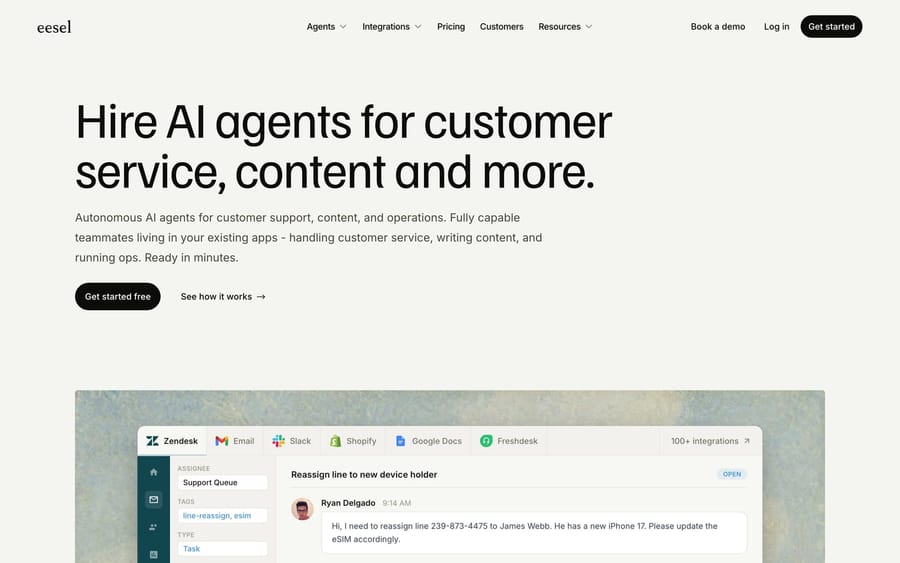
Best for: Small and mid-size teams who want to switch an agent on this afternoon without a sales call.
eesel connects to your help desk and your docs, trains on past tickets alongside help center content, and runs either as an autonomous agent or as a copilot. The thing it does better than anyone else on this list is procurement: you sign up, connect Zendesk, simulate against thousands of past tickets, and go live without talking to a human. Its simulation mode is genuinely useful for getting a resolution-rate estimate before committing spend.
Pricing (September 2026)
A fixed monthly batch of credits, from $299 for 500 to $1,749 for 5,000, where "a ticket or chat is 1 credit, however long." That is about $0.60 a ticket on the smallest batch and about $0.35 on the largest. There is no platform fee and no per-seat fee, the free plan is 100 credits, and agents pause when the batch runs out unless you turn on overage at $0.80 a credit under a cap you set. Paying a year upfront gets two months free. A separate Enterprise tier is custom-priced, with a dedicated person for setup, SSO and HIPAA.
Where it falls short
The 500-credit floor costs $299 even in a quiet month, and above 5,000 credits pricing moves to a sales call. Action-taking is thinner than the enterprise platforms below: eesel is strongest at answering from knowledge, less so at executing multi-step operations against your systems. And older guides still quote its retired $0.40-per-task pricing, so confirm any figure against the current pricing page.
3. Zendesk AI agents
Best for: Zendesk teams who want resolution with no second vendor to procure.
Zendesk bought its way to the front of this race (Ultimate in 2024, then Forethought, completed on 26 March 2026) and folded both into what it now calls the Resolution Platform. Its AI agents resolve tickets across messaging and email against your help center and business rules, and because they're native, they inherit your triggers, views, SLAs and Explore reporting without an integration step.
For a team that already lives in Zendesk, that matters more than any individual feature. There's no second admin console, no data-sharing review, no separate vendor on the renewal calendar.
Pricing (September 2026)
Zendesk's pricing page says AI agents are included in every Suite and Support plan and billed per automated resolution, and lists the rate: $1.50 per automated resolution committed and $2.00 pay-as-you-go, on top of your seats. Its plan table includes 5 automated resolutions per agent a month on Support Team and Suite Team and 10 on Suite Professional; Zendesk's help center describes that allowance as a monthly dollar amount per seat since 18 May 2026 ($2, $5 or $10 depending on plan, capped at $5,000 a year). Copilot for human agents is a separate $50 per agent per month on Suite Professional and above.
Where it falls short
The price is the highest per resolved ticket on this list, and it scales linearly with success: 3,000 resolutions a month is $4,500 at the committed rate, and the seat allowance barely dents that for a small team. You're also locked to Zendesk's roadmap and to Zendesk-only deployment, so the moment part of your support moves to another channel or desk, the agent doesn't come with it. Configuration depth is shallower than the dedicated platforms on this list.
4. Pluno AI
Best for: Technical support teams whose hard tickets end in a Jira ticket.
Pluno (formerly AwesomeQA) built its name on the ticket that can't be auto-resolved. It trains on your full past-ticket history rather than help center content alone, and its escalation copilot hands off to Jira or Slack with a structured summary, then syncs changes back to Zendesk bi-directionally. It now also sells Deflection AI, which resolves tickets on its own and bills only when it does, alongside an agent copilot and AI tagging. Its stated philosophy is to escalate when uncertain rather than guess, which is the right default for engineering-heavy queues.
Pricing (checked 6 October 2026)
Now published: a platform fee of €850 a month for 1,000 to 3,000 tickets, which scales with ticket volume and includes the escalation copilot and AI tagging, plus €0.90 per resolution for Deflection AI (escalations aren't charged), €49 a seat for the AI Copilot and €35 a seat for Quality Assurance. Annual billing takes 15% off, and the trial is 14 days with every module and no credit card (pluno.ai/pricing).
Where it falls short
The €850 platform fee comes before any resolution or seat charge, so a small team pays it even in a quiet month, and it prices in euros. Its standout strength is still the escalation path to engineering; if your queue is mostly order status and returns rather than bugs, most of what sets it apart doesn't apply. And it's self-serve: there's no hands-on setup on the standard plan.
5. Intercom Fin
Best for: Teams who want a proven resolution agent with a published per-outcome price, on Zendesk or Intercom.
Fin is the most-cited per-resolution product in the category, and the reason is the pricing page: $0.99 for a resolution, stated in public, with a definition of "resolution" you can argue with before you buy rather than after. Fin runs on Intercom's own messenger and email, and Intercom sells it to run on other help desks including Zendesk. Procedures let it take actions rather than only answer.
Update (September 2026): Salesforce completed its acquisition of Fin, the company formerly called Intercom, on 10 September 2026, in a deal agreed in June at about $3.6 billion. Fin is still sold at $0.99 an outcome, and Salesforce's announcement cites a 76% average resolution rate. Worth weighing in any long-term Intercom or Fin decision.
Pricing (September 2026)
$0.99 per outcome (fin.ai/pricing). The 50-outcome monthly minimum applies only when Fin runs on a help desk other than Intercom, which includes every Zendesk deployment. Fin's own definition of a resolution: "No further help is requested after Fin's last answer." Procedure handoffs and disqualifications also bill at $0.99; qualifications bill at $9.99. A conversation simply passed to your team without an outcome is not charged. One outcome per conversation however many actions Fin takes.
Where it falls short
Fin is happiest on Intercom, and a Zendesk deployment is the supported-but-secondary path: you'll be configuring a product whose defaults assume a different desk. The $9.99 qualification outcome surprises teams who model the bill on $0.99 alone. And the Salesforce transition adds roadmap risk to a multi-year decision that didn't exist a year ago.
6. Stylo Assist
Best for: Zendesk teams who want a proven sidebar copilot and nothing more.
Stylo has been in the Zendesk AI market since 2020, which makes it a veteran here. Its Context Engine combines its own NLP with GPT models to generate replies, translate, summarize threads and turn macros into personalized responses.
Pricing (September 2026)
$15 per agent per month (Basic) to $25 per agent per month (Professional), with a Growth plan at $20 in between, a 3-agent minimum on the upper plans and a 14-day free trial (askstylo.com/pricing).
Where it falls short
It drafts; it does not resolve. Every ticket still needs an agent to read, approve and send, so the ceiling on what it saves you is handle time rather than volume. Per-seat pricing also means the bill tracks your headcount rather than your ticket count, which is the wrong direction if the point of the purchase was to grow support without growing the team. Less configuration depth than the resolution platforms: one persona, no channel-specific formatting, no choosing which article the AI cites.
7. Forethought
Best for: Understanding where Zendesk's AI roadmap is going, more than as a standalone purchase.
Forethought pioneered agentic, self-learning support automation (intent prediction, triage, deflection and agent assist) and did the triage piece better than most. Zendesk acquired it, the deal closed on March 26, 2026, and it now operates as Forethought AI agents by Zendesk with its capabilities folding into the Resolution Platform.
Pricing (September 2026)
Quote only. Historically a platform fee plus roughly $0.12 per deflection, with Vendr data showing a median around $59,500/year. Expect this to migrate toward Zendesk's resolution-based pricing.
Where it falls short
Buying it today is a bet on Zendesk's direction rather than on an independent vendor. The standalone product is being absorbed, and roadmap decisions now belong to the company that also sells you the help desk. If you're weighing it, you're really weighing entry 3 on this list.
8. Ada
Best for: Large CX organizations with high volume and genuine multilingual depth requirements.
Ada has been at this since 2016 and helped define the idea of an AI agent that resolves rather than deflects. It's deployed at scale for large brands across 50+ languages, with the reporting, guardrails and QA tooling a big CX organization expects, and it integrates with Zendesk rather than replacing it.
Pricing (September 2026)
Not on ada.cx, but not secret either. Ada's own site sends you to a demo form, but its Salesforce AgentExchange listing starts at $30,000 per company a year, and its AWS Marketplace listing sells a 12-month contract at $33,000 that includes 60,000 conversations, about $0.55 a conversation, with discounts listed for 24- and 36-month terms (both checked 25 September 2026). Vendr's procurement data across 114 purchases gives a median of $72,000/year, a low of $36,079 and a high of $309,200. Billing is tied to conversation volume rather than resolutions. Ada has argued publicly against per-resolution billing, so treat any "Ada charges per resolution" claim as out of date.
Where it falls short
The marketplace listing prices one package, 60,000 conversations a year; above that, or for anything custom, you're back in a sales cycle before you can model your bill. Deployments typically run 8–16 weeks with professional services involved, and conversation-based billing charges you for everything the agent touches, solved or not, so the bill peaks in your worst month. If you're a mid-market team, you're a small account in a book of business built for much larger ones.
9. Decagon
Best for: High-volume consumer brands and fintechs that want a custom enterprise agent taking real actions.
Decagon builds AI concierge agents across chat, email and voice, with heavy emphasis on enterprise controls, QA and analytics. It's the name that comes up most often head-to-head with Ada, it's AI-native rather than retrofitted, and it's usually more flexible than Ada on which unit it bills you in.
Pricing (September 2026)
Quote only. Decagon offers both per-conversation (its most common model) and per-resolution billing. Third-party sources, not Decagon, estimate a platform fee around $50,000/year and up, plus roughly $0.99 per conversation at standard volumes.
Where it falls short
Same procurement problem as Ada: no public price, no trial, a sales cycle before you learn anything concrete. It's a newer company than Ada or Zendesk, so there's less longitudinal evidence of how deployments age. And an enterprise agent platform in front of Zendesk means two systems to administer and two places your conversation history lives.
10. Sierra
Best for: Large enterprises that want a bespoke, brand-owned agent and have a team to build and maintain it.
Founded by Bret Taylor and Clay Bavor, Sierra is an agent operating system rather than a configure-and-go product: agents across chat, voice, SMS, WhatsApp, email and ChatGPT that take actions like processing a refund or saving a cancellation. It raised $950M at a $15.8B valuation in May 2026 (CNBC), and it sells on outcomes rather than seats.
Pricing (September 2026)
Quote only, outcome-based. No public pricing. Third-party benchmarks land around $150,000–$350,000+/year, blended across per-conversation and per-outcome billing.
Where it falls short
It's the most expensive way to solve this problem and the most demanding: you're buying a platform to build on, which means engineering time on your side as well as Sierra's. For a Zendesk team whose queue is mostly order status, password resets and returns, that's a large amount of machinery aimed at a problem the cheaper tools on this page already close.
11. Unbabel for Zendesk
Best for: Enterprises that need human-verified translation quality with a guarantee behind it.
Unbabel pairs machine translation with human linguists and a quality-estimation layer that tells you, per message, how confident it is. For regulated or high-stakes communication where a mistranslation is a legal problem rather than an awkward sentence, that combination is the reason to buy it. It's a long-standing app on the Zendesk Marketplace.
Pricing (September 2026)
Quote only. Unbabel publishes no price list; third-party estimates put the annual minimum around $10,000, with larger tiers near $30,000 and $120,000 a year.
Where it falls short
It's translation only. It resolves nothing and drafts nothing. The human editing step adds latency, so it isn't instant, and translations arrive as internal notes, which complicates the agent's workflow. At a $10,000 floor it's out of reach for most teams, and an AI-only translation layer inside a resolution agent covers the common cases at a fraction of the cost.
Which smaller Zendesk AI apps are worth a look?
Two smaller Zendesk Marketplace apps didn't make the eleven because they're narrower than everything above, but they're cheap and they work.
SwiftEQ: a Dublin company running 14+ single-purpose Zendesk apps. The Agent Co-writer is €9 per agent per month with a free tier of 100 AI replies and 100 translations, and Translate Conversations is €7 per agent per month with custom glossary support. Cheapest option in both categories. The trade-off: the apps don't share data with each other, and there's no learning from your resolved tickets.
Easy Ticket AI: a self-learning assistant that claims to train on your Zendesk data in 10 minutes, with sentiment analysis and macro recommendations. $20 per agent per month, 14-day trial. The trade-off: limited public information and review volume, and a $50 surcharge to train on knowledge outside the help center.
What does 3,000 tickets a month cost on each tool?
Sticker rates are hard to compare across billing units, so here is the same volume priced three ways. Assume 3,000 support tickets a month and a 60% automation rate: 1,800 of them handled by AI, the rest going to a human.
| Tool | Billing unit | Monthly cost at 1,800 AI-handled tickets (Sept 2026) |
|---|---|---|
| Zendesk AI agents | Per automated resolution | $2,700 committed ($1.50) / $3,600 pay-as-you-go, at Zendesk's published rates |
| Macha | Per ticket, tiered | $1,199 for the 3,000-ticket tier |
| Intercom Fin | Per outcome | $1,782 at $0.99, before qualification outcomes |
| eesel AI | Per credit, monthly batch | $849 for the 2,000-credit batch; Enterprise is custom-priced |
| Ada | Annual conversation package | $2,750 ($33,000 a year on AWS Marketplace, covers up to 60,000 conversations) |
| Decagon / Sierra | Quote | Not modelable without a sales call |
Two caveats on that arithmetic, because a table like this is easy to misread. Vendors count their unit differently: a Zendesk "automated resolution" and an eesel "credit" are not the same event, and a Macha ticket covers a whole thread including follow-ups. And every figure assumes the AI actually resolves at 60%, which is a number you should verify with a simulation on your own tickets rather than accept from anyone's marketing page, ours included.
Frequently asked questions
What's the best AI agent for Zendesk? On our five criteria, Macha, at 24 out of 25, if you're on Zendesk, Freshdesk, Gorgias, Front, HubSpot or Intercom and want the agent set up and run for you with a predictable monthly bill: the Macha team analyzes your past tickets, builds the knowledge base and the agent, and runs it in safe mode until the drafts are right, at about $0.40 a ticket, which includes setup and a dedicated success manager who handles your changes. That's our product, and the table above prices the alternatives at the same volume. If you want to start this afternoon without a sales call, eesel AI (23). If you want no second vendor, Zendesk's own AI agents (22), at $1.50–$2.00 per automated resolution. If you want a published per-outcome price from a large vendor, Intercom Fin at $0.99, now owned by Salesforce. Ada, Decagon and Sierra are the enterprise answers, and all three are quote-only.
How much do Zendesk AI tools cost? Four billing units, as of September 2026. Per resolution: $0.99 (Fin) to $2.00 (Zendesk pay-as-you-go). Per ticket: about $0.40 (Macha) and about $0.35 to $0.60 (eesel, by monthly batch). Per agent seat: $15–$25 a month (Stylo, SwiftEQ, Easy Ticket AI). Annual contract: $30,000 (Ada's AgentExchange listing) to an estimated $350,000+ (Sierra). The unit matters more than the rate, because per-seat pricing grows with your headcount and per-resolution pricing grows with your success.
Can I use multiple Zendesk AI tools together? Yes, and plenty of teams do: a resolution agent on the repetitive queue, a copilot for the agents handling the rest, a translation layer if you need certified quality. Watch for double billing. If a resolution agent and a help desk both count the same ticket, you pay twice for one conversation, so check how each vendor counts before you stack them.
Should I use Zendesk's native AI or a third-party tool? Native wins on integration and loses on price and portability. At $1.50 a resolution committed, Zendesk is the most expensive per resolved ticket on this page, and the agent doesn't follow you if part of your support moves to another desk. Third-party tools cost less per ticket and work across desks, at the cost of one more integration and one more vendor relationship. If you're certain you'll be on Zendesk in three years, native is a defensible choice.
Which AI tools work on all Zendesk plans? Most third-party tools, including Macha, Stylo, SwiftEQ, eesel and Pluno, work on any Zendesk plan including Team and Growth, because they run through the API rather than a plan-gated feature. Zendesk's own AI agents are included in every Suite and Support plan, billed per automated resolution against the per-seat allowance.
What's the fastest way to test one of these before committing? Ask for a simulation against your own past tickets rather than a demo on the vendor's data. Macha, eesel and Fin can all replay historical tickets and show you what the agent would have said. That produces a resolution rate for your queue specifically, which is the only number worth budgeting against.
Which Zendesk AI tool should you pick?
"I want to automate repetitive tickets and know the bill in advance."
Model the published-price resolvers against your own volume: Macha at about $0.40 a ticket, eesel from $299 for 500 credits, Fin at $0.99 an outcome, Zendesk at $1.50–$2.00 a resolution, and Pluno at €0.90 a resolution on top of an €850 platform fee. At 3,000 tickets a month the spread between them is over $2,000. Macha is the one of these where the vendor's team does the setup and runs the agent with you on every plan, which is why it ranks first here.
"We're an enterprise and price isn't the constraint."
Shortlist Ada, Decagon and Sierra, and budget 8–16 weeks for deployment. Ask each one to price the same 12-month volume in the same unit so the quotes are comparable.
"We just want our agents writing faster."
Stylo, or SwiftEQ if budget is tight. Don't buy a resolution platform to solve a drafting problem.
"Our escalations to engineering are a mess."
Pluno AI, for the Jira and Slack handoff.
"Mistranslation is a compliance risk for us."
Unbabel, and only Unbabel, because it's the one that puts human linguists behind a quality guarantee.
Running Macha on your Zendesk
The Macha team builds and runs the first agent for you rather than handing over an empty console: it analyzes your past tickets, builds the knowledge base and the agent, and keeps drafts as internal notes until you're happy with them. The trial is $50 of free usage, about 125 tickets, with no credit card and no time limit. Connect Zendesk, run a simulation against your last few thousand tickets, and see the resolution rate on your own queue before you decide anything.