Shopify
 Stripe
 Slack
Slack Notion
 Google Workspace
 Confluence

What Are the Best Freshservice Alternatives in 2026? 10 Tools Compared


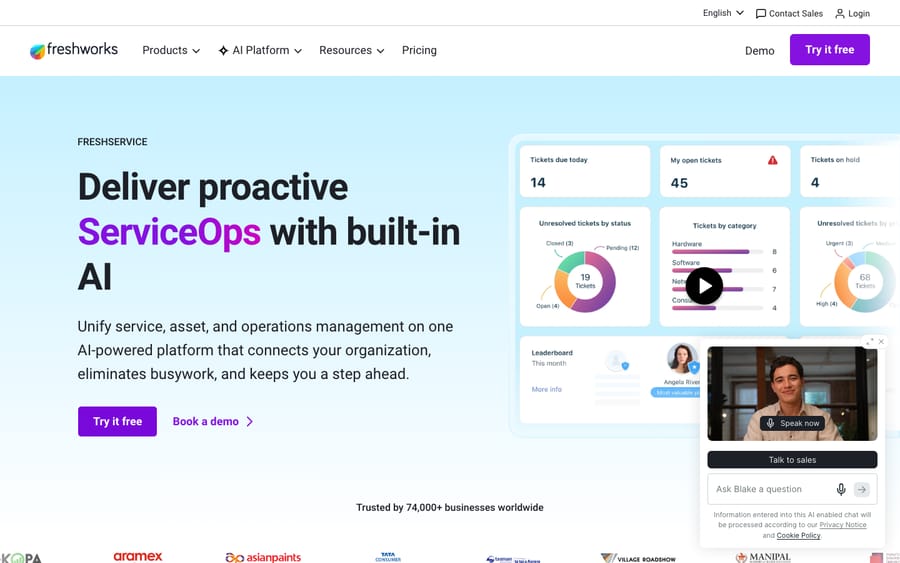
The best Freshservice alternatives in 2026 are Macha (if the queue is customer support and you want the AI agent set up for you), ServiceNow, Jira Service Management, ManageEngine ServiceDesk Plus, SolarWinds Service Desk, Atera, Ivanti Neurons, GLPI, Zendesk and Zoho Desk, and the right one depends on why you're leaving. Freshservice runs from $19 per agent a month on Starter to $99 on Pro, the first plan with problem, change and release management.
Key takeaways
- The leading ITSM alternatives to Freshservice for 2026 range from ServiceNow and Ivanti Neurons for enterprise ITSM to GLPI as the free, open-source option and Zendesk for unified customer and internal support.
- Freshservice starts at $19 per agent a month on Starter, but problem, change and release management first appear on Pro at $99, and Freddy AI Copilot adds $29 per agent.
- Jira Service Management is free for 1 to 3 agents, then costs about $20 per agent a month on Standard and about $51 on Premium.
- ManageEngine ServiceDesk Plus starts at $13, $27 and $67 per technician a month for cloud and on-premise alike, while SolarWinds Service Desk costs $39, $99 or $124 billed annually.
- Macha ranks first for teams whose real problem is a customer-support queue: it isn't ITSM, but on a help desk it runs on the Macha team builds and runs the AI agent for about $0.40 a ticket, setup and a dedicated success manager included.

The best Freshservice alternatives in 2026 start with Macha if the queue you're really trying to fix is customer support (the Macha team sets up and runs the AI agent on your help desk, about $0.40 a ticket). For IT service management they are ServiceNow and Ivanti Neurons for enterprise ITSM, Jira Service Management for Atlassian teams (free for up to 3 agents), ManageEngine ServiceDesk Plus for value and on-premise (from $13 per technician a month), SolarWinds Service Desk, Atera for MSPs, GLPI as the free open-source option, and Zendesk or Zoho Desk for lighter internal support. Freshservice itself runs from $19 per agent a month on Starter to $99 on Pro, the first plan with problem, change and release management.
How do the best Freshservice alternatives compare?
| Tool | Rating (approx.) | Pricing model | Best for | vs Freshservice |
|---|---|---|---|---|
| Macha | Our product (not rated here) | ~$0.40/ticket, from $299/mo for 750 tickets; setup included | Customer-support queues, set up and run for you | Not ITSM; AI agent on a customer help desk, done for you |
| ServiceNow | G2 4.3/5 (~2,000+) | Quote-only, per-fulfiller (~$100–$200/mo list) | Large enterprises, complex governance | Far more powerful and extensible; far costlier and heavier to implement |
| Jira Service Management | G2 4.3/5 (~900+) | Free 1–3 agents; ~$20–~$51/agent/mo + Enterprise | Dev-aligned & Atlassian-stack teams | Tighter dev/ops integration; pricier modules at scale |
| ManageEngine ServiceDesk Plus | G2 4.5/5 | From $13–$67/tech/mo; free edition ≤5 techs | Value-focused full-ITIL & on-prem | Deeper ITIL/asset depth per dollar; busier UI |
| SolarWinds Service Desk | G2 4.5/5 | $39–$124/technician/mo | Mid-market wanting clean SaaS ITSM+ITAM | Strong asset discovery; pricier at entry |
| Atera | G2 4.6/5 (~900+) | $129–$209/tech/mo (MSP, annual), unlimited devices | MSPs & lean IT wanting RMM+PSA+ITSM | All-in-one remote IT mgmt; lighter on pure ITIL |
| Ivanti Neurons for ITSM | G2 4.2/5 (~307) | Quote-only, ~$25–$59/user/module | Enterprises unifying ITSM + endpoint/security | Broader endpoint/security suite; heavier, quote-only |
| GLPI | G2 4.6/5 | Free open-source; paid cloud/support | Budget & open-source / on-prem teams | Free and self-hostable; steeper setup, dated UI |
| Zendesk (Employee Service) | G2 4.3/5 (~7,142) | $55–$115/agent/mo + AI add-ons | Teams unifying customer + internal support | One stack for CX and internal IT; less native ITIL |
| Zoho Desk | G2 4.4/5 | ~$14–$40/agent/mo | Light internal IT in the Zoho stack | Cheaper, customer-leaning; not full ITSM |
Prices re-checked on 24 September 2026; ratings observed June 2026. All are vendor-set and approximate, so verify before buying.
One note on scope, because it matters: Freshservice is a service desk for internal IT, not a customer-facing help desk. If you're not sure of the distinction, our help desk vs service desk guide breaks it down, and what is Freshservice covers the product itself. For each alternative below we cover what it is, who it wins for, its pricing model, its G2/Capterra rating as a real-user signal, and how it differs from Freshservice. Ratings were gathered in June 2026 and prices re-checked on 24 September 2026; where a number is vendor-set or moves fast, we flag it.
Why do teams look for a Freshservice alternative?
Freshservice isn't broken; it's a genuinely good mid-market ITSM tool. But a few recurring, fair reasons push IT teams to shop around:
- Price scales faster than headcount. Freshservice starts at $19/agent/month on Starter and $49 on Growth, billed annually, but problem, change and release management first appear on Pro ($99/agent/month), with Enterprise quote-only. Teams often upgrade for features, not seats, and the jump stings.
- AI is a paid add-on. Freddy AI Copilot costs $29/agent/month on top of the seat price; only Enterprise bundles the Freddy AI Agent.
- Depth ceilings at the top. Reviewers consistently praise Freshservice's UI and automation but note it has "room to evolve in analytics and enterprise-grade flexibility." Large enterprises with complex governance, deep discovery, or heavy customization sometimes outgrow it.
- Deployment and ecosystem fit. Freshservice is cloud-only. Teams that need on-premise hosting, open-source control, or a tool that lives inside an existing stack (Atlassian, Microsoft, an RMM for an MSP) often need something else.
None of this makes Freshservice a bad choice; it makes it a specific one: strong for cloud-first mid-market IT that wants fast time-to-value. Keep your real reason for leaving in mind as you read; it determines which alternative below actually fixes your problem.
How did we compare the tools?
We focused on established, currently-selling ITSM and IT service desk tools that a Freshservice team could realistically move to, spanning the full range: enterprise platforms, developer-centric service desks, value-focused ITIL suites, MSP-oriented RMM+PSA tools, and open-source options. For each we pulled live pricing from the vendor's own pages (or cited third-party trackers where pricing is quote-only), the current G2 or Capterra star rating and approximate review count as a real-user signal, and we read through review sentiment for recurring praise and complaints. G2's and Capterra's review pages are bot- and login-walled to automated access, so the verbatim sentiment in the "what users say" section is attributed by reviewer role, platform, and period rather than named profiles. Prices were re-checked on 24 September 2026; confirm on each vendor's page before you sign. We make Macha and rank it first for teams whose real problem is a customer-support queue and who want the AI agent set up and run for them. It isn't an ITSM tool; for IT service management, the other nine are the shortlist.
What are the 10 best Freshservice alternatives?
1. Macha: the done-for-you pick if the queue is customer support
What it is: An AI agent layer that runs on top of customer help desks: Zendesk, Freshdesk, Gorgias, Front, HubSpot or Intercom. On the Freshworks side that's Freshdesk, the customer-support product, not Freshservice. Macha isn't an ITSM tool: it doesn't connect to Freshservice and isn't built for internal IT, change or asset management. Who it wins: If the reason you're leaving Freshservice is a customer-support queue, or you landed here while comparing Freshworks products, Macha is the AI agent for that queue, set up and run for you on one of those help desks. For IT service management, the nine ITSM tools below are the shortlist. Pricing model: About $0.40 a ticket, from $299 a month for 750 tickets, billed per ticket rather than per agent. There's no free plan; the trial is $50 of free usage (about 125 tickets), no credit card. Rating: We make it, so we don't rate it here.
Done for you: You connect your help desk and the tools your answers come from, which takes about 15 minutes. The Macha team then analyzes about a month of your past tickets, builds the knowledge base and the agent, tests it on a sample of those tickets, and runs it in safe mode, with drafts as internal notes in your help desk, until the drafts are right. It goes live in under a week, on the trial and every plan. The $0.40 a ticket includes that setup and a dedicated success manager who handles your changes after go-live: new categories, instruction changes, new tools.
Pros: nobody on your team builds or tunes the agent; it resolves routine customer tickets inside your existing workflow and hands off to a human with context; per-ticket billing doesn't grow with seats. Watch-outs: no free plan (the trial is $50 of usage); it's not ITSM and works on top of a customer help desk, not as a standalone service desk; and it's only as good as the data and knowledge behind it. vs Freshservice: Freshservice charges Freddy AI Copilot at $29 per agent a month on top of seats and leaves the configuration to your admins. Macha covers customer support only, with the agent built and run for you. Here's how the AI layer works.
2. ServiceNow: the enterprise ITSM standard
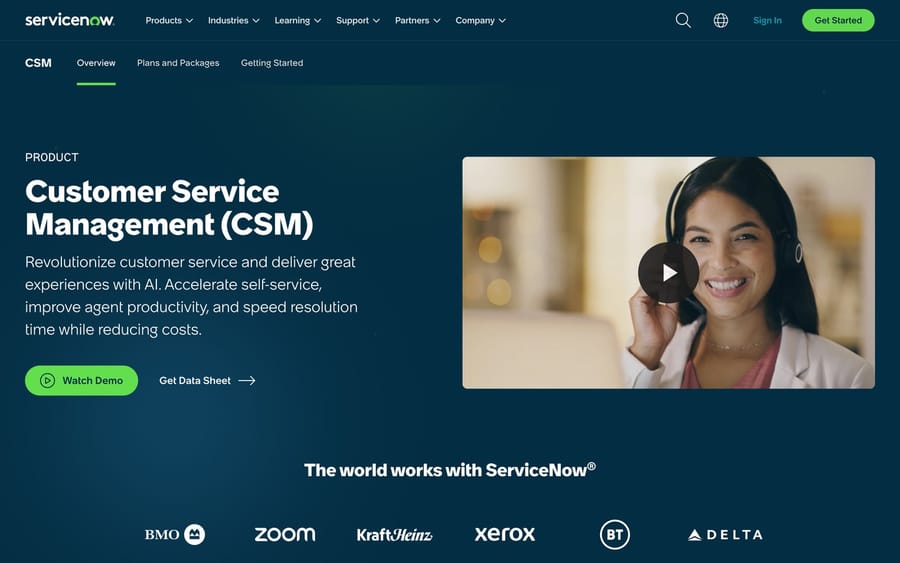
What it is: The category's heavyweight: a deeply extensible enterprise platform spanning ITSM, ITOM, ITAM, and far beyond, with industry-leading workflow automation, CMDB, and now AI-native tiers (Foundation, Advanced, Prime). Who it wins: Large enterprises with complex governance, multi-department service management, and the budget and admin resources to run a platform, not just a tool. Pricing model: Quote-only, per "fulfiller." Historical list pricing runs roughly $100–$200/fulfiller/month, dropping to ~$50–$110 at large volume; total 3-year cost of ownership commonly lands at 3–5x the license figure once implementation and management are counted. Rating: G2 ~4.3/5 across ~2,000+ reviews. vs Freshservice: Vastly more powerful and configurable, and vastly heavier and more expensive. As one G2 reviewer put it bluntly, "it's expensive and it's complex." Freshservice is what teams pick to avoid a ServiceNow-scale implementation; ServiceNow is where you go when you've genuinely outgrown that simplicity.
3. Jira Service Management: the dev-aligned service desk
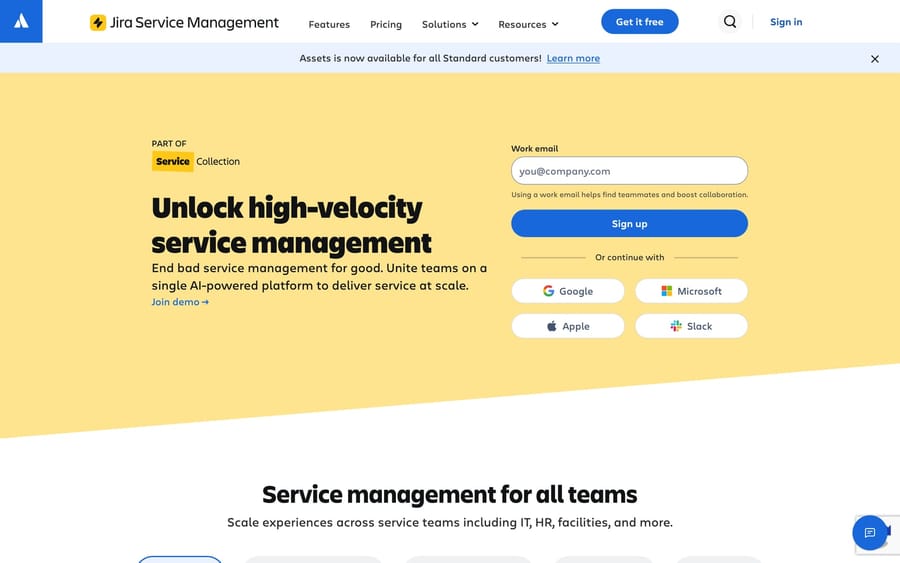
What it is: Atlassian's ITSM product, built on the Jira platform with ITIL-aligned incident, problem, and change management, strong SLA tracking, and native links to Jira Software and Confluence. Who it wins: IT and DevOps teams already living in the Atlassian ecosystem, especially where IT and engineering need to share incidents and changes. Pricing model: Free for 1–3 agents, then Standard ~$20/agent/month and Premium ~$51/agent/month (annual list, per Unthread's 2026 breakdown; Atlassian now sells it inside its Service Collection), with a custom Enterprise tier. Rating: G2 4.3/5 (~900+ G2 reviews; ~992 on Gartner Peer Insights). vs Freshservice: Unbeatable dev/ops alignment and a generous free tier, but reviewers consistently flag that cost "scales quickly as agents and features are added," and the jump from Standard to Premium unlocks essential ITSM modules, a steep price curve. Freshservice often feels more turnkey for a pure IT service desk.
4. ManageEngine ServiceDesk Plus: the value full-ITIL suite
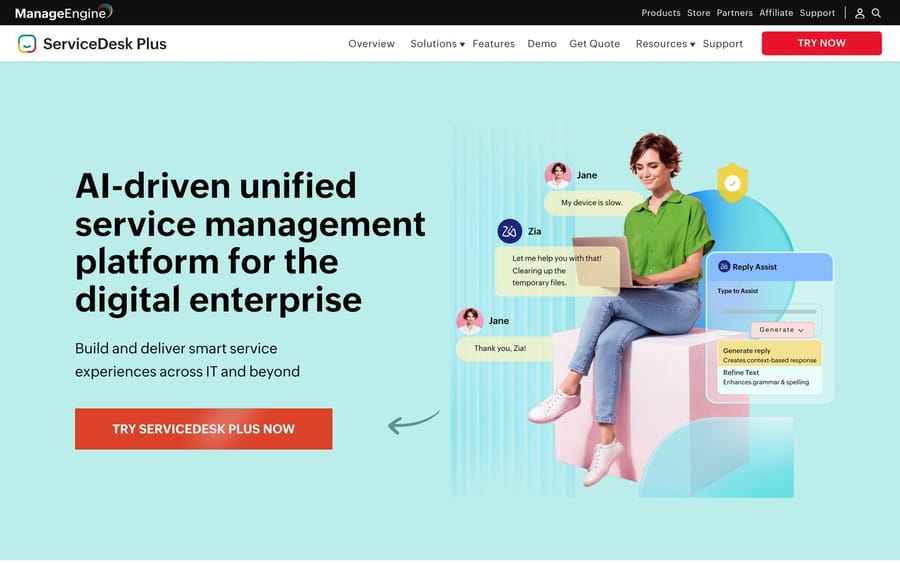
What it is: A mature, full-featured ITIL suite from ManageEngine (a division of Zoho Corp) covering incident, problem, change, release, asset, and project management, available both in the cloud and on-premise. Who it wins: Value-conscious IT teams that want broad ITIL depth per dollar, and anyone who needs on-premise deployment. Pricing model: ManageEngine lists the same starting prices for cloud and on-premise: $13/technician/month (Standard), $27 (Professional) and $67 (Enterprise), with a free Standard edition for up to 5 technicians. Rating: G2 4.5/5, widely praised as strong value. vs Freshservice: Arguably deeper ITIL and asset management at a lower price, plus the on-prem option Freshservice lacks. The trade-off, per Capterra reviewers, is a busier interface and a knowledge base that "doesn't tie into support tickets very well." A genuine like-for-like swap for many Freshservice teams.
5. SolarWinds Service Desk: the clean SaaS ITSM + ITAM pick
What it is: A cloud ITSM platform with strong, automated asset discovery, incident and change management, and a clean, modern interface, born from SolarWinds' IT-monitoring heritage. Who it wins: Mid-sized organizations that want ITIL-aligned service management with solid IT asset management baked in, without enterprise-platform complexity. Pricing model: Per technician: Essentials $39, Advanced $99, Premier $124 per technician/month, billed annually, with unlimited requesters. Rating: G2 4.5/5. vs Freshservice: Strong on automated asset discovery and a tidy SaaS experience, but reviewers note the entry price "feels high compared to competitors" like Jira and Zoho for smaller teams. Best for mid-market IT where ITAM is a first-class need.
6. Atera: the all-in-one for MSPs and lean IT
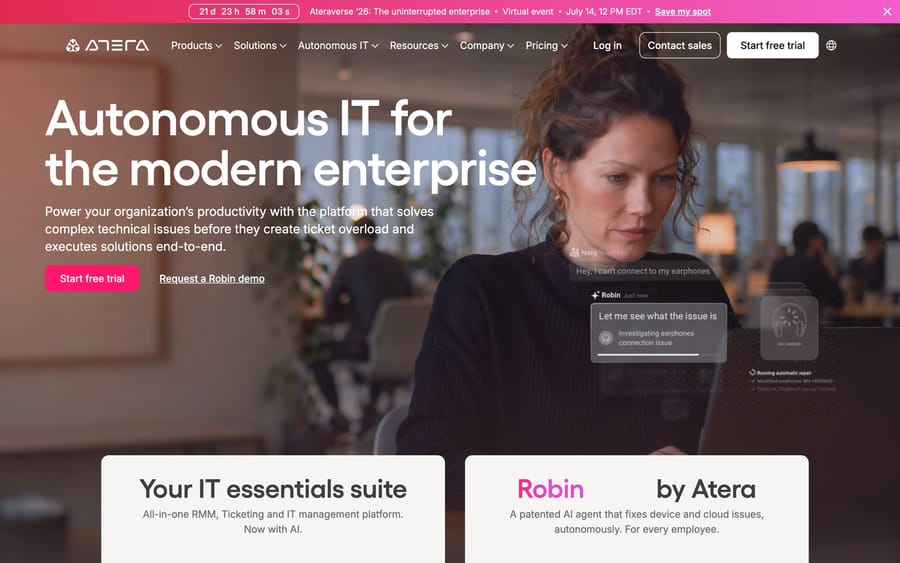
What it is: An all-in-one remote IT management platform combining RMM (remote monitoring and management), PSA/ticketing, and automation, with AI ticket summaries and a distinctive per-technician, unlimited-devices model. Who it wins: Managed service providers and lean internal IT teams that manage lots of endpoints and want monitoring, ticketing, and automation in one flat-rate tool. Pricing model: Pay per technician with unlimited devices. Atera's pricing pages block automated access, so these come from SuperOps' 2026 breakdown (a competitor): MSP plans run $129–$209/technician/month billed annually, and IT-department plans $149–$219, with AI Copilot an extra $95/technician/month. Rating: G2 4.6/5 across ~900+ reviews. vs Freshservice: A different shape of tool: Atera bundles endpoint monitoring and remote management that Freshservice doesn't, and the unlimited-device pricing is a big win for device-heavy shops. The flip side is shallower pure-ITIL process depth, basic reporting, and a dated UI in places. Best when remote device management matters as much as ticketing.
7. Ivanti Neurons for ITSM: the endpoint-and-security-unified platform
What it is: An enterprise ITSM platform that's part of Ivanti's broader Neurons suite, designed to unify service management with endpoint management, patching, and security. Who it wins: Larger enterprises that want ITSM tightly integrated with device management and security operations under one vendor. Pricing model: Quote-only; per-user pricing reportedly starts around $25–$59/user depending on the modules selected. Rating: G2 4.2/5 across ~307 reviews. vs Freshservice: Broader reach into endpoint and security management than Freshservice offers, which is the whole appeal for security-conscious IT orgs, but it's heavier, quote-only, and reviewers cite setup complexity and a learning curve. Overkill if you only need a service desk.
8. GLPI: the open-source option
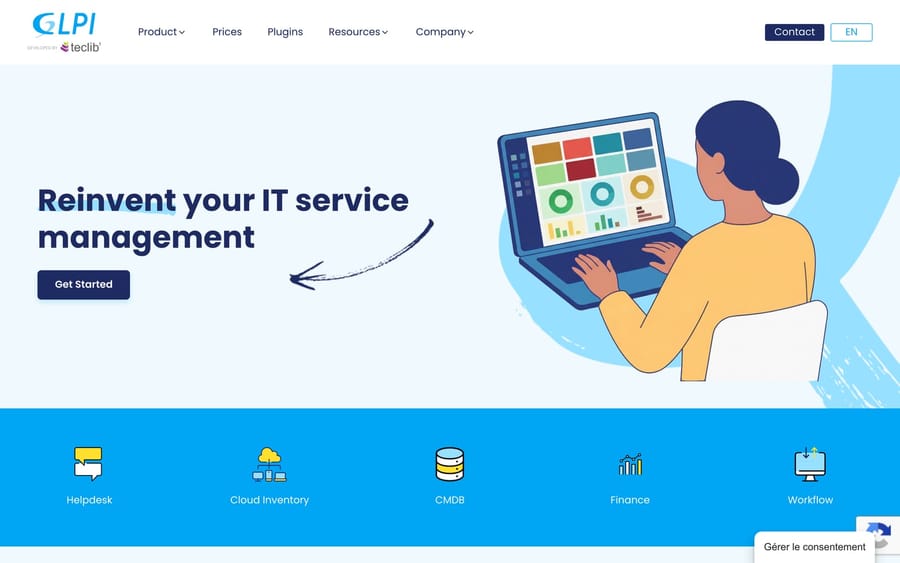
What it is: A free, open-source ITSM and IT asset management platform (maintained by Teclib') covering ticketing, a CMDB, asset tracking, a knowledge base, and ITIL-aligned processes, with a large plugin ecosystem. Who it wins: Budget-constrained teams, on-prem/data-sovereignty requirements, and IT shops with the in-house skills to self-host and customize. Pricing model: Free and open-source to self-host; paid cloud hosting and commercial support are available through Teclib. Rating: G2 4.6/5, Capterra 4.5/5. vs Freshservice: Eliminates per-seat licensing entirely and gives you full control, a genuinely different value proposition. The cost shows up as effort: a steeper learning curve for admins and an interface that "may feel dated compared to modern SaaS solutions." Best when budget or control outweighs convenience.
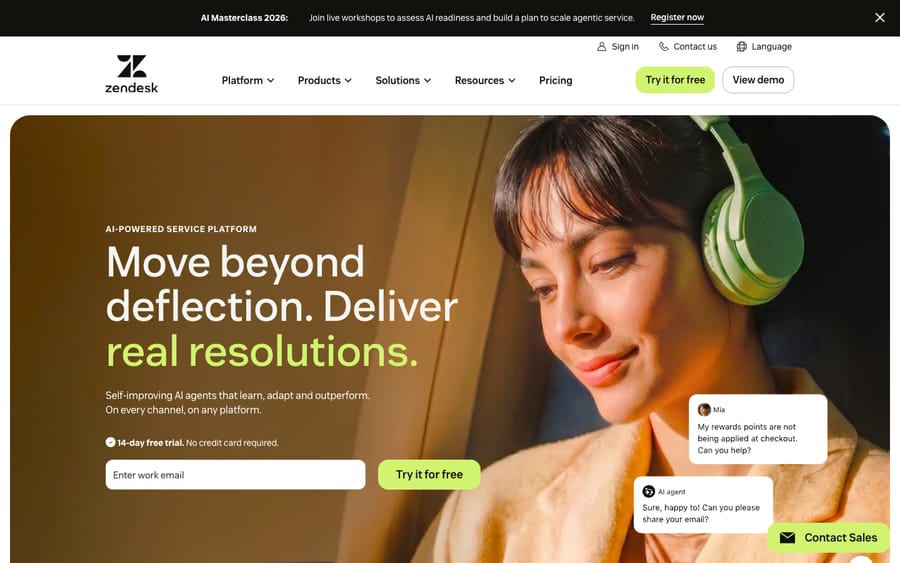
9. Zendesk: for teams unifying customer and internal support
What it is: A mature support platform best known for customer service, with Zendesk for Employee Service extending the same workspace to internal IT, HR, and other internal teams, with omnichannel ticketing, automation, robust reporting, and native AI agents. Who it wins: Organizations that want one platform for both customer support and internal IT/HR, rather than a dedicated ITIL tool. Pricing model: Suite plans run $55 (Suite Team) and $115/agent/month (Suite Professional) billed annually, with Enterprise quote-only; the pricing page no longer lists a Suite Growth tier. Copilot adds $50/agent/month on Suite Professional and above, and AI agents bill per automated resolution at $1.50 committed or $2.00 pay-as-you-go, per Zendesk's pricing page. Rating: G2 4.3/5 across ~7,142 reviews, one of the largest review bases in support software. vs Freshservice: A strong choice if you value a single stack across CX and internal service, with deep ticketing and a vast app ecosystem, but it's less of a purpose-built ITIL/asset tool than Freshservice, and AI carries its own usage cost. It's a good fit when "service desk" for you means employee support more than formal ITSM.
10. Zoho Desk: the light internal-IT option in the Zoho stack
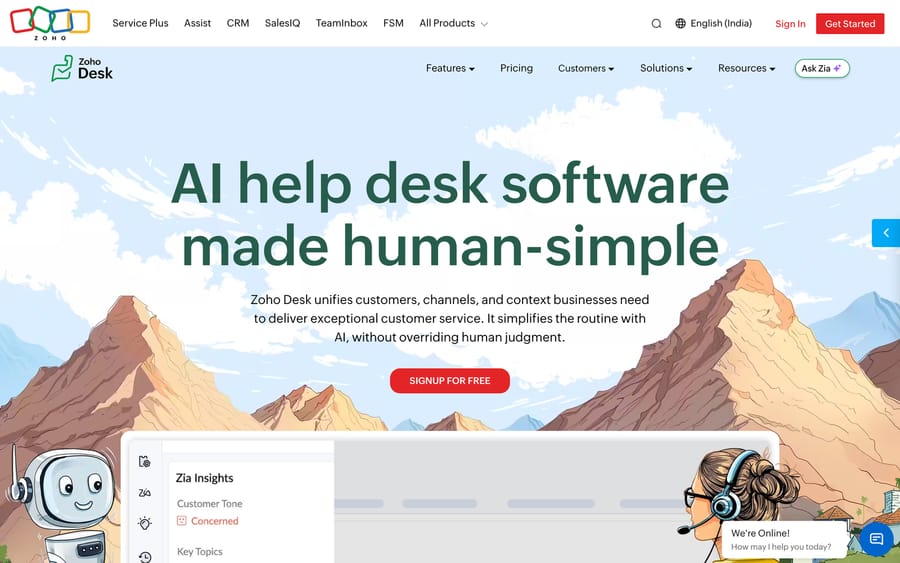
What it is: Zoho's help desk product. Worth a clear caveat: Zoho Desk is a customer-support tool, not a full ITSM platform; Zoho's true ITSM family is ManageEngine ServiceDesk Plus (covered above). But for lighter internal IT support, especially inside the Zoho ecosystem, it's a budget-friendly option. Who it wins: Small teams already running Zoho One/CRM that need a low-cost internal request desk rather than formal ITIL change/asset management. Pricing model: Roughly $14–$40/agent/month (annual), with a free plan for up to 3 agents (Zoho's pricing page served us local-currency prices, so treat the dollar range as approximate). Rating: G2 4.4/5. vs Freshservice: Cheaper and tightly integrated with the Zoho suite, but it lacks Freshservice's native ITSM modules (change, release, CMDB-grade asset management). If you need real ITSM, look at ManageEngine ServiceDesk Plus instead; if you just need cheap internal ticketing in Zoho, Desk fits.
What do users say about the alternatives?
Ratings give you the average; reviews give you the why. G2 and Capterra review pages are bot- and login-walled, so the following is attributed by reviewer role, platform, and period, and reflects aggregate sentiment we read across pages (verify on each vendor's reviews tab):
"It's expensive and it's complex." That's the most consistent ServiceNow theme on G2, echoed across enterprise IT reviewers citing high licensing and implementation cost and a steep learning curve (2026).
Jira Service Management is "powerful but expensive to scale," with the jump from Standard to Premium "unlocking essential ITSM modules", a recurring note from mid-market IT reviewers on G2 (2026).
ManageEngine ServiceDesk Plus delivers "all the features an IT team would need... including asset management at an incredibly attractive price," though "the knowledge base... doesn't tie into support tickets very well." Source: IT administrator reviews on Capterra (2026).
SolarWinds Service Desk "brings ticketing, incident tracking and asset management into one platform... it makes it easier to resolve issues," with reviewers praising the clean, drag-and-drop admin experience. Source: IT support reviewer on G2 (2026).
Atera's "pricing model is very refreshing, per technician instead of per device," which a reviewer said "saves a ton of money" for device-heavy shops, though others note reporting "feels stuck" a few years back. Source: MSP reviewer on Capterra (2026).
Ivanti Neurons for ITSM has a "steep learning curve to maximize the potential return on investment," and its "modules, while diverse and powerful, can feel disjointed from one another." Source: enterprise IT reviewer on G2 (2026).
GLPI is an "advanced and highly developed tool for open-source software": "although the entry barrier is relatively high, with proper configuration, it becomes a truly excellent ITSM tool." Source: open-source IT reviewer on G2 (2026).
Zendesk wins on automation and reporting, but reviewers caution the agent workspace "can feel heavy and slow when handling a large number of tickets" and that pricing "can be expensive for smaller teams." Source: support-team reviewers on G2 (2026).
Read together, the themes line up with the reasons teams leave Freshservice: enterprise tools (ServiceNow, Ivanti) trade power for cost and complexity; value tools (ManageEngine, GLPI) trade polish for price; and the dev- and CX-aligned options (Jira, Zendesk) win on ecosystem fit but climb in cost at scale.
How do you choose the right Freshservice alternative?
- Name your real reason for leaving. Is the queue really customer support? Macha, set up and run for you on a help desk it runs on. Price at scale? Look at ManageEngine or GLPI. Need enterprise governance and depth? ServiceNow or Ivanti. Dev-aligned? Jira Service Management. Device-heavy or an MSP? Atera. One stack with customer support? Zendesk. Don't switch platforms to fix a single feature gap.
- Match the tool to your deployment and stack. Need on-premise or open-source? ManageEngine on-prem or GLPI. All-in on Atlassian? Jira. Already in Zoho? ManageEngine ServiceDesk Plus (or Zoho Desk for light needs).
- Model the total cost, including AI and add-ons. Freshservice taught this lesson: the sticker per-agent price rarely matches the bill once modules, AI, and implementation are counted. For quote-only tools (ServiceNow, Ivanti), budget for implementation and a multi-year TCO, not just licenses.
- Weigh migration and admin cost honestly. Heavier platforms need dedicated admins; open-source needs in-house skills. That effort pays off for a structural need and is overkill for a single missing report.
- Pilot on real workflows. Run your top incident, change, and request flows in a trial before committing, and measure setup time and adoption against your Freshservice baseline.
Frequently asked questions
What is the best Freshservice alternative in 2026? If the queue you're fixing is customer support, Macha, which we make and rank first: the Macha team sets up and runs the AI agent on your help desk at about $0.40 a ticket, which includes setup and a dedicated success manager who handles your changes. For IT service management it depends on why you're leaving. ServiceNow is the most powerful enterprise platform; Jira Service Management wins for dev-aligned and Atlassian teams; ManageEngine ServiceDesk Plus is the best value and on-prem pick; SolarWinds Service Desk is strong for mid-market ITSM + asset discovery; Atera is best for MSPs and lean IT; Ivanti Neurons unifies ITSM with endpoint/security; GLPI is the open-source choice; and Zendesk fits teams unifying customer and internal support.
Is Freshservice an ITSM tool or a help desk? Freshservice is an ITSM (IT service management) tool, a service desk for internal IT, with incident, problem, change, and asset management. That's distinct from a customer-facing help desk (like Freshdesk). See help desk vs service desk and what is Freshservice.
What's the cheapest Freshservice alternative? GLPI is free and open-source if you can self-host, making it the lowest-cost option. ManageEngine ServiceDesk Plus is the best-value paid ITSM (from $13/technician/month, with a free Standard edition for up to 5 techs), and Jira Service Management is free for 1–3 agents. Always add implementation and add-on costs when comparing.
What is the best alternative to ServiceNow that's simpler? If ServiceNow is too heavy and expensive, Freshservice, Jira Service Management, and ManageEngine ServiceDesk Plus are the most common simpler, lower-cost ITSM choices; they deliver ITIL-aligned service management without ServiceNow's implementation and licensing scale.
Does Macha replace Freshservice? No. Macha is an AI agent layer on top of Zendesk, Freshdesk, Gorgias, Front, HubSpot or Intercom (customer support), not an ITSM tool, and it doesn't connect to Freshservice. If you run customer support on one of those desks and want AI deflection, Macha helps there, with the agent set up and run for you by the Macha team on the trial and every plan, but for IT service management, pick one of the ITSM tools above.
Which Freshservice alternative should you pick?
The best Freshservice alternative is the one that fixes your specific reason for looking. Macha is the top pick if the queue is customer support and you want the AI agent set up and run for you; for ITSM, ServiceNow and Ivanti are the enterprise heavyweights; ManageEngine ServiceDesk Plus and GLPI are the value and open-source picks; Jira Service Management wins for dev-aligned teams; SolarWinds and Atera suit mid-market IT and MSPs respectively; and Zendesk fits teams unifying customer and internal support. Pin down your deployment needs and stack, model the total cost including AI and implementation, and pilot on real workflows before you migrate.
Ratings gathered June 2026; prices re-checked 24 September 2026. ITSM pricing and AI terms in this category change fast; confirm current details on each vendor's site before buying.