Intercom
 Shopify
 Stripe
 Slack
Slack Notion
 Google Workspace
 Confluence

Freshdesk vs Intercom (2026): Which Should You Choose, and What Does Each Cost?


Freshdesk is a per-agent omnichannel help desk from $19 an agent a month, while Intercom is a messenger-first platform from $29 a seat that bills its Fin AI agent at $0.99 per outcome. Freshdesk suits teams that want a predictable bill; Intercom suits product-led teams that want AI to resolve most conversations and can live with variable cost.
Key takeaways
- Freshdesk suits cost-conscious teams wanting predictable per-agent ticketing from $19 a month, while Intercom suits product-led teams wanting Fin to resolve conversations at $0.99 per outcome.
- Freshdesk costs $19, $55 or $89 per agent a month on annual billing, and Intercom costs $29, $85 or $132 per seat, with 20 or 50 free Lite seats on the upper Intercom plans.
- Freshdesk includes 500 Freddy AI Agent sessions on every plan and charges $49 per 100 more, while Freddy AI Copilot costs $29 per agent on Pro and Enterprise only.
- Salesforce's acquisition announcement cites a 76% average resolution rate for Fin, a vendor figure, and Fin also runs on other help desks with a 50-outcome monthly minimum.
- Salesforce completed its roughly $3.6 billion acquisition of Fin, the company formerly called Intercom, on September 10, 2026, so Intercom's roadmap now sits inside Agentforce.

Pick Freshdesk if you want predictable, per-agent omnichannel ticketing from $19 an agent a month; pick Intercom if you want a messenger-first platform built around the Fin AI agent, from $29 a seat a month plus $0.99 per Fin outcome. Both prices are on the vendors' pricing pages as of 24 September 2026. The choice isn't about which tool is better. It's about which trade-off fits your team: broad, budget-friendly ticketing, or a higher-end messenger with the most-talked-about AI agent in the category.
| Freshdesk | Intercom | |
|---|---|---|
| Entry price (annual) | $19/agent/mo (Growth) | $29/seat/mo (Essential) |
| Top published tier | $89/agent/mo (Enterprise) | $132/seat/mo (Expert) |
| AI agent | Freddy AI Agent: 500 sessions included, then $49 per 100 | Fin: $0.99 per outcome |
| Trial | 14 days on the Enterprise plan | 14 days, no credit card |
| Owner | Freshworks | Salesforce (since 10 September 2026) |
A disclosure up front: Macha (the company publishing this) builds an AI agent layer that runs on top of customer-support help desks, specifically Zendesk, Freshdesk, Gorgias, Front, HubSpot or Intercom. So we work alongside both of these products rather than competing with them, and we'll keep the writeup even-handed and save the one aside about where we fit for the end.
One timely note before we start: on 12 May 2026 the company behind Intercom renamed itself Fin, after its AI agent, and kept "Intercom" as the name of the help desk product. In June 2026 Salesforce signed a definitive agreement to acquire Fin for roughly $3.6 billion, and it completed the acquisition on September 10, 2026. Nothing changed for current Intercom customers on the day, but if you're choosing a multi-year platform, factor in that Intercom's roadmap will increasingly sit inside Salesforce's Agentforce orbit. We flag where that matters below.
How did we compare Freshdesk and Intercom?
We pulled plan names and prices from the official pricing pages for Freshdesk and Intercom and re-checked both on 24 September 2026. For real-user signal we used G2 and Capterra aggregate ratings, review counts, and recurring pros and cons, with a representative user quote for each tool. Those ratings are mid-2026 readings and weren't re-read for this update. The acquisition details come from Salesforce's 10 September 2026 press release and the June 15, 2026 announcement of the agreement. Pricing and ratings in this space move fast, so confirm current numbers before you budget. Our next review is scheduled for December 2026.
What is the core difference between Freshdesk and Intercom?
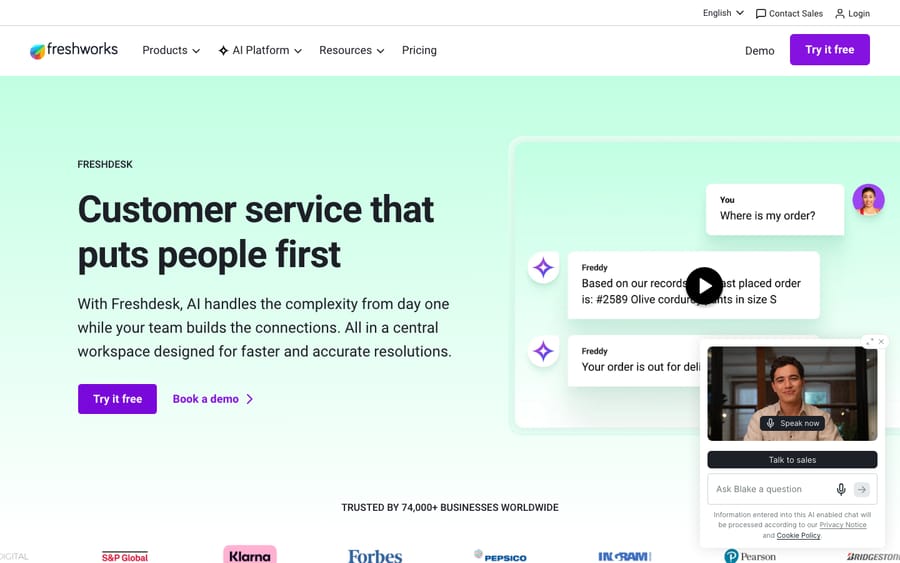
Freshdesk is a help desk first. Its center of gravity is the ticket queue: customers reach you by email, web form, phone, social, or chat, every message becomes a ticket in a shared inbox, and agents (or Freddy AI) work it to resolution. Freshworks prices it to be accessible for small and mid-sized teams, which is why it shows up so often on "affordable Zendesk alternative" lists. The mental model is omnichannel ticketing at a fair price.
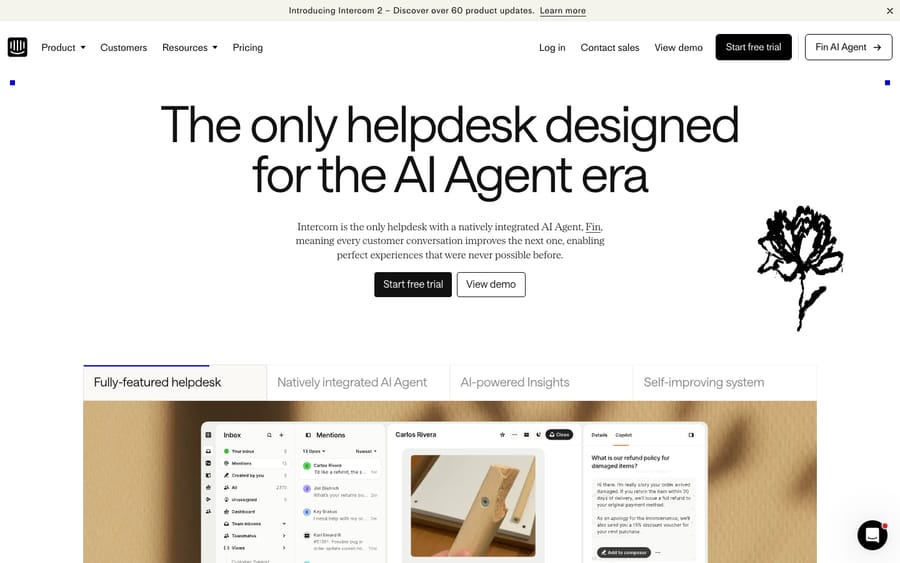
Intercom is a messenger first. It grew up as the in-app chat widget for SaaS and product-led companies, and it still feels like that: real-time conversations, proactive messages, product tours, and a polished customer-facing experience. Over the last two years it has bet the company on Fin, its AI agent, to the point of renaming the company after it. Where Freshdesk sells you a help desk and treats AI as an add-on, Intercom increasingly sells you an AI-first customer service platform where the human help desk is the thing wrapped around the AI.
That difference in DNA, ticket queue against chat-and-AI, explains nearly every other contrast below.
How do Freshdesk and Intercom compare side by side?
| Freshdesk | Intercom | |
|---|---|---|
| Category | Value omnichannel help desk | Premium messenger / AI-first platform |
| Best at | Affordable ticketing across many channels | In-app live chat + AI automation |
| Pricing model | Per agent / month | Per seat / month + usage-based AI |
| Entry price (annual) | $19/agent/mo (Growth) | $29/seat/mo (Essential) |
| Top tier (annual) | $89/agent/mo (Enterprise) | $132/seat/mo (Expert) |
| Free option | Free Program for up to 2 agents for 6 months, started from inside an account; 14-day trial | No free plan (14-day trial) |
| AI agent | Freddy AI Agent (500 sessions included, then per session) | Fin AI Agent ($0.99 per outcome) |
| AI pricing feel | Add-on on top of seats | Core to the product; pay per outcome |
| Channels | Email, phone, chat, social, WhatsApp | Messenger-led; email, chat, social, SMS, phone |
| G2 rating (mid-2026) | ~4.4 / 5 (~3,700 reviews) | ~4.5 / 5 (~3,000+ reviews) |
| Capterra rating (mid-2026) | ~4.5 / 5 (~3,400 reviews) | ~4.5 / 5 (~1,100 reviews) |
| Best for | Cost-conscious teams needing broad channel coverage | Product-led teams wanting top-tier chat + AI deflection |
Prices from the official pricing pages, 24 September 2026. Ratings are mid-2026 readings from G2 and Capterra. Confirm before budgeting.
How much do Freshdesk and Intercom cost?
This is where the two diverge most, and it's the part most likely to surprise you on the invoice.
Freshdesk: per agent, per month (billed annually):
- Growth: $19 · core omnichannel help desk: ticketing, automation, SLA management, collaboration.
- Pro: $55 · custom objects, advanced ticketing, CSAT, round-robin and richer routing, custom reporting.
- Enterprise: $89 · skills-based assignment, audit logs, approval workflows, sandbox, added security.
- Free Program · $0 for up to 2 agents for the first 6 months. It's no longer listed on the pricing page; you start it from Admin, Account, Plans and Billing. It replaced the old open-ended free plan, so treat it as an on-ramp, not a permanent free tier.
Freshdesk's 14-day trial runs on the Enterprise plan. Freddy AI is a separate line item (more below). For the full breakdown, see Freshdesk pricing explained.
Intercom: per seat, per month + usage (billed annually):
- Essential: $29/seat · shared inbox, messenger, tickets, basic help center; no Lite seats included. (Earlier in September the page showed $19 during a pricing test; on 24 September it showed $29.)
- Advanced: $85/seat · automation, multiple inboxes, workflows; includes 20 free Lite seats.
- Expert: $132/seat · advanced security, SLAs, multi-brand; includes 50 free Lite seats.
- Fin AI Agent: $0.99 per outcome, added on top of any plan. Every plan needs at least 1 full seat.
The structural difference: Freshdesk's bill is mostly predictable (seats × tier), while Intercom's bill has two moving parts: seats plus a usage meter for Fin. At low volume the per-outcome model can be cheap; at high volume, $0.99 per outcome scales with your ticket count, so a busy month costs more. Take 2,000 Fin outcomes a month: that's $1,980 before a single seat. That's fine if you want AI to shoulder the load and you're comfortable with variable cost; it's nerve-wracking if you need a fixed number for finance. Intercom's Lite seats (free seats for occasional collaborators) soften the per-seat sting on higher plans, but the headline holds: Freshdesk is the cheaper, more predictable starting point; Intercom is the premium, usage-led one. Run the numbers for your own volume in Intercom pricing explained.
Is Fin better than Freddy AI?
Both platforms put AI front and center, but they price and position it very differently.
Freddy AI (Freshdesk) comes in pieces. Freddy AI Agent is the autonomous bot that deflects and resolves customer queries; Freshdesk meters it per session, with the first 500 sessions included on every plan and $49 per 100 sessions after that. Freddy AI Copilot is agent-assist (reply suggestions, summaries, tone) at $29/agent/month, and it's offered on the Pro and Enterprise tiers only. The framing is "add AI onto your help desk."
Fin (Intercom) is the headline act. It's an AI agent built specifically for support resolution, billed at $0.99 per outcome, charged once per conversation. An outcome is the customer confirming they're helped, not asking for more, or Fin completing a workflow. Salesforce's acquisition announcement cites an average resolution rate of 76% across Fin customers, which is a vendor figure, not an independent one. Fin also runs outside Intercom, on other help desks including Freshworks, with a 50-outcome monthly minimum. The framing is the inverse of Freshdesk's: "AI resolves, humans handle the rest."
Which model is better depends on your appetite. Pay-per-outcome (Fin) ties cost to the AI closing something, and it also means the vendor earns more as your volume grows. Pay-per-session plus a per-seat add-on (Freddy) is more predictable and cheaper to dabble with, but you're buying capability rather than outcomes. Neither is free; on both platforms, budget AI as its own line item on top of the seat price. And Fin's roadmap will now be shaped by Salesforce's Agentforce priorities.
Which has better channels and faster setup?
Channels. Both cover the modern basics (email, chat, social, phone, messaging) with different centers of gravity. Freshdesk leans into omnichannel ticketing: it's built to unify many channels into one queue, and phone is a first-class part of the Freshworks suite. Intercom leans into the in-app messenger and proactive, conversational experiences; if your support happens inside a web or mobile product, Intercom's widget and outbound messaging feel native in a way a traditional help desk doesn't.
Ease of setup. Reviewers routinely describe Freshdesk as fast to adopt, with new agents productive after little training, which suits lean teams without a dedicated admin. Intercom is polished but heavier to configure: workflows, the messenger, and especially tuning Fin's knowledge sources reward (and somewhat require) investment. Rule of thumb: if you want to be live this week on a budget, Freshdesk; if you're willing to invest in setup for a premium conversational and AI experience, Intercom.
What do users say about Freshdesk and Intercom?
Aggregate review sentiment tracks the positioning closely. Both tools are well-liked; the complaints are predictable.
- Freshdesk: ~4.4/5 on G2 (about 3,700 reviews) and ~4.5/5 on Capterra (about 3,400 reviews). The recurring praise is ease of use and value: reviewers describe getting a team "up and running without heavy training" and call it good value for small-to-mid teams. The most common watch-out is that useful features sit behind higher tiers (CSAT, advanced routing, Copilot), so the real cost can creep above the Growth sticker.
- Intercom: ~4.5/5 on G2 (3,000+ reviews) and ~4.5/5 on Capterra (about 1,100 reviews, ease-of-use ~4.4). Reviewers love the messenger and live-chat experience and, increasingly, Fin's deflection. As one G2 reviewer put it: "Intercom is by far the leader in live chat software… the experience is immediately familiar to [users], which makes it feel simple and reliable." The consistent criticisms are cost (it's the pricier platform, and the Fin meter adds variability) and reporting depth.
Net: ratings are essentially a tie. The split is on why people rate them highly (Freshdesk for affordability and simplicity, Intercom for chat polish and AI) and on what they complain about (Freshdesk's tier-gating, Intercom's price).
Should you choose Freshdesk or Intercom?
- Choose Freshdesk if you're a cost-conscious team that needs solid omnichannel ticketing without a premium bill. You want email, phone, chat and social at one predictable per-agent price, fast setup, and the option to add AI later rather than building around it. It's the safer pick for traditional support orgs and lean teams. (Comparing the broader market? See the best Freshdesk alternatives.)
- Choose Intercom if you're a product-led or SaaS team that lives in an in-app messenger and wants aggressive AI deflection, and you can accept a premium, partly usage-based bill. If Fin closing most of your conversations is the goal and variable cost is acceptable, Intercom is built for exactly that.
- Lean Freshdesk if budget predictability is non-negotiable; lean Intercom if conversational experience and AI-first automation come first and cost second.
- Either way, budget AI separately. Freddy (per session, plus per-seat Copilot) and Fin (per outcome) are both add-ons, and both are the most common source of "the bill was higher than the sticker."
- One forward-looking caveat for Intercom: with Salesforce now owning Fin, weigh how comfortable you are tying a multi-year support stack to a platform that is being folded into Agentforce.
Where does an AI layer like Macha fit?
One narrow aside, scoped to where we operate: whether you land on Freshdesk or Intercom, Macha is an AI agent layer that runs on top of your existing help desk. It connects to your knowledge sources and works ticket by ticket: reading the ticket, pulling the right answer, drafting a reply, tagging, routing, inside the help desk you already use.
To be clear about scope: Macha is a layer on top of a help desk, not a help desk itself, so it's not a Freshdesk or Intercom alternative. It isn't a third option in this bake-off; it's only relevant if you want a dedicated AI layer rather than relying on Freddy or Fin alone. Pricing is one plan by ticket volume, starting at $299 a month for 750 tickets, charged once per ticket however many messages it takes, with setup and monitoring by the Macha team included. If you'd rather watch the automation work before committing, there's $50 of free usage (about 125 tickets), no credit card and no time limit.
Frequently asked questions
What's the main difference between Freshdesk and Intercom? Freshdesk is a value-priced, omnichannel help desk built around ticketing, billed per agent at a predictable monthly rate. Intercom is a premium, messenger-first, AI-first platform billed per seat plus usage for its Fin AI agent ($0.99 per outcome). Freshdesk optimizes for affordable coverage; Intercom for a polished chat experience with aggressive AI deflection.
Which is cheaper, Freshdesk or Intercom? Freshdesk, in almost every scenario. Its entry plan is $19 an agent a month against Intercom's $29 Essential seat (24 September 2026), and Freshdesk's bill is more predictable. Intercom adds per-outcome Fin charges that scale with volume, so a busy month can cost meaningfully more. Add AI as a separate line item on either.
Is Intercom's Fin AI better than Freshdesk's Freddy? They're built differently. Fin is positioned as an AI-first agent priced per outcome, with a vendor-reported 76% average resolution rate. Freddy is a per-session bot (500 sessions included, then $49 per 100) plus a $29 per-seat Copilot on Pro and Enterprise, framed as an add-on to the help desk. Fin tends to be more autonomous out of the box; Freddy is cheaper to start with.
Is Intercom being acquired by Salesforce? It already has been. In June 2026, Salesforce signed a definitive agreement to acquire Fin, the company formerly called Intercom, for approximately $3.6 billion, and completed it on September 10, 2026. Nothing changed immediately for customers, but Intercom's roadmap will increasingly align with Salesforce's Agentforce.
Does Freshdesk or Intercom have a free plan? Freshdesk offers a Free Program ($0 for up to 2 agents) for the first 6 months only, started from inside an account rather than the pricing page, plus a 14-day trial on the Enterprise plan. Intercom has no free plan, only a 14-day trial with no credit card.
Vendor prices checked on Freshworks' and Intercom's official pricing pages on 24 September 2026; ratings are mid-2026 readings from G2 and Capterra; acquisition details from Salesforce's June 15 and September 10, 2026 announcements. Next review: December 2026.
Add AI agents to your Freshdesk
Macha reads the ticket, drafts the reply and takes the action, inside the Freshdesk you already run.