Intercom
 Shopify
 Stripe
 Slack
Slack Notion
 Google Workspace
 Confluence

How Much Does Intercom Cost in 2026? Seat Plans, Fin AI and Add-ons


Intercom charges $29, $85 or $132 per seat per month on annual billing, then bills its AI agent Fin at $0.99 per outcome on top. That second, usage-based layer is why two teams of the same size can get very different invoices.
Key takeaways
- Intercom costs $29 for Essential, $85 for Advanced and $132 for Expert per seat per month on annual billing, though some visitors saw a $19 Essential test price on 24 September 2026.
- Intercom's AI agent Fin is billed at $0.99 per outcome on top of seats, charged at most once per conversation, and a sales qualification costs $9.99.
- A 10-seat Intercom team on Advanced with Copilot on every agent and about 1,500 Fin resolutions a month pays close to $31,500 a year.
- Fin's 50-outcome monthly minimum applies only when Fin runs on a non-Intercom help desk such as Salesforce or HubSpot, not on an Intercom seat plan.
- Intercom's Copilot add-on for human agents costs $29 per agent per month on annual billing and $35 monthly, separate from Fin.

Intercom costs $29 (Essential), $85 (Advanced) or $132 (Expert) per seat per month on annual billing, and its AI agent Fin adds $0.99 per outcome on top of the seats (intercom.com/pricing and fin.ai/pricing, checked 24 September 2026). For a busy team, the Fin line can match or pass the seat bill, so conversation volume drives the invoice more than headcount does.
| Line item | Price (24 Sept 2026) | Notes |
|---|---|---|
| Essential seat | $29 / seat / month annual, $39 monthly* | Inbox, Messenger, Fin access, public help center |
| Advanced seat | $85 / seat / month annual, $99 monthly | Adds workflows and round robin; 20 Lite seats |
| Expert seat | $132 / seat / month annual, $139 monthly | Adds SSO, HIPAA, SLAs, multibrand; 50 Lite seats |
| Fin outcome | $0.99 (qualification $9.99) | At most one charge per conversation |
| Copilot | $29 / agent / month annual, $35 monthly | AI for human agents, per seat |
| Proactive Support Plus | $99 / month | Includes 500 messages |
| Free plan | None | 14-day free trial |
*Essential is inside a live pricing test. On 24 September 2026 intercom.com/pricing showed $29 a seat on annual billing ($39 monthly) on some page loads and $19 annual ($29 monthly) on others; it showed $19 on September 20 and $29 on September 21. Read Essential off the page on the day you budget.
Update, 2026: On June 15, 2026, Salesforce announced a definitive agreement to acquire Intercom, now branded "Fin", for roughly $3.6 billion, with the Fin AI agent folding into Salesforce's Agentforce platform. Salesforce completed the acquisition on September 10, 2026. Pricing and plans haven't changed since, but if you're signing a multi-year contract, factor in possible roadmap and packaging changes. More on what this means below.
How much does Intercom cost per seat in 2026?
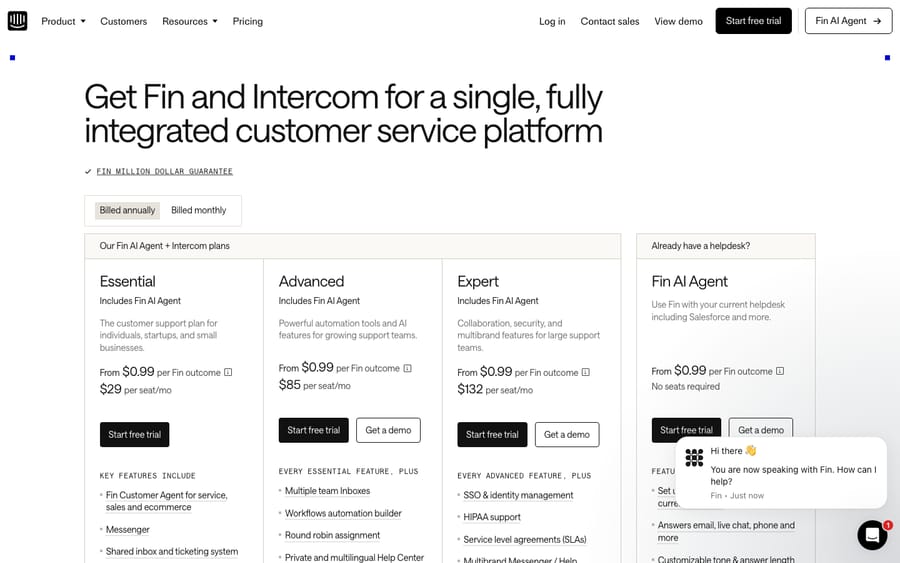
Intercom has three seat-based plans. All three are per full seat, per month, and the pricing page opens on annual billing. Switch the toggle to monthly and the same seats cost $39 (Essential), $99 (Advanced) and $139 (Expert). Some visitors currently see a test price on Essential instead: $19 annual or $29 monthly.
| Plan | Price (annual / monthly billing) | Lite seats included | Best for |
|---|---|---|---|
| Essential | $29 / $39 per seat / month | None | Small teams wanting inbox + Messenger + Fin |
| Advanced | $85 / $99 per seat / month | 20 | Growing teams needing workflows + automation |
| Expert | $132 / $139 per seat / month | 50 | Larger orgs needing SSO, SLAs, multibrand |
A few structural notes before the breakdown:
- There's no permanent free plan. Intercom runs a 14-day free trial, and Fin's trial has unlimited outcomes, but there's no forever-free tier.
- "Lite seats" are not full seats. Advanced and Expert bundle in 20 and 50 Lite seats respectively. These are limited-access seats for occasional collaborators (people who need to read or leave internal notes), not full agent licenses.
- Fin AI is priced separately, on usage. None of the seat prices include Fin outcomes. That's the line item to model carefully.
What does each Intercom plan include?
The jump between tiers isn't "more of the same". Specific, often-needed features are gated to specific plans.
Essential: $29/seat/month
The entry point, and more capable than the price suggests. It's also the one plan Intercom has been price-testing, so take the number off the page rather than from any write-up.
Essential includes the Fin AI agent (you still pay per outcome on top), the Messenger, a shared inbox and ticketing, pre-built reports, and a public help center. For a small team that wants messaging-style support with AI deflection from day one, it's a reasonable starting tier. The catch is that automation and routing are thin here.
Advanced: $85/seat/month
The big step up, and where most growing teams land. Advanced adds the workflows automation builder, multiple team inboxes, round-robin assignment, and a private and multilingual help center, plus the 20 Lite seats. At $85 against $29, Advanced costs almost three times the Essential rate, and much of what unlocks here (assignment rules, real workflow automation) is what many teams consider table stakes. Budget for Advanced if you're past a couple of agents.
Expert: $132/seat/month
The governance-and-scale tier. Expert adds SSO and identity management, HIPAA support, SLAs, and multibrand Messenger and Help Center, plus 50 Lite seats. If you're a smaller team, ask whether you need SSO, SLAs and multibrand. If not, you're paying a $47/seat/month premium over Advanced for governance you may not touch.
How much does Fin AI cost on top of the seats?
Fin is billed per outcome, $0.99 each, on top of your seats. It's the most important number in Intercom's pricing, because for a busy support team the Fin line can rival or pass the entire seat cost. Note the incentive: Intercom earns more as Fin closes more conversations, and it also writes the definition of "closed".
What counts as a billable Fin outcome?
You're charged for one outcome per conversation, however many questions the customer asks or actions Fin takes. The $0.99 outcomes listed on fin.ai/pricing are:
- Resolution: no further help is requested after Fin's last answer. That covers a confirmed resolution (the customer says something like "that helped") and an assumed resolution (the customer leaves after Fin's answer without asking again). Both cost $0.99.
- Procedure handoff: Fin completes a Procedure you've configured that hands off to a human.
- Disqualification: Fin decides a sales prospect doesn't match your criteria.
- Self-serve routing: Fin matches a prospect to a routing outcome marked self-serve.
There's also a higher-priced sales outcome: a Qualification (Fin qualifies a sales lead) is $9.99. That only applies to sales and lead-qualification flows, so most support teams won't hit it.
If Fin can't resolve and passes the conversation to your team without one of those outcomes, you're not charged. That's the fair part of the model: you broadly pay when Fin does the work, not when it punts.
Why do assumed resolutions matter?
If a customer reads Fin's answer and closes the chat, whether because it solved their problem or because they gave up, that can count as a billable resolution. It's a defensible default (most people who don't reply were helped), but it means your Fin bill isn't a clean count of problems solved. Watch resolution-rate reporting in the first month and check it against CSAT before you trust the deflection math.
Is there a minimum or a trial?
Fin has a 14-day free trial with unlimited outcomes and no credit card, which is the cheapest way to get a real read on your resolution rate. The 50-outcome monthly minimum applies when you run Fin on a non-Intercom help desk such as Salesforce or HubSpot, not on an Intercom seat plan.
| Fin outcome | What triggers it | Price |
|---|---|---|
| Resolution | No further help requested after Fin's answer (confirmed or assumed) | $0.99 |
| Procedure handoff | Fin completes a configured handoff to a human | $0.99 |
| Disqualification | Fin rules a sales prospect out | $0.99 |
| Self-serve routing | Fin routes a prospect to a self-serve outcome | $0.99 |
| Qualification | Fin qualifies a sales lead | $9.99 |
| Escalation with no outcome | Fin passes to a human without resolving | Free |
What other add-ons land on an Intercom invoice?
Beyond seats and Fin outcomes, three more line items can show up:
- Copilot (AI for your agents): Intercom's in-inbox helper for human agents drafts, summarizes and surfaces answers. It costs $29/agent/month on annual billing and $35 monthly, per the pricing page. It's per seat, so you can assign it selectively.
- Proactive Support Plus: outbound messages, product tours and proactive campaigns cost $99/month including 500 messages, with usage beyond that billed on top.
- SMS, WhatsApp and phone: all pay-as-you-go per message or minute on top of your plan. Easy to miss if you support over those channels.
The pattern holds throughout: the seat price buys the inbox and Messenger, and nearly everything that makes Intercom AI-driven or omnichannel is metered.
What does a 10-seat team really pay for Intercom?
Sticker math says "10 seats on Advanced is $850/month." Here's a more honest 2026 estimate for a mid-sized team running Fin for real, all on annual billing:
| Line item | Calculation | Monthly | Annual |
|---|---|---|---|
| Advanced seats (10) | 10 × $85 | $850 | $10,200 |
| Copilot (10 agents) | 10 × $29 | $290 | $3,480 |
| Fin resolutions (~1,500/mo) | 1,500 × $0.99 | $1,485 | $17,820 |
| Estimated total | ~$2,625 | ~$31,500 |
The seats are $10,200 a year. With Copilot on every agent and Fin handling about 1,500 resolutions a month, the run-rate is closer to $31,500 a year, roughly triple the seat sticker. Fin is the swing factor: at 500 resolutions a month it's about $495/month, and at 4,000 it's about $3,960/month on its own, more than the seats and Copilot combined.
The lesson isn't that Intercom is overpriced. It's that your Fin volume, not your headcount, drives the bill. Model monthly conversation volume and an honest resolution rate first, then add seats, and remember that assumed resolutions can push the billable count above what you'd call "solved".
What catches Intercom buyers out?
A few things that don't show up in the big price boxes but do show up on the invoice:
- Fin is the real cost. Per-outcome billing means AI spend scales with ticket volume. It's the opposite shape of seat pricing, and it's the line most teams under-budget.
- Assumed resolutions are billable. A customer who leaves without replying can count as a paid resolution. Audit this against CSAT early.
- Lite seats aren't full seats. The 20 and 50 Lite seats on Advanced and Expert are limited-access collaborators. Don't plan headcount around them.
- Essential to Advanced is a big jump. $29 to $85 buys fairly basic automation (workflows, assignment rules), so the practical entry price for a real support setup is Advanced.
- AI for your agents is extra too. Copilot ($29/seat/month annual) is separate from Fin. Wanting both agent-side and customer-side AI means two AI line items on top of seats.
- Annual is the cheaper rate. Monthly billing runs $39, $99 and $139 per seat, and annual locks in your seat count, so don't over-provision.
- Channels and proactive cost extra. SMS, WhatsApp and phone are pay-as-you-go, and Proactive Support Plus starts at $99/month. Map your channels before you commit.
What does the Salesforce acquisition change for Intercom buyers?
On June 15, 2026, Salesforce signed a definitive agreement to acquire the company, which has rebranded from Intercom to "Fin", for approximately $3.6 billion. Salesforce's stated plan is to fold Fin's AI agent into Agentforce, its enterprise agent platform, with Fin as the packaged, fast-to-deploy option next to Agentforce's deeper enterprise build. The deal completed on September 10, 2026.
What it means for buyers, practically:
- Short term, nothing has changed. Plans, seat prices and Fin's $0.99 model are as described above, checked two weeks after the close.
- Medium term, expect alignment with Salesforce. Packaging, pricing and roadmap often shift after an acquisition closes, and Fin's place inside Agentforce could change how it's sold and bundled.
- If you're signing multi-year, build in some flexibility (or a re-evaluation clause) given the new owner.
We go deeper on the AI agent itself (capabilities, resolution quality and limits) in our Fin AI explainer, and we cover the wider market in the best Intercom alternatives.
How does per-ticket AI pricing compare with Fin's per-outcome model?
Teams scrutinize Intercom's pricing because the resolution rate is the variable that controls the bill, and per-outcome billing means cost rises with volume, including assumed resolutions that may not map to problems actually solved. The unit of AI pricing matters here.
An aside on a different model: Macha is an AI agent layer that runs on top of your existing help desk: Zendesk, Freshdesk, Gorgias, Front, Intercom or HubSpot. It isn't a like-for-like swap for Intercom, because it doesn't replace the platform; it runs agents inside it. What's relevant here is the pricing shape: Macha bills per ticket, one conversation charged once however many messages, tags, lookups or drafts it takes, on one plan priced by volume ($299/month up to 750 tickets, $599 up to 1,500, with setup and monitoring by the Macha team included). The bill never hangs on an outcome definition you don't control. Neither model is universally cheaper; they bill for different things. If the per-outcome math worries you, try it on your own desk with $50 of free usage and no credit card. The integration details live on the Macha product page.
Frequently asked questions
How much does Intercom cost per seat? On annual billing, Intercom costs $29 (Essential), $85 (Advanced) and $132 (Expert) per seat per month as of 24 September 2026, or $39, $99 and $139 on monthly billing. Intercom is also testing a lower Essential price, $19 annual ($29 monthly), which some visitors saw on 24 September, so check the page on the day. On top of seats, Fin is billed at $0.99 per outcome, and add-ons like Copilot and Proactive Support Plus cost extra.
What is Intercom's Fin AI pricing? Fin charges $0.99 per outcome, at most once per conversation. Billable outcomes are resolutions, procedure handoffs, disqualifications and self-serve routing ($0.99 each); a sales qualification is $9.99. If Fin escalates to a human without an outcome, you're not charged. The trial runs 14 days with unlimited outcomes, and the 50-outcome monthly minimum applies only when Fin runs on a non-Intercom help desk.
What counts as a Fin "resolution"? A resolution is when no further help is requested after Fin's last answer. That includes a confirmed resolution (the customer says it helped) and an assumed one (the customer leaves without asking again). Both cost $0.99, so the billable count can run higher than the number of problems genuinely solved.
Does Intercom have a free plan? No permanent free plan. Intercom offers a 14-day free trial, and Fin's trial needs no credit card, but there's no forever-free tier.
Is Fin AI included in the seat price? No. Every Intercom seat plan includes access to Fin, but you pay $0.99 per outcome on top of your seats. Fin usage is the line item most teams under-budget.
Is Intercom being acquired by Salesforce? It already has been. Salesforce announced a definitive agreement on June 15, 2026 to acquire the company (now branded "Fin", formerly Intercom) for about $3.6 billion, with Fin folding into Agentforce, and completed the acquisition on September 10, 2026. Seat and Fin pricing hadn't changed as of 24 September 2026.
Is Intercom worth the price?
It depends on your Fin volume more than on the seat tier. The seat tiers, Essential ($29), Advanced ($85) and Expert ($132) per seat per month annually, are only the floor. The budgeting work is in Fin's $0.99-per-outcome model, which scales with ticket volume rather than headcount and can quietly become your largest line item: our 10-seat example turns an "$850/month" plan into a ~$2,625/month run-rate once Fin and Copilot are on. Add assumed resolutions, the Lite-seat caveat, metered channels and Salesforce's ownership, and the advice is the same as for any usage-priced tool: model conversation volume and resolution rate before seats, run the 14-day Fin trial to get real numbers, and you'll land close to your actual invoice.
Pricing checked against intercom.com/pricing and fin.ai/pricing on 24 September 2026. Intercom revises pricing periodically and is running a price test on Essential, so confirm exact numbers in a quote before you commit. Acquisition details per Salesforce's June 15, 2026 newsroom announcement.
Add AI agents to your Intercom
Macha reads the conversation, drafts the reply and takes the action, inside the Intercom you already run.