Intercom
 Shopify
 Stripe
 Slack
Slack Notion
 Google Workspace
 Confluence

CoSupport AI: The Complete Guide (2026)


If you're evaluating AI agents for customer support in 2026, CoSupport AI (the product at cosupport.ai) tends to stand out for two reasons: it claims to hold a US patent on its message-generation architecture, and it pitches an unusual, flexible pricing model — including a flat monthly fee for unlimited AI replies. It's part of the wave of generative-AI platforms that sit on top of your existing helpdesk and automate repetitive tickets. But the marketing is confident, the pricing is more layered than it first appears, and the review base is small — which leaves the usual questions open: what is CoSupport AI, what does it really cost, and is it right for your team?
Key takeaways
- CoSupport AI, founded in 2020 in Los Angeles, bundles three tools: an autonomous AI Agent called CoSupport Customer, an agent-assist copilot called CoSupport Agent, and a natural-language analytics layer called CoSupport BI.
- CoSupport AI markets up to 90% autonomous resolution at 99% accuracy, and backs a 60% ticket-reduction claim with a refund if the AI misses 60% resolution by day 60 of a 30-day pilot.
- CoSupport AI holds US patent US11823031B1, granted in January 2024, covering a multi-model message-generation architecture the company markets as reducing hallucinations.
- CoSupport AI plans are advertised from $99 a month across three billing models, fixed-price unlimited, pay-per-resolution, and pay-per-response, plus a one-time setup fee.
- One CoSupport AI case study reports a US personalized-goods marketplace handling about 16,000 monthly inquiries with a 21-agent team, auto-resolving roughly 75% of inquiries and saving about $7,000 a month.

This is our honest, researched attempt at that answer. We'll cover what CoSupport AI does, how its three tools work, what's behind the patent claim, what it actually costs, where it's strong, where it isn't, and how it compares to the alternatives. Full disclosure: we build an AI support product ourselves (Macha) — so we'll be upfront about that. The goal here is a genuine guide to CoSupport AI, not a pitch, and where we can't verify a claim, we say so.
What is CoSupport AI?
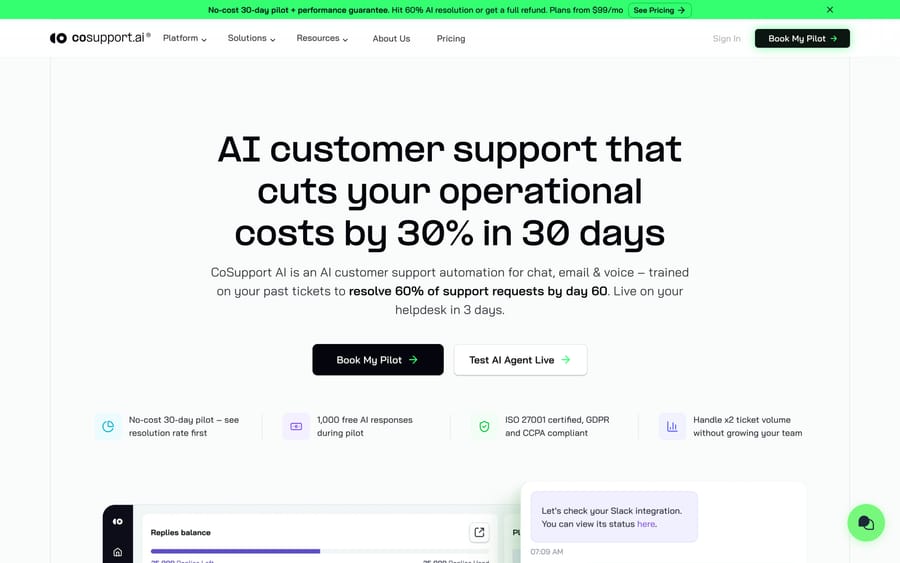
CoSupport AI's homepage, positioning it as AI for customer support teams.
CoSupport AI is a generative-AI customer support platform trained on your past tickets and knowledge. It was founded in 2020 in Los Angeles by Roman Lutsyshyn (an ML engineer) and Daria Leshchenko (a support entrepreneur) (eesel AI). Its core promise is cutting operational costs by automating repetitive tickets while keeping answers grounded in your data — the company frames the win as savings and speed, not just deflection.
Unlike single-bot products, CoSupport AI is really three tools in one: an autonomous AI Agent (branded "CoSupport Customer"), an agent-assist AI Assistant copilot (branded "CoSupport Agent"), and an AI Business Intelligence layer, CoSupport BI, that turns support and company data into insights (cosupport.ai). The naming is worth untangling up front, because "Agent" in CoSupport's world means the human-facing copilot, while "Customer" means the autonomous bot — the reverse of what you might expect. Architecturally the whole suite sits in the same category as Macha, Intercom Fin, and Decagon: an AI layer that connects to the helpdesk you already run rather than a helpdesk replacement. It integrates natively with Zendesk, Freshdesk, Zoho Desk, Intercom, and Salesforce, plus custom tools via API, and supports omnichannel chat, email, and social in 40+ languages (cosupport.ai). The vendor markets a fast, largely hands-off rollout — it claims you can be live in under 10 minutes once your data is connected (Product Hunt), though "10 minutes" is best read as the technical hook-up, not the tuning and QA a production launch really needs.
How CoSupport AI works
CoSupport's model is knowledge-first: you connect it to your helpdesk and knowledge sources, it learns from your historical tickets, macros, and documentation, and then it drives one or more of the three products below. Because all three share the same trained model of your business, teams commonly start with the copilot, prove out reply quality, and then graduate the same knowledge base into autonomous resolution — a sensible crawl-walk-run path rather than an all-or-nothing switch.
CoSupport Customer (AI Agent) — autonomous resolution
The AI Agent is the fully autonomous piece: it resolves customer inquiries end to end across chat, email, and social, grounded in your historical tickets and knowledge. CoSupport markets it as resolving up to 90% of inquiries at 99% response accuracy (cosupport.ai) — figures we'd treat as vendor-reported (more on that below). In practice, autonomous resolution shines on high-volume, repetitive intents — order status, returns, "where is my refund," account and policy questions — and the platform is designed to hand off cleanly to a human when confidence drops or the customer asks for one.
CoSupport Agent (AI Assistant) — a copilot for agents
The AI Assistant generates ready-to-use reply suggestions inside your agents' workflow, drafting a full response the human can accept, tweak, or discard. CoSupport says it cuts ticket handling time by up to 80% (cosupport.ai). This agent-assist mode is a lower-risk entry point for teams not ready to hand full conversations to automation: a human still owns every send, so the blast radius of a bad suggestion is a single edit rather than a customer-facing mistake. It's also the natural place to build trust in reply quality before flipping intents over to the autonomous agent.
CoSupport BI — natural-language analytics
The third tool, CoSupport BI, is a natural-language analytics assistant: you ask plain-English questions about your support and company data — "why did tickets spike last week?", "which product drives the most refunds?" — and get answers, trends, and predictions back, delivered inside Slack or Microsoft Teams (cosupport.ai/cosupport-bi). This is a genuine differentiator. Most AI-agent vendors stop at deflection and leave analytics to the helpdesk's native dashboards; CoSupport turns the conversation corpus into a queryable business-intelligence layer that non-analysts can actually use. Whether it replaces a dedicated BI stack is a separate question — treat it as a conversational insights layer over your support data, not a full data-warehouse replacement.
The patented architecture
CoSupport's headline technical claim is a US patent (US11823031B1), granted in January 2024, covering a multi-model message-generation architecture the company says reduces hallucinations and keeps responses brand-consistent (eesel AI). Rather than piping every query through one general-purpose LLM, the patented approach orchestrates multiple models and a retrieval step so that answers stay tethered to your source data — the mechanism behind CoSupport's "AI that doesn't hallucinate" positioning (Product Hunt). The patent is real and is a legitimate marketing point — though, as always, a patent describes a specific method, not a guarantee of superior real-world accuracy, and "reduces hallucinations" is not the same as "eliminates" them. The practical way to judge the claim is a pilot on your own ticket data.
Actions and custom tools
CoSupport connects to your helpdesk and can extend into your own systems via custom API integrations (cosupport.ai). This matters because the difference between a smart FAQ bot and a true agent is whether it can do things — look up an order in your OMS, check a subscription in your billing system, issue a refund — not just describe them. CoSupport's custom-integration path is where that wiring happens, though (as with most vendors in this space) the deeper the action, the more it leans on scoped, quote-led implementation work rather than a self-serve toggle. If you want the mechanics of wiring an agent up to your backend to take real actions, our guide to custom tools for AI agents walks through the pattern.
The vendor's performance claims
CoSupport markets aggressively on outcomes: up to 90% autonomous resolution, 99% accuracy, a 60% reduction in ticket volume within 60 days, and up to 80% faster handling (cosupport.ai). Treat all of these as vendor-reported figures, not independently audited benchmarks. What lends them some weight is that CoSupport backs the 60% claim commercially — it advertises a no-cost 30-day pilot and a full refund if the AI doesn't reach 60% resolution by day 60 (eesel AI). A money-back guarantee tied to a specific number is a stronger signal than a marketing stat alone, and it's a smart way to de-risk the buy. Still, real results depend on your ticket mix, knowledge quality, and how much you actually automate — the guarantee lowers the downside, it doesn't set your ceiling.
Who uses CoSupport AI — customers and verticals
CoSupport's published case studies skew toward mid-market ecommerce, SaaS, and services teams — the kind of operations with high, repetitive ticket volume where automation pays back fast. A few concrete examples from its customer page (cosupport.ai/customers):
- A US personalized-goods marketplace (~16,000 monthly inquiries, a 21-agent team) reportedly auto-resolves ~75% of inquiries and saves roughly $7,000/month (ecommerce case study).
- eCatering uses CoSupport to handle around 50% of repetitive email queries — product questions, order tracking — wired directly into Freshdesk.
- ProjectFitter reportedly automated 70% of support requests across Freshdesk and Freshchat within a month.
- Hour Timesheet automated over 50% of incoming chats and cut resolution time by around 70%.
- Cocoatech automates roughly 81% of tickets, freeing agents for complex cases.
These are vendor-published outcomes, so read them as directional rather than audited — but the pattern is informative. CoSupport lands best where a large share of volume is repetitive and answerable from existing knowledge (Freshdesk shows up repeatedly in its stories). If your ticket mix is dominated by novel, judgment-heavy, or account-specific issues, expect a lower autonomous-resolution ceiling than the marketing figures suggest.
Data, privacy, and deployment
CoSupport positions itself for teams that care about answer grounding and data handling: the patented multi-model architecture is pitched partly as a data-security and accuracy measure (keeping generation tethered to your content rather than free-associating), and the platform trains on your tickets and knowledge rather than serving a generic model (cosupport.ai). Deployment is SaaS, connected to your helpdesk via native integration or API, with the vendor advertising a fast initial hookup (Product Hunt).
One honest gap: at the time of writing we couldn't independently verify CoSupport's formal compliance posture (e.g., published SOC 2 Type II or GDPR/DPA documentation) from public sources. That's not a red flag on its own — many vendors gate compliance artifacts behind an NDA — but if you're in a regulated vertical or handle sensitive PII, make SOC 2 status, data-residency options, sub-processor lists, and a signed DPA explicit requirements in your evaluation and get them in writing before a pilot goes to production.
CoSupport AI pricing (2026)
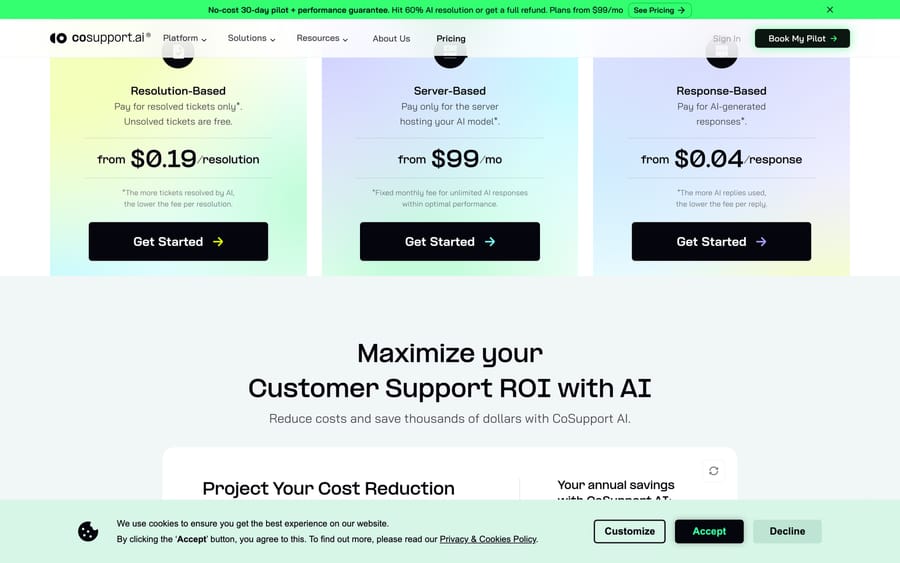
CoSupport AI's pricing page, advertising plans "from $99/month" — the real, per-volume numbers are quote-gated behind a demo.
Here's where you need to read carefully, because CoSupport's pricing is more layered than the headline suggests. Plans are advertised "from $99/month," but that number sits on top of three different billing models plus a one-time setup/integration fee, and the real quotes are gated behind a demo (eesel AI).
The three models CoSupport offers are:
| Model | How it works | Best for |
|---|---|---|
| Fixed price / unlimited replies | Flat monthly fee, unlimited AI responses | Teams that want full cost control and predictability |
| Pay per resolution | Charged per resolved inquiry | Lower-volume or seasonal teams |
| Pay per response | Charged per AI reply | Teams testing before committing |
A few honest caveats, all as of 2026 (pricing here moves fast — confirm current numbers with CoSupport). First, there's typically a one-time fee for solution integration into your CRM and project launch, after which you pay the recurring model you chose (cosupport.ai/pricing). Second, the real numbers are quote-gated — the "$99/mo" headline aside, you'll need a demo to get an actual price for your volume (eesel AI). Third, at any meaningful ticket volume the per-unit models add up quickly, so the flat, server-based "unlimited" plan often looks cheapest on paper — a genuine advantage of CoSupport's model for high-volume teams, provided the flat quote is reasonable. To CoSupport's credit, offering a truly unlimited flat option is rare in a category dominated by per-resolution metering.
How to think about the pricing model
The three billing models map cleanly to three buyer situations, and picking the right one is most of the negotiation:
- Fixed/unlimited rewards predictability and scale. If you have high, steady volume, a flat fee turns a variable cost into a line item you can budget, and your effective per-ticket cost falls as volume rises. The risk is over-paying in a slow season.
- Pay-per-resolution rewards outcomes. You only pay when the AI actually closes an inquiry, which aligns cost with value — attractive for seasonal or lower-volume teams, but the per-unit rate can bite at scale.
- Pay-per-response is the lowest-commitment on-ramp — good for a cautious pilot, but the least efficient once you're automating at volume, since you pay for every reply whether or not it resolves anything.
The savvy move is to model your annual cost under all three at your real volume, then let the guarantee (no-cost 30-day pilot, refund if you miss 60% by day 60) de-risk the commitment. Also budget the one-time setup fee into year-one total cost of ownership — it's easy to anchor on the monthly and forget the upfront. The honest headline for buyers: CoSupport's pricing is flexible and can be genuinely cheap at scale, but it is not transparent — you cannot price yourself without a sales conversation.
Pros and cons
Pros
- Flexible pricing, including flat "unlimited" — the unlimited-replies model is a rare, budget-friendly option for high-volume teams and removes per-ticket anxiety.
- Three tools in one — autonomous agent, agent copilot, and business intelligence, so you can grow from assist into automation and get analytics along the way.
- Patented architecture (US11823031B1) — a real, granted patent the company markets as a hallucination-reducing differentiator (a positioning claim to validate on your own data, not an audited benchmark).
- Strong, if small, review base — 4.9/5 on G2 and 5.0 on Capterra, with praise for fast integration and quality replies (G2).
- Broad integrations and languages — Zendesk, Freshdesk, Intercom, Salesforce, Zoho, custom API; 40+ languages.
Cons
- Opaque pricing — the "$99/mo" headline hides three billing models plus a setup fee, and real numbers require a demo (eesel AI).
- One-time setup/integration fee — a real upfront cost and integration dependency to factor in.
- Thin review base — glowing but small (~13 G2, ~10 Capterra), so the sample is limited.
- Vendor-reported performance claims — the 90% resolution and 99% accuracy figures aren't independently audited.
- Patent ≠ guaranteed accuracy — the patented architecture is a method, not proof of real-world superiority; validate on your own data.
Who CoSupport AI is best for
CoSupport AI is a strong candidate if you're a mid-to-high-volume support team that wants predictable, flat-fee AI rather than per-ticket metering, values a bundled business-intelligence layer, and runs a helpdesk it supports (Zendesk, Freshdesk, Intercom, Salesforce, Zoho). The flat unlimited model is especially attractive if your volume is large enough that per-resolution pricing would sting.
It's a weaker fit if you want fully transparent, self-serve pricing you can evaluate without a sales call, or if you need to start small with zero setup commitment — the integration fee and demo-gated quotes add friction up front.
CoSupport AI vs alternatives (including Macha)
| CoSupport AI | Macha | Intercom Fin | eesel AI | |
|---|---|---|---|---|
| Model | AI layer on your helpdesk | AI agent layer on your helpdesk | AI agent (native to Intercom) | AI layer on your helpdesk |
| Helpdesks | Zendesk, Freshdesk, Zoho Desk, Intercom, Salesforce | Zendesk, Freshdesk, Front, Intercom, Gorgias | Intercom (best), plus others | Zendesk, Freshdesk, Intercom, Gorgias + more |
| Pricing unit | Fixed/unlimited, per-resolution, or per-response (+ setup fee) | Per ticket (from $299/mo for 750 tickets, ~$0.40/ticket) | Per resolution (~$0.99) | Tiered subscription (interaction-based) |
| Build agents | Trained on your tickets; demo-led setup | Plain-English agent builder | Content + workflow builder | Trained on tickets/docs; self-serve |
| Autonomous + copilot | Both (Customer + Agent) | Both | Both | Both |
| Extras | Bundled AI BI (Slack/Teams NL analytics), patented architecture | Custom tools, multi-agent orchestration | Deep Intercom ecosystem | Prompt/simulation testing |
| Setup | One-time integration fee; fast hookup | Self-serve | Self-serve | Self-serve |
| Pricing transparency | Demo-gated | Public | Public | Public |
A few honest reads of that table. CoSupport's edge is the bundled BI layer and the flat "unlimited" option — nobody else here gives you conversational analytics in Slack/Teams alongside the agent, and few offer a truly uncapped flat fee. Fin's edge is depth inside Intercom; if you already live there, it's the incumbent to beat. eesel's edge is self-serve setup and testing tooling for teams that want to move fast without a sales call.
Where Macha differs: we're also an AI agent layer that runs on top of the helpdesk you already use, but we let you build agents in plain English — describe what the agent should do and it does it — and we publish transparent, per-ticket pricing (one charge per thread, from $299/month for 750 tickets) rather than gating quotes behind a demo. We won't claim Macha ships CoSupport's bundled BI or its patented architecture; the honest framing is fit, by use case:
- Choose CoSupport if you're a high-volume team drawn to a flat "unlimited" price, you want a bundled business-intelligence layer, and you're comfortable running a demo-led, setup-fee onboarding.
- Choose Macha if you want a transparent, self-serve AI agent for customer service that plugs into Zendesk, Freshdesk, Front, Intercom, or Gorgias, is built and adjusted in plain English, takes real actions via custom tools, and prices by the ticket with no demo gate — see our pricing.
- Choose Fin if you're already all-in on Intercom and want the deepest native fit.
- Choose eesel if self-serve speed and simulation testing matter more to you than a bundled BI layer.
None of these is strictly "better" — they're tuned to different buyers. The right call depends on your helpdesk, your volume, how much you value transparent pricing, and whether analytics is a must-have.
How we researched this
The plans, the setup fee and the architecture claims in this guide come from CoSupport AI’s own pricing, product and patent pages and its published case studies, read when the post was written; those are the figures quoted here. On September 21, 2026 we re-checked the internal links in this post and added the comparisons above, and we did not re-price the plans on that pass. CoSupport is demo-gated, so we have not run it ourselves, and G2 turned away every request we made that day, which is why there is no third-party review score here rather than an estimated one.
Frequently asked questions
What is CoSupport AI? CoSupport AI (cosupport.ai) is a generative-AI customer support platform founded in 2020 in Los Angeles. It bundles three tools — an autonomous AI Agent, an agent-assist AI Assistant, and an AI Business Intelligence layer — and installs on top of helpdesks like Zendesk, Freshdesk, Intercom, Salesforce, and Zoho.
How much does CoSupport AI cost? Plans are advertised from $99/month, but that headline sits over three billing models — fixed/unlimited, pay-per-resolution, and pay-per-response — plus a one-time setup fee, and real quotes are gated behind a demo. Confirm current pricing with CoSupport.
Is CoSupport AI really patented? Yes. CoSupport holds US patent US11823031B1 (granted January 2024) covering a multi-model message-generation architecture the company markets as reducing hallucinations. The patent is real, though it describes a method rather than guaranteeing real-world accuracy.
How accurate is CoSupport AI? CoSupport claims up to 90% autonomous resolution at 99% accuracy. These are vendor-reported figures; validate them with a pilot on your own ticket data. CoSupport does back the outcome commercially — it advertises a no-cost 30-day pilot and a full refund if the AI doesn't reach 60% resolution by day 60 — which is a stronger signal than a marketing stat alone.
What's the difference between CoSupport Customer, CoSupport Agent, and CoSupport BI? CoSupport Customer is the autonomous AI Agent that resolves tickets end to end. CoSupport Agent is the AI Assistant copilot that drafts reply suggestions for human agents. CoSupport BI is a natural-language analytics assistant that answers plain-English questions about your support and company data inside Slack or Microsoft Teams. Note the naming quirk: "Agent" is the human copilot, "Customer" is the bot.
Which helpdesks does CoSupport AI integrate with? Native integrations include Zendesk, Freshdesk, Zoho Desk, Intercom, and Salesforce, with additional systems supported through a custom API. It handles chat, email, and social across 40+ languages.
How long does CoSupport AI take to deploy? CoSupport advertises going live in under 10 minutes once your data is connected. Treat that as the technical hookup; a production launch still needs knowledge-base cleanup, intent scoping, and QA before you route real customers to the autonomous agent.
Is CoSupport AI SOC 2 or GDPR compliant? CoSupport positions its patented architecture partly as a data-security measure, but we couldn't independently verify a published SOC 2 Type II report or GDPR/DPA documentation from public sources at the time of writing. If you're in a regulated vertical, make compliance artifacts, data residency, and a signed DPA explicit requirements and get them in writing before going to production.
What are the best CoSupport AI alternatives? Common alternatives include Macha (plain-English AI agents on your existing helpdesk, transparent per-ticket pricing), Intercom Fin (best if you're on Intercom), and eesel AI (self-serve setup with simulation testing). The right pick depends on your helpdesk, volume, and how you prefer to be billed.
Prefer an AI agent that runs on the helpdesk you already use, is built in plain English, and publishes transparent per-ticket pricing with no demo gate? See how Macha compares — explore Macha's pricing or read our overview of AI agents for customer service.
Resolve tickets automatically with AI agents
Macha's AI agents work on top of the help desk you already use — no code.