Intercom
 Shopify
 Stripe
 Slack
Slack Notion
 Google Workspace
 Confluence

Intercom Fin AI Agent (2026): What It Costs, How It Works and Who It Fits


Intercom Fin is an AI customer-service agent that resolves questions from your help content and charges $0.99 per outcome, once per conversation. Here is how it works, what counts as a billable resolution, where it runs, and where the per-outcome model gets expensive.
Key takeaways
- Intercom Fin charges $0.99 per outcome, billed once per conversation, and offers a 14-day free trial with unlimited outcomes and no credit card required.
- Running Fin on a help desk other than Intercom costs a $49 per month base plan that includes 50 resolutions, with each additional outcome billed at $0.99.
- Fin reports a 76% average resolution rate across 12,000+ customers, a vendor claim that Salesforce repeated when it completed the acquisition on September 10, 2026.
- Fin counts an assumed resolution when a customer leaves without asking for more help or goes quiet for 24 hours, which is why critics dispute its billing.
- Intercom help desk seats cost $29, $85 or $132 a month on annual billing, and Fin's per-outcome charges sit on top of those seat fees.

Intercom Fin is an AI customer-service agent that answers and resolves customer questions from your own help content, and it costs $0.99 per outcome, billed once per conversation (fin.ai/pricing, checked 24 September 2026). On a help desk other than Intercom there's a $49/month base plan that includes 50 resolutions, and every setup gets a 14-day free trial with no credit card.
| Question | Answer (24 September 2026) |
|---|---|
| Price | $0.99 per outcome (resolution or Procedure handoff) |
| Billing unit | Once per conversation, however many questions Fin answers |
| Base plan off Intercom | $49/month including 50 resolutions |
| Intercom seats (if you use its help desk) | Essential $29, Advanced $85, Expert $132 per seat/month, annual |
| Channels | Chat, email, phone (Fin Voice), WhatsApp, SMS, social, Slack |
| Help desks | Intercom, Zendesk, Salesforce, HubSpot, Freshworks and others |
| Trial | 14 days, unlimited outcomes, no credit card |
| Owner | Salesforce, since September 10, 2026 |
We sell an AI agent ourselves (Macha, more on that near the end), so treat this as a guide written by people who watch this market closely, not a neutral encyclopedia and not a Fin advertisement. Where Fin is strong, we'll say so plainly; where it has real watch-outs, we'll name them.
Update, September 2026: On June 15, 2026, Salesforce signed a definitive agreement to acquire Fin (the company formerly known as Intercom) for ~$3.6 billion. Salesforce completed the acquisition on September 10, 2026, and Fin joins Salesforce while continuing to serve its existing customers. The $0.99 price and the 14-day trial were unchanged on fin.ai two weeks after the close, but factor the change of ownership into any long-term decision. Sources: Salesforce press release · TechCrunch · Salesforce, completion.
What is Intercom Fin?
Fin is Intercom's AI agent for customer service: software that reads a customer's question, finds the answer in your content, and replies in a human-like way to resolve the issue without a human agent. Intercom positions it as the front line of support. Fin answers first, and only the conversations it can't handle reach your team.
One naming note before we go further: the company rebranded from Intercom to Fin on May 12, 2026, so "Fin" is now both the product and the company name, while "Intercom" stays as the name of its help desk software. We keep saying "Intercom Fin" throughout this guide because that's how most people still search for it.
Under the hood, Fin runs on what Intercom calls the Fin AI Engine: a pipeline of custom models (query refinement, retrieval, reranking, answer generation, and a validation step meant to curb hallucinations). Fin now brands its own models as Apex 1.0 and Apex Flash, trained on customer-service conversations (fin.ai). The practical takeaway: Fin isn't a thin wrapper around a chatbot. It's a retrieval-augmented system built to answer from your knowledge rather than the open internet.
Fin says it averages a 76% resolution rate across 12,000+ customers and handles about 2 million resolutions a week (fin.ai, 24 September 2026). Salesforce's completion announcement uses the same 76% average. Those are the vendor's own numbers, so weigh them as marketing claims rather than independent benchmarks, but the scale is real and Fin is one of the most widely deployed AI agents on the market.

How does Fin work?
Fin's core loop is simple to describe and harder to do well: ingest your content, retrieve the right passage for each question, generate a grounded answer, and escalate when it isn't confident.
It answers from your content. Fin pulls from Help Center articles, internal support docs, PDFs, webpages, and short text "snippets" you write for it, then uses retrieval-augmented generation to ground its replies in those sources (Intercom Help). This is the single biggest factor in how good Fin is for you: thin or stale documentation produces a thin, stale agent.
It works across channels. Fin isn't chat-only. It runs over live chat (Messenger, WhatsApp, SMS, social), email (with spam and phishing filtering), and phone via Fin Voice, plus internal channels like Slack and Discord. It's multilingual with real-time translation (fin.ai says "dozens of languages"), and Fin Vision lets it interpret images like screenshots and invoices (Intercom Help).
It does more than answer, through Procedures and Actions. Beyond Q&A, Fin can run multi-step workflows. Procedures (what Intercom used to call "Fin Tasks") are natural-language instructions that let Fin follow business rules, call APIs and data connectors, and take actions like updating an order or tagging a ticket. Actions connect Fin to your backend systems so it can fetch order status, process a return, or look up account data mid-conversation. That's the difference between "here's the help article" and "done, your return is processed."
It hands off when it should. Fin is designed to escalate to a human when that's the safest option, and you can configure escalation rules. Conversations that escalate under your escalation rules aren't billed (more below).
Fin beyond Intercom's help desk. Fin doesn't require Intercom's help desk. Through "Fin for platforms," it runs on Salesforce (Service Cloud), HubSpot and Freshworks (Freshdesk/Freshchat), and there's a dedicated Fin for Zendesk integration that covers Zendesk Messenger and Zendesk tickets (fin.ai Help: Fin for Zendesk). Fin's pricing page now also names Dixa, Front, Zoho, Sprinklr and Gorgias among supported help desks (fin.ai/pricing). The 14-day trial applies there too, and fin.ai says setup takes "less than an hour" on any help desk. Earlier versions of this guide said non-Intercom deployments were sales-only; fin.ai no longer presents it that way, though larger contracts still go through sales.
What can Fin do?
- Grounded answers from Help Center, docs, PDFs, webpages and snippets (RAG with a validation step).
- Omnichannel: chat, email, phone/voice (Fin Voice), WhatsApp, SMS, social, Slack/Discord.
- Procedures for multi-step, rule-bound workflows (formerly "Tasks").
- Actions / data connectors to read and write to your backend systems.
- Fin Vision for image understanding; multilingual replies with translation.
- Testing tools: simulations, batch testing and answer inspection before you go live.
- Runs on your existing help desk: Intercom natively; Salesforce, HubSpot and Freshworks via "Fin for platforms"; a dedicated Fin for Zendesk integration; and others listed on fin.ai.
How much does Intercom Fin cost?
Fin charges $0.99 per outcome. Per fin.ai/pricing and Fin pricing: Outcomes (both checked 24 September 2026), the support outcomes are:
| Billable outcome | Price | What it means |
|---|---|---|
| Resolution | $0.99 | Fin answered and the customer confirmed it helped, or left without asking for more help |
| Procedure handoff | $0.99 | Fin completes a Procedure configured to end in a handoff to a human or a workflow |
| Minimum | 50 outcomes/month | Applies when Fin runs on a non-Intercom help desk |
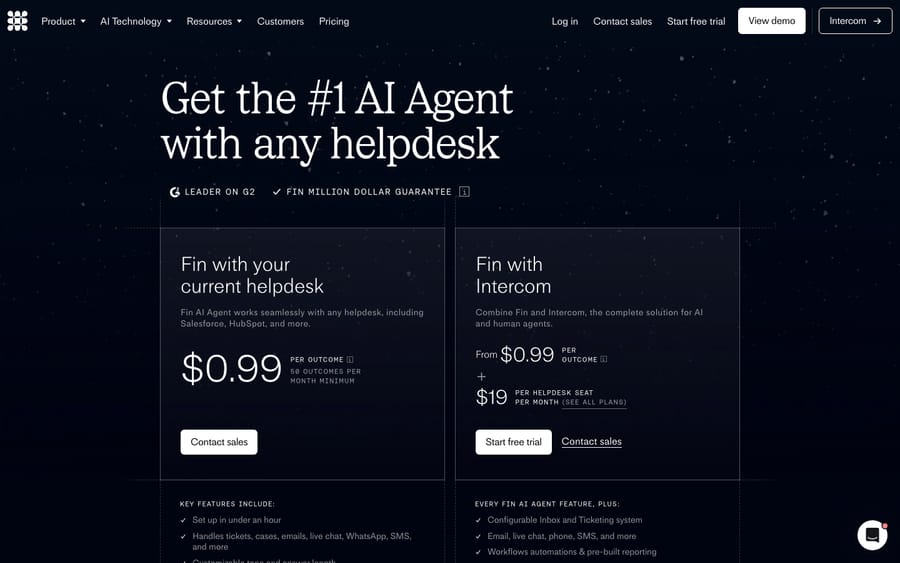
There's a $49/month base plan. For Fin on a non-Intercom help desk, Fin documents a $49/month base fee that includes 50 resolutions, with each additional outcome at $0.99 (Fin pricing: Outcomes). So 100 resolutions in a month works out to $49 (first 50) + $49.50 (next 50) = $98.50. That base plan is the practical floor most standalone buyers hit before the per-outcome charges stack up.
A note on "qualification" and "disqualification." You'll see those listed as outcomes too. Qualification ($9.99) and disqualification are Fin for Sales outcomes, not support resolutions. They apply when Fin scores sales prospects, and Fin states that Fin for Sales is currently not available with Fin for platforms outside Intercom (Fin pricing: Outcomes). If you're buying Fin for customer support, the numbers that matter are the $0.99 resolution and the $49 base.
The 14-day free trial includes unlimited Fin outcomes and needs no credit card, so you can pressure-test Fin on real traffic before committing (fin.ai/pricing).
What's free vs. charged. You're billed once per conversation even if Fin answers several questions or runs several Procedures. You are not charged when a conversation escalates under your guidance or escalation rules, when a Procedure fails, or when Fin only asks a clarifying question that gets no reply (Fin pricing: Outcomes). That structure is customer-friendly in places, though a Procedure you configured to end in a handoff does bill at $0.99.
If you also use Intercom's help desk, Fin's per-outcome charge sits on top of seat fees. On annual billing, seats run Essential $29, Advanced $85 and Expert $132 per seat a month; Essential has moved between $19 and $29 during a pricing test, so read it off the page. Add-ons include Copilot ($29 per agent a month annual, $35 monthly) and Pro ($99 a month, covering analysis of 1,000 conversations) (Intercom pricing). On a non-Intercom help desk you pay the outcome charges without Intercom seats.
What counts as a resolution, and why is it debated?
This is where Fin gets contentious, and it's worth understanding before you sign anything. A resolution is counted two ways (Fin pricing: Outcomes):
- Confirmed resolution: the customer affirms the answer helped ("yes," "thanks," etc.).
- Assumed resolution: the customer exits without asking for more help, or goes quiet for 24 hours after Fin's last reply.
The assumed-resolution case is the lightning rod. A customer leaving isn't the same as a customer being helped; people abandon chats because they got distracted, gave up, or found the answer elsewhere. Critics (and a fair number of Reddit threads) argue you can be billed for "resolutions" that didn't resolve anything (aimdoc, Gleap). Intercom's counter is that confirmed-plus-assumed is the standard way to measure deflection at scale, and that the carve-outs prevent the worst over-billing. Both points are fair. The incentive is plain, though: the vendor defines the outcome and earns on every one it counts.
How predictable is Fin's cost at scale?
The deeper issue isn't the $0.99. It's that the bill scales with how much customers use Fin, not with anything you directly control. That's fine when volume is low and painful when it spikes. Third-party roundups and community posts cite bills jumping from roughly $119 to $854/month, one team reporting $4,000 climbing to $9,000/month, and another projecting $1,200 to $10,000/month at scale (myaskai, Gleap). Treat those as anecdotal community reports, not audited figures, but the pattern is intuitive: the more successful your deployment, the bigger the invoice. Do the math at your projected volume. At 2,000 resolutions a month, Fin's resolution charges alone are about $1,980, before seats.
What do real users say about Fin?
We aren't an Intercom customer, so here's the third-party signal instead. Fin by Intercom holds a 4.5/5 rating on G2 across roughly 3,900 reviews (as reported in August 2026) and is listed as G2's top AI Agent by review volume (G2). Sentiment is strong on capability and setup, and the recurring complaint is, predictably, pricing.
A representative example: a Verified User in Financial Services at a mid-market company (51–1,000 employees), reviewing on G2 (May 2025), praised Fin's "seamless setup within the Intercom inbox and its ability to surface accurate, conversational answers from our existing help center — dramatically reducing average first-response times and agent load," while flagging that "higher-tier pricing may be a barrier for smaller teams" (G2). Love the product, watch the bill: that split is the most common pattern in Fin's public reviews.
What are Fin's strengths?
- Capable. Fin is one of the most mature AI agents available: strong RAG, multi-channel (including voice), real workflow automation via Procedures and Actions, and Vision.
- Mostly aligned pricing. Pay-per-outcome means if Fin doesn't resolve, you broadly don't pay, and escalations under your rules aren't billed. For low-to-moderate volume, that's a clean, low-risk way to start.
- Help desk-agnostic. Between Fin for platforms and the dedicated Fin for Zendesk integration, you don't have to rip out your existing help desk to use it.
- Fast to stand up. fin.ai claims setup in less than an hour, and the 14-day unlimited trial lets you validate on live traffic with no card.
- Scale. 12,000+ customers and about 2 million resolutions a week (vendor-reported) signal a heavily used product.
What are Fin's limitations?
- Cost unpredictability at scale. Success raises your bill, and forecasting at high volume is hard. Heavy-volume teams often find a flat or per-ticket model cheaper and steadier.
- The resolution-definition dispute. Assumed resolutions mean you can pay for conversations that weren't truly resolved. Audit your assumed-vs-confirmed mix.
- Only as good as your content. Sparse, outdated or contradictory documentation produces weak answers. Budget real effort for knowledge upkeep.
- Minimums off Intercom. On another help desk you pay the $49 base with its 50 included resolutions whether or not Fin uses them.
- Stacked costs on Intercom. If you run Intercom's help desk too, seats plus outcomes plus add-ons (Copilot, Pro) add up quickly.
- Roadmap and ownership uncertainty. With Salesforce's completed acquisition, Fin's long-term roadmap and its relationship to Salesforce's own Agentforce aren't settled. For multi-year decisions, weigh that alongside today's product.
Who is Fin best for?
Fin is a strong fit if you want a mature, multi-channel AI agent with public, outcome-based pricing and you have (or will build) solid help content. It's especially attractive for teams already on Intercom, for those who value paying only when the agent resolves, and for low-to-moderate volumes where the per-resolution math stays comfortable. It's a tougher fit if you have very high volume (predictability suffers) or thin content.
What are the alternatives to Fin?
Fin is the category benchmark, but it isn't the only option. Worth evaluating:
- Zendesk AI agents: native if you're on Zendesk, tightly integrated but priced and architected differently. See our Zendesk vs. Intercom breakdown.
- Decagon, Ada, Sierra: enterprise AI agents competing directly with Fin, generally quote-only.
- Macha: an AI agent layer that runs on top of the help desk you already have: Zendesk, Freshdesk, Gorgias, Front, HubSpot or Intercom (more below).
- For a broader, hands-on roundup of options that sit alongside Zendesk, see our guide to the best AI Zendesk alternatives.
Where does Macha fit, and how does its pricing compare?
Full disclosure, this is our product. Macha is an AI agent layer that runs on top of the help desk you already have. It isn't a help desk and it isn't trying to replace yours. Like Fin, it reads the customer's question, answers from your connected knowledge and past tickets, takes actions, and escalates to a human with full context when it isn't confident. You can see how Macha works on Zendesk.
The fairest contrast is the pricing model, not the feature list. Fin bills per outcome: you pay when a conversation is deemed resolved (including assumed resolutions). Macha bills per ticket: one plan priced on ticket volume, from $299/month for up to 750 tickets, charged once per ticket whether the agent drafts a reply, tags, routes or resolves, with setup and monitoring by the Macha team included. Most automation isn't a tidy "resolution"; it's work done along the way. Neither model is universally better. Per-resolution can be cheaper at low volume, and only paying on success is reassuring; per-ticket tends to be more predictable as volume grows and pays for automation that isn't a clean deflection. If you want to compare on your own traffic, you can start with $50 of free usage, no credit card required.
How we researched this
The pricing, outcome definitions and capability detail here come from fin.ai, Fin's help center and Intercom's pricing page, re-checked on September 24, 2026. The resolution rate and customer counts are Fin's own claims, cross-checked against Salesforce's acquisition announcement. We are not Intercom customers, so nothing here comes from hands-on use of Fin. The G2 rating is as reported in August 2026; we couldn't load G2 directly.
Frequently asked questions
What is Intercom Fin? Fin is Intercom's AI agent for customer service. It reads customer questions, retrieves answers from your help content using RAG, and resolves issues across chat, email and voice, escalating to a human when it can't help. It runs on the Fin AI Engine and Fin's own Apex models.
How much does Intercom Fin cost? $0.99 per outcome, billed once per conversation. On a non-Intercom help desk there's a $49/month base plan that includes 50 resolutions, then $0.99 each after. The 14-day free trial has unlimited outcomes and no credit card. If you also use Intercom's help desk, seats cost $29 (Essential), $85 (Advanced) or $132 (Expert) a month on annual billing. ("Qualification" at $9.99 and "disqualification" are Fin for Sales outcomes, not support resolutions.)
What counts as a "resolution" in Fin? Either a confirmed resolution (the customer affirms Fin's answer helped) or an assumed resolution (the customer leaves without asking for more help, or goes quiet for 24 hours). You're billed once per conversation. You're not charged for escalations under your rules, failed Procedures, or unanswered clarifying questions.
Can Fin work on Zendesk or Salesforce? Yes. Fin runs on Salesforce, HubSpot and Freshworks through Fin for platforms, has a dedicated Fin for Zendesk integration covering Zendesk Messenger and tickets, and lists other help desks such as Front, Gorgias and Zoho on its pricing page. The 50-outcome monthly minimum applies off Intercom.
Is Fin's pricing predictable? At low-to-moderate volume, reasonably so. At high volume it's less predictable because the bill scales with customer usage: more successful deflection means a bigger invoice. Model the cost at your real volume before committing, and watch your assumed-vs-confirmed resolution mix.
What's the difference between Fin and Macha? Both are AI agents that answer from your knowledge and escalate to humans. Macha runs as a layer on top of Zendesk, Freshdesk, Gorgias, Front, HubSpot or Intercom and bills per ticket (from $299/month for up to 750 tickets); Fin bills per outcome and runs on Intercom or other help desks. Choose based on volume and pricing-model fit.
Did Salesforce's acquisition change Fin's price? Not as of September 24, 2026. The deal closed on September 10, 2026, and fin.ai still listed $0.99 per outcome and the 14-day trial two weeks later.
Should you buy Intercom Fin?
Intercom Fin is one of the most capable and widely deployed AI agents on the market: strong retrieval, multi-channel reach (including voice), real workflow automation, and a public price you can model. Its $0.99-per-outcome structure is transparent and, in places, fair (escalations under your rules aren't billed). The real questions are about scale and definitions: the bill grows with success, "assumed resolutions" can blur what you're paying for, and Fin is only as good as the content you feed it.
If you're on Intercom, or want a mature agent with pay-on-outcome pricing at moderate volume, Fin belongs on the shortlist. If you want a per-ticket model that runs on top of your existing help desk, weigh an alternative like Macha, and run the numbers on your own traffic before you decide either way.
Pricing and capabilities verified against fin.ai, Fin's help center and Intercom's pricing page on September 24, 2026. Fin updates its product and pricing frequently, so confirm current figures before relying on them.
Add AI agents to your Intercom
Macha reads the conversation, drafts the reply and takes the action, inside the Intercom you already run.