Intercom
 Shopify
 Stripe
 Slack
Slack Notion
 Google Workspace
 Confluence

Zendesk vs. Intercom (2026): Pricing, AI & Which One Fits


Zendesk and Intercom both call themselves customer service platforms, but they were built around different ideas: Zendesk is a structured ticketing system for multi-channel support at volume; Intercom is a conversation/inbox built for in-app, real-time messaging. That difference — and the way each now prices AI — is what should drive your choice. Most comparisons online are either published by a competitor or quoting 2024 prices; this one uses verified June-2026 numbers and stays neutral.

Short version: Intercom if support happens inside your product and conversations resolve in a message or two; Zendesk if you run high-volume, multi-touch support across email, phone, and social. The AI pricing twist below matters for both.
Update (June 2026): Salesforce has agreed to acquire Fin (formerly Intercom) for ~$3.6 billion and plans to fold it into Salesforce's Agentforce — the deal was announced June 15, 2026 and is expected to close around Q4 of Salesforce's FY2027, worth weighing in any long-term Intercom/Fin decision.
The 30-second verdict
| If you are… | Pick |
|---|---|
| A SaaS / product-led team doing in-app chat & onboarding | Intercom |
| A team that lives on live chat + proactive messaging/tours | Intercom |
| A classic multi-channel support org (email/phone/social) at volume | Zendesk |
| An enterprise needing deep SLAs, routing, and Explore analytics | Zendesk |
| Resolving most tickets in 1–2 messages | Intercom |
| Handling cases that take 3+ touches across teams | Zendesk |
| Mainly frustrated that your AI doesn't resolve enough | Add an AI layer on either (below) |
How we compared: pricing is verified against each vendor's official page (June 2026), with third-party/estimated figures flagged; features are checked against the products (and we ran a live Zendesk instance hands-on — screenshots below are from it); and the user sentiment below comes from real G2 and Capterra reviews. Macha is our own product — we flag that wherever it comes up.
Pricing: a seat model vs. a seat-plus-usage model
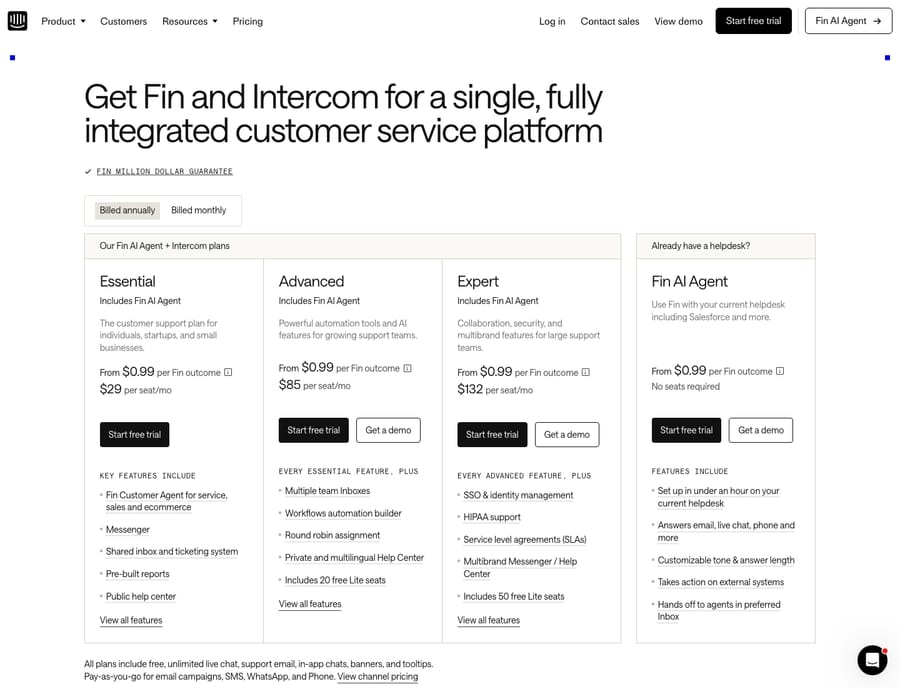
This is the part people get wrong most often. **Zendesk charges per agent seat. Intercom charges per seat and per AI resolution** — a hybrid that's cheaper to start and harder to predict.
| Zendesk Suite (per agent/mo, annual) | Intercom (per seat/mo, annual) | |
|---|---|---|
| Entry | Support Team $19 · Suite Team $55 | Essential $29 |
| Mid | Suite Professional $115 | Advanced $85 |
| Top | Suite Enterprise — contact sales | Expert $132 |
| Autonomous AI | Copilot add-on $50/agent + ~$2.00/resolution | Fin AI Agent $0.99/resolution (escalations not charged) |
| Collaborators | Light agents (paid) | Lite seats free |
Sources: Zendesk pricing, Intercom pricing, verified June 2026. Zendesk's per-resolution AI tiers come from third-party teardowns (eesel, Futurum), not its public page — confirm in a quote. Older articles citing Intercom "$39/$99/$139" or Zendesk Suite "$69/$149/$219" are out of date.
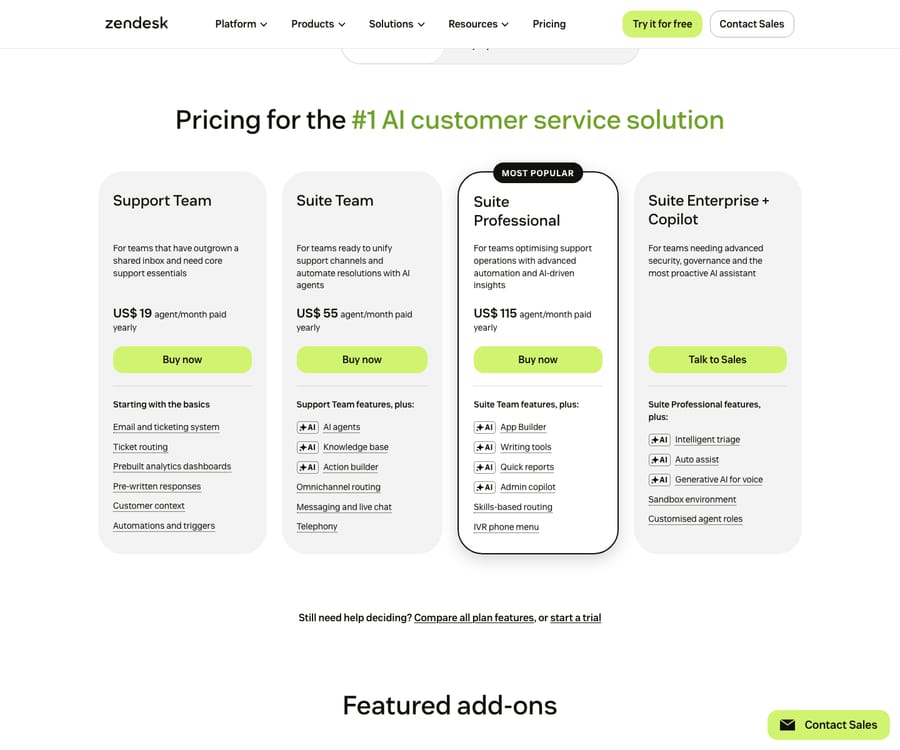
Beyond the per-seat plans, Zendesk’s AI and CX capabilities are sold as separate add-ons — each priced per agent on top of your base plan:
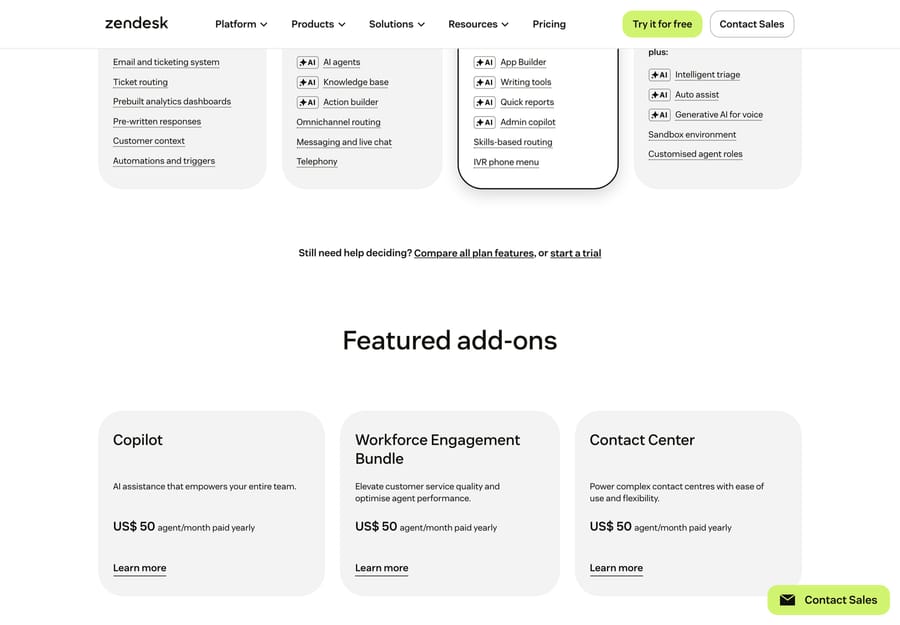
Two things fall out of this:
- Intercom is usually cheaper to start (lower seats, free Lite seats, half the per-resolution AI price), but the seat-plus-usage model means your bill grows as the AI succeeds — Fin has a 50-resolution monthly minimum and no ceiling. That's why "Intercom gets expensive" is the #1 complaint you'll read online: it's not the sticker, it's the uncapped usage.
- Zendesk is more predictable (flat per-seat), but the autonomous-AI stack — $50/agent Copilot plus ~$2.00/resolution — is roughly double Fin's per-resolution price and adds up fast.
A worked example: 20 seats, ~1,000 AI resolutions/month
| Zendesk (Suite Professional) | Intercom (Advanced) | |
|---|---|---|
| Seats (20) | 20 × $115 = $2,300 | 20 × $85 = $1,700 |
| Agent-assist AI | + 20 × $50 Copilot = $1,000 | + 20 × $29 Copilot = $580 |
| Autonomous AI (1,000 resolutions) | ~1,000 × $2.00 = ~$2,000 | ~1,000 × $0.99 = ~$990 |
| Rough monthly total | ~$5,300 | ~$3,270 |
Illustrative list math, not a quote. At this volume Intercom is clearly cheaper — but notice the shape: both bills rise with every resolution. Push to 10,000 resolutions/month and Intercom adds ~$9,900, Zendesk ~$20,000 — the per-resolution model that looks cheap at low volume becomes the dominant line item as your AI gets better at its job. That's the tension worth planning around (and the reason the flat per-action AI layer below exists).
Feature-by-feature: who wins what
| Capability | Winner | Why |
|---|---|---|
| Core model | Depends | Zendesk = structured tickets (great for 3+ touch, multi-agent cases); Intercom = conversations (great for 1–2 message resolves) |
| In-app messaging & live chat | Intercom | The Messenger is its origin and still best-in-class for in-product chat |
| Omnichannel (email/voice/social/SMS) | Zendesk | Deeper native voice + broader channels; Intercom bolts some on pay-as-you-go |
| Automation / workflows | Tie (edge Intercom in 2026) | Intercom's Workflows + new "Procedures" let AI take actions; Zendesk's triggers are powerful but heavier to configure |
| Native AI | Intercom (Fin) today | Fin is the more turnkey autonomous agent (claimed ~67% resolution, 45+ languages); Zendesk's platform is strong but lags on out-of-box polish |
| Knowledge base & self-service | Slight Zendesk | More mature help-center/Guide tooling |
| Reporting / analytics | Zendesk (Explore) | Deeper SLA/queue/agent analytics at scale |
| Integrations | Zendesk | Larger marketplace (~1,500+ vs ~450+) |
| Outbound / proactive messaging & product tours | Intercom | Tours, banners, checklists, in-app campaigns — Zendesk has no real equivalent |
| Ease of setup | Intercom | ~1–2 weeks vs Zendesk's longer, config-heavy rollout |
| Total cost at scale | Usually Zendesk (predictable) | Intercom's seat + per-resolution hybrid is unpredictable as volume grows |
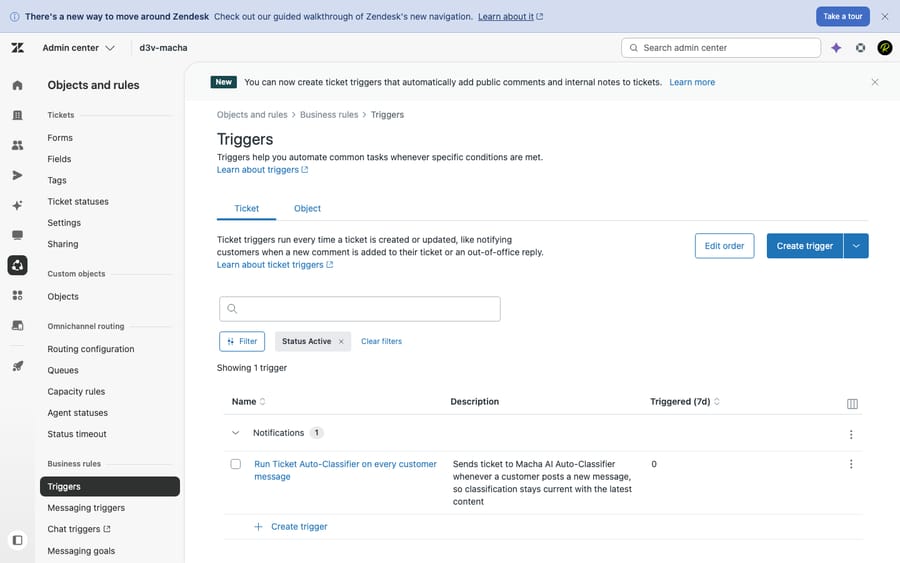
Beyond the table — the differences you'll actually feel. The split comes down to shape of work. Zendesk treats every interaction as a structured ticket with a status, assignee, SLA, and audit trail — which is exactly what you want when a case bounces across three agents and two weeks, but it's heavier than a product team wants for a quick in-app question. Intercom treats everything as a conversation in the Messenger — fast and friendly for one- and two-touch resolves and unbeatable for in-product engagement, but it strains when you're running high-volume, multi-touch support with strict SLAs and regional routing. The triggers screenshot above is the tell: Zendesk gives you deep, condition-by-condition control (and the omnichannel routing menu on the left — Queues, Capacity rules, Routing configuration), but you'll spend real admin time wiring it; Intercom gets you live faster but with a lower ceiling on routing depth. Neither is "better" — they're built for different teams.
Strengths & weaknesses, honestly
Zendesk — strengths: mature enterprise ticketing and routing; deepest reporting (Explore); largest integration marketplace; strong native voice/omnichannel; predictable per-seat pricing. Zendesk — weaknesses: AI value is add-on-gated and stacks ($50/agent Copilot + ~$2/resolution); long, config-heavy setup; live chat/messaging feels bolted-on next to Intercom; classic ticketing UX can feel dated to product teams.
Intercom — strengths: best-in-class in-app Messenger and live chat; strongest turnkey autonomous AI (Fin); excellent proactive/outbound (tours, campaigns); fast setup; free Lite seats. Intercom — weaknesses: pricing is the #1 online complaint — the seat-plus-$0.99/resolution hybrid is unpredictable and scales with success; weaker at high-volume multi-touch ticketing; shallower analytics; smaller integration catalog.
What real users say
Both score well; the difference shows in the complaints. Ratings as of mid-2026 (counts approximate — review sites rate-limit scraping):
| G2 | Capterra | |
|---|---|---|
| Zendesk | 4.3 / 5 (~6,700 reviews) | 4.4 / 5 (~4,080) |
| Intercom | 4.5 / 5 (~3,000 reviews) | 4.5 / 5 (~1,130) |
- Intercom — praised for Fin's deflection and a polished inbox: "Offers customers a great and efficient support experience while saving our internal team countless hours" (Matt B., Director of Products, Capterra, Jan 2026). The dominant complaint is cost — the seat-plus-resolution model is the #1 gripe online: "The cost seems to be high and it keeps continuing to increase" (Anna H., Capterra, Jan 2026).
- Zendesk — praised for breadth and scale, with two recurring knocks: tier-gated pricing and its own support quality. "Strong value for money considering the wide range of features" (Ifra S., Zendesk developer, Capterra, Dec 2025) vs. "Their support is some of the worst I've ever experienced" (Katie Y., Head of Customer Success, Capterra, Mar 2025).
The reviews echo the analysis: Intercom wins on AI and chat polish; both draw fire on cost — Intercom's for being unpredictable (it scales with success), Zendesk's for being add-on-gated.
Who each is genuinely for
- Intercom → product-led, SaaS, and B2B-software companies where support happens inside the product; teams that prioritize live chat, in-app onboarding, proactive messaging and tours; orgs where conversations resolve in 1–2 messages and that want the strongest turnkey AI agent. Skews SMB-to-mid-market and blended support+growth teams.
- Zendesk → classic multi-channel support orgs (email, phone, social, chat) handling high ticket volume with complex, multi-touch, multi-agent cases; enterprises needing SLA management, granular routing, deep analytics, and compliance (HIPAA, audit logs). Skews mid-market-to-enterprise CX departments.
Rule of thumb: average resolution in 1–2 messages and embedded in your product → Intercom. Average case needs 3+ touches across channels and teams → Zendesk.
The AI question — both now price per resolution
Here's the 2026 story almost no comparison tells you straight: Zendesk and Intercom have converged on resolution-priced AI. Intercom's Fin pioneered "$0.99 per resolution"; Zendesk answered with outcome-based pricing of roughly $2.00 per automated resolution. Both are genuinely capable — but both create the same two problems for a team that already has a help desk and just wants better AI:
- Cost scales with success. The better the AI deflects, the bigger the bill — and the vendor defines what counts as a "resolution."
- Lock-in. Each vendor's best AI is tied to (or priced to favor) its own platform. Fin can run standalone on top of another help desk, but its deepest value lives inside Intercom; Zendesk AI is effectively locked to Zendesk.
So if your real problem is "our AI doesn't resolve enough," switching between Zendesk and Intercom mostly trades one resolution-priced bot for another. The other path: keep the help desk that fits your team and add an AI agent layer on top. A layer like Macha is helpdesk-agnostic, handles multi-turn conversations, takes API-backed actions, and prices per AI action rather than per resolution — so cost tracks the work done, not a vendor-defined outcome, and you don't migrate. The honest caveat: a layer is still another vendor to manage and integrate, it only resolves as well as the knowledge base behind it, and per-action credits aren't free — at very high volume you're still paying for the work, just measured differently. (More: native AI vs. an AI layer and building a chatbot that actually resolves.)
Before you switch: migration realities
The hardest part of moving between these two is the data-model mismatch — Zendesk "tickets" don't map cleanly to Intercom "conversations." Native importers and tools like Help Desk Migration move contacts, conversation history, and KB articles (both directions), but:
- Macros, triggers, automations, and workflows do not port — they're rebuilt from scratch.
- Threading, internal notes, and custom fields often need transformation, and historical SLA/metric continuity usually breaks.
- API rate limits and export caps can throttle large migrations — plan a parallel run and test before cutover.
A common middle path worth knowing: teams keep Zendesk for ticketing and bolt Fin (or an independent AI layer) on top rather than fully replatforming.
Frequently asked questions
Is Intercom cheaper than Zendesk? Usually to start — lower seat prices, free Lite seats, and half Zendesk's per-resolution AI price ($0.99 vs ~$2.00). But Intercom's seat-plus-usage model is less predictable and climbs with AI volume, so compare total cost at your real resolution count.
What's the difference between Intercom Fin and Zendesk AI? Both are autonomous AI agents priced per resolution. Fin is more turnkey and can run standalone; Zendesk AI is more enterprise-integrated but add-on-gated and roughly twice the per-resolution price. Quality is close; fit and cost differ.
Is Zendesk or Intercom better for a SaaS company? Usually Intercom — its in-app Messenger, onboarding tours, and proactive messaging suit product-led support. Zendesk wins once you're handling high volumes of complex, multi-channel tickets.
Do I have to choose between them to get good AI? No. If AI resolution is the real goal, an AI agent layer like Macha adds autonomous AI on top of Zendesk or Intercom (or any help desk), priced per action — no migration, no per-resolution lock-in.
Which is easier to set up? Intercom, typically — most teams are live in 1–2 weeks. Zendesk's depth means a longer, more configuration-heavy rollout.
The bottom line
Pick Intercom if your support lives inside your product and you value live chat, proactive messaging, and the most turnkey AI agent — just plan for usage-based cost that grows with success. Pick Zendesk if you run high-volume, multi-channel, multi-touch support and need deep routing, analytics, and predictable per-seat pricing. And keep the AI question separate: both now charge per resolution, so if autonomous resolution is the goal, an AI layer on top of whichever desk you choose is often the cheaper, lock-in-free path. (Weighing other options too? See our best Zendesk alternatives shortlist.)
Want better AI without the per-resolution lock-in? See how Macha adds autonomous AI agents on top of Zendesk or Intercom, priced per action. 7-day free trial, no credit card required. Start Trial.
Add AI agents to your Zendesk
Macha reads the ticket, drafts the reply and takes the action, inside the Zendesk you already run.