Intercom
 Shopify
 Stripe
 Slack
Slack Notion
 Google Workspace
 Confluence

The Best AI-First Zendesk Alternatives (2026)


Zendesk's AI is genuinely capable — but it's add-on-gated and priced per outcome. Copilot is a flat $50/agent/month assist layer, and its autonomous "Automated Resolutions" bill roughly $1.30–$2.00 per resolution (third-party estimate; Zendesk only publishes that committed usage costs less than overage). So if you're shopping for an AI-first alternative, you're usually after one of two things: an AI agent that resolves more than Zendesk's native one, or a product that feels AI-native rather than AI-bolted-on. This guide maps that field — and splits it into the two categories most listicles blur together.

Read this before you switch. "AI-first Zendesk alternative" is really two different shopping trips. One is replacing your help desk with an AI-native one. The other is keeping your help desk and adding an AI agent layer on top — no migration. They cost and behave very differently, so we cover both, clearly labelled. If your only gripe is Zendesk's AI, the second path is usually cheaper and faster. (Native AI vs. an AI agent layer →)
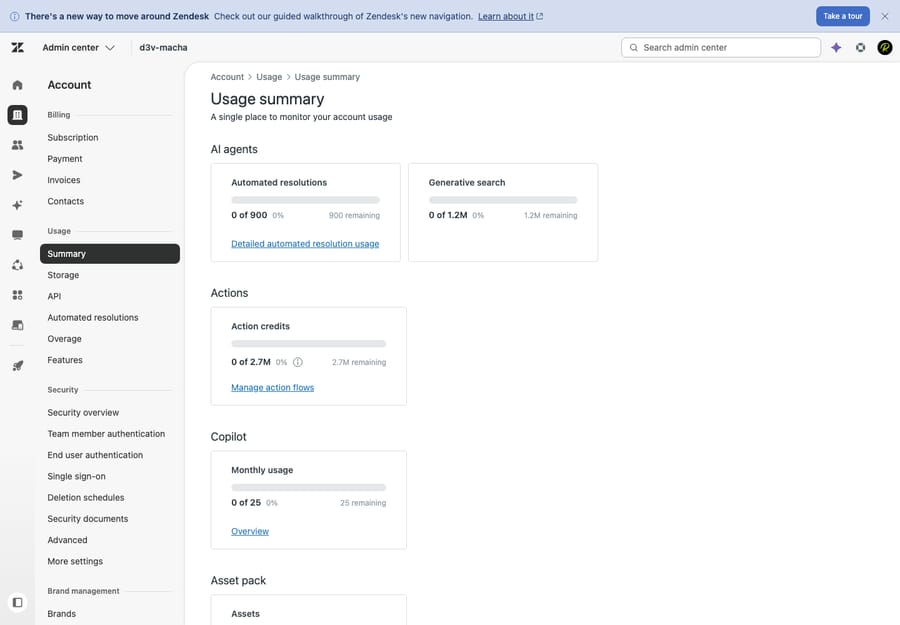
The baseline we're measuring against: Zendesk's in-product AI usage meters on a live test account. Automated resolutions, Generative search, Action credits, and Copilot each draw down their own allowance — the per-outcome model every AI-first alternative below is competing with. (More on how that bill is built: Zendesk AI pricing explained.)
First, the freshness check most lists get wrong
Two names you'll still see on "AI Zendesk alternative" lists are no longer alternatives at all: Zendesk bought both of them.
- Ultimate.ai — acquired by Zendesk in 2024; the standalone product wound down and its automation now lives inside Zendesk AI Agents.
- Forethought — Zendesk completed its acquisition on March 26, 2026 (its largest deal to date). Forethought's self-learning agents are being folded into Zendesk's resolution platform.
If a 2026 listicle recommends Forethought or Ultimate as a way off Zendesk, it's out of date — you'd be buying Zendesk. We've left both out of the field below for that reason, and it's a useful reminder that this category consolidates fast.
How we built this list: pricing is verified against each vendor's pricing page or, where pricing is quote-only, against current third-party teardowns (G2, eesel, vendor reviews — June 2026), with estimates flagged. AI claims are checked against each product. We ran Zendesk hands-on in a live test account (screenshot above) to set the baseline. Ratings are from G2, observed June 2026, with review-base sizes noted because a 4.9 on 61 reviews isn't comparable to a 4.5 on thousands. Macha is our own product — flagged wherever it appears, and deliberately placed in the "layer" category, not the "help desk" one, because that's what it is.
Deflection vs. resolution vs. automation — the lens that matters
Before the tools, fix the vocabulary, because AI pricing hides here. AI in support does three different jobs:
- Deflection — stopping a ticket from reaching a human (a help-center answer, a chatbot suggestion).
- Resolution — fully closing a ticket the customer raised. This is what Zendesk, Intercom Fin, and Gorgias meter and bill.
- Automation — doing any step of the work: summarizing, tagging, triaging, routing, looking up an order in another system, drafting, or resolving.
Update (September 2026): Salesforce completed its acquisition of Fin — the company that had already renamed itself from Intercom on May 12, 2026, before any deal was signed — on September 10, 2026, in a deal worth ~$3.6 billion, and plans to fold it into Salesforce's Agentforce. Worth weighing in any long-term Intercom/Fin decision.
Most AI-first help desks price the resolution outcome (per closed ticket). That's clean when every interaction is a simple deflect-or-resolve — and limiting when a lot of your AI's value is the triage, lookup, and routing work that never "resolves" anything by itself. Keep that distinction in mind as the prices below go by.
Category A: AI-first help desks (these replace Zendesk)
These are full help desks you'd migrate to. Each is built around an autonomous AI agent rather than treating AI as an add-on. The catch is the migration — and the pricing model, which is almost always per resolution.
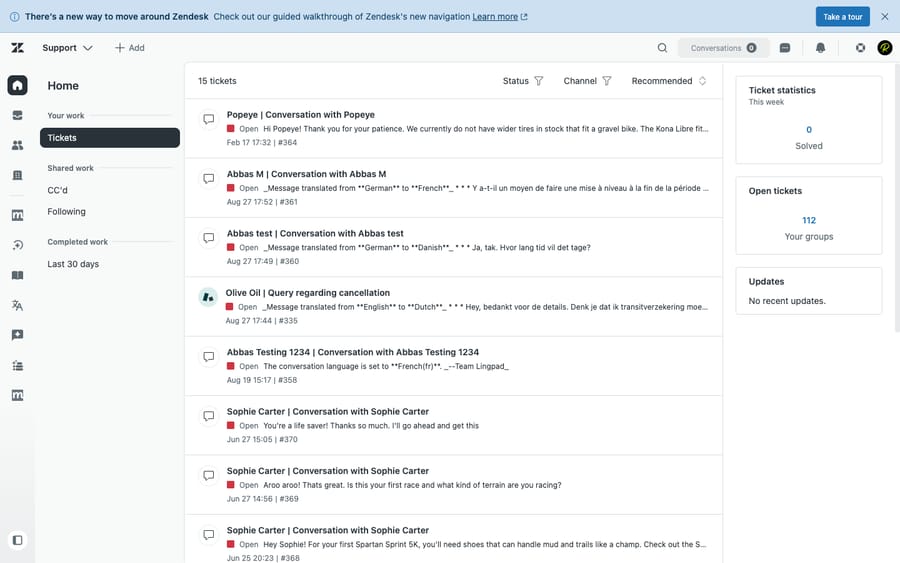
What you'd be leaving (or beating): the Zendesk agent workspace on our live test account — ticket context, side conversations, and the Copilot assist panel. An AI-first replacement has to clear this bar before the migration is worth it.
1. Intercom (+ Fin) — the AI-first incumbent
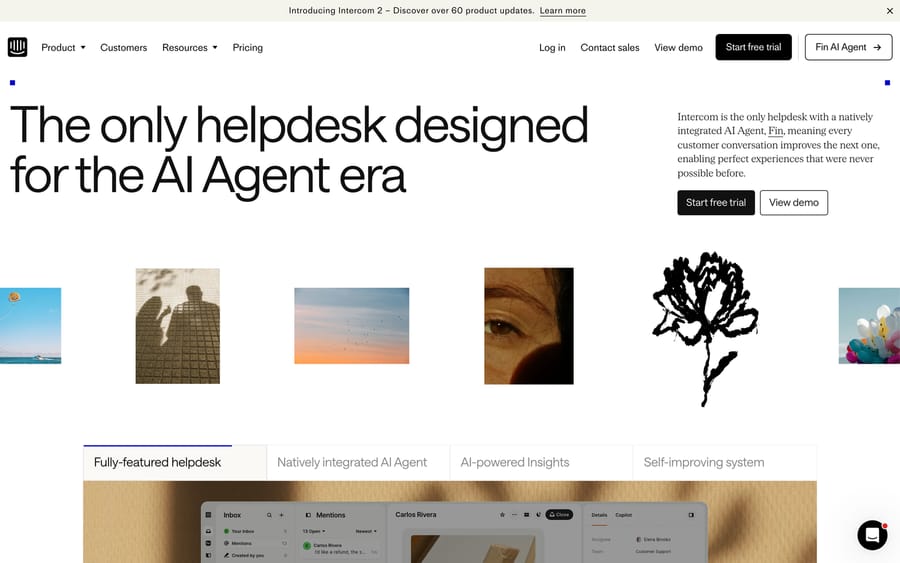
The most mature AI-native option. Intercom's Fin agent pioneered per-resolution pricing and remains the benchmark for turnkey autonomous resolution (vendor-claimed ~67% resolution rate, 45+ languages). AI model: Fin runs on frontier LLMs over your content and can take actions. Pricing: per-seat plans (Advanced $85 / Expert $132 a seat, billed annually, with the entry Essential plan inside a live pricing test at $19 to $29) plus $0.99 per Fin resolution (escalations not charged; 50-resolution monthly minimum). Best for: product-led / SaaS teams where support happens in-app and conversations resolve in a message or two. The catch: the seat-plus-resolution hybrid is unpredictable — your bill grows as the AI succeeds, which is the #1 complaint you'll read online. "Offers customers a great and efficient support experience while saving our internal team countless hours," writes Matt B., Director of Products (Capterra, Jan 2026) — but the dominant gripe is exactly the cost dynamic above: "The cost seems to be high and it keeps continuing to increase" (Anna H., Capterra, Jan 2026). G2: 4.5 (~2,900 reviews). Full Zendesk vs. Intercom breakdown →
2. Pylon — AI-native for B2B/SaaS
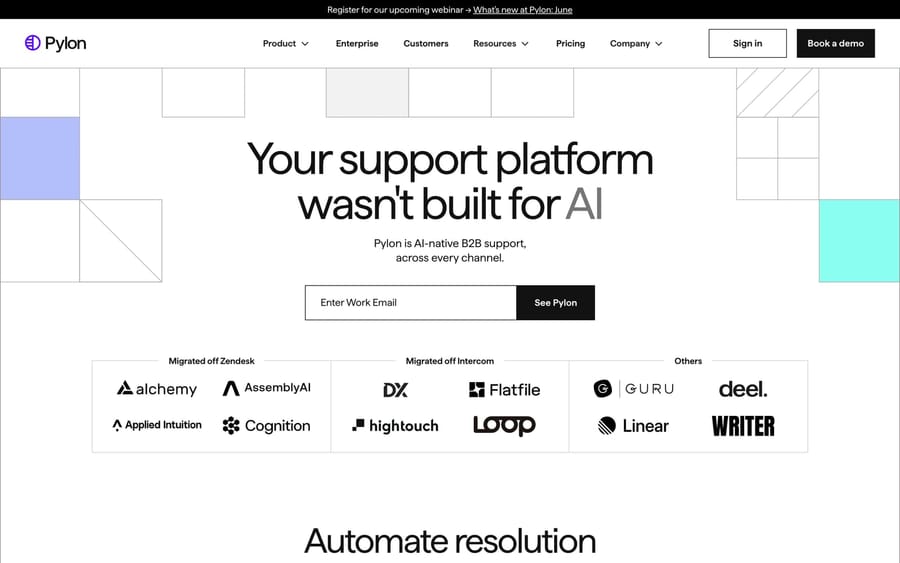
Built for B2B support across Slack Connect, email, and in-app — a genuinely AI-native platform rather than a retrofit. AI model: AI agents trained on your docs and past issues, with a strong knowledge-ops layer. Pricing: seats from $59 / $89 / $139, with AI Agents priced by 30-day issue volume — roughly $100/mo under 200 issues, $200 for 200–500, $500 for 500–1,000. Note that's a flat volume band, not strict per-resolution — more predictable than a $0.99-per-close meter. Best for: B2B/SaaS teams whose customers live in shared Slack channels. The catch: aimed squarely at B2B — not built for high-volume consumer support — and the 4.9 rating sits on a small review base. Early G2 reviewers (paraphrased, given that small base) praise the Slack-native B2B workflow, fast setup, and responsive team while wishing email handling matched the Slack core; Pylon's own (vendor-reported) case study has Sardine migrating ~120,000 tickets off Zendesk in 5 days and cutting median first response from ~15 minutes to under a minute — a directional signal, not independent proof. G2: 4.9 (61 reviews — small base, treat with care). Full Zendesk vs. Pylon breakdown →
3. Gorgias — AI-first for e-commerce

The e-commerce specialist, with order/refund/subscription context inside the ticket and an AI Agent built to act on it. AI model: AI Agent that resolves common Shopify/store questions and can take store actions (order status, cancellations). Pricing: ticket-based plans, plus the AI Agent at $0.90/resolution (annual; $1.00 monthly), and $1.50 per resolution over your allowance. Watch the double-count: an AI resolution also counts as a billable ticket, so one conversation can hit the bill twice. Best for: Shopify/BigCommerce merchants. The catch: narrow fit outside retail; automation rates land in the 26–56% range depending on catalog and content. Merchants single out the e-commerce depth — "native ecommerce sidebar giving us quick access to customer orders" (Frank A., Head of Digital, Capterra, Mar 2026) — while the recurring knock is price relative to alternatives: "pricing can be a little high in comparison to some other platforms" (Candace B., Operations Manager, Apparel & Fashion, Capterra, Apr 2025). G2: 4.6 (~1,200 reviews). Full Zendesk vs. Gorgias breakdown →
4. Kustomer — AI omnichannel at scale
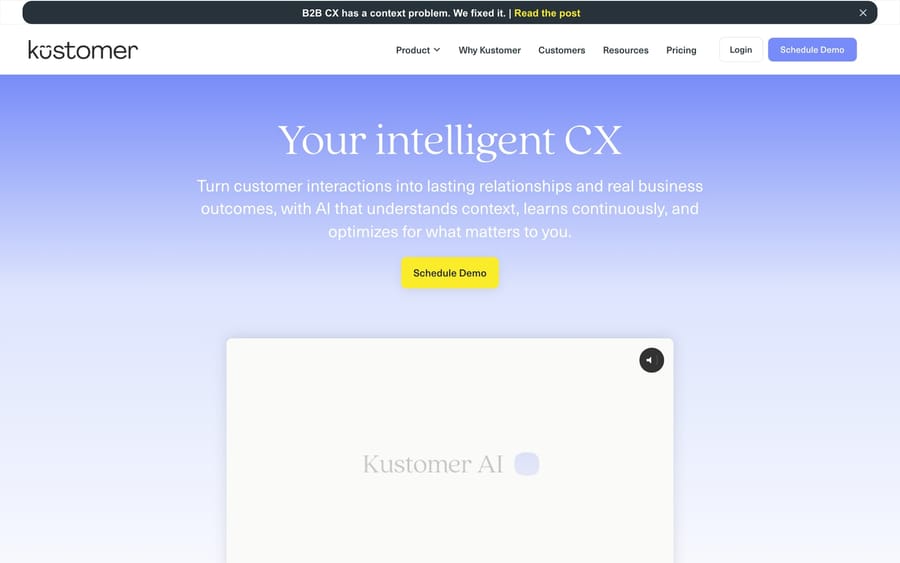
A single customer timeline across every channel, with KIQ AI layered on top — built for high-volume CX teams. AI model: KIQ self-service agents plus agent-assist. Pricing: Enterprise $89 / Ultimate $139 per seat (8-seat minimum, annual), plus $0.60 per engaged conversation and AI Agents for Reps at $40/user. Note the unit: Kustomer charges per engaged conversation (any interaction where AI responds, even if it escalates) — not per resolution, which can be cheaper or pricier depending on your escalation rate. Best for: mid-market-to-enterprise omnichannel teams at volume. The catch: seat minimums and add-ons make it a real investment. Fans love the unified timeline — "the best application for customer service and CRM" (Natalia Isabel R., Customer Experience, Capterra, Feb 2025) — while the recurring criticism is pace of change: "[it] seems somewhat stagnant in terms of API updates" (Aaron F., SVP of Engineering, Capterra, Jan 2025). G2: 4.4 (~150 reviews). Full Zendesk vs. Kustomer breakdown →
Category A at a glance
| Tool | AI model | AI pricing | Best for | G2 |
|---|---|---|---|---|
| Intercom + Fin | Turnkey autonomous agent | Seats + $0.99/resolution | Product-led / SaaS | 4.5 (~2,900) |
| Pylon | AI agents + knowledge ops | Seats + $100–$500/mo by volume | B2B / SaaS (Slack) | 4.9 (61 ⚠) |
| Gorgias | E-commerce AI Agent | Tickets + $0.90/resolution | Shopify / e-commerce | 4.6 (~1,200) |
| Kustomer | KIQ self-service + assist | Seats + $0.60/engaged conv. | Omnichannel at scale | 4.4 (~150) |
| Zendesk (baseline) | Copilot + Automated Resolutions | $50/agent + ~$1.30–$2.00/resolution \* | The incumbent | 4.3 (~6,700) |
\ Zendesk's per-resolution rates are third-party estimates (eesel, Voiceflow, CorePiper); Zendesk only states committed usage is cheaper than overage. ⚠ Pylon's rating sits on a small base.*
Category B: AI agent layers (these sit on top of your existing desk)
This is the path most teams shopping for "better AI than Zendesk" actually want — and the one listicles skip. Instead of replacing your help desk, you add an autonomous AI agent on top of it. You keep Zendesk (or whatever you run), your tickets, your macros, and your team's muscle memory, and skip the migration entirely. (The best Zendesk AI agents, compared →)
5. Macha — the helpdesk-agnostic automation layer
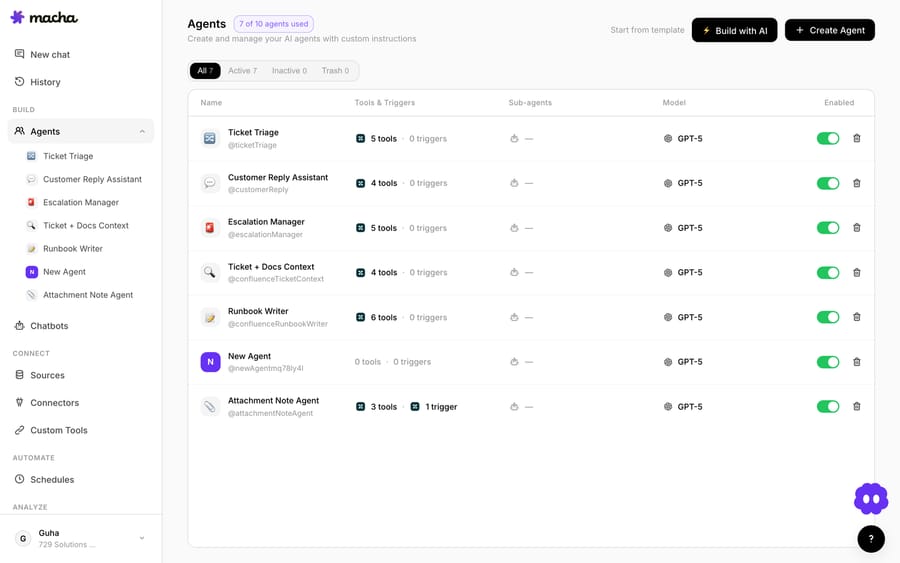
This is where we fit, and we'll be direct about it because this is an AI-first post. Macha is an AI agent layer that runs on top of Zendesk, Freshdesk, or whatever help desk you already use — not a help desk you'd switch to. It resolves tickets end-to-end, but it's built for the broader automation category, not just the resolution outcome: one agent can summarize, tag, triage, look up data in another system, draft, and resolve.
The pricing difference is the point. Where Fin, Gorgias, and Zendesk bill per resolution, Macha prices per ticket: one charge per thread, however many replies, tool calls or steps it takes, and the model you choose doesn't change the charge. It's one plan priced on ticket volume, from $299/month for 750 tickets (~$0.40/ticket) — so you pay for the tickets the AI works rather than a vendor-defined outcome. A summarize-and-route ticket and a fully resolved ticket cost the same, not a flat per-close fee on top.
Best for: teams whose help desk is fine but whose AI isn't — and who don't want to migrate or get locked into a per-resolution meter. The honest watch-outs:
- It's another vendor and integration to set up and maintain alongside your desk.
- It's only as good as the knowledge you connect — point it at thin or stale docs and resolution quality drops, same as any AI.
- Per-ticket pricing isn't free. A monthly ticket tier is more predictable than an uncapped per-resolution meter, but you should still model your volume.
Want better AI without replatforming? See how Macha adds autonomous AI agents on top of your existing help desk, priced per ticket. $50 of free usage, no credit card required. Start Trial.
6. eesel AI — pay-per-ticket layer
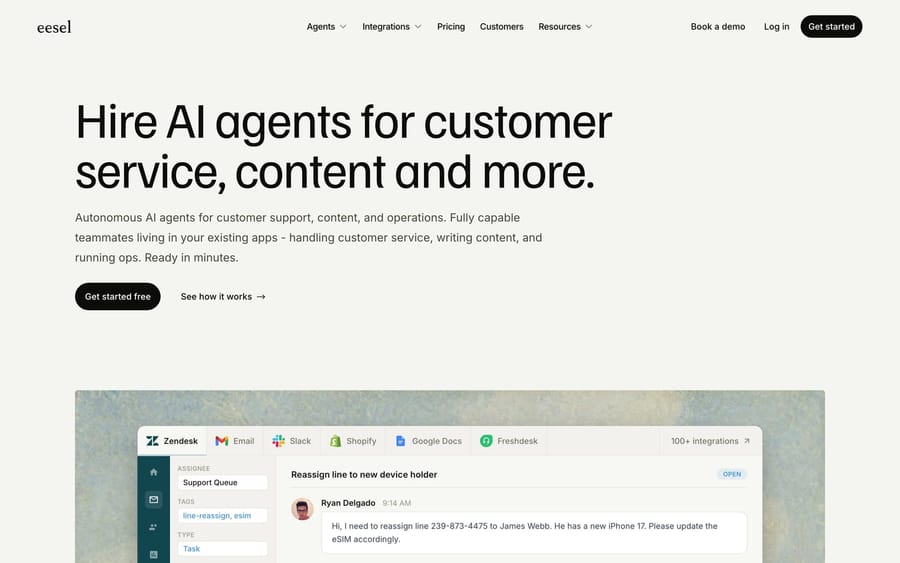
A helpdesk-agnostic AI layer that trains on your docs and past tickets and drafts or resolves. Pricing: since early 2026, a pay-per-task model at $0.40 per ticket — one ticket = one task no matter how many messages, with no seat fee, no platform fee and no monthly minimum on self-serve. A separate Enterprise tier adds a $1,000/month flat platform fee on top of that usage. Best for: teams that want a simple, low-commitment per-ticket layer on top of an existing desk. The catch: like any layer, resolution quality tracks your knowledge base; per-ticket cost is real at high volume.
7. Fin (standalone) — the same agent, bolted on
Worth knowing twice: Intercom's Fin can also run as a standalone layer on top of another help desk (including Zendesk) at the same $0.99 per resolution. So Fin appears in both categories — as Intercom's native agent, and as an add-on layer. The catch: its deepest value lives inside Intercom, and you're still on a per-resolution meter.
A note on Forethought and Ultimate: both used to belong in this layer category. They're now owned by Zendesk (Forethought as of March 2026), so adding them isn't "an alternative to Zendesk" anymore — it's buying into Zendesk's stack. Plan accordingly.
Category B at a glance
| Layer | Runs on top of | Pricing model | Pricing category | Best for |
|---|---|---|---|---|
| Macha | Any help desk (Zendesk, Freshdesk…) | Per ticket (from $299/mo for 750 tickets) | Automation | Better AI without migrating |
| eesel AI | Any help desk | ~$0.40 per ticket | Resolution/ticket | Simple per-ticket layer |
| Fin (standalone) | Zendesk + others | $0.99 per resolution | Resolution | Turnkey agent, Intercom-adjacent |
What it actually costs at volume
Pricing-per-unit is abstract until you multiply it out. Here's the AI portion of the monthly bill at a steady ~1,000 AI resolutions/month (the AI add-on only — seats are extra, and excluded so the per-outcome models are comparable). Treat this as illustrative, not a quote: your real number swings with escalation rate, and allowances.
| Tool | AI unit | Unit price | ~1,000/mo AI bill | Notes |
|---|---|---|---|---|
| eesel AI (layer) | per ticket | ~$0.40 | ~$400/mo | One ticket = one task regardless of messages |
| Gorgias | per resolution | $0.90 (annual) | ~$900/mo | An AI resolution also bills as a ticket — real cost can run higher |
| Intercom Fin | per resolution | $0.99 | ~$990/mo | Escalations not charged; 50-resolution monthly minimum |
| Zendesk (baseline) | per resolution | ~$1.30–$2.00 \* | ~$1,300–$2,000/mo \* | Third-party estimate (eesel/Voiceflow/CorePiper) — flagged |
| Macha (layer) | per ticket | ~$0.40 (from $299/mo for 750 tickets) | monthly tier, not per close | See note below |
\ Zendesk's per-resolution rate is a third-party estimate; Zendesk only states committed usage costs less than overage. All figures are the AI add-on only and assume a flat 1,000 units — a deliberately simplified model, not a vendor quote.*
Why Macha doesn't slot into the same column. The four rows above bill the resolution outcome (or, for eesel, the ticket). Macha bills the automation category — per ticket, on a monthly tier — so there's no honest "× 1,000 resolutions" figure to print: the bill depends on how many tickets the AI works each month, not how many close. A pure deflection (one help-center answer) and a multi-step automation (look up an order in another system, draft, then resolve) are each one ticket. The practical difference: on a per-resolution meter your cost rises every time the AI succeeds and the vendor defines "success"; on a per-ticket tier you pay the same for triage/lookup/routing work that never "resolves" anything as for a clean close — and agents pause rather than run up overages when the month's tickets run out. (This is illustrative framing, not a price quote — model your own monthly ticket volume.)
How to choose
- You want a more AI-native product and you're open to migrating → an AI-first help desk: Intercom for product-led/SaaS, Pylon for B2B, Gorgias for e-commerce, Kustomer for omnichannel scale.
- Your help desk is fine — the AI is the problem → an AI agent layer (Macha, eesel, or Fin standalone) on top of what you already run. No migration.
- You're worried about cost scaling with success → favour a per-ticket layer on a fixed monthly tier or a flat-band model (Pylon) over an uncapped per-resolution meter.
- You're still weighing whether to switch desks at all → start with the broader best Zendesk alternatives shortlist, then come back to the AI question separately.
The key mental move: the AI question is separable from the help-desk question. Pick the platform that fits your team and channels; pick your AI — native or layered — on its own merits.
Frequently asked questions
What's the most AI-first alternative to Zendesk? Among full help desks, Intercom (with Fin) is the most mature AI-native option, with Pylon the strongest AI-native pick for B2B. But if you only want better AI and not a new help desk, an AI agent layer like Macha or eesel gives you autonomous resolution on top of Zendesk without migrating.
Are AI-first help desks cheaper than Zendesk's AI? Sometimes. Intercom's Fin ($0.99/resolution) is roughly half Zendesk's estimated per-resolution rate, and Gorgias is $0.90. But all three share Zendesk's core dynamic — cost rises as the AI resolves more. Layers priced per ticket, such as Macha and eesel, change that shape. Model your real volume before deciding.
Can I get better AI than Zendesk without switching help desks? Yes — that's exactly what an AI agent layer is for. Tools like Macha and eesel run on top of Zendesk and add autonomous resolution, so you keep your tickets, macros, and integrations and skip the migration. (Zendesk AI vs. an AI agent layer →)
Is Forethought or Ultimate a good Zendesk alternative? Not anymore — Zendesk acquired Ultimate (2024) and Forethought (March 2026). Both now live inside Zendesk's own AI, so choosing them isn't moving off Zendesk.
What's the difference between a per-resolution and a per-ticket price? Per-resolution bills you each time the AI closes a ticket (Fin, Gorgias, Zendesk). Per-ticket bills you once for each thread the AI works, however many steps it takes — summarize, triage, look up, draft, or resolve (Macha's model, from $299/month for 750 tickets). Per-resolution is simplest when every job is a clean deflect-or-close; per-ticket fits when a lot of your AI's value is the work around resolution.
The bottom line
If you want a more AI-native help desk and are willing to migrate, Intercom/Fin, Pylon, Gorgias, and Kustomer are the strongest AI-first replacements — each excellent in its lane, and each (except Pylon's flat bands) priced per resolution, so plan for cost that scales with success. But the more common reality is that Zendesk's desk is fine and its AI isn't — in which case an AI agent layer like Macha sits on top, adds autonomous resolution, and prices per ticket instead of per outcome, with no migration. Choose the platform for fit; choose your AI separately. And ignore any list that still calls Forethought or Ultimate an alternative — those are Zendesk now.
The AI, not the migration? See how Macha adds autonomous AI agents on top of your existing help desk, priced per ticket — not per resolution. $50 of free usage, no credit card required. Start Trial.
Add AI agents to your Zendesk
Macha reads the ticket, drafts the reply and takes the action, inside the Zendesk you already run.