Intercom
 Shopify
 Stripe
 Slack
Slack Notion
 Google Workspace
 Confluence

Zendesk vs. Kustomer (2026): Tickets vs. the Customer Timeline


The genuine difference between Zendesk and Kustomer isn't a feature count — it's the data model. Zendesk is ticket-centric: the ticket is the atomic unit, and one customer can spawn many disconnected tickets. Kustomer is built around a single unified customer timeline: every email, chat, order, and data point lives on one customer record, CRM-style. That choice shapes everything — agent experience, pricing, and how AI gets its context. This guide uses verified June-2026 pricing (Kustomer's is now mostly off its public page) and stays neutral.

Short version: Kustomer if you want a CRM-style unified customer view for high-volume omnichannel CX; Zendesk if you want the broadest, most extensible, best-supported ticketing platform.
The 30-second verdict
| If you are… | Pick |
|---|---|
| A high-volume omnichannel B2C/DTC brand at scale | Kustomer |
| Wanting one unified customer record (not ticket sprawl) | Kustomer |
| Heavy on repeat contacts where context continuity matters | Kustomer |
| With high conversations-per-agent or seasonal spikes | Kustomer (per-conversation pricing) |
| Wanting low entry price + the biggest integration ecosystem | Zendesk |
| Running structured queues with strict SLAs and routing | Zendesk |
| An SMB or anyone wanting a cheap pilot path | Zendesk |
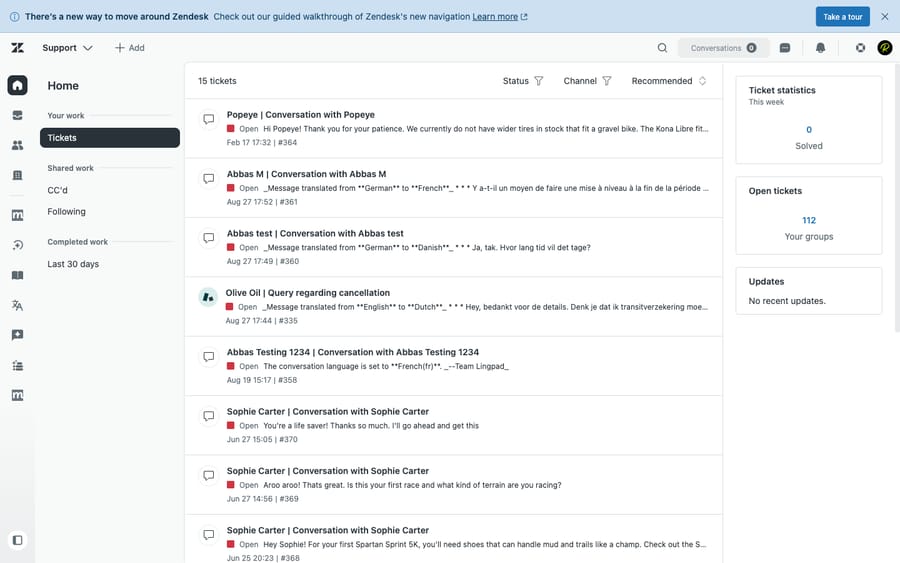
How we compared: Zendesk pricing is verified against its official page (June 2026); Kustomer now hides most numbers on its public page, so those figures are third-party-sourced and flagged as estimates throughout. Features are checked against the products — and we ran Zendesk hands-on in a live test account (screenshot below). User sentiment comes from real G2, Capterra, and TrustRadius reviews (observed June 2026). Macha is our own product — we flag that wherever it comes up.
Pricing: per-seat (with a floor) vs. per-conversation
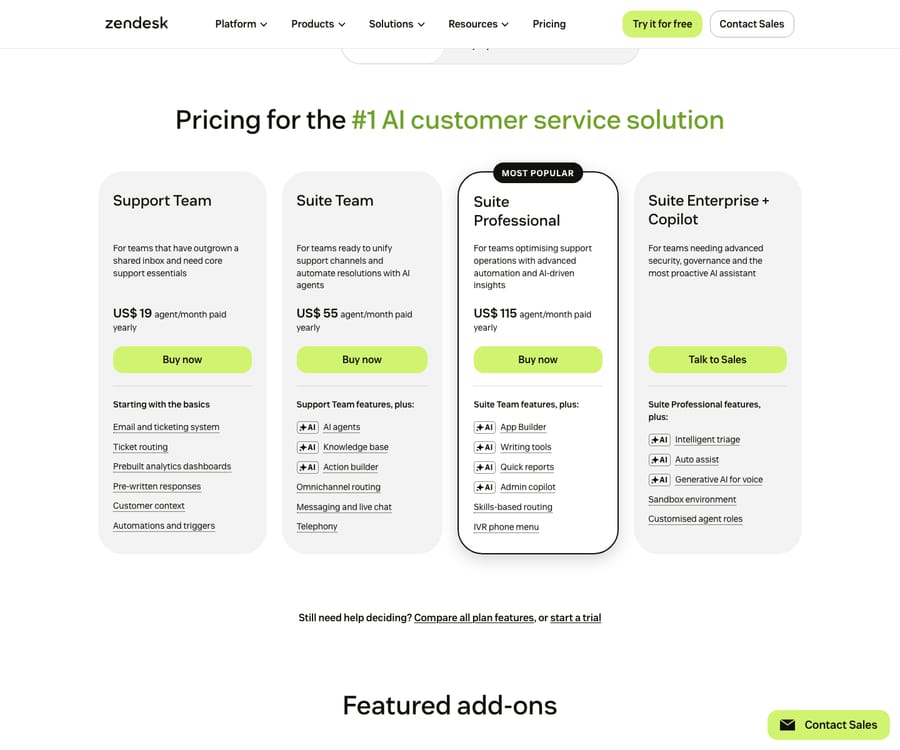
Zendesk (per agent/month, annual): Support Team $19, Suite Team $55, Suite Professional $115, Enterprise contact sales; Copilot $50/agent (Professional+); AI agents ~$1–$2 per automated resolution. A low, transparent entry point. Source: Zendesk pricing.
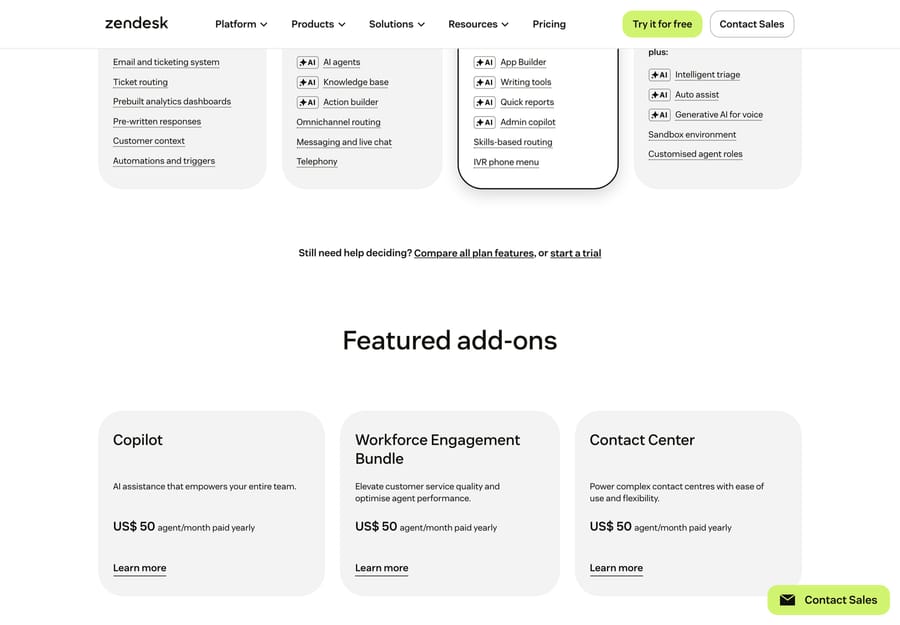
Beyond the per-seat plans, Zendesk’s AI and CX capabilities are sold as separate add-ons — each priced per agent on top of your base plan:
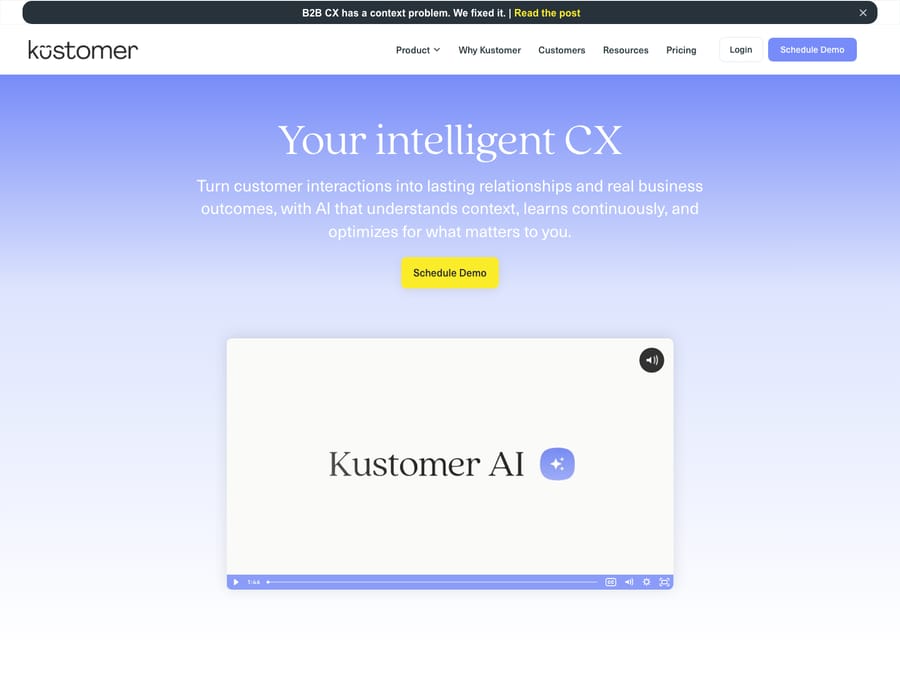
Kustomer: its public pricing page now shows mostly a feature table, so the numbers below come from third-party sources — treat as estimates and confirm with a quote. Kustomer offers two models:
- Per seat (annual, 8-seat minimum): Enterprise ~$89/seat, Ultimate ~$139/seat — so the floor is roughly $8,500/year just to start.
- Per conversation (unlimited seats): from ~$0.35/conversation (Enterprise) or ~$0.50 (Ultimate).
- AI add-ons: AI Agents for Customers from ~$0.60 per engaged conversation; AI for Reps ~$40/user; in December 2025 Kustomer bundled seven "AI Assistant" tools into seats at no extra charge.
The contrast: Zendesk has a far lower entry point and a transparent ladder, but adds cost via Copilot + per-resolution AI + WFM/QA. Kustomer has a higher floor (8-seat minimum, annual-only) but bundles more per seat and offers a genuinely different per-conversation model that decouples cost from headcount — attractive when conversations-per-agent are high or seasonal.
The per-conversation break-even (the math nobody shows)
Kustomer's per-conversation option (~$0.35–$0.50) is the interesting one. Roughly: a seat handling fewer than ~250–280 conversations/month is cheaper on a $89–$139 seat; above that, per-conversation can be cheaper — and it shines for seasonal teams where you'd otherwise pay for idle seats. Zendesk has no per-conversation equivalent, so if your volume is spiky or your conversations-per-agent are very high, Kustomer's model can genuinely win. Model it at your real conversations-per-agent ratio.
Feature-by-feature: who wins what
| Capability | Winner | Why |
|---|---|---|
| Data model | Kustomer | One unified customer timeline vs ticket sprawl — full context on one record |
| Omnichannel at scale | Tie (Kustomer edge) | Both cover all channels; Kustomer threads them into one timeline natively |
| Automation / workflows | Zendesk | 15+ years of mature triggers, automations, macros, skills-based routing, SLAs |
| Native AI | Zendesk (breadth) / contested | Zendesk's AI is broader and more productized; Kustomer's is better grounded in the timeline but narrower |
| Knowledge base & self-service | Zendesk | Guide is a mature multi-brand help center + community |
| Reporting / analytics | Zendesk (out-of-box) / Kustomer (custom) | Explore is polished for ops metrics; Kustomer is flexible at the customer-object level but a steeper build |
| Integrations | Zendesk (decisive) | ~1,500+ marketplace apps vs Kustomer's ~50 |
| Voice | Zendesk | More mature Talk/Contact Center; Kustomer Voice is newer, pay-as-you-go |
| Agent workspace / efficiency | Kustomer | Timeline view = less tab-switching, full context in one pane |
| Scalability (high volume) | Tie (different shapes) | Zendesk for structured queues + strict SLAs; Kustomer for relationship-driven, repeat-contact CX |
Strengths & weaknesses, honestly
Zendesk — strengths: lowest entry price; transparent tiers; massive 1,500+ integration ecosystem; mature KB, voice, WFM/QA; battle-tested SMB→enterprise; deep routing/SLA/automation; large talent pool. Zendesk — weaknesses: ticket-centric model fragments customer context; costs balloon with add-ons (Copilot Pro+-gated, per-resolution AI, WFM/QA); AI resolution pricing is opaque; can feel heavy.
Kustomer — strengths: unified customer-timeline data model (a genuine differentiator); CRM-native context; clean modern UI; strong omnichannel threading; flexible per-conversation pricing; bundles more per seat; built for high-volume DTC. Kustomer — weaknesses: high floor (8-seat minimum, annual-only — no cheap pilot); opaque public pricing; small integration marketplace (~50); thinner KB/self-service and voice; smaller ecosystem/talent pool; AI add-ons priced separately and can stack.
What real users say
The headline ratings flatter both, but the base is wildly different — Zendesk has tens of thousands of reviews; Kustomer's count is a fraction of that, so its averages are far more sensitive to a handful of opinions. (Observed June 2026.)
| G2 | Capterra | Other | |
|---|---|---|---|
| Zendesk | 4.3 / 5 (~6,700) | 4.4 / 5 (4,079) | TrustRadius 8.7/10 |
| Kustomer | 4.5 / 5 (~513) | 4.6 / 5 (79)* | Smaller base across every site |
\*Kustomer's review base is small — 79 on Capterra and a few hundred on G2 versus Zendesk's thousands — so treat its slightly higher averages as directional, not decisive; a small base is easier to skew and tends to over-represent enthusiasts.
- Zendesk — reviewers consistently praise feature breadth and everyday omnichannel usability, while the recurring knocks are pricing/add-on creep and the cost-to-value ratio for leaner teams. Praise: "a very good tool to provide customer support in an omnichannel way, it's easy to use" (Pablo T., CX Consultant, Capterra, Dec 2025). Criticism: "packed full of features… [but] for organizations with a tighter budget, it might be hard to justify the price" (Alexandra V., People Business Partner, Capterra, Mar 2026).
- Kustomer — fans love the unified customer timeline and the automation built around it, calling out how little context slips through the cracks; the dominant criticisms are complexity / learning curve and cost gating (advanced automation and reporting living behind higher tiers), plus a sense the product has been slow to evolve. Praise: "the best application for customer service and CRM" (Natalia Isabel R., Customer Experience, Capterra, Feb 2025). Criticism: "[it] seems somewhat stagnant in terms of API updates" (Aaron F., SVP of Engineering, Capterra, Jan 2025).
The pattern tracks the rest of this comparison: Zendesk users grumble about what they pay, while Kustomer users grumble about what it takes to set up and master — and they do so from a much thinner review base.
Who each is genuinely for
- Kustomer → high-volume omnichannel B2C/DTC or e-commerce brands at scale where customers contact you repeatedly and context continuity drives CSAT; teams that want a CRM-style unified customer view at the center of support; orgs with high conversations-per-agent or seasonal spikes that benefit from per-conversation pricing — and that can commit to 8+ seats and annual terms.
- Zendesk → broad, general-purpose teams (SMB → enterprise) that want the safest, most extensible, best-supported option; high-volume structured queues with strict SLAs and skills routing; teams reliant on a deep integration ecosystem; anyone wanting a low entry price and a gradual scale path.
"Is Kustomer owned by Meta?" — no, not since 2023
A common question worth settling: Meta (Facebook) acquired Kustomer (announced ~$1B in 2020, closed February 2022), then divested it in May 2023 during its "year of efficiency," selling it back to its original venture backers (reportedly ~$250M). Kustomer is now an independent, venture-backed company again, led by its founders. So if you're evaluating it in 2026, you're buying from an independent vendor — worth knowing for both procurement and the (smaller-vendor) risk/upside calculus versus Zendesk's scale.
The AI question — both assist; an overlay can resolve
Honest 2026 read: both vendors' native AI is primarily assistive plus first-line deflection. Zendesk's is the broader product line (Copilot, AI agents priced per resolution, intelligent triage); Kustomer's KIQ is better contextually grounded in the unified timeline but newer and narrower. Neither is a best-in-class autonomous resolution engine, and both monetize AI as stacking add-ons (Zendesk per-resolution; Kustomer per-engaged-conversation + per-rep).
This is where an external AI agent layer adds value — and it neatly sidesteps the tickets-vs-timeline debate. A layer like Macha sits on top of either platform, unifies context from your KB and historical conversations, and drives genuinely autonomous resolution across whichever system of record you keep — priced per action, with no re-platforming. It's an automation layer on top of your help desk, not a replacement. The honest caveat: a layer is another vendor and integration to manage, it only resolves as well as the knowledge you connect, and per-action pricing isn't free at high volume — it's additive, not a free win. (More: native AI vs. an AI layer.)
Before you switch: migration realities
The hard part is data-model translation. Moving to Kustomer means re-architecting from tickets to customer objects/timelines — historical tickets get mapped onto customer records, and routing/automation logic gets rebuilt around events rather than ticket states. Moving to Zendesk from Kustomer means flattening rich timelines into tickets (with some relationship context lost). Also weigh:
- Integrations: leaving Zendesk's 1,500+ ecosystem for Kustomer's ~50 may strand integrations and require custom API work.
- KB/macros rarely port cleanly — plan to rebuild.
- Reporting baselines reset (ticket-based vs conversation/customer-based metrics).
- Commitment friction: Kustomer is annual-only with an 8-seat minimum — there's no cheap pilot path, so budget the floor before committing.
Frequently asked questions
Is Kustomer owned by Meta/Facebook? No. Meta acquired Kustomer (closed 2022) but divested it in May 2023; it's now an independent, venture-backed company again.
How is Kustomer different from Zendesk? Data model. Zendesk is ticket-centric (one customer can have many tickets); Kustomer organizes everything around a single unified customer timeline, CRM-style.
Is Kustomer cheaper than Zendesk? Not at entry — Kustomer has an 8-seat minimum (~$89–$139/seat, annual), so the floor is ~$8.5k/year, while Zendesk starts at $19–$55/agent. But Kustomer's per-conversation option can win at high conversations-per-agent or for seasonal teams.
Which is better for high-volume e-commerce CX? Kustomer's unified timeline suits high-volume, relationship-driven DTC; Zendesk suits structured, SLA-driven queues and anyone needing the bigger ecosystem.
Can I add autonomous AI to either? Yes — an AI agent layer like Macha adds autonomous resolution on top of Kustomer or Zendesk, priced per action, no migration.
The bottom line
Choose Kustomer if a unified customer timeline is the point — high-volume, omnichannel, relationship-driven CX where context continuity matters, and you can commit to its 8-seat floor (its per-conversation model is a real edge for spiky volume). Choose Zendesk if you want the lowest entry price, the deepest integration ecosystem, mature voice/WFM, and a gradual scale path. And because both native AIs lean assistive, an AI layer on top is how you get autonomous resolution regardless of which data model you pick.
Tickets or timeline — want autonomous AI on top of either? See how Macha layers AI agents over your help desk, priced per action. 7-day free trial, no credit card required. Start Trial.
Add AI agents to your Zendesk
Macha reads the ticket, drafts the reply and takes the action, inside the Zendesk you already run.