Intercom
 Shopify
 Stripe
 Slack
Slack Notion
 Google Workspace
 Confluence

Zendesk vs. Pylon (2026): Established CX vs. AI-Native B2B Support


Zendesk and Pylon are a generational contrast. Zendesk is the ~15-year incumbent — a deep, general-purpose, ticket-centric platform built for broad multi-channel CX at scale. Pylon is the modern, AI-native challenger (built 2023–24) for B2B/SaaS teams that support customers in shared Slack and Microsoft Teams channels. If your support lives in Slack and you want an AI-native tool, Pylon is purpose-built for you; if you run broad, high-volume, multi-channel support, Zendesk is the established workhorse. This guide uses verified June-2026 pricing and is honest about where each actually wins.

Short version: Pylon for AI-native, Slack-connected B2B support; Zendesk for broad, high-volume, general-purpose CX at scale.
The 30-second verdict
| If you are… | Pick |
|---|---|
| A B2B/SaaS team supporting customers in shared Slack/Teams | Pylon |
| Account-based support with tier-driven SLAs | Pylon |
| Tightly integrated with Linear/Jira for eng workflows | Pylon |
| Running broad B2C or mixed high-volume support | Zendesk |
| Needing native voice/SMS/social + a big ecosystem | Zendesk |
| An enterprise needing deep governance and proven scale | Zendesk |
How we compared: pricing is verified against each vendor's official page (June 2026), with third-party/estimated figures flagged; features are checked against the products (we ran Zendesk hands-on in a live test account — the screenshot below is from it); and the user sentiment below comes from real G2 and Capterra reviews. Macha is our own product — we flag that wherever it comes up.
Pricing: both transparent, both add-on-heavy
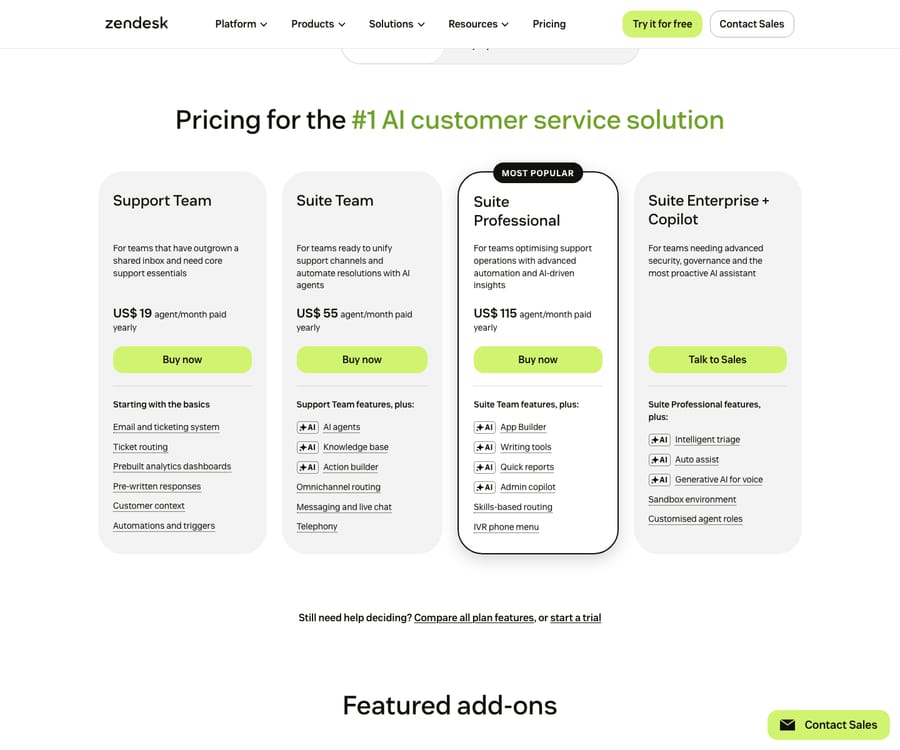
Zendesk Suite (per agent/month, annual): Support Team $19, Suite Team $55, Suite Professional $115, Enterprise contact sales; Copilot $50/agent; AI agents ~$1.50–$2.00 per automated resolution. Source: Zendesk pricing.
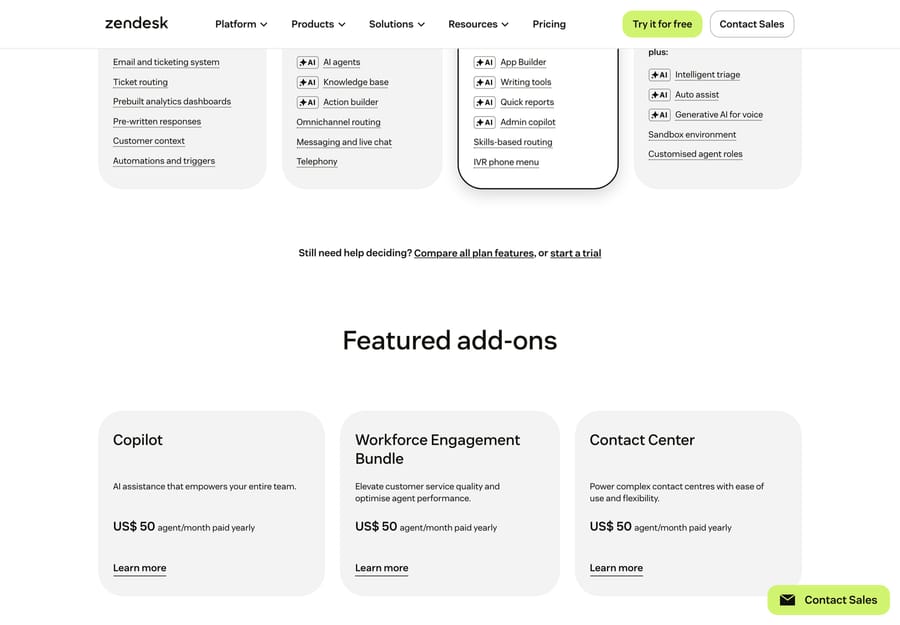
Beyond the per-seat plans, Zendesk’s AI and CX capabilities are sold as separate add-ons — each priced per agent on top of your base plan:
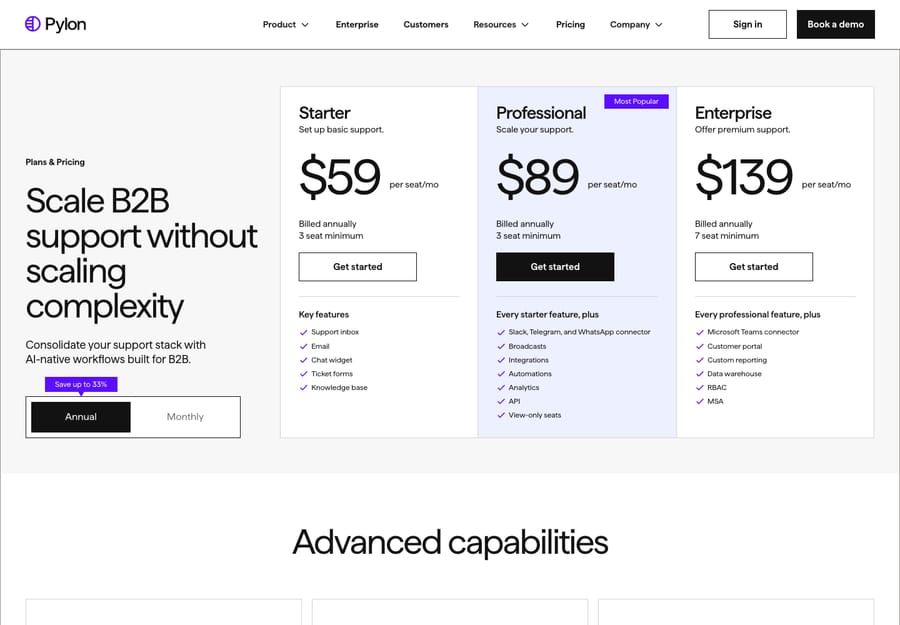
Pylon (per seat/month, annual): Starter $59 (3-seat min), Professional $89 (3-seat min), Enterprise $139 (7-seat min). Source: Pylon pricing. Pylon's base seat is roughly half Zendesk Suite Professional — but the add-ons stack:
- AI Assistants (agent-assist): $50/seat
- AI Agents (autonomous): from $100/mo, scaling with issue volume
- Account Intelligence: $10/account (min 50 accounts)
- Phone support: $35/seat
So the headline gap narrows fast once you turn on AI and account features. Rather than quote someone else's estimate, here's the math worked out at list price for a 10-agent team with moderate AI (≈500 autonomous resolutions/month):
| Pylon (Professional) | Zendesk (Suite Professional) | |
|---|---|---|
| Seats (10) | 10 × $89 = $890 | 10 × $115 = $1,150 |
| Agent-assist AI | + 10 × $50 AI Assistants = $500 | + 10 × $50 Copilot = $500 |
| Autonomous AI (~500 resolutions/mo) | AI Agents from ~$100 | 100 included (≈10/agent) + 400 × $2 = ~$800 |
| Rough monthly total | ~$1,490 (~$17.9K/yr) | ~$2,450 (~$29.4K/yr) |
Illustrative list math, not a quote — Pylon's AI Agents scale with volume and Account Intelligence (+$10/account) can add more; Zendesk's per-resolution meter rises with deflection. Pylon comes out cheaper here, mostly on seats and a lower autonomous-AI floor — but the gap is sensitive to your AI volume and how many of Pylon's add-ons you switch on, so run it on your own numbers.
At 25 agents the shape holds and the gap widens in absolute terms: Pylon Professional ≈ 25 × $89 + 25 × $50 (AI Assistants) + ~$200 AI Agents = ~$3,675/mo (~$44K/yr); Zendesk ≈ 25 × $115 + 25 × $50 (Copilot) + ~1,000 billable resolutions × $2 (after the ~250 included) = ~$6,125/mo (~$73.5K/yr). The more seats and AI you add, the more Zendesk's per-resolution meter and $50/agent add-on compound — which is the real cost story, not the sticker seat price.
Feature-by-feature: who wins what
| Capability | Winner | Why |
|---|---|---|
| Slack/Teams-connected customer channels | Pylon (decisive) | Built Slack-Connect-first; unifies hundreds of shared customer channels into one queue with bidirectional sync. Zendesk's Slack is a bolt-on on a ticket-first core |
| Ticketing & agent workspace | Zendesk | Mature ticket lifecycle, macros, views, SLAs, side conversations refined over a decade |
| Omnichannel breadth (voice/SMS/social) | Zendesk | Full voice/contact-center, SMS, social; Pylon now has WhatsApp/Telegram + a Phone add-on but it's not its depth |
| B2B account/customer management | Pylon | Account tier is a first-class object; routing, SLAs, and account intelligence tie to it automatically |
| Automation / workflows | Zendesk | Deeper triggers, automations, and complex routing; Pylon's is lighter (improving) |
| Native AI | Tie / depends | Pylon's AI is cohesive and AI-native; Zendesk's is broader and better on edge cases — but neither resolves the long tail alone (see below) |
| Knowledge base & self-service | Zendesk (mature) / Pylon competitive | Guide is enterprise-grade; Pylon's KB is modern with AI article generation and auto-translate |
| Reporting / analytics | Zendesk | Explore + enterprise dashboards; Pylon's customization is lighter |
| Integrations (Linear/Jira for B2B) | Pylon (for B2B/dev) / Zendesk (breadth) | Pylon's dev-tool integrations are first-class; Zendesk's marketplace is far larger overall |
| Modernity / time-to-value | Pylon | "Live in days," modern AI-native UI; Zendesk is heavier to implement |
| Scale / enterprise compliance / high volume | Zendesk | Proven at very high volume with deep compliance and governance |
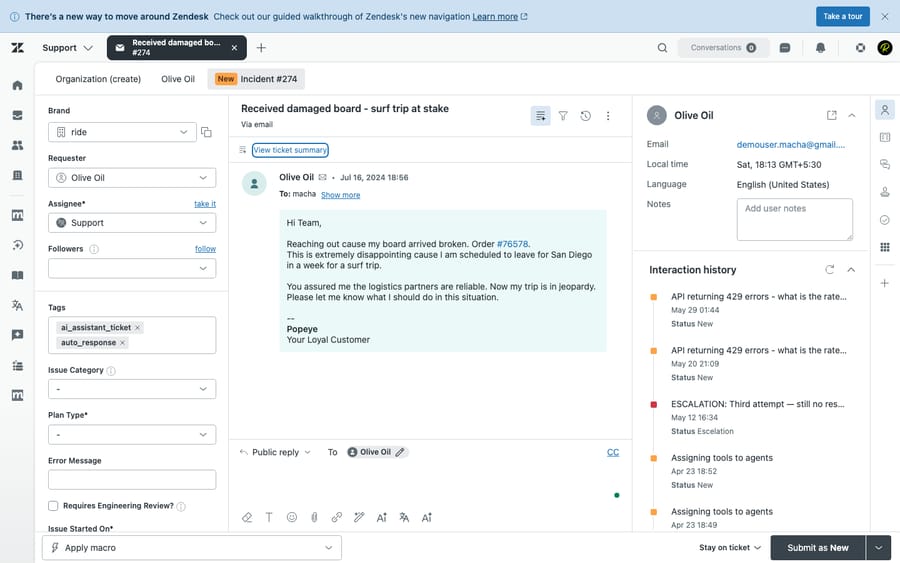
The structural difference most comparisons skip. This isn't really a feature-checklist fight — it's a choice about where support lives. Pylon is built for B2B teams whose customers already live in shared Slack or Teams channels: the conversation happens there, tied to an account and tier, and Pylon adds ticketing structure on top. Zendesk inverts that — it pulls every channel into a structured ticket (above), with a portal, SLAs, and an audit trail as the center of gravity. For a B2B SaaS company managing a few hundred high-value accounts in Slack, Pylon's model feels native and Zendesk's feels heavy. For a company fielding thousands of one-off requests across email, voice, and social from consumers, Zendesk's structure is the point and Pylon's channel model doesn't fit. Pick the shape that matches your customers, not the longer feature list.
Strengths & weaknesses, honestly
Pylon — strengths: best-in-class shared Slack/Teams support; account/tier-native B2B model; modern AI-native architecture; fast setup; transparent lower base pricing; strong Linear/Jira integrations; a 4.9/5 G2 rating (on a small, early review base). Pylon — weaknesses: narrower channel depth (voice/SMS/social aren't its strength, though a Phone add-on now exists); lighter automation and reporting customization; add-on stacking inflates real cost; less proven at extreme volume/enterprise compliance; a younger ecosystem.
Zendesk — strengths: deep, mature ticketing and automation; full omnichannel incl. voice; enterprise scale, compliance, and governance; huge integration marketplace; robust reporting; broad B2C + B2B fit. Zendesk — weaknesses: ticket-centric, not account/Slack-native (Slack is bolted on); AI feels added-on and carries per-resolution overage billing; higher seat cost; slower, heavier implementation; can feel legacy for a modern B2B SaaS motion.
What real users say
The review picture is lopsided, and it's worth being honest about why:
| G2 | Capterra | |
|---|---|---|
| Zendesk | 4.3 / 5 (~7,000 reviews) | 4.4 / 5 (~4,080) |
| Pylon | 4.9 / 5 (~50 reviews) | No meaningful listing* |
\A "Pylon" on Capterra is a solar-design tool, not this B2B support platform — don't be fooled by its stars. The B2B Pylon has effectively no Capterra footprint yet.* Pylon's 4.9 on G2 is genuinely high, but on a small base (~50 reviews) — impressive for a young product, though not the statistically settled signal Zendesk's thousands of reviews provide. Read it as "early customers love it," not "proven at Zendesk's scale."
- Zendesk reviewers praise breadth, ecosystem, and scale, but consistently flag pricing surprises and Zendesk's own support quality — e.g. "Strong value for money considering the wide range of features" (Ifra S., Zendesk developer, Capterra, Dec 2025) versus "Their support is some of the worst I've ever experienced" (Katie Y., Head of Customer Success, Capterra, Mar 2025).
- Pylon reviewers (G2, paraphrased given the small base) praise the Slack-native B2B workflow, fast setup, and responsive team, while wishing its email handling and integration breadth matched its Slack core. Pylon's own case studies are striking but vendor-reported — e.g. Sardine migrated 120,000 tickets in 5 days off Zendesk and reports cutting median first response time from roughly 15 minutes to under a minute — useful as a directional signal, not independent proof.
Who each is genuinely for
- Pylon → B2B/SaaS companies that support customers in shared Slack/Teams channels; modern startups and scale-ups; technical and account-based support where CS, support, and engineering collaborate; teams of ~5–50 agents wanting fast setup and account-tier-driven SLAs; companies tightly integrated with Linear/Jira.
- Zendesk → broad B2C or mixed B2C/B2B high-volume support; contact centers needing voice/SMS/social; enterprises needing deep automation, governance, compliance, and proven scale; teams of 25+ agents with complex multi-channel workflows and mature reporting needs.
Decide by your support motion (not the feature list)
Feature tables flatten a choice that's really about how your customers reach you. Work down this list and stop at the first row that matches — it's a faster, more honest decision than scoring 40 checkboxes:
- Most of your support already happens in customers' Slack/Teams channels? → Pylon. Its account-and-channel model is native here; forcing this into Zendesk's ticket portal fights the grain.
- You support thousands of consumers across email, voice, social, and SMS? → Zendesk. Pylon's channel breadth and voice depth aren't built for high-volume B2C.
- You're a B2B SaaS team where support, CS, and engineering co-own accounts (and live in Linear/Jira)? → Pylon, unless you also need enterprise governance/compliance at scale, in which case Zendesk.
- You need proven scale, deep automation, SLAs, audit trails, and mature reporting? → Zendesk. This is what the premium buys.
- Resolution rate is the real problem on either one? → it's not a desk switch; it's an AI layer (below).
If two rows pull in different directions, that's the signal you're a run-both candidate — Pylon (or Zendesk) for the motion that fits, with the other where it's strongest — rather than a clean either/or.
The AI question — and the long tail neither resolves alone
Both platforms market strong AI, but with different DNA: Pylon is genuinely AI-native (triage, routing, drafting, KB generation, autonomous resolution built into one stack), while Zendesk's AI is broader and handles more edge cases but is bolted onto a ticketing core and priced per resolution with auto-billed overages. The honest, independently-reported reality: both cap around 20–30% real autonomous deflection — neither reliably resolves the long tail end-to-end.
That long tail is exactly where an independent AI agent layer earns its place. A layer like Macha sits on top of either platform, ingests your knowledge base and past tickets, and pushes autonomous resolution higher on the harder tickets the native AI defers to humans — priced per action, helpdesk-agnostic, and not a replacement for your desk. The honest caveat: a layer is one more vendor and integration to manage, it only resolves as well as the knowledge you feed it, and per-action pricing isn't free at high volume — it's additive to your desk, not a shortcut around it. (More: native AI vs. an AI layer.)
Before you switch: migration realities
- To Pylon: it offers full historical data migration and "live in days," and runs migration incentives to pull teams off legacy tools — easiest for Slack-heavy B2B. The key re-map is ticket-based SLAs → account-tier-based SLAs, plus a channel-coverage audit (confirm voice/SMS needs are met by Pylon's Phone add-on).
- To Zendesk: large data volumes (tickets, macros, triggers, Guide articles) make migration heavier, and deep customization creates lock-in; it suits teams consolidating many channels.
- Either direction: re-model cost from one add-on stack to the other (Zendesk seat + Copilot + per-resolution vs Pylon seat + AI Assistants + AI Agents + Account Intelligence).
Frequently asked questions
Is Pylon cheaper than Zendesk? At equal seats, Pylon's base is roughly half Zendesk Suite Professional ($59–$139 vs $115+). But Pylon's add-ons (AI Assistants $50/seat, AI Agents from $100/mo, Account Intelligence $10/account) stack up — model your real configuration.
What is Pylon best at? Supporting B2B customers in shared Slack/Teams channels, with an account-tier-native model and modern AI-native tooling. It's purpose-built for that motion in a way Zendesk isn't.
Is Zendesk better than Pylon? For broad, high-volume, multi-channel CX (voice/SMS/social), deep automation, big ecosystem, and enterprise scale — yes. For Slack-connected B2B support, Pylon is the better fit.
How good is each platform's AI? Both are capable, but independent analysis puts real autonomous resolution around 20–30% for each — neither resolves the long tail alone.
Can I push autonomous resolution higher? Yes — an AI agent layer like Macha sits on top of Pylon or Zendesk and resolves more of the long tail, priced per action.
The bottom line
Choose Pylon if you're a B2B/SaaS team supporting customers in Slack/Teams and want a modern, AI-native tool that's live in days. Choose Zendesk if you need broad, high-volume, multi-channel CX with native voice, deep automation, and enterprise scale. And since both native AIs cap around 20–30% autonomous resolution, an AI layer on top is how you close the long tail on either.
If neither quite fits, it's worth widening the search: teams that want a unified customer timeline instead of a ticket queue should weigh Zendesk vs. Kustomer, and for the full shortlist see our best Zendesk alternatives guide.
Close the long tail on Pylon or Zendesk? See how Macha layers autonomous AI agents over your help desk, priced per action. 7-day free trial, no credit card required. Start Trial.
Add AI agents to your Zendesk
Macha reads the ticket, drafts the reply and takes the action, inside the Zendesk you already run.