Intercom
 Shopify
 Stripe
 Slack
Slack Notion
 Google Workspace
 Confluence

Zendesk AI Pricing Explained (2026): Copilot, Automated Resolutions & the Real Cost


Of all the line items in a Zendesk quote, AI is the one buyers misread most often. It's not a single price, and it's not even a single type of price. Zendesk charges for AI in two completely different ways at the same time — one fixed per seat, one variable per outcome — and the variable one has no natural ceiling. That's why two teams on the same plan can see AI bills that differ by an order of magnitude.

This guide breaks down exactly how Zendesk prices AI in 2026: the Copilot agent-assist add-on, the per-resolution Automated Resolutions meter, what literally counts as a "resolution," the mid-2026 AI-plan consolidation, the other usage meters hiding in your account, and worked examples so you can estimate your real monthly AI spend. It's a spoke off our main Zendesk pricing explained guide — start there for the seat prices; come here for the AI math.
How we sourced this. The Copilot $50/agent price and the included automated-resolution allowances are official, from Zendesk's pricing page and Zendesk's automated-resolutions help doc. The per-resolution dollar rates are a third-party estimate — Zendesk only states that committed usage costs less than overage, so those numbers are flagged as estimates throughout. The screenshots are first-hand from a live Zendesk test account.
The two layers of Zendesk AI (and why it matters)
Everything Zendesk calls "AI" falls into one of two buckets, and they're priced on opposite logic:
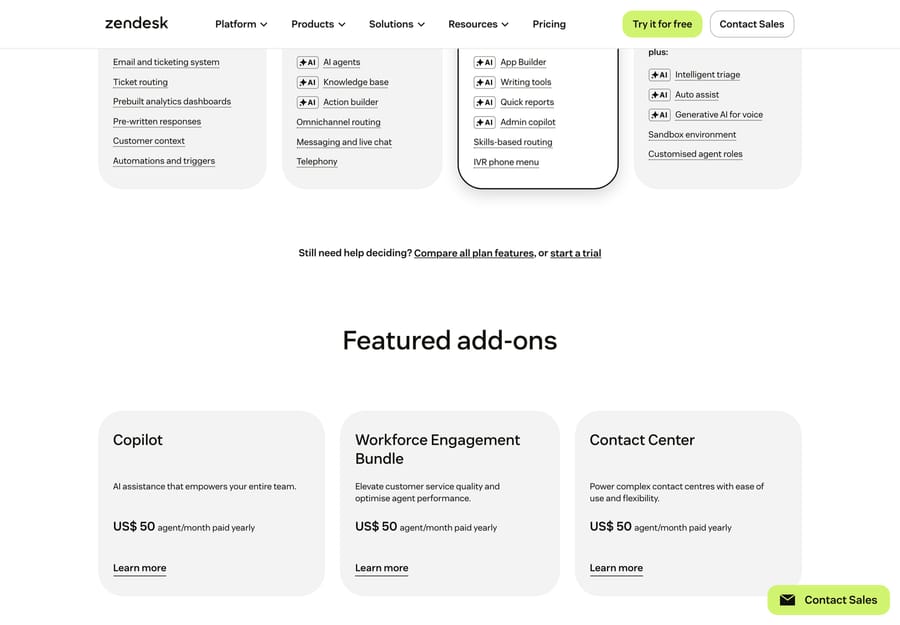
- Copilot — the assistive layer. Priced per seat: a flat $50 per agent per month. It helps your human agents. You pay the same whether they use it 5 times a day or 500. (Copilot is a distinct add-on — not the same thing as Zendesk's autonomous "AI agents," which we cover in Layer 2.)
- Automated Resolutions (AR) — the autonomous layer. Priced per outcome: you pay each time an AI agent closes a customer issue on its own. The more successful it is, the more you pay.
Miss this split and you'll budget wrong in both directions — over-provisioning seats you don't need, or under-provisioning for a resolution meter that grows precisely when things are going well. Let's take them one at a time.
Layer 1: Copilot — $50/agent/mo (official)
Copilot is Zendesk's agent-assist add-on — the layer that helps your human agents inside the agent workspace. It's a separate, per-seat product, and it's easy to confuse with Zendesk's autonomous AI agents (the old "AI agents – Advanced" tier); they are not the same thing, and the autonomous tier's packaging changed in mid-2026 (see the consolidation note below). Copilot itself is still sold as a standalone $50/agent/mo add-on on Zendesk's pricing page. What it includes:
- Agent copilot — suggested replies and next steps drafted for the human agent.
- Intelligent triage — auto-detects intent, language, and sentiment to categorize and route tickets.
- AI-generated replies and rewrite/tone tools.
- Macro and answer suggestions surfaced as the agent types.
The price is $50 per agent per month on an annual contract (official), and it requires Suite Professional or higher to add on. So a Suite Professional seat ($115) effectively becomes $165/agent/mo once Copilot is on. On the top tier it's folded in as the "Suite Enterprise + Copilot" bundle.
The thing to internalize: Copilot cost is predictable. It's a seat multiplier. Twenty agents with Copilot is $1,000/month, full stop, regardless of how heavily they lean on it. That predictability is the opposite of the second layer.
Freshness note: the mid-2026 AI-agent consolidation (rollout May–June 2026)
Here's the packaging change most older write-ups get wrong. In a June 2026 announcement, Zendesk began folding its autonomous "AI agents – Advanced" capabilities into the Suite and Support plans rather than selling them as a separate add-on. Per the announcement, the rollout was phased from May 11 to June 12, 2026, and it removes the old split between "Essential" and "Advanced" AI agents — capabilities that used to require the AI agents – Advanced add-on (agentic reasoning, multi-step procedures, external API integrations) are now included across Suite and Support plans.
Two clarifications, because the naming trips people up:
- This consolidation is about the autonomous AI-agent (Advanced) tier — the thing that produces automated resolutions (Layer 2). It is not a change to Copilot.
- Copilot is unchanged and still separate. It remains the agent-assist add-on at $50/agent/mo (official) on Zendesk's pricing page. Copilot is not a rebrand of "Advanced AI."
What didn't change with this rollout: automated resolutions are still metered and billed per outcome (Layer 2 below). Folding the capability into plans isn't the same as making the resolutions free — the per-resolution meter and its allowances still apply. As with all Zendesk AI packaging, this moves fast, so confirm current packaging in your own quote before you budget.
Layer 2: Automated Resolutions — priced per outcome
When a customer-facing AI agent resolves an issue without a human touching it, Zendesk counts that as one automated resolution (AR) — and AR is the unit it bills autonomous AI on. Each plan tier ships with a small included allowance per agent per month (official, from Zendesk's AR help doc):
| Plan tier | Included automated resolutions |
|---|---|
| Team | 5 per agent/mo |
| Growth & Professional | 10 per agent/mo |
| Enterprise | 15 per agent/mo |
A couple of official details that catch teams out:
- The allowance is pooled and capped annually at roughly 10,000 allocated automated resolutions per year.
- Unused resolutions expire — annually, or when your subscription ends. You don't bank them.
Once you've burned through the allowance, you pay per resolution beyond it. Here Zendesk gets vague: its docs only say committed usage (buying 100+ resolutions in advance) costs less per resolution than overage (pay-as-you-go) — it doesn't publish the rates. Third-party teardowns consistently land on:
| Mode | Per-resolution rate (third-party estimate) |
|---|---|
| Committed (bought ahead, 100+) | ~$1.30–$1.50 |
| Overage / pay-as-you-go | ~$2.00 |
(These dollar figures are estimates from sources like eesel, Voiceflow, and CorePiper — confirm them in your own quote.) As of January 2026, overage is reportedly auto-billed each month with no built-in cap unless you negotiate one into the contract (third-party). That's the line item most likely to surprise you: it scales with how well your AI performs.
Copilot and Zendesk’s other AI/CX capabilities are sold as separate add-ons — each per agent, on top of your base plan:
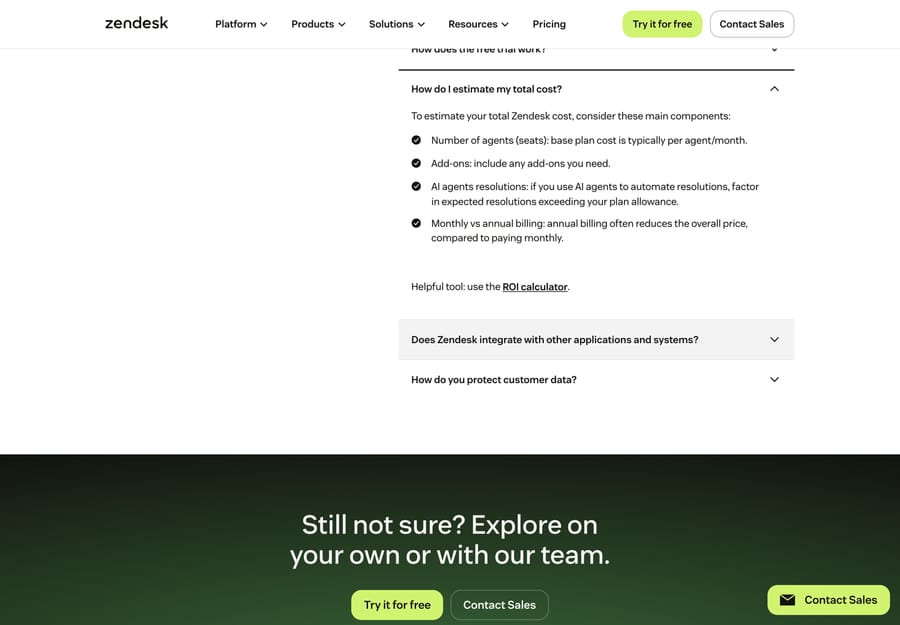
What actually counts as an "automated resolution"
This is the most important — and least understood — part of Zendesk AI pricing, because it defines what you're billed for. The definition is official, from Zendesk's AR help doc, and it differs by channel.
Messaging (chat/social). For advanced AI agents, the conversation is evaluated 2 hours after the customer's first message by default — configurable up to a 72-hour maximum (not a flat 72-hour window). At that evaluation point a resolution counts when AI evaluation has confirmed the response was relevant, and the last interaction includes one of:
- the user gave positive or no feedback, or
- the user clicked at least one help-center article link the AI shared (for article recommendations; generative replies don't require a click), or
- the user completed the final step of an answer flow.
(Note: older/essential messaging agents used a 72-hour inactivity window. The configurable 2-hour-to-72-hour evaluation applies to advanced AI agents — verify the window set on your account.)
Email & web form. A resolution counts after 72 hours of inactivity when all of these hold:
- the AI agent provided a generative reply to the customer's question,
- the user gave positive or no feedback,
- no human agent responded to the ticket, and
- AI evaluation confirmed the response was relevant.
Two practical takeaways. First, the 72-hour window plus the "no human reply" rule means a ticket a human later touches doesn't count — you're billed only for genuinely hands-off closures, which is fair. Second, "no feedback" still counts as a resolution. A customer who never replies (whether satisfied or because they gave up) can be billed as resolved, as long as AI verification passes. That's worth watching when you reconcile the meter against actual satisfaction.
2026 update: "verified resolutions" and the three resolution tiers (Relate 2026)
This is the most important recent change to how the AR meter behaves, so price it in. At Relate 2026, Zendesk leaned hard into outcome-based pricing — CEO Tom Eggemeier's framing was that "the era of the chatbot... is over" — and on May 18, 2026 it rolled out a three-tier model that decides which AI-agent interactions actually count against your allowance (per Zendesk's automated-resolution-tiers help doc):
- Assisted Escalation — the AI agent contributed, but a human finished the resolution. Free — doesn't draw down your allowance.
- Contained Resolution — the AI handled the interaction to completion and the customer didn't ask for more help, but it wasn't independently verified. Free.
- Verified Resolution — the AI resolved the issue and a separate LLM evaluation model independently confirmed it (within a 72-hour window). This is the only tier that counts against your allowance and is billed.
The practical effect: Zendesk now bills only for resolutions that pass a second, independent AI verification — a tighter bar than the older "no feedback still counts" behaviour. The committed-vs-overage rates above (~$1.50 vs. ~$2.00, third-party estimate) still apply, but they now apply to verified resolutions only. Zendesk has signalled this "pay for outcomes, not licenses" model is the platform's direction of travel and is transitioning to it gradually — so confirm exactly which billing model and tier definitions your contract is on before you budget.
The other AI meters in your account
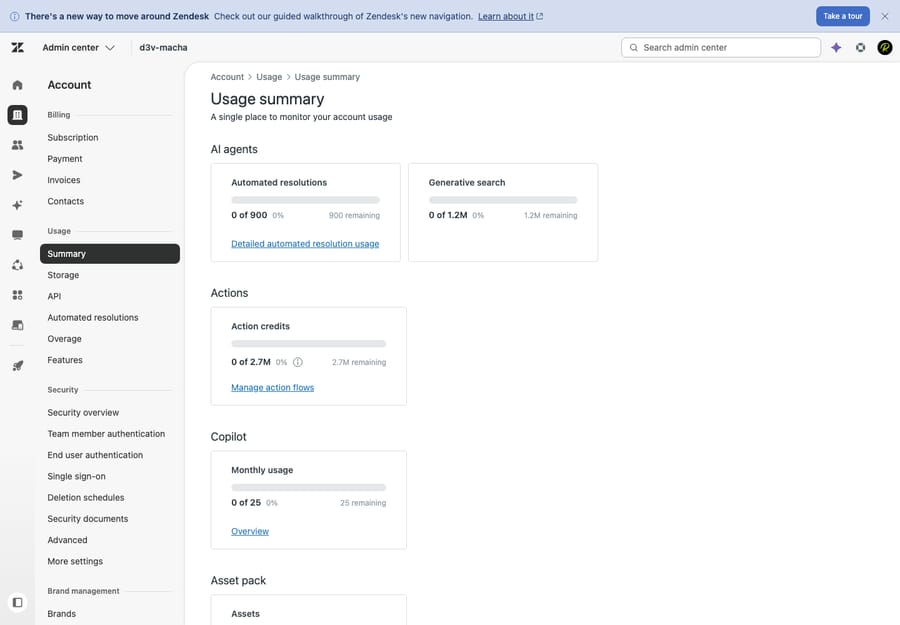
Copilot and Automated Resolutions get the headlines, but Zendesk's in-product Usage summary meters several AI activities, each drawing down its own allowance:
- Automated resolutions — the autonomous-AI meter above.
- Generative search — AI-generated answers in search/help-center experiences.
- Action credits — consumed when AI agents take actions (e.g., calling APIs or running steps in a flow).
- Copilot monthly usage — tracks Copilot consumption against your seats.
You won't see most of these on the marketing page; you see them in-product, after you've signed. The screenshot below is the Usage menu on our test instance.
Where to check this in your own account: your plan and seat count live in Zendesk under Admin Center → Account → Billing → Subscription. The metered AI charges are tracked separately under Admin Center → Account → Usage — look for Automated resolutions and any Overage. The takeaway: agent seats are billed on your plan, while AI automated resolutions accrue as usage on top — so your real bill is "seats + usage," not just the sticker price.
A worked example: 20 agents, Suite Professional + Copilot
Let's put real numbers on the AI portion of a bill. Assume a 20-agent team on Suite Professional with the Copilot add-on, and an AI that handles ~500 automated resolutions a month.
| AI line item | Monthly |
|---|---|
| Copilot add-on — 20 × $50 (official) | $1,000 |
| Included automated resolutions — 20 × 10 | 200 included (free) |
| Overage — 300 resolutions @ ~$1.50 committed (estimate) | ~$450 |
| AI cost (on top of seats) | ~$1,450/mo |
(The 20 Suite Professional seats themselves are another 20 × $115 = $2,300/mo; this table isolates the AI cost.)
The per-resolution math is the part to feel. Your first 200 resolutions are "free" (already paid for in seats), so the marginal cost of AI is zero — until you cross the allowance. After that, every additional resolution costs ~$1.50–$2.00. Push volume to 1,000 resolutions/month and the overage line jumps to 800 × ~$1.50 = ~$1,200; at 2,000 it's ~$2,700. The Copilot half stays flat at $1,000 the whole time.
That's the defining feature of Zendesk's AI pricing: the bill grows as the AI succeeds. A great month for deflection is, by design, a more expensive month.
Two more scenarios: a small team and an enterprise
The shape of the bill changes a lot with size, because the included allowance scales with seats while the overage scales with volume. Here are two more illustrative runs (illustrative, not a quote — Copilot $50 and the 5/10/15 allowances are official; per-resolution rates are third-party estimates):
Small team — 5 agents on Suite Team, ~150 automated resolutions/mo. Team includes 5 ARs per agent/mo, so 5 × 5 = 25 included.
| AI line item | Monthly |
|---|---|
| Copilot add-on — 5 × $50 (official) | $250 |
| Included automated resolutions — 5 × 5 | 25 included (free) |
| Overage — 125 resolutions @ ~$1.50 committed (estimate) | ~$188 |
| AI cost (on top of seats) | ~$438/mo |
Note: Copilot requires Suite Professional or higher, so a true Team-plan shop may not be able to add Copilot at all — in that case the AI bill is just the overage line (~$188), and the assist layer isn't on the table until you upgrade.
Enterprise — 50 agents on Suite Enterprise + Copilot, ~3,000 automated resolutions/mo. Enterprise includes 15 ARs per agent/mo, so 50 × 15 = 750 included.
| AI line item | Monthly |
|---|---|
| Copilot add-on — 50 × $50 (official) | $2,500 |
| Included automated resolutions — 50 × 15 | 750 included (free) |
| Overage — 2,250 resolutions @ ~$1.50 committed (estimate) | ~$3,375 |
| AI cost (on top of seats) | ~$5,875/mo |
At enterprise volume the overage line overtakes Copilot — the per-outcome meter, not the per-seat fee, becomes the thing to forecast and negotiate (committed pricing and a contractual overage cap both matter here). For a deeper breakdown of the non-AI costs that stack alongside all of this — escalation clauses, implementation, monthly-billing premiums — see what Zendesk really costs.
The honest take
Zendesk's two-layer model has a clear logic, and it cuts both ways:
- Copilot (per seat) is predictable but blunt. You pay $50/agent whether an agent uses it constantly or never. For a team that genuinely lives in the workspace, it's good value; for one that doesn't, it's $50 × headcount of partly-idle license.
- Automated Resolutions (per outcome) is "fair" but unpredictable. You only pay when AI actually closes something — but the meter has no natural ceiling, overage can be auto-billed, and your cost rises with your success. Budgeting it means forecasting volume you don't fully control, and "no feedback = resolved" can inflate the count relative to true satisfaction.
Neither is wrong. But if your reason for reading this is that the per-resolution meter is the part scaring your budget, it's worth knowing the autonomous-AI layer doesn't have to come from your help desk — and doesn't have to be priced per vendor-defined outcome.
Where an AI agent layer fits — priced per ticket, not per resolution
This is an AI-cost question, so here's the direct answer: autonomous resolution is a feature you can add on top of Zendesk rather than buy inside it. An AI agent layer like Macha runs on top of Zendesk (no migration — you keep your desk, tickets, and workflows) and resolves tickets end-to-end. The difference is the pricing model.
It helps to separate three things AI can do:
- Deflection — stopping a ticket from reaching a human.
- Resolution — closing a ticket the customer raised.
- Automation — doing any step of the work: summarizing, tagging, triaging, looking up an order in another system, drafting, or fully resolving.
Zendesk's AR meter prices the resolution outcome specifically. Macha is built for the broader automation category, so it bills per ticket — one conversation between the agent and one person, charged once however many messages, lookups or drafts it takes, and whichever model it runs on. Pricing starts at $299 a month for 750 tickets, about $0.40 each. You pay the same whether the thread ends in a full resolution or a summarize-and-route — which is the point: there is no vendor-defined outcome to argue about, and no per-model rate to optimise. (More on how this compares natively: Zendesk AI vs. an AI agent layer.)
The honest watch-outs, because this isn't free magic:
- It's another vendor and integration to set up and maintain alongside Zendesk.
- It's only as good as the knowledge you connect — point it at thin or stale docs and resolution quality suffers, same as any AI.
- Volume still costs money. A flat per-ticket rate is more predictable than an uncapped per-resolution meter, but it isn't zero — model your ticket volume either way.
If the AI line is the part of your Zendesk bill you want to get off the per-outcome treadmill, that's the trade to weigh. $50 of free usage, no credit card required — start a trial and run it on top of your existing Zendesk.
Frequently asked questions
How much does Zendesk AI cost? Two layers. Copilot (the agent-assist add-on) is $50/agent/mo (official) on Suite Professional or higher. Automated Resolutions are billed per outcome: each tier includes 5–15 free resolutions per agent/month, then you pay roughly $1.30–$2.00 per resolution beyond that (third-party estimate; committed is cheaper than overage). Your total AI cost is the seat-based Copilot fee plus the variable resolution meter.
What's the difference between Zendesk Copilot and Automated Resolutions? Copilot is assistive and priced per seat — it helps human agents (drafts, triage, suggestions). Automated Resolutions is autonomous and priced per outcome — you pay when an AI agent closes a customer issue without a human. They're separate products, billed separately.
How many automated resolutions are included in my plan? Per agent per month: 5 on Team, 10 on Growth/Professional, 15 on Enterprise (official). The allowance is pooled and capped at ~10,000 allocated resolutions/year, and unused resolutions expire annually or when your subscription ends.
What counts as an automated resolution? Official definition: for messaging (advanced AI agents), the conversation is evaluated 2 hours after the customer's first message by default — configurable up to a 72-hour maximum — plus AI relevance verification plus positive/no feedback (or an article-link click, or a completed answer flow). For email/web, a generative reply plus a 72-hour inactivity window plus positive/no feedback plus no human reply plus AI verification. Notably, "no feedback" still counts as resolved.
Why did my Zendesk AI bill spike? Almost always the Automated Resolutions overage. Once you cross the included allowance, every extra resolution is billed (~$1.50–$2.00, third-party estimate), and overage is auto-charged with no cap unless you negotiated one. The bill grows as the AI deflects more — by design.
Is Zendesk AI worth it, or should I use a separate AI agent layer? Copilot is hard to beat for in-workspace human assist. For autonomous resolution, the per-outcome meter is what makes cost unpredictable — which is why some teams keep Copilot and run an AI agent layer (priced per ticket) on top for the autonomous work. See Zendesk AI vs. an AI agent layer and the best Zendesk AI agents.
The bottom line
Zendesk AI pricing is two meters, not one price: a fixed $50/agent Copilot fee for assisting humans, and a variable per-resolution charge for autonomous AI that includes 5–15 free resolutions per agent and then bills ~$1.50–$2.00 each (estimate) with no real cap. The official numbers — Copilot's price, the allowances, the resolution definition — are knowable; the total isn't, because it scales with success. Model your resolution volume before you sign, decide whether autonomous AI should live inside the desk or as a per-ticket layer on top, and you'll budget — and negotiate — from solid ground. For the full plan-by-plan picture, head back to the Zendesk pricing pillar.
Copilot pricing and automated-resolution allowances verified against Zendesk's official pricing page and AR help doc, June 2026; per-resolution dollar rates are third-party estimates, flagged inline. Zendesk changes AI packaging frequently — confirm current numbers in your quote before budgeting.
Add AI agents to your Zendesk
Macha reads the ticket, drafts the reply and takes the action, inside the Zendesk you already run.