Intercom
 Shopify
 Stripe
 Slack
Slack Notion
 Google Workspace
 Confluence

Yellow.ai: The Complete Guide (2026)


If you're evaluating enterprise conversational AI to automate customer service across chat and voice, Yellow.ai is one of the biggest names you'll run into. It's a broad, build-your-own agentic AI platform that Yellow.ai says is used by 1,100+ enterprises worldwide, and it's designed to handle massive interaction volumes across dozens of channels and languages. This complete 2026 guide covers what Yellow.ai actually does, how its AI works, what it costs, its honest pros and cons, who it fits best, and how it compares to alternatives — including where a leaner, help-desk-native tool like Macha may be a better fit.

We researched pricing and reviews in July 2026. Yellow.ai doesn't publish public pricing, so the figures below are third-party estimates, clearly flagged as such, with sentiment drawn from current G2 and Capterra reviews.
What Yellow.ai is
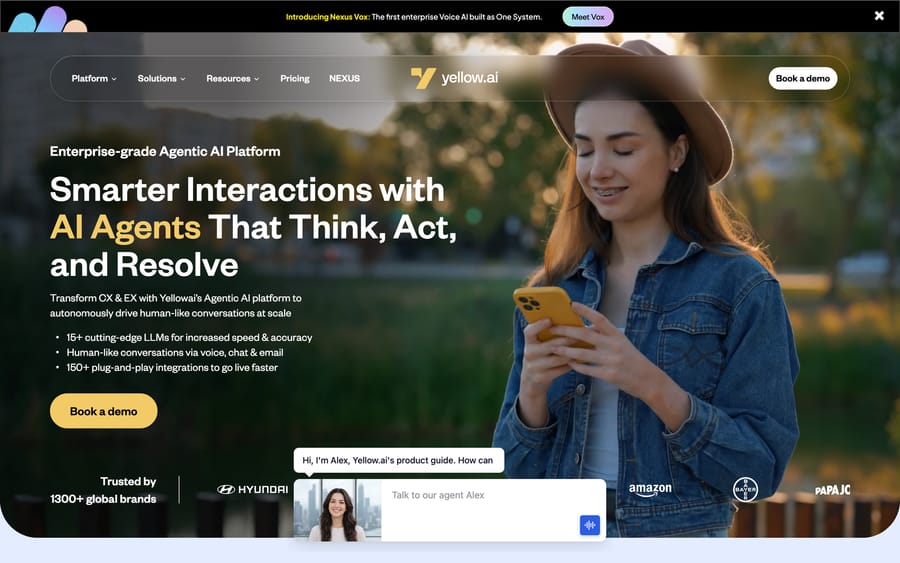
Yellow.ai's homepage — agentic AI for customer service across channels.
Yellow.ai is an enterprise conversational and agentic AI platform for automating both customer experience (CX) and employee experience (EX). At its core, it lets you build AI agents ("bots") that handle customer conversations across chat and voice, deployed to wherever your customers are — websites, apps, WhatsApp, IVR/phone, social channels, and more. The company positions the product as an end-to-end automation layer that spans marketing, commerce, support, and internal HR/IT service desks, rather than a point solution for a single channel.
The pitch is breadth and scale. Yellow.ai spans 35+ channels and 135+ languages, and it's built to handle enterprise-grade volumes — the company says its models are trained on 16 billion-plus conversations annually and reports headline outcomes like up to 60% lower operational costs, 50% higher agent efficiency, and roughly 97% intent accuracy for well-tuned deployments. Those are vendor figures, so treat them as best-case marketing benchmarks rather than guaranteed results, but they signal the segment Yellow.ai plays in: large, high-volume operations where even single-digit percentage gains translate into real money.
Yellow.ai is used across retail and e-commerce, BFSI (banking, financial services, and insurance), utilities, telecom, healthcare, and logistics, with BFSI historically its largest revenue segment because of demand for secure, compliant, 24/7 automated support. Named customers include Sony, Domino's, Hyundai, Coca-Cola, Mondelēz, Tata Motors, and Union Bank of the Philippines, among a roster the company puts at 1,100–1,300+ enterprises depending on the source and date.
Importantly, Yellow.ai is a standalone platform you build on, not a plugin that sits on top of an existing help desk. You design conversation flows, connect it to your systems, and deploy and operate your own bots. That's the single most important architectural fact to internalize: with Yellow.ai you are standing up a new automation platform and owning its lifecycle, not switching on automation inside a help desk you already run.
The Dynamic Automation Platform
Yellow.ai's overall product is branded the Dynamic Automation Platform (DAP). The idea is a single low-code environment where a team can discover automation opportunities, build agents visually, connect them to enterprise systems, ship them across channels, and then measure and tune performance — all without spinning up a separate tool for each stage. In practice DAP bundles the bot-building studio, the analytics layer, the integration catalog, and the voice and chat runtimes into one console. Because everything lives in one place, DAP is genuinely powerful for a central automation or CX-engineering team that owns bots across many business units; the flip side is that it's a platform to be administered, with the staffing and governance that implies.
How Yellow.ai's AI works
Yellow.ai combines a proprietary NLP engine with modern large-language-model capabilities, and in the last couple of years it has leaned hard into an agentic, multi-LLM architecture rather than a single fixed model.
- Orchestrator LLM — arguably Yellow.ai's flagship differentiator. Rather than treating each user message in isolation, the Orchestrator LLM reads the whole conversation, keeps a memory window of prior turns, and drives toward the customer's underlying goal. It can recognize multiple intents in a single utterance, decide which conversational flow or backend tool to trigger, and handle mid-conversation topic switches — looping back to the original request without losing the thread. Notably, Yellow.ai markets it as requiring no training data: it reasons over context instead of relying on exhaustively labeled intent examples. This is what "agentic" concretely means here — the model plans and routes, not just replies.
- Multi-LLM routing — Yellow.ai does not lock you to one foundation model. The platform can route different tasks to different underlying LLMs (its own and third-party models), which lets teams balance cost, latency, and quality per use case.
- DynamicNLP — its longer-standing proprietary natural-language engine, which uses zero-shot learning to recognize common intents without exhaustive training data. It predates the LLM wave and still underpins fast, deterministic intent matching in many flows.
- Agentic RAG — retrieval-augmented generation grounded in your knowledge base (help-center articles, PDFs, internal docs), so answers cite your own content instead of hallucinating. This is the mechanism behind "answer from our docs" behavior.
- Agentic AI lifecycle — a structured workflow spanning discover, build, respond, debug, test, measure, and analyze, so teams manage bots end-to-end inside one methodology rather than ad hoc.
The build experience centers on a drag-and-drop studio with flow diagrams and reusable nodes, so teams can design conversation logic visually rather than writing everything in code. When visual flows aren't enough, custom scripting is available via Node.js, which is where more complex integrations and business logic tend to live.
VoiceX: Yellow.ai's voice AI
Voice is a genuine strength and a major reason large enterprises pick Yellow.ai. Its voice product, VoiceX, is an LLM-powered voice platform built for autonomous, human-like phone conversations rather than rigid IVR menus. Yellow.ai emphasizes:
- Ultra-low latency so exchanges feel like real-time speech, not a delayed bot.
- Seamless multi-turn conversations where the agent handles interruptions, follow-ups, and back-and-forth without dropping context.
- Accent, tone, and language robustness — the agent is designed to understand many languages and accents and to handle tricky inputs like spelled-out phonetic alphabets (useful for order numbers, names, and postal codes).
- Deep backend integration — for example, Yellow.ai describes a Sony voice deployment integrated directly with Sony's CRM so the voice agent can look up, record, and personalize using live customer data.
Typical VoiceX use cases are IVR replacement, outbound campaigns (reminders, collections, renewals), and voice-based verification/authentication. If phone is a first-class channel for you — common in BFSI, telecom, and utilities — this is where Yellow.ai clearly out-scopes most help-desk-native automation tools.
Enterprise integrations, deployment, and channels
Yellow.ai ships 150+ prebuilt integrations into CRMs (e.g., Salesforce), CCaaS/contact-center stacks, help desks (Zendesk, Freshdesk, and others), ITSM tools, and core business systems, plus REST APIs and webhooks for anything not covered out of the box. On channels, the 35+ it supports include web chat, in-app messaging, WhatsApp and other messaging apps, SMS, email, social platforms, and voice/IVR — the breadth that makes it "omnichannel" in a real sense.
On deployment, Yellow.ai is sold as enterprise SaaS (it's also listed on AWS Marketplace), with the security and compliance posture large buyers expect — SOC 2, ISO certifications, GDPR/HIPAA considerations, and options around data residency for regulated industries. Rollouts are typically managed or co-delivered: because you're building bots and wiring integrations, most non-trivial deployments involve Yellow.ai's professional-services or partner teams and a multi-week-to-multi-month implementation, not a same-day switch-on.
Key features
- Orchestrator LLM — context-aware, multi-intent, no-training conversation orchestration.
- VoiceX voice AI — low-latency, human-like voice agents for IVR replacement, outbound, and verification.
- Omnichannel chat + voice across 35+ channels and 135+ languages.
- Drag-and-drop bot builder with flow diagrams, prebuilt nodes, and Node.js scripting.
- Agentic RAG to ground answers in your own knowledge base.
- Multi-LLM flexibility plus the proprietary DynamicNLP engine.
- Analytics dashboards with real-time trend monitoring and performance tuning.
- 150+ integrations into CRMs, CCaaS, help desks, ITSM, and enterprise systems.
- Human handoff to live agents for complex issues.
- Employee-experience (EX) automation for HR and IT service desks, not just customer support.
Yellow.ai pricing
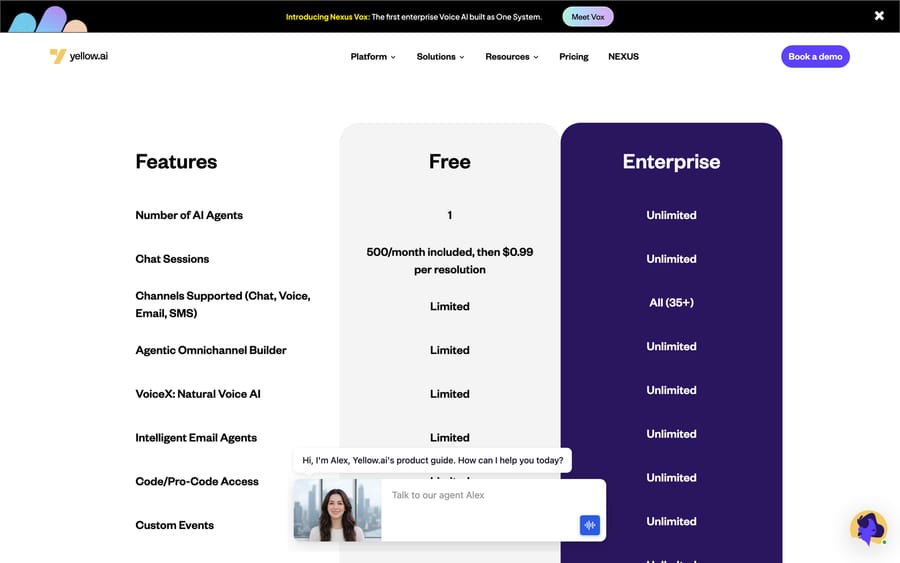
Yellow.ai's pricing page — quote-based, with no public list prices or tiers.
Yellow.ai uses custom, quote-based pricing — nothing meaningful is published publicly, and you'll need a demo or sales conversation to get real numbers. This is normal for the enterprise conversational-AI category (Kore.ai and Cognigy operate the same way), but it does mean you can't self-serve or comparison-shop a list price. Cost is driven by:
- Interaction volume — the biggest lever, typically measured as monthly tracked users (MTU) or total conversations/sessions. Voice minutes are usually metered separately from chat sessions.
- Channels deployed — each additional channel (WhatsApp, voice/IVR, social) can add cost and setup.
- Deployment model — chat-only vs. voice, self-serve vs. fully managed, and the depth of custom integrations and professional services.
- Add-ons and support tier — premium support, SLAs, data-residency, and advanced security options.
Because so much is bundled into a negotiated contract, two companies with similar ticket volumes can land on very different numbers depending on channel mix and services.
Third-party estimates (not official)
Based on third-party sources — clearly not Yellow.ai's own figures:
- Small deployments: roughly $100–$300 per month.
- Enterprise deployments with voice bots and multiple channels: typically $500–$5,000+ per month, and materially higher for global, high-volume voice programs.
Treat these as directional only. Because pricing scales with volume and channels, high-traffic voice deployments land at the top of that range or well beyond it, and enterprise annual contracts are common — third-party marketplace listings have put annual costs anywhere from roughly $10,000 to $58,000+. Note too that cost is a recurring theme in critical reviews — some customers feel the value doesn't always match the price, especially once implementation and services are factored in — so it's worth pressure-testing any quote against your realistic 12-month volume projection and asking exactly what a "conversation" or "tracked user" means in the contract.
What reviewers say: Yellow.ai holds 4.4 out of 5 from 106 reviews on G2 and 4.5 out of 5 from 37 reviews on Capterra, both checked 21 September 2026. That is a genuinely large sample for this category, and the two scores landing within 0.1 of each other makes it one of the more reliable review signals in this series.
Pros and cons
Pros
- Strong voice AI (VoiceX) — few competitors match its low-latency, multi-turn voice agents; a real edge for phone-heavy operations.
- Orchestrator LLM — context-aware, multi-intent handling with no training data is a genuine step beyond older intent-tree chatbots.
- User-friendly builder — reviewers like the drag-and-drop studio, flow diagrams, and clickbox functions for designing conversations without deep engineering.
- Real-time dashboards — trend monitoring and analytics that leaders find easy to read.
- 24/7 automation at scale — genuinely built for high volume; strong when you're a global enterprise fielding millions of interactions.
- Broad channel + language coverage — few platforms match its 35+ channels and 135+ languages, including robust voice.
- Deep enterprise adoption — a reported 1,100+ enterprises and marquee logos across BFSI, retail, and telecom.
Cons
- Support and communication complaints — a recurring theme in reviews, with mentions of slow responses and high staff turnover; one reviewer described months of delays without a working product.
- Bot reliability / context loss — some users report bots losing context or misfiring on intent matching, and instability when new features are added.
- Vendor lock-in concerns — reviewers flag difficulty migrating away, including cases where Yellow.ai holds the WhatsApp number, making it cumbersome to switch providers.
- Cost and opaque pricing — high pricing is a common complaint, compounded by quote-only pricing that makes budgeting and comparison hard.
- Build and maintenance effort — as a build-your-own platform, meaningful setup, ongoing tuning, and dedicated ownership are required; it's not "set and forget."
- Overkill for single-help-desk teams — if all your support lives in one Zendesk or Freshdesk inbox, standing up a full platform is more than the job needs.
Who Yellow.ai is best for
Yellow.ai shines for large, global enterprises with high interaction volumes and multi-channel, multi-language needs — especially where voice automation is a core requirement. If you're a retail, BFSI, healthcare, or logistics brand fielding millions of conversations across chat and phone in many markets, Yellow.ai has the breadth and scale to handle it.
It's a weaker fit if you're a smaller team that wants fast time-to-value without a heavy build, if your support lives inside a single help desk (like Zendesk or Freshdesk) and you'd rather automate it there than stand up a separate platform, or if you're wary of long implementation timelines and vendor lock-in.
Customers and verticals
Yellow.ai's adoption skews toward large, regulated, high-volume industries where automation ROI is easy to justify:
- Banking and financial services (BFSI) — historically its biggest segment. Union Bank of the Philippines used Yellow.ai's low-code platform to scale self-service, reportedly growing chatbot adoption from ~28,000 to ~120,000 users per month while cutting operating costs to serve by around 51%. Secure, compliant, always-on support is the core draw here.
- Retail and e-commerce — brands like Domino's, Coca-Cola, and Mondelēz use it for order tracking, promotions, and high-volume seasonal support across chat and messaging channels.
- Telecom and utilities — voice-first, high-call-volume environments where VoiceX-style IVR replacement and outbound campaigns (billing reminders, renewals) pay off.
- Automotive, electronics, and manufacturing — Sony, Hyundai, and Tata Motors appear among named customers, with Sony highlighted for deep CRM-integrated voice automation.
- Healthcare and logistics — appointment handling, status queries, and 24/7 multilingual coverage.
The common thread: these are enterprises fielding millions of interactions across multiple channels, markets, and languages — exactly the profile Yellow.ai is engineered for.
Yellow.ai vs. alternatives (including Macha)
Yellow.ai competes with other broad conversational/agentic AI platforms, and — depending on your use case — with lighter help-desk-native tools.
| Tool | Core approach | Voice | Setup effort | Pricing model | Best for |
|---|---|---|---|---|---|
| Yellow.ai | Standalone build-your-own agentic platform | Yes (strong) | High (build + maintain) | Custom, volume-based | Large global enterprises, multi-channel + voice |
| Kore.ai | Enterprise conversational AI platform | Yes | High | Custom (quote) | Large enterprises building complex assistants |
| Cognigy | Enterprise conversational + voice AI | Yes (strong) | High | Custom (quote) | Contact-center / CCaaS-heavy enterprises |
| Ada | No-code CX automation platform | Limited | Medium | Custom (quote) | Mid-market/enterprise chat automation |
| Macha | AI agent layer on top of your help desk | No (text-first) | Low (connect + build in plain English) | From $299/mo for 750 tickets (~$0.40/ticket) | Zendesk/Freshdesk teams automating email + chat fast |
Here's the honest positioning, since Macha is our product: Macha and Yellow.ai aren't the same kind of tool. If you need a broad multi-channel voice-and-chat platform to build custom bots for millions of interactions across many markets, Yellow.ai (or Kore.ai / Cognigy) is the right category — not us. Macha solves a narrower, deliberately simpler problem: it's an AI agent layer that runs on top of the help desk you already use — Zendesk or Freshdesk — and resolves inbound email and chat tickets where they already live. You build agents in plain English, connect custom tools to your systems, and you're billed per ticket on one published plan (from $299/month for 750 tickets) rather than by enterprise contract — you can see how our pricing works. For teams whose whole world is a support inbox and who want automation live in days rather than a multi-month platform build, that's a very different — and often faster — path than standing up Yellow.ai. If you genuinely need voice and dozens of channels, Yellow.ai is built for that and we're not; pick the tool that matches the use case.
The two platforms most often shortlisted against Yellow.ai both have full guides here: Kore.ai, which competes with it directly on enterprise breadth and voice, and Cognigy, which publishes far more about how its agents are actually built.
How we researched this: The features, pricing and customer figures above come from Yellow.ai's own public pages and the third-party sources linked inline, checked when this guide was researched in August 2026. This pass, on 21 September 2026, re-checked the post's links, added the review figures quoted above and cross-referenced our guides to the closest alternatives; it did not re-price the plans against Yellow.ai's site, so read the pricing as accurate to August 2026 rather than to today. Both sites block scripted requests, so those figures were read in a real browser session on 21 September 2026.
Frequently asked questions
What does Yellow.ai do? Yellow.ai is an enterprise conversational and agentic AI platform for automating customer and employee experience. You build AI agents that handle chat and voice conversations across 35+ channels and 135+ languages, grounded in your knowledge base.
How much does Yellow.ai cost? Yellow.ai uses custom, quote-based pricing tied to interaction volume, channels, and deployment model. Third-party estimates put small deployments around $100–$300/month and enterprise voice-plus-multi-channel deployments at roughly $500–$5,000+/month. Confirm current pricing directly with Yellow.ai.
Does Yellow.ai support voice? Yes, and it's a core strength. Its VoiceX platform provides LLM-powered, low-latency voice agents that handle multi-turn conversations, understand many languages and accents, and can integrate with backend systems like CRMs. Common uses are IVR replacement, outbound campaigns, and voice-based verification.
What is the Orchestrator LLM? It's Yellow.ai's context-aware conversation engine. Rather than matching one message at a time, it reads the whole conversation, retains a memory of prior turns, recognizes multiple intents, and routes to the right flow or tool — handling topic switches without losing the customer's original goal, and reportedly without requiring training data.
Does Yellow.ai integrate with Zendesk or Freshdesk? Yes. Yellow.ai offers 150+ prebuilt integrations, including help desks like Zendesk and Freshdesk, plus CRMs, CCaaS/contact-center tools, and REST APIs. That said, Yellow.ai is a standalone platform you connect to your help desk, not automation that runs natively inside it — which is the key architectural difference from a help-desk-native tool.
How long does Yellow.ai take to implement? It varies by scope. A simple chat bot can go live quickly, but most enterprise deployments — multiple channels, voice, and deep integrations — involve professional services and a multi-week to multi-month rollout. Plan for ongoing tuning and dedicated ownership, since it's a platform to operate rather than a switch to flip.
Who is Yellow.ai best for? Large, global enterprises with high interaction volumes and multi-channel, multi-language needs — particularly those in BFSI, retail, telecom, and utilities that require voice automation alongside chat.
What are the best Yellow.ai alternatives? Broad-platform alternatives include Kore.ai, Cognigy, and Ada. For teams that just want to automate ticket-based support inside an existing help desk without a heavy build, an AI agent layer like Macha addresses a different, narrower use case — automating email and chat where they already live, priced per ticket.
Sources
Resolve tickets automatically with AI agents
Macha's AI agents work on top of the help desk you already use — no code.