Intercom
 Shopify
 Stripe
 Slack
Slack Notion
 Google Workspace
 Confluence

What Are the Best Yellow.ai Alternatives in 2026?


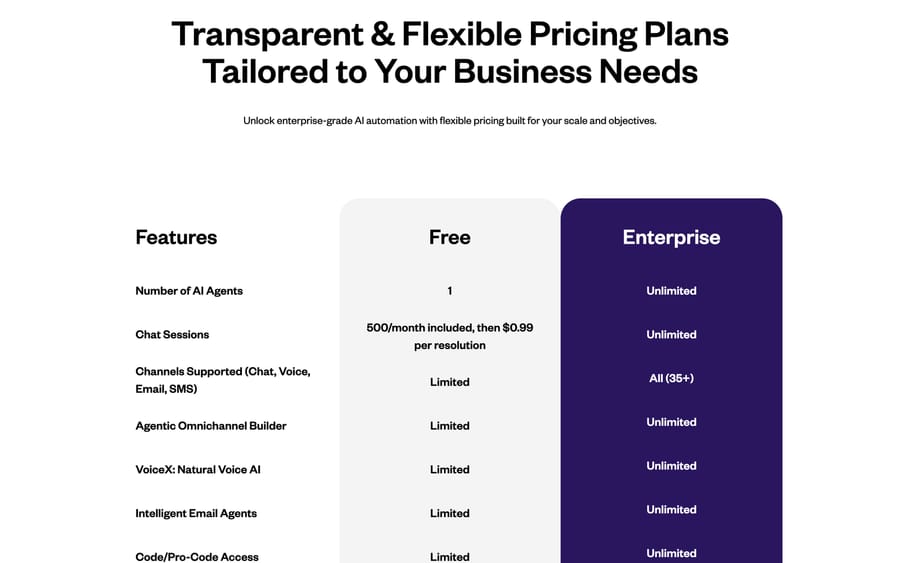
Yellow.ai's AWS Marketplace listing prices its Basic plan at $10,000 a year for one chatbot use case and its Standard plan at $25,000 for four, and its own pricing page sells everything beyond a free tier by quote. The closest like-for-like alternatives are Kore.ai and NiCE Cognigy for voice-heavy enterprise contact centers, with Ada for chat-first CX teams. If you don't need a whole conversational platform, Google's Conversational Agents, Botpress and Retell AI publish usage prices you can start on today, and Intercom Fin, Macha or Zendesk's own agent will automate tickets inside the help desk you already run.
Key takeaways
- The best Yellow.ai alternatives in 2026 are Kore.ai, NiCE Cognigy and Ada for enterprise platforms, Google Conversational Agents, Botpress and Retell AI for usage pricing, and Intercom Fin, Macha and Zendesk for help-desk agents.
- Yellow.ai's AWS Marketplace listing charges $10,000 for 12 months on the Basic plan with one use case and $25,000 on the Standard plan with four, with conversation limits that the listing doesn't print.
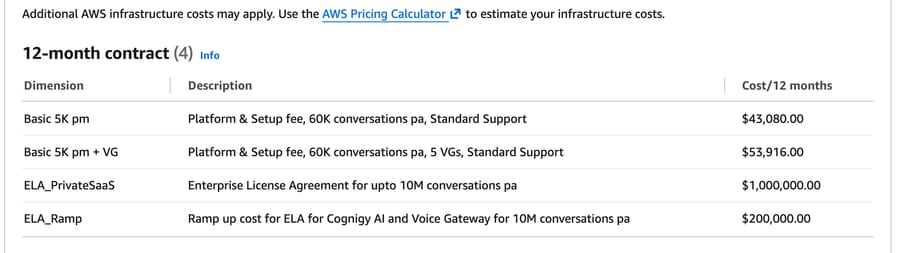
- NiCE Cognigy's AWS listing sells 60,000 conversations a year for $43,080, which works out to about $0.72 a conversation, or $53,916 with five voice gateways added.
- At 5,000 chat conversations a month, the published prices on this page run from about $210 on a purely deterministic Google Flows agent to about $7,667 on Kore.ai's AWS terms.
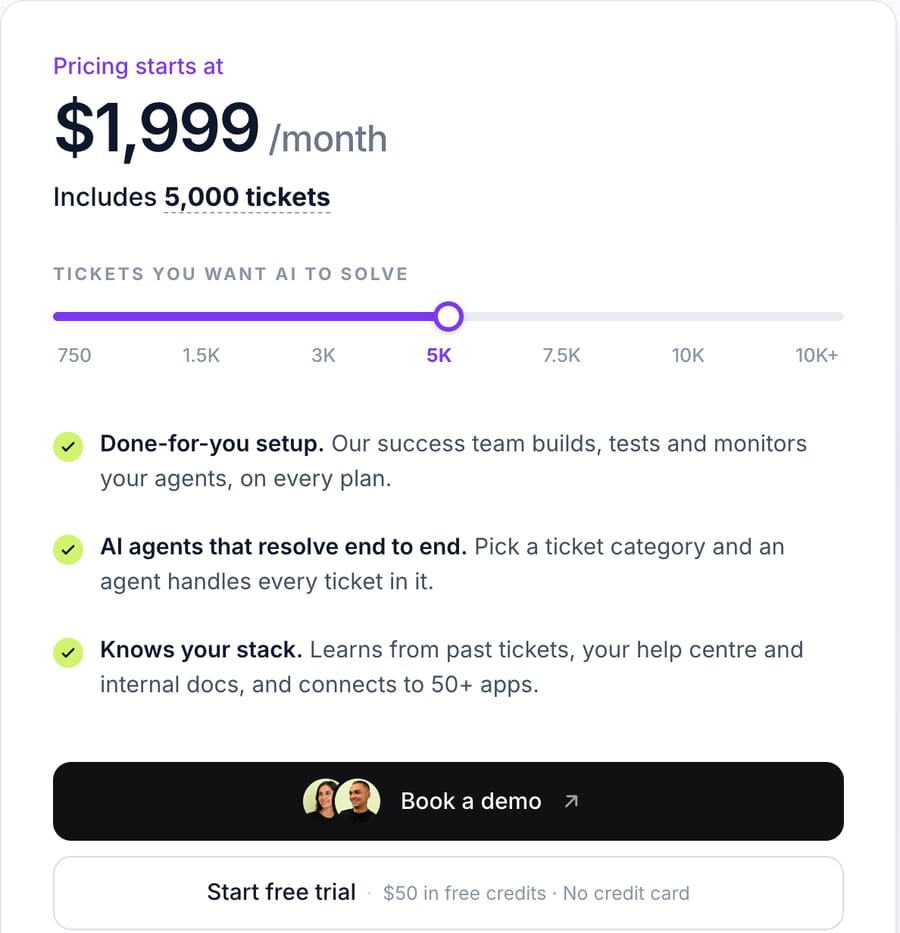
- Macha bills about $0.40 per ticket on a plan that starts at $299/month for 750 tickets, and 5,000 tickets a month costs $1,999 with setup by Macha's team included.

How do the Yellow.ai alternatives compare at a glance?
Nine tools in three groups: enterprise platforms that compete with Yellow.ai head-on (1 to 3), build-it-yourself tools with public usage pricing (4 to 6), and agents that work inside a help desk (7 to 9).
| Tool | Billing unit | Published entry price | Voice | Free start | Main watch-out |
|---|---|---|---|---|---|
| Yellow.ai (the baseline) | Per resolution (Free); contract (Enterprise) | Free: 500 chat sessions a month, then $0.99 per resolution; AWS Basic $10,000/yr | Yes, VoiceX | Free plan | Enterprise is quote-only; reviewers report slow implementations |
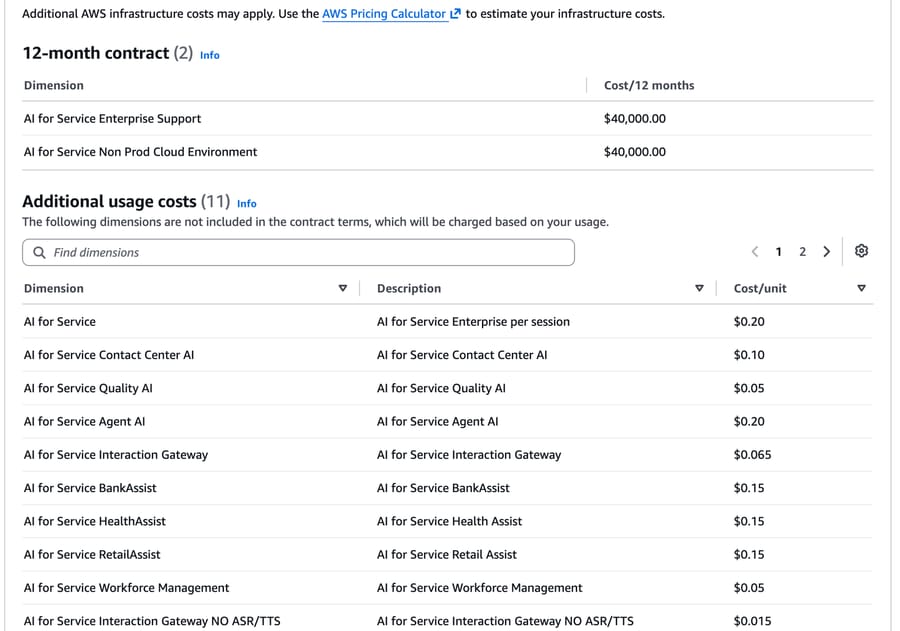
| 1. Kore.ai | Per session plus fixed fees | $0.20 per session + $80,000/yr in fixed AWS fees | Yes | None listed | Fixed fees land before the first session |
| 2. NiCE Cognigy | Annual conversation bundle | $43,080/yr for 60,000 conversations (AWS) | Yes, via voice gateways | None listed | You pay for the full 60,000 whether you use them or not |
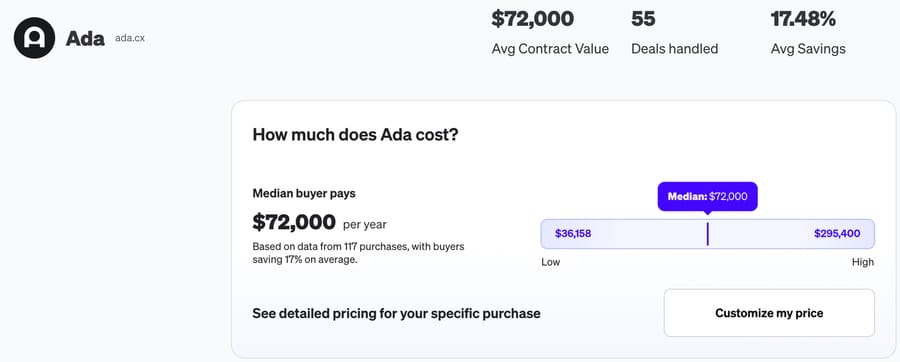
| 3. Ada | Annual contract | No list price; Vendr median $72,000/yr | Not published | Demo only | No public price at all |
| 4. Google Conversational Agents | Per request (chat) or per second (voice) | $0.007 per request (Flows), $0.012 (Playbooks) | Yes, $0.001 to $0.002 a second | $600 to $1,000 in credits | You build and host the agent yourself on Google Cloud |
| 5. Botpress | Per conversation | $150/mo for 250 conversations (annual) | Enterprise plan only | 25 conversations free | Auto-adds paid packs at 95% of quota |
| 6. Retell AI | Per minute (voice), per message (chat) | $0.07 to $0.31 a minute | Yes, voice-first | $10 in credits | Voice cost depends on the model and voice you pick |
| 7. Intercom Fin | Per outcome | $0.99 per outcome, 50-outcome monthly minimum off Intercom | Fin Voice by sales | 14-day trial (Intercom desk) | Standalone Fin on another desk is "Contact sales" |
| 8. Macha | Per ticket | $299/mo for 750 tickets | No | $50 of usage, no card | Text channels only; SOC 2 still in progress |
| 9. Zendesk AI agents | Per automated resolution | $1.50 committed, $2.00 pay-as-you-go | Not on this rate | 14-day Suite trial | Runs on Zendesk alone, and seats are billed separately |
Prices are as published on each vendor's page or AWS listing when we read them on October 5, 2026, except Zendesk (September 25). Confirm before you buy.
Disclosure: Macha publishes this blog and is entry 8 in this list. It's described on the same five points as every other tool and carries its own "where it falls short" line.
Why do teams look for a Yellow.ai alternative?
Credit first. Yellow.ai does a lot that most tools on this page don't. Its pricing page lists 35+ channels on Enterprise across chat, voice, email and SMS, 150+ out-of-the-box integrations, VoiceX for phone agents, and a separate employee-experience product for HR and IT desks. Its homepage lists SOC 2 Type II, ISO 27001, ISO 27701, HIPAA and PCI-DSS v4.0.1. For a bank or a telecom that needs one vendor to run WhatsApp, IVR and web chat in a dozen languages, that breadth is the point. Our Yellow.ai guide covers the platform itself in detail.
The reasons teams look elsewhere are mostly about price shape, delivery and fit:
- The real price is a contract. The pricing page has two columns: Free and "Contact us." The only list prices for a paid deal are on Yellow.ai's AWS Marketplace listing: $10,000 for 12 months on a Basic plan with one chatbot use case, or $25,000 for four. Both come with "tiered conversation limits" that the listing doesn't print, so you can't work out a per-conversation cost before you talk to sales.
- The sales math assumes a lot of automation. The savings calculator on the same pricing page defaults to a 90% target automation rate and, on its default inputs, shows $346,154 of first-year savings. That's the vendor's number, built to sell an annual contract. Ticket queues with refunds, account changes and angry follow-ups rarely automate at 90%, so check the quote against a rate you'd actually hit.
- Implementations can drag. The G2 reviews shown on Yellow.ai's AWS listing include a July 2024 review from Brandon S.: "We still don't have a working product and it's been almost 5 months," on a rollout he says was meant to take six weeks. Another, from Martin M. in July 2026, is titled "Atrocious Support Ruins the Experience." Not every review reads like that. An airline reviewer on the same listing wrote, "The chat bot is great! we can reach 95% deflection rates!" Overall, Yellow.ai held 4.4 out of 5 from 106 G2 reviews when we checked in September.
- The company is changing shape. Yellow.ai agreed in August 2026 to go public through a merger with Bluerock Acquisition Corp. and has said it plans to buy outsourced contact-center (BPO) operators. A vendor that also owns the agents answering your phones earns on software and staffing at once, so expect managed, services-heavy deals to get more attention than self-serve ones.
- It's a platform, not a feature. If all your support lives in one Zendesk or Freshdesk inbox, standing up a separate bot platform with its own flows, integrations and admin is more than the job needs.

How we chose and compared these alternatives
We included a tool if it can stand in for the job Yellow.ai is usually bought for: an AI agent that answers customers over chat, messaging or voice, uses your knowledge and backend systems, and hands off to a person when it should. Tools that only route tickets or only draft replies for a human were left out. Each entry is described on the same five points:
- What it is, in one or two sentences.
- Billing unit and entry price, quoted from the vendor's page or AWS listing on the access date.
- Voice and channels, because voice is the main reason teams pick Yellow.ai in the first place.
- Who it fits.
- Watch-out, the thing most likely to make it the wrong choice.
We didn't rank by star ratings. Several of these vendors sell mostly by contract and have small or old review samples, and G2 blocks automated reads. Where we quote a review, it's one shown on a public AWS listing with the reviewer's name and date. Sierra and Decagon also compete for Yellow.ai's enterprise deals, but neither publishes a price; we cover them in our Sierra alternatives roundup.
Which enterprise platforms compete directly with Yellow.ai?
These three sell the way Yellow.ai sells: annual contracts, implementation help, and enough channel and voice coverage to replace it across a contact center.
1. Kore.ai
What it is: an enterprise conversational AI platform with voice, chat and agent-assist products, sold in packaged editions such as AI for Service, plus industry versions for banking, healthcare and retail. Kore.ai's own site sells by demo and prints no prices.
Billing unit and entry price: the AWS Marketplace listing for AI for Service is the clearest public number. It charges $0.20 per enterprise session, plus two fixed 12-month fees of $40,000 each for enterprise support and a non-production cloud environment. Add-ons are metered separately: Contact Center AI at $0.10, Agent AI at $0.20, the Interaction Gateway at $0.065, and the BankAssist, HealthAssist and RetailAssist packs at $0.15 each.
Voice and channels: voice, chat and agent assist, with the contact-center pieces priced as separate dimensions.
Who it fits: large enterprises, especially in banking and healthcare, that want Yellow.ai's breadth with a pre-built industry pack and are already buying through AWS.
Watch-out: the $80,000 a year in fixed fees arrives before the first session, so Kore.ai only gets cheaper per conversation at very high volume. Our Kore.ai alternatives roundup runs the numbers at several volumes, and the Kore.ai guide covers the platform.
2. NiCE Cognigy
What it is: a conversational AI platform for contact centers, now owned by NiCE, with strong voice support through its own Voice Gateway. It's the tool most often shortlisted against Yellow.ai for phone-heavy operations.
Billing unit and entry price: an annual bundle of conversations. The AWS listing sells "Basic 5K pm" at $43,080 for 12 months, covering the platform, setup, standard support and 60,000 conversations a year. Adding five voice gateways makes it $53,916. At the top end the listing shows an Enterprise License Agreement for up to 10 million conversations a year at $1,000,000, plus a $200,000 ramp-up fee.
Voice and channels: voice is a core strength, and the Voice Gateway is priced right there on the listing.
Who it fits: contact centers that run a lot of phone traffic and want a known annual cost. Of the enterprise platforms here, it's the only one whose AWS listing ties the price to a stated conversation count.
Watch-out: a bundle bills the same whether you use 60,000 conversations or 20,000. The Basic tier works out to about $0.72 a conversation if you use all of them, and more if you don't. See the Cognigy guide for how its agents are built.
3. Ada
What it is: an AI customer service agent platform, chat-first and sold to mid-market and enterprise teams by demo. Ada's pricing page is a demo request form that asks for your expected contact volume, starting with a "0 - 99,999" band.
Billing unit and entry price: no list price. Vendr's Ada page puts the median buyer at $72,000 a year from 117 purchases, with a range of $36,158 to $295,400. Vendr describes the structure as a platform fee tied to conversation volume bands, plus implementation.
Voice and channels: chat and messaging are the core, and Ada's public pages we read don't price voice separately.
Who it fits: CX teams that want Yellow.ai-style automation without its voice-and-IVR focus, and are comfortable with an annual contract.
Watch-out: you can't model the cost before a sales call, and Vendr's range spans roughly eight times from low to high. Our Ada alternatives roundup compares it against ten agents.
Which alternatives publish usage pricing you can start on today?
These three are lighter. They don't come with Yellow.ai's implementation team, but they print a price per unit, and you can sign up and build this afternoon. The incentive is the mirror image of the enterprise group: they earn when you use more, not when you sign for more.
4. Google Conversational Agents (Dialogflow CX)
What it is: Google Cloud's agent builder, in two editions. Flows (the product long known as Dialogflow CX) are deterministic agents built from intents and pages. Playbooks are generative agents written as natural-language instructions, with data stores for your knowledge.
Billing unit and entry price: per request for chat and per second of audio for voice. Google's pricing page lists $0.007 per request on Flows and $0.012 on Playbooks, and $0.001 or $0.002 per second for voice. Data store indexing is free up to 10 GiB a month. New users get $600 in Flows credits and $1,000 in Playbooks credits, valid for 12 months.
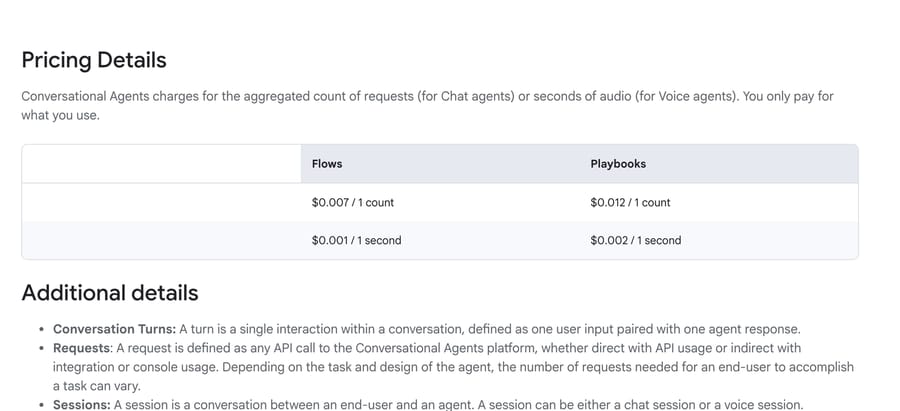
Voice and channels: yes. A voice turn is billed on listening time plus the length of the spoken reply, rounded up to the second.
Who it fits: teams with engineers on Google Cloud who want the cheapest per-conversation cost here and are happy to own the build.
Watch-out: one billing rule catches people out. If a Playbook calls a Flow at any point, every turn in that conversation is billed at the Playbook rate. And there's no implementation team in the price: the low unit cost assumes you build, test and maintain the agent yourself.
5. Botpress
What it is: a bot-building platform with a visual studio, its own help desk and webchat, and a managed "built for you" service.
Billing unit and entry price: per conversation, with AI usage included up to a limit. The pricing page lists Free at $0 for 25 conversations, Plus at $150 a month billed annually for 250 conversations, and Team at $750 a month billed annually for 1,500. Extra conversations come in packs of 100 for $65 on Plus and $50 on Team. Botpress counts any exchange with at least two messages from the customer as a conversation, and 3 minutes of a voice call as one.
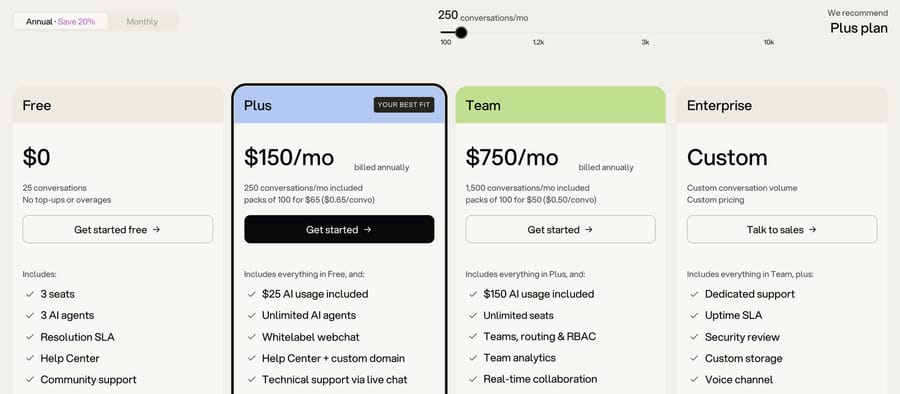
Voice and channels: WhatsApp from Plus up, but the voice channel is listed only on Enterprise.
Who it fits: small and mid-sized teams that want a configurable chat agent on web and WhatsApp with a predictable monthly bill.
Watch-out: at 95% of your quota, Botpress automatically adds a pack of 100 conversations, and packs persist month to month until you remove them. Botpress argues on the same page that resolution pricing "raises your bill when your bot gets smarter," which is the same incentive point this post makes about per-resolution vendors. Our Botpress pricing breakdown has more.
6. Retell AI
What it is: a voice-first agent platform for phone calls, with chat agents as a second product. It's the most direct answer to "we only bought Yellow.ai for VoiceX."
Billing unit and entry price: per minute for voice and per message for chat. The pricing page lists $0.07 to $0.31 a minute for voice agents and $0.002 and up per message for chat agents, with $10 in free credits and 20 concurrent calls included. The per-minute price is built from parts: $0.055 a minute for Retell's voice infrastructure, $0.015 to $0.040 for the voice, and the language model on top.
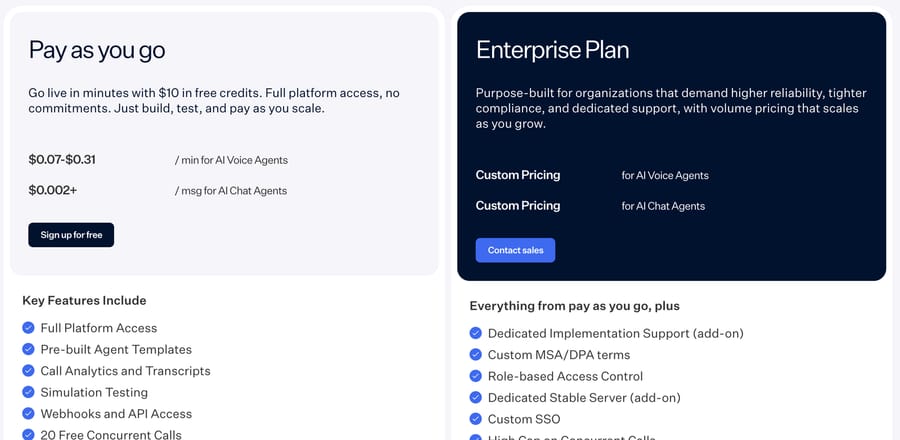
Voice and channels: phone is the product. Bring-your-own SIP trunking isn't charged for telephony.
Who it fits: teams whose main Yellow.ai use case is inbound or outbound calls (appointment reminders, order status by phone, first-line triage) and who'd rather pay by the minute than sign a platform contract.
Watch-out: a 3-minute call costs $0.21 at the floor and $0.93 at the top of the range, so the model you choose decides the bill. Chat and email ticketing aren't its core. See our Retell AI pricing breakdown.
Which AI agents work inside the help desk you already run?
If your customers mostly email or chat and your team already lives in a help desk, a separate bot platform is the long way round. These three work on the tickets where they already sit.
7. Intercom Fin
What it is: Intercom's AI agent, sold on Intercom's own help desk or on top of another one. Salesforce completed its acquisition of Fin on September 10, 2026.
Billing unit and entry price: per outcome. The Fin pricing page lists $0.99 per outcome with your current help desk and a 50-outcome monthly minimum, or from $0.99 per outcome plus a help desk seat on Intercom. Intercom's normal Essential seat is $29 billed annually; the page showed $19 when we loaded it, which matches a lower price Intercom has been testing. Salesforce cites a 76% average resolution rate for Fin, which is a vendor figure.

Voice and channels: the page lists tickets, email, live chat, WhatsApp and SMS. Fin Voice is sold through sales.
Who it fits: teams that want to pay only when the agent finishes the job, particularly ones already on Intercom.
Watch-out: standalone Fin on another help desk is "Contact sales," and an outcome includes completed workflows that end in a handoff. Our Fin guide explains what counts.
8. Macha
What it is: this is our product. Macha is an AI agent layer that connects to Zendesk, Freshdesk, Gorgias, Front, HubSpot or Intercom over each desk's API. An agent is written instructions plus the tools it's allowed to use: read the ticket and its history, search connected knowledge, look up an order in Shopify or a payment in Stripe through built-in connectors, then post a reply or internal note, tag, or update fields. Systems without a built-in connector are added as a custom API tool that Macha's team sets up during onboarding. See Macha on Zendesk for how it sits in a desk.
Billing unit and entry price: per ticket. A ticket is one thread between Macha and one person, charged once no matter how many messages it takes. The tiers are $299 a month for 750 tickets, $599 for 1,500, $1,199 for 3,000, $1,999 for 5,000, $2,999 for 7,500 and $3,999 for 10,000, with custom pricing above that, which is about $0.40 per ticket at every tier, billed monthly. Seats are unlimited and there are no overages: agents pause at the limit unless you add a top-up. Setup and monitoring by the Macha team are included. The trial is $50 of free usage (about 125 tickets), no credit card, no time limit.
Voice and channels: text only. Email and chat tickets in your help desk, plus Macha's own website chatbot and live chat. On Zendesk, Macha's Messaging trigger fires on messages arriving through Zendesk messaging, which covers WhatsApp, Messenger, Instagram, LINE, Telegram and web chat.
Who it fits: teams already running one of the desks above whose tickets need the agent to act (find the order, check the charge, tag and route) and who want the agent built with them rather than a platform to staff. Against Yellow.ai's AWS terms, the comparison depends on your volume and channel mix: Macha's 750-ticket tier costs $3,588 a year, under the $10,000 Basic plan, and you can see the cost of any volume on the pricing page before you talk to anyone.
Where it falls short: no voice, so a team that bought Yellow.ai for VoiceX should look at Retell AI, Cognigy or Kore.ai instead. It doesn't build standalone bots for channels outside a help desk, and there's no employee-experience product. It has no G2 or Capterra profile to check us against. And our security page says SOC 2 certification is in progress with completion expected in December 2026, while Yellow.ai already lists SOC 2 Type II, ISO 27001 and PCI-DSS.
9. Zendesk AI agents
What it is: Zendesk's native AI agents for messaging and email, part of its Suite plans. Zendesk also bought Forethought, completing the deal on March 26, 2026.
Billing unit and entry price: per automated resolution. Zendesk's pricing page lists $1.50 per committed automated resolution and $2.00 pay-as-you-go, with 5 included automated resolutions per agent a month on Suite Team and 10 on Suite Professional (up to 10,000 a year). Since May 18, 2026 only verified resolutions count against the allowance, per Zendesk's automated resolution tiers article. Suite Team is $55 per agent a month billed annually.
Voice and channels: Zendesk messaging (which carries WhatsApp and social channels) and email. Phone isn't part of this per-resolution rate.
Who it fits: teams fully on Zendesk who want one vendor and one bill.
Watch-out: it's the highest per-resolution rate on this page, the seats come on top, and it works only in Zendesk. Zendesk's pricing page served local currency from our location on October 5, so the rates above are from our September 25 reading of the US page.
What does each alternative cost at 5,000 conversations a month?
Here's one worked example. A team handles 5,000 chat conversations a month (60,000 a year, which happens to be exactly Cognigy's Basic bundle). We assume six customer turns per conversation and that the AI fully resolves 40% of them, or 2,000. Both figures are synthetic assumptions, not customer data. Seats, implementation and taxes are left out unless the vendor bundles them.
| Tool | How it's billed at this volume | Monthly cost |
|---|---|---|
| Google Conversational Agents, Playbooks | 5,000 × 6 requests × $0.012 | $360 |
| Google Conversational Agents, Flows (purely deterministic; any turn using a data store, generator or generative fallback bills at $0.012) | 5,000 × 6 requests × $0.007 | $210 |
| Yellow.ai, AWS Basic | $10,000 / 12, one use case, conversation limit not printed | $833 (if 5,000 fits the limit) |
| Macha | 5,000-ticket tier | $1,999 |
| Intercom Fin, on another help desk | 2,000 outcomes × $0.99 | $1,980 |
| Botpress Team, annual | $750 + 35 packs × $50 | $2,500 |
| Zendesk AI agents, committed | 2,000 × $1.50, plus seats | $3,000 + seats |
| NiCE Cognigy Basic, AWS | $43,080 / 12 | $3,590 |
| Ada | Vendr median $72,000 / 12, not volume-specific | about $6,000 |
| Kore.ai AI for Service, AWS | 5,000 × $0.20 + $80,000 / 12 | $7,667 |
Google is cheapest by a wide margin, and every dollar of build and maintenance work sits outside the table. The per-outcome tools (Fin, Zendesk) get more expensive as the agent gets better, because a higher resolution rate means more billable outcomes. And the enterprise contracts (Cognigy, Ada, Kore.ai) price in implementation and support that the usage tools don't, which is what Yellow.ai's own Enterprise quote will be competing with. For a longer look at how help-desk-native and standalone pricing diverge, see help desk AI vs a standalone AI agent.
Voice changes the math. A 3-minute call costs $0.36 on Google's Playbooks voice rate, $0.21 to $0.93 on Retell AI, and counts as one conversation on Botpress Enterprise. Macha doesn't handle calls, so it isn't a candidate for that line of the budget.
How do you choose a Yellow.ai alternative?
Start with the channel that carries most of your volume, then the buying model you can live with:
- Phone is the main channel and you want a contract: NiCE Cognigy or Kore.ai. Cognigy prints a conversation count; Kore.ai's per-session price is lower but carries $80,000 a year of fixed fees.
- Phone is the main channel and you'd rather pay by the minute: Retell AI, or Google's voice agents if you have engineers on Google Cloud.
- Chat and messaging across many channels, enterprise procurement: Ada, or stay on Yellow.ai and negotiate with the AWS figures in hand.
- Chat on your website and WhatsApp, small team, fixed budget: Botpress.
- Email and chat tickets in a help desk you already run: Intercom Fin if you want to pay per outcome, Zendesk AI agents if you're all-in on Zendesk, or Macha if you want a per-ticket agent that takes actions and is built with you.
If you're coming from a different enterprise vendor, our eesel AI alternatives roundup covers the smaller help-desk agents in more depth.
Where Macha fits
Macha fits teams already running Zendesk, Freshdesk, Gorgias, Front, HubSpot or Intercom whose Yellow.ai deployment is really a ticket-automation project: email and chat questions about orders, refunds, accounts and subscriptions. The agent reads the ticket, looks up the order through the Shopify connector or the charge through the Stripe connector, and replies or hands off inside the desk; anything else with an API is added as a custom API tool that Macha's team sets up during onboarding. At 5,000 tickets a month it's the $1,999 tier, about $0.40 per ticket, with setup and monitoring included. If voice or IVR replacement is a core requirement, it isn't the right tool. You can test it on your own tickets with $50 of free usage (about 125 tickets), no credit card, no time limit.
Frequently asked questions
What are the best Yellow.ai alternatives? For enterprise contact centers, Kore.ai, NiCE Cognigy and Ada. For usage-priced builds, Google Conversational Agents, Botpress and Retell AI. For automation inside an existing help desk, Intercom Fin, Macha and Zendesk AI agents. The right one depends mostly on whether voice is a core channel.
How much does Yellow.ai cost? Yellow.ai's pricing page lists a Free plan with 1 AI agent and 500 chat sessions a month, then $0.99 per resolution, and an Enterprise plan by quote. Its AWS Marketplace listing prices a 12-month Basic plan with one use case at $10,000 and a Standard plan with four use cases at $25,000.
What is the cheapest Yellow.ai alternative? On published prices, Google's Conversational Agents: $0.007 per chat request on Flows or $0.012 on Playbooks, about $210 to $360 a month at 5,000 six-turn conversations. The $210 assumes a purely deterministic Flows agent: Google bills any turn that uses a data store, generator or generative fallback at the $0.012 Playbook rate, so an agent that answers from your knowledge base costs the $360 line. You build and maintain the agent yourself, so engineering time is the real cost.
Which Yellow.ai alternative is best for voice? NiCE Cognigy and Kore.ai for enterprise contact centers on annual contracts, and Retell AI for pay-as-you-go phone agents at $0.07 to $0.31 a minute. Botpress includes voice only on its Enterprise plan.
Is Kore.ai or Cognigy cheaper than Yellow.ai? On AWS list prices, no at the entry level. Yellow.ai's Basic plan is $10,000 a year, Cognigy's Basic is $43,080 for 60,000 conversations, and Kore.ai's AI for Service carries $80,000 a year in fixed fees plus $0.20 a session. Yellow.ai's limits aren't printed, so the comparison only holds if your volume fits its tier.
Can I use Yellow.ai with Zendesk? Yes. Yellow.ai lists help desks including Zendesk among its integrations, but it runs as a separate platform connected to the desk. Agents that work inside the desk, such as Zendesk AI agents, Intercom Fin or Macha, act on the ticket directly.
How we researched this
- Sources and access dates: Yellow.ai pricing and homepage; Yellow.ai's AWS Marketplace listing, including the G2 reviews it displays; Kore.ai AI for Service on AWS; NiCE Cognigy on AWS; Vendr's Ada page and ada.cx/pricing; Google Conversational Agents pricing; Botpress pricing; Retell AI pricing; Fin pricing; Macha pricing and security. All were read and screenshotted on October 5, 2026 in a US-locale browser.
- Earlier readings: Zendesk's AI agent rates, included resolutions and Suite Team price come from our September 25, 2026 reading of the US pricing page, because zendesk.com served local currency from our location on October 5. Yellow.ai's 4.4 out of 5 from 106 G2 reviews was read on September 21, 2026 for our Yellow.ai guide. Vendr has no Yellow.ai page, so there's no third-party contract median for Yellow.ai here.
- Vendor self-reports: Yellow.ai's savings calculator figures ($346,154 first-year savings at a 90% automation target), its channel, integration and certification counts, and Salesforce's 76% Fin resolution rate are the vendors' own claims. Vendr's Ada median is Vendr's aggregate of buyer data, not an Ada price.
- Arithmetic: Cognigy per conversation: $43,080 / 60,000 = $0.718. Cost table: Google Playbooks 5,000 × 6 × $0.012 = $360; Flows 5,000 × 6 × $0.007 = $210; Yellow.ai $10,000 / 12 = $833; Fin 2,000 × $0.99 = $1,980; Botpress (5,000 − 1,500) / 100 = 35 packs × $50 = $1,750, plus $750 = $2,500; Zendesk 2,000 × $1.50 = $3,000; Cognigy $43,080 / 12 = $3,590; Ada $72,000 / 12 = $6,000; Kore.ai 5,000 × $0.20 = $1,000, plus $80,000 / 12 = $6,667, total $7,667. Macha's 750-ticket tier: $299 × 12 = $3,588. Voice: Google 180 seconds × $0.002 = $0.36; Retell 3 × $0.07 = $0.21 and 3 × $0.31 = $0.93.
- What we ran and what we didn't: this page compares published pricing, AWS listings and documentation. We didn't run Yellow.ai, any alternative or Macha for it. The 5,000 conversations, six turns and 40% resolution rate are synthetic assumptions, not customer data.
To see per-ticket pricing on your own tickets, start a trial with $50 of free usage (about 125 tickets), no credit card, no time limit; every tier is on the pricing page.
Resolve tickets automatically with AI agents
Macha's AI agents work on top of the help desk you already use — no code.