Intercom
 Shopify
 Stripe
 Slack
Slack Notion
 Google Workspace
 Confluence

Intercom Fin AI Explained (2026): What It Costs per Resolution and How It Works


Intercom Fin is the AI agent at the centre of Intercom's platform, and since 10 September 2026 it belongs to Salesforce. This guide covers what Fin does, how its engine works, what the $0.99 per-outcome price covers, how it deploys, and the problems teams hit most often. Prices were checked on Fin's own pricing page on 24 September 2026; confirm them in your own account before you commit.
Key takeaways
- Intercom Fin costs $0.99 per outcome, billed once per conversation however many messages it takes.
- Fin runs on Intercom and on four other help desks: Zendesk, Salesforce, Freshworks and HubSpot, with a 50-outcome monthly minimum outside Intercom.
- Salesforce completed its acquisition of Fin on 10 September 2026, and the $0.99 rate has not changed since.
- Salesforce reports an average Fin resolution rate of 76%; a team's own rate depends mostly on how complete its knowledge base is.
- On Intercom, Fin needs at least one full seat, from $29 a seat, and there is a 14-day free trial.

Intercom Fin is an AI customer-service agent that answers and resolves customer questions on its own, and it costs $0.99 per outcome, billed once per conversation (fin.ai/pricing, checked 24 September 2026). It runs on Intercom and on four other help desks: Zendesk, Salesforce, Freshworks and HubSpot. Running it outside Intercom carries a 50-outcome monthly minimum. Salesforce completed its acquisition of Fin, the company formerly called Intercom, on 10 September 2026, and the $0.99 rate is unchanged since the deal closed.
| Question | Answer (checked 24 September 2026) |
|---|---|
| Price | $0.99 per outcome; $9.99 per sales qualification |
| Billing unit | One outcome per conversation, however many messages |
| Channels | Chat, email, WhatsApp, SMS, phone and Slack |
| Help desks | Intercom, Zendesk, Salesforce, Freshworks, HubSpot |
| Minimums | 50 outcomes a month on a non-Intercom help desk; 1 full seat on Intercom (from $29 a seat) |
| Trial | 14 days |
| Owner | Salesforce, since 10 September 2026 |
What is Intercom Fin AI?
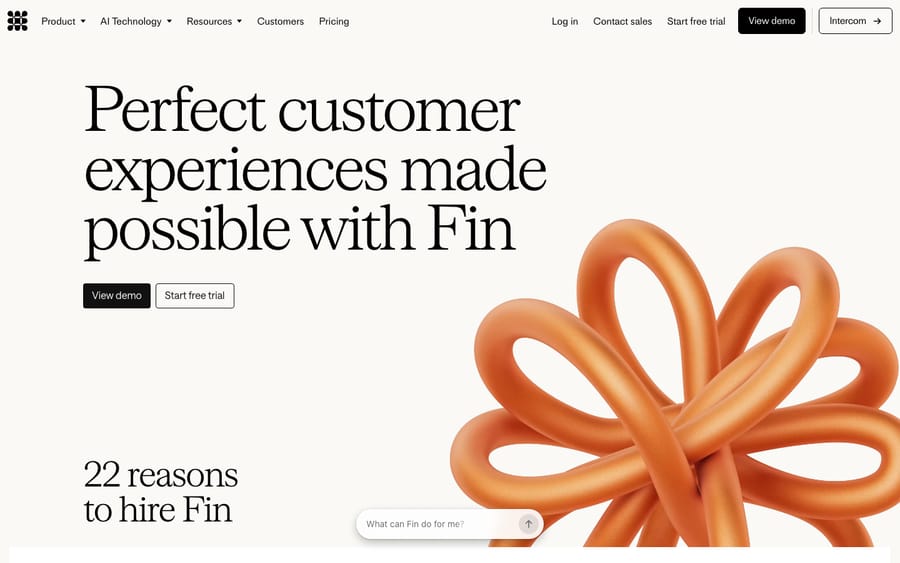
Fin is Intercom's AI customer-service agent, an autonomous bot that answers and resolves customer questions directly, across channels, before a human ever gets involved. It's not a reply-suggestion tool bolted onto the inbox (Intercom sells that separately as Copilot, the agent-assist sidekick). Fin is the customer-facing resolution layer: it reads the question, pulls from your knowledge, and either answers, takes an action, or hands off to a human.
Where it runs matters more than most people expect. Fin works across chat, email, WhatsApp, SMS, phone, and Slack, and it doesn't only run on Intercom. Fin's own help center documents four non-Intercom platforms in its navigation, Zendesk, Salesforce, Freshworks (Freshdesk and Freshchat), and HubSpot, each with its own setup guide, which is part of why Intercom rebranded the standalone agent as a product in its own right. Under the hood, it's powered by Intercom's proprietary support-tuned model, now called Apex (Salesforce acquisition coverage).
The short version: Fin = the resolution layer; Copilot = the agent-assist layer. This guide is about Fin.
How does Fin decide what to answer?
The thing that makes Fin more than a wrapper around a chatbot is the Fin AI Engine, which Intercom describes as a bespoke retrieval-augmented-generation (RAG) architecture rather than a raw call to a foundation model (Fin AI Engine docs). Every customer message runs through three sequential phases:
- Refine Query: Fin interprets what the customer is actually asking, factors in conversation history and account context, checks whether any workflow or guidance should trigger, and applies safety filters.
- Generate Response: using RAG, it retrieves the most relevant material from your connected knowledge, combines it with the refined question, and drafts a grounded answer (or executes an action) rather than free-styling from the model's general knowledge.
- Validate Accuracy: it runs quality checks before sending, and if confidence is too low it asks a clarifying question or hands off instead of guessing, which is Intercom's stated defense against hallucinations.
Knowledge sources
Fin is only as good as what you connect to it. It draws on three buckets:
- Content: help-center articles, PDFs, past conversations, and approved public web pages, plus Knowledge Snippets you add directly for gaps your docs don't cover.
- Data: dynamic, real-time information (account status, order details) used to personalize answers rather than give generic ones.
- Integrations & Actions: connections to third-party systems Fin can actually act on, not just read.
Guidance, Tasks and Procedures
Two newer capabilities are where Fin moves from "answers questions" to "does work":
- Fin Guidance lets you write plain-language rules (tone, policy, when to escalate) that the engine checks and applies before it responds, so Fin stays on-brand and within policy (guidance docs).
- Fin Tasks / Procedures let Fin complete multi-step jobs against live systems (look up an order, process a refund, update a record) using data connectors, including an MCP connector approach for standardized tool access.
That combination of RAG-grounded answers and guided, action-taking procedures is what lets Fin claim end-to-end resolution over simple deflection.
How much does Intercom Fin cost?
Here's the part that drives most of the searches. Fin isn't priced per agent or per message. It's priced per outcome, $0.99 each (fin.ai/pricing, checked September 24, 2026). This is the headline that makes Fin look cheap and, depending on your volume, sometimes isn't.
Intercom's own outcomes article defines five types (Fin AI Agent outcomes, read September 20, 2026):
| Outcome | Price | What it means |
|---|---|---|
| Resolution | $0.99 | Customer's issue is answered and no further help is requested |
| Handoff (procedure) | $0.99 | Fin completes a defined procedure that routes the customer onward |
| Disqualification | $0.99 | Fin determines a lead/contact doesn't qualify |
| Self-serve qualification | $0.99 | Fin routes a prospect to a self-serve outcome, such as signing up for a trial |
| Qualification | $9.99 | Fin qualifies a sales lead (a higher-value outcome) |
For support teams, the one that matters is the resolution. And the definition has a wrinkle worth understanding before it shows up on an invoice. A resolution is counted two ways:
- Confirmed resolution: the customer explicitly says it helped ("Ok, thanks", "That worked").
- Assumed resolution: the customer simply leaves after Fin's last answer without asking for more help.
That assumed category is the one to watch: a customer who reads Fin's reply and closes the chat is billed as a resolution even if they were silently unsatisfied. Intercom does build in fairness mechanics, and they're genuinely better than most usage meters:
- One outcome per conversation, no matter how many messages or actions Fin takes.
- You're not billed if the customer asks for a human at any point, or if a Fin Procedure fails to complete.
- A greeting isn't an answer. Intercom's article states plainly that "a resolution is only counted when Fin provides an actual answer to a customer's query. If Fin merely responds to a greeting, this is not considered an answer or resolution."
- An unanswered clarifying question isn't billable either: if Fin asks something and the customer never replies, the conversation auto-closes with no resolution state recorded.
- If a conversation was marked resolved but the customer reopens it later seeking more help, even in a different billing period, that resolution is deducted and not charged.
- You can cap it. The same article says you can "set usage reminders and hard limits to ensure you're happy with how many resolutions Fin is able to provide," configured through Manage Fin usage alerts and limits.
The cost details people miss
The $0.99 number rarely tells the whole story:
- Seats are usually still required. If you run Fin on Intercom, you also pay for Intercom's per-seat plans on top. On intercom.com/pricing on September 24, 2026, Essential was $29, Advanced $85 and Expert $132 a seat per month, with at least one full seat required. Essential was $19 on September 20, so read the figure off the page on the day you budget. Always check which basis a quote uses. Lite seats are free; full seats aren't.
- A 50-outcome monthly minimum sits on the "Fin with your current helpdesk" block, the one for running Fin on Salesforce, HubSpot, Zendesk or Freshworks.
- Two add-ons stack on top. Copilot, the agent-assist sidekick, is $35 per user per month. The Pro add-on, which bundles Operator and the AI quality tooling, starts at $99 per month.
- No volume discount is advertised on the public page; it's a flat per-outcome rate. The one published discount is the Early Stage program, 93% off Intercom plus a year of Fin for companies that qualify.
- A 14-day free trial gives unlimited Fin outcomes with no card required, which is a fair way to model real cost before committing.
The honest read: per-resolution billing is appealing because you nominally "only pay when Fin delivers value," and the refund-on-reopen rule is buyer-friendly. But assumed resolutions, the seat fees underneath, and the lack of volume breaks mean a high-volume team should model the all-in number against real ticket data, not the $0.99 sticker. For the full breakdown, see Intercom pricing explained and our Fin pricing deep dive.
How long does Fin take to set up?
Fin's biggest practical selling point is speed to value. Because it's packaged and pre-trained, most teams can connect knowledge sources and get a working agent live in days. Salesforce drew the same contrast when explaining the acquisition (Agentforce is the powerful-but-slower enterprise build; Fin is the fast-to-deploy option). Deployment in practice means: connect your help center and content, add Knowledge Snippets for gaps, write Guidance for tone and escalation rules, wire up any Tasks/Procedures that touch live systems, then test against real conversation history before flipping it on to customers. The lighter your knowledge base, the more limited the result, which leads straight to the next two sections.
What resolution rate does Fin actually reach?
Intercom markets strong resolution numbers, and they're not fabricated, but they're a ceiling, not a baseline. Salesforce cites an average resolution rate of 76% (Salesforce, September 10, 2026). That is an average across Fin customers, and a given team's rate tracks almost entirely with how complete and well-structured your knowledge base is. Thin docs, login-walled content Fin can't read, or lots of account-specific edge cases all drag the number down. Treat 90%+ as "achievable with excellent content and tuning," and plan for less on day one.
What goes wrong with Fin, and how do you fix it?
Fin is a strong product, and most of what goes wrong with it is a configuration problem. These are the eight complaints that recur across Intercom's own troubleshooting documentation, its public community forum and public discussion threads, with what causes each and what to do. We've ordered them by how often they come up.
1. The bill climbs exactly as Fin gets better, and "assumed" resolutions are most of it. This is the loudest complaint about Fin by a distance, and the cause is arithmetic: you pay per outcome, so a Fin that resolves more costs more. The headline threads are public. r/SaaS carries "My Intercom billing shot up by 120%, it was because of AI" and "Is the $1 per resolution with Intercom AI worth it?", and r/intercom carries "Has anyone genuinely cut their Fin bill in half without...". A Fin reviewer on G2 put the forecasting problem plainly in a review our Plan 1B research read in June 2026: "I never really know how many conversations it will handle in a given month, which makes it harder to predict expenses." The fix: set the guard rails Intercom ships and then audit the mix. Turn on usage reminders and a hard limit so the meter can't run past a number you've agreed. Then split your resolutions into confirmed and assumed, because the assumed ones are where a disputed bill lives, and check them against CSAT and reopen rates, which the resolution count alone will never show you. Learn the five carve-outs above (greetings, unanswered clarifying questions, human requests, failed Procedures and reopens), because each one is money you shouldn't be paying, and reopens are refunded across billing periods.
2. Fin repeats and rephrases the same answer instead of escalating. This is the failure customers notice fastest, and on Intercom's own Train Fin forum it has a named cause. In the thread How are you stopping Fin from looping and being repetitive?, marked ANSWERED with 337 views, Amber Stephens writes: "Something is going wrong with my anti-repetition guidance. No matter what, Fin will not stop repeating/rephrasing the same answer multiple times. I have guidance on asking clarifying questions and am wondering if that's part of the issue." She adds, "I'm stuck and am a team of one."
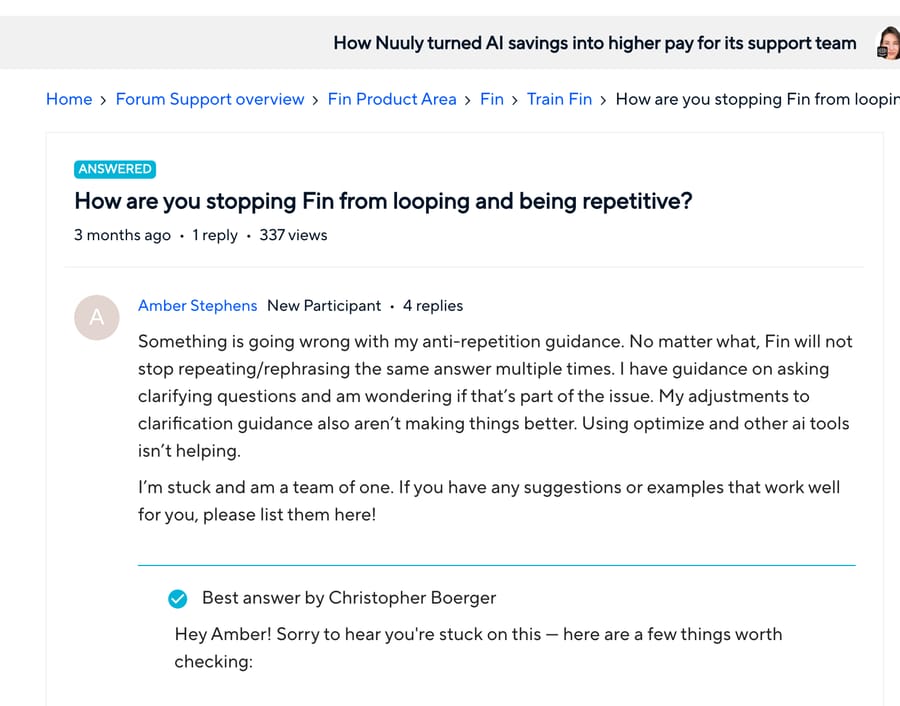
The fix, from the accepted answer by Christopher Boerger, in his order: start with "conflicting or overlapping guidance rules," which he calls "the most common cause of Fin rephrasing and circling back with the same answer." Multiple rules that touch the same behavior, such as clarification plus answer style plus follow-up, interact in ways nobody designed. Keep each rule focused on a single objective, one purpose per rule, no chaining, and audit for contradictory rules. Second, take control of the follow-up question Fin writes for itself by "ending a guidance rule with your own question", so Fin uses yours instead of generating one. Third, know the limit before you spend a week on wording: Fin's clarifying questions "are baked into its AI model and can't be directly edited," so the lever is Guidance that adds deterministic clarification steps, not prompt surgery. If you have the Pro add-on, Fin Operator will debug an individual conversation and show why Fin answered the way it did.
3. Fin answers from a help-center article instead of running the Procedure that would actually fix it. A customer asks for a refund, you have a Procedure that collects the order number, checks eligibility and issues the refund, and Fin replies with your "How do I get a refund?" article instead. Intercom documents this as a known failure and names the cause: "Fin defaults to Help Center answers when relevant content exists for a topic, so if an article covers the same intent as your procedure, Fin may answer from it directly rather than triggering the procedure" (Troubleshooting Fin Procedures and Data connectors). The fix, in Intercom's own order: first enable Agentic Switch at Fin AI Agent › Train › Procedures › Settings › Agentic Switch, which lets Fin move from a help-center answer to a live Procedure mid-conversation. Only the procedure Fin is switching out of needs the setting on. If that doesn't do it, open the conversation in the Inbox, read Fin's thoughts to find which article it surfaced, and either delete that article or rewrite it to point the customer at support so the Procedure wins.
4. Fin starts answering wrongly, on content that hasn't changed. Intercom publishes a number for this, and the number is low. Its Fin AI Agent FAQs say "While Fin has a very low hallucination rate (<1%)", and that Fin "only provides answers based on your support content or data". A rate under 1% is still hundreds of conversations a year at any real volume, and the reports that reach the forum are about sudden changes rather than steady error. In FIN suddenly hallucinates and no longer responds correctly, posted November 26, 2025 and now at 1,016 views and 5 replies, Samuel Scherzinger reports that Fin "suddenly and randomly answers with wrong answers" on content he had not touched.
The fix, in the order the forum's Top Expert Nathan Sudds works it: first check whether new content reached the source material, because a newly connected page or an edited article is a more likely cause than the model changing under you. Use the Improve Answer process to see which content produced the answer. Then check your Fin Tasks for guidance toggles left unchecked, which is where he suspected the problem in that thread. Intercom's own instruction, when the answer genuinely isn't grounded in your content, is to report it: "notify our Support team so we can report this feedback."
The harder version of this problem is the one nobody reports, and it has a forum thread of its own. In What happens when Fin gives a customer the wrong answer but nobody notices?, posted September 14, 2026, Jon Vaughan gives the only method that reliably catches it: pull "a random slice of conversations Fin marked resolved and read them against policy," then watch for repeat contacts on the same topic and compare CSAT on AI resolutions against human ones. Assumed resolutions are exactly where a silent wrong answer hides, which is why this check and problem 1 are the same audit run once.
5. A Procedure never triggers at all. Intercom's troubleshooting article lists five checks before anything cleverer, and they're in frequency order: the Procedure is still a draft rather than published; Fin isn't deployed, so the "Let Fin handle" step never runs; the audience targets Users when the customer is a Lead, or the reverse; a higher-priority workflow intercepts the conversation before Fin evaluates procedure intent; or the trigger criteria are too narrow to match what customers actually type. The fix: work that list top to bottom, then widen the trigger by adding positive examples (messages that should fire it) and negative ones (messages that shouldn't) to the "When to use this procedure" description, and validate with Simulations before you publish. One gap worth knowing before you design around it: Slack appears as a selectable channel, but Intercom states that procedure triggers are not currently supported for Slack conversations.
6. Fin barges back into a conversation a human has already taken over. On Intercom's public forum, a user posting as RobAPH described it on October 17, 2025: "When a conversation is handed over to a teammate, everything starts fine - the teammate replies, but as soon as the customer responds again, Fin jumps back in and interrupts." The same post reports a second version of the fault: a customer replying "thank you" after a handoff reads as a positive resolution, so Fin closes the conversation and the teammate misses it. Another user, Charlie Moore, replied the same day: "I'm experiencing similar issues as well" (Fin AI Agent issues on the Whatsapp Channel). The fix came from Nathan Sudds, one of the forum's Top Experts, on October 18: the culprit is usually a workflow sitting on the "When a user sends any message" trigger rather than Fin itself. He recommends turning on Show Conversation Events in the thread "and checking to see which workflow was engaging with the conversation in those instances," and reports the same root cause on the email channel, where "too broad exposure on the 'sends any message workflow'" was reassigning threads it shouldn't touch. Narrow that workflow's audience, and the interruptions stop.
7. You can't see why Fin did what it did. When an answer is wrong, the instinct is to rewrite the article. Often the real problem is a step earlier, in how Fin read the question. The fix: open the conversation in the Inbox, click the three dots at the top right and select Show conversation events (⌘ + E on a Mac, Ctrl + Shift + E on Windows), then expand Fin's thoughts. That view gives you the Procedure step Fin was executing, how it interpreted the customer's intent, and why it skipped, revisited or branched. The honest limit, which Intercom states outright: the debugger and the thoughts timeline only appear when a Procedure was triggered. If Fin gave a bad answer in an ordinary conversation, those tools aren't there, and you're back to auditing content, which is what Intercom's AI-powered content recommendations are for.
8. Running Fin on your existing help desk isn't the self-serve path it looks like. Fin's pricing page shows two blocks side by side, and only one of them has a "Start free trial" button. "Fin with the Intercom helpdesk" does; "Fin with your current helpdesk" says "Contact sales" and carries the 50-outcome monthly minimum. So a Zendesk or Salesforce team evaluating Fin is in a sales conversation from the start, while an Intercom team can validate on live traffic for 14 days without a card. The fix here is budgeting: treat the 50-outcome floor as a fixed monthly cost from day one, ask in the first call whether the minimum is waived at your volume, and read Fin's platform-specific setup guide for your help desk before the demo, because the Zendesk build in particular splits into tickets, messaging and Messenger paths that behave differently. If you'd rather not go through sales at all, our Fin alternatives guide covers the agents that sell self-serve, and the Decagon and Sierra guides cover the enterprise end.
One failure that only bites once, at setup: in FIN ChatBot not answering questions, a user importing a large site found Fin could not answer a single test question, and the cause was indexing lag. The portal reported the import ready before the content had finished processing, and the agent worked about two hours later. If you have just connected a big source and everything fails, wait before you rebuild anything.
One thing that is not on this list: outages. Intercom runs a public status page, now branded Fin Status, with separate US, EU and AU regions. Check the region your app URL points at rather than the front page.
How we researched this
On September 21, 2026 we read Intercom's Fin AI Agent FAQs and four threads in Intercom's public community, in its dedicated Train Fin and Deploy Fin categories, for the looping, hallucination, silent-wrong-answer and indexing failures below. On September 20, 2026 we read fin.ai/pricing, Intercom's "Fin AI Agent outcomes" article (updated the day before), its "Troubleshooting Fin Procedures and Data connectors" article, the fin.ai help center navigation, Intercom's public community forum and the Fin status page. Community threads on Reddit are blocked to our crawler, so those are linked by their public URLs and summarized by their own headlines only. We did not revisit G2 on this pass, so the ratings and review quotes below carry the June 2026 date our earlier research checked them, and we are not an Intercom customer, so nothing here comes from our own Fin account.
Strengths and honest limits
Where Fin is strong:
- Genuinely autonomous resolution: it answers, acts, and closes routine tickets on its own.
- Multichannel out of the box: chat, email, WhatsApp, SMS, phone, Slack.
- Fast to deploy and pre-trained, so time-to-value is short.
- Buyer-friendly billing mechanics: one charge per conversation, refunds on reopen, no charge on human handoff, and hard limits you can set yourself.
- Top-rated by users: 4.5/5 across 2,900+ G2 reviews when we checked in June 2026, billed as the #1 AI Agent on G2.
The honest limits:
- Cost stacks. The $0.99 outcome fee sits on top of seat plans and, off-Intercom, a 50-outcome minimum, with no volume discounts. It's the single most common complaint in reviews.
- "Assumed" resolutions can bill for conversations the customer wasn't actually happy with.
- Complex/nuanced queries still trip it up; reviewers note it can miss the mark on very specific or multi-part questions.
- It's only as good as your knowledge. Headline resolution rates depend on KB quality you may not have yet.
- Debugging stops at the Procedure boundary. Fin's thoughts explain a Procedure; they don't explain an ordinary bad answer.
- Upselling friction. Recurring G2 sentiment flags constant nudges toward higher tiers and add-ons.
What real users say
On G2, Fin held 4.5/5 from 2,900+ reviews when our research checked it in June 2026. The praise is consistent: easy to set up, fast resolutions, and it "understands the customer question quite well" for common queries, saving real agent time. The criticism is just as consistent and centers on money and nuance: reviewers call the pricing "excessively high" with "constant upselling," point to the layered seat-plus-resolution-plus-add-on structure, and note Fin "sometimes does not fully understand complex or very specific customer queries." None of this makes Fin a weak product; it's a strong one. But it rewards teams with solid content and steady volume, and frustrates those expecting set-and-forget at a flat low price.
What does the Salesforce acquisition change for Fin buyers?
This is the development that should shape any 2026 decision, and it is now done. Salesforce signed a definitive agreement on June 15, 2026 to acquire Fin (formerly Intercom) for approximately $3.6 billion, and completed the acquisition on September 10, 2026 (Salesforce newsroom, TechCrunch on the agreement). Salesforce's framing: Fin folds into Agentforce, with Agentforce as the deeply customizable enterprise option and Fin as the packaged, pre-trained, live-in-days agent for smaller and mid-market teams.
Worth keeping the sequence straight, because a lot of coverage gets it backwards: the company renamed itself from Intercom to Fin on May 12, 2026, before the Salesforce agreement, not because of it. Intercom remains the help desk's name.
What it means for buyers: nothing changed on the invoice at close. The $0.99 model still stands, as the pricing page we read on September 20 shows. But the roadmap, packaging, and pricing now sit with Salesforce, and tighter Agentforce alignment is the likely direction. If you're evaluating Fin on a multi-year horizon, that's the risk to weigh. (See our running view of Intercom AI vs. a dedicated AI agent layer for how this affects stack choices.)
A fair note on stack choice
A quick, honest aside, since this is a Macha guide. Fin is native to Intercom (and runs on four other documented help desks) and bills per resolution, one outcome per conversation. Macha is an AI agent layer for the help desk you already run — Zendesk, Freshdesk, Gorgias, Front, Intercom and HubSpot today. To be clear, Macha is not an Intercom replacement, so this isn't a drop-in swap for Fin. The reason it's worth mentioning at all is that the billing philosophy is a genuine fork in the road for teams still choosing a stack. Fin charges per resolution, including assumed ones, which means the vendor earns more as your self-service gets worse and the definition of "resolved" is the vendor's to measure. Macha charges per ticket: one thread with one person is one charge, however many replies or steps it takes, whether triaging, tagging, drafting, or resolving. It starts at $299 a month for 750 tickets, about $0.40 a ticket at every tier, and setup and monitoring by the Macha team are included. It suits teams already running one of those help desks who want an agent acting inside the ticket they already have. Neither model is universally cheaper; which one fits depends on whether your work looks like discrete resolved conversations or like one thread with many small actions inside it. If your help desk is one of those, that contrast is worth weighing. The tiers are on our pricing page, and there's $50 of free usage, no credit card required, if you want to model it against your own tickets. If your help desk is Intercom, Fin is the native path and Macha can layer on it too, and our best Intercom Fin alternatives guide covers the rest.
Frequently asked questions
What is Intercom Fin AI? Fin is Intercom's AI customer-service agent, an autonomous bot that resolves customer questions end-to-end across chat, email, WhatsApp, SMS, phone, and Slack. It reads your knowledge, answers or takes actions, and hands off to a human when it can't confidently resolve. As of mid-2026 Intercom rebranded the company itself to Fin.
How much does Fin AI cost? Fin is billed per outcome: $0.99 per resolution (also per handoff, per disqualification and per self-serve qualification), and $9.99 for a sales qualification. You're charged only one outcome per conversation. Intercom seat plans apply on top at $85 and $132 a seat a month billed annually for Advanced and Expert, or $99 and $139 billed monthly, with the entry Essential plan inside a live pricing test at $19 to $29 annually; the Copilot add-on is $35 per user per month and the Pro add-on starts at $99 per month. There's a 50-outcome monthly minimum on the non-Intercom help desk plan, and no volume discount is advertised. A 14-day free trial with unlimited outcomes is available on Intercom. Confirm current figures at fin.ai/pricing.
What counts as a resolution in Fin? Either a confirmed resolution (the customer says it helped) or an assumed resolution (the customer leaves after Fin's last answer without asking for more help). You're not billed if the customer requests a human, if Fin only answered a greeting, if Fin asked a clarifying question nobody answered, or if a Fin Procedure fails. A resolution is refunded if the customer reopens the same conversation later seeking help, even across billing periods.
Why is my Fin bill higher than I expected? Almost always because Fin is resolving more. You pay per outcome, so a better agent costs more. Split your outcomes into confirmed and assumed resolutions before you dispute anything, since assumed ones bill when a customer simply leaves. Then set usage reminders and a hard limit, which Intercom supports natively, and check that seats, the Copilot add-on at $35 a user and the Pro add-on from $99 a month aren't the part that actually moved.
Why isn't my Fin Procedure triggering? Work Intercom's own checklist in order: confirm the Procedure is published rather than draft, confirm Fin is deployed, check the audience targets the right type (Users versus Leads), look for a higher-priority workflow intercepting the conversation first, and widen trigger criteria that are too narrow by adding positive and negative examples. If Fin answers from a help-center article instead, enable Agentic Switch or remove the competing article. Note that procedure triggers aren't supported on Slack, even though Slack appears as a selectable channel.
How does the Fin AI Engine work? It's a bespoke RAG architecture that runs each message through three phases: Refine Query (interpret intent and context), Generate Response (retrieve relevant knowledge and draft a grounded answer or action), and Validate Accuracy (quality-check before sending, or ask/hand off if confidence is low). It draws on your content, dynamic data, and integrations, and applies Fin Guidance and Fin Tasks/Procedures.
Has Fin been acquired by Salesforce? Yes, and the deal is closed. Salesforce signed a definitive agreement on June 15, 2026 for approximately $3.6 billion and completed the acquisition on September 10, 2026. Fin folds into Agentforce. The company had already renamed itself from Intercom to Fin on May 12, 2026, before the agreement, so the rename wasn't a result of the deal. Pricing was unchanged at close.
Is Fin AI worth it? For teams with a solid knowledge base and steady volume, Fin is a strong, fast-to-deploy agent, 4.5/5 on G2 across 2,900+ reviews as of June 2026. The common reservations are cost (the per-resolution fee stacks on seats and add-ons, with no volume discount), "assumed" resolutions billing for conversations the customer wasn't necessarily happy with, and weaker handling of complex queries. Model the all-in cost against your real ticket data, not the $0.99 sticker.
Does Fin hallucinate? Intercom publishes a rate: its Fin AI Agent FAQs say "While Fin has a very low hallucination rate (<1%)" and that Fin "only provides answers based on your support content or data." Under 1% is still a meaningful count at volume. When Fin starts answering wrongly on content you did not change, check what new content reached the source material first and look for Fin Tasks with guidance toggles left unchecked, then report the answer to Intercom Support.
Why does Fin keep repeating the same answer? The accepted answer on Intercom's own community names conflicting or overlapping guidance rules as the most common cause of Fin rephrasing and circling back. Keep each guidance rule to one objective with no chaining, audit for contradictory rules, and control the follow-up question by ending a rule with your own question so Fin uses that instead of generating one. Fin's clarifying questions are built into the model and cannot be edited directly.
The bottom line
Intercom Fin AI is one of the most capable packaged AI support agents on the market in 2026: a genuinely autonomous, multichannel resolver built on a purpose-tuned RAG engine, with Guidance and Procedures that let it act, not just answer. Its $0.99 per-resolution model is appealing and has fair mechanics, but the real cost includes seats, two add-ons, a non-Intercom minimum, and assumed resolutions, so model the all-in number. Performance is strong but tracks your knowledge-base quality, and the headline resolution rates are a ceiling, not a floor. Most of what goes wrong after launch is configuration, and Intercom documents the fixes: hard limits for the bill, Agentic Switch for the help-center-beats-Procedure problem, the trigger checklist for a Procedure that never fires, and a narrower "any message" workflow for the handoff interruptions. If you're on Intercom, Fin is the native path; if your stack is Zendesk, Freshdesk, Gorgias or Front, weigh a dedicated AI agent layer instead. From here, dig into Intercom pricing explained, the best Intercom Fin alternatives, or the Macha on Zendesk model.
Sources: Fin AI Agent FAQs · Intercom community, How are you stopping Fin from looping and being repetitive? · Intercom community, FIN suddenly hallucinates and no longer responds correctly · Intercom community, What happens when Fin gives a customer the wrong answer but nobody notices? · Intercom community, FIN ChatBot not answering questions · fin.ai/pricing · Fin AI Agent outcomes · Troubleshooting Fin Procedures and Data connectors · Manage Fin usage alerts and limits · The Fin AI Engine · Fin Guidance docs · AI-powered content recommendations · Fin Status · Intercom community: Fin AI Agent issues on the Whatsapp Channel · Salesforce completes the acquisition of Fin · TechCrunch on the June agreement
Fin capabilities and pricing verified against fin.ai/pricing and Intercom's help documentation on September 20, 2026. G2 ratings and quotes carry their June 2026 check date. Intercom updates pricing and packaging frequently, and Fin is now a Salesforce product, so confirm specifics in your own account before relying on them.
Add AI agents to your Intercom
Macha reads the conversation, drafts the reply and takes the action, inside the Intercom you already run.