Intercom
 Shopify
 Stripe
 Slack
Slack Notion
 Google Workspace
 Confluence

What Is Dixa? Pricing, Mim AI Agent and Who It's For (2026)


Dixa is a Copenhagen-built help desk and contact center for ecommerce brands, priced from €89 per agent a month on annual billing with its Mim AI agent billed at €0.35 per conversation. It suits mid-market consumer brands ready to move phone, chat, email and social onto one platform.
Key takeaways
- Dixa is an omnichannel help desk with a native phone system, founded in Copenhagen in 2015, priced at €89, €139 or €179 per agent a month on annual billing.
- Dixa's Mim AI agent is included in every plan and billed at a flat €0.35 per conversation, whether Mim resolves it or hands it to a human.
- Dixa offers no self-serve free trial; every plan starts with a demo, and Dixa says most teams are live in 2-4 weeks.
- Dixa built much of its automation and analytics on the 2022 Solvemate and Miuros acquisitions, a $43 million double deal.
- Dixa's Mim runs only inside Dixa, while Macha adds AI agents on top of an existing help desk from $299 a month for 750 tickets.

Dixa is a Copenhagen-built omnichannel help desk and contact center for ecommerce brands, priced from €89 per agent a month on annual billing, with its Mim AI agent included in every plan and billed at a flat €0.35 per conversation (dixa.com/pricing, checked 24 September 2026). There's no self-serve trial; every plan starts with a demo.
| Question | Short answer |
|---|---|
| What it is | Omnichannel help desk with native phone, founded in Copenhagen in 2015 |
| Seat price (annual) | Growth €89, Ultimate €139, Prime €179 per agent/month |
| Seat price (monthly) | €109, €169, €215 |
| AI agent | Mim, in every plan, €0.35 per conversation, usage only |
| Paid add-ons | AI Co-Pilot, Quality Assurance, AI Auto QA, Voice Transcription |
| Trial | None; guided rollout, most teams live in 2-4 weeks |
| Best for | Mid-market ecommerce and consumer brands that want voice, chat, email and social in one tool |
We've written this as a vendor guide, not a sales pitch. (Full disclosure: we build Macha, an AI agent layer that runs on top of existing help desks. Dixa is a help desk, not something we compete with, and we explain how the two relate near the end.) Everything below is sourced to Dixa's own pages plus third-party review sites, with anything we couldn't verify flagged.
What is Dixa?
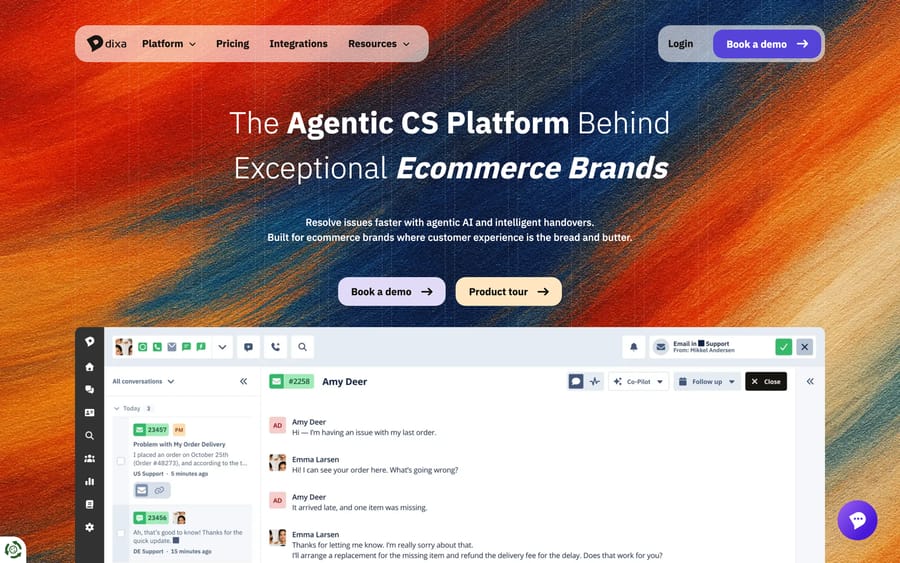
Dixa's homepage — a conversational customer-service platform.
Dixa is an omnichannel customer service platform, a help desk, founded in Copenhagen, Denmark in 2015. It pulls the conversations a support team handles across email, live chat, phone, social and messaging into a single agent workspace, so a customer's history follows them however they reach out (dixa.com).
Dixa's founding idea was to make customer service feel less like a ticket queue and more like a continuous conversation. The company calls this "conversational customer service," and it shapes the product: instead of a customer generating ticket #4471 today and ticket #5502 next week, Dixa threads every interaction (an email, a chat, a phone call, an Instagram DM) into one running conversation tied to that person. Agents see the full relationship, not a fragment. Dixa has leaned on this in its marketing since the early days, once even described in terms of bringing Danish "hygge" to support (Forbes).
In 2026 Dixa markets itself as an "agentic customer service platform." Underneath the AI messaging, the core product is still a full contact center and help desk: ticketing, routing, a native phone system, chat widgets, knowledge and reporting. It's aimed at ecommerce and retail brands, where support is tied to orders, refunds and shipping (dixa.com/about-us). The about page says Dixa serves 850+ ecommerce brands across 42 countries (its FAQ on the same page says 1,000+), that it has raised $158M, and that Christian Lohmann is CEO. Brands quoted on its site include Oliver Bonas, Rapha, tink and Stayforlong.
The short version: Dixa is a conversation-centric, omnichannel help desk with a built-in AI agent (Mim), best suited to consumer brands that want channels, voice and automation in one place.
How does Dixa work?
Dixa is built around a single conversation thread per customer rather than a pile of disconnected tickets. The main pieces:
- Unified agent workspace (Team Hub): phone, email, chat, WhatsApp, Instagram, Messenger and SMS land in one interface, with customer context and history attached to one running conversation. Dixa's pricing FAQ says every plan includes all of these channels natively.
- Native voice and contact center: IVR, call recording, customer callback and voicemail are in every plan, so voice isn't bolted on through a third party (Capterra). Many help desks treat phone as an integration; Dixa ships a cloud phone system inside the platform.
- Intelligent routing: Dixa's routing engine assigns conversations by skill, priority, language and availability. Ultimate adds skills-based routing and routing with external data.
- Knowledge base: a native help center that customers self-serve from and that Mim draws on to answer questions.
- Reporting, surveys and QA: real-time and historical dashboards and surveys in every plan, with Quality Assurance, AI Auto QA and Advanced Insights as add-ons (Advanced Insights is included on Prime). Much of this traces back to the Miuros acquisition.
A practical note on deployment: because Dixa is an all-in-one platform, standing it up means migrating channels, phone numbers, macros and history off whatever you run today. That's more of a project than adding a widget. Dixa says every rollout is guided, with a dedicated success manager, and that most teams are live in 2-4 weeks.
What is Mim, and how does Dixa's AI work?
Dixa's headline AI product is Mim, its AI agent. Dixa's own FAQ dates the autonomous version to 2025. Rather than only surfacing a help-center article, Mim is designed to act: it reads an incoming message, reasons through your knowledge base and policies, and completes the action a customer needs (a refund, an order cancellation, a shipping update), then hands off to a human with the full conversation when it can't (dixa.com/ai-agent). Dixa lists Mim on chat, email, WhatsApp, Messenger and SMS. That order-aware, action-taking behavior is the strongest part of Dixa's AI story and the reason it lands with ecommerce teams.
Much of Dixa's AI and automation was acquired rather than built in-house. In 2022 Dixa completed a $43 million double acquisition of Solvemate and Miuros (Dixa newsroom). Solvemate was a chatbot and conversational-automation company (customers included On, JustPark and Holidu); Miuros was a CX analytics and QA business (customers included Deezer, Wise and About You). Those two products became the backbone of Dixa's automation and quality/insights layers, and Mim builds on that lineage. It's useful to know: Dixa's knowledge, automation and analytics didn't all start in one codebase, which occasionally shows in how the pieces fit together.
Alongside Mim, Dixa sells:
- AI Co-Pilot: GPT-powered help for human agents (smart replies, summaries, translations, spellcheck, a writing style guide). A seat-based add-on.
- AI Voice Transcription: turning calls into searchable, analyzable text. An add-on on every plan.
- Quality Assurance and AI Auto QA: scorecards across 100% of conversations, with optional automatic issue detection. Seat-based add-ons.
- Advanced Insights: the Miuros-derived analytics for spotting operational issues and coaching agents. An add-on on Growth and Ultimate, included on Prime.
One limit hasn't changed: Mim lives only inside the Dixa platform. It's not a standalone agent you can point at a help desk you already run. To get Mim, you run Dixa.
How much does Dixa cost?
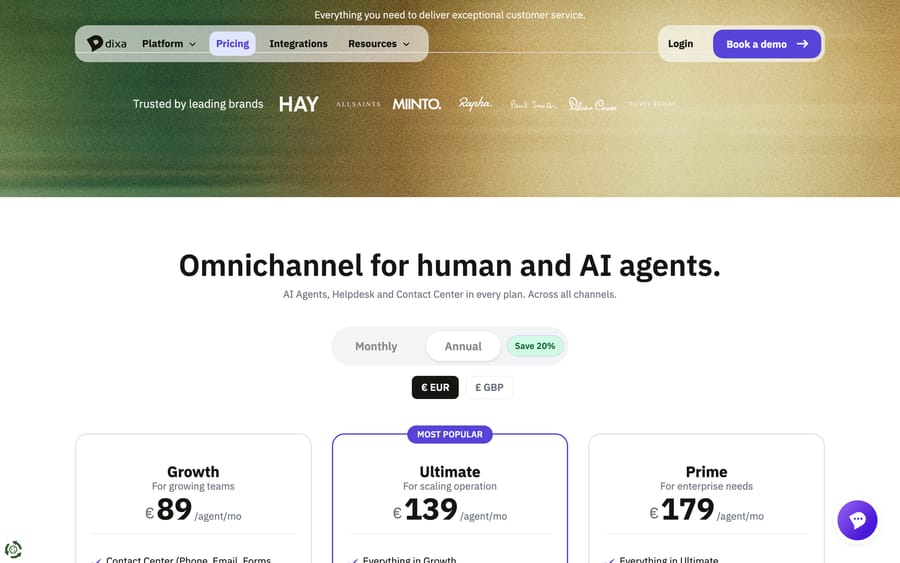
Dixa's published per-agent pricing.
Dixa uses per-seat (per-agent) pricing in euros or pounds, with no USD list price, and it does not offer a self-serve free trial. Every plan routes through "Book a Demo" (dixa.com/pricing, checked 24 September 2026). Annual billing saves about 20%:
| Tier | Annual (per agent / mo) | Monthly (per agent / mo) | What it adds |
|---|---|---|---|
| Growth | €89 (£75) | €109 | Contact center (phone, email, forms, chat, social), knowledge base, Mim, intelligent routing, IVR, call recording, SLAs, Shopify and Klaviyo integrations |
| Ultimate | €139 (£115) | €169 | Routing with external data, standard AI intent detection, advanced automations, skills-based routing, sandbox |
| Prime | €179 (£149) | €215 | SSO, advanced AI intent detection, Advanced Insights, custom roles, auto redaction, multiple organizations |
The AI pricing is where Dixa has changed most. Mim is in every plan and billed per conversation at a flat €0.35, usage only, with no per-seat component and no allowance cap, whether Mim resolves the conversation or hands it to a human (Dixa's pricing FAQ, marked "Updated July 2026"). Earlier third-party reports described Mim as a quote-only add-on with a roughly 7-seat minimum; the pricing page no longer says either, though it does say Dixa is built for mid-market teams and scopes the starting commitment on a call.
Name the incentive on both sides. Dixa argues per-resolution pricing (Fin at $0.99, Zendesk's automated resolutions) bills you for outcomes the vendor counts, and that a flat per-conversation rate stays predictable. The flip side: you pay €0.35 even when Mim fails and a human finishes the job, so a low resolution rate raises your effective cost per resolved conversation. At a 50% resolution rate, that's €0.70 per conversation Mim actually closes.
Dixa's own comparison puts a Growth seat plus Co-Pilot at €128 against €165 for Zendesk Suite Team plus Contact Center and Copilot (Dixa's figures, based on Zendesk prices as of 30 June 2026). Budget for the seat, Mim usage, any add-ons and the implementation work. Voice minutes and channel usage sit outside the seat price, so check the overage list during the demo.
What are Dixa's pros and cons?
Pros
- Omnichannel in one place: email, chat, social and a native phone system in every plan, not a patchwork of integrations.
- Order-aware AI: Mim's refund, cancellation and shipping actions go beyond article-suggesting bots.
- Published AI price: €0.35 per conversation is easy to model, unlike many quote-only AI agents.
- Conversation-first design: unified threads tied to the customer, which reviewers generally like working in.
- Analytics and QA depth: the Miuros-derived insights and Auto QA go further than what many help desks ship natively.
Cons
- Paying for failures: per-conversation AI billing charges for conversations Mim hands back to your team.
- No free trial: you can't try it without talking to sales.
- High seat price: €89 to €179 per agent is steep if you don't need voice.
- You're switching help desks: adopting Dixa means migrating your whole support operation, not just adding AI.
- Narrower ecosystem: Dixa's integration marketplace is smaller than incumbents like Zendesk.
- Mim is Dixa-only: you can't run its AI agent on top of a help desk you already like.
Who is Dixa best for?
Dixa is a strong fit if you're a mid-market ecommerce or consumer retail brand that wants voice, chat, email and social in a single platform and an order-aware AI agent, and you're prepared to migrate your support operation onto a new help desk. Dixa's pricing FAQ cites tink, which went from 80-90 seasonal Black Friday hires to 10 after switching, and Oliver Bonas says it nearly doubled the workload achieved each day. That consolidation story is Dixa at its best.
If you already run a help desk you're happy with, if voice isn't central to your support, or if you're a small team wanting to add AI without replatforming, the fit is weaker, and that's where an AI-agent layer is the more sensible path.
On third-party review sites Dixa is modestly covered: Capterra lists it at 4.3 out of 5 from 20 reviews, which we read on September 21, 2026. G2 turned away every request we made that day, scripted and browser alike, so there is no G2 score here.
How does Dixa compare with alternatives, and where does an AI layer fit?
Dixa competes in the help desk and contact-center category with Zendesk, Freshdesk, Gorgias, Intercom and Front, and on the AI half of that decision against Gorgias Automate and Intercom Fin, which we cover in full. Choosing between them is mostly about channels, voice needs, ecommerce depth, ecosystem and budget. Here's a rough map, including where Macha (which is not a help desk) fits:
| Category | Native voice | AI agent | Pricing model | Best for | |
|---|---|---|---|---|---|
| Dixa | All-in-one help desk | Yes (built-in) | Mim, €0.35 per conversation | Per agent + AI usage | Ecommerce/retail brands wanting channels, voice and AI in one platform |
| Zendesk | All-in-one help desk | Add-on (Contact Center, $83/agent/mo) | Yes, billed per automated resolution | Per agent + resolutions | Broadest ecosystem, larger or complex orgs |
| Gorgias | Help desk (ecommerce) | Limited | Yes | Per ticket/resolution tiers | Shopify-first ecommerce support |
| Intercom / Front | Help desk / inbox | Limited/no | Yes (Fin at $0.99 per outcome, etc.) | Per seat + resolution | Messaging-led or shared-inbox teams |
| Macha | AI-agent layer (not a help desk) | N/A (uses your channels) | Yes, its whole product | Per ticket, from $299/mo for 750 tickets | Teams keeping their current help desk and adding AI on top |
That last row is a different category. Macha is not a Dixa alternative: we don't sell a help desk. Macha is an AI agent layer that runs on top of the help desk you already use (Zendesk, Freshdesk, Gorgias, Front, HubSpot or Intercom). So the honest comparison isn't "Dixa vs Macha," it's:
- If you want an all-in-one help desk with a built-in AI agent, and you're happy to migrate platforms, Dixa (with Mim) is a coherent choice.
- If you already have a help desk and want to add AI agents on top of it, built in plain English and priced per ticket rather than per seat, that's the Macha approach. Because we connect into your existing stack and support custom tools (so an agent can look up an order or trigger an action the way Mim does), you get action-taking automation without changing where your team works.
The economics differ too. Macha is per ticket (see pricing), billed per ticket rather than per message, with setup and monitoring by the Macha team included, and no seat fee. Dixa bundles the help desk and the AI together; Macha layers AI onto whatever help desk you've already chosen.
How we researched this
On 24 September 2026 we re-read Dixa's pricing, about and AI agent pages and updated the plan prices, the Mim billing model and the company facts to match. The Capterra rating dates from our 21 September 2026 read. We have not run Dixa as our own help desk, so nothing here comes from hands-on use.
FAQ
What is Dixa? Dixa is an omnichannel customer service platform (help desk) built in Copenhagen, bringing email, chat, phone and social into one agent workspace. In 2026 it markets itself as an agentic AI customer service platform, aimed mainly at ecommerce and retail brands.
What is Mim in Dixa? Mim is Dixa's AI agent. It reads customer messages, reasons through your knowledge base and policies, and completes actions such as refunds, cancellations and shipping updates, rather than only suggesting an article. It's included in every Dixa plan and billed at €0.35 per conversation.
How much does Dixa cost? Dixa's annual per-agent prices are €89 (Growth), €139 (Ultimate) and €179 (Prime) a month; monthly billing is €109, €169 and €215. Mim is billed on top at a flat €0.35 per conversation. AI Co-Pilot and Quality Assurance are seat-based add-ons. There's no public free trial.
Does Dixa have a free trial? No. Dixa routes every plan through "Book a Demo" and runs a guided rollout with a dedicated success manager; it says most teams are live in 2-4 weeks.
Is Dixa the same as Macha? No. Dixa is a help desk with a built-in AI agent. Macha is an AI agent layer that runs on top of an existing help desk (Zendesk, Freshdesk, Gorgias, Front, HubSpot or Intercom) and is priced per ticket, from $299/month for 750 tickets. Macha complements a help desk rather than replacing one, and Macha doesn't connect to Dixa.
Who should use Dixa? Mid-market ecommerce and consumer retail brands that want voice, chat and email in one platform plus an order-aware AI agent, and are ready to migrate their support operation onto a new help desk.
What did Dixa acquire, and why does it matter? In 2022 Dixa completed a $43 million double acquisition of Solvemate (conversational automation and chatbots) and Miuros (CX analytics and QA). Those products became the foundation of Dixa's automation, QA and insights features, and they inform Mim. It's why Dixa's analytics and QA are relatively strong for a platform of its size.
Does Dixa include phone / voice? Yes. Unlike many help desks that treat phone as a third-party add-on, Dixa ships a native cloud phone system (IVR, callback, voicemail and call recording) in every plan. Voice transcription is an add-on, and voice minutes are metered separately from the seat price.
How long does it take to implement Dixa? Adopting Dixa means migrating channels, phone numbers, macros and history. Dixa pairs every rollout with a dedicated success manager and says most teams are live in 2-4 weeks. It's a platform switch, not a plug-in.
Can I use Dixa's Mim AI agent on top of my current help desk? No. Mim only runs inside the Dixa platform. If you want to keep your existing help desk (Zendesk, Freshdesk, Gorgias, Front, HubSpot or Intercom) and add an AI agent on top of it, that's the job an AI-agent layer like Macha does, and Macha does not connect to Dixa.
Simple per-ticket AI pricing
One thread with one person is one charge, however many replies it takes.