Intercom
 Shopify
 Stripe
 Slack
Slack Notion
 Google Workspace
 Confluence

What Are the Best Drift Alternatives in 2026? 9 Replacements After the Sunset


Clari and Salesloft announced the sunset of Drift on 6 March 2026, and drift.com now lands on Salesloft's Chat Agents. The right replacement depends on which of Drift's three jobs you used: marketing chat, sales routing or support deflection.
Key takeaways
- Intercom with Fin is the closest all-round Drift replacement, at $29 a seat a month on annual billing plus $0.99 per Fin outcome.
- Clari and Salesloft announced the gradual sunset of Drift on 6 March 2026, named 1mind as the AI successor, and have published no hard end-of-life date.
- Chili Piper's entry Routing & Scheduling plan now costs $1,250 a month billed annually with 15 seats included, replacing the old per-user price.
- Warmly no longer offers a free plan; its AI Web-Deanonymization tier starts at $10,000 a year and Inbound Chat costs $20,000 a year.
- Macha covers only the support side of Drift, priced per ticket from $299 a month for 750 tickets on the help desk a team already runs.

The best Drift alternatives in 2026 are Intercom with Fin for chat plus support ($29 a seat a month plus $0.99 per Fin outcome), Qualified for Salesforce-native pipeline chat, HubSpot Chat for HubSpot shops, and Chili Piper, Warmly, Landbot, Tidio, Ada or Macha for narrower jobs. There is no single "Drift replacement." Drift bundled three different jobs into one product: conversational marketing (engaging anonymous visitors), sales pipeline routing (qualifying and booking meetings with hot leads), and, for many teams, inbound support deflection (answering repetitive questions in chat). Most teams relied on one or two of those, and can replace them for less than one enterprise Drift contract.
| Tool | Primary job | Best for | Entry pricing (checked 24 Sept 2026) | AI model |
|---|---|---|---|---|
| Intercom (+ Fin) | Chat + support + AI, all-in-one | The closest all-round like-for-like | $29/seat/mo (annual) + $0.99 per Fin outcome | Fin AI Agent |
| Qualified | Salesforce-native pipeline chat | Enterprise B2B sales on Salesforce | Custom quote only | Piper the AI SDR Agent |
| HubSpot Chat | Native chat inside HubSpot CRM | HubSpot-centric marketing/sales | Included in Sales/Service Hub tiers | Breeze / chatbot builder |
| Landbot | No-code chatbot flow builder | Visual, rule-first lead-capture bots | Free plan (100 chats/mo); Starter €40/mo monthly | Rules + optional GPT |
| Tidio | Affordable SMB live chat + AI | SMBs and lean ecommerce | Free plan; Starter $24.17/mo; Lyro from $32.50/mo | Lyro AI |
| Warmly | Visitor de-anonymization + chat | Outbound B2B "who's on my site" | From $10,000/yr; no free plan | AI chat + orchestration |
| Chili Piper | Meeting routing & booking | "Route and book the meeting" only | $1,250/mo billed annually, 15 seats included | Routing (not a chatbot) |
| Ada | Enterprise support automation | Large-volume customer support | Custom / enterprise | Ada AI Agent |
| Macha | Support automation on your help desk | Deflecting inbound support tickets | From $299/mo for 750 tickets | Agents inside your help desk |
Prices come from each vendor's pricing page on 24 September 2026, except where the section below names a third party. Vendors change pricing often, so confirm directly. We build one of the tools on this list (Macha), and we'll be upfront about where it fits (the support-automation side) and where it doesn't.
What was Drift, and why is it going away?
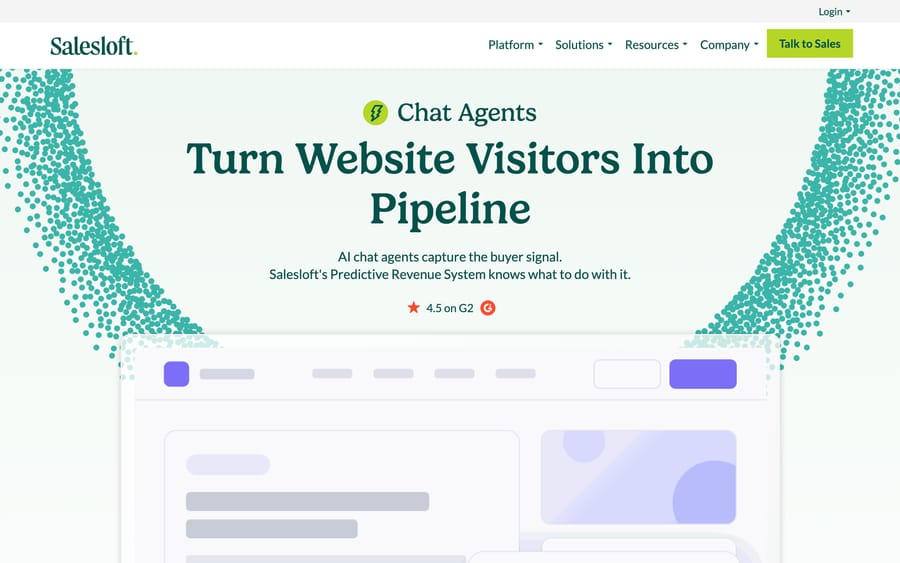
Visit drift.com today and you land on Salesloft: the Drift product has been absorbed into Salesloft's "Chat Agents."
Drift more or less invented conversational marketing in the mid-2010s: a website chat widget that greeted anonymous visitors, qualified them with a chatbot, routed hot accounts to the right rep in real time, and booked the meeting before they left the page. Its "no forms" pitch became the default B2B pipeline-chat tool for a generation of demand-gen teams. Then several things went wrong in sequence:
- The Salesloft acquisition (Feb 2024). Salesloft bought Drift and folded it into a broader revenue-orchestration play. The deal terms were never officially announced. Pricing reportedly hardened to a widely cited ~$30,000/year minimum, and SMB customers were deprioritized (myaskai, eesel).
- The 2025 security incident. A Drift/Salesloft OAuth breach exposed data across a large number of organizations (coverage cites 700+), and Drift went offline in September 2025 while it was investigated (wiserreview).
- The 2026 sunset. Clari and Salesloft, which merged in December 2025, announced the gradual sunset of Drift on 6 March 2026 and named 1mind as the AI successor for inbound qualification and AI demos (warmly, 1mind). No hard end-of-life date has been published.
Drift's older Premium tiers reportedly started around ~$2,500/month and rose with steep annual commitments (prospeo), so cost was pushing teams to look elsewhere before the sunset.
One caveat: 1mind is real but narrow. Coverage notes it focuses on inbound qualification and AI demos and does not replicate everything Drift did, such as visitor de-anonymization and outbound automation (warmly). "Just migrate to the official successor" isn't a complete answer for most teams. Below are the strongest replacements, grouped by the job you need done.
1. Intercom (with Fin): the closest all-round replacement
What it is. Intercom bundles website chat, a shared inbox, a help center and the Fin AI Agent, which resolves conversations on its own from your help content. For a team that used Drift as "the chat widget plus the AI that answers people," it's the nearest single-vendor swap. Salesforce completed its acquisition of Fin on 10 September 2026; Fin is still sold at the same price.
Strengths. Chat, support and AI resolution in one place, so there's no stitching three tools together. Fin is one of the more mature support-focused AI agents on the market, and the help center, workflows and reporting are well developed. Migration is straightforward because Intercom already lives on thousands of B2B sites.
Best for. Teams that want chat, support and AI in one product and are happy to run front-line conversations through Intercom rather than a marketing CRM.
Pricing reality. Far lower entry cost than Drift. Essential, Intercom's entry plan, is $29 a seat a month on annual billing (intercom.com/pricing, 24 Sept 2026), so a 10-seat team lands near $3,480 a year versus Drift's ~$30,000 minimum. Advanced is $85 and Expert $132 a seat. The catch is Fin's usage model: seats plus $0.99 per Fin outcome. Cheap at low volume; the per-outcome meter adds up as you deflect thousands of conversations a month, and the vendor earns more the more conversations it closes, whether or not you'd have wanted a human on them.
Limitations. Support-and-chat first. It is not a conversational-marketing engine in the Drift sense: no native account de-anonymization or outbound sales plays. If your Drift value was pipeline routing, Intercom covers only part of the job.
2. Qualified: for Salesforce-native enterprise sales
What it is. Qualified is the enterprise conversational-marketing platform most often called the closest like-for-like to Drift's sales side: real-time chat, AI-driven lead routing and meeting booking, built to live natively inside Salesforce. Piper the AI SDR Agent engages visitors and books qualified pipeline automatically.
Strengths. The native Salesforce integration is deeper than Drift's ever was. Routing, ownership and reporting all resolve against your Salesforce data without middleware. For a Salesforce-centric revenue team, that's the single biggest reason to choose it.
Best for. Enterprise B2B sales teams whose Drift use was pipeline generation and who already run on Salesforce.
Pricing reality. Qualified publishes three tiers (Premier, Enterprise, Ultimate) and no prices; every plan is a custom quote after a demo (qualified.com/pricing). Third-party coverage cites roughly $3,500/month and up, with a negotiated ~$40K/year commonly reported (salespeak). It's a lateral move on cost, not a saving; you're paying for depth.
Limitations. Overkill and over budget for SMBs, and heavily tied to Salesforce. Off Salesforce, most of its advantage evaporates.
3. HubSpot Chat: for teams already on HubSpot
What it is. HubSpot's built-in live chat and chatbot builder, part of the Sales and Service Hubs, with its Breeze AI layer for automated responses. It's a native feature of the CRM rather than a standalone product.
Strengths. Zero integration glue. Every chat logs directly to the contact record, on the same timeline as deals, emails and form submissions (text.com). For a team already on HubSpot, that unified history is useful, with nothing extra to buy or maintain.
Best for. HubSpot-centric marketing and sales teams that want native chat and don't need a specialist tool.
Pricing reality. Bundled. Chat and chatbot come with paid Sales/Service Hub tiers rather than as a separate line item, so if you already pay for HubSpot the incremental cost is low.
Limitations. The AI and routing are solid but less specialized than a dedicated conversational-marketing platform. For sophisticated real-time enterprise routing or de-anonymization, it will feel basic.
4. Landbot: for no-code conversational flows
What it is. Landbot is a visual, no-code chatbot builder. You design conversation flows on a drag-and-drop canvas (branching questions, lead capture, routing rules) and can layer in GPT-powered responses where you want them.
Strengths. Speed and control for non-technical teams. If your Drift value was a well-structured qualifying flow ("what are you here for, what size company, book a call"), Landbot lets marketing own and iterate that flow directly, across web, WhatsApp and Messenger.
Best for. Marketing teams that want a rules-first, visually built lead-capture bot and prefer deterministic flows over open-ended AI.
Pricing reality. A free plan covers 100 chats a month with no AI chats. Starter is €40 a month billed monthly (€32 on annual billing) for 500 chats and 100 AI chats; Professional is €100 monthly for 2,500 chats (landbot.io/pricing, 24 Sept 2026).
Limitations. A bot builder, not a revenue platform: no native de-anonymization, no Salesforce-grade routing, and the AI is metered separately. Great for structured capture; not a match for enterprise pipeline orchestration.
5. Tidio: for SMBs on a budget
What it is. Tidio is affordable live chat plus the Lyro AI agent, aimed at small businesses and ecommerce rather than the enterprise. Think of it as Drift built for a 10-person company.
Strengths. Low cost and fast setup. Lyro handles visitor questions, basic qualification and routing out of the box, and the live-chat experience is polished for SMB budgets (G2).
Best for. SMBs and lean ecommerce teams that want affordable AI chat without an enterprise contract.
Pricing reality. The free plan includes 50 billable conversations a month. Starter is $24.17 a month and Growth starts at $49.17; both include 50 one-off Lyro conversations. After that, a dedicated Lyro plan starts at $32.50 a month for 50 conversations and scales by conversation quota (tidio.com/pricing, 24 Sept 2026). That's a fraction of Drift for the volumes an SMB actually sees.
Limitations. Less depth on enterprise sales routing, account-based orchestration and CRM integration. It scales down well and up poorly; a large B2B revenue team will outgrow it.
6. Warmly: for visitor de-anonymization + chat
What it is. Warmly pairs website visitor de-anonymization with live chat and orchestration on one platform. It identifies the companies (and, where possible, contacts) browsing your site, then engages them by chat, video or automated messaging based on who they are (text.com).
Strengths. This is the piece the official successor, 1mind, reportedly does not cover: knowing who is on your site. If the Drift value for you was "an enterprise account is on the pricing page, ping the owner now," Warmly rebuilds that signal-plus-engagement loop directly.
Best for. Outbound-minded B2B teams that want intent signal and engagement combined, not just a chat widget.
Pricing reality. Warmly no longer lists a free plan. AI Web-Deanonymization is $10,000 a year, Inbound Chat $20,000 a year and AI Inbound Autopilot $30,000 a year on annual billing, with quarterly billing costing more (warmly.ai/pricing, 24 Sept 2026). The chat tier sits in the same range as Drift's reported minimum, so this is a swap for capability, not for savings.
Limitations. Value depends on your traffic being identifiable B2B accounts. For consumer or long-tail traffic the reveal rate and ROI drop. It's a sales-signal tool first, not a support platform.
7. Chili Piper: for meeting routing and booking
What it is. Chili Piper is a scheduling and lead-routing tool, not a chatbot. It handles the "qualify the inbound lead and instantly book the right rep" step many teams actually relied on Drift for.
Strengths. It does one job very well: real-time routing, round-robin assignment and instant meeting booking off a form or hand-raise. If the chatbot was incidental and the booking was the point, it replaces the part you cared about.
Best for. Teams whose Drift use was really "route the lead and book the meeting."
Pricing reality. The old ~$22.50-per-user price is gone. Routing & Scheduling is $1,250 a month billed annually ($15,000 a year) with 15 seats included and extra seats at $45 a month; Experiences is $3,500 a month with 30 seats. There is no free plan and no monthly billing. A standalone scheduler, ChiliCal, is $12 a user a month but needs at least 200 seats (chilipiper.com/pricing, 24 Sept 2026). For booking alone that's still about half of Drift's reported minimum.
Limitations. No website chat widget and no conversational AI. Pair it with a chat tool if you still want on-site conversation; on its own it's a router, not a full Drift replacement.
8. Ada: for enterprise support automation
What it is. Ada is an enterprise AI-agent-first support automation platform. Where Intercom and Tidio bundle chat with AI, Ada is built to resolve high volumes of customer support conversations on its own across channels.
Strengths. Scale and automation depth. For large support organizations that used Drift mainly to deflect repetitive inbound questions, Ada is purpose-built for it: multilingual, high-volume, with strong workflow and analytics tooling.
Best for. Large customer-support teams whose Drift use was deflection at scale, not sales pipeline.
Pricing reality. Custom and enterprise. Ada does not publish list prices; deals are negotiated by volume. Expect an enterprise commitment, not a self-serve credit card.
Limitations. Overkill for small teams, and a support tool rather than a marketing-chat or pipeline-routing platform. If your Drift use was sales, Ada isn't the answer.
9. Macha: for the support-automation use case (on top of your help desk)
What it is. The caveat first: Macha is not a conversational-marketing or sales-chat replacement. If your Drift use was pipeline generation, de-anonymization or meeting booking, pick one of the tools above. But many teams also leaned on Drift to deflect and automate inbound support questions in chat, and that's the job Macha is built for.
Macha is an AI agent layer for customer service that runs on top of the help desk you already use: Zendesk, Freshdesk, Gorgias, Front, HubSpot or Intercom. You don't rip out your support stack; you add automation to it. You build agents in plain English, and because Macha supports custom tools, an agent can look up an order, check a subscription or trigger a real backend action rather than reciting a canned FAQ answer. That's the difference between deflecting a ticket and resolving it.
Strengths. Sitting on your existing help desk means no migration of ticket history or agent workflows; automation runs where your team already works. Agents take real actions through custom tools, so they handle account-specific questions, not just generic ones. Setup and monitoring by the Macha team are included.
Best for. Teams moving the support side of Drift into automation on their existing help desk, especially anyone frustrated by Drift's flat five-figure minimum who wants cost to track actual usage.
Pricing reality. Macha is priced per ticket, not per seat and not per resolution. One thread with one person is one charge however many messages it takes. Plans start at $299/mo for 750 tickets (about $0.40 a ticket), then $599 for 1,500 and $1,199 for 3,000, billed monthly. Compared with Drift's flat minimum and Fin's $0.99-per-outcome meter, cost tracks ticket volume rather than headcount or a per-outcome success fee.
Limitations. This is not website conversational marketing or outbound sales chat. Macha doesn't de-anonymize visitors or route hot leads to AEs. If that was your Drift use, choose Qualified, Intercom or Warmly. And it's a layer on top of a help desk; if you don't run one of the supported help desks, it isn't the right starting point.
How do you choose between marketing chat and support automation?
The biggest mistake when replacing Drift is treating it as one decision. Drift bundled marketing chat, sales routing and support automation into a single contract, which is why it was expensive. The sunset is your chance to unbundle. Start with which job you actually relied on.
If Drift was your conversational-marketing or sales engine (engaging anonymous visitors, qualifying and routing leads, booking meetings), you're shopping in the sales-chat category:
- On Salesforce and enterprise-scale? Qualified.
- Want an all-in-one at a lower entry cost? Intercom (with Fin).
- Already standardized on HubSpot? HubSpot Chat.
- The real value was knowing who's on your site? Warmly.
- Just need to route and book the meeting? Chili Piper.
- Want a marketing-owned, no-code qualifying flow? Landbot.
If Drift was really answering repetitive customer questions (support deflection dressed up as chat), the best picks are different:
- Small team or ecommerce on a budget? Tidio.
- Enterprise support at high volume? Ada.
- Keep your existing help desk and add a ticket-priced AI agent layer that takes real actions? Macha.
Many teams need one tool from each column, say HubSpot Chat for marketing and Macha for support automation, and still spend less than one renewed Drift contract. Map your must-keep workflows first, then buy against them.
FAQ
Why do I need a Drift alternative in 2026? Clari and Salesloft announced the gradual sunset of the Drift conversational marketing platform on 6 March 2026, and drift.com now redirects to Salesloft's "Chat Agents." There's no published end-of-life date and existing accounts still work, but active R&D has ended and Salesloft is steering current customers toward a successor, 1mind. That's why teams are evaluating replacements rather than building new roadmaps on Drift.
Is Drift shut down right now, or still working? As of September 2026 the product pages are still live and existing customers can still use it. It's a wind-down, not an overnight shutoff. With R&D halted and a sunset announced, plan your migration now rather than wait for a forced cutover.
What is the closest replacement for Drift? For most teams, Intercom with its Fin AI Agent is the closest all-round like-for-like, at $29 a seat a month plus $0.99 per Fin outcome. For Salesforce-native enterprise sales specifically, Qualified is the nearest match.
Is 1mind a full replacement for Drift? 1mind is Salesloft's named successor and a real product, but coverage indicates it focuses on inbound qualification and AI-powered demos and does not replicate everything Drift did, such as visitor de-anonymization and outbound automation. Evaluate it against the alternatives here based on the job you need done.
What's the cheapest Drift alternative? For SMBs, Tidio has a free plan with 50 conversations a month and a Starter plan at $24.17 a month. Landbot's free plan covers 100 chats a month for basic no-code bots. Chili Piper is no longer a cheap option: its entry plan is $15,000 a year.
Is Macha a Drift alternative? Only for the support-automation use case. Macha is not a conversational-marketing or sales-chat tool. It's an AI agent layer that runs on top of your existing help desk (Zendesk, Freshdesk, Gorgias, Front, HubSpot or Intercom) and is priced per ticket, from $299 a month for 750 tickets. If you used Drift to automate inbound support, Macha fits; if you used it for sales pipeline or visitor de-anonymization, choose Qualified, Intercom or Warmly.
How much did Drift cost? Older Premium plans reportedly started around ~$2,500/month, and after the Salesloft acquisition the entry point is widely cited at roughly a ~$30,000/year minimum with steep annual commitments. That was a key reason many teams were already moving to cheaper or more specialized tools before the sunset.
Resolve tickets automatically with AI agents
Macha's AI agents work on top of the help desk you already use — no code.