Intercom
 Shopify
 Stripe
 Slack
Slack Notion
 Google Workspace
 Confluence

Kore.ai: The Complete Guide (2026) — Features, Pricing & Alternatives


If you're evaluating enterprise conversational or agentic AI in 2026, Kore.ai is one of the heavyweight names you'll run into fast. It's used by nearly 500 of the Global 2000 — banks, telcos, healthcare giants — and it's one of the more capable, broadest platforms in the category. But that breadth cuts both ways: Kore.ai is powerful, but it's also complex, largely sales-led, and its pricing is scattered across a mix of tiers, per-seat charges, and negotiated enterprise contracts. So buyers land on the same questions they always do — what is Kore.ai, what does it actually cost, and is it right for my team?

This guide is our honest attempt at answering them. We'll cover what Kore.ai does, how the XO Platform and the newer Agent Platform work, the GALE generative-AI layer, its vertical apps, its integrations and deployment options, who uses it, what it realistically costs (with every number flagged for confidence), where it's strong, where it isn't, and how it compares. We build an AI support product ourselves, so we'll be upfront about that — but this is a genuine guide to Kore.ai, not a sales pitch. Where we can't verify something, we say so.
What is Kore.ai?
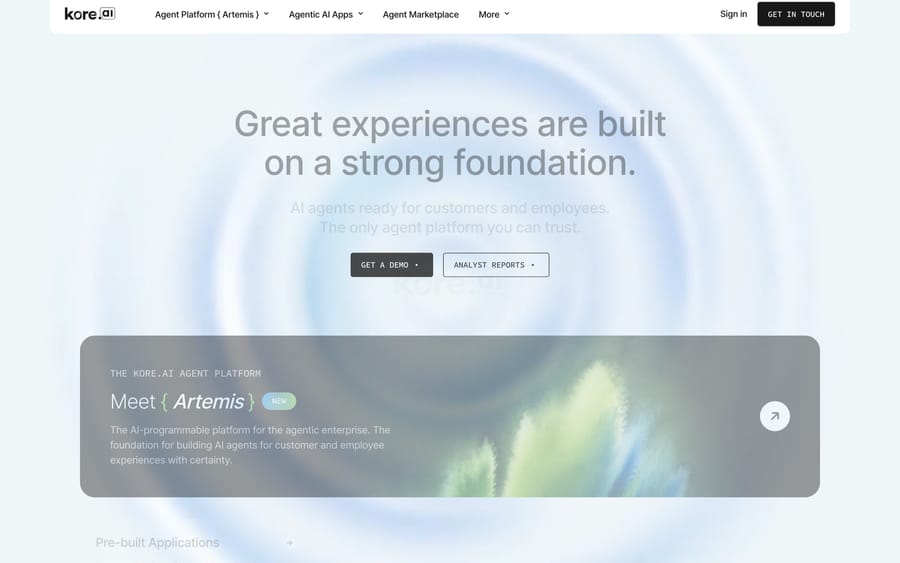
Kore.ai's homepage, positioning it as an enterprise agentic-AI platform.
Kore.ai is an enterprise conversational and agentic AI platform for building, deploying, and managing AI agents that handle customer and employee interactions across channels. It's positioned as a broad, trusted enterprise platform — model-, data-, channel-, and cloud-agnostic — with pre-built applications for banking, healthcare, HR, IT, and more (kore.ai).
The company was founded in 2014 by Raj Koneru, a serial entrepreneur whose prior companies include Kony, iTouchPoint, Seranova, and Intelligroup (Kore.ai about). Over the years it has grown from a conversational-AI (chatbot) platform into a full agentic-AI suite. Its overarching brand for this is XO — Experience Optimization — the idea of optimizing customer, agent, and employee experiences through AI-native products.
Kore.ai frames its portfolio around three "AI for" motions: AI for Service (customer self-service and contact-center automation), AI for Work (employee productivity — IT, HR, knowledge), and AI for Process (agentic automation of back-office workflows). That framing is what separates Kore.ai from a pure customer-support tool: it's deliberately built to sit across the whole enterprise, not just the support inbox.
The scale is substantial. Kore.ai has reportedly raised roughly ~$223M in total funding, including a reported $150M Series D led by FTV Capital in January 2024, with participation from NVIDIA and existing investors (Kore.ai news). The company says it is trusted by nearly 500 Global 2000 companies; publicly referenced customers include PNC Bank, AT&T, Cigna, Coca-Cola, Airbus, Roche, Experian, Deutsche Bank, and CVS. The customer base skews heavily toward regulated, high-volume industries — banking and financial services, healthcare, telecom, and retail — which is both a signal of enterprise trust and a hint about where the platform's design priorities lie.
How Kore.ai's AI works
Kore.ai's core is the XO Platform, and its recent direction is agentic orchestration. A few pieces matter.
The XO Platform
On the XO (Experience Optimization) Platform, teams build virtual assistants and agents using a no-code/low-code dialog builder, train them with multi-engine NLU for intent recognition, and deploy across the full channel stack without rebuilding for each channel (Kore.ai for service). This is the classic Kore.ai strength: a mature, enterprise-grade conversational engine with fine-grained dialog control. The dialog builder gives designers explicit control over conversation flows, entities, context, and fallback behavior — the kind of deterministic control that regulated buyers in banking and healthcare tend to demand, where a hallucinated answer isn't just embarrassing but a compliance problem.
Crucially, the XO Platform straddles no-code and pro-code: business teams assemble flows visually, while developers drop into scripting, custom JavaScript, API service nodes, and webhooks for the parts that need real engineering. That dual model is a big part of why large organizations pick it — a conversation designer and a software engineer can work on the same assistant without one blocking the other.
GALE — the generative-AI layer
To modernize that classic dialog engine for the LLM era, Kore.ai introduced GALE (Generative AI Layer for Enterprises). GALE is a dedicated framework for bringing large language models into the platform safely: prompt management, model evaluation and comparison, retrieval-augmented generation over enterprise knowledge, and security/governance controls so generative outputs meet enterprise standards. It's model-agnostic — teams can plug in different LLMs, evaluate them side by side, and route to whichever performs best for a given task rather than being locked to one provider. GALE is the bridge between Kore.ai's deterministic, flow-based heritage and the more open-ended generative behavior enterprises now expect.
Voice and digital channels
Kore.ai is one of the few platforms that treats voice and digital as first-class equals. The same assistant can be deployed to web and mobile chat, WhatsApp and messaging apps, email, and — importantly — real-time voice over telephony and contact-center platforms. It ships a Voice Gateway and integrates with contact-center suites (Genesys and others), so an agent built once can answer a phone call and a web chat with shared logic and knowledge. For enterprises whose highest-volume channel is still the phone, this voice reach is a genuine differentiator over chat-only tools.
The Agent Platform and multi-agent orchestration
More recently, Kore.ai has leaned into multi-agent orchestration — purpose-built specialized agents that collaborate on complex objectives, handing work between one another rather than trying to cram everything into one monolithic bot. This is the platform's answer to agentic AI: compose specialized agents and orchestrate them.
That direction culminated in the Kore.ai Agent Platform, a more recent agent-management layer positioned as an AI-native foundation for building, governing, and optimizing the agents, systems, and workflows running across an enterprise. Alongside it, Kore.ai emphasized cross-framework agent management — the ability to build agents in Kore.ai or in external frameworks like LangGraph, CrewAI, AutoGen, Google ADK, AWS AgentCore, Microsoft Foundry, and Salesforce Agentforce, and govern them all from one control plane. The strategic bet: as enterprises inevitably build agents in many frameworks, Kore.ai wants to be the neutral governance layer that tames the sprawl. It's a genuinely forward-looking position — though, as with any new platform, buyers should validate how mature that cross-framework governance is for their specific stack.
Vertical and functional apps
Rather than sell only a blank platform, Kore.ai packages pre-built vertical and functional applications on top of it, which shortens time-to-value for common use cases:
- BankAssist — banking and financial-services assistant (balances, transactions, disputes, card servicing).
- HealthAssist — healthcare assistant (appointments, benefits, member and patient support).
- RetailAssist — retail and e-commerce customer service (orders, returns, product help).
- IT Assist and HR Assist — employee-facing service-desk automation for IT tickets and HR queries.
- SearchAssist / Search AI — enterprise search and knowledge answers grounded in your documents.
- WorkAssist — an employee productivity assistant spanning workplace tools.
These are configurable starting points with domain intents, flows, and integrations already wired — a meaningful head start for a large deployment.
Deployment, security, and compliance
Kore.ai supports a wide range of deployment models: public-cloud SaaS, sovereign/regional cloud, private cloud, and on-premises / self-hosted, with data residency by region. On compliance it carries the certifications regulated buyers ask for — SOC 2 Type II, ISO 27001, and PCI DSS, plus HIPAA-aligned handling for healthcare and FedRAMP Moderate authorization for public-sector workloads. This flexibility and compliance depth is one of the clearest reasons a bank, hospital network, or government agency shortlists Kore.ai over a lighter, SaaS-only tool.
Integrations
The platform ships with 100+ purpose-built integrations across contact center (CCaaS), CRM, ITSM, and other enterprise systems, plus API/webhook service nodes for anything not covered out of the box, and it connects to all major cloud providers — reinforcing the "model-, data-, channel-, and cloud-agnostic, fits-into-your-stack" enterprise pitch.
Key features
- XO Platform — no-code/low-code and pro-code dialog builder with multi-engine NLU.
- GALE — the Generative AI Layer for Enterprises: prompt management, model evaluation, RAG, and governance for LLMs.
- AI for Service / Work / Process — customer support, employee assistance, and back-office process automation.
- Product lines — Automation AI (self-service), Contact Center AI and Agent AI (agent-facing/voice), and Search AI (knowledge).
- Voice + digital — real-time voice over telephony plus web, mobile, and messaging from one build.
- Multi-agent orchestration of specialized agents on complex tasks.
- Agent Platform — build, govern, and optimize agents, with cross-framework management (LangGraph, CrewAI, AutoGen, Agentforce, and more).
- Vertical/functional apps — BankAssist, HealthAssist, RetailAssist, IT Assist, HR Assist, SearchAssist, WorkAssist.
- Flexible deployment — SaaS, sovereign, private cloud, or on-premises with regional data residency.
- Enterprise compliance — SOC 2 Type II, ISO 27001, PCI DSS, HIPAA-aligned, FedRAMP Moderate.
- 100+ enterprise integrations across CCaaS, CRM, and ITSM, plus API/webhook nodes.
Kore.ai pricing (researched — third-party estimates)
Here's the honest state of Kore.ai pricing as of 2026: there is no clean, official public rate card. Kore.ai does not list plan-by-plan monthly costs on its website, and serious deployments run through a sales process with a negotiated contract. That said, Kore.ai is somewhat more documented than a fully-opaque enterprise vendor — its own docs describe some usage-based billing mechanics, and third-party teardowns fill in the rest. Based on documented billing and independent pricing analyses, the shape looks like this (Featurebase, Quiq, eesel AI):
- Free / trial credits — new accounts get around $500 in free credits (roughly on the order of ~5,000 test requests) to build and evaluate before committing.
- Automation AI (self-service) — reportedly billed in 15-minute conversation sessions, with third-party teardowns citing a rate around ~$0.20 per session. Cheap per unit, but it adds up fast at high conversation volume, and long or multi-turn interactions consume more sessions.
- Contact Center AI and Agent AI — billed per seat, with third-party estimates in the range of roughly $50–$150 per seat per month depending on features and volume commitments.
- Standard / entry plans — smaller published or reseller-listed tiers have appeared around $50–$150/month (annual) for basic access, with practical entry-level deployments often landing closer to $500–$1,500/month once real usage and modules are included.
- Enterprise contracts — negotiated, commonly reported anywhere from about $50,000 to $300,000+ per year depending on interaction volume, channels, add-on modules, and deployment model. Standalone support tiers (e.g., a premium support SLA) can carry their own additional fee.
What drives the cost. Three things matter most. First, the billing model is blended — session-based for self-service, per-seat for agent-facing and voice — so your total depends on your mix of channels, conversation volume, and headcount. Second, cost scales with adoption: more conversations, adding voice (pricier than chat), longer sessions, multilingual support, extra integrations, and premium modules all push the number up. Third, deployment model is a real lever — SaaS is the baseline, while private-cloud, sovereign, or on-premises deployments and stricter compliance typically command materially higher, custom pricing.
Treat every dollar figure above as a third-party estimate, not a quote — confirm your specific scenario directly with Kore.ai, and re-check within six months.
What reviewers say: Kore.ai holds 4.6 out of 5 from 507 reviews on G2, checked 21 September 2026 — one of the largest review samples of any vendor in this series, which makes the recurring complaints below about implementation effort worth more than a handful of anecdotes would be.
Pros and cons
Strengths
- Deep, mature enterprise platform. A decade of conversational-AI engineering shows: fine-grained dialog control, strong multi-engine NLU, and broad channel/integration coverage.
- Broad scope. Customer and employee experiences (AI for Service / Work / Process), self-service and agent-facing, chat and real-time voice — few platforms span as much from a single foundation.
- Both no-code and pro-code. Business teams and developers can build on the same assistant, which suits large orgs with mixed skill sets.
- Deployment and compliance depth. SaaS, sovereign, private cloud, and on-premises options plus SOC 2, ISO 27001, PCI DSS, HIPAA-aligned, and FedRAMP Moderate — table stakes for banks, hospitals, and government.
- Pre-built vertical apps. BankAssist, HealthAssist, RetailAssist, IT/HR Assist give regulated buyers a real head start.
- Forward-looking agent management. The Agent Platform and cross-framework governance are a smart bet on the multi-agent, multi-framework enterprise future.
- Serious customer proof. A reported ~500 Global 2000 customers (publicly referenced names include PNC, AT&T, Cigna, Coca-Cola, Deutsche Bank, CVS) de-risk vendor viability.
- Free credits to build and test before committing — rarer than you'd think in this segment.
Limitations
- Steep learning curve. G2 and Gartner Peer Insights reviewers consistently flag that advanced features are hard to master, and note occasional bugs in the XO Platform (e.g., sub-intent issues, chatbot crashes) (G2). Getting real value typically requires trained conversation designers.
- Complex, fragmented pricing. Mixing session-based, request-based, and per-seat billing across modules makes forecasting genuinely hard, and the lack of a clean public rate card means every serious buyer negotiates.
- Enterprise-weight implementation. Realistic deployments are sales-led and need internal expertise and often a services engagement; this isn't a spin-up-in-an-afternoon tool.
- Breadth over focus. The platform does a lot, which can mean far more configuration than a purpose-built support tool for a single use case — for a team that just wants ticket deflection on an existing helpdesk, most of that surface area is overhead.
- Rapid platform churn. With XO, GALE, and now the Agent Platform all evolving quickly, product naming and capabilities shift; teams should validate current-state features rather than rely on last year's docs.
Who Kore.ai is best for (and who it isn't)
Best for: large enterprises — especially regulated industries like banking, insurance, and healthcare — that need a broad, governable conversational/agentic platform across customer and employee experiences, require voice and flexible on-prem/sovereign deployment, have the internal expertise to build on it, and want to manage a growing fleet of agents (including agents built in other frameworks) through one control plane. For that profile, Kore.ai is a legitimate leader.
Not for: SMBs and lean support teams, anyone who wants a fast, self-serve path to AI on their existing helpdesk, or teams that only need customer-support automation and don't want to build and govern a full conversational platform. For those, Kore.ai's power is overkill and its learning curve is a tax.
Kore.ai vs. alternatives
Kore.ai sits in a crowded enterprise field. The honest shortlist:
| Tool | Best for | Channels | Pricing | Deployment |
|---|---|---|---|---|
| Kore.ai | Broad enterprise conversational + agentic AI across service, work & process | Voice + chat + messaging | Session + per-seat + enterprise (~$50K–$300K+/yr, quote-only) | SaaS, private cloud, or on-prem; sales-led, complex |
| Salesforce Agentforce | Enterprises already deep in Salesforce | Chat + digital, CRM-native | Per-action / add-on to Salesforce | Sales-led, cloud |
| Cognigy | Enterprise voice + chat contact-center AI | Voice + chat | Custom, enterprise | Sales-led, SaaS/on-prem |
| Intercom Fin | CX automation with public per-resolution pricing | Chat, in-app | Public, per resolution | Self-serve-ish |
| Macha | AI customer-support agents on top of your existing helpdesk | Chat + tickets/email (helpdesk-native) | From $299/mo for 750 tickets (~$0.40/ticket); $50 free usage | Self-serve, light — no platform to build |
A note on where we fit, since we'd rather be upfront than pretend we're neutral. Macha is an AI agent layer that runs on top of your existing helpdesk — Zendesk, Freshdesk, Front, Intercom, or Gorgias — not a broad conversational/agentic platform like Kore.ai. We don't claim to match Kore.ai across voice, employee experience, and full contact-center orchestration; we're focused on customer-support automation for teams that already run a helpdesk and want AI agents without building and governing a whole platform. The honest differentiators: Macha is self-serve and fast (start on a free trial instead of a sales-led implementation), you build agents in plain English, and it bills per ticket (from $299/month for 750 tickets) rather than a mix of session and per-seat enterprise fees. If your need is a broad, governable enterprise platform across customer and employee channels — with voice and on-prem — Kore.ai (or Cognigy/Agentforce) is the right category. If it's AI customer support on the helpdesk you already run, that's where Macha fits. See AI agents for customer service and custom tools for how agents take real actions.
Two of those alternatives have full guides here: Cognigy, the closest like-for-like on enterprise conversational AI, and Agentforce, if your system of record is Salesforce and you would rather activate an agent layer inside it.
How we researched this: The features, pricing and customer figures above come from Kore.ai's own public pages and the third-party sources linked inline, checked when this guide was researched in August 2026. This pass, on 21 September 2026, re-checked the post's links, added the review figures quoted above and cross-referenced our guides to the closest alternatives; it did not re-price the plans against Kore.ai's site, so read the pricing as accurate to August 2026 rather than to today. The G2 rating and review count above were read in a real browser on 21 September 2026, since G2 blocks scripted requests.
Frequently asked questions
What is Kore.ai? Kore.ai is an enterprise conversational and agentic AI platform for building and deploying AI agents across customer and employee channels. Founded in 2014 by Raj Koneru, its flagship is the XO (Experience Optimization) Platform, and it has more recently added a dedicated Agent Management Platform for cross-framework agent governance.
How much does Kore.ai cost? Kore.ai doesn't publish a full rate card. As of 2026, reported billing includes free trial credits (~$500) for new accounts, Automation AI billed in 15-minute sessions at roughly $0.20 per session, Contact Center AI and Agent AI billed per seat (roughly $50–$150/seat/month), smaller entry tiers around $50–$150/month, and enterprise contracts negotiated anywhere from about $50,000 to $300,000+ per year. These are third-party estimates; costs scale with volume, channels (voice is pricier), modules, and deployment model.
What is the XO Platform? XO (Experience Optimization) is Kore.ai's core platform: a no-code/low-code and pro-code dialog builder with multi-engine NLU for intent recognition and omnichannel deployment, used to build and run enterprise virtual assistants and agents across chat and voice.
What is GALE? GALE (Generative AI Layer for Enterprises) is Kore.ai's framework for bringing large language models into the platform safely — prompt management, model evaluation and comparison, retrieval-augmented generation over enterprise knowledge, and governance controls. It's model-agnostic, so teams can plug in and compare different LLMs.
What is the Kore.ai Agent Platform? It's Kore.ai's agentic-AI foundation for building, governing, and optimizing AI agents and workflows across the enterprise, including managing agents built in external frameworks like LangGraph, CrewAI, AutoGen, and Salesforce Agentforce from one control plane.
Does Kore.ai support voice, and can it be deployed on-premises? Yes to both. Kore.ai supports real-time voice over telephony and contact-center platforms alongside chat and messaging, and it offers SaaS, sovereign/regional cloud, private cloud, and on-premises deployment with regional data residency — backed by SOC 2, ISO 27001, PCI DSS, HIPAA-aligned, and FedRAMP Moderate compliance.
Who uses Kore.ai? The company reports nearly 500 Global 2000 companies. Publicly referenced customers include PNC Bank, AT&T, Cigna, Coca-Cola, Airbus, Roche, Deutsche Bank, Experian, and CVS — concentrated in banking, telecom, healthcare, retail, and other large regulated enterprises.
Is Kore.ai good for small businesses? Generally no. While it offers free credits for testing, Kore.ai is an enterprise platform with a steep learning curve, complex quote-only pricing, and sales-led implementation. Smaller teams are usually better served by self-serve tools that layer onto an existing helpdesk.
What are the main alternatives to Kore.ai? Salesforce Agentforce and Cognigy are close enterprise peers (voice + chat, sales-led). For customer-support automation specifically, Intercom Fin offers public per-resolution pricing, and Macha is a self-serve AI agent layer that runs on top of an existing helpdesk (Zendesk, Freshdesk, Front, Intercom, Gorgias), billed per ticket.
The bottom line
Kore.ai is one of the most capable and complete enterprise conversational/agentic AI platforms in 2026 — broad, mature, and increasingly focused on governing the sprawl of enterprise agents through its newer Agent Platform. If you're a large enterprise, especially in a regulated industry, that needs a governable platform across customer and employee channels (and voice, and flexible deployment) and has the expertise to build on it, Kore.ai belongs on your shortlist and may well win the evaluation.
The caveats are real: it's complex, has a steep learning curve, and its blended pricing is hard to forecast, and it's built for enterprise-weight implementation. If you want a fast, self-serve path to AI on a helpdesk you already run, a lighter AI layer will get you most of the value with far less overhead. Match the tool to your scope — that's the whole decision.
Researched and verified July 2026 against Kore.ai's site, G2, Gartner Peer Insights, and independent pricing teardowns. Pricing blends tiers, sessions, and per-seat charges; all figures are third-party estimates and may be outdated — confirm directly with Kore.ai. We'll re-check this guide within six months.
Simple per-ticket AI pricing
One thread with one person is one charge, however many replies it takes.