Intercom
 Shopify
 Stripe
 Slack
Slack Notion
 Google Workspace
 Confluence

Agentforce: The Complete Guide (2026)


If you work anywhere near customer service, sales, or CRM in 2026, you've heard about Agentforce — Salesforce's platform for building and deploying autonomous AI agents directly inside the Salesforce ecosystem. It's one of the most talked-about launches in enterprise software, and it has reshaped how a lot of teams think about AI at work. This guide is a balanced, researched walkthrough of what Agentforce actually is, how its Atlas Reasoning Engine works, what it really costs (the pricing is genuinely knowable, which is refreshing), its honest pros and cons, who it's for, and the alternatives worth comparing — including where we fit in.

We've written this as a vendor guide, not a sales pitch. Full disclosure up front: we build Macha, an AI agent layer for Zendesk and Freshdesk. Agentforce is a category peer at the AI-agent level, not a head-to-head helpdesk competitor, and we'll explain the difference honestly near the end. Everything below is sourced to Salesforce's own materials and recent third-party analysis, with vendor claims flagged where they appear.
What is Agentforce?
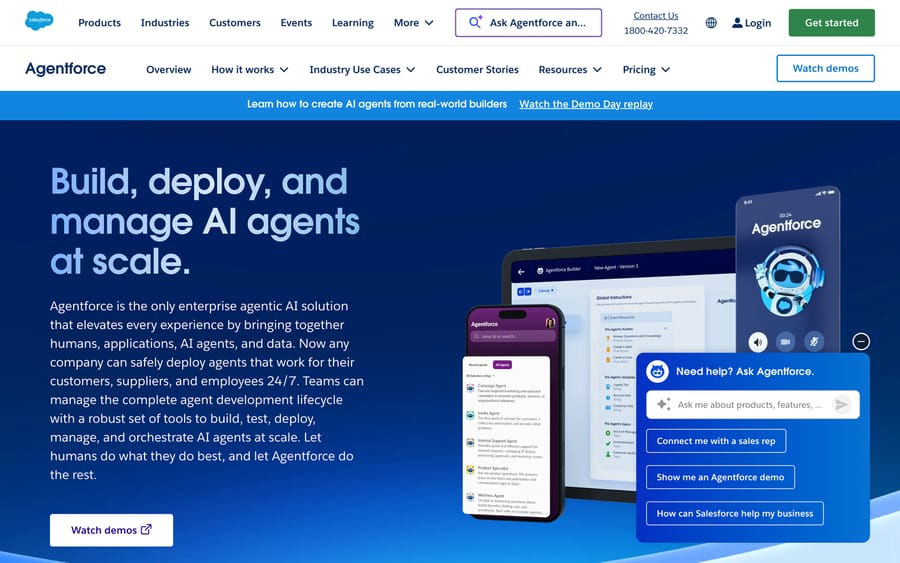
Salesforce Agentforce's homepage — "build, deploy, and manage AI agents at scale."
Agentforce is Salesforce's agentic AI platform — a system for building, deploying, and managing AI agents that live inside the Salesforce ecosystem and act on your CRM data. Where earlier Salesforce AI (Einstein) mostly surfaced predictions and suggestions, Agentforce agents are designed to take action: resolve a support case, qualify a lead, draft and send follow-ups, update records, and trigger workflows — with far less human hand-holding (Salesforce).
The pitch is unification. Because Agentforce is native to Salesforce, its agents run on the same data, security model, and automation (Flows, Apex) that you already use. You're not bolting a separate AI product onto your CRM and hoping the integration holds — the agent lives where the data lives. For the millions of teams already standardized on Salesforce, that proximity to data and workflow is the whole value proposition.
The short version: Agentforce is a CRM-native, enterprise-grade agent platform for companies already invested in Salesforce. If Salesforce is your system of record, Agentforce is designed to be the AI layer that acts on it.
Agentforce 360: the current generation
The product has moved fast. The 2024 release established the agent-plus-Atlas concept; Agentforce 2.0 (early 2025) added a richer library of pre-built actions, reasoning improvements, and tighter Slack integration. At Dreamforce '25, Salesforce rebranded the whole stack as Agentforce 360 — a unified agentic layer spanning the Agentforce Platform, Data 360 (the former Data Cloud), the Customer 360 apps, and Slack — which reached general availability in early 2026 as part of the Spring '26 release (Salesforce, Salesforce Ben).
Four capabilities define the 360 generation: Agentforce Builder (a conversational agent-building workspace), Agent Script (a scripting language for deterministic control), Agentforce Voice (natural voice agents), and Intelligent Context (grounding in unstructured data via Data 360). When you read "Agentforce" today, this is what most buyers mean — and it's the version this guide describes.
How Agentforce works: the Atlas Reasoning Engine
The engine under the hood is what Salesforce calls the Atlas Reasoning Engine — the "brain" that decides what an Agentforce agent should do and does it. Rather than a single prompt-and-response, Atlas runs a reason–act–observe (ReAct) loop: it thinks through a step, takes an action, checks the result, and loops until it completes the goal (Salesforce Engineering, Salesforce).
In practice, a typical Atlas cycle looks like this:
- Data retrieval (RAG grounding). The agent pulls live, relevant data from Salesforce, Data Cloud, or external systems via the Model Context Protocol (MCP) — so its answers are grounded in your actual records, not just the model's training data.
- Plan building. Atlas decides which "tools" it needs to reach the goal — an Apex class, a specific Flow, a prompt template, or an API call — and sequences them.
- Execution and reflection. It runs the actions, checks whether the outcome is good enough, and if not, loops back and tries a different approach. Salesforce describes this as System-2, inference-time reasoning — deliberate, multi-step thinking rather than a single reflexive answer.
Two things make Atlas notable for enterprise buyers. First, observability: every decision — planning, tool selection, execution, reflection — is logged, which matters for auditing, debugging, and improving agent behavior over time. Second, proactivity: agents can trigger actions when CRM data changes, an email arrives, or a meeting approaches, rather than only responding when prompted. Salesforce cites early-pilot metrics like a 2x lift in response relevance and a 33% improvement in end-to-end accuracy versus DIY systems — genuinely strong numbers, though these are vendor-reported and worth validating against your own use case.
Data 360: the grounding layer
Atlas is only as good as what it's grounded in, and that grounding comes from Data 360 (formerly Data Cloud). It unifies structured records and unstructured content — knowledge articles, PDFs, transcripts, emails — into a single retrieval layer agents can search at runtime. The Spring '26 additions of Intelligent Context and Tableau Semantics let agents reason over messy, unstructured data and analytics rather than just clean CRM fields. In practice, Data 360 is the difference between an agent that guesses and one that cites your actual policy or the customer's actual order — and it's a metered cost line of its own beyond the free Foundations allotment.
Agentforce Builder and Agent Script
The build experience matured in the 360 generation. Agentforce Builder replaces the older low-code Agent Builder with a conversational, single-workspace environment: describe what you want in natural language, then refine in a document-like editor with autocomplete, a low-code canvas, or a pro-code script view. Agent Script is the layer for teams that need determinism — a human-readable expression language for conditional logic, precise tool selection, and repeatable behavior "every time." It's Salesforce's answer to the reliability problem that plagues purely prompt-driven agents: creativity where you want it, hard rails where you don't.
Key features
- CRM-native agents for service, sales, marketing, and commerce that act on live Salesforce data.
- Atlas Reasoning Engine — ReAct-style planning, RAG grounding via Data 360 + MCP, and inference-time reasoning.
- Agentforce Builder — a conversational, single-workspace environment to define an agent's topics, instructions, and the actions (Flows, Apex, prompt templates, APIs) it can take, from natural-language guidance down to pro-code.
- Agent Script — a human-readable scripting language for deterministic, rule-guided agent behavior.
- Data 360 grounding — unifies structured and unstructured data (Intelligent Context, Tableau Semantics) for accurate, cited answers.
- Full observability — every reasoning and action step is logged for auditing and tuning.
- Proactive triggers — agents act on CRM events, not just direct questions.
- Agentforce Voice — natural, on-brand voice agents for phone and contact-center channels.
- Pre-built agent types and vertical packages — Service Agent, Sales Development Representative, Sales Coach, Personal Shopper, Buyer, Merchant, and Campaign Optimizer, plus vertical packages for Retail, Field Service, HR Service, Financial Services, Public Sector, Manufacturing, IT Service, and Commerce (VantagePoint).
- Slack-native agents — Agentforce for Sales, IT Service, HR Service, and Tableau run natively inside Slack.
- Guardrails and Salesforce's security model — agents inherit your existing permissions, sharing rules, and data governance.
- Testing Center and Foundations — sandboxed testing plus free starter credits to pilot before committing.
Service, Sales, and Employee agents
Agentforce ships in three broad flavors. Service agents are the customer-facing tier — they resolve support cases, answer product questions, process returns, and escalate to humans with context; this is the tier most directly comparable to a support-focused AI like Fin or Macha. Sales agents (the SDR and Sales Coach) qualify inbound leads, book meetings, draft outreach, and role-play deals with reps. Employee agents are internal-facing — HR service, IT service, and analytics assistants that live inside Slack. The same Atlas engine and Flex Credits power all three; the difference is which data and actions each is scoped to.
Agentforce pricing (researched — some figures are third-party estimates)
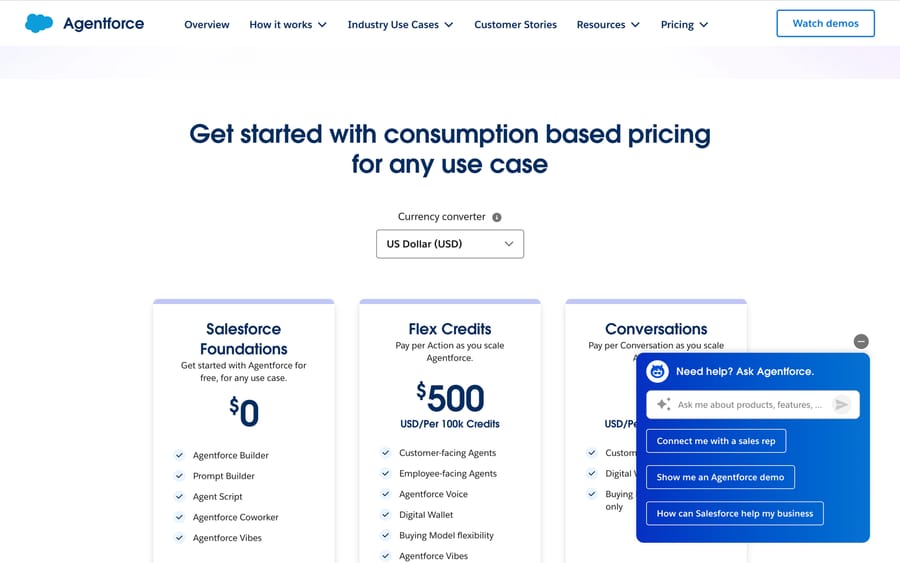
Agentforce's consumption-based pricing: $0 Foundations and Flex Credits at $500 per 100k credits (pay-per-action).
Here's the good news for anyone who's tried to price enterprise AI: unlike many agent platforms that hide behind "contact sales," Salesforce publishes real Agentforce rates. As of July 2026, there are three published models — Flex Credits, Conversations, and per-user licensing — and you pick the one that fits (Salesforce, Jitendra Zaa, Constellation Research).
A quick note on history, because it explains the confusion in older articles: Agentforce launched in 2024 with the flat $2-per-conversation model. In May 2025, Salesforce revamped pricing around Flex Credits for more granular, predictable usage, and Flex Credits is the model new deployments buy. Agentforce Conversations still bills for customers already on it, so the $2 per conversation figure is real but historical, and a separate current $2 unit exists inside Flex Credits for the Help Agent. Both are covered below.
Flex Credits
The flexible, usage-metered model. Flex Credits cost $500 per 100,000 credits, and a standard agent action consumes 20 credits, so $0.10 an action, which is Salesforce's own arithmetic on its pricing page rather than an estimate. An Agentforce Voice action costs 30 credits. Flex Credits cover every use case: customer-facing agents, employee-facing agents, and voice. You can buy them three ways — pre-purchase, pay-as-you-go, or a pre-commit deal — and heavy usage typically lands better rates via commitment (Salesforce Agentforce pricing, and the Flex Credits rate card PDF for the per-usage-type rates).
Conversations (legacy) and the Help Agent's $2 resolution
Two different things carry a $2 price tag, and mixing them up is the most common error in secondhand Agentforce pricing articles.
Agentforce Conversations is the original 2024 model: a flat $2 per conversation, where a conversation is a 24-hour session between a user and an agent, sold on a pre-purchase basis. It still bills for existing Conversations customers, but it isn't the model Salesforce puts in front of new buyers. Treat it as history unless you're already on it.
Help Agent Resolutions is a current Flex Credits usage type and also costs $2: 400 credits per resolved session. Unresolved sessions are free, and the actions and Data 360 queries taken inside a resolved session are included in that price. Sessions cap at two hours on messaging and ten minutes on voice, so a longer resolved call bills as more than one resolution. This is outcome pricing inside the credit model, which is a genuinely different thing from the legacy per-conversation plan.
Per-user licensing
Salesforce sells seats as well, and the numbers are often misquoted. The Agentforce User License is $5 a user a month, and it does not make agent usage free: it still requires Flex Credits, which meter on top. The $125 a user a month figure that appears in most third-party articles is the add-on license, not the base user license, and the Industries add-on is $150. Agentforce 1 Editions start at $550 a user a month and include a pool of credits for the org, which Salesforce's own Agentforce page puts at 2.5 million a year while the Service Cloud price list shows 2.75 million for Max. That's roughly 3,500 to 3,800 three-action conversations a month.
The practical question is where $5 stops being cheaper than $125. At 20 credits an action and $0.005 a credit, an action costs $0.10, so the $120 gap is 1,200 actions a month, about 55 a working day. Below that, the metered $5 license is cheaper; above it, the add-on is. Most customer-facing support deployments never reach that per-person number, which is why they land on Flex Credits.
Salesforce Foundations (the free tier)
One important constraint: Flex Credits and Conversations can't be used in the same Salesforce org — you commit to one model per org. For testing, Salesforce Foundations is a genuinely useful free on-ramp. Available to all customers on Enterprise Edition or above, it includes 200,000 Flex Credits, 250,000 Data Cloud (Data 360) credits, Agent Builder, and Prompt Builder at no cost (getclientell) — at ~20 credits per action, roughly 10,000 actions to pilot before you spend a dollar on agent usage.
The honest caveat on cost
Published rates are the floor, not the ceiling. The bigger line items in most Agentforce budgets are implementation, Data 360, and the underlying Salesforce licenses — plus integration and admin work. Multiple reviewers flag significant cost overruns during implementation and that per-action costs "can add up" fast at scale (Enterprise Dreamin'). As a rough anchor, a support agent handling 100,000 standard actions a month spends around $10,000/month in Flex Credits alone — before Data 360 and licensing. The unit rates are transparent; total cost of ownership still requires a real model with your volumes.
Credit burn: what consumes Flex Credits, and how to cap it
The rates above are published and stable. What catches teams out is that the meter counts operations, not outcomes, and several things consume credits when nobody is watching. On r/salesforce this is the most consistent thread cluster about Agentforce, and the headline one, "PSA: Be Careful With Your Agentforce and Salesforce Credits", puts the consequence in business terms: "It is kinda ironic how a $30k unexpected usage bill will ruin an upcoming $60k investment over 12 months. The company had to find the money..." The same post makes the point that there is more than one meter, naming "credits, and data service credits, and flex credits."
What consumes credits
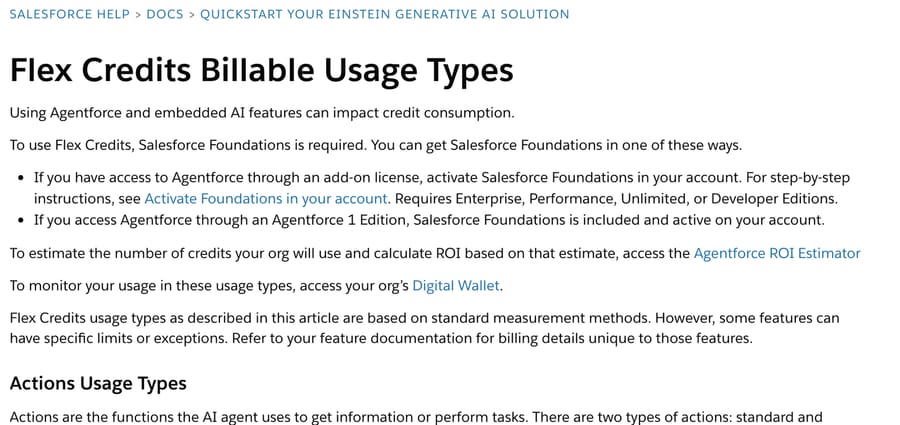
Salesforce's own Flex Credits Billable Usage Types article opens with the line that matters: "Using Agentforce and embedded AI features can impact credit consumption." Embedded is doing work in that sentence. These are the consumers, roughly in the order they surprise people.
- Agent actions, at 20 credits each, 30 for a voice action and 16 in a sandbox. An agent that takes four steps to answer costs four times one that takes one, and the customer cannot tell the difference.
- Embedded AI features you did not think of as agents. Prompt templates and features that call the model directly bill per 2,000-token chunk, at 2, 4 or 16 credits for Basic, Standard and Advanced models. A 6,500-token prompt meters as four chunks.
- Data 360 grounding. Processing documents for grounding spends credits at its own rates, and re-processing an updated document spends them again.
- Autonomous and scheduled agents. An agent triggered by a record change runs whether or not a person is involved, which is where an async loop turns into money.
- Testing. Sandbox actions are 16 credits instead of 20, which is a discount rather than an exemption. Five hundred test conversations at three actions each is 24,000 credits.
- Model choice. An Advanced model costs 16 credits per 2,000-token chunk against 2 for Basic, eight times the rate, and it is a configuration setting.
Two threads in the same subreddit are about exactly this shape of problem rather than the totals: "Agentforce eats up credit. Which solution is better?", from someone building a summary generator and comparing designs by consumption, and "How to estimate agentforce usage/costs", asking how to forecast internal employee use before committing. Both are design questions that only exist because the meter is per operation.
How to cap it
Salesforce gives you two tools, and it is worth being precise about what each one does.
Estimate first. The same help article points at the Agentforce ROI Estimator "to estimate the number of credits your org will use and calculate ROI based on that estimate." Do this per agent, before it goes live, and write the number down. An estimate on record is what turns a later spike into a measurable event.
Then monitor in Digital Wallet. Salesforce's instruction is "To monitor your usage in these usage types, access your org's Digital Wallet." It needs the View Consumption permission and it opens from the App Launcher under Consumption Cards. It breaks consumption down to the individual agent and the individual action, shows historical trends, and sends threshold alerts by desktop notification, Slack and the monthly account summary email.
The honest gap, and the reason to read the previous paragraph carefully: those are monitoring and alerting tools. We checked Salesforce's Digital Wallet documentation for a hard cap that stops an agent at a spend limit, the way Copilot Studio's per-agent monthly limit does, and did not find one in Salesforce's Digital Wallet documentation, which describes thresholds, notifications and reports. A thread titled "Agentforce & Digital Wallet lack hard caps for async loops" reaches the same conclusion from the operator side. If you know of a native circuit breaker, we would rather be corrected than leave this wrong.
So the practical controls are the ones you build. Buy on Pre-Purchase rather than pay-as-you-go while you are still learning the agent's shape, because a prepaid block is a ceiling by construction, even though unused credits expire at the end date. Set Digital Wallet threshold alerts low enough that a human sees the first bad day. Keep autonomous and scheduled agents in a separate org or sandbox until their per-run credit cost is measured. And design for fewer actions per answer, because that is the only lever that reduces the bill without reducing the work. This section is for teams already committed to Salesforce as the system of record; if you only need support tickets answered, the credit meter is a cost you are taking on for capability you may not use.
What the billing unit rewards
Per-action pricing means Salesforce earns more when your agent takes more steps to reach the same answer. That is not a trick, but it does put the incentive to design lean agents entirely on your side of the table, and it is why the action-level view in Digital Wallet exists at all. The Help Agent's $2 resolution flips this to an outcome, with the caveat that Salesforce writes the definition of a resolved session. Our dedicated Agentforce pricing post works the arithmetic at three volumes; this section is about what to watch and what to switch off.
Deployment and the Salesforce ecosystem
Deploying Agentforce is a platform project, not a plugin install. A typical rollout involves connecting or cleaning your CRM data, standing up Data 360 for grounding, building and scripting agents in Agentforce Builder, wiring the actions (Flows, Apex, prompt templates, external APIs) each agent can take, testing in the Testing Center, and setting guardrails before anything reaches a customer. For a mid-market team with a Salesforce admin, a focused service agent can go live in a few weeks; a broad, multi-agent enterprise deployment across service, sales, and internal ops is typically a months-long program, often with a Salesforce partner.
The flip side of that effort is the ecosystem itself — both Agentforce's greatest strength and its clearest lock-in. Agents inherit Salesforce's permissions, sharing rules, and audit model for free; they act natively on Customer 360 data, run inside Slack, and reuse the Flows and Apex you already built. But that same depth means Agentforce assumes you're on Salesforce and paying for it. If your system of record lives elsewhere, connecting it means custom APIs, middleware, and field mapping. The core trade-off: Agentforce is exceptional if and only if Salesforce is your platform of record.
Adoption and named traction
Agentforce has real enterprise traction. As of early 2026, Salesforce reported more than 6,000 paid Agentforce deals since launch (~6,000, vendor-reported), with Spring '26 GA extending deployments across 124 countries (Salesforce). Over 60% of Agentforce/Data 360 bookings came from existing-customer expansion — a signal that early adopters are widening deployments rather than churning (Salesforce). Treat vendor-reported figures (including the widely cited "85% of queries resolved without a human") as directional claims to validate against your own use case, not guarantees.
Pros and cons
Where Agentforce is strong
- CRM-native by design. If your data and workflows already live in Salesforce, agents act on them directly — no fragile third-party integration to maintain.
- Genuine action-taking. Reviewers report agents automating manual CRM updates, lead prospecting, and email drafting, with teams citing 5–6 hours saved per rep per week (G2).
- Transparent unit pricing. Published Flex Credit and per-conversation rates are a real advantage over quote-only competitors.
- Enterprise-grade governance. Agents inherit Salesforce's permissions, sharing, and audit model, and Atlas logs every step.
- Free piloting via 200,000 Foundations credits.
The honest limitations
- Implementation complexity and cost. The most consistent complaint: initial setup is overwhelming and time-consuming, with real cost overruns (Lindy, Oliv).
- Learning curve. Powerful but complex; customizations and admin tasks often need technical/developer skill.
- Data-quality dependency. Agentforce is only as good as your Salesforce data — duplicates and messy records produce weak agent responses.
- Integration effort for non-Salesforce systems. Connecting external platforms can require custom APIs, middleware, and field mapping, adding cost and time.
- ROI at smaller scale. For SMBs, the pricing plus the Salesforce dependency may not justify the investment.
- You need Salesforce. Agentforce is not a standalone product — it assumes you're on (and paying for) the Salesforce platform.
Who Agentforce is best for
Agentforce makes the most sense for companies already standardized on Salesforce — especially mid-market and enterprise teams with a Salesforce admin or developer bench, clean CRM data, and the appetite for a real implementation. If Salesforce is your system of record across service, sales, and marketing, Agentforce puts autonomous agents directly on top of it.
It's a weaker fit if you're not on Salesforce, if you want AI resolving tickets on a lighter helpdesk without a platform-scale build, if you're a small team wary of implementation cost, or if your CRM data isn't clean enough to trust an agent to act on.
Agentforce vs alternatives (including Macha)
Agentforce sits at the CRM-native, platform-scale end of the AI-agent market. Depending on what you actually need, several alternatives are worth comparing:
- Intercom Fin, Decagon, Sierra, Ada — standalone AI-agent platforms competing for CX deals, with varying pricing transparency and customization depth.
- Native helpdesk AI (Zendesk AI, Freshworks Freddy) — the AI baked into the support platform you may already run.
- Macha — an AI agent layer that runs on top of Zendesk and Freshdesk (more below).
| Agentforce | Intercom Fin | Sierra | Macha | |
|---|---|---|---|---|
| Pricing model | Flex Credits ($500/100k published; ~$0.10/action est.), $2/conversation, or ~$125/user/mo (est.) | Per-resolution (~$0.99, published) | Outcome-based, quote-only | Per ticket (from $299/mo for 750 tickets) |
| Access mode | Requires Salesforce; guided build | Self-serve + sales | Enterprise sales-only | Self-serve |
| Typical deploy time | Weeks to months (implementation) | Days to weeks | Weeks to months | Minutes to hours |
| Runs on top of your existing helpdesk? | No — runs inside Salesforce | Native to Intercom | No — standalone | Yes — installs on Zendesk / Freshdesk |
| Best for | Teams standardized on Salesforce CRM | Mid-market wanting fast, transparent resolution AI | Large enterprises wanting a custom voice + chat agent | Teams on Zendesk / Freshdesk wanting resolution AI live quickly |
Pricing models are accurate as published; deploy times are typical ranges, not guarantees. As always, confirm current terms with each vendor. For a broader view, see our guide to AI agents for customer service.
An honest note on where Macha fits
We build Macha, so take this in the spirit of full disclosure. Macha and Agentforce both deploy AI agents that take real action — but they solve different problems. Agentforce is a CRM-native platform: you build agents inside Salesforce, on Salesforce data, with a real implementation. Macha is an AI agent layer that installs on top of the help desk you already run, on Zendesk, Freshdesk, Gorgias or Front — it reads the customer's question, pulls from your connected knowledge and past tickets, and resolves issues right inside your helpdesk, escalating to a human with full context when it isn't confident.
The honest contrast: Macha is self-serve and far faster and cheaper to deploy — you connect it to the helpdesk you already run rather than commissioning a platform build, and you don't need Salesforce at all. On pricing, Macha charges per ticket — one thread between Macha and one person, charged once no matter how many messages it takes — from $299/month for 750 tickets, about $0.40 per ticket, and you can wire agents to your own systems with custom tools. See our full pricing for the details. The flip side, just as honestly: Macha is not the right tool if Salesforce is your system of record and you want agents acting natively on CRM data across sales and marketing — that's exactly where Agentforce is stronger. If you're on a major helpdesk and want resolution AI live quickly without a platform-scale build, that's the line where Macha fits. The trial is $50 of free usage (about 125 tickets), no credit card, no time limit.
How we researched this
The pricing, credit and product detail in this guide comes from Salesforce’s own Agentforce pricing and product pages, its Digital Wallet and consumption documentation, and third-party coverage of the May 2025 Flex Credits change (Constellation Research, Jitendra Zaa), checked in July 2026. On September 21, 2026 we re-checked the internal links in this post and refreshed its cross-references; we did not re-price the plans on that pass, so treat the dollar figures as the July 2026 reading. We are not Agentforce customers and Salesforce does not offer a self-serve trial of it, so nothing here is from hands-on use, and G2 blocked our scripted request for Agentforce’s rating, so we have left review scores out rather than estimate one.
Frequently asked questions
What is Agentforce? Agentforce is Salesforce's agentic AI platform for building and deploying autonomous AI agents inside the Salesforce ecosystem. Its agents act on live CRM data — resolving support cases, qualifying leads, drafting emails, and updating records — powered by the Atlas Reasoning Engine.
How much does Agentforce cost? Salesforce publishes three models. Flex Credits cost $500 per 100,000 credits, with a standard action using 20 credits (~$0.10, a third-party estimate) and a voice action using 30 credits. The Conversations model is a flat $2 per 24-hour conversation. Some agent types are also available via per-user licensing starting around $125/user/month (third-party estimate). Flex Credits and Conversations can't be used in the same org, and implementation, Data 360, and Salesforce licensing are separate costs.
What's the difference between Agentforce, Agentforce 2.0, and Agentforce 360? They're successive generations of the same platform. Agentforce launched in 2024; Agentforce 2.0 (early 2025) added more pre-built actions and reasoning improvements; and Agentforce 360 (announced at Dreamforce '25, GA in early 2026) rebranded the full stack — Agentforce Platform, Data 360, Customer 360 apps, and Slack — and introduced Agentforce Builder, Agent Script, Agentforce Voice, and Intelligent Context. "Agentforce 360" is the current generation.
What is Data 360 and do I need it? Data 360 (formerly Data Cloud) is the grounding layer that gives agents context by unifying structured CRM records with unstructured content like knowledge articles and transcripts. You need it for agents to answer accurately from your real data; Salesforce Foundations includes 250,000 Data 360 credits free, and usage beyond that is metered separately from Flex Credits.
What is the Atlas Reasoning Engine? Atlas is the reasoning engine behind Agentforce. It runs a reason–act–observe (ReAct) loop — retrieving grounded data via RAG, planning which tools to use, executing actions, and reflecting on results — using inference-time (System-2) reasoning, with every step logged for observability.
Do I need Salesforce to use Agentforce? Yes. Agentforce is native to the Salesforce platform and acts on Salesforce/Data Cloud data. It's not a standalone product you can run without Salesforce.
Is Agentforce good for small businesses? It can be, but many small teams find the implementation cost, learning curve, and Salesforce dependency hard to justify. Lighter, self-serve AI agents or the AI built into your existing helpdesk are often a better fit at small scale.
What are the main alternatives to Agentforce? Standalone AI-agent platforms like Intercom Fin, Decagon, Sierra, and Ada; native helpdesk AI such as Zendesk AI and Freshworks Freddy; and Macha, which runs as an AI agent layer on top of Zendesk and Freshdesk.
What consumes Agentforce Flex Credits? Agent actions at 20 credits each (30 for voice, 16 in a sandbox), embedded AI features such as prompt templates billed per 2,000-token chunk at 2, 4 or 16 credits by model tier, Data 360 grounding and re-processing, autonomous or scheduled agents that run with no person involved, and test runs in a sandbox. Salesforce's own wording is that "using Agentforce and embedded AI features can impact credit consumption," and the embedded features are the ones teams forget.
How do I cap Agentforce credit spend? Estimate each agent with the Agentforce ROI Estimator before launch, monitor in Digital Wallet (View Consumption permission, App Launcher, Consumption Cards) where usage breaks down by agent and by action with threshold alerts to desktop, Slack and the monthly summary email, and buy on Pre-Purchase while you are still learning the agent's shape so the prepaid block acts as a ceiling. We did not find a documented native hard cap that halts an agent at a spend limit, so the controls are estimate, alert and prepay.
The bottom line
Agentforce is one of the most serious entrants in agentic AI — a CRM-native platform with a genuinely capable reasoning engine, real action-taking, enterprise-grade governance, and (unusually) transparent published pricing. For a company already standardized on Salesforce, with clean data and the resources for an implementation, it's a powerful way to put autonomous agents directly on your system of record.
The honest caveats are equally real: it assumes you're on Salesforce, implementation is complex and can run over budget, agent quality depends on your data hygiene, and costs scale with usage. If you're not on Salesforce — or you simply want AI resolving tickets on top of the helpdesk you already run — a self-serve layer like Macha, native helpdesk AI, or a transparent per-resolution agent like Fin will get you there faster. Match the tool to your stack, and Agentforce's strengths make a lot more sense.
Researched July 2026 against Salesforce's official pricing and product pages and recent third-party coverage. Published Flex Credit and per-conversation rates are Salesforce's own; vendor-reported performance metrics are flagged as such. Verify current details with Salesforce before deciding.
Resolve tickets automatically with AI agents
Macha's AI agents work on top of the help desk you already use — no code.