Intercom
 Shopify
 Stripe
 Slack
Slack Notion
 Google Workspace
 Confluence

Is Sierra AI Worth It? Review, Pricing Estimates and Who Should Buy (2026)


Sierra AI builds autonomous customer-service agents for large enterprises, publishes no prices, and third-party estimates put a contract near $150K a year before setup. It scores 17 out of 30 on our rubric, with full marks on capability and zero on published pricing and entry cost.
Key takeaways
- Sierra AI scores 17 out of 30 on the review's six-criterion rubric, one point below the 18-point shortlist bar, losing points on pricing transparency and review volume rather than capability.
- Sierra AI publishes no pricing page, and third-party estimates put the annual platform contract near $150K plus a one-off setup fee of $50K to $200K.
- Sierra AI raised a $950M Series E in May 2026 at a reported $15.8B post-money valuation, up from $10B in September 2025.
- Sierra AI holds 130 ratings at 4.5 out of 5 on G2 and 7 ratings at 4.7 out of 5 on Gartner Peer Insights, with no Capterra listing.
- Sierra AI's AWS Marketplace listing shows a $1,000,000 placeholder for a 12-month platform contract, with outcomes billed as additional usage above the contract.

Sierra AI is an enterprise platform for autonomous customer-service agents, founded in 2023 by Bret Taylor and Clay Bavor, and it publishes no prices: third-party estimates put the annual platform contract near $150K, plus a one-off setup fee of $50K to $200K. It scores 17 out of 30 on the six-criterion rubric we use across this site, one point below our shortlist bar, and every point it drops is about what a buyer can learn before a sales call. On capability alone it scores 15 out of 15.
Disclosure: we build Macha, an AI agent layer for Zendesk, Freshdesk, Gorgias, Front, Intercom and HubSpot. Sierra is a category peer, not a head-to-head competitor, and the difference is explained near the end. Everything below is sourced to Sierra's own materials and third-party reporting, with anything we couldn't verify flagged.
How does Sierra AI score in our review?
We score products on six criteria, 0 to 5 each, for a maximum of 30, and 18 out of 30 is the bar a product has to clear before it goes on one of our shortlists. It is the same rubric we publish and show the working for on best help desk software. For an AI agent vendor rather than a help desk, we read "AI that resolves" as resolves end to end rather than drafts a suggestion for a human, and everything else is scored exactly as it is there.
| Criterion (0-5) | Sierra | Why |
|---|---|---|
| Published pricing | 0 | There is no pricing page. sierra.ai/pricing returned a 404 when we checked it on 22 and 24 September 2026, and the AWS Marketplace listing carries a $1,000,000 placeholder rather than a rate. |
| Entry cost for a small team | 0 | No free plan, no trial, no self-serve sign-up. Third-party estimates put the annual platform contract near $150K before a one-off implementation fee. |
| AI that resolves | 5 | Agents resolve end to end rather than deflecting to articles, and they run across chat, voice, email, SMS and messaging. |
| Write actions | 5 | Documented actions change real records: process a return, update an account, save a cancellation, sell an upgrade. |
| Independent review base | 2 | 130 ratings on G2 and 7 on Gartner Peer Insights. No Capterra listing exists, and the Trustpilot profile for sierra.ai carries zero reviews (all checked 22 September 2026). |
| Channel coverage | 5 | Chat, voice, email, SMS and messaging in one platform, with contact-center routing in front of or behind it. |
| Total | 17 / 30 | Below the 18/30 bar. |
Fifteen of those seventeen points come from three criteria. On what the agent can actually do, Sierra is a clean 15 out of 15, which very little else in this category manages. It loses every remaining point on procurement: nothing published, no entry point below a six-figure commitment, and a review base of 130 for a company valued at $15.8B. If your shortlist rule is "we have to be able to cost it before we talk to anyone", Sierra fails that rule by design rather than by oversight, and the pricing section below explains why the company thinks that is the right trade.
Is Sierra AI worth it?
It is worth it if you run millions of customer contacts a year, you want one agent across voice and chat that takes actions in your systems, you have procurement people who can negotiate an outcome definition, and you can fund a six-figure contract plus a four-to-ten-week build. For that buyer the supervisory guardrails and the hands-on implementation team are worth real money, and Sierra's reviewers say so.
It is not worth it if you need to be live this month, you want to edit the agent yourself on a Tuesday afternoon, you need a number before a sales call, or you already run a help desk and only want the repetitive tickets in it answered. Those are different products, and the alternatives section names them.
What is Sierra AI?
Sierra is an enterprise conversational AI platform that lets companies build, deploy, and operate branded AI agents across customer touchpoints, chat, voice, email, SMS, and messaging. Founded in 2023 and based in San Francisco, the company positions itself not as a chatbot tool but as an "agent OS": the operating layer where a business designs an autonomous agent, gives it goals and guardrails, connects it to backend systems, and lets it actually do things, process a return, update an account, save a cancellation, rather than just answer FAQs (sierra.ai/about).
The founding story is a big part of Sierra's gravity. Bret Taylor co-created Google Maps, was CTO of Facebook, founded Quip (acquired by Salesforce), served as co-CEO of Salesforce, and serves on OpenAI's board. His co-founder, Clay Bavor, spent 18 years at Google, most recently leading Google Labs after running its virtual-reality efforts; the two met there (sierra.ai/about, SiliconANGLE). That pedigree translated directly into capital: in May 2026 Sierra raised a $950M Series E at a reported $15.8B post-money valuation, up from a $10B valuation in September 2025 and roughly $4.5B in October 2024 (TechCrunch, Tech Startups, and covered by CMSWire). Valuations in this space move fast, so treat the exact figure as a point-in-time snapshot.
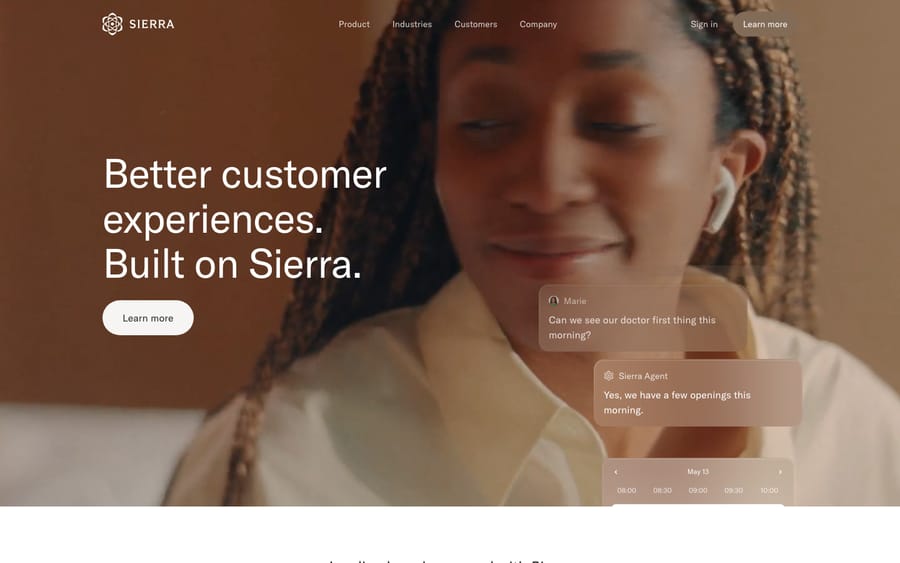
The short version: Sierra is a premium, enterprise-grade, build-it-with-us platform. It is not a self-serve app you sign up for on a Tuesday and launch by Friday, and understanding that is the key to evaluating it.
How does Sierra AI work?
Sierra's product centers on what it now calls Agent OS (Agent OS 2.0 as of its most recent release). The idea is that everything an AI agent needs, reasoning, memory, channels, tooling, supervision, analytics, lives in one platform. The main pieces (sierra.ai/blog/agent-os-2-0):
- Multi-channel deployment. A single agent can operate across chat, voice, email, SMS, messaging, and even ChatGPT and contact-center systems, so the same logic and brand voice show up wherever customers reach you.
- The Agent SDK. This is Sierra's developer surface, a declarative way to define an agent's goals and the guardrails it cannot cross (Sierra's own example: "orders can only be returned within 30 days of purchase"). It supports composable skills, tuning controls for how creative vs. deterministic the agent behaves, CI/CD with GitHub Actions, multi-agent orchestration, and simulation/testing so you can validate behavior before shipping (sierra.ai/product/agent-sdk).
- Agent Studio. A more no-code/low-code builder with "Journeys" (designing workflows in natural language) and "Workspaces" for team collaboration, aimed at letting non-engineers contribute, though, as we'll see, day-to-day editing freedom is one of the platform's debated points.
- The Agent Data Platform. A memory layer that unifies structured and unstructured customer data so an agent can carry context across conversations rather than treating each chat as a blank slate.
- Supervisory agents and guardrails. This is one of Sierra's genuine differentiators. Every production agent runs with supervisory agents watching for ambiguous or sensitive situations, plus deterministic guardrails for hard business rules. Supervisors can take subtle corrective action, e.g., steering an agent away from mentioning a competitor, rather than just killing the conversation (sierra.ai/blog/enterprise-grade-agents).
- A "constellation of models." Rather than betting on a single LLM, Sierra orchestrates multiple models, picking combinations per task and locale to balance accuracy, latency, and tone (sierra.ai/blog/constellation-of-models).
Layered on top are Insights (analytics tools like Explorer for digging into interactions) and Live Assist (real-time AI suggestions for human agents). The throughline is autonomy with control: Sierra wants agents that take real action, wrapped in enough supervision that an enterprise brand is comfortable putting them in front of millions of customers.
Voice and contact-center depth
Voice is one of Sierra's more serious investments, and it matters because that's where enterprise contact-center budgets actually sit. Per Sierra's own materials, its voice agent is built to replace rigid IVR menus with natural, real-time conversation, handling interruptions and corrections, parsing tricky inputs like order numbers, email addresses, and policy identifiers by voice, and adjusting to sentiment and tone mid-call (sierra.ai/voice, sierra.ai/blog/sierra-speaks). It's designed to integrate with existing contact-center platforms, sitting in front of or behind traditional IVR, with skills-based routing and AI-generated call summaries on every hand-off to a human agent. Sierra also says its voice agents can take card and ACH payments over the phone through PCI-certified infrastructure without an IVR handoff. One honest caveat from reviewers: because Sierra routes requests through multiple models for accuracy, voice latency can occasionally be noticeable, and in a live call even a sub-second pause is felt (Quiq).
Security and compliance
For the enterprises Sierra targets, security posture is table stakes, and Sierra's is substantial. Its Trust Center lists SOC 2 Type II, ISO 27001, ISO 42001, HIPAA, PCI DSS Level 1 (Service Provider), GDPR, CCPA, and CSA STAR (trust.sierra.ai, sierra.ai/product/trust-and-reliability). On data handling, Sierra states that customer data is never shared across organizations and never used to train models, that PII can be encrypted and masked, and that sensitive payment data flows through dedicated PCI-certified infrastructure that never touches its core platform, LLMs, or persistent storage. We're relaying Sierra's published claims here rather than independently auditing them, but the certifications are the kind a regulated buyer (healthcare, financial services) will want to see, and Sierra clearly built for that audience.
Who uses Sierra AI?
Sierra leans hard on enterprise logos, and they're substantial. Companies Sierra publicly names as customers include WeightWatchers, Sonos, ADT, SiriusXM, Casper, Chime, Cigna, Nordstrom, Nubank, Ramp, Rivian, Rocket Mortgage, Singtel, Sutter Health, and Wayfair (sierra.ai/customers). The company also claims its agents serve a meaningful share of large enterprises, coverage cites figures like "roughly 40% of the Fortune 50," which we'd treat as a vendor claim rather than an independently audited stat.
The most-cited results come from WeightWatchers, whose Sierra agent reportedly handles close to 70% of customer sessions at a 4.6/5 satisfaction score (sierra.ai/blog/introducing-sierra). Sonos uses a Sierra agent for product support, speaker setup, troubleshooting, multi-room configuration, and ADT applies it to customer service, billing, and lead qualification. These are real, sizeable deployments; just keep in mind the headline metrics are vendor-reported, so the right reading is "credible and impressive, but not third-party verified."
How much does Sierra AI cost?
Here's the part Sierra is genuinely known for. Most software, including most AI tools, charges per seat, per resolution attempted, or per message/credit consumed. Sierra instead pioneered outcome-based pricing: you pay only when the agent achieves a defined, valuable result (sierra.ai/blog/outcome-based-pricing-for-ai-agents).
What counts as an "outcome" is negotiated per contract but typically means things like a resolved support conversation, a saved cancellation, an upsell, or a cross-sell. Sierra's stated principle: "If the conversation is unresolved, in most cases, there's no charge." For lower-value interactions like routing or a simple greeting, Sierra uses blended pricing that mixes outcome-based and consumption-based models. The pitch is incentive alignment. Sierra only makes money when it delivers measurable value, unlike seat-based vendors who arguably profit from inefficiency.
It's a compelling model on paper. But two honest caveats:
- "Resolution" is defined in the contract, not by you in the moment. The criteria for a successful outcome and the rate attached to it are negotiated upfront. That can be fair, or it can mean disputes over what genuinely counts as "resolved." It rewards close attention during procurement.
- There is no public pricing whatsoever. Sierra publishes no pricing page, no calculator, and no per-outcome rate (eesel AI). Every deal is custom-quoted.
What Sierra actually costs (third-party estimates, flagged)
Because Sierra discloses nothing, the numbers floating around come entirely from third-party analyses and procurement data, not official figures. Treat all of the following as estimates:
| Cost component | Estimated range (third-party, re-read 22 September 2026) | Notes |
|---|---|---|
| Annual platform/base contract | ~$150K to start | Larger deployments cited at $350K–$750K+; complex multi-channel at $750K–$1.5M+ |
| Setup / implementation fee | $50K–$200K | One-time; tied to integration depth |
| Year-one total (base enterprise) | $200K–$350K+ | Platform + implementation, before usage |
| Per-outcome / per-resolution rate | Not disclosed | Some blogs guess ~$1–$2.50; treat as speculative |
| Implementation timeline | 4–10 weeks (up to 3–7 months full) | Sierra's team does the build |
Sources: Fin.ai, eesel AI, Lorikeet. These figures are independent estimates; Sierra has not confirmed them, and your actual quote will be custom.
What Sierra's AWS Marketplace listing reveals
One public artifact is closer to a rate card than anything on sierra.ai. Sierra sells through AWS Marketplace, and listing prodview-juxdqyapn54uo, read on September 19, 2026, carries two dimensions. Sierra Platform is sold as a 12-month contract, described as "Sierra platform access; pricing is determined via private offer," with $1,000,000.00 in the public price field. Sierra Outcomes sits under "Additional usage costs" as "Additional Sierra Platform Outcomes" at $0.01 per unit. Both numbers are placeholders, and the page says so: listings sold through private offers fill the public field with a round figure. Don't quote either one.
The structure is the part that's worth having. AWS's own pricing text says a contract "entitles you to a specified quantity of use for the contract duration," with usage-based pricing applying to "overages or additional usage not covered in the contract," charged "on top of the contract price." Read alongside Sierra's own post, a Sierra deal looks like a yearly platform commitment that includes some quantity of outcomes, then a per-outcome charge for everything above it. A second listing, prodview-6lfsxsfkrdz3e, has the platform dimension only. Azure's marketplace returned nothing from Sierra on September 19, 2026, Google Cloud's returned only unrelated products, and Vendr has a Sierra profile with no pricing data or deal count.
One note on a comparison below: Salesforce completed its acquisition of Fin, formerly Intercom, on September 10, 2026 (Salesforce newsroom), so Fin is now an Agentforce product.
An illustrative year-one cost model (estimates only)
To make the numbers concrete, here's a worked example. Every input below is an illustrative assumption. Sierra publishes no rates, so treat this as a thought exercise, not a quote. Picture a mid-size enterprise with roughly 10,000 resolvable support conversations a month (~120,000 a year):
- Annual platform base: ~$150K (low end of third-party estimates)
- One-time setup / implementation: ~$100K (midpoint of the $50K–$200K range; a year-one cost only)
- Outcome volume: assume the agent resolves ~60% of those conversations = ~72,000 paid outcomes/year
- Per-outcome rate: ~$1.50 (a speculative figure from third-party blogs; Sierra has never disclosed this) → ~$108K
Illustrative year-one total ≈ $150K + $100K + $108K ≈ $358K, dropping toward ~$258K in year two once setup falls away (assuming flat volume and rate). Flex any input and the total swings hard: at a $2.50 per-outcome rate the usage line alone is ~$180K. The point isn't the exact figure, it's the shape: a six-figure platform commitment plus a usage line that scales with how much work the agent actually does. Build your own version with your real conversation volume before any sales call, and treat every number Sierra-side as something to pin down in the contract.
The honest takeaway: Sierra is a six-figure-and-up commitment with a custom contract, a multi-week-to-multi-month build, and pricing you can only learn by talking to sales. That's appropriate for the enterprises it targets, and a non-starter for most smaller teams.
What goes wrong with Sierra, and how do you fix it?
Sierra's reviews are thinner than its funding suggests, because there's no free tier and no self-serve account, so nobody stumbles into it and complains. What reviewers do say is consistent, and it lines up with what Sierra's own product pages have been built to answer. Six problems, in the order they'd hit a live deployment.
1. Changing the agent means going back to Sierra. This is the most-repeated complaint about Sierra and the one with the largest operational cost: a team that can't edit its own agent logic iterates at the vendor's cadence. The fix is to negotiate for it, because Sierra ships the surface. Agent Studio is Sierra's no-code builder, and its pitch is exactly this problem: the page promises teams can build and manage agents with no code required. It carries Journeys (composable building blocks with goals and guardrails), Agent instructions, which can "use AI to instantly generate journeys from your existing operating procedures," Knowledge management for the Help Center content, FAQs and policies grounding the agent, and Agent Traces, which "debug and refine journeys as you build with real-time traces of every decision, tool call, and response." Put Agent Studio access and training for named people on your side into the statement of work, and ask in writing whether post-launch changes are covered by the platform fee or billed as professional services. That one question has a large number attached to it over a three-year contract.
2. Long conversations lose the thread. The most-cited technical gripe is specific. A G2 reviewer wrote: "Sierra AI may struggle to maintain context in longer conversations, leading to repetitive or irrelevant responses. At times, the AI's responses can feel generic and lack the depth or nuance of a human conversation." The fix has two halves, and the first is in the build. Sierra's Agent Data Platform is the memory layer meant to carry context across conversations instead of treating each one as a blank slate, so confirm it's actually wired to your systems of record and not still on defaults. The second half is content: Agent Studio's Knowledge gaps feature "automatically identifies common themes missing from your knowledge base," and Expert Answers drafts articles from how your own care representatives resolve edge cases. Generic answers are usually a knowledge problem wearing a model problem's clothes. Before launch, replay your longest real transcripts, not your cleanest ones.
3. Voice can feel slow, because accuracy is bought with extra model hops. Sierra orchestrates a "constellation of models," picking combinations per task and locale, and reviewers note that routing through several of them can make voice latency noticeable. On a live call a sub-second pause is felt, which is a different bar from chat. The fix: ask during the build which intents can run on a shorter path, keep the highest-volume simple intents deterministic, and measure latency on a real call, not in a demo. Sierra's voice agent is designed to sit in front of or behind existing contact-center platforms with skills-based routing, so keep a fallback route that doesn't depend on the agent completing.
4. "In most cases, there's no charge" is doing a lot of work. Sierra's outcome-based pricing post states the principle plainly: "If the conversation is unresolved, in most cases, there's no charge." The exceptions aren't listed. The same post says routing and "greeter-style interactions may align better with consumption-based pricing, where payment is based on conversation count," so a voice deployment that answers and routes most callers pays per conversation for that share whether or not anything was resolved. And the outcome criteria are "clear, agreed-upon criteria for each outcome upfront," which makes the definition a contract term you negotiate, not a product setting you can read. The fix is a procurement checklist: get the exceptions to the no-charge rule in writing; get the included outcome quantity inside the platform fee and the overage rate above it, and check whether the overage rate matches the in-contract rate; establish whether a single conversation can generate more than one billable outcome when an agent saves a cancellation and sells an upgrade; and confirm you can export per-conversation outcome flags to reconcile an invoice, since outcome billing you can't audit is just a bill.
5. You can't check Sierra's uptime or read its manual before you sign. We tried both on September 20, 2026. docs.sierra.ai loads a sign-in page whose terms describe the documentation itself as confidential and for evaluation only. status.sierra.ai resolves but answers "We couldn't find that page," and sierra.ai/changelog returns a 404. Compare that with Decagon, which runs a public status page with per-region, per-channel components and a 90-day history anyone can read. This is the same transparency complaint reviewers make about pricing, in a different place: a G2 reviewer put it as "limited transparency on technical details and pricing, which makes it harder to fully assess long-term costs and integration." The fix is contractual, since there's nothing to read. Ask for an SLA with service credits instead of a target, an incident-notification commitment with a named channel, documentation access under NDA during evaluation, and the last four quarters of availability for the regions you'll run in. A vendor confident in its numbers will hand them over.
6. Setup is a project, and the reviews that say so are from the people who did it. On Gartner Peer Insights, an audit manager at an energy and utilities company with $50M to $250M in revenue wrote on June 13, 2026 that Sierra's "initial integration is complex but powerful," which is about as fair a summary as the category gets. Third-party estimates put implementation at four to ten weeks, and up to three to seven months for a full build. The fix is a scoping decision. Sierra ships "40+ pre-built integrations" to third-party knowledge bases, systems of record and contact centers, so the first question is how much of your stack those cover and how much needs custom work through Sierra's integration framework. Scope the first release to one channel and a handful of high-volume journeys, get it live, and expand from something that already works.
How we researched this
On September 19 and 20, 2026 we read Sierra's Agent Studio, About and outcome-based-pricing pages, both of its AWS Marketplace listings including the pricing tabs, its Trust Center, and its documentation and status URLs, and we searched the Azure and Google Cloud marketplaces and Vendr for Sierra listings. G2 and Gartner Peer Insights figures were read on September 19, 2026. Sierra sells only through its own team with no self-serve account, so we built no agent on it and didn't contact sales, which means every Sierra cost below is either Sierra's own wording, a placeholder we label as one, or a competitor's estimate we label as one.
What are Sierra's key features?
- Autonomous, action-taking agents across chat, voice, email, SMS, and messaging.
- Agent SDK with declarative goals, deterministic guardrails, composable skills, and CI/CD (GitHub Actions).
- Supervisory agents that monitor and subtly correct live conversations, a strong safety story.
- Constellation-of-models architecture instead of single-LLM dependence.
- Agent Data Platform for cross-conversation memory and context.
- Insights and Live Assist for analytics and human-agent augmentation.
- Outcome-based commercial model that aligns cost with results.
What do Sierra's users say?
A fair warning on evidence: first-hand reviews of Sierra are thin for a company this size, and that's a direct consequence of the model. Sierra is enterprise, quote-only, and sold through a guided implementation, so there's no free-trial crowd leaving feedback.
Here is every rating base we could find, with the date we read it. We went looking on all four of the sites a review query usually lands on, and two of them have nothing at all.
| Source | Rating | Ratings counted | Checked |
|---|---|---|---|
| G2 | 4.5 / 5 | 130 | 22 September 2026 |
| Gartner Peer Insights | 4.7 / 5 | 7 | 19 September 2026 |
| Capterra | no listing | 0 | 22 September 2026 |
| Trustpilot | no score | 0 | 22 September 2026 |
That table is the finding, not a gap in our research. A company at a $15.8B valuation with no Capterra profile and an empty Trustpilot page is telling you something accurate about how it sells: nobody buys Sierra without meeting Sierra, so nobody reviews it casually either. Treat the 4.5 as the opinion of 130 people who completed an enterprise implementation, which is a different and smaller population than the one behind a 7,000-rating help desk score.
Most reviews are posted anonymously by role and segment, so we can attribute the platform and the gist but usually not a person. We're quoting what genuinely exists.
What users complain about
Four themes repeat across the G2 dislikes, and they are consistent enough that you can plan around them. Reporting depth is the newest one: a CTO at a company under 50 employees wrote on 27 August 2026 that "the analytics dashboard is functional but a bit limited for deeper cohort analysis, we end up exporting data to a separate BI tool for anything beyond surface-level reporting", and added that "customizing conversation flows for edge cases sometimes requires going back to their team rather than being fully self-serve, which slows iteration when you're moving fast" (G2). A developer at an enterprise with more than 1,000 employees made the same point about setup on 15 August 2026: getting the most out of Sierra "can require some setup and tuning, especially when connecting it to existing systems and defining how it should handle different scenarios", and for complex issues they "would still want a human involved rather than relying completely on the AI".
The other three, in the order they show up: pricing opacity, context loss in long conversations, and occasional latency. All four are covered with a fix each in the problems section above, which is the part of this page worth reading twice before a sales call.
From verified G2 reviews of Sierra (verbatim, anonymized by the platform):
"Sierra AI may struggle to maintain context in longer conversations, leading to repetitive or irrelevant responses. At times, the AI's responses can feel generic and lack the depth or nuance of a human conversation.", G2 reviewer, Sierra product page (G2, 2026)
"What I dislike about Sierra is the limited transparency on technical details and pricing, which makes it harder to fully assess long-term costs and integration, and the fact that scalability and consistency at enterprise scale are still largely unproven.", G2 reviewer, Sierra product page (G2, 2026)
"The platform can be slow at times, and there are occasional bugs that need fixing.", G2 reviewer, Sierra product page (G2, 2026)
On the positive side, the most concrete named endorsement comes not from an anonymous reviewer but from a Sierra customer reference, Minted's COO, who described their Sierra agent as delivering "a better, faster experience that still feels personal and thoughtful" (eesel AI). Read that one as a vendor-friendly customer quote rather than independent feedback. The honest synthesis across what's available: reviewers respect the action-taking depth and the hands-on implementation team, but recurring gripes are pricing opacity, context loss in long conversations, limited self-service editing, and occasional latency, themes we carry into the limitations below.
What are Sierra's strengths and limits?
Where Sierra is strong
- Enterprise-grade safety and control. The supervisor + deterministic-guardrail design is a real answer to the "what if the AI says something wrong to a customer" fear that stalls enterprise AI projects.
- Genuine action-taking depth. Reviewers consistently note Sierra agents resolve complex issues end-to-end, not just deflect to articles. Its implementation team also draws praise for being hands-on (G2 reviews).
- Founder pedigree and resourcing. With Taylor and Bavor at the helm and billions in funding, Sierra isn't going anywhere, a real consideration for a multi-year enterprise bet.
- Incentive-aligned pricing: in principle, you pay for results.
The honest limitations
- Enterprise-only, by design. Sierra is built for large companies with budget and IT resources for a ground-up build. Small and mid-size teams looking for something quick are not the target (Quiq).
- Premium, opaque pricing. Six figures and up, with no published rates, you can't even ballpark it without a sales process.
- You often can't edit it yourself. A recurring review complaint: changing logic or prompts frequently requires going back to Sierra's team, which slows iteration (eesel AI reviews).
- Setup complexity. Powerful, but a real implementation project measured in weeks to months, not minutes.
- Performance nuance. Some reviewers note Sierra can lose context in very long conversations or feel slower than lighter tools.
- Not a helpdesk. Sierra is the agent layer; you still run your support platform (Zendesk, Salesforce, etc.) alongside it.
Who is Sierra AI best for?
Sierra makes the most sense for large enterprises, think millions of customer contacts a year, that want a custom-built, autonomous agent across voice and chat, have the budget for a six-figure-plus contract, and value enterprise-grade supervision and a vendor with serious staying power. If you're a Fortune-500 brand standardizing on conversational AI as core infrastructure, Sierra is squarely on your shortlist.
Who should not buy Sierra AI
Four buyers should stop here, and we would rather say so than have you sit through a discovery call.
- Anyone who needs a price before a meeting. There isn't one. Not a range, not a calculator, not a marketplace rate. If your finance process needs a number to start, Sierra cannot give you one.
- Startups and most mid-market teams. The floor is a six-figure annual commitment plus implementation. Below roughly a million contacts a year the arithmetic rarely works, and Sierra's own reviewers describe a build measured in weeks.
- Teams that want to own their own agent logic. The single most repeated complaint is that meaningful changes route back through Sierra's team. Agent Studio exists to fix that, but negotiate access and training into the statement of work rather than assuming it.
- Teams whose problem is tickets in an existing help desk. If you run Zendesk, Freshdesk, Gorgias, Front, Intercom or HubSpot and you want the repetitive half of the queue answered inside it, you are buying a layer, not a platform. Sierra is a platform.
It's also a poor fit if you're a startup or mid-market team that needs to launch in days, wants transparent pricing, prefers to own and iterate on your own agent logic, or simply wants AI to resolve tickets on top of the helpdesk you already run.
What are the alternatives to Sierra AI?
Sierra sits at the enterprise, custom-build end of the market. Depending on what you actually need, several alternatives are worth a look:
- Intercom Fin: a strong, more self-serve AI agent with published per-resolution pricing; popular with mid-market and growth-stage teams.
- Decagon, Lorikeet, Ada: other AI-agent platforms competing for enterprise CX deals, with varying degrees of customization and pricing transparency.
- Native helpdesk AI (Zendesk AI, Salesforce Agentforce, Freshworks Freddy), if you'd rather use the AI baked into your existing platform. We cover the trade-offs in our Zendesk AI explained guide.
- Macha: an AI agent layer that runs on top of the help desk you already use (more below).
Sierra vs Fin vs Decagon vs Macha, at a glance
These four sit at different points on the same spectrum. The table below is our own read of how they differ on the axes that actually decide a purchase, pricing model, how you buy, time to live, whether it runs on top of your existing helpdesk, and who each is genuinely built for. Pricing models are accurate as published; deploy times are typical ranges, not guarantees, and vary with scope.
| Sierra | Intercom Fin | Decagon | Macha | |
|---|---|---|---|---|
| Pricing model | Outcome-based (pay per resolved outcome; blended for low-value steps) | Per outcome (published, $0.99, 50-outcome monthly minimum) | Per-conversation or per-resolution, custom/negotiated | Per ticket, from $299/mo for 750 tickets (~$0.40/ticket), published |
| Access mode | Enterprise sales-only (quote + guided build) | Self-serve + sales | Enterprise sales-only | Self-serve trial, $50 of free usage |
| Setup | Sierra's team builds it, weeks to months | Days to weeks, self-serve on Intercom | Weeks (enterprise onboarding) | Built, tested and monitored by the Macha team |
| Runs on top of your existing helpdesk? | No: a standalone agent layer that integrates with, but isn't installed inside, your help desk | Native to Intercom; documented for Zendesk, Salesforce, Freshworks and HubSpot | No: a standalone agent platform | Yes: installs on top of Zendesk, Freshdesk, Gorgias, Front, Intercom or HubSpot |
| Best for | Large enterprises wanting a custom voice + chat agent with heavy supervision | Mid-market / growth teams wanting transparent, fast-to-launch resolution AI | Enterprises wanting a custom CX agent with negotiated pricing | Teams already on Zendesk, Freshdesk, Gorgias, Front, Intercom or HubSpot wanting agents working inside the ticket |
A couple of honest hedges: Decagon, like Sierra, is quote-only, so its pricing specifics are reported rather than published, verify directly. And Fin's headline per-resolution rate can be bundled differently inside larger Intercom plans. As always, confirm current terms with each vendor before deciding.
If your starting point is Zendesk specifically, our roundup of the best AI agents for Zendesk compares the practical options side by side.
An honest note on where Macha fits
We build Macha, so take this in the spirit of full disclosure. Macha and Sierra both deploy AI agents, but they solve different problems. Sierra is an enterprise platform where you build a custom, branded agent from the ground up with Sierra's team, on an outcome-based contract. Macha is an AI agent layer that installs on top of the Zendesk, Freshdesk, Gorgias, Front, Intercom or HubSpot you already run. It reads the customer's question, pulls from your connected knowledge and past tickets, and resolves issues right inside your help desk, escalating to a human with full context when it isn't confident.
The honest contrast: you connect Macha to the help desk you already run instead of commissioning a custom agent over weeks or months, and the Macha team builds, tests and monitors the agents, which is included on every plan. On pricing, Macha charges per ticket: one thread with one person is one charge, however many replies or tool calls it takes, from $299 a month for 750 tickets and about $0.40 a ticket at every tier, published on the pricing page. There's no outcome definition to negotiate and no platform fee to amortize. The flip side, just as honestly: Macha is not the right tool if you're an enterprise that needs a fully custom voice-and-chat agent built to bespoke specifications, or if you're not on one of the help desks it connects to. Sierra is genuinely better at the heavy, custom, enterprise end. Macha suits teams on a major help desk that want agents resolving tickets inside it without a six-figure build. You can try it with $50 of free usage, no credit card required.
If you are running this evaluation seriously, the two names that show up on almost every Sierra shortlist are Decagon, which sells the same outcome-priced enterprise agent story, and Intercom Fin, which prices per resolution and is the cheaper entry point for teams already on Intercom. Both guides break down pricing and review data the same way this one does.
Frequently asked questions
What is Sierra AI? Sierra is an enterprise conversational AI platform, an "agent OS", that lets companies build and deploy autonomous, branded AI agents across chat, voice, email, SMS, and messaging. The agents take real actions (returns, account updates, cancellations), not just answer FAQs. It was co-founded in 2023 by Bret Taylor and Clay Bavor.
Who founded Sierra AI? Bret Taylor (co-creator of Google Maps, former Facebook CTO, founder of Quip, former co-CEO of Salesforce, and an OpenAI board member) and Clay Bavor (a longtime Google VP who led its VR/AR efforts and Google Labs). The two met while working at Google.
How much does Sierra AI cost? Sierra publishes no pricing. It uses an outcome-based model, you pay when an agent achieves a defined result (a resolution, saved cancellation, upsell, etc.), with no charge in most cases when a conversation is unresolved. Third-party estimates (not confirmed by Sierra) suggest annual contracts starting around $150K, setup fees of $50K–$200K, and year-one budgets of $200K–$350K+. Treat all figures as estimates and get a custom quote.
What is Sierra's outcome-based pricing? A model where you're charged per valuable business outcome the agent delivers rather than per seat or per message. The specific outcomes and rates are negotiated in each contract, and lower-value interactions (routing, greetings) use a blended consumption-based rate.
Can I edit a Sierra agent myself, or does Sierra have to do it? Sierra ships Agent Studio, a no-code builder with Journeys, natural-language agent instructions that can be generated from your existing operating procedures, knowledge management and real-time Agent Traces for debugging. The recurring review complaint is that teams end up going back to Sierra anyway, so put Agent Studio access and training for named people on your side into the statement of work, and ask in writing whether post-launch changes are covered by the platform fee or billed as professional services.
Does Sierra have a public status page? Not that we could find. On September 20, 2026 status.sierra.ai resolved but answered "We couldn't find that page," docs.sierra.ai required a sign-in, and sierra.ai/changelog returned a 404. Since you can't verify availability yourself, ask for an SLA with service credits, an incident-notification commitment and the last four quarters of availability for your regions before signing.
Who are Sierra AI's customers? Sierra publicly names large enterprises including WeightWatchers, Sonos, ADT, SiriusXM, Casper, Chime, Cigna, Nordstrom, Nubank, Ramp, Rivian, Rocket Mortgage, Singtel, Sutter Health, and Wayfair.
What are the main alternatives to Sierra AI? Intercom Fin, Decagon, Lorikeet, and Ada at the AI-agent-platform level; native helpdesk AI like Zendesk AI, Salesforce Agentforce, and Freshworks Freddy; and Macha, which runs as an AI agent layer on top of Zendesk, Freshdesk, Gorgias, Front, Intercom and HubSpot.
Is Sierra AI worth it? It depends entirely on scale. Sierra scores 17 out of 30 on our rubric, below the 18-point bar we use for shortlists, but it loses all of that on published pricing, entry cost and review volume rather than on capability, where it scores a full 15 out of 15. For an enterprise running millions of contacts a year with procurement support, it is worth the process. For anyone who needs to cost the tool before a sales call, it is not.
What do users complain about with Sierra AI? Four things repeat on G2: reporting depth (reviewers export to a BI tool for anything beyond surface-level analysis), having to go back to Sierra's team to change agent logic, loss of context in very long conversations, and occasional latency, especially on voice where several models are chained. Pricing opacity is the fifth and the most-cited of all.
Does Sierra AI have a free trial? No. There is no free plan, no trial and no self-serve sign-up. Every deployment starts with a sales conversation and a guided implementation, which is also why its independent review base is small: 130 ratings on G2, 7 on Gartner Peer Insights, no Capterra listing and an empty Trustpilot profile as of 22 September 2026.
Is Sierra AI good for small businesses? Generally no. Sierra is built for large enterprises with the budget and IT resources for a custom, multi-week-to-multi-month implementation. Smaller teams are usually better served by a self-serve AI agent or the AI built into their existing helpdesk.
Researched June 2026 against Sierra's official site and third-party coverage, and re-checked on September 19, 20 and 24, 2026 against Sierra's Agent Studio and About pages, its AWS Marketplace listings, its documentation sign-in and its status URL, plus G2 and Gartner Peer Insights. Sierra publishes no pricing; every dollar figure here is a third-party estimate and is flagged as one. Vendor-reported metrics (customer share, satisfaction scores) are noted where used. Verify current details with Sierra before deciding.
Simple per-ticket AI pricing
One thread with one person is one charge, however many replies it takes.