Intercom
 Shopify
 Stripe
 Slack
Slack Notion
 Google Workspace
 Confluence

Is Decagon AI Worth It? 2026 Review, Pricing Estimates and User Complaints


Decagon AI is an enterprise platform for autonomous support agents valued at $4.5B, with no published pricing, no trial and a reported platform fee of about $50,000 a year. Below is how it works, what its 30 G2 reviewers complain about, what its status page shows, and which teams should skip it.
Key takeaways
- Decagon AI scores 16 out of 30 on our six-criterion rubric, below the 18-point shortlist bar, with full capability marks but almost none for pricing transparency or trial access.
- Decagon's pricing page still returned a 404 on 24 September 2026, and third-party teardowns put the entry cost at roughly a $50,000 annual platform fee plus usage.
- Decagon raised a $250M Series D in January 2026 that tripled its valuation to $4.5B, and it sells only through demos and guided enterprise implementations.
- Decagon holds a 4.8 out of 5 rating on G2 from 30 ratings, and its Capterra and Trustpilot listings carry no reviews at all.
- At a 60% resolution rate, Decagon's reported $0.99 per-conversation price equals $1.65 per resolution, which is the conversion to use when comparing two billing quotes.

Decagon AI is an enterprise platform for autonomous customer-support agents, and it scores 16 out of 30 on our six-criterion rubric: full marks for what the product does, almost nothing for procurement, because decagon.ai/pricing still returns a 404 (checked 24 September 2026) and third-party teardowns put the entry cost at roughly a $50,000 annual platform fee. It fits mid-market and enterprise teams with action-heavy support and a named owner for the deployment. It doesn't fit anyone who wants a trial, because there isn't one. We sell an AI support product ourselves, so we say where Macha fits near the end, and every figure we couldn't confirm is labeled.
| Question | Answer (checked 24 September 2026) |
|---|---|
| What it is | AI agents that resolve and act on support conversations, founded 2023 |
| Published pricing | None; the pricing URL returns a 404 |
| Reported entry cost | ~$50,000 a year platform fee plus usage (third-party estimate) |
| Reported usage rate | ~$0.99 per conversation, or a higher per-resolution rate (third-party estimate) |
| Trial | None; demo request only |
| Channels | Chat, email, voice and SMS |
| Valuation | $4.5B after a $250M Series D in January 2026 |
| Independent reviews | 4.8 / 5 on G2 from 30 ratings |
| Our score | 16 / 30, below our 18-point shortlist bar |
How does Decagon AI score in our review?
Six criteria, 0 to 5 each, 30 available, and 18 out of 30 is the bar a product clears before it goes on one of our shortlists. Same rubric, same anchors, as the one we publish with its working on best help desk software. For an AI agent vendor rather than a help desk, "AI that resolves" is read as resolves end to end rather than drafts a suggestion.
| Criterion (0-5) | Decagon | Why |
|---|---|---|
| Published pricing | 0 | decagon.ai/pricing returns a 404, re-confirmed 24 September 2026. No rate card, no calculator, no marketplace figure that isn't a placeholder. |
| Entry cost for a small team | 0 | No self-serve tier and no trial. The most consistently cited third-party figure is a ~$50,000 annual platform fee before a single conversation. |
| AI that resolves | 5 | Agents resolve end to end across chat, email, voice and SMS from one agent definition, and the QA tooling around them is the best-equipped in this batch. |
| Write actions | 5 | Documented actions against Zendesk, Salesforce and Stripe: process refunds, update subscriptions, verify identities, look up orders. |
| Independent review base | 1 | 30 ratings on G2, and that is the whole of it. The Capterra listing carries zero reviews and the Trustpilot profile carries zero reviews (both checked 22 September 2026). |
| Channel coverage | 5 | Chat, email, voice and SMS from one agent, with a public status page that breaks availability down per channel. |
| Total | 16 / 30 | Below the 18/30 bar. |
Decagon takes 15 of the 15 capability points and 1 of the 15 procurement points. That is not a close call in either direction, and it is the same shape Sierra and Forethought produce: these are excellent products that a buyer cannot evaluate without entering a sales process. The one thing Decagon does that its peers do not is run a public, component-level status page with 90 days of history, which is worth a great deal when you are trying to judge a vendor you cannot trial.
Is Decagon AI worth it?
It is worth it if you are mid-market or enterprise, your support involves real actions rather than article lookups, and you can staff a named owner for the deployment. Its 30 reviewers are unusually happy, and the simulation and regression tooling is genuinely ahead of the category.
It is not worth it if you want to try before you buy, or your support is mostly knowledge-based question answering. Both are disqualifying rather than inconvenient: there is no trial at all, and the heavyweight machinery is exactly what you would be paying for and not using.
What is Decagon AI?
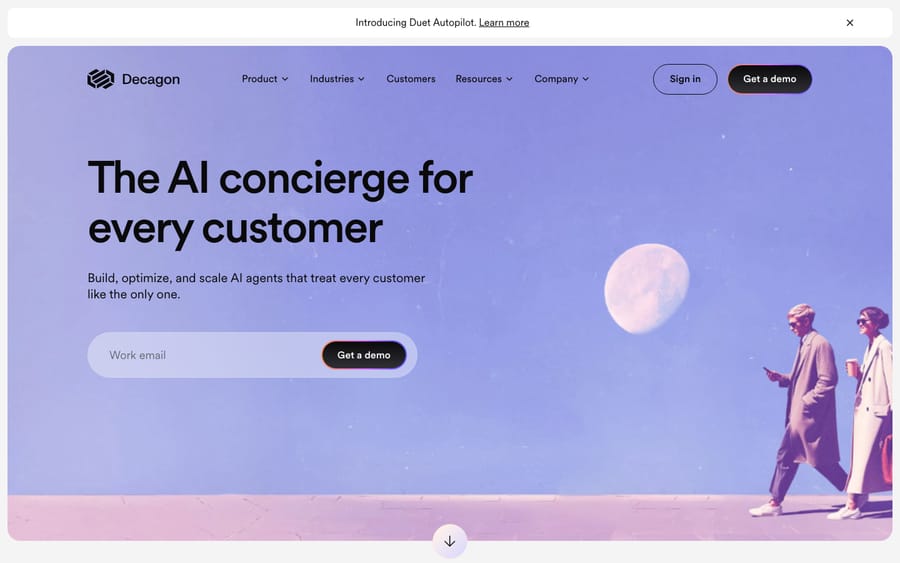
Decagon is an enterprise AI platform for customer support. Founded in 2023 by Jesse Zhang and Ashwin Sreenivas, it builds, deploys, and operates AI agents that handle customer conversations end to end, answering questions, taking actions (refunds, cancellations, account updates), and escalating to humans only when needed. The company markets this under the banner of the "AI concierge": not a deflection chatbot that points people at help-center articles, but an agent meant to resolve the whole interaction (decagon.ai).
Under the hood, Decagon's agents are built on foundation models from OpenAI, Anthropic, and Cohere, layered with each company's own data, help-center content, historical tickets, and connected systems, so responses are grounded in the business rather than generic (OpenAI has published a Decagon customer story). It operates across chat, email, voice, and SMS from a single platform, with the pitch that the same agent logic runs consistently on every channel.
The momentum is real. Decagon raised a $131M Series C at a $1.5B valuation in June 2025 (co-led by Accel and Andreessen Horowitz's growth fund), then a $250M Series D in January 2026 that tripled its valuation to $4.5B (led by Coatue and Index Ventures), one of the faster valuation climbs in enterprise software (Businesswire, and reported by Bloomberg). In March 2026 it completed its first employee tender offer at the same $4.5B valuation (TechCrunch).
How do Decagon's AI agents work?
The thing that distinguishes Decagon from a basic FAQ bot is its approach to how you tell the agent what to do. Three pieces matter.
Agent Operating Procedures (AOPs)
AOPs are Decagon's headline concept and its main differentiator. The idea borrows from how human teams use Standard Operating Procedures (SOPs): you write what the agent should do in plain English, and the platform compiles those instructions into structured, executable logic (Decagon: AOPs).
A practical example: you might write "If a customer requests a refund within 30 days and has no previous refunds, process it automatically; otherwise escalate to a human." Decagon turns that into a workflow the agent can run reliably, including pulling the order, checking the refund window, and executing the refund through a connected system. Crucially, Decagon executes the sensitive validation steps in code rather than leaving them to the model's discretion, which is how it adds guardrails around actions like refunds and identity verification (Decagon: AOP resources).
This is a genuinely thoughtful design. It's a hybrid between "let the LLM figure it out" (flexible but unpredictable) and rigid decision-tree flows (predictable but brittle). AOPs aim for the middle: natural-language authoring with code-level reliability on the parts that must not go wrong.
Actions, integrations, and channels
Decagon agents don't just answer, they do. They connect to systems like Zendesk, Salesforce, and Stripe to take real actions: process refunds, update subscriptions, verify identities, look up order status. That action-taking, across chat, email, voice, and SMS from one agent definition, is the core of the "concierge" positioning (eesel AI: what is Decagon).
Testing, QA, and observability
For enterprises, the operational tooling is as important as the agent itself. Decagon includes:
- Simulations: test core workflows against AI-generated mock customer personas before going live.
- Unit and regression testing: validate individual workflow components, and replay historical transcripts against a new agent version to catch regressions (a feature reviewers note arrived relatively recently).
- Watchtower: continuous monitoring of live conversations.
- A/B experimentation and analytics: compare agent versions and turn conversations into reporting.
Decagon also leans hard into "decision transparency", the ability to see why the agent did what it did at any point in a conversation, which matters for regulated industries and for the inevitable "why did the bot say that?" investigation.
Who uses Decagon?
Decagon's customer base skews toward high-growth consumer tech and large enterprises in travel, fintech, retail, and telecom. Decagon's homepage names Deutsche Telekom, American Airlines, Square, Delta, Snapchat, Chime, Ticketmaster, Duolingo, Perplexity, Oura, ClassPass, Curology, Hunter Douglas and Rippling among others (checked 24 September 2026), and earlier coverage adds Notion, Eventbrite, Substack, Bilt and Affirm (Contrary Research, Sacra).
Decagon publishes some eye-catching outcome numbers from these deployments, Chime resolving ~70% of chat and voice, Duolingo around 80% deflection, ClassPass ~95% cost reduction, and Hunter Douglas generating ~$1M in revenue through AI conversations (decagon.ai, still listed on 24 September 2026). Treat these as vendor-reported marketing figures: they're real customers and plausible results, but they're self-selected best cases, not independently audited benchmarks, and your mileage will depend heavily on ticket mix and how much you invest in configuration.
The common thread among Decagon customers is scale and complexity: enough ticket volume to justify a six-figure contract and a dedicated team to run it.
What features does Decagon include?
| Capability | What Decagon offers |
|---|---|
| Core model | Autonomous AI agents on OpenAI / Anthropic / Cohere foundation models |
| Authoring | Agent Operating Procedures (AOPs), plain-language instructions compiled to executable logic |
| Channels | Chat, email, voice, SMS from one platform |
| Actions | Refunds, cancellations, identity checks, subscription changes via integrations |
| Integrations | Zendesk, Salesforce, Stripe, and other systems of record |
| QA & testing | Simulations, unit testing, regression testing, A/B experiments |
| Monitoring | Watchtower live monitoring, analytics suite, decision transparency |
| Deployment | Sales-led, custom implementation with assigned engineering support |
| Status page | Public, at status.decagon.ai, with separate US and EU regions and per-channel components |
| G2 rating | 4.8 / 5 from 30 ratings (re-read on G2 itself, 22 September 2026; the same figure appears on Decagon's AWS Marketplace listing, which republishes G2's reviews) |
How much does Decagon AI cost in 2026?
Here's the honest version: Decagon does not publish pricing. We checked decagon.ai/pricing again on 24 September 2026 and it still returns a 404. There's no self-serve tier and no trial, so every number starts with a sales conversation. Everything below is assembled from third-party teardowns and reviews, and should be treated as approximate and possibly outdated, verify directly with Decagon before budgeting.
What's reported across multiple sources:
- Annual platform fee: ~$50,000/year. This is the most consistently cited figure, appearing across several teardowns and reviews, but it is reported, not confirmed by Decagon (Quiq, eesel AI).
- Usage pricing, two models. Decagon offers either per-conversation (you pay for every conversation the agent touches, resolved or not) or per-resolution (you pay only when the agent fully closes a ticket without a human). Per-conversation is estimated at ~$0.99 per conversation; per-resolution is described as higher per unit but only billed on success (Quiq, eesel AI).
- Total contract value. Reviews and procurement chatter put annual contracts somewhere in the ~$95K to $590K+ range, with one teardown citing a ~$400K median, again, third-party estimates, not official (G2 pros/cons, eesel AI).
Whose interest each billing unit serves. Worth naming before you negotiate. A per-conversation price pays Decagon for every conversation the agent touches, resolved or not, so its incentive is volume and you carry the risk that the agent fails. A per-resolution price moves that risk onto Decagon, which earns nothing on a conversation it can't close, but it earns more for everything its own instrumentation counts as resolved, and you're negotiating against a definition you don't control. A flat platform fee on top of either one insulates Decagon from your volume dropping. None of that is sharp practice. It just means the model you pick decides which party is exposed, and you should pick the exposure you'd rather carry.
A genuine watch-out with the per-resolution model: the definition of "resolution" is ambiguous. If a customer gets a partial answer and gives up, does that count? Decagon determines resolution algorithmically, and several reviewers flag this as a source of billing disputes and hard-to-forecast costs, especially during seasonal volume spikes (Fin AI). Decagon has written thoughtfully about resolution-based pricing as a model, but the practical accounting is something to pin down hard in contract negotiations.
What the AWS Marketplace listing shows. Decagon sells through AWS Marketplace under listing prodview-pnbnafhjefhhy, read on September 19, 2026. It carries a single 12-month dimension, "Platform Access," described as "Pricing determined by private offer," with a $1,000,000.00 placeholder in the public price field. Don't read that as Decagon's price: AWS listings sold through private offers fill the field with a round number. The useful part is the structure. There's no separate usage dimension, so conversation or resolution volume sits inside the negotiated contract rather than billing as an overage on top. Ask what volume the platform fee covers and what happens above it.
One note on a comparison below: Salesforce completed its acquisition of Fin, formerly Intercom, on September 10, 2026 (Salesforce newsroom), so Fin is now an Agentforce product.
Bottom line on pricing: plan for a six-figure annual commitment and a sales-led process. If you're a startup or SMB hoping to swipe a card and start, Decagon isn't built for you, and that's by design.
What do real users say about Decagon?
Here is every rating base a review query lands on, with the date we read it. Three of the four have nothing, and that is the finding rather than a gap in our research.
| Source | Rating | Ratings counted | Checked |
|---|---|---|---|
| G2 | 4.8 / 5 | 30 | 22 September 2026 |
| Capterra | listing exists, no score | 0 | 22 September 2026 |
| Trustpilot | profile exists, no score | 0 | 22 September 2026 |
| Gartner Peer Insights | no product page found | 0 | 22 September 2026 |
Thirty ratings is the entire independent evidence base for a company valued at $4.5 billion. That is a direct consequence of selling only through a guided enterprise implementation: nobody signs up on a Tuesday, so nobody complains on a Wednesday. It also means a single unhappy team could move the average visibly, so read the 4.8 as "thirty implementations went well" and not as a statistical claim.
What users complain about
The G2 dislikes, read on 22 September 2026, converge on one thing: the edges. A developer at an enterprise with more than 1,000 employees wrote on 10 August 2026 that Decagon "can still struggle with more complex or unusual customer questions", and that "sometimes the responses need to be reviewed or corrected by a human, especially when the conversation requires deeper context" (G2). A team lead at a mid-market company made the identical point on 3 September 2026, asking for "better handling of edge cases and smoother handoffs". A manager at a mid-market company answered the dislike question with "nothing till now, will share if we have any issues".
Setup complexity is the second theme and it is consistent across the older reviews. The useful thing about both complaints is that Decagon has built the tools that answer them: Simulations against generated personas for the edge cases, and Agent Operating Procedures so that changing behaviour is not a change request. Whether a team uses them is a staffing decision, which is why the problems section above leads with naming an owner.
What is Decagon good at?
- Genuinely capable autonomous resolution. Decagon is built to resolve and act, not just deflect. For complex, action-heavy support (refunds, account changes, identity verification), that's a meaningful step beyond article-suggesting bots.
- AOPs are a strong abstraction. The plain-language-to-executable-logic model, with code guardrails on sensitive steps, is one of the better answers in the market to "flexible but safe."
- Enterprise-grade tooling. Simulations, regression testing, Watchtower monitoring, and decision transparency are the kind of operational features large, regulated teams actually need.
- High user satisfaction where it lands. G2 reviewers rated it 4.8/5 across 30 reviews when we checked on September 19, 2026, and repeatedly praise fast implementation (relative to expectations), a responsive team, and best-in-class AI quality.
- Serious backing and customer proof. A $4.5B valuation and logos like Notion and Chime de-risk the "will this vendor be around" question.
What are Decagon's limitations?
- Enterprise-only, sales-led, opaque. No self-serve signup, no published pricing, no trial. Decagon does run a documentation site at docs.decagon.ai, but it sits behind a customer sign-in, so you can't read how the product works before you buy it. Evaluating Decagon means engaging sales, which is a real friction point and a recurring complaint.
- Six-figure cost floor. With a reported ~$50K platform fee plus usage, Decagon is impractical for SMBs and startups. Usage-based billing also makes budgets harder to forecast under volume spikes.
- Heavy implementation and ongoing management. Reviewers consistently say you need a dedicated person (or "Agent Engineer") to set up AOPs, integrate systems, and tune behavior, with implementation often spanning weeks to months.
- Feature maturity gaps. As a young product, some areas are still maturing, reviewers note basic user roles/permissions, shallow audit logs, and that regression testing only arrived recently (G2 pros/cons).
- Some capabilities are platform-gated. At least one reviewer flagged that "Agent Assist" was limited to Zendesk, constraining use across other tools.
- Resolution-billing ambiguity. As noted above, what counts as a "resolution" can be contentious.
What goes wrong with Decagon, and how do you fix it?
Decagon sells only to large companies through a guided implementation, so there's no free-tier crowd posting bug reports. What does exist is unusually good evidence: Decagon runs a public, component-level status page, and its AWS Marketplace listing republishes G2 reviews with names and dates. Between those two and the reviews our earlier research read, five problems recur. We've ordered them by how often they'd bite a live deployment.
1. The agent keeps talking while its tools have stopped working. This is the failure mode that matters most for an action-taking agent, because chat can look healthy while the refund never happens. It's on Decagon's own record: status.decagon.ai logs an incident titled "Increase in Tool Failures" on July 23, 2026, degraded for 22 minutes across both the US voice and the US chat, email and SMS components. A related one, "Degraded Salesforce Integration Performance," ran for 1 hour 53 minutes on August 19, 2026, hitting the system of record rather than the agent. The fix is in the AOP, not in Decagon. Write the sensitive steps so a failed or empty tool response routes to a human instead of letting the model answer around the gap, which is exactly what Decagon's code-level guardrails on validation steps are for. Then subscribe to the status feed properly: the page offers email, RSS, Atom, JSON and Slack webhook subscriptions, per component and per region, so a US team can watch the US components and skip the EU noise.
2. Voice degrades more often than chat, and for longer. Reading the same status page's 90-day history to September 20, 2026, the US voice component logged more incidents than the chat, email and SMS one, and the long ones were voice: "Issue with Certain Voice Conversations" on August 10 (3 hours 21 minutes), "Voice Call Errors" on August 31 (12 hours 27 minutes), a second voice-call error incident on September 1 (28 minutes), and "Intermittent instability affecting incoming calls" on August 20 (2 hours 27 minutes). The same window shows "Delayed AI Responses" for 12 hours 27 minutes on August 31 and "Investigating Issue with Intermittent Failures" for 9 hours 29 minutes on September 14 on the chat side. All of it was degradation rather than a hard outage, and the components report 100% uptime over the window, which tells you these show up as slow and flaky rather than down. The fix: if you're putting Decagon on the phone, keep a working fallback path in your telephony layer, subscribe to the voice component separately from chat, and agree in the contract what a degradation means for the outcome count on a call that never completed.
3. Implementation needs an owner, and reviewers say so plainly. The praise for Decagon is real, and so is the consistent note that this is a project. Among the G2 reviews Decagon's own AWS Marketplace listing republishes, CA Rahul B. wrote on August 21, 2026: "I find the setup quite complex," and Akash R. wrote on September 3, 2026 that he wanted "better handling of edge cases and smoother handoffs." Earlier reviews describe needing a dedicated person, sometimes titled an "Agent Engineer," to write AOPs, connect systems and tune behavior, with implementation spanning weeks to months. The fix is to use the thing Decagon built for exactly this. AOPs are pitched as the answer to "slow and costly builds" where "traditional approaches rely on technical teams or outside support, turning even small changes into long, expensive cycles" (Decagon: AOPs). Name an internal owner before kickoff, have them write AOPs rather than filing change requests, and lean on Simulations against generated personas plus regression replay of historical transcripts before every release. Edge cases and handoffs are precisely what a simulation suite is for.
4. Nobody can tell you what a "resolution" is until it's a contract term. Decagon offers per-conversation or per-resolution billing, and per-resolution is where disputes live: if a customer gets a partial answer and drifts away, the algorithm decides whether you pay. Decagon is unusually candid about this on its own comparison page, which says "Most enterprises choose per-conversation for predictable costs and to avoid negotiating what counts as a 'resolution.'" The fix: take the vendor's own advice unless you have a reason not to, and if you do choose per-resolution, get the definition, the measurement method and the dispute process in writing before signing, plus an export of per-conversation outcome flags so you can reconcile an invoice. The arithmetic that converts between the two is simple: at a resolution rate of R, a conversation price of C is equivalent to C ÷ R per resolution, so at 60% a $0.99 conversation equals $1.65 a resolution. Anything above that and the per-conversation deal wins, provided your resolution rate holds.
5. You can't read the manual before you buy. Decagon has a documentation site at docs.decagon.ai, but when we opened it on September 20, 2026 it redirected to a customer sign-in. There's no pricing page, no trial and no self-serve account, so an evaluation runs entirely on what sales shows you. The fix is procedural. Ask in the first call for documentation access under NDA, a sandbox you can break, and the specific list of what the platform fee includes. Ask what the status page's degradation history looks like in your region over the last quarter, since you can read it yourself anyway. And price the same volume against a vendor that publishes, so you know what the opacity costs: our Sierra and Forethought guides cover the other quote-only platforms, and best Decagon AI alternatives covers the ones with public prices.
How we researched this
On September 19 and 20, 2026 we read Decagon's product pages including the AOP page, its AWS Marketplace listing and pricing tab, its public status page and 90-day incident history for both US components, and confirmed that decagon.ai/pricing returns a 404 and that docs.decagon.ai redirects to a sign-in. On 22 September 2026 we went back to G2, Capterra and Trustpilot directly in a real Chrome session and re-read all three, which is where the rating table and the newer reviewer quotes above come from, with the roles, company sizes and dates G2 prints. The older reviewer quotes come from the G2 reviews republished on Decagon's own AWS Marketplace listing, with the names and dates that listing prints. Decagon offers no self-serve account, so we built no agent on it and didn't contact sales. Every dollar figure here is a third-party estimate and labeled as one.
Who is Decagon best for, and who should skip it?
Best for: mid-market-to-enterprise companies with high support volume, complex action-based workflows (fintech, travel, subscriptions, telecom), the budget for a six-figure contract, and the internal resourcing to staff a dedicated owner. If you need voice + chat + email under one agent and want deep QA tooling, Decagon is a legitimately strong fit.
Not for: startups and SMBs, teams that want to try before they buy, teams without an engineer to own the deployment, or anyone whose support is mostly knowledge-based Q&A that doesn't need heavyweight enterprise machinery. For those, the cost and implementation overhead won't pay off.
Who should not buy Decagon AI
- Anyone who needs to test before committing. There is no free tier, no trial and no self-serve account. The evaluation is a sales process or it does not happen.
- Anyone whose finance process needs a number first.
decagon.ai/pricing404s. The ~$50K platform figure and the six-figure contract ranges in this post are all third-party, and none of them has been confirmed by Decagon. - Teams without a named owner. Reviewers describe needing a dedicated person, sometimes titled an Agent Engineer, to write Agent Operating Procedures and tune behaviour. Without one, the implementation stalls and the contract keeps running.
- Teams that only need answers. If your queue is policy and how-to questions with no refunds, subscription changes or identity checks in it, you are paying for the action layer and using the answer layer.
What are the alternatives to Decagon?
Decagon sits in a crowded field. The honest shortlist:
- Intercom Fin: a more accessible AI agent with a public price of $0.99 per outcome (fin.ai/pricing, checked 24 September 2026), a 14-day trial, and Salesforce as its owner since 10 September 2026.
- Sierra: another well-funded enterprise "AI agent" peer (founded by Bret Taylor), similar enterprise, sales-led profile.
- Zendesk AI / Agentic AI: if you're already on Zendesk, its native AI agents are the lowest-friction starting point. See our guide to Zendesk AI.
- Ada, Forethought, eesel: other automation-first players spanning enterprise and mid-market.
A note on where we fit, since we'd rather be upfront than pretend we're neutral. Macha is an AI agent layer that runs on top of the Zendesk, Freshdesk, Gorgias, Front, HubSpot or Intercom you already run. It's not a help desk and not a Decagon-style rip-and-replace platform. The honest differentiators versus Decagon: you can start with $50 of free usage, no credit card required instead of a multi-month sales-and-implementation cycle; it layers onto the help desk you already run instead of asking you to migrate; and it bills per ticket, from $299 a month for 750 tickets and about $0.40 a ticket at every tier, one charge however many steps the agent takes, with no "resolution" to define and setup and monitoring by the Macha team included. Decagon is the heavier, enterprise-custom option; Macha suits teams that want resolution inside the help desk they already have, without a six-figure contract. Which is right depends entirely on your scale and budget. If you're weighing AI options around Zendesk specifically, our roundup of the best AI Zendesk alternatives lays out the trade-offs, and Macha on Zendesk covers how the layer model works.
Frequently asked questions
Is Decagon AI worth it? For a mid-market or enterprise team with action-heavy support and a named owner for the deployment, yes, and its reviewers say so at 4.8 from 30 ratings. It scores 16 out of 30 on our rubric, below our 18-point shortlist bar, and it loses all 14 of those points on published pricing, entry cost and review volume rather than on anything the product does. For a team that wants to try it first, no, because there is no way to.
What do users complain about with Decagon AI? Two things, repeatedly: complex or unusual questions that still need a human to review or correct the answer, and handoffs that could be smoother at those edges. Setup complexity is the older complaint, with reviewers describing a need for a dedicated owner to write Agent Operating Procedures. Nobody in the current review set complains about answer quality on ordinary questions.
How many reviews does Decagon AI have? Thirty, all on G2, rated 4.8 out of 5 as of 22 September 2026. Its Capterra listing exists with no reviews on it, its Trustpilot profile has none either, and we found no Gartner Peer Insights product page. That is the complete independent evidence base, and it is small because Decagon sells only through guided enterprise implementations.
What is Decagon AI? Decagon is an enterprise AI platform for customer support, founded in 2023. It deploys autonomous "AI concierge" agents that handle customer conversations across chat, voice, email, and SMS, answering questions and taking actions like refunds and cancellations, and escalating to humans when needed. It's built on OpenAI, Anthropic, and Cohere models grounded in each company's own data.
What does Decagon do that a normal chatbot doesn't? It's built to resolve and act, not just deflect. Through Agent Operating Procedures (AOPs), teams describe workflows in plain English that compile into executable logic, letting the agent process refunds, verify identities, and update subscriptions, with code-level guardrails on sensitive steps.
How much does Decagon AI cost? Decagon doesn't publish pricing; decagon.ai/pricing still returned a 404 when we checked on 24 September 2026, and it's fully custom and sales-led. Third-party teardowns report a ~$50,000/year platform fee plus usage (estimated ~$0.99 per conversation, or a higher per-resolution rate), with total annual contracts reportedly ranging from ~$95K to $590K+. Its AWS Marketplace listing has one 12-month "Platform Access" dimension marked "Pricing determined by private offer" with a $1,000,000 placeholder, which is a structure rather than a price. These are third-party figures and may be outdated; confirm directly with Decagon.
Does Decagon have outages? Decagon runs a public status page at status.decagon.ai with separate US and EU regions and per-channel components. Over the 90 days to September 20, 2026 the US components logged several degradations rather than hard outages, including "Increase in Tool Failures" on July 23, "Degraded Salesforce Integration Performance" on August 19, "Voice Call Errors" for 12 hours 27 minutes on August 31 and "Investigating Issue with Intermittent Failures" for 9 hours 29 minutes on September 14. Voice took more of them than chat. You can subscribe per component by email, RSS, JSON or Slack webhook.
Should I pick per-conversation or per-resolution billing with Decagon? Decagon's own comparison page says most enterprises pick per-conversation "for predictable costs and to avoid negotiating what counts as a 'resolution.'" Per-conversation means paying for misses; per-resolution means the vendor's algorithm decides what you pay for. At a 60% resolution rate a $0.99 conversation price equals $1.65 per resolution, so use that conversion to compare two quotes. If you do take per-resolution, get the definition and the dispute process in writing.
Who uses Decagon? Large enterprises and high-growth tech companies across travel, fintech, retail and telecom. Decagon's homepage names Deutsche Telekom, American Airlines, Delta, Chime, Duolingo, Rippling and Oura, and earlier coverage adds Notion, Eventbrite, Substack and Affirm.
Is Decagon good for small businesses? Generally no. With a six-figure cost floor, sales-led onboarding, no trial, and an implementation that needs a dedicated owner, Decagon is built for enterprises. Smaller teams are usually better served by self-serve tools that layer onto an existing helpdesk.
What are the main alternatives to Decagon? Intercom Fin, Sierra, Zendesk's native AI, Ada, and Forethought are common peers. For teams that want an AI agent on top of an existing Zendesk or Freshdesk rather than a full platform replacement, Macha is a lighter-weight, self-serve option.
Should Decagon be on your shortlist?
Decagon is one of the strongest enterprise AI support platforms in 2026, and its $4.5B valuation, marquee customers, and thoughtful AOP design back that up. If you're a large or fast-scaling company with complex, action-heavy support, real budget, and the team to run it, Decagon belongs on your shortlist and may well win the evaluation.
The caveats are equally real: it's expensive, opaque, enterprise-only, and demanding to implement, with usage-based billing that can be hard to forecast and a "resolution" definition worth scrutinizing in the contract. If you can't get past a sales gate, can't staff a dedicated owner, or your support is mostly knowledge-based Q&A on a helpdesk you already love, a lighter, self-serve AI layer will get you most of the value for a fraction of the cost and effort. Match the tool to your scale.
Researched June 2026 against Decagon's site, the OpenAI customer story and independent pricing teardowns, and re-checked on September 19, 20 and 24, 2026 against Decagon's product pages, its public status page, its AWS Marketplace listing and its documentation sign-in. Pricing is custom and unpublished; all dollar figures are third-party estimates and may be outdated, so confirm directly with Decagon.
Simple per-ticket AI pricing
One thread with one person is one charge, however many replies it takes.