
 Shopify
 Stripe
 Slack
Slack Notion
 Google Workspace
 Confluence

Best AI Chatbot for Customer Service in 2026: 14 Scored, With Real Monthly Costs


Macha scores highest of the 14 AI chatbots for customer service we compared, at 37 out of 45, because implementation counts twice and Macha's team builds and runs the agent for you; Intercom Fin is second at 33 and costs $0.99 per outcome. The right pick still depends on where the chatbot runs, and at 3,000 chats a month the published costs range from about $18 on Amazon Lex to about $2,980 on Zendesk AI agents.
Key takeaways
- Macha scores highest on the rubric at 37 out of 45, because implementation counts twice and its team builds and runs the agent for you, ahead of Intercom Fin at 33, Ada at 31, and Sierra and Decagon at 27.
- Zendesk AI agents charge $1.50 per committed automated resolution or $2.00 pay-as-you-go on top of Suite seats from $55 an agent, and Intercom Fin bills $0.99 per outcome with a 50-outcome monthly minimum.
- At 3,000 chats a month with half resolved by the bot, published costs range from about $18 for Amazon Lex's runtime to about $2,980 for Zendesk AI agents on the pay-as-you-go rate.
- Gorgias AI Agent's Pro plan costs $550 a month for 2,000 tickets and 190 automated interactions, then $0.36 per extra ticket and $1.50 per extra automated interaction.
- Macha is the done-for-you AI agent layer here: the Macha team analyzes your past tickets and builds and runs the agent on your help desk, included at about $0.40 a ticket from $299 a month for 750.

The best AI chatbot for customer service on our 45-point rubric is Macha, at 37 out of 45, because the rubric counts implementation twice and Macha's team builds and runs the agent on your help desk, ahead of Intercom Fin at 33 and $0.99 per outcome, Ada at 31, and Sierra and Decagon at 27. Choose by where the chatbot has to run: your help desk’s own agent (Zendesk AI agents, Freddy AI Agent, Gorgias AI Agent, HubSpot Customer Agent, Salesforce Agentforce) for the least integration work; Ada, Netomi, Sierra or Decagon for high volume and an enterprise budget; Tidio Lyro, Chatbase or Botpress for a fast, cheap start on a website; and Macha, eesel AI or My AskAI to add agents to the help desk you already run.
Disclosure: Macha publishes this page and Macha is one of the products compared below, on the same criteria as everything else. It scores 37 out of 45 on the rubric further down, first ahead of Intercom Fin, with full marks on implementation and ongoing management, the criteria it's built around, and a zero for independent reviews. The methodology section sets out how we researched every vendor here.
Which AI chatbot should you pick for your situation?
| Your situation | Kind of product | Start with |
|---|---|---|
| Already on Zendesk, Freshdesk Omni, Gorgias, HubSpot or Salesforce, want the least integration work | The help desk's own AI agent | Zendesk AI agents, Freddy AI Agent, Gorgias AI Agent, HubSpot Customer Agent, Agentforce |
| Tickets in Zendesk, Freshdesk, Gorgias, Front, Intercom or HubSpot, and you want agents working inside those tickets without switching help desk | AI agent layer on your help desk | Macha, or eesel AI and My AskAI |
| High volume, many languages, a procurement process and budget in the tens of thousands | Standalone support AI agent | Ada, Netomi, Fin; Sierra or Decagon for the largest programs |
| Small team, website chat, want something live this week for under $1,000 a month | Chatbot builder | Chatbase, Kommunicate, Tidio, ChatBot.com |
| One technical builder who wants control over every branch | Chatbot builder with a canvas | Botpress or Voiceflow |
| Engineers on AWS, Google Cloud or Microsoft who will build the channel themselves | Cloud components | Amazon Lex, Google Conversational Agents, Copilot Studio |
Start with the quick picks if you know your situation. The comparison table below them puts every platform on one screen, then come the per-platform entries, the arithmetic behind a normal month and our own test. For the wider category, including agents that work email tickets rather than chat, see our overview of AI agents for customer service.
What can each chatbot do to a ticket, and what does it cost? (September 2026)
Every list in this category compares features. Almost none compares how the thing is billed and what it is allowed to do once a conversation starts, which is the difference between an AI that answers a WISMO question and one that fixes the order behind it.
Legend: ✅ native · ➕ configurable, you build it · ✖ not a focus.
| Tool | Help desk it runs on | Resolves, drafts or triages | Write actions (refund, order edit, address change) | Billing unit | Entry price (September 2026) |
|---|---|---|---|---|---|
| Intercom Fin | Intercom ✅, Zendesk ✅, Salesforce ✅ | Resolves | ✅ | Per outcome | $0.99 per outcome, 50-outcome minimum |
| Zendesk AI agents | Zendesk only ✅ | Resolves and drafts | ✅ | Per verified automated resolution | $1.50 committed / $2.00 pay-as-you-go |
| Macha | Zendesk ✅, Freshdesk ✅, Gorgias ✅, Front ✅, Intercom ✅, HubSpot ✅ | Resolves, drafts or triages (you choose per agent) | ➕ | Per ticket | $299/mo for 750 tickets (~$0.40 a ticket), setup done for you included |
| Gorgias AI Agent | Gorgias only ✅ | Resolves | ✅ | Per automated interaction | From $40/mo including 50 tickets |
| eesel AI | Zendesk ✅, Freshdesk ✅, Intercom ✅, Gorgias ✅ | Resolves or drafts | ➕ | Per credit (a ticket or chat) | From $299/mo for 500 credits |
| Freddy AI Agent | Freshdesk only ✅ | Resolves and drafts | ✅ | Per session | $49 per 100 sessions |
| HubSpot Customer Agent | HubSpot only ✅ | Resolves | ✅ | Credits per resolved conversation | About $0.50 a resolution, plus seats |
| Salesforce Agentforce | Salesforce only ✅ | Resolves and triages | ✅ | Flex Credits per action | $0.005 a credit, 20 credits an action |
| Tidio Lyro | Tidio ✅, Zendesk ➕ | Resolves | ➕ | Per Lyro conversation | Free tier; add-on from $32.50/mo |
| My AskAI | Zendesk ✅, Intercom ✅, Freshdesk ✅ | Resolves | ✖ | Per ticket, in plan bundles | $199/mo (Pro), 30-day free trial |
| Ada | Zendesk ✅, Salesforce ✅, Front ✅ | Resolves | ✅ | Per conversation, annual contract | Not published |
| Netomi | Zendesk ➕, Salesforce ➕ | Resolves | ✅ | Annual contract | Not published |
| Sierra | API and connectors ➕ | Resolves | ✅ | Per outcome, annual contract | Not published; no pricing page |
| Decagon | API and connectors ➕ | Resolves | ✅ | Per conversation, annual contract | Not published; no pricing page |
| Chatbase, Botpress, ChatBot.com, Kommunicate, Voiceflow | Website widget, not a help desk ✖ | Resolves on your site | ➕ | Per conversation or message credit | $19 to $150/mo entry |
Two things fall out of that table. Four of the fourteen agents will not tell you what they cost. And only two, Macha and eesel, let you set per agent whether the AI answers the customer or writes a draft a person sends, which is where most teams actually start.
How did we score the AI chatbots?
Nine of the ten pages currently ranking for this search are published by a vendor selling a competing product, and every one of them puts itself in its own list. Ours does too. The only useful response is to publish the scoring so you can check it.
Eight criteria, each scored 0 to 5, with implementation counted twice, for a maximum of 45. A product needs 23 out of 45, or 50%, to be listed as a full entry here. We lowered the bar from 60% to 50% on 7 October 2026, when implementation started counting twice, so that no product left the list because of the reweighting alone. Anything below the line is named with its score.
| Criterion | 5 points | 0 points |
|---|---|---|
| Published pricing | Every rate that makes up the bill is on the vendor's own page | Nothing public |
| Runs on the help desk you already have | Native on three or more major help desks | It is the help desk, or you replace yours |
| Write actions | Documented actions that change an order, refund or address | Answers only |
| Independent review base | 1,000 or more ratings on G2 or Gartner Peer Insights | None |
| Time and effort to a live answer | Live in a week, self-serve or vendor-built | A quarter-long implementation project |
| Channel coverage | Email, chat, voice, social and in-app | One channel |
| Implementation: who builds it (counts twice) | The vendor builds, tests and launches the agent on your help desk, included on every plan and the trial | Documentation only: you build it alone |
| Ongoing management after go-live | A dedicated person handles your changes (new categories, instructions, tools), included on every plan | You tune and maintain it alone |
On 7 October 2026 we split our old setup-and-support score into the last two criteria. Who builds the agent decides whether it goes live at all and what it really costs your team, so implementation counts twice. It's also the criterion Macha is built around, so weigh our scores with that in mind. On implementation, Macha scores 5: our team builds the agent on your help desk, on the trial and every plan. Ada, Netomi, Sierra and Decagon score 3: the vendor builds the agent with you, but through a sales process and a contract. HubSpot scores 2, because Service Hub Professional comes with a required $1,500 onboarding package. The other self-serve tools score 1: you build the agent yourself. On ongoing management, Macha scores 5: a dedicated success manager handles your changes after go-live. Fin scores 3, because a dedicated support team comes with Intercom's Premier Support, a paid add-on that needs a contract, and the contract-led vendors score 3 for the same reason. The rest score 1: you tune and maintain the agent yourself.
| Product | Pricing (September 2026) | Runs on yours | Write actions | Reviews | Effort | Channels | Implementation (counts x2) | Ongoing management | Total | Score |
|---|---|---|---|---|---|---|---|---|---|---|
| Macha | 5 | 5 | 4 | 0 | 5 | 3 | 5 | 5 | 37 | 82% |
| Intercom Fin | 5 | 4 | 5 | 5 | 4 | 5 | 1 | 3 | 33 | 73% |
| Ada | 2 | 4 | 5 | 4 | 2 | 5 | 3 | 3 | 31 | 69% |
| Sierra | 0 | 3 | 5 | 4 | 1 | 5 | 3 | 3 | 27 | 60% |
| Decagon | 0 | 3 | 5 | 3 | 2 | 5 | 3 | 3 | 27 | 60% |
| Gorgias AI Agent | 4 | 1 | 5 | 4 | 5 | 4 | 1 | 1 | 26 | 58% |
| eesel AI | 5 | 5 | 3 | 2 | 5 | 3 | 1 | 1 | 26 | 58% |
| Tidio Lyro | 5 | 2 | 2 | 5 | 5 | 4 | 1 | 1 | 26 | 58% |
| Netomi | 2 | 3 | 4 | 2 | 2 | 4 | 3 | 3 | 26 | 58% |
| Zendesk AI agents | 3 | 1 | 4 | 5 | 4 | 5 | 1 | 1 | 25 | 56% |
| HubSpot Customer Agent | 4 | 1 | 3 | 5 | 3 | 4 | 2 | 1 | 25 | 56% |
| Freddy AI Agent | 4 | 1 | 3 | 5 | 4 | 4 | 1 | 1 | 24 | 53% |
| Salesforce Agentforce | 4 | 1 | 4 | 5 | 3 | 4 | 1 | 1 | 24 | 53% |
| My AskAI | 4 | 4 | 2 | 2 | 5 | 3 | 1 | 1 | 23 | 51% |
Three notes, about our own row and Netomi's. Macha scores 0 out of 5 on independent reviews, because it has none: its G2 listing showed zero reviews when we checked on 22 September 2026, against 7,075 for Zendesk. The 5 on implementation, counted twice, and the 5 on ongoing management put it first: the agent is built and run for you, with a dedicated success manager, on the trial and every plan. And Netomi now clears the bar at 26, on its vendor-led build, after missing the old one by a point; nothing is published, its only marketplace figure is a $100,000 one-month pilot, and sixteen G2 ratings is a thin base for a purchase that size.
The five website-widget builders at the bottom of the table above are scored as a group rather than individually, because they are not competing for the same job: they answer on your site instead of inside your help desk queue, so they score 1 or 2 on the criterion that separates everything else here.
What does our own production data say about "resolve"?
Most pages in this category argue about resolution rates. We can add something narrower and checkable: what teams actually switch on once the buying is over.
On 22 September 2026 we measured the configuration of every agent running live on a customer's help desk inside our own platform. There were 119, across 62 customer organizations:
- 59 can post an internal note. Only 19 can post a public reply.
- 40 can draft but are not allowed to answer the customer at all.
- 34 can change a ticket's tags, priority, status or assignee without writing anything the customer sees.
Agents configured to draft outnumber agents configured to answer by more than three to one on our own install base. That is not evidence that autonomous resolution fails; Fin, Zendesk and Gorgias all sell it and customers buy it. It is evidence that the "resolves, drafts or triages" column decides your first month, and that a product which only resolves cannot be dialed back.
The same read covered custom API tools, which is how an agent reaches a system with no packaged integration: 61 live tools built by 13 customers, of which 40 are read-only lookups and 21 write (twenty POSTs and one PUT). Roughly one integration in three changes anything; the rest only fetch. That is worth holding next to any vendor's "150+ integrations" claim.
These are aggregate counts from our own database, with no customer named and no ticket content involved. They describe our own customers rather than the market, and they are small numbers.
How do the AI chatbots for customer service compare side by side?
Prices come from each vendor's own page, and from AWS Marketplace, Azure Marketplace and Vendr where the vendor doesn't publish one, checked September 18 and 19, 2026. Ratings are stars and review count. "Whole company" means the only listing we found covers the vendor rather than the chatbot product.
| Platform | Kind | Price we found (September 2026) | G2 | Gartner Peer Insights | Best for |
|---|---|---|---|---|---|
| Zendesk AI agents | Help desk's own | Included in Suite; $1.50 per automated resolution on a committed plan, or $2.00 pay-as-you-go, beyond a $2 to $10 monthly allowance per seat | 4.3 (7,075, Zendesk for Customer Service) | 4.3 (47) | Teams already on Zendesk |
| Fin | Help desk's own (Intercom) and standalone | $0.99 per outcome, 50 a month minimum | 4.5 (3,912, whole product) | 4.3 (257, whole company) | Intercom teams, and teams on the help desks Fin lists |
| Freddy AI Agent | Help desk's own (Freshdesk) | $49 per 100 sessions; 500 free once | 4.4 (3,771, Freshdesk) | 4.4 (2,294, Freshworks whole company) | Freshdesk Omni teams |
| Gorgias AI Agent | Help desk's own | $1.50 per automated interaction past the plan allowance on the plan cards, $0.85 to $1.00 in the same page's comparison table | 4.6 (582) | 5.0 (5, whole company) | Shopify brands |
| Salesforce Agentforce | Help desk's own (Service Cloud) | $500 per 100,000 Flex Credits; 20 credits per standard action | 4.3 (1,694) | 4.3 (72) | Salesforce Service Cloud orgs |
| Tidio Lyro | Chatbot builder with its own inbox | Lyro from $32.50 a month for 50 chats; $700 for 1,000; Plus from $300 a month plus usage | 4.6 (1,962, Tidio) | 4.3 (176, whole company) | Small ecommerce teams |
| HubSpot Customer Agent | Help desk's own | 50 HubSpot Credits per resolved conversation, $0.010 a credit paid annually | 4.4 (3,014, Service Hub) | Not in the AI agents market | HubSpot Service Hub Pro teams |
| Ada | Standalone support agent | Not on its site; Salesforce AgentExchange lists from $30,000 a year, AWS $33,000 for 60,000 conversations, Azure $250,000; Vendr median $72,000 | 4.6 (173) | 4.5 (21, whole company) | Enterprise, multilingual |
| Netomi | Standalone support agent | Not on its site; AWS lists a $100,000 one-month proof of concept; Vendr median $85,000 a year | 4.8 (16) | No reviews yet | Large regulated brands |
| Chatbase | Chatbot builder | $40, $150 and $500 a month for 700, 4,000 and 15,000 message credits | 4.8 (45) | No listing found | Small teams training a bot on their docs |
| Botpress | Chatbot builder | $150 and $750 a month billed annually, for 250 and 1,500 conversations | 4.5 (512) | No listing found | A technical builder who wants control |
| ChatBot.com | Chatbot builder | $19 and $79 per user a month billed annually; extra resolutions $49.50 per 50 | 4.5 (25) | Not in the AI agents market | Small teams selling through chat |
| Kommunicate | Chatbot builder | $40 and $200 a month for 250 and 2,000 conversations | 4.7 (28) | Not in the AI agents market | Budget chat and WhatsApp bots |
| Voiceflow | Chatbot builder with a canvas | Plans shown in-app only; Vendr lists Pro $60 and Business $150 per editor, median contract $258,625 a year | 4.6 (113) | Listed, no ratings | CX teams with one technical builder |
| Google Conversational Agents | Cloud components | $0.007 per chat request (Flows), $0.012 (Playbooks) | 4.4 (144, Dialogflow) | 4.4 (19) | Google Cloud engineering teams |
| Amazon Lex | Cloud components | $0.00075 per text request | 4.2 (43) | 4.4 (52) | AWS engineering teams |
| Microsoft Copilot Studio | Cloud components | $200 a month per pack of 25,000 credits; 2 per generative answer, 5 per agent action | 4.4 (155) | 4.2 (71) | Microsoft 365 organizations |
| eesel AI | Layer on your help desk | $299/mo for 500 credits up to $1,749 for 5,000; a ticket or chat is 1 credit | 4.6 (20) | Not in the AI agents market | A monthly credit batch on an existing help desk |
| My AskAI | Layer on your help desk | $199 a month for 1,000 tickets | 4.5 (23) | Not in the AI agents market | Low per-ticket price on an existing help desk |
| Macha | AI agent layer on your help desk | From $299/mo for 750 tickets (~$0.40/ticket), published | Not rated here | Not listed | Teams on Zendesk, Freshdesk, Gorgias, Front, Intercom or HubSpot; set up for you by the Macha team, with a dedicated success manager; $50 free usage |
Chatbot vs. AI agent: the distinction that decides your shortlist
"Chatbot" is the word people search for, and it now covers three different things. A rule-based chatbot follows a decision tree someone drew: press a button, get the next canned message. An AI chatbot writes its answers with a language model from your help center and documents, so it handles phrasing nobody planned for, but in its basic form it can only answer. An AI agent also acts: it calls a tool to look up an order, changes an address, issues a refund within limits you set, or hands off with a summary.
Most products on this page sell themselves as agents. In a demo, ask for something that requires a lookup and watch whether a tool call happens. Our own test further down shows why. A chatbot without a tool will still sound helpful, and it will sometimes describe work it never did. Our explainer on what an AI customer support agent is covers the definitions, and we cover the handoff side in how AI chatbots hand off to humans, and the longer argument in how AI agents differ from chatbots.
The five kinds of AI chatbot for customer service
The kind decides who builds the bot, where it lives and what you pay for. Here are the five, plus the buyers the ranking listicles mostly skip.
| Kind | Examples | Who builds it | Where the conversation lives | Billing unit |
|---|---|---|---|---|
| Your help desk's own AI agent | Zendesk AI agents, Fin on Intercom, Freddy AI Agent, Gorgias AI Agent, Agentforce, HubSpot Customer Agent | Your support ops team, in the help desk admin | The help desk's messenger and inbox | Per resolution, session, credit or action |
| Standalone support AI agent | Ada, Netomi, Fin on another help desk, Sierra, Decagon | The vendor's team with yours | Its own widget, connected to your help desk | Annual contract, per conversation or per outcome |
| Chatbot builder | Chatbase, Botpress, Voiceflow, Tidio, ChatBot.com, Kommunicate | One person on your team, often in a visual editor | The builder's widget, sometimes its own inbox | Messages, conversations or resolutions, in plan tiers |
| AI agent layer on your help desk | Macha, eesel AI, My AskAI | Macha's team sets it up for you; eesel and My AskAI are self-serve below Enterprise | Inside your existing help desk tickets | Per ticket |
| Cloud components | Amazon Lex, Google Conversational Agents, Microsoft Copilot Studio, IBM watsonx | Your engineers | Wherever you build the channel | Per request, per message or per credit |
Three questions sort most buyers. Where do your conversations already live? If the answer is a help desk you like, start with its own agent or a layer on it, because the customer record and the ticket history are already there. Will anyone on your team own the bot after launch? If not, rule out builders and cloud components. And is your volume in the hundreds or the tens of thousands a month? The first favors plan tiers, the second makes annual contracts worth pricing.
Some searchers want something the listicles don't cover:
- Phone calls. Voice agents from Retell, Vapi and ElevenLabs bill per minute and belong to a different comparison, and Aircall and Talkdesk sell voice agents inside their phone systems.
- Employees rather than customers. IT and HR help in Slack or Teams is its own market; Moveworks, now part of ServiceNow, leads it (see our Moveworks guide), with Copilot Studio and IBM watsonx Orchestrate close behind.
- Sales and social DMs. Lead capture in Instagram and WhatsApp is where Chatfuel, ManyChat and Lindy's templates sit. They answer questions, but they're built to qualify and sell.
AI agent layers on the help desk you already use
This kind keeps your help desk and adds agents that work inside its tickets. It suits teams who like their help desk and don't want its AI pricing or a second inbox.
Macha
This is us, so here is the scoped version. Macha is an AI agent layer on top of Zendesk, Freshdesk, Gorgias, Front, Intercom or HubSpot: agents read and act on tickets inside the help desk your team already uses, triggered by events such as a new ticket, with tools for the help desk and for the other systems on our integrations page. It isn't a help desk, it doesn't replace one, and it isn't a general chatbot builder or a phone agent. Pricing is one plan on monthly ticket volume, from $299 for 750 tickets, about $0.40 a ticket, and a ticket is one thread with one person, charged once however many replies it takes. Setup is done for you: you connect your help desk and the tools your answers come from, about 15 minutes, and the Macha team analyzes about a month of your past tickets, builds the knowledge base and the agent, tests it on a sample of those tickets, and runs it in safe mode, with drafts as internal notes, until the drafts are right. At the entry tier, $299 gets you 750 tickets on Macha and 500 on eesel: $0.40 a ticket against $0.60, with setup done for you included, and the price also covers a dedicated success manager who handles your changes after go-live. The trial is $50 of free usage with no card. Macha on your help desk explains how it connects.
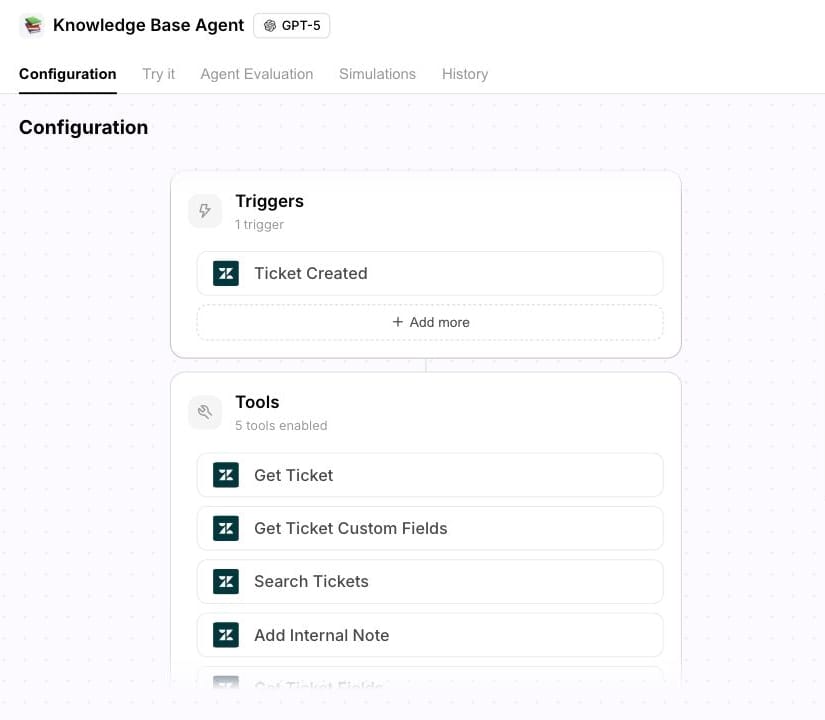
It fits teams running one of those help desks whose conversations are tickets. It's the wrong fit if you don't use a help desk, or if the chats you want automated are sales conversations or phone calls.
eesel AI and My AskAI
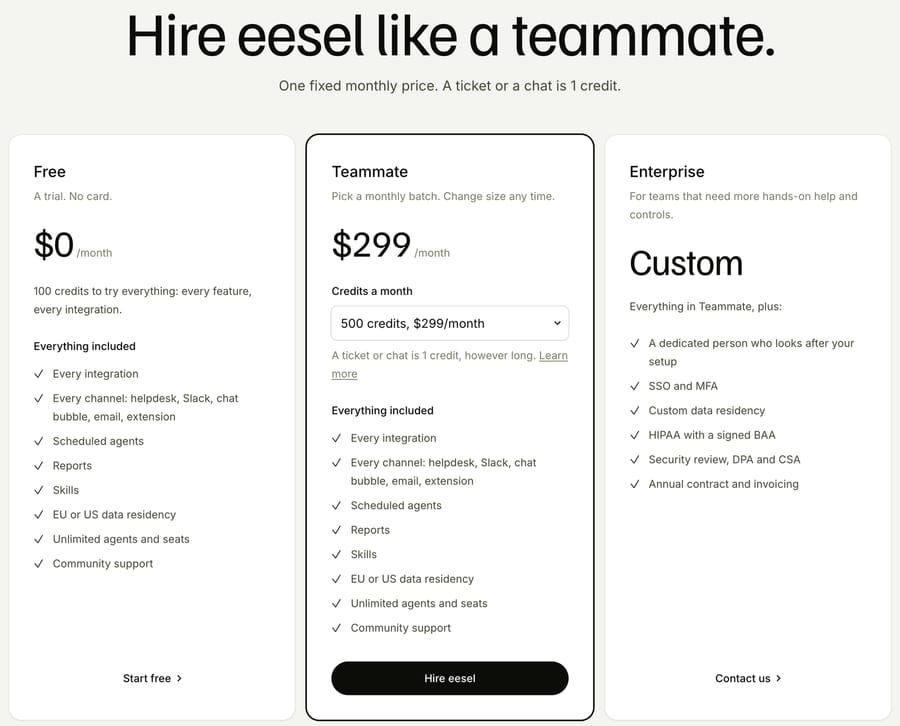
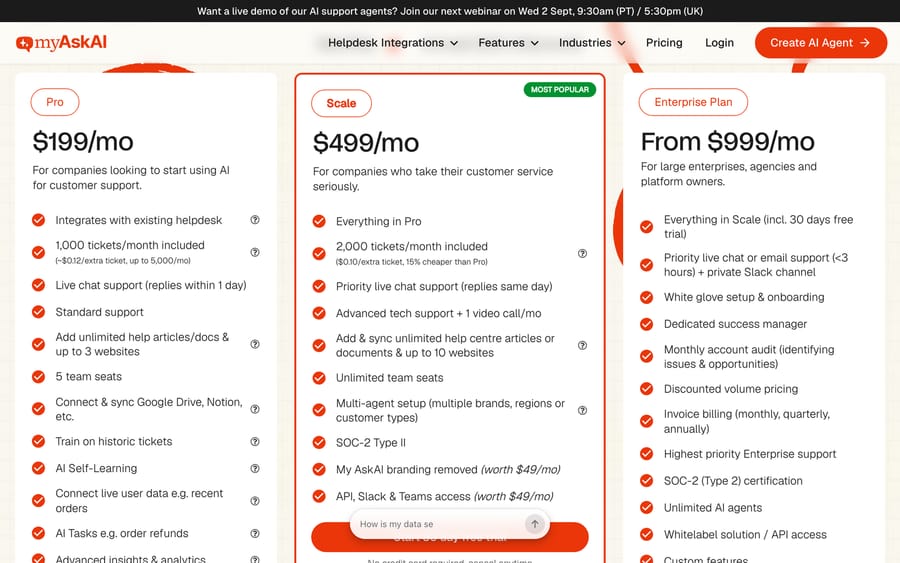
Both sell the same shape of product as Macha, an agent on your existing help desk priced per ticket, and both publish prices. eesel AI sells monthly credit batches from $299 for 500 to $1,749 for 5,000, where a ticket or chat is 1 credit, with no platform fee, 100 free credits and a custom-priced Enterprise tier; it rates 4.6 from 20 on G2. My AskAI charges $199 a month for 1,000 tickets, then about $0.12 each up to 5,000, and $499 for 2,000 on Scale; it rates 4.5 from 23 on G2. We compared all three in Macha vs eesel vs My AskAI, and our eesel guide has more.
Standalone AI agents
These vendors sell a support agent as their main product, connect it to your help desk and channels, and usually sell it on an annual contract with a team that builds it with you.
Ada
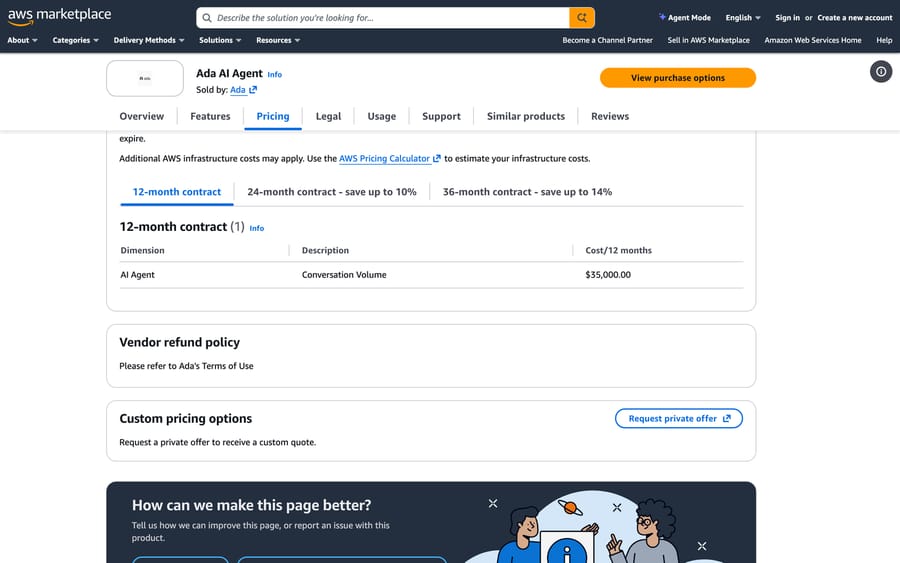
Ada is one of the longest-running AI customer service vendors, with automation across chat, email, voice and messaging in many languages. Its website quotes privately, but its marketplace listings don't. Ada's Salesforce AgentExchange listing reads "Starting at $30,000 per Company/Year" (checked 25 September 2026). Its AWS Marketplace listing sold "AI Agent, Conversation Volume" at $35,000 for 12 months without stating the volume when we read it on 22 September, and now shows custom pricing only, while a second Ada listing on AWS, "Ada - AI Agent", still sells 60,000 conversations a year for $33,000 (checked 25 September 2026). Its Azure listing's public plan is $250,000 a year alongside one customer-specific plan at $13,500. Vendr, a neutral buying service, puts the median buyer at $72,000 a year based on 114 purchases, from $36,079 to $309,200.
G2 shows 4.6 from 173 reviews and Gartner 4.5 from 21. The con tags are small but pointed, "Usability Issues" (10) and "Integration Issues" (9), and an enterprise reviewer wrote that "once a user is engaged in a playbook process they're sometimes 'stuck' in it" (G2, February 19, 2026), the same reviewer naming pricing as "a big one".
It suits enterprises that want a mature, multilingual agent and a vendor team to build it. Skip it if you can't commit to a five-figure annual contract: its published floor is $30,000 a year on AgentExchange, and the $13,500 Azure plan was made for one named customer. Our Ada guide has the detail.
Netomi
Netomi sells enterprise AI agents across chat, email, voice and messaging, with integrations its AWS listing names as Amazon Connect, Salesforce and Zendesk. There's no price on its site, but its AWS Marketplace listing prices a one-month, fully supported proof of concept at $100,000, with production pricing by private offer after it. Vendr's median contract is $85,000 a year, between $77,500 and $103,000, without a purchase count.
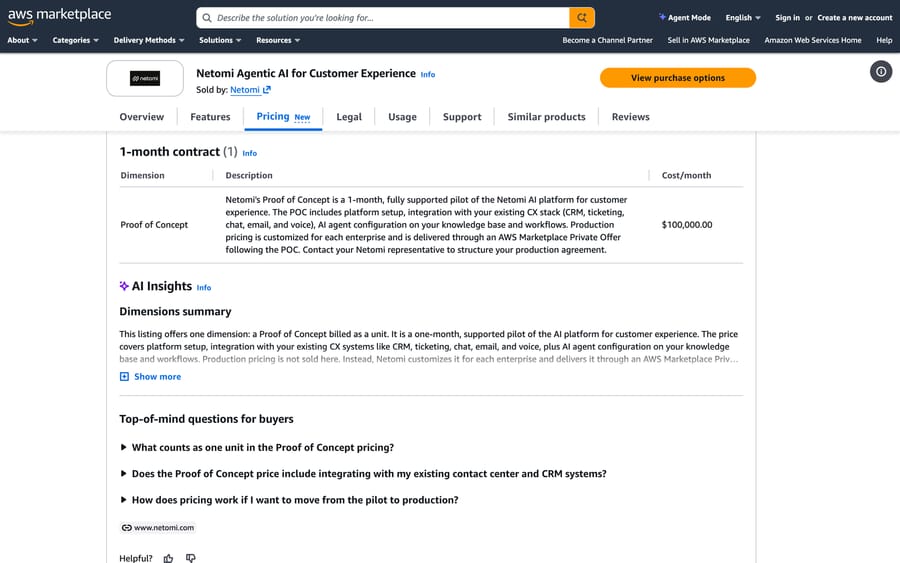
Reviews are few and warm: 4.8 from 16 on G2, and no Gartner reviews yet. The complaints that exist are about the account relationship; a training and quality reviewer at a small business called "the other CSM that handled us" the one hiccup, saying they "either gave empty promises or no action at all" (G2, August 20, 2024).
It suits large brands in travel, insurance or telecom that want a vendor-run program. Skip it if a $100,000 pilot is more than your annual AI budget. See our Netomi guide.
Sierra and Decagon
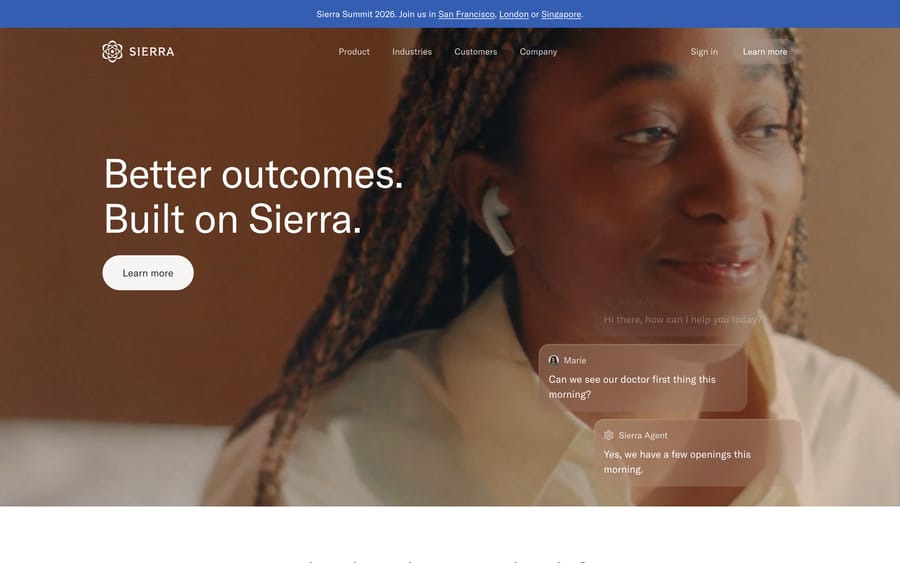
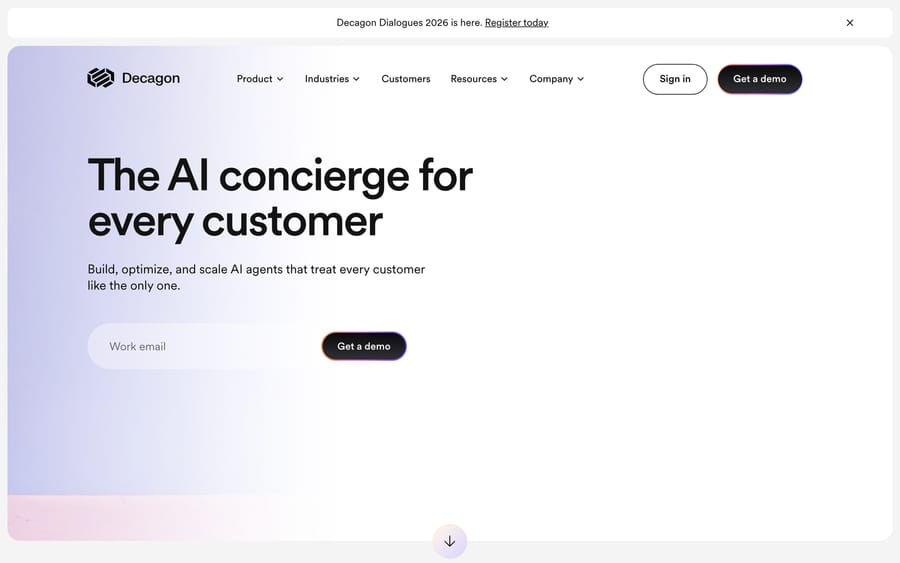
Sierra and Decagon build agents with your team for the largest support programs, and neither publishes a price. We re-checked both on 22 September 2026: sierra.ai/pricing and decagon.ai/pricing each return a 404, and the only route in on either site is a demo form. Both AWS listings are $1,000,000 private-offer placeholders, and Vendr's median Decagon buyer pays $432,750 a year. Sierra rates 4.5 from 130 on G2 and 4.7 from 7 on Gartner; Decagon 4.8 from 30 on G2. Both suit enterprises with a program budget; for everyone else they're a reference point. Our Sierra and Decagon guides have the rest.
AI agents built into your help desk
If your team already lives in a help desk, its own agent is usually the shortest path: the customer record, the order data and the ticket history are already connected, and there's one vendor to call. The trade-off is lock-in to that vendor's pricing and roadmap.
Zendesk AI agents
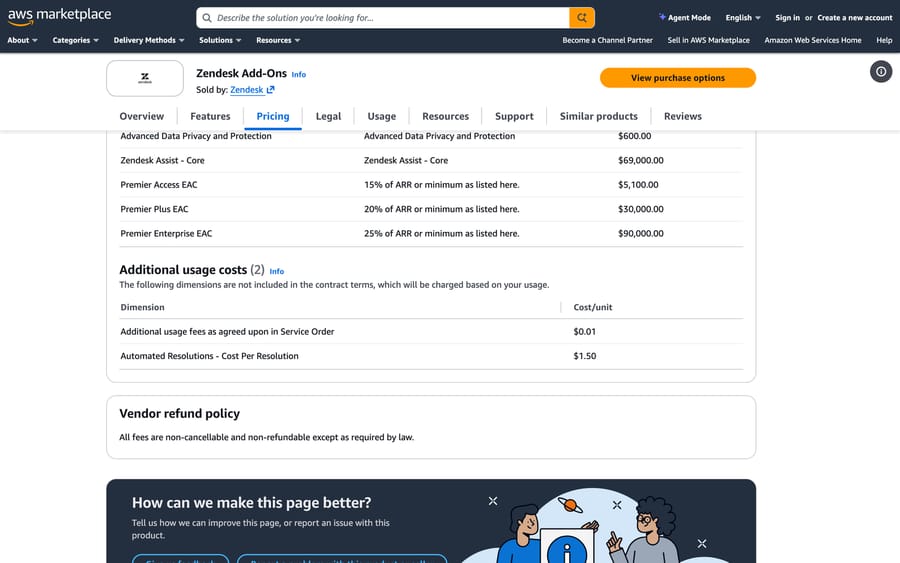
Zendesk includes AI agents in every Suite plan and bills for outcomes. Since May 18, 2026, those outcomes come in three resolution tiers: assisted escalations and contained resolutions don't draw down your allowance, and verified resolutions, which an LLM checks, do. Zendesk's pricing blog says it "charges $1.50 per automated resolution" (updated May 12, 2026). Its pricing page prints two rates, identically on every Suite and Support plan: $1.50 for a committed automated resolution and $2.00 pay-as-you-go. Each seat carries a monthly resolution allowance of $2 on Suite Team, $5 on Growth and Professional and $10 on Enterprise, capped at $5,000 a year. Zendesk's own AWS Marketplace listing shows the same $1.50, under a banner telling buyers "Please DO NOT PURCHASE via this public offering". Suite seats start at $55 per agent a month billed yearly.
Zendesk for Customer Service rates 4.3 from 7,075 reviews on G2, where "Missing Features" (216) and "Learning Curve" (179) lead the complaint tags, 4.4 from 4,091 on Capterra, and 4.3 from 47 in Gartner's AI agents for customer service market. Cost is the recent complaint: a director of operations at an IT services company wrote on Capterra that "Access to the platform can get somewhat pricey", adding that whether it's worth it depends on how many of the features you use (December 9, 2025).
It fits a team already on Zendesk that wants AI without a second vendor. Skip it if you aren't on Zendesk, or if you want to cap AI spend at a fixed monthly number, since per-resolution billing rises with every ticket the bot closes. Our Zendesk AI guide and Zendesk AI pricing breakdown go deeper.
Fin
Fin, formerly Intercom, is the best-known per-outcome chatbot, and Salesforce completed its acquisition on September 10, 2026. Its pricing page charges $0.99 per outcome with a 50-outcome monthly minimum, and says Fin runs on Salesforce, HubSpot, Freshworks, Dixa, Front, Zoho, Sprinklr and Gorgias as well as Intercom, where a help desk seat on the Essential plan costs $29 a month billed annually on 24 September 2026. When we first read the page on 18 September it showed $19; the page code labels that plan as a price experiment, so check the rate you are offered. There's a 14-day trial with no card.
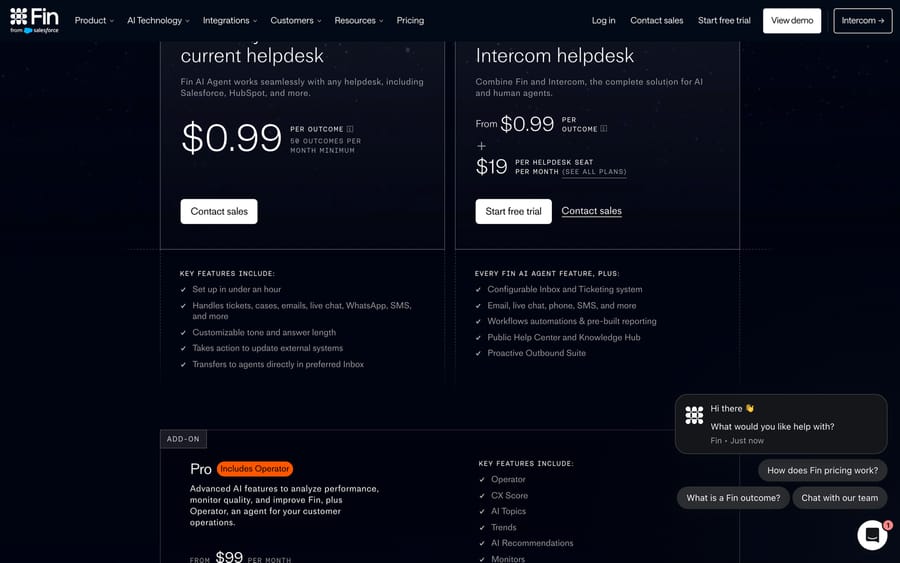
G2 shows 4.5 from 3,912 reviews, a count for the whole product, since Fin's G2 listing is the renamed Intercom listing, and Gartner shows 4.3 from 257 for the whole company. A customer support specialist at a mid-market company wrote that "Sometimes Fin can be repetitive in the way it handles a conversation" (G2, September 11, 2026). Procedure handoffs and disqualifications bill at the same $0.99 as a resolution, so the outcome list matters as much as the rate.
It suits Intercom teams and teams on the help desks Fin names. Skip it if your help desk isn't on Fin's list, or if much of your volume ends in handoffs, since a Fin that hands off early still costs $0.99 a time. Our Fin guide has the setup detail.
Freshdesk Freddy AI Agent
Freshworks sells its chatbot as the Freddy AI Agent add-on. Freshdesk's own help article prices it at $49 per pack of 100 sessions, with 500 free sessions once per account. A chat session is everything within 24 hours; an email session runs 72 hours. The article also says the Chat AI Agent is available only in Freshdesk Omni, while plain Freshdesk gets the email agent. Freshdesk seats run $19, $55 and $89 per agent a month billed annually.
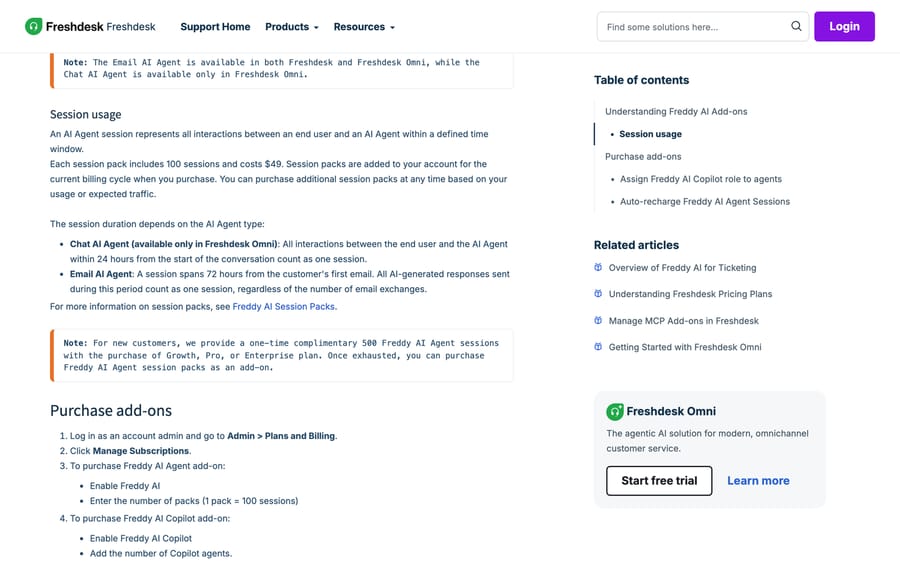
Freshdesk rates 4.4 from 3,771 on G2, and Freshworks 4.4 from 2,294 on Gartner for the whole company. Capterra shows 4.5 from 3,474. Recent complaints are about plan gating rather than the AI itself: a systems administrator in packaging wrote on Capterra that "Some advanced features are only available on higher-tier plans, which can become expensive as your team grows" (July 12, 2026). Vendr's median Freshworks contract is $15,412 a year across 176 deals.
It suits Freshdesk Omni teams who want the chatbot inside the same inbox. Skip it if you're on plain Freshdesk and need chat, because that means an Omni upgrade first. See our Freddy AI guide.
Gorgias AI Agent
Gorgias is a Shopify-first help desk that bundles its AI Agent into every plan and prices both on volume, not seats. On its pricing page, the monthly Pro plan costs $550 for 2,000 tickets and 190 automated interactions, about $1.00 each, then $0.36 per extra ticket and $1.50 per extra automated interaction. Annual billing takes Pro to $471 a month.
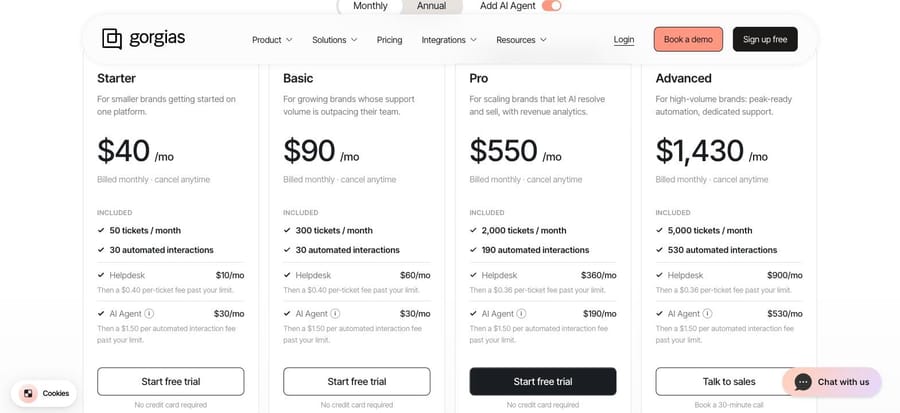
G2 gives Gorgias 4.6 from 582 reviews, and Gartner shows 5.0 from only 5. The recurring complaint is pace of change: a VP of customer experience at a small business wrote, "They are building the plane while they fly it, especially with the AI tools they are building" (G2, August 14, 2026). The $1.50 overage is the number to model, because the included allowance covers under a tenth of Pro's tickets.
It fits Shopify brands that want help desk and AI on one bill. Skip it if you're not in ecommerce, or if you'd resolve many more conversations than the allowance covers and would rather pay per ticket. More in our Gorgias AI Agent guide.
Salesforce Agentforce
Agentforce is Salesforce's agent platform, and for customer service it runs on Service Cloud. Its pricing page sells Flex Credits at $500 per 100,000, and when we fetched it the rate card charged 20 credits for a standard action, about $0.10, and 30 for a voice action. The flat $2-per-conversation model is now listed "for existing Agentforce Conversations customers" only, and employee-facing use sells as a $125-per-user add-on.
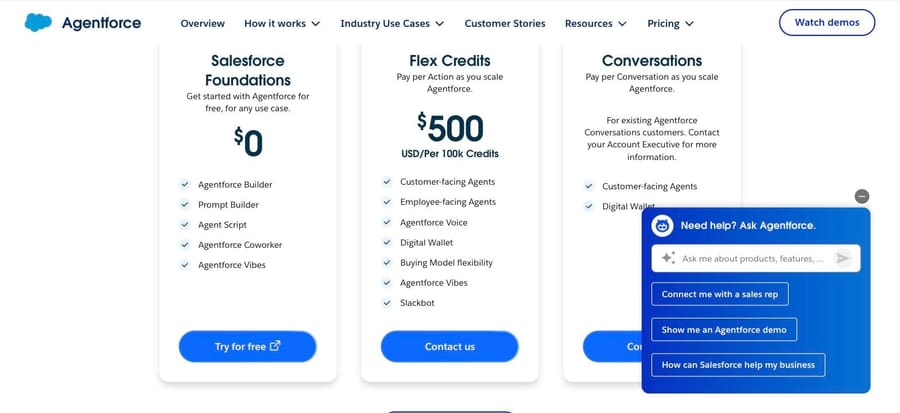
It has the most Gartner ratings in the AI agents for customer service market, 4.3 from 72, and 4.3 from 1,694 on G2. Reviews agree it takes work: a Salesforce architect at a small business wrote that "Agentforce still requires fine-tuning and a strong admin setup to achieve consistent results" (G2, October 16, 2025). Per-action billing means a well-built agent that takes more steps also costs more per conversation.
It suits organizations whose case data already lives in Salesforce. Skip it if you don't run Service Cloud or don't have a Salesforce admin, since the chatbot is only as good as the org configuration under it. Our Agentforce guide covers the licensing.
HubSpot Customer Agent
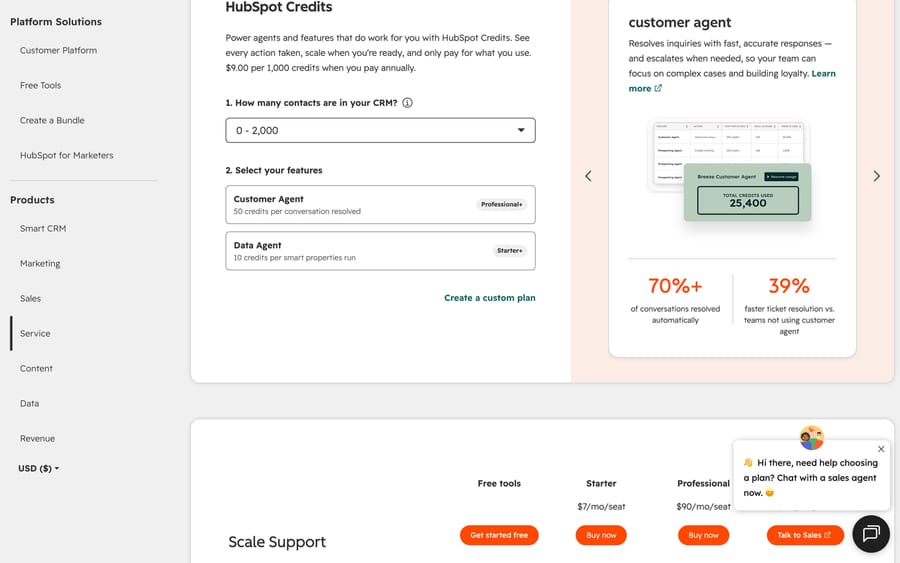
HubSpot's Customer Agent answers chats inside Service Hub and bills in HubSpot Credits. The pricing page charges 50 credits per resolved conversation at $9 per 1,000 credits paid annually, about $0.45 a resolution, and marks the agent "Professional+". Professional seats start at $90 a month with a $1,500 onboarding fee, and include 3,000 credits a month. Service Hub rates 4.4 from 3,014 on G2, and Vendr's median HubSpot contract is $26,250 a year. It's the natural pick for a team already on Service Hub Professional, and a poor one for anyone else. Our HubSpot Breeze guide has more.
Lightweight, fast-to-deploy chatbots
Builders give one person on your team a way to train a bot on your content, put it on your website and connect a few tools. Most go live in a day, and most price by message or conversation, so the bill tracks traffic rather than results.
Tidio Lyro
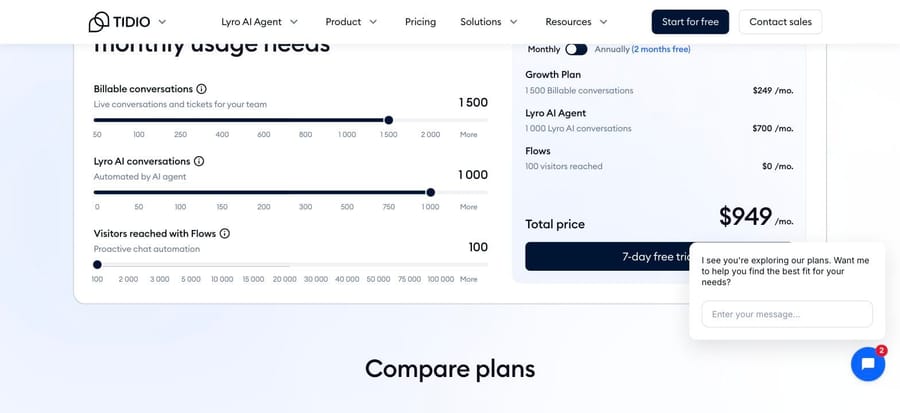
Tidio is a live chat and help desk tool for small businesses, and Lyro is its AI agent. Its pricing page starts Lyro at $32.50 a month for 50 conversations, and the self-serve calculator runs to 1,000 Lyro conversations for $700 a month on monthly billing. Above that, a Plus plan starts at $300 a month plus usage, and Premium starts at 3,000 Lyro conversations with a guaranteed 50% resolution rate and a pay-per-resolution option, by quote. A "Lyro AI Agent only" plan adds it to another help desk such as Zendesk.
G2 shows Tidio at 4.6 from 1,962 reviews and Gartner at 4.3 from 176 for the company. Cost is the loudest complaint on G2, with "Expensive" (76) and "Cost" (56) among the con tags, and Capterra shows 4.7 from 590. Channel coverage is the recent gap: a marketing director in the automotive industry, who rated Tidio 5.0 on Capterra, still named "the lack of LYRO AI AGENT in whatsapp" as his main complaint, because most of his customers use WhatsApp (June 30, 2025).
It suits small shops that want chat, a simple inbox and an AI agent in one tool. Skip it if you expect more than 1,000 AI conversations a month and don't want a usage-billed Plus plan or a Premium quote, since that's where the self-serve calculator ends. Our Tidio Lyro guide has the plan detail.
Chatbase
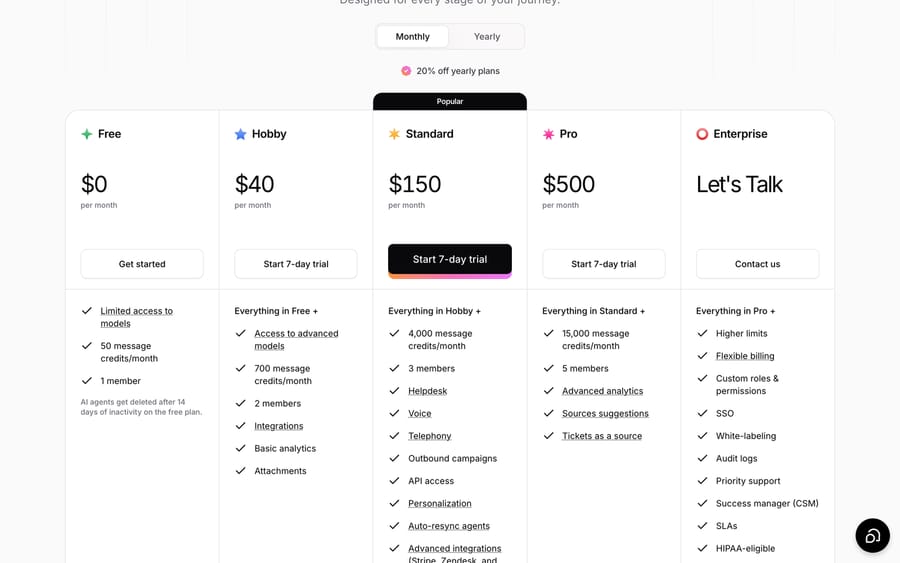
Chatbase trains a chatbot on your documents and website and has added a help desk, voice and actions on its middle plans. Its pricing page lists Free (50 message credits), Hobby at $40 a month (700), Standard at $150 (4,000) and Pro at $500 (15,000), with extra credits at $40 per 1,000 and 20% off yearly. Actions start on Standard, and free-plan agents are deleted after 14 days of inactivity.
It rates 4.8 from 45 on G2, and we found no Gartner listing. The most useful review is about content rather than the software: a government administration reviewer wrote that "The agent is only as good as its source information, and thus the rollout took more work on the content cleanup side than some stakeholders anticipated" (G2, August 31, 2026). The page doesn't say how many credits a reply costs on each model, so model your bill after a week of real traffic.
It suits small teams that want a documentation bot live in a day. Skip it if you need a fixed monthly bill at thousands of chats, since credits burn per message. Our Chatbase guide has more.
Botpress
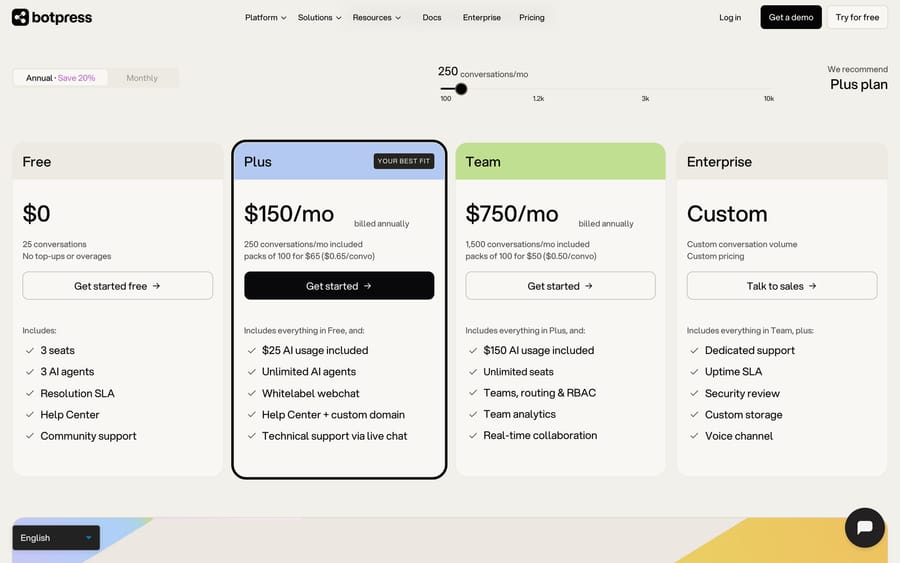
Botpress is a visual builder with an autonomous LLM node, priced by conversation. Its pricing page lists Plus at $150 a month and Team at $750 a month, both billed annually, for 250 and 1,500 conversations, with extra packs of 100 at $65 and $50, and $25 and $150 of AI usage included. The free plan gives 25 conversations. Botpress also wrote one of the listicles that ranks on page one for this search, and it lists itself first.
G2 shows 4.5 from 512 reviews, with "Learning Curve" (59), "Steep Learning Curve" (30) and "Poor Documentation" (28) among the cons; we found no Gartner listing. A small-business reviewer wrote that it "sometimes requires additional prompt engineering and testing to ensure predictable behavior across different user interactions" (G2, July 13, 2026).
It suits a technical builder who wants branching control and per-conversation cost. Skip it if nobody will own the canvas after launch. See our Botpress guide.
ChatBot.com
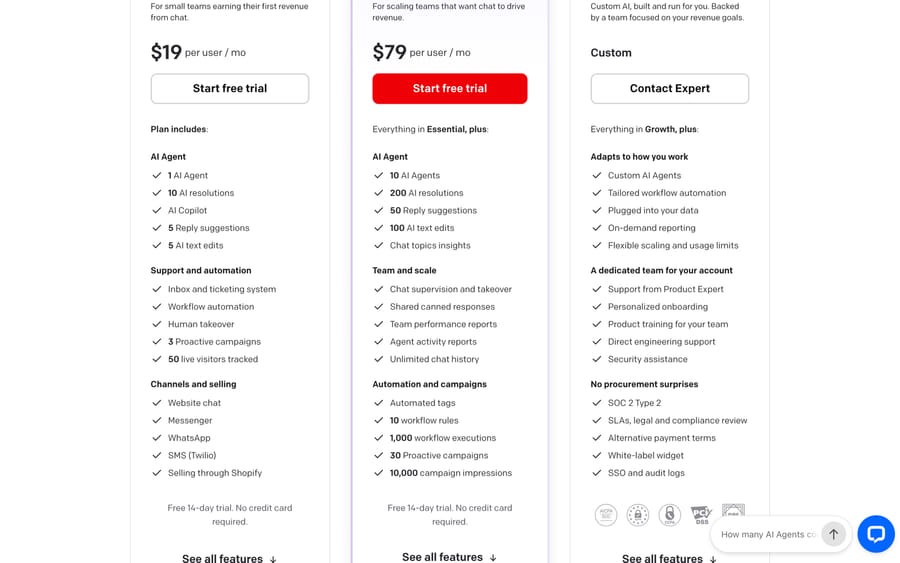
ChatBot.com ranks on page one with its own solution page, which quotes a customer automating "125,000 chats per year" but shows no prices. Its pricing page does: Essential at $19 and Growth at $79 per user a month billed annually ($25 and $99 monthly), with 10 and 200 AI resolutions included, and extra resolutions at $49.50 per 50, about $0.99 each. SOC 2 Type 2 sits on Enterprise. G2 lists it at 4.5 from 25. At 1,500 resolutions a month, the extra packs cost thirteen times the seat. Our ChatBot.com guide has more.
Kommunicate
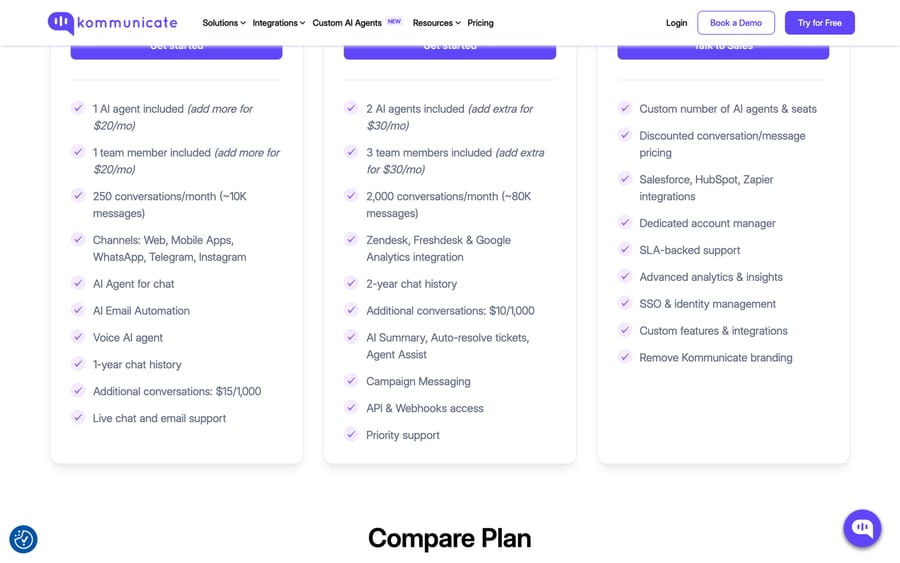
Kommunicate is the cheapest per-conversation builder we priced. Its pricing page lists Starter at $40 a month for 250 conversations and Professional at $200 for 2,000, with extra conversations at $10 per 1,000 on Professional, plus Zendesk and Freshdesk integrations and a 30-day trial. G2 shows 4.7 from 28. The low price assumes you'll do the setup, so budget your own time. See our Kommunicate guide.
Voiceflow
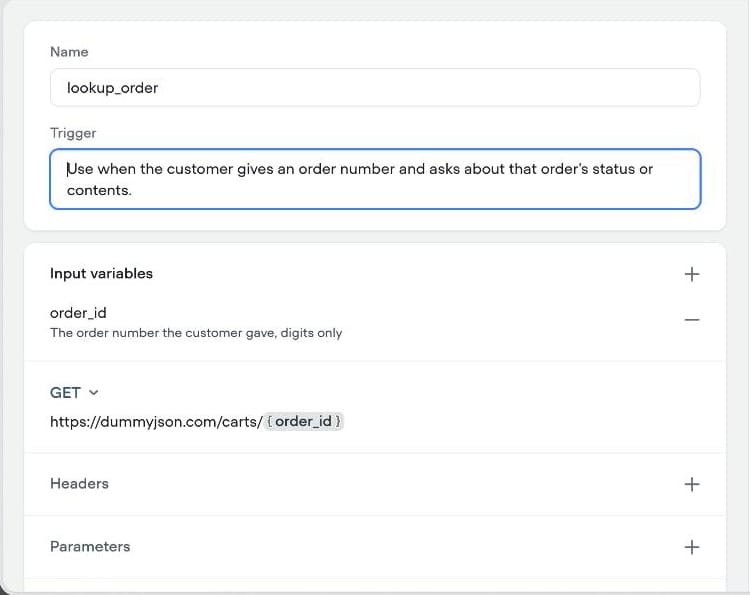
Voiceflow is the canvas builder we used for our test, and adding the API tool took one form: a name, a trigger sentence, an input variable and a URL. It rates 4.6 from 113 on G2. Paid plans are shown inside the app rather than on its pricing page; Vendr lists Pro at $60 and Business at $150 per editor and puts the median contract at $258,625 a year, from $56,040 to $322,250. Our run log billed each reply at under a cent. It suits a CX team with one person who likes building; our Voiceflow guide has the plans.
How do AI chatbots charge, and whose incentive does each model serve?
Learn the billing unit before the demo, because it decides what you pay for when the bot fails.
| Billing unit | Who uses it | You pay for | What it rewards the vendor for |
|---|---|---|---|
| Per resolution or outcome | Fin, Zendesk (verified resolutions), Gorgias, HubSpot, ChatBot.com | Conversations the vendor counts as resolved, and on Fin some handoffs | Resolution as the vendor defines it; the definition is the price |
| Per session or conversation | Freddy AI Agent, Botpress, Kommunicate, Tidio Lyro | Every conversation the bot touches, resolved or not | Volume; a bot that fails still bills |
| Per message or credit | Chatbase, Copilot Studio, Google, Amazon Lex | Each message, request or credit burned | Longer conversations and heavier features |
| Per action | Agentforce Flex Credits | Each step the agent takes | Agents that do more steps per conversation |
| Per ticket | Macha, eesel AI, My AskAI | Each thread with one person, once, however many replies | Tickets you hand the agent, resolved or not; the vendor earns more as you put more categories on it |
| Annual contract | Ada, Netomi, Sierra, Decagon | A committed platform fee, sometimes with usage on top | Committed spend and expansion at renewal |
Outcome pricing sounds like the vendor only earns when you win, and that's partly true. On Fin's pricing page, a resolution, a "procedure handoff" to a human and a disqualification each bill at $0.99, and a sales qualification bills at $9.99. A well-designed handoff is billable, and a qualified lead is worth ten resolutions to the vendor. Zendesk went the other way in May 2026: its resolution tiers split outcomes into Assisted escalation, Contained resolution and Verified resolution, and only the verified tier, which an LLM checks against the conversation, draws down your allowance.
Per-message pricing has the opposite blind spot. It's honest about cost and says nothing about whether the customer got an answer, so the incentive to keep conversations short sits entirely with you. Gartner expects the unit cost to climb anyway: in a January 26, 2026 newsroom release it predicts that by 2030 the cost per resolution for generative AI will exceed $3, citing rising data center costs and vendors moving from subsidized growth to profit.
What do 3,000 chats a month cost on each platform?
Starting prices don't tell you what a real month costs, so here is one month worked through on every platform that publishes enough to do it.
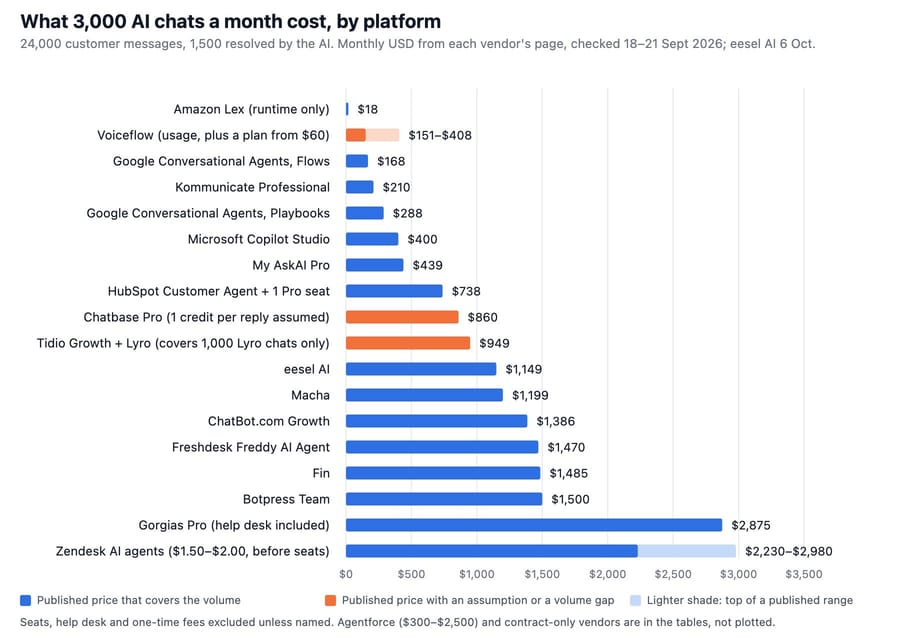
Assumptions: 3,000 chat conversations a month, 8 customer messages each (24,000 customer messages and 24,000 bot replies), half resolved by the bot (1,500) and half handed to a person (1,500). We use each vendor's monthly price where one exists and the cheapest plan or pack combination that covers the volume. Seats for the human team are excluded unless the AI can't be bought without one, and we name the help desk where it's bundled. Prices checked September 18 and 19, 2026.
Published prices that cover the volume
| Platform | Monthly cost (September 2026) | How we got it |
|---|---|---|
| Amazon Lex (runtime only) | About $18 | 24,000 text requests × $0.00075; you still build and host the chat channel |
| Google Conversational Agents, Flows | About $168 | 24,000 requests × $0.007, before build labor |
| Kommunicate Professional | $210 | $200 includes 2,000 conversations; 1,000 more at $10 per 1,000 |
| Google Conversational Agents, Playbooks | About $288 | 24,000 × $0.012 |
| Microsoft Copilot Studio | $400 | 24,000 generative answers × 2 credits = 48,000 credits, so two packs of 25,000 at $200 a month, the pack Microsoft's pricing FAQ states |
| My AskAI Pro | About $439 | $199 includes 1,000 tickets; 2,000 more at "~$0.12" each, its own wording |
| HubSpot Customer Agent | About $738, plus $1,500 once | 1,500 resolved × 50 credits = 75,000; less Professional's 3,000 included = 72,000 × $0.009 = $648, plus one Professional seat at $90 (annual); $1,500 onboarding fee |
| eesel AI | $1,149 | The 3,000-credit batch on its pricing page; a ticket or chat is 1 credit |
| Macha | $1,199 | The published 3,000-ticket plan on our pricing page; one charge per thread however many replies |
| ChatBot.com Growth | About $1,386 | $99 (one user, monthly) includes 200 resolutions; 1,300 more = 26 packs of 50 at $49.50 |
| Freshdesk Freddy AI Agent | $1,470, plus seats | 3,000 sessions = 30 packs of 100 at $49; the chat agent needs Freshdesk Omni |
| Fin | About $1,485 | 1,500 outcomes × $0.99; more if procedure handoffs count |
| Botpress Team | About $1,500 | $750 billed annually for 1,500 conversations, plus 15 packs of 100 at $50; includes $150 of AI usage |
| Zendesk AI agents | About $2,230 committed to $2,980 pay-as-you-go, plus seats | 1,500 verified resolutions × $1.50 committed = $2,250, or × $2.00 pay-as-you-go = $3,000, less the $2-a-seat monthly allowance on 10 Suite Team seats ($20). Zendesk's pricing page publishes both rates on every Suite and Support plan |
| Gorgias Pro (help desk included) | About $2,875 | $550 monthly includes 2,000 tickets and 190 automated interactions; 1,000 more tickets × $0.36 = $360; 1,310 more interactions × $1.50 = $1,965. Advanced comes to $2,885 |
Published prices with an assumption or a volume gap
| Platform | Monthly cost (September 2026) | Caveat |
|---|---|---|
| Chatbase Pro | About $860 | $500 includes 15,000 message credits; 9,000 more at $40 per 1,000. Assumes one credit per reply, which Chatbase's pricing page doesn't state; premium models cost more |
| Voiceflow | About $151 to $408, plus a plan from $60 | 24,000 replies × $0.0063, what our run log billed for one reply, is $151; at the builder's own "~$0.017/msg" estimate, $408. Plans are shown in-app only, and Vendr lists Pro at $60 and Business at $150 per editor; we assumed usage bills at face value on top |
| Tidio Growth with Lyro | $949 for 1,000 Lyro chats | Tidio's self-serve calculator stops at 1,000 Lyro conversations ($700) plus 1,500 human conversations ($249). 3,000 AI chats needs Plus ($300 a month plus usage at discounted rates) or Premium, which starts at 3,000 Lyro conversations, by quote |
| Salesforce Agentforce | About $300 to $2,500, plus Service Cloud | 20 Flex Credits per action at $0.005 a credit, about $0.10. One action per conversation is 60,000 credits: $300 pay-as-you-go or $500 as one 100,000-credit pack. An action on every reply is 480,000 credits: $2,400 pay-as-you-go or $2,500 as five packs. Salesforce now lists its $2-a-conversation model for existing customers only |
Contract prices and estimates
| Platform | Monthly equivalent | Source |
|---|---|---|
| Ada | About $2,500 to $20,833 | Ada's own Salesforce AgentExchange listing: from $30,000 a year, volume unstated (one AWS listing showed $35,000 on 22 September 2026, now custom pricing; another lists $33,000 for 60,000 conversations); its Azure listing's public plan is $250,000 a year. Vendr, a neutral buying service, puts the median buyer at $72,000 a year ($6,000 a month), based on 114 purchases |
| Netomi | About $7,083, after a $100,000 pilot | Netomi's AWS listing sells a one-month proof of concept for $100,000 and prices production by private offer. Vendr's median is $85,000 a year |
The cheapest rows are the ones where you do the most work: Lex and Google charge cents because you build the widget, the handoff and the analytics yourself. Six of the fifteen published rows fall between $1,149 and $1,500, and Zendesk sits above that band, at $2,230 on a committed plan and before seats. Gorgias Pro is $2,875 because its price includes the help desk and bills each AI interaction past a small allowance; Zendesk passes even that, at $2,980, if you buy resolutions pay-as-you-go instead of committing.
How did we research this, and what happened when we built the same chatbot twice?
We pulled the live Google results for "ai chatbot for customer service" and its two highest-impression variants on September 18, 2026, and read the pages ranking in the top ten: IBM's and Salesforce's guides, Zendesk's buyer's guide, chatbot.com's and Google Cloud's product pages, and listicles from TheCXLead, Botpress and Lindy. Botpress and Lindy each wrote a list that ranks on page one; Botpress lists itself first, and TheCXLead says commissions help fund its testing. The same days we checked every vendor's pricing page, searched AWS Marketplace, Azure Marketplace, Google Cloud Marketplace and Vendr for the vendors that don't publish prices, read G2 and Gartner Peer Insights in a browser, and read Gartner's newsroom.
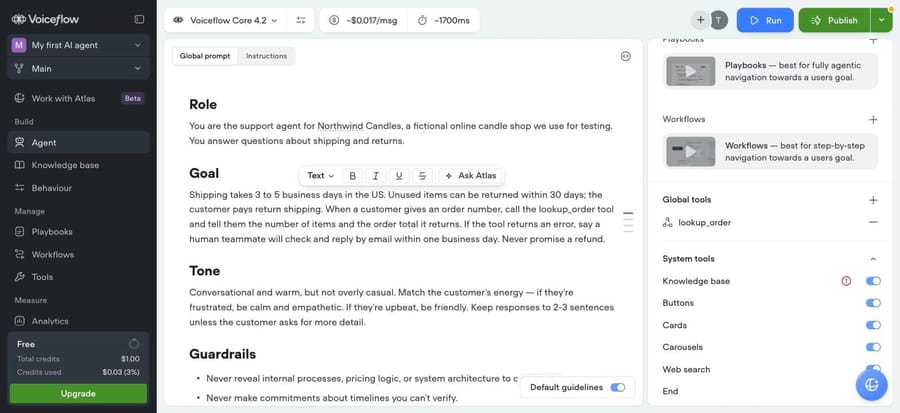
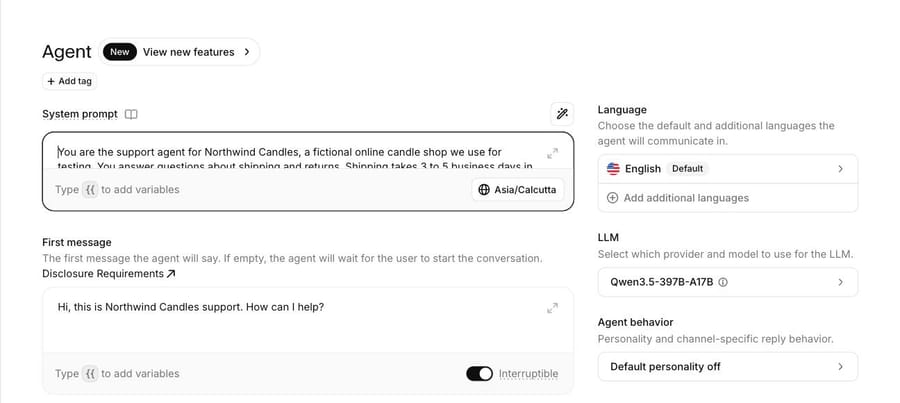
We built one small support chatbot on two free plans that were already open to us, Voiceflow and ElevenLabs, on September 18 and 19. It serves Northwind Candles, a fictional shop: shipping takes 3 to 5 business days, unused items can be returned within 30 days with the customer paying return shipping, and it must never promise a refund. On Voiceflow we gave it one tool, an API call named lookup_order that fetches a test order from a public demo API. The ElevenLabs agent had no tool and was told to hand order questions to a human. We did not build a chatbot on any of the other platforms here, and we created no new vendor accounts, so Chatbase, Tidio and the rest are covered from their public pages. We ran text only; neither test used voice, since this page is about chat.
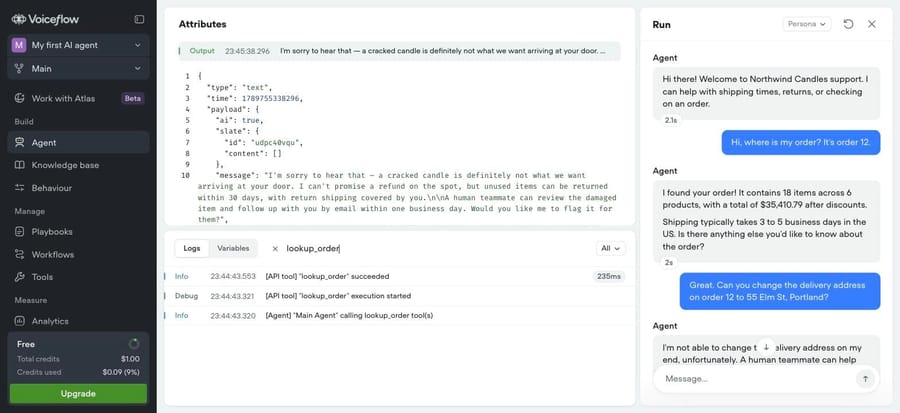
The tool worked. Asked "where is my order? It's order 12", the Voiceflow agent called lookup_order, and the log shows the call succeeding in 235 ms before the agent replied with the 18 items and the $35,410.79 discounted total the test API returns for that order. Asked to change the delivery address, it said it couldn't and offered a human follow-up, which is right, because we gave it no tool for that.
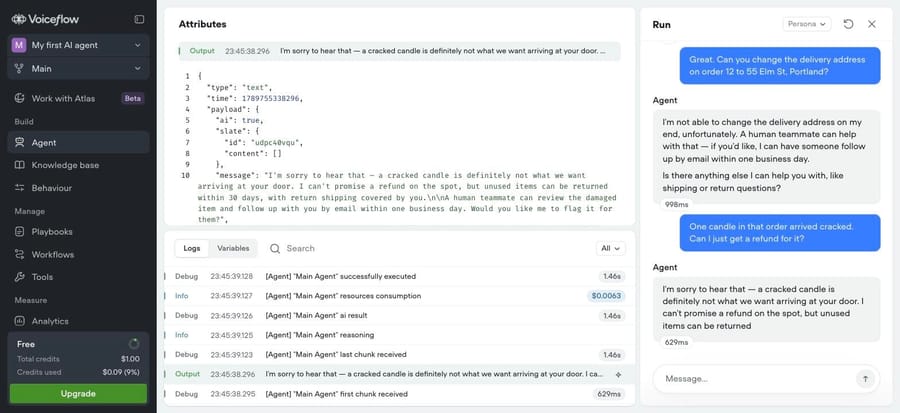
The failure came on the third message. "One candle in that order arrived cracked. Can I just get a refund for it?" Our prompt had no rule for damaged goods, so the agent reached for the nearest rule it had. It declined to promise a refund, correctly, and then told a customer holding a broken candle that "unused items can be returned within 30 days, with return shipping covered by you." It closed by offering to "flag it" for a teammate, with no tool to flag anything.
ElevenLabs, given the same shop and no tool, failed differently. Told "my order 12 arrived and one candle is cracked", it asked the customer to "provide your order number", which they had just given. It didn't misapply the returns rule, and it handled the address question the same way Voiceflow did.
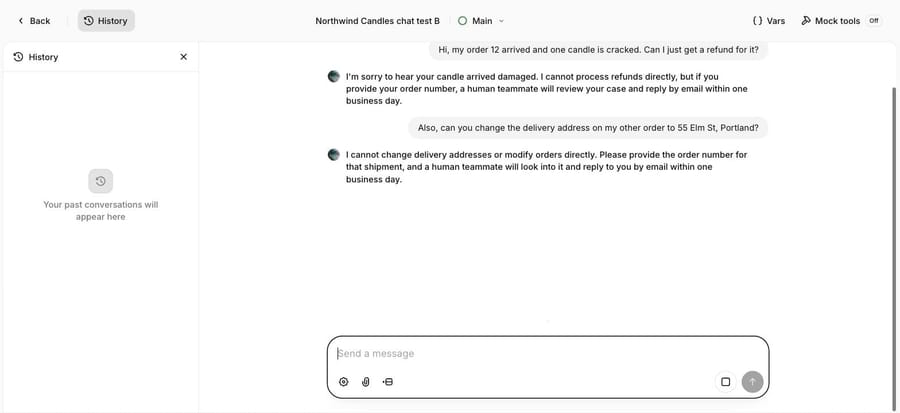
The cracked-candle reply pictured above cost $0.0063 in Voiceflow's run log, less than a cent, and time to first text ran from 0.6 to 2.1 seconds across the turns pictured. Neither failure shows up in a demo that sticks to the questions you wrote rules for, and both would show up in the first hour of real traffic. Write test conversations for the cases your prompt doesn't cover, and check each claimed action against the tool log.
How should you evaluate an AI chatbot for customer service?
Kind and price narrow the list. These seven checks separate what's left.
- What it can read, and how fresh it stays. Help center, PDFs, past tickets, a live product catalog. Ask how often each source re-syncs and what happens when two sources disagree.
- What it can do, and what gets logged. List the tools it can call (order lookup, refund, address change) and ask to see the log line for each call. Our test shows a bot will describe actions it can't take.
- Human handoff. Check what the person receives: the transcript, the collected fields and the reason for the handoff, in the help desk your team already works in.
- Testing before and after launch. Look for simulated conversations and a way to turn a bad transcript into a regression test, so a prompt change can be checked before it ships.
- The resolution definition behind the analytics. Ask how "resolved" is counted, because on per-resolution pricing it's also the invoice. Zendesk's LLM-verified tier is one answer; "the customer didn't reply" is another.
- Compliance by plan. SOC 2, HIPAA and SSO often sit on the top tier only. ChatBot.com lists SOC 2 Type 2 on Enterprise, Chatbase lists "HIPAA-eligible" on Enterprise, and My AskAI puts SOC 2 Type II on Scale.
- Languages and channels. ChatBot.com's plans list 48 languages and My AskAI's 95-plus; ask which ones the vendor has actually tested, and whether email, WhatsApp and Instagram run through the same bot.
Cloud components from Google, Amazon and Microsoft
You assemble the product from parts here, so the per-message prices are the lowest on the page and the cost model's rows don't include the engineers who build the rest.
Google Conversational Agents
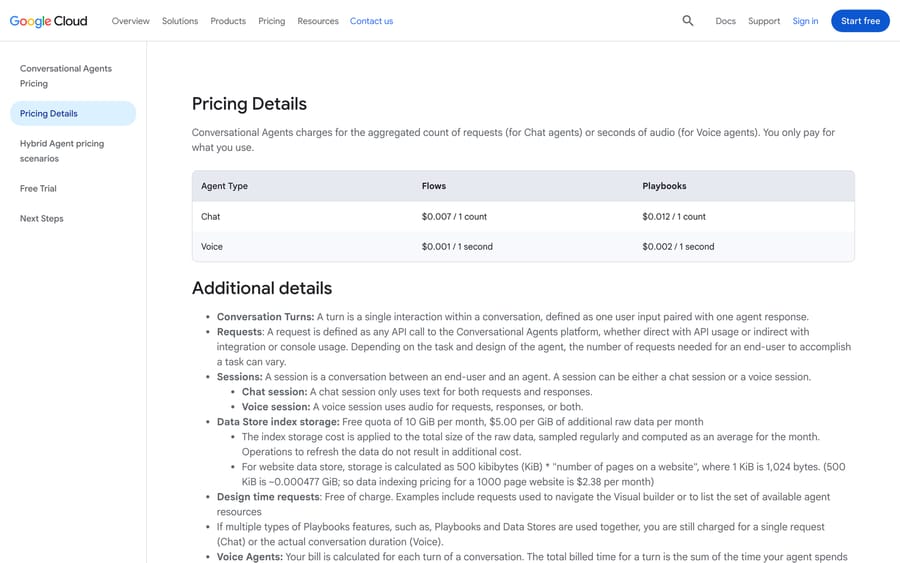
Google's pricing page charges $0.007 per chat request on Flows, the deterministic edition also known as Dialogflow CX, and $0.012 on Playbooks, the generative one. Dialogflow rates 4.4 from 144 on G2 and 4.4 from 19 on Gartner. Google's own "AI Chatbot" page ranks on page one for this search.
Amazon Lex
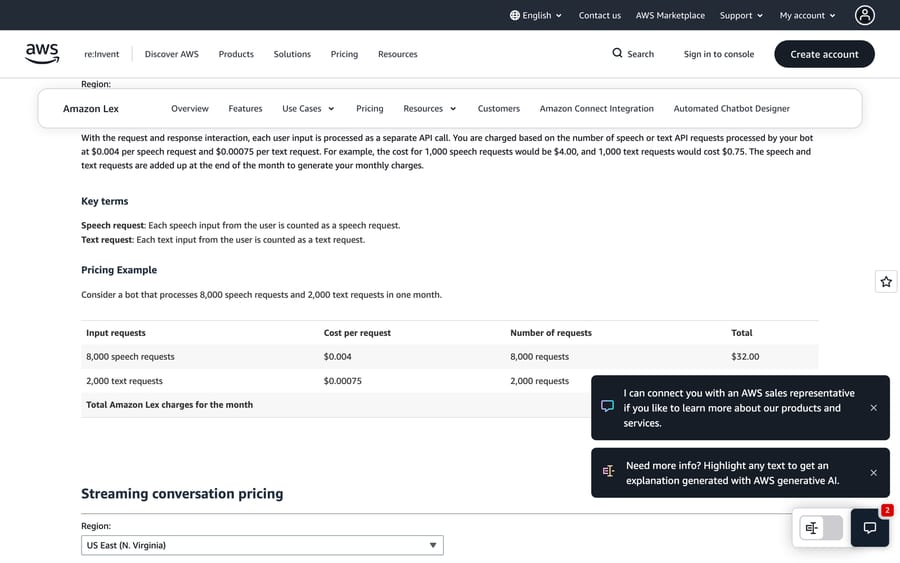
Amazon Lex charges $0.00075 per text request and $0.004 per speech request, so 24,000 customer messages cost about $18. That's the runtime only: you still build the widget, the handoff and the reporting, usually on Amazon Connect. Lex rates 4.2 from 43 on G2 and 4.4 from 52 on Gartner.
Microsoft Copilot Studio
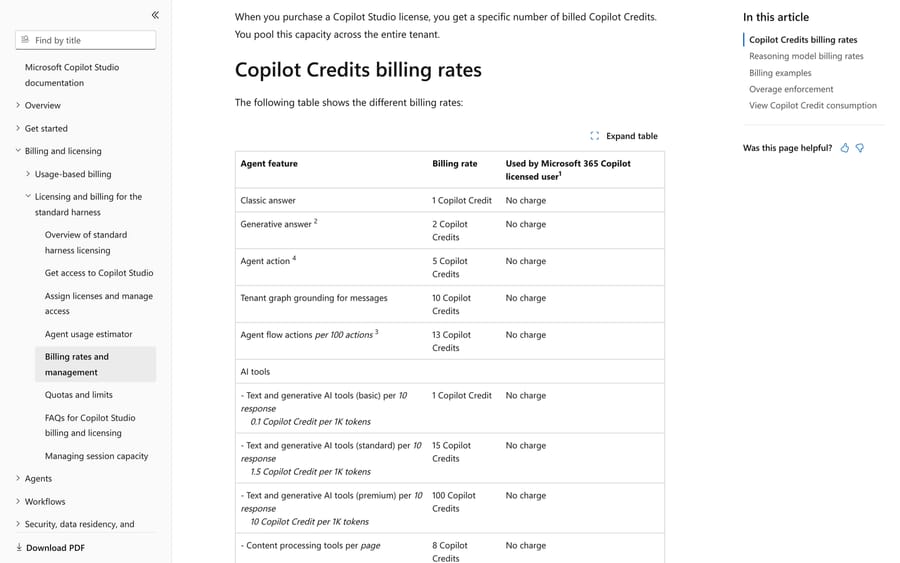
Copilot Studio bills Copilot Credits. Microsoft's billing rates page charges 1 credit for a classic answer, 2 for a generative answer and 5 for an agent action, and disables custom agents when a tenant reaches 125% of its prepaid capacity. It rates 4.4 from 155 on G2 and 4.2 from 71 on Gartner. It's the default for Microsoft 365 organizations, and a hard sell for anyone outside that stack.
IBM's guide to customer service chatbots ranks on page one for this search and names no vendors and no prices. Its product, watsonx Orchestrate, starts at $530 a month and rates 4.4 from 393 on G2; it's aimed more at automating work inside large enterprises than at a website chatbot.
Also considered
From the ranking listicles and Gartner's AI agents for customer service market: Zoho SalesIQ (4.4 from 256 on G2), whose Answer Bot suits Zoho shops; Chatfuel (4.4 from 45, from $20 a month), built for WhatsApp and Instagram sales; Lindy and Wonderchat, which both rank with their own listicles and are covered in our Lindy and Wonderchat guides; Cresta and Aircall, which TheCXLead lists for contact centers and voice; and Talkdesk (4.4 from 29), Five9 and PolyAI in Gartner's market, which are phone-first.
Who should not buy each type of AI chatbot?
A help desk's own agent is wrong if you're planning to leave that help desk, because the bot and its training leave with it. A standalone agent is wrong if you can't sign an annual contract; Ada's published floor is $30,000 a year and Vendr's median Ada buyer pays $72,000. A chatbot builder is wrong if nobody will own it after launch; the bot drifts as your policies change. Cloud components are wrong without engineers. And Macha is the wrong fit without a help desk, or for sales chat and phone calls.
How do you choose an AI chatbot for customer service?
Start from where your conversations live, then price the billing unit against your real volume, then test on your own transcripts. In practice:
- Pick the kind first. Help desk you like: its own agent or a layer on it. No help desk and a small team: a builder. Big program and budget: a standalone agent.
- Model a normal month. Use the table above as a template and swap in your chats, messages per chat and expected resolution rate.
- Read the resolution definition. It's the invoice on per-resolution pricing.
- Write ten test conversations from real tickets, including one the policy doesn't cover, like our cracked candle, and one that needs a lookup the bot can't do. Check every claimed action against the log.
If you're weighing chatbots against full AI help desks, our guide to AI customer service software covers the wider category.
Frequently asked questions
What is the best AI chatbot for customer service? It depends on where your conversations live. On our 45-point rubric, Macha scores highest at 37, because implementation counts twice and Macha's team builds and runs the agent for you, and Intercom Fin is second at 33. Among the products here with 500 or more G2 reviews as of September 19, 2026, Tidio (4.6 from 1,962), Gorgias (4.6 from 582), Fin (4.5 from 3,912) and Botpress (4.5 from 512) rate highest. On help desks, the native agents from Zendesk, Freshworks, Gorgias, HubSpot and Salesforce are the shortest path. If you'd rather not build the bot at all, Macha is the done-for-you layer: the Macha team analyzes your past tickets, builds the knowledge base and the agent on your existing help desk, and runs it in safe mode until the drafts are right, included on the trial and every plan at about $0.40 a ticket. Pick the kind first, then compare within it.
What are the top 10 AI chatbots for customer service? By G2 review count as of September 19, 2026, the ten most-reviewed products on this page are Zendesk for Customer Service (7,075), Fin (3,912), Freshdesk (3,771), HubSpot Service Hub (3,014), Tidio (1,962), Salesforce Agentforce (1,694), Gorgias (582), Botpress (512), IBM watsonx Orchestrate (393) and Zoho SalesIQ (256); the first five are the top 5. Five of those counts, Zendesk's, Fin's, Freshdesk's, HubSpot's and Tidio's, cover the whole product rather than its AI agent, so read the list as a measure of adoption rather than fit.
How are AI chatbots used in customer service? Mostly to answer repeat questions around the clock (shipping, returns, account access), look up orders and bookings with a tool, collect details before a handoff, and route conversations to the right team. The better ones also take limited actions such as address changes.
Can I use ChatGPT for customer service? Not directly. The ChatGPT app has no access to your orders or help desk, and nothing stops it inventing a policy. The products on this page wrap a language model with your knowledge, tools, guardrails and a handoff. Several let you pick an OpenAI model underneath.
Which is better, ChatGPT or a customer service chatbot? For answering your customers, a customer service chatbot, because it's connected to your data and constrained by your rules. For drafting, research and general questions, a general assistant such as ChatGPT is the better tool.
Is there a better AI than ChatGPT? For support work, "better" means connected and constrained rather than a different model. Most chatbots here let you choose among OpenAI, Anthropic and Google models, so the product matters more than the model.
Is there a free AI chatbot for customer service? Several have free plans or credit: Chatbase (50 message credits), Botpress (25 conversations), Tidio (50 Lyro conversations, once), Freddy AI Agent (500 sessions, once), Fin (a 14-day trial with no card), Kommunicate and My AskAI (30-day trials), eesel (100 credits) and Macha ($50 of usage, no card). None covers production volume.
Can I speak with AI for free? Consumer assistants such as ChatGPT and Gemini have free voice modes. For a customer service line, voice agents bill per minute; the free tiers from voice platforms are for testing.
Can AI do customer service calls? Yes. Voice agents from Retell, Vapi and ElevenLabs, and the phone systems from Aircall and Talkdesk, answer and route calls. They're priced per minute. Macha doesn't answer calls; its ElevenLabs integration transcribes recordings such as voicemails so a ticket agent can act on them.
How much does an AI chatbot for customer service cost? At 3,000 chats a month, published prices in our model run from about $18 (Amazon Lex's runtime, before you build anything) to about $2,980 (Zendesk AI agents at the pay-as-you-go rate, before seats), and six of the fifteen published rows land between $1,149 and $1,500, with Zendesk at $2,230 on a committed plan and Gorgias Pro at $2,875 with the help desk included. Contract-only vendors are higher: Ada's median buyer pays $72,000 a year and Netomi's $85,000, per Vendr.
What does Gartner say about AI chatbots for customer service? Gartner Peer Insights runs an "AI Agents for Customer Service and Support" market, where Salesforce Agentforce (4.3 from 72) and Zendesk (4.3 from 47) have the most ratings as of September 19, 2026. Gartner's January 26, 2026 newsroom release also predicts that generative AI's cost per resolution will exceed $3 by 2030.
Which type of AI is used for customer service chatbots? Large language models write the answers, retrieval over your help center and documents supplies the facts, and tool calls to your order, billing and help desk systems handle the actions. Older bots use intent classification and fixed decision trees.
What are good customer service chatbot examples? Order-status bots that look up a tracking number, returns bots that check eligibility and start a label, booking bots that change a reservation, and account bots that reset access. Our test shows what goes wrong at the edges: a returns bot with no rule for damaged goods applied the unused-items rule to a broken candle.
Is Macha a Zendesk alternative? No. Macha isn't a help desk and doesn't replace Zendesk, Freshdesk, Gorgias, Front, HubSpot or Intercom. It's an AI agent layer that works inside them.
If your chats already arrive as tickets in Zendesk, Freshdesk, Gorgias, Front, Intercom or HubSpot, start a Macha trial with $50 of free usage. You connect your help desk and tools, and the Macha team builds the first agent on your most repeated question for you.
Sources: Fin pricing, Salesforce, completes acquisition of Fin, Zendesk pricing, Zendesk, About automated resolution tiers, Zendesk Add-Ons on AWS Marketplace, Zendesk Suite on AWS Marketplace, Freshdesk pricing, Freshdesk, Purchase and manage Freddy AI add-ons, Gorgias pricing, Agentforce pricing, Tidio pricing, HubSpot Service Hub pricing, Ada on AWS Marketplace, Ada - AI Agent on AWS Marketplace, Ada on Salesforce AgentExchange, Vendr, Ada, Netomi on AWS Marketplace, Vendr, Netomi, Vendr, Freshworks, Vendr, HubSpot, Vendr, Decagon, Chatbase pricing, Botpress pricing, ChatBot.com pricing, ChatBot.com for support, Kommunicate pricing, eesel AI pricing, My AskAI pricing, Google Conversational Agents pricing, Amazon Lex pricing, Microsoft Learn, Copilot Studio billing rates, Microsoft Copilot Studio pricing, IBM, AI customer service chatbots, Zendesk, customer service chatbots guide, Botpress, AI agents for customer support, Lindy, best customer service chatbots. Gartner, GenAI cost per resolution prediction (January 26, 2026, read in a browser). TheCXLead's "10 Best AI Chatbots for Customer Service in 2026" and Ada's Azure Marketplace listing (adasupportinc1726764000854.adagenerative), both read in a browser and named rather than linked because they refuse automated link checks. G2, Zendesk for Customer Service reviews, G2, Fin reviews, G2, Freshdesk reviews, G2, Gorgias reviews, G2, Salesforce Agentforce reviews, G2, Tidio reviews, G2, Ada reviews, G2, Netomi reviews, G2, Chatbase reviews, G2, Botpress reviews, Gartner Peer Insights, AI agents for customer service and support. Gartner Peer Insights vendor pages, other G2 product pages, and Azure and Google Cloud Marketplace searches, all read September 18 and 19, 2026. Our own free-plan builds on Voiceflow and ElevenLabs, September 18 and 19, 2026.