







 Shopify
 Stripe
 Slack
 Notion
 Google Workspace
 Confluence


HubSpot vs Freshdesk (2026): Seat Prices, AI Costs and Which Help Desk Fits


HubSpot Service Hub is a help desk built on top of a CRM, so every ticket sits on the same contact record as the deals, emails and renewal dates; Freshdesk is a standalone ticketing tool that's cheaper per seat and deeper on SLA and routing rules at the middle tier. On list prices, Service Hub Professional costs $90 a seat a month on annual billing plus a one-time $1,500 onboarding fee, against $55 for Freshdesk Pro. The AI meters work differently too: HubSpot's Customer Agent charges 50 credits (about $0.50) per resolved conversation, while Freddy AI Agent charges $49 per 100 sessions whether the conversation gets resolved or not. Below are both price lists as checked on November 21, 2026, a 10-agent cost model, and a plain answer on who should pick which.
Key takeaways
- HubSpot Service Hub Professional costs $90 a seat a month billed annually, plus a required $1,500 onboarding fee, while Freshdesk Pro costs $55 an agent a month billed annually with no onboarding fee.
- HubSpot's Customer Agent bills 50 HubSpot Credits per resolved conversation, which HubSpot prices at $0.50, and Service Hub Professional includes 3,000 credits a month that don't roll over.
- Freddy AI Agent bills $49 per 100 sessions after a one-time 500 free sessions, and an email session is a 72-hour window charged whether or not the AI resolves it.
- At 10 agents and 1,500 AI-handled email conversations a month, our model puts HubSpot Professional at $1,320 and Freshdesk Pro at $1,285 a month, assuming HubSpot's agent resolves 900 of them.
- Macha runs AI agents inside either help desk at about $0.40 per ticket, with setup and a dedicated success manager from the Macha team included on the trial and every plan.
| HubSpot Service Hub | Freshdesk | |
|---|---|---|
| What it is | Help desk on HubSpot's CRM | Standalone ticketing help desk |
| Free plan | Yes, up to 2 users | No, 14-day trial of Enterprise |
| Entry paid tier (annual) | Starter $7/seat (new-customer price; $20 list) | Growth $19/agent |
| Mid tier (annual / monthly) | Professional $90 / $100 per seat | Pro $55 / $66 per agent |
| Top tier (annual) | Enterprise $150/seat | Enterprise $89/agent |
| Onboarding fee | $1,500 (Pro), $3,500 (Enterprise) | None listed |
| Customer-facing AI | Customer Agent, 50 credits per resolution | Freddy AI Agent, $49 per 100 sessions |
| Agent-side AI | Customer Agent reply recommendations, no credits used | Freddy AI Copilot, $29/agent on Pro and Enterprise |
| Best for | Teams whose support is tied to sales and renewals | Support teams that want ticketing depth per dollar |
Which should you pick: HubSpot or Freshdesk?
Pick by where your customer data already lives, then check the price.
| If you are... | Pick | Why |
|---|---|---|
| Already on HubSpot Sales or Marketing Hub | HubSpot | Tickets land on the contact and deal your reps already use |
| A B2B SaaS team where support affects renewals | HubSpot | Renewal date, deal stage and owner sit next to the ticket |
| A support team of 10+ agents with no CRM preference | Freshdesk | $35 a seat less at the mid tier, and SLA policies on Pro |
| A team of two that wants free | HubSpot | Service Hub Free covers 2 users; Freshdesk has no free plan |
| Running high AI volume with a low resolution rate | HubSpot | You pay per resolution, not per conversation touched |
| Running high AI volume with a high resolution rate | Close call | Freshdesk sessions get cheaper per resolution as your rate climbs |
In short, HubSpot is a CRM decision that comes with a help desk, and Freshdesk is a help desk decision. If you'd buy HubSpot anyway, Service Hub is the natural add. If you wouldn't, you're paying a CRM premium of about $35 a seat at the middle tier for a contact timeline you may not use.
Plenty of teams don't pick at all. They keep Freshdesk for tickets and HubSpot for the CRM and sync the two, which our HubSpot and Freshdesk integration guide covers.
How does HubSpot Service Hub pricing compare with Freshdesk pricing?
HubSpot charges per seat, and its pricing page shows two numbers per tier. We checked it in a US-locale browser on November 21, 2026 and flipped the billing toggle to be sure which is which: Pay Monthly turns Starter's $7 into $10 and Professional's $90 into $100.
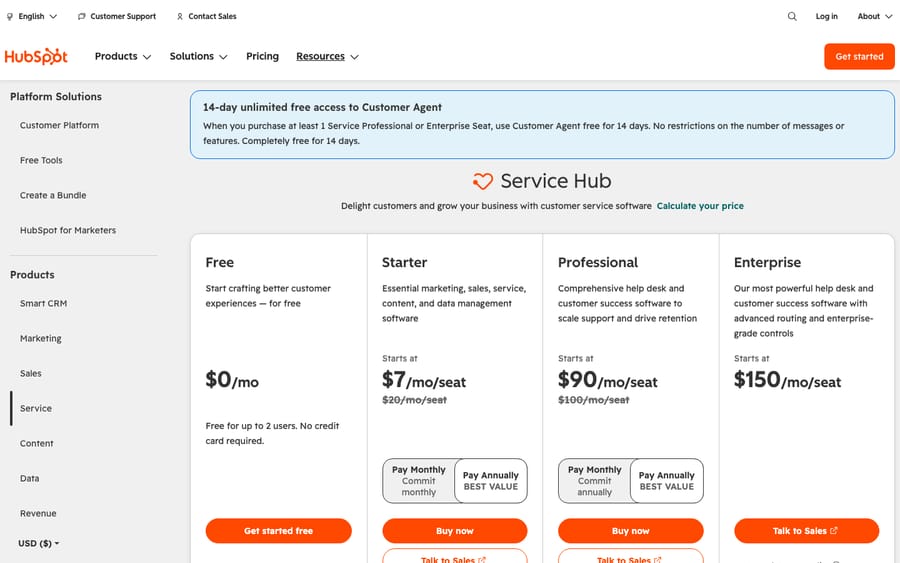
- Free: $0, up to 2 users.
- Starter: $7 a seat a month paid annually, or $10 paid monthly, both shown against a struck-through $20 list price, with the note "Discounts available for new customers only." It includes 500 HubSpot Credits, live chat and ticketing.
- Professional: $90 a seat a month paid annually, $100 paid monthly, plus a required one-time Professional Onboarding fee of $1,500. It adds Customer Agent, the Help Desk Workspace, a knowledge base, the customer portal and feedback surveys, with 3,000 HubSpot Credits.
- Enterprise: $150 a seat a month, a $3,500 onboarding fee, 5,000 credits, and adds conditional SLAs and skill-based routing.
The $7 Starter price is a landing offer. It's about a third of list, it applies to new customers, and the features most support teams end up wanting (the Help Desk Workspace, the AI agent, the knowledge base) start at Professional. HubSpot's incentive is plain: get the CRM in cheaply, then sell the $90 seat and the $1,500 onboarding once your process depends on it. Our HubSpot Service Hub pricing guide goes tier by tier.
Freshdesk's page serves rupees from our location, so we used the US copy that the Wayback Machine saved on November 21, 2026.
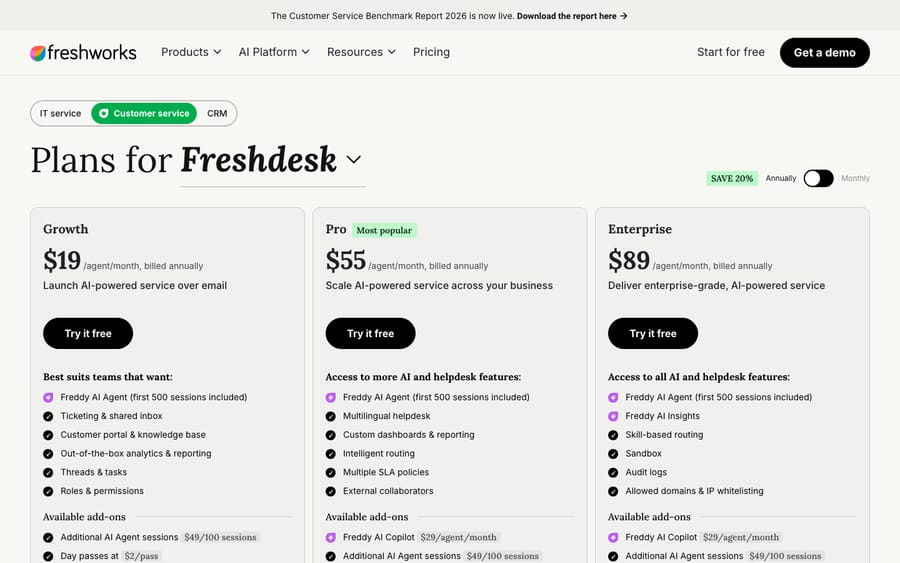
- Growth: $19 an agent a month annually, $23 monthly. Ticketing and shared inbox, customer portal and knowledge base, reporting, roles and permissions.
- Pro: $55 annually, $66 monthly. Adds a multilingual help desk, custom dashboards, intelligent routing, multiple SLA policies and external collaborators.
- Enterprise: $89 annually, $107 monthly. Adds Freddy AI Insights, skill-based routing and a sandbox.
- Trial: 14 days on the Enterprise plan. The page lists no free plan.
Freshdesk's free tier used to be the reason small teams started there. Admins on r/sysadmin discussed its free ticketing ending and went looking for replacements, and an r/msp thread complained about a steep renewal increase. Today HubSpot is the one of the two with a free plan. Our Freshdesk pricing guide has the add-ons, including day passes.
How do Breeze Customer Agent credits compare with Freddy AI sessions?
The two vendors differ most on what triggers an AI charge.
HubSpot's Customer Agent charges on resolution. HubSpot's announcement (updated April 13, 2026) moved it to "50 credits per resolution," priced at $0.50 per resolved conversation from April 14, down from $1.00 per conversation. HubSpot's credits article (updated November 12, 2026) says credits reset monthly and don't roll over. When they run out, one of three things happens depending on your setting: usage-based features pause until the reset, the account auto-upgrades to a larger capacity pack for the rest of the term, or you pay per credit in arrears at $0.010 a credit.
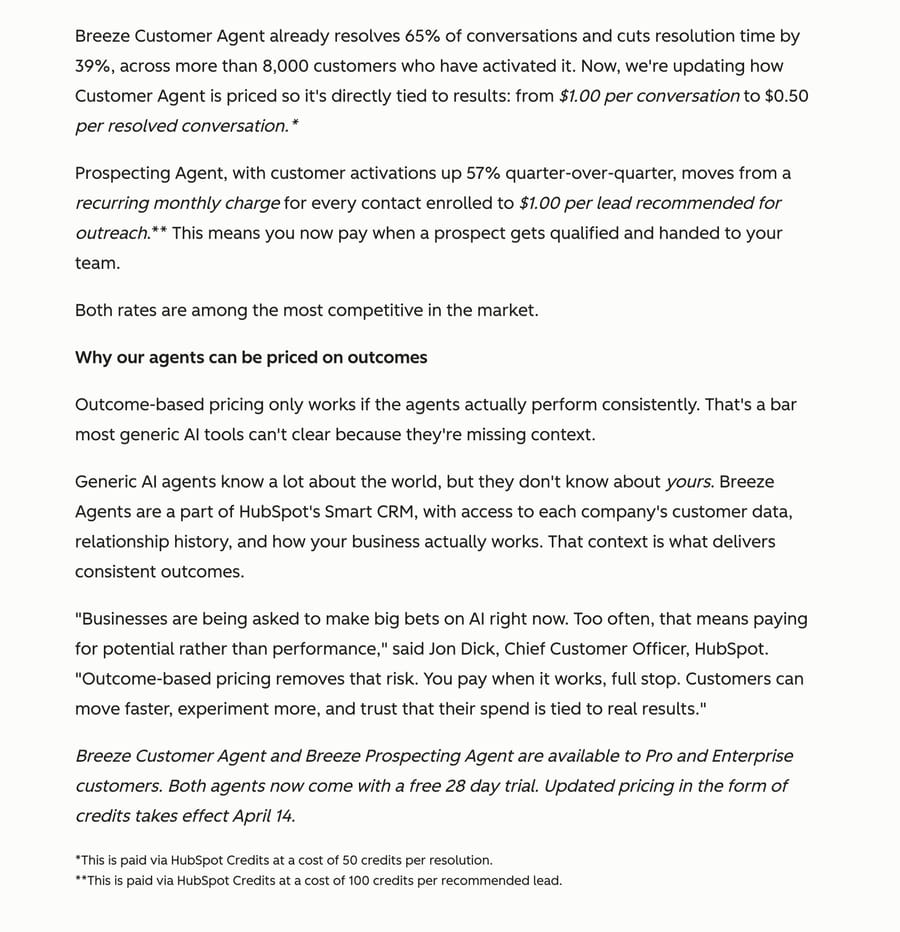
Two details change the math. First, credits are a shared pool. The 3,000 included with Service Hub Professional also pay for other Breeze and data features, so the Customer Agent's budget is whatever's left after those. One r/hubspot user described burning far past their credit allowance by enriching a large list by mistake, at a cost they put at about $11,000 for the year. Second, HubSpot writes the definition of resolved. Its Customer Agent overview counts a conversation as resolved when the agent shared a content source or took an action and the visitor didn't ask for a person, sets that status 72 hours after the visitor's last reply, and says a reassignment by a workflow doesn't stop it counting. The April announcement offered a 28-day free trial of the agent, while the pricing page now shows 14 days of free Customer Agent access with a Professional or Enterprise seat. The same overview (updated September 16, 2026) adds that the agent needs a Professional or Enterprise subscription and runs on chat, email, Facebook and WhatsApp.
Freddy AI Agent charges on sessions. Freshdesk's pricing FAQ says "an Email AI Agent session is defined as a 72-hour window starting from the customer's first email. All AI responses within that window count as a single session, regardless of the number of replies." Every plan gets 500 free sessions, once per account, then $49 per 100 sessions, and session packs expire with your payment cycle. Freddy AI Copilot, the agent-side drafting tool, is a separate $29 an agent a month on Pro and Enterprise.
A session meter earns Freshworks the same whether its AI fixes the ticket or hands it to a person, so the vendor's revenue tracks your volume, not your outcomes. A resolution meter earns HubSpot more as its agent gets better, which sounds aligned until you notice that HubSpot also writes the definition of "resolved" and sells the credit pool that every other AI feature draws from.
What does each cost for a 10-agent team?
Here's the model, with every assumption stated. Ten agents, annual billing, 1,500 email conversations a month that the AI agent handles first, and a 60% AI resolution rate (900 resolved, 600 handed to a person). No Copilot on either side, and no other HubSpot features drawing on the credit pool.
| Monthly cost | HubSpot Service Hub Professional | Freshdesk Pro |
|---|---|---|
| Seats | 10 × $90 = $900 | 10 × $55 = $550 |
| AI usage | 900 × 50 = 45,000 credits, minus 3,000 included = 42,000 × $0.01 = $420 | 1,500 sessions = 15 packs × $49 = $735 |
| Monthly total | $1,320 | $1,285 |
| One-time | $1,500 onboarding | None |
| First-year total | $17,340 | $15,175 |
Freshdesk's first year is lower partly because the 500 free sessions cover a third of the first month (10 packs, $490, instead of 15). From month two it's $1,285 every month.
Now change one assumption. If the AI resolves 40% instead of 60%, HubSpot's usage drops to 600 × 50 = 30,000 credits, minus 3,000, or $270, and its monthly total falls to $1,170. Freshdesk stays at $1,285, because sessions bill on every conversation the AI touches. Push the resolution rate to 80% and HubSpot climbs to $1,470 while Freshdesk holds still. Seats still dominate both bills; the AI meter decides which side of the line you land on.
If you'd rather not pay a per-resolution or per-session meter at all, the other route is an AI agent layer that bills per ticket and runs inside the desk you already have.
Which platform has more help desk features?
| Capability | HubSpot Service Hub | Freshdesk | Edge |
|---|---|---|---|
| Contact and deal context on the ticket | Native, same CRM record | Through an integration | HubSpot |
| SLA policies | SLA goals on Professional; conditional SLAs on Enterprise | Multiple SLA policies on Pro | Freshdesk |
| Skill-based routing | Enterprise | Enterprise ("intelligent routing" on Pro) | Freshdesk at the mid tier |
| Knowledge base | Professional (1 base, up to 2,000 articles) | Every plan | Freshdesk |
| Free option | 2 users | None | HubSpot |
| AI agent unit | Per resolution (credits) | Per session | Depends on resolution rate |
HubSpot's strength is that support isn't a separate system. A rep calling a customer about renewal sees their open tickets on the contact timeline, and the support agent sees the deal and its owner. That's the reason to buy it, and it's also the cost: HubSpot's help desk gets better the more of HubSpot you buy. Freshdesk is the opposite shape. It gives you multiple SLA policies and intelligent routing at $55; HubSpot has SLA goals on Professional at $90 and keeps conditional SLAs and skill-based routing for Enterprise at $150. But anything about the customer beyond the ticket has to come from somewhere else.
Users notice the AI gap on both sides. An r/hubspot thread from October 2026 called Breeze disappointing on straightforward tasks despite careful prompting. Freshdesk's AI questions are more about the bill: the 500 free sessions are a one-time allowance, so a team that trials Freddy in month one is paying from month two.
What breaks when you move between HubSpot and Freshdesk?
The data model is the hard part. Freshdesk organizes everything around the ticket, with contacts and companies attached. HubSpot organizes around the contact, and a ticket is one more object associated with it, alongside deals and companies. So a migration from Freshdesk to HubSpot has to decide how Freshdesk's custom ticket fields map to HubSpot ticket properties, how Freshdesk groups map to pipelines and teams, and what to do with automations, which never migrate and have to be rebuilt as HubSpot workflows. Going the other way, you lose the deal and lifecycle context, which doesn't fit anywhere in Freshdesk.
Our Freshdesk to HubSpot migration guide has the step order. If you're also weighing Zendesk, see Zendesk vs HubSpot Service Hub and Zendesk vs Freshdesk.
Where Macha fits
Macha isn't a help desk, so it doesn't replace either one. It runs AI agents inside the one you keep, and its pitch to a team stuck between Customer Agent credits and Freddy sessions is a different unit: about $0.40 per ticket, one thread with one person charged once however many replies it takes. At 1,500 tickets a month that's $599/month for 1,500 tickets, with the model and tool calls not changing the charge.
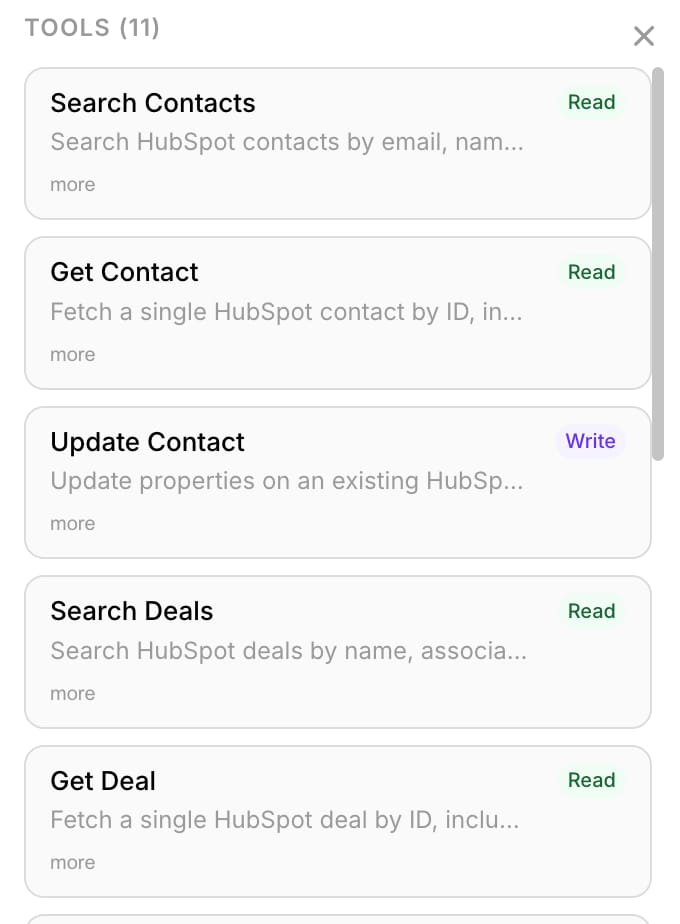
On HubSpot, Macha's connector reads Service Hub tickets, the contact and their deals, updates a ticket's status, owner or priority, and logs a note on the ticket or contact. That's where HubSpot's CRM context pays off for an AI agent: it can check the renewal date or deal stage before it answers a billing question. The contact-context use case shows the flow.
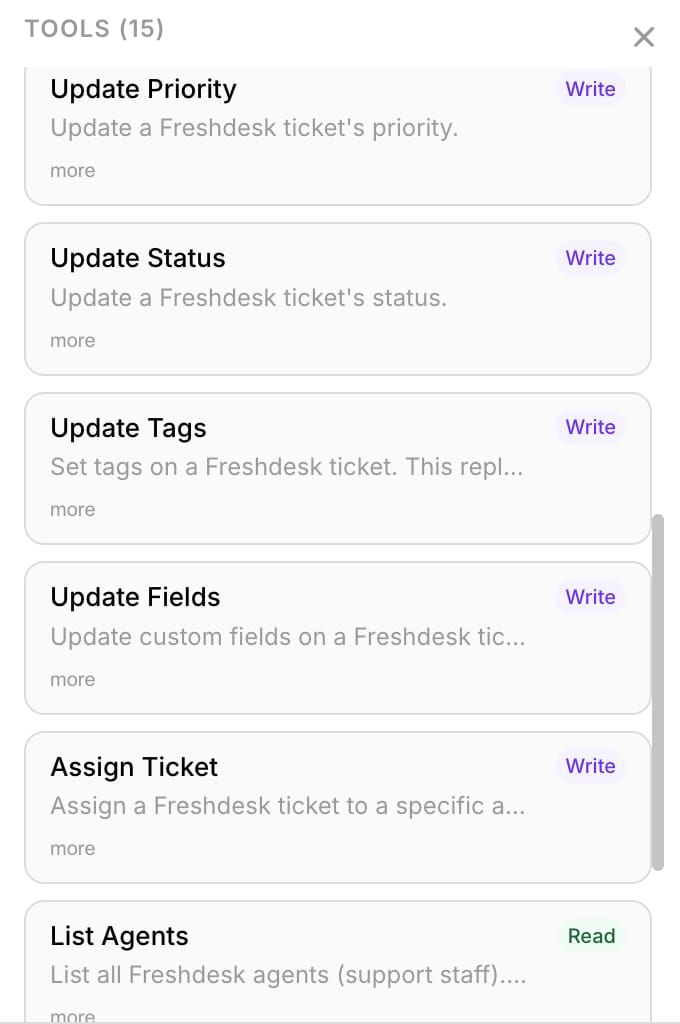
On Freshdesk, the connector reads tickets, contacts, ticket fields and knowledge base articles, adds public replies and internal notes, and updates priority, status, tags and fields or assigns the ticket. Runs start on Ticket Created, Ticket Updated or a custom webhook. The internal-notes use case is the safe-mode version, where drafts wait for a person to approve them.
The bigger difference is who does the work. Customer Agent and Freddy are self-serve: you write the knowledge, set the handoff rules and tune it. Macha is the done-for-you option. The Macha team analyzes your past tickets, builds the knowledge base and the agent on your existing desk, and runs it in safe mode until the drafts are right, included on the trial and every plan at about $0.40 per ticket, which covers setup and a dedicated success manager who handles your changes. Macha suits support teams on Zendesk, Freshdesk, Gorgias, Front, Gladly, Crisp, HubSpot or Intercom that want an agent acting inside the ticket and don't want to staff its upkeep. See Macha on HubSpot, Macha on Freshdesk or how done-for-you works.
How we researched this
We read HubSpot's Service Hub pricing page in a US-locale browser on November 21, 2026 and toggled between Pay Annually and Pay Monthly to label each price; the $20 and $100 figures are struck-through list prices on that page. Customer Agent pricing comes from HubSpot's April 13, 2026 announcement and two knowledge base articles (updated November 12 and September 16, 2026). Freshdesk's pricing page serves rupees from our location, so its prices, the monthly rates and the session definition come from the US Wayback Machine copy saved at 14:28 UTC on November 21, 2026. Reddit threads are paraphrased and linked, with no names. The 10-agent model is our arithmetic on list prices; the 1,500 conversations and the 40%, 60% and 80% resolution rates are assumptions, not data from either vendor, and real bills also depend on discounts, other credit usage and taxes. We captured each vendor page shown above on the same day. We didn't run HubSpot's or Freshdesk's AI agents. The Macha connector details come from Macha's integration listings and the connector screens in the Macha demo workspace.
Common questions
Is HubSpot or Freshdesk cheaper?
Freshdesk is cheaper per seat at every paid tier: $19, $55 and $89 an agent a month on annual billing against HubSpot's $7 (new-customer Starter), $90 and $150, and HubSpot adds $1,500 or $3,500 onboarding on Professional and Enterprise. HubSpot is the only one with a free plan, for up to 2 users.
Does Freshdesk have a free plan in 2026?
No. Freshdesk's pricing page lists Growth, Pro and Enterprise with a 14-day trial of Enterprise. HubSpot Service Hub Free covers up to 2 users.
How much does HubSpot's Customer Agent cost per conversation?
50 HubSpot Credits per resolved conversation, which HubSpot prices at $0.50. Conversations it doesn't resolve don't use credits, and Professional includes 3,000 credits a month shared with other HubSpot features.
What is a Freddy AI Agent session?
For email, a 72-hour window starting from the customer's first email, with every AI reply in that window counted as one session. Sessions cost $49 per 100 after a one-time 500 free sessions per account.
Can I use HubSpot and Freshdesk together?
Yes. Many teams keep Freshdesk for ticketing and HubSpot as the CRM and sync contacts and ticket data between them through an integration.
Which is better for B2B SaaS support?
HubSpot, if you already run sales on it, because the ticket sits on the same record as the deal, owner and renewal date. If your CRM is elsewhere, Freshdesk gives more ticketing for the money.
If your team is between Customer Agent credits and Freddy sessions, start a trial with $50 of free usage (about 125 tickets), no credit card, no time limit; the Macha team sets up the first category on the desk you already use.