Intercom
 Shopify
 Stripe
 Slack
Slack Notion
 Google Workspace
 Confluence

Zendesk vs. HubSpot Service Hub (2026): Support Depth vs. CRM Unity


Zendesk and HubSpot Service Hub solve the same problem from opposite directions. Zendesk is a support-first platform — two decades of ticketing, routing, and omnichannel depth. HubSpot Service Hub is customer service built into the HubSpot CRM, so tickets live on the same record as your marketing and sales activity. The trade-off is real: support depth vs. one unified customer database. This guide uses verified June-2026 pricing (including the fees most comparisons skip) and stays neutral.

Short version: HubSpot if you're already on HubSpot and want marketing + sales + service on one record; Zendesk if support is your core operation and you need depth and scale.
The 30-second verdict
| If you are… | Pick |
|---|---|
| Already running HubSpot (Marketing/Sales Hub) | HubSpot Service Hub |
| An SMB/mid-market wanting one CRM for all teams | HubSpot Service Hub |
| Running high-volume or complex multi-channel support | Zendesk |
| A dedicated CX org needing routing, SLAs, QA, voice | Zendesk |
| Tying support directly to revenue/retention reporting | HubSpot Service Hub |
| Wanting the deepest, most scalable help desk | Zendesk |
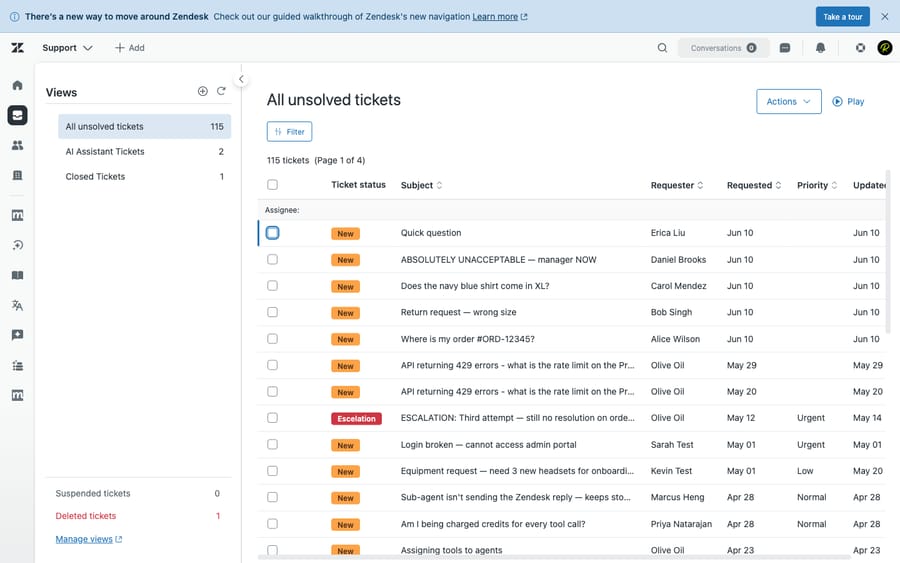
How we compared: Zendesk pricing is verified against its official page (June 2026); HubSpot Service Hub's seat pricing is verified against its official page, while the one-time onboarding fees and per-conversation Breeze AI credit costs are estimates we flag where they appear. Features are checked against the products — and we ran Zendesk hands-on in a live test account (screenshot below). User sentiment comes from real G2, Capterra, and TrustRadius reviews. Macha is our own product — we flag that wherever it comes up.
Pricing: the fees nobody mentions
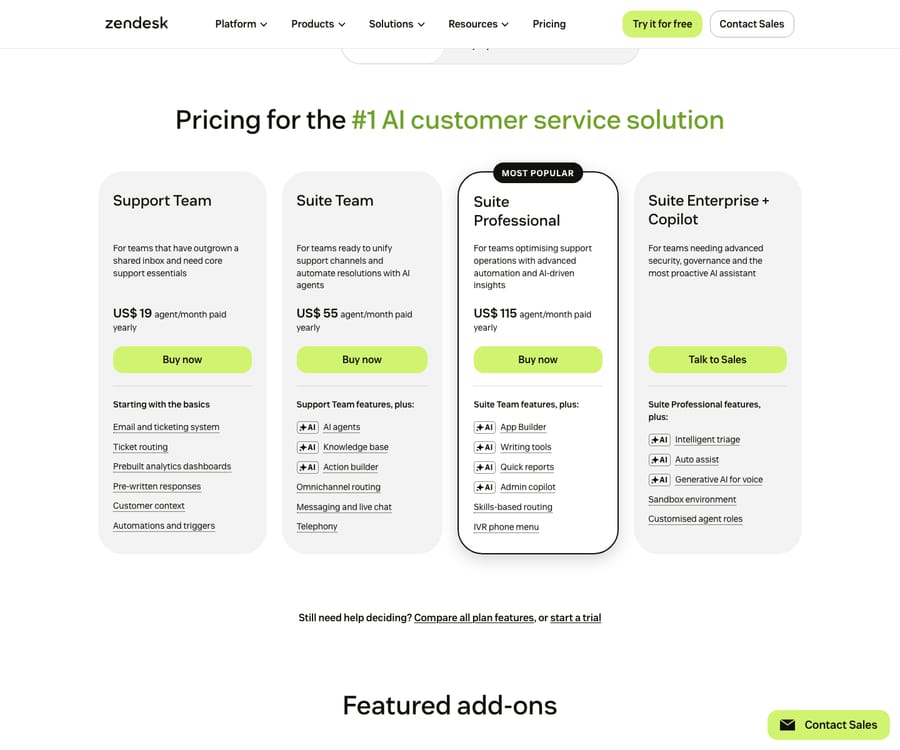
Zendesk Suite (per agent/month, annual): Support Team $19, Suite Team $55, Suite Professional $115, Enterprise contact sales; Copilot add-on $50/agent; AI agents ~$1.50–$2.00 per automated resolution. No mandatory onboarding fee. Source: Zendesk pricing.
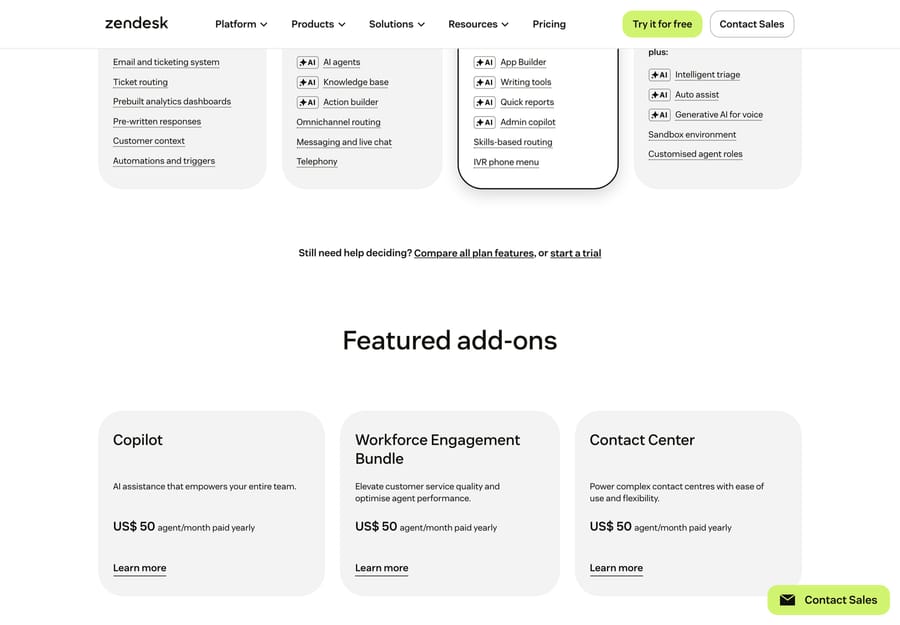
Beyond the per-seat plans, Zendesk’s AI and CX capabilities are sold as separate add-ons — each priced per agent on top of your base plan:
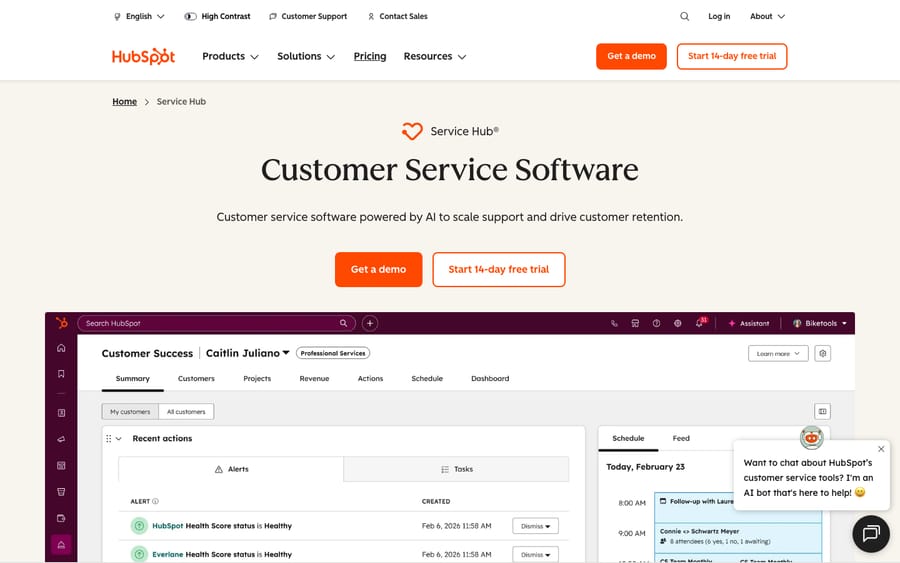
HubSpot Service Hub (per seat/month, annual):
| Plan | Per seat | One-time onboarding | AI credits |
|---|---|---|---|
| Free tools | $0 | — | basic |
| Starter | ~$7–9 (~$20 monthly) | none | 500 |
| Professional | $90 | $1,500 (required) | 3,000 |
| Enterprise | $150 | $3,500 (required) | 5,000 |
Source: HubSpot Service Hub pricing. Confirm current seat minimums at purchase.
Two things to budget for that the headline price hides:
- The Professional jump + mandatory onboarding. Real support capability — the help desk workspace, skill-based routing, advanced reporting, and the customer-facing AI agent — lives at Professional ($90/seat) plus a $1,500 one-time onboarding fee (Enterprise adds $3,500). The free tier and cheap Starter are genuinely useful, but "serious support HubSpot" converges with Zendesk Suite Professional ($115).
- Breeze AI is credit-metered. HubSpot's Breeze Copilot (agent-assist) is free on all plans, but the customer-facing Breeze Customer Agent (Professional/Enterprise only) consumes ~50 credits per conversation — roughly $0.50–$1.50 per resolved conversation, with extra credits around $30 per 1,000. (Per-resolution cost is an estimate — sources vary; confirm with HubSpot.)
The honest read: HubSpot is far cheaper to start and unbeatable if you already pay for HubSpot; Zendesk has no free tier and no onboarding fee, but charges per-agent for AI plus per-resolution usage. Model both at your real seat count and AI volume.
Feature-by-feature: who wins what
| Capability | Winner | Why |
|---|---|---|
| Ticketing & agent workspace | Zendesk | Mature, purpose-built; advanced macros, triggers, SLAs; HubSpot's help desk is newer and full only at Professional+ |
| CRM unification | HubSpot (decisive) | Tickets sit on the same record as marketing emails, page views, and deals — one database across teams |
| Omnichannel | Zendesk | Deeper native channels; HubSpot lacks native SMS and some social needs connectors |
| Automation / workflows | Tie | Zendesk wins support-specific routing/SLA; HubSpot wins cross-funnel (service↔marketing↔sales) in one builder |
| Native AI | Zendesk (depth) | Mature, support-specific AI agents + QA + triage; HubSpot Breeze is unified but shallower on CX autonomy |
| Knowledge base & self-service | Zendesk (slight) | More mature multi-brand help center; HubSpot KB is solid but lighter |
| Reporting/analytics | Zendesk support metrics / HubSpot cross-funnel | Explore is support-depth; HubSpot reports across the whole lifecycle |
| Integrations | Zendesk support stack / HubSpot marketing-sales stack | Pick by which ecosystem you live in |
| Ease of setup | HubSpot | Free tier live in an afternoon; Zendesk takes more configuration |
| Voice / call center | Zendesk | Native contact center; HubSpot calling is more limited |
| High-volume scalability | Zendesk | Built for large, complex, high-ticket operations |
Strengths & weaknesses, honestly
Zendesk — strengths: best-in-class ticketing and agent workspace; deep omnichannel + native voice; mature AI (Copilot, autonomous agents, QA); strong support marketplace; scales to enterprise; no onboarding fee. Zendesk — weaknesses: no free tier; per-agent add-on stacking ($50 each for Copilot/AI/WFM/voice) plus per-resolution AI gets expensive; steeper admin curve; weak native marketing/sales.
HubSpot Service Hub — strengths: true CRM unification (one record across marketing/sales/service); genuine free tier and cheap Starter; fast, friendly setup; Breeze Copilot free on all tiers; great for closing the loop between support and revenue. HubSpot Service Hub — weaknesses: support depth trails Zendesk; native omnichannel gaps (no native SMS, limited social/voice); real support gated behind Professional ($90) + $1,500 onboarding; credit-based Breeze cost adds complexity, and the customer agent can't be steered with custom instructions and bills even on unhelpful answers.
What real users say
Both products rate well; the difference is in the base and the recurring complaints. (Observed June 2026.)
| G2 | Capterra | TrustRadius | |
|---|---|---|---|
| Zendesk | 4.3 / 5 (~7,100+) | 4.4 / 5 (4,081) | 8.7 / 10 |
| HubSpot Service Hub | 4.4 / 5 (~2,850) | 4.4 / 5 (190)* | listed (~56 ratings)* |
\*HubSpot Service Hub's Capterra base (190) and TrustRadius base (~56) are far smaller than Zendesk's — treat those averages as directional, not decisive, and weight the larger G2 samples more heavily.
- Zendesk — praised for feature breadth and value relative to what's included: "Zendesk Suite offers strong value for money considering the wide range of features included — ticketing, automation, analytics, and omnichannel support" (Ifra S., Zendesk Developer, Capterra, Dec 2025). The recurring knock is Zendesk's own support quality: "Their support is some of the worst I've ever experienced and keeps getting worse" (Katie Y., Head of Customer Success, Capterra, Mar 2025). The pattern: people buy it for depth, then grumble about cost creep and slow vendor support.
- HubSpot Service Hub — praised for fitting the wider HubSpot stack: "Fits in incredibly well with the rest of the HubSpot tech stack… lots of customizability to fit our business' support requirements" (Nabil B., Director, Marketing & Advertising, Capterra, Dec 2024). The dominant criticism is complexity plus cost at the higher tiers: "It's complicated, sometimes clunky (need to check for errors), and the advanced plans are expensive for a small business" (Sean C., Marketer, Capterra, Nov 2025). The theme matches the pricing story: cheap and unified to start, but real capability and polish arrive at the pricier Professional/Enterprise tiers.
The split mirrors the whole comparison: Zendesk users complain about what they pay for support depth; HubSpot users love the unified record but feel the jump in price and complexity once they outgrow the cheap tiers.
Who each is genuinely for
- Zendesk → dedicated CX/support orgs (SMB → enterprise) with high or complex ticket volume that need routing depth, SLAs, QA, native voice, and scale; teams that will integrate CRM separately.
- HubSpot Service Hub → teams already on HubSpot, and SMB/mid-market companies that want marketing, sales, and service unified on one customer record, with light-to-moderate support volumes and a premium on setup speed and entry cost.
The deciding question is usually: is HubSpot already your CRM? If yes, Service Hub's unified record is a real step-change. If not, Zendesk gives you a better, more scalable support operation.
The AI question — both bounded by their own KB
Zendesk's AI is the more mature, support-specific stack (autonomous agents now billed per verified resolution, with an evaluation model gating what counts). HubSpot's Breeze is more accessible — free Copilot everywhere, a credit-metered Customer Agent at Pro+. But both share the same ceiling for a team that already owns them: AI quality is bounded by your knowledge base, scoped to one platform's data, and (for HubSpot's customer agent) hard to control — it can be "confidently wrong" on a sparse KB and charges even when it doesn't help.
This is where an independent AI agent layer earns its place: it sits on top of either help desk, ingests knowledge across sources (help center + Notion + Drive + past tickets) instead of one platform's KB, drives autonomous resolution with custom guardrails both vendors lack, and prices per action rather than per resolution. A layer like Macha is helpdesk-agnostic — keep HubSpot's CRM unification or Zendesk's depth, and add controllable autonomous AI on top. The honest caveat: a layer is still another vendor and integration to manage, it only resolves as well as the knowledge you connect to it, and per-action pricing isn't free at high volume — it's additive to your stack, not a free win. (More: native AI vs. an AI layer and the best AI help desk software.)
Before you switch: migration realities
Zendesk's ticket-centric schema (tickets, organizations, custom fields, macros, triggers, SLAs, multi-brand help centers) doesn't map 1:1 onto HubSpot's CRM object model (contacts/companies/tickets/pipelines). Migration tools move tickets, contacts, KB articles, and attachments either direction, but:
- Macros, triggers, automations, and reports don't migrate — rebuild them.
- HubSpot's onboarding fees ($1,500 Pro / $3,500 Enterprise) effectively bundle guided setup; Zendesk has no fee but complex configs need admin time.
- Re-author the KB — Breeze Customer Agent quality depends entirely on it.
Plan a parallel run, historical-ticket cutover, and agent retraining either way.
Frequently asked questions
Is HubSpot Service Hub cheaper than Zendesk? To start, yes — free tier and ~$7–20 Starter. But real support capability sits at Professional ($90/seat) plus a $1,500 onboarding fee, which converges with Zendesk Suite Professional ($115). Compare total cost including AI.
Should I use HubSpot Service Hub if I already use HubSpot? Usually yes — that's its strongest case. Support on the same record as marketing and sales is a genuine advantage if you're already invested in HubSpot.
Which has better AI? Zendesk's support-specific AI is deeper and more controllable; HubSpot's Breeze is more accessible (free Copilot) but its customer agent is shallower and can't take custom instructions. Both are bounded by your KB.
Which is better for high-volume support? Zendesk — it's built for scale, with deeper routing, SLAs, QA, and native voice.
Can I add autonomous AI without switching? Yes — an AI agent layer like Macha adds controllable autonomous AI on top of Zendesk or HubSpot, priced per action.
The bottom line
Choose HubSpot Service Hub if you're already on HubSpot or want marketing, sales, and service unified on one record — and your support volume is light-to-moderate. Choose Zendesk if support is your core operation and you need depth, scale, native voice, and the most mature CX AI. Either way, keep the AI question separate: both bots are bounded by their own KB and platform, so an AI layer on top can add controllable, autonomous resolution without a migration.
Want controllable autonomous AI on top of HubSpot or Zendesk? See how Macha layers AI agents over your help desk, priced per action. 7-day free trial, no credit card required. Start Trial.
Add AI agents to your Zendesk
Macha reads the ticket, drafts the reply and takes the action, inside the Zendesk you already run.