Shopify
 Stripe
 Slack
Slack Notion
 Google Workspace
 Confluence

Botpress: The Complete Guide (2026)


Botpress is a Quebec-based platform for building AI agents, sold mostly to support teams, with a free plan and paid plans from $150 a month billed annually. This guide covers what Botpress is today (it's changed a lot since the open-source chatbot days), how its agents are built and run, what the per-conversation pricing works out to at real volumes, where reviewers say it gets hard, and how it compares with Chatbase and with an agent layer that runs inside your existing help desk.

If you last looked at Botpress two years ago, most of what you remember has been renamed or repriced. The ranking reviews for "botpress pricing" still quote an $89 Plus plan and a $495 Team plan. Neither exists on the pricing page we captured on September 15, 2026. We build AI agents for customer service ourselves, so we read vendor pricing pages for a living, and we've tried to separate what Botpress publishes from what third parties report.
What is Botpress?
Botpress started as an open-source chatbot framework and is now a hosted AI agent platform. Press coverage puts its founding at 2017 under CEO Sylvain Perron. In June 2025 it raised a $25 million Series B led by Framework Venture Partners, with Deloitte Ventures, HubSpot Ventures, Inovia and Decibel participating. The Logic reported a $120 million post-money valuation and about $45 million raised in total.
The open-source part still exists, in a narrower form. The botpress GitHub repository (about 14.9k stars when we checked) holds the MIT-licensed CLI, SDK, API client and public integrations for the cloud product. The self-hosted v12 platform lives in a separate legacy repo. If you were drawn to Botpress because you could run the whole thing on your own servers, that's no longer the main product.
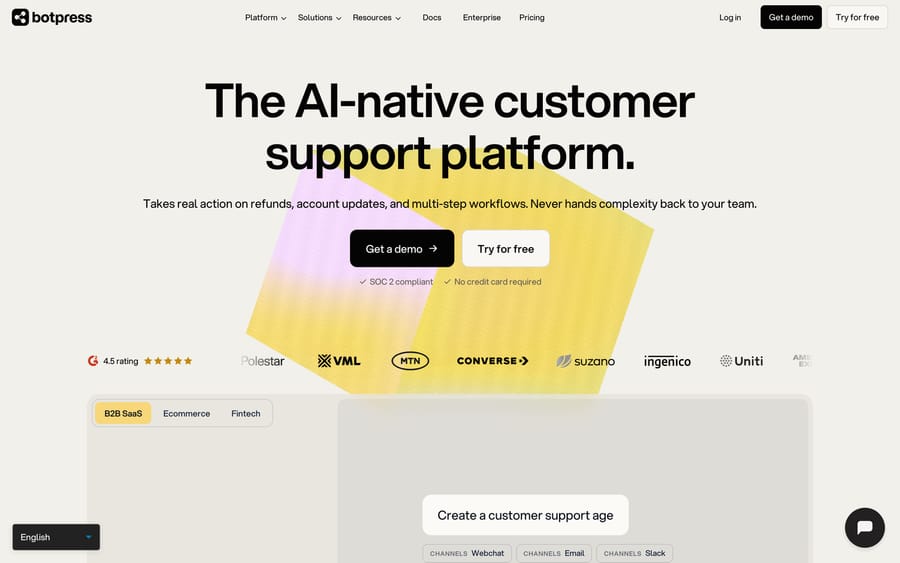
The homepage now pitches Botpress squarely at support: agents that "process refunds, update accounts, and run multi-step workflows." It claims 750k agents built. The company also sells a help desk of its own, which matters for how you evaluate it (more on that below).
People researching Botpress usually fall into three groups: developers and agencies who want a flexible builder, support leads comparing AI agent vendors, and teams who outgrew a simple website chatbot and want something that can call APIs.
How Botpress AI agents work
Botpress now has three ways to build, and they suit different people.
Botpress Viber is the newest. On the Viber page, you describe the agent in plain language and Viber builds, tests and publishes it. What it builds has five parts: instructions (identity, tone, memory, safety rules), playbooks (reusable procedures such as "escalate refunds over $500"), tools and integrations (including HTTP requests and MCP tools), escalation conditions, and simulations you rerun before publishing. Editing happens by talking to Viber. You can open the underlying screens to inspect what it built, but changes go through the conversation.
Botpress Studio is the older visual builder, and it's where most of the tutorials you'll find online live. The docs index shows the building blocks: workflows made of nodes, cards inside nodes (send message, execute code, capture information, AI task, AI transition), an Autonomous Node that lets an LLM pick the next step, knowledge bases, tables, hooks, variables at four scopes, and versioning. Studio also ships prebuilt "agents" that run alongside the main flow: a Summary Agent, Policy Agent, Knowledge Agent, Translator Agent, HITL (human-in-the-loop) Agent and a few others.
The ADK is a TypeScript library for developers who'd rather write agents in code.
At runtime, the pieces work the same way whichever builder you use. A message arrives on a channel (webchat, WhatsApp, Slack, Messenger, Telegram, Instagram, or Twilio for voice and SMS). The agent retrieves from its knowledge base, follows its instructions and playbooks, calls whatever tools it's been given, and either answers or hands off to a human with the conversation history attached.
Botpress Desk and the help desk question
Botpress Desk is described as "our built-in helpdesk, handling L1, L2, and L3 tickets." The same page says Botpress "connects to your existing Zendesk or Intercom helpdesk," and the homepage offers both routes: work on top of your current help desk, or use Desk as a standalone one.
Look at how the page argues for it. It prices out seats: "Every agent you add costs $165/month on Zendesk, $114/month on Intercom, and $0 on Botpress." That's a pitch to move your human team into Desk as well as your AI. A vendor that owns the inbox keeps the whole support budget, where an AI layer on someone else's help desk only earns the automation line. Neither route is wrong, but you should know which one a sales conversation is steering you toward.
The Zendesk integration itself is conversation-led. Per its listing, a Botpress bot can create tickets from chat, update fields, check ticket status, add notes or tags, and hand a conversation to a live Zendesk agent. Its model is a chatbot conversation that opens or updates Zendesk tickets, which differs from an agent that picks up tickets already sitting in Zendesk queues.
Key Botpress features
- Three builders: Viber (prompt-built), Studio (visual) and the ADK (TypeScript).
- Knowledge bases: websites, FAQs and files, with vector storage limits per plan (100MB free, 1GB Plus, 5GB Team).
- Tables: a built-in database for agents to read and write (1K, 100K and 500K rows by plan).
- Actions through integrations: Zendesk, Intercom, HubSpot, Salesforce and a hub of others, plus HTTP and MCP tools.
- Human handoff: escalation rules with conversation context passed to the person who picks it up.
- Channels: webchat, WhatsApp, Slack, Messenger, Telegram, Instagram; voice is an Enterprise feature on the pricing grid.
- Help Center: a public knowledge base, with a custom domain on paid plans.
- Botpress Desk: an optional help desk with routing, teams and RBAC on the Team plan.
- Compliance: SOC 2 on the homepage, plus DPA and BAA (HIPAA) listed in the plan comparison.
Botpress pricing in 2026
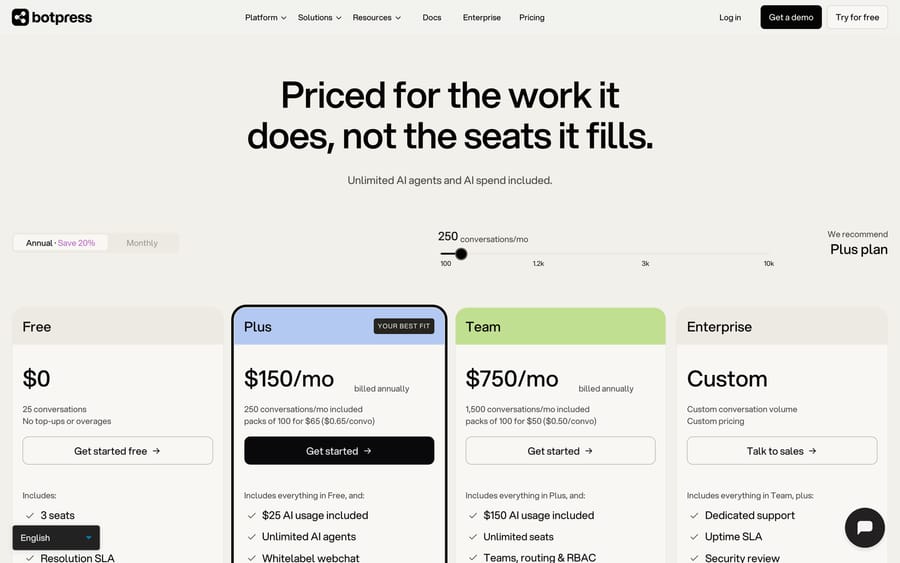
Botpress publishes its prices. The pricing page headline is "Priced for the work it does, not the seats it fills," and the unit is the conversation.
| Plan | Price (billed annually) | Conversations included | Extra conversations | AI usage included | Seats |
|---|---|---|---|---|---|
| Free | $0 | 25 | None, hard cap | Included | 3 |
| Plus | $150/mo | 250/mo | $65 per 100 | $25 | 3 |
| Team | $750/mo | 1,500/mo | $50 per 100 | $150 | Unlimited |
| Enterprise | Custom | Custom | Custom | Custom | Unlimited |
The page defaults to annual billing with a "Save 20%" label. Only the annual figures are in the page's HTML, so we haven't stated monthly-billed prices; expect them to be higher. Storage beyond the plan limits is a $40/month add-on (100K table rows, 1GB vector, 10GB files).
What counts as a conversation
The FAQ on the pricing page defines it precisely, and the definition drives your bill more than the headline price does:
- Any exchange with at least two messages from the end user in the billing month counts.
- A conversation that spans two months counts in both months.
- Multiple anonymous sessions each count separately.
- Three minutes of voice counts as one conversation.
- AI-only and human-assisted conversations count the same, and so do emulator (test) conversations.
When you pass 95% of your quota, Botpress automatically adds a pack of 100 conversations. Packs persist month to month until you remove them, and unused conversations in a pack expire at month end.
AI usage on top of conversations
Each conversation includes $0.10 of LLM cost, which is where the $25 (Plus) and $150 (Team) allowances come from. When a workspace reaches 95% of its AI spend limit, the FAQ says Botpress buys a $10 credit grant "sold at cost." A long, tool-heavy conversation on a large model can use more than its $0.10, so the conversation price is a floor.
The arithmetic at three volumes
Here's the math, using the published annual prices and assuming conversations stay within their AI allowance:
- 250 conversations a month: Plus at $150, or $0.60 a conversation.
- 1,000 conversations a month: Plus at $150 plus 750 extra at $0.65 = $637.50. Team at $750 covers it with 500 to spare, so the break-even sits a little above 1,100 conversations.
- 3,000 conversations a month: Team at $750 plus 1,500 extra at $0.50 = $1,500, or $0.50 a conversation, and $9,000 a year for the base plan committed up front.
Auto-added packs persist until you remove them, so a busy month quietly raises every later month's bill. Counting a month-spanning conversation twice, and counting test conversations, ties more of the vendor's revenue to how your traffic behaves than to what the agent resolved. That incentive is spelled out in the FAQ, which few buyers read before signing.
Botpress pros and cons
Pros
- Published pricing, a real free plan and no per-seat charge, which is rare in this category.
- Three builders cover the no-code lead, the flow designer and the TypeScript developer.
- Tools, HTTP requests and MCP let agents take actions beyond answering questions.
- A large community: the Desk page cites a 31k+ community, and there are years of YouTube tutorials.
- Funded and compliance-ready (SOC 2, DPA, BAA) for teams that need paperwork.
Cons
- Learning curve. eesel's review and Voiceflow's review both say anything past a basic FAQ agent tends to need developer skills. Both reviews predate the current pricing and Viber, so weigh that accordingly.
- The billing unit is broad. Test conversations, anonymous sessions and month-spanning threads all count.
- Many tutorials and third-party articles describe older Studio flows and the retired pricing, so research takes longer than it should.
- Help desk integration is chat-first: the bot opens and updates tickets rather than working the queue you already have.
- Voice sits on Enterprise.
Who Botpress is best for
Botpress fits teams that want a general-purpose agent builder they control, especially when someone on the team is comfortable with flows, APIs or TypeScript. Agencies building agents for several clients are a natural match, and so are SaaS or e-commerce companies whose support starts in a website or WhatsApp chat and needs to call their own backend.
It's also a reasonable pick if you're small and don't yet run a help desk. Botpress Desk plus the Plus plan gives you an inbox and an AI agent from one vendor.
It's the wrong fit if your team already lives in Zendesk, Freshdesk, Gorgias or Front and most volume arrives as email tickets. In that case the question is whether an agent can work the tickets in the tool you already pay for, and a chat-first builder answers a different question.
Botpress vs alternatives
Botpress usually gets compared with Chatbase (simpler, trained on your content) and with agent layers that run inside a help desk. Our Chatbase guide covers that tool in depth, and if your shortlist runs to the enterprise end of purpose-built support agents, our Decagon AI guide covers that one.
| Botpress | Chatbase | Macha | |
|---|---|---|---|
| Model | AI agent builder with an optional help desk (Desk) | AI chatbot and agent trained on your content | AI agent layer on your existing help desk |
| Builders | Viber (prompt), Studio (visual), ADK (code) | No-code dashboard | Agents written in plain English |
| Pricing | Free; Plus $150/mo, Team $750/mo billed annually, per conversation, published | Free; Hobby $40/mo, Standard $150/mo, Pro $500/mo, message credits, published | From $299/mo for 750 tickets (~$0.40/ticket), published |
| Where it runs | Webchat, WhatsApp, Slack and more; Zendesk and Intercom via integration | Website widget and messaging channels | Inside Zendesk, Freshdesk, Gorgias or Front |
| Setup | Self-serve, or "Built by Botpress" service | Self-serve | Built, tested and monitored by the Macha team |
| Trial | Free plan, 25 conversations | Free plan | $50 free usage |
Chatbase prices are from its pricing page on September 15, 2026.
Macha takes the other route from Botpress Desk. It never replaces your help desk; it's an AI agent layer on the help desk you already use, so agents read and act on tickets where your team already works, with connectors such as Shopify, Stripe, Slack and Notion for the lookups and actions. A ticket is one thread with one person and one charge however many replies it takes, and the model doesn't change the price. That suits teams already running Zendesk, Freshdesk, Gorgias or Front who want agents working the existing queue and who'd rather the Macha team build and monitor them. Current tiers are on the pricing page.
If you want to design and own a chat agent across web and WhatsApp and have someone technical on the team, Botpress is the stronger fit.
Botpress FAQ
Is Botpress free? Yes, there's a Free plan with 25 conversations, 3 seats and 3 agents, and no top-ups or overages. Paid plans start at $150 a month billed annually for Plus.
How much does Botpress cost? Plus is $150/month and Team is $750/month, both billed annually, with 250 and 1,500 conversations included. Extra conversations cost $65 or $50 per 100. Enterprise is custom. See the pricing page.
Is Botpress still open source? Partly. The GitHub repository holds MIT-licensed tools, SDKs and integrations for the cloud platform. The old self-hosted v12 is in a separate legacy repository.
What is Botpress Viber? Viber builds an agent from a plain-language description: instructions, playbooks, tools, escalation rules and simulations. You edit it by describing changes rather than dragging nodes.
Does Botpress integrate with Zendesk? Yes. The Zendesk integration lets a Botpress bot create, update and close tickets, add notes and tags, and hand conversations to live Zendesk agents.
What counts as a conversation in Botpress pricing? Any exchange with at least two end-user messages in a billing month. Conversations spanning two months count twice, anonymous sessions count separately, and test conversations count.
Is Botpress a help desk? It offers one. Botpress Desk is a full ticketing system, but Botpress can also run on top of Zendesk or Intercom.
What are the best Botpress alternatives? Chatbase for a simpler content-trained chatbot, Voiceflow for teams that want a design-led builder, and Macha if you want agents working inside Zendesk, Freshdesk, Gorgias or Front.
Sources: Botpress homepage, Botpress pricing, Botpress Viber, Botpress Desk, Botpress Zendesk integration, Botpress customers, Botpress docs index, botpress on GitHub, GlobeNewswire: Botpress Series B, The Logic: Botpress Series B, eesel: Botpress deep dive, Voiceflow: Botpress review, Chatbase pricing.
Resolve tickets automatically with AI agents
Macha's AI agents work on top of the help desk you already use — no code.