 Shopify
 Stripe
 Slack
Slack Notion
 Google Workspace
 Confluence

What Does the Macha ElevenLabs Integration Do? Audio Transcription for AI Agents


The Macha ElevenLabs integration lets your AI agents transcribe voicemails, call recordings and audio attachments into text they can triage and act on. It is speech-to-text only, runs on ElevenLabs Scribe v2, and needs nothing more than an ElevenLabs API key.
Key takeaways
- The Macha ElevenLabs integration adds one tool, Transcribe Audio, which converts audio files into text and does not give agents a spoken voice.
- ElevenLabs Scribe v2 lists 90+ languages, and its 5% or lower word error rate applies to the languages in its excellent tier, not to all of them.
- ElevenLabs says Scribe v2 Realtime achieves 93.5% accuracy across 30 commonly used European and Asian languages.
- Zendesk's native call transcription only covers calls made through Zendesk Talk, while Macha's ElevenLabs tool transcribes any audio file handed to the agent.
- Macha charges one ticket however many tools run, while ElevenLabs bills its own API separately, with rates starting at $0.40 per hour of transcribed audio at scale.

The Macha × ElevenLabs integration gives your AI agents one tool, Transcribe Audio, which turns an audio file into text the agent can then summarize, triage, search and act on like any typed message. It runs on ElevenLabs Scribe v2, connects with a single API key, and plugs into the same agents you already run on top of Zendesk, Freshdesk, Gorgias, Front, HubSpot or Intercom (here's how that works on Zendesk).
One thing to be clear about up front: this integration is speech-to-text, not text-to-speech. ElevenLabs is famous for generating lifelike voices, but that isn't what Macha wires up here. Macha doesn't make your agents talk. It lets them hear.
| Question | Short answer |
|---|---|
| What does it add? | One tool: Transcribe Audio |
| Direction | Speech in, text out (no spoken replies) |
| Model | ElevenLabs Scribe v2, 90+ languages |
| Credential | An ElevenLabs API key |
| Live calls? | No, recorded files only |
| Cost on Macha's side | Covered by the ticket; ElevenLabs bills its API separately |
What does the ElevenLabs integration actually do?
Connect ElevenLabs to Macha with an API key and your agents gain one tool: Transcribe Audio.
Transcribe Audio: Upload an audio file and get an accurate text transcription using ElevenLabs speech recognition.
That's the whole surface area. It's deliberately small: one reliable primitive the rest of your agent logic builds on. The integration sits in Macha's Productivity category, authenticates via API key, and adds no knowledge source of its own (it produces text for your agents; it isn't a place agents go to look things up).
In practice the flow looks like this:
- An audio file enters the workflow: uploaded into a chat, attached to a ticket, or dropped in by an upstream step.
- Your agent calls Transcribe Audio.
- ElevenLabs returns a text transcript.
- The agent does whatever you instructed it to do with that text: summarize it, pull out the order number, decide the ticket's priority, draft a reply, route it to the right team.
Macha already supports dropping audio straight into a conversation. The drag-and-drop uploader accepts "images, documents (PDF, DOCX, CSV, XLSX), and audio files," so getting a recording in front of an agent means dragging it onto the input. Once the agent fires the tool, you'll see a live "Using Transcribe Audio" status while it runs, the same tool-status surface every Macha agent shows when it reaches for a connector.
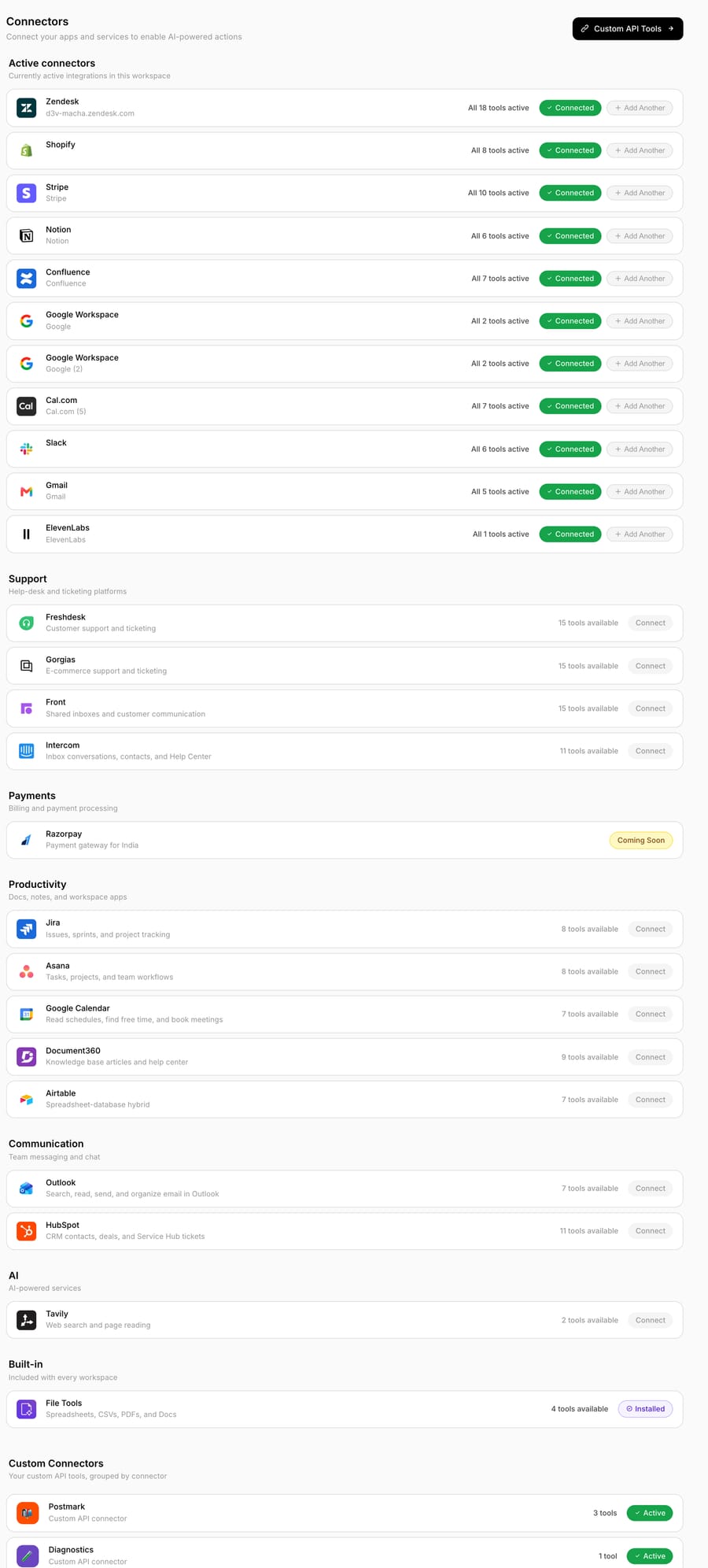
ElevenLabs sits in that same Connectors directory next to your help desk and commerce tools. Connecting it is the standard Macha flow: pick the connector, paste a credential, and its tools become available to your agents. It exposes exactly one tool, which is why the directory shows "1 tool available."
Why would a support team want agents to transcribe audio?
Most support data is text. Some of it isn't: a voicemail, a recorded call, a 90-second audio note from a field tech, a screen recording with narration. That data usually stays trapped in a call-recording system, a voicemail inbox or an attachment nobody opens, because turning it into something actionable used to mean a human sitting down to listen.
When transcription is a tool your agent can call mid-workflow, voice stops being a dead end and becomes another input. A few concrete shapes this takes:
- Voicemail triage. A customer's voicemail gets transcribed, summarized into a ticket, tagged with the likely topic, and prioritized before an agent ever picks it up.
- Call-note automation. Drop a sales or support call recording in and the agent produces structured notes: who, what they wanted, next steps, objections.
- Audio attachments on tickets. A customer films a defect and narrates the problem. The agent reads the narration, not just the pixels, and routes accordingly.
- Meeting recaps for the team. ElevenLabs' own suggested pattern: "When an audio file is shared, transcribe it and summarize the key points for the team," then drop that summary into Slack or a Notion doc via Macha's other connectors.
Plenty of tools transcribe, so the transcription alone isn't the point. The point is that the transcript lands inside an agent that can act on it straight away using everything else it's connected to: your help desk, your order system, your knowledge base.
How accurate is ElevenLabs Scribe?
Transcription is only useful if you can trust it, so the model matters. ElevenLabs released Scribe v2 on 9 January 2026 and says it "achieves the lowest word error rate recorded on industry-standard benchmarks." (ElevenLabs, Scribe v2) Its realtime sibling, Scribe v2 Realtime, "achieves 93.5% accuracy across 30 commonly used European and Asian languages," according to ElevenLabs' launch post. ElevenLabs' charts put both ahead of Gemini, OpenAI and Deepgram models, though it doesn't publish the competitor scores as text, so we don't repeat numbers for them here.
On languages, be precise. ElevenLabs' speech-to-text page lists 90+ languages, grouped into accuracy tiers that run from "excellent" (5% word error rate or lower) down to "moderate" (above 20% WER). So the 5% figure applies to the best-supported languages, not to every one of the 90+. (ElevenLabs, Speech to Text) Scribe v1 originally documented 99 languages; the v2 pages say 90+, and we use that figure. If a specific language matters to your queue, check its tier on ElevenLabs' current list.
| What you're transcribing | What ElevenLabs states |
|---|---|
| Multilingual queues | 90+ languages; files can mix languages |
| Common languages | 5% WER or lower in the "excellent" tier |
| Multiple speakers | Speaker diarization and word-level timestamps |
| Long recordings | Files up to 3 GB |
For a support team, the practical read: on the well-supported languages, the text your agent reasons over is close to what the customer actually said. On a lower-tier language, plan for more human review.
How do you set up ElevenLabs in Macha?
The setup takes four steps:
- In Macha, open Integrations and connect ElevenLabs.
- Paste your ElevenLabs API key. That's the only credential; there's no OAuth flow.
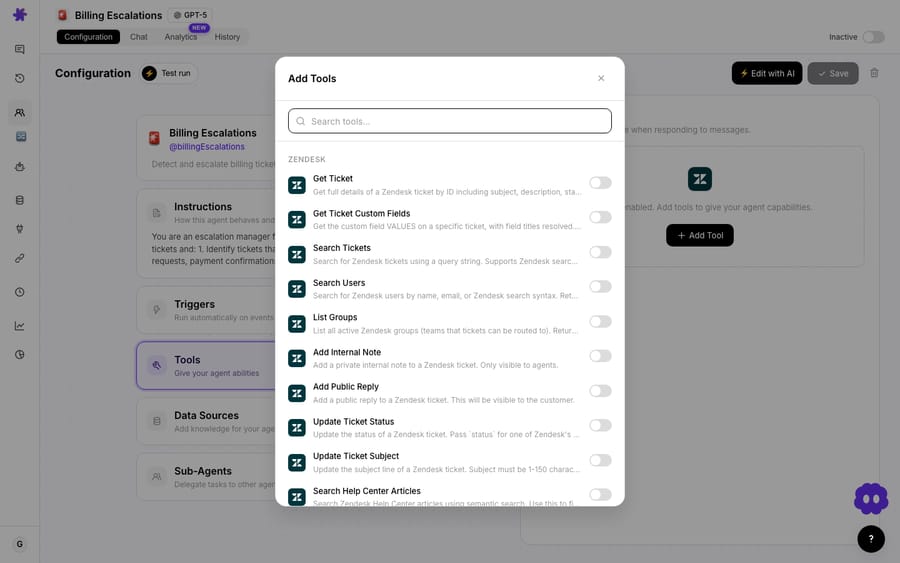
- Add the Transcribe Audio tool to whichever agents should handle audio. In the agent builder, the tool shows up in the same picker as the rest of your connectors.
- Write the instruction. Tell the agent when to transcribe and what to do with the result, for example: "If an audio file is attached, transcribe it, summarize the customer's issue in two sentences, and set the ticket priority based on urgency."
Macha agents are model-agnostic, so the reasoning on top of the transcript (the summary, the routing decision, the reply) runs on whatever model you've assigned that agent. The transcription step is its own tool call.
How does it compare with help desk transcription or standalone tools?
Versus your help desk's native call transcription. Zendesk, for instance, can transcribe and summarize calls, but only calls that happen through Zendesk Talk. (Zendesk help) If your audio comes from anywhere else (a voicemail box, an uploaded file, a recording from another phone system), that native feature can't see it. Macha's ElevenLabs tool transcribes any audio file you can hand the agent, wherever it came from.
Versus standalone transcription tools. Sonix, Fireflies, Otter, Rev and similar tools transcribe accurately, but they hand you a transcript and stop. The text then sits in their product, waiting for a human to do something with it. Their business is the transcript; Macha's is the ticket, which is why the integration exists for the next step: the transcript lands inside an agent that acts on it inside your support stack.
If all you need is a searchable archive of meeting transcripts and you never want an agent to act, a dedicated transcription app is the simpler tool.
What are the limits, and when shouldn't you use it?
- It doesn't give your agents a voice. ElevenLabs is best known for text-to-speech and voice agents, and people often assume "Macha × ElevenLabs" means spoken AI replies. Macha doesn't do that today. The integration is transcription only: speech in, text out.
- No live-call streaming. The tool transcribes audio files. It isn't an agent listening on an active phone call and whispering answers in real time. Think recordings and attachments.
- It's a tool call, and the ticket already covers it. Macha bills per ticket, one conversation charged once, so a workflow that transcribes, summarizes and routes costs the same single ticket. ElevenLabs bills you separately for its own API; its speech-to-text page quotes rates starting at $0.40 per hour of transcribed audio at scale, plus a free tier. See Macha's pricing for our side.
- Garbage in, garbage out. A recording that's near-inaudible to a human will still produce a shaky transcript. For refunds or account changes, keep a human in the loop on anything the agent flags as low-confidence.
- PII lives in voice too. Call recordings often contain card numbers, addresses and names. Scribe v2 offers entity detection across "up to 56 categories" of personal, health and payment data, but don't assume the transcript Macha receives is scrubbed. If your compliance posture requires redaction, build it into the workflow.
What does a real workflow look like?
Say you run support for an e-commerce brand and customers can leave voicemails for after-hours issues. You build one Macha agent on top of your help desk and give it the Transcribe Audio tool plus your usual ticket and order connectors. The instruction:
"When a ticket has an audio attachment, transcribe it. Summarize the customer's issue in two sentences. If they mention an order number, look it up. Set priority to high if they sound upset or mention a failed delivery. Post the summary as an internal note and tag the ticket with the topic."
An overnight voicemail arrives as an attachment. By the time a human opens the queue in the morning, the agent has turned that 45-second recording into an internal note, surfaced the order, set the priority, and tagged it. The human starts from a decision, not from pressing play.
That's the pattern across every voice use case: the integration doesn't replace the human's judgment; it removes the part where the human had to listen first.
FAQ
Does Macha's ElevenLabs integration make my agents speak? No. It's speech-to-text only. It transcribes audio into text your agents can act on; it doesn't generate spoken voice replies.
What audio can it transcribe? Audio files you hand the agent: voicemails, call recordings, audio notes, and audio attachments uploaded into chat or onto a ticket. It runs on ElevenLabs Scribe v2, which supports 90+ languages.
How accurate is the transcription? ElevenLabs reports 5% word error rate or lower for languages in its "excellent" tier, and 93.5% accuracy across 30 common languages for Scribe v2 Realtime. Accuracy drops for less-supported languages.
Does it work in real time on live calls? No. It transcribes recorded audio files, not live streaming calls.
How is it priced? Transcription runs as a Macha tool call inside a ticket, and a ticket is charged once however many tools it uses. There's no separate per-minute fee from Macha; you'll need your own ElevenLabs API key, which ElevenLabs bills. Start with the free trial ($50 of usage, no credit card required) and see pricing for plan details.
What do I need to connect it? Just an ElevenLabs API key. Add it under Integrations, then attach the Transcribe Audio tool to your agents.
Ready to wire it up? Browse the full integrations catalog, read the docs, or start a free trial ($50 of usage, no credit card required). For more patterns like this one, the Macha blog covers how teams connect agents and connectors across real support workflows.