Intercom
 Shopify
 Stripe
 Slack
Slack Notion
 Google Workspace
 Confluence

Netomi: The Complete Guide (2026)


If you are evaluating enterprise AI for customer service, Netomi almost certainly shows up on your shortlist. It is one of the longest-standing "agentic AI" vendors in the customer experience space, with publicly referenced customers that read like a Fortune 500 directory: Delta Air Lines, MetLife, the NBA, and dozens of large retail, travel, and insurance brands. This guide covers what Netomi actually is, how its AI works, what it really costs (the honest answer: a lot, and not published), where it shines, where it frustrates buyers, and which alternatives are worth putting next to it.

We build AI agents for customer service ourselves, so this is written from the perspective of someone who has to compare these platforms in practice — not a press release. We will keep it balanced.
What is Netomi?
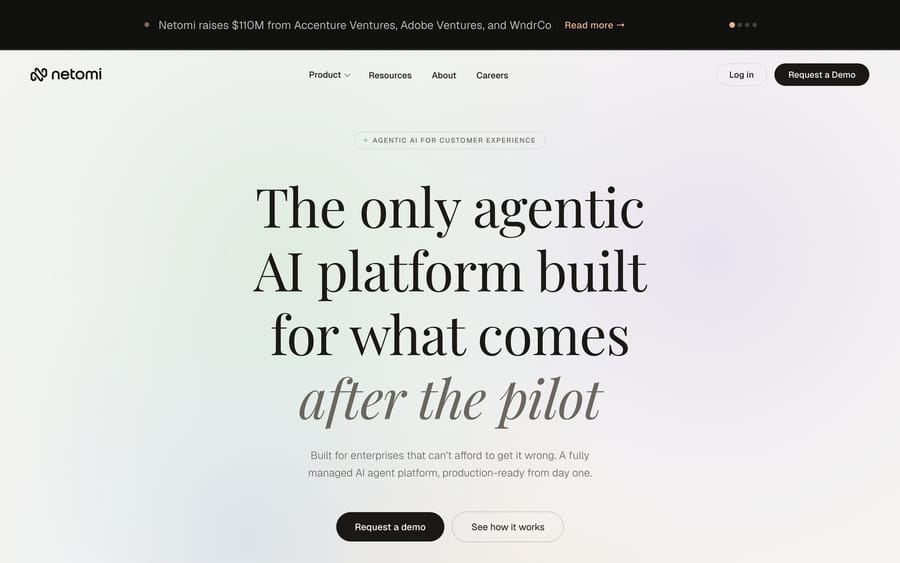
Netomi's homepage, focused on agentic AI for customer experience.
Netomi is an AI customer experience platform that uses conversational and generative AI to automate and assist customer support across channels. Founded in 2016, the company positions itself squarely in the enterprise segment. It supports email, chat, voice, social, SMS, and messaging in more than 100 languages, and it markets itself around a single headline promise: automatically resolving a large share of routine customer questions — Netomi reportedly cites figures around 80% for common queries (a vendor-reported metric) — while keeping humans in control of the edge cases. Its flagship offering is branded Netomi Wisdom, an agentic-AI system the company describes as "built for what comes after the pilot" — a jab at rivals whose demos impress but whose production deployments stall.
The important thing to understand about Netomi is who it is for. The company has reportedly raised significant capital — a reported ~$110M round (2026) with strategic backers reportedly including Accenture Ventures, Adobe Ventures, and WndrCo — and it deliberately focuses on large brands in retail, travel, insurance, finance, and telecom. Publicly referenced customers include WestJet, Singtel, MGM Resorts, Sephora, and Nestlé, alongside the marquee names it leads with publicly. Netomi does not chase the SMB or mid-market. There is no free tier, no self-serve signup, and no published price list. If you are a 15-person support team, Netomi is almost certainly not aimed at you — and that is by design.
To make the fit concrete: WestJet, one of Netomi's most-cited references, runs an AI agent (branded "Juliet") that, per Netomi's case study, handles a range of case types across channels including web chat and Facebook Messenger, resolving a large share of contacts without a human. That is the shape of a "good" Netomi deployment — high volume, many channels, one global brand, deep backend integration. It is not the shape of a team that just wants to auto-answer 40 repetitive tickets a day inside Zendesk.
How Netomi's AI works
Netomi's architecture is built around two complementary modes:
- Autopilot — the fully autonomous agent that handles routine customer questions and tasks end to end, without a human in the loop.
- Copilot — a real-time assist layer that drafts responses and surfaces knowledge for human agents handling more complex conversations.
Underneath, Netomi leans on what it calls "sanctioned generative AI": large language models wrapped in governance controls, brand-voice guardrails, and accuracy mechanisms. This framing is central to how Netomi sells. Rather than pitching raw LLM speed, it pitches safety — the idea that a regulated bank or a global airline can deploy generative AI without it hallucinating a refund policy or going off-brand. For risk-averse enterprises, that governance story is often the deciding factor.
What "sanctioned generative AI" actually means
The word "sanctioned" is doing real work here, and it is worth unpacking because it is Netomi's core differentiator. In practice, Netomi's governance layer is organized around several named control categories rather than a single "safety toggle":
- Duty-of-care management — content moderation, user-privacy controls, and bias/legal safeguards, with escalation triggers designed to hand off vulnerable or sensitive interactions (think a distressed traveler or a customer in financial hardship) to a human.
- Topic guardrails — the AI is restricted to content and answers a brand has explicitly approved, so it will not improvise on subjects it was not sanctioned to discuss (a refund exception, a medical claim, a legal question).
- Prompt security — detection and blocking of prompt injection and jailbreak attempts, which matters when a public-facing bot can be probed by anyone on the internet.
- Human in the loop — visibility into the AI's reasoning plus the ability to build deterministic, rule-based workflows for the paths that must never be left to a model's discretion.
For a compliance officer at a bank or airline, this is the language that gets a deal approved. It is less about "how good is the chatbot" and more about "can I prove to a regulator that this system cannot go off the rails." That is a genuinely different sales conversation than most SMB-focused AI tools ever have.
Autopilot, Copilot, and continuous learning
Netomi also markets itself as a "continuous-learning" platform: rather than a static bot you configure once, the system is meant to improve from resolved conversations over time. In day-to-day operation the platform is no-code, though real deployments typically involve Netomi's own team for integration, tuning, and ongoing optimization. Buyers frequently praise the "handholding" — weekly post-launch sessions and performance insights — which is both a strength (you are not alone) and a signal (this is a high-touch, services-heavy engagement rather than a plug-and-play tool). The trade-off is time-to-value: you are buying an implementation program, not downloading an app.
Key features
- Omnichannel automation across chat, email, voice, social, SMS, and messaging (WhatsApp, Facebook Messenger, and more), in 100+ languages.
- Autopilot + Copilot dual model — full automation where safe, agent assist where not.
- Governance and guardrails — brand-voice controls, duty-of-care and topic guardrails, prompt-injection defense, and human-in-the-loop workflows aimed at regulated industries.
- Backend integrations — connects to CRMs, order-management systems, and help desks so agents can take real actions (order status, account lookups), not just answer FAQs.
- Analytics and reporting on resolution rates, deflection, and CSAT.
- Industry-tuned solutions for retail/e-commerce, travel, insurance/finance, and tech/telecom.
Channels and languages
Where many AI-support tools are effectively "chat plus email," Netomi's channel breadth is one of its real selling points. It covers web and in-app chat, email, voice, SMS, and social/messaging surfaces including WhatsApp, Facebook Messenger, and (in the past) assistant platforms like Google Assistant. The 100+-language support is not a footnote for its target customer: a global airline or telecom genuinely needs a single AI layer that answers a Portuguese WhatsApp message and an English voice call with the same governed knowledge. If your operation is single-channel and single-language, most of this breadth is capacity you will pay for and never use.
Help-desk and system integrations
Netomi is designed to sit on top of, and act inside, the systems an enterprise already runs. Its published integrations span the major help desks and CRMs — Zendesk (it ships a Zendesk Support app), Salesforce, Freshdesk, Khoros, and Kustomer — plus contact-center and back-office systems such as Genesys, Twilio, Shopify, Workday, and Slack. This is what lets a Netomi agent do things — trigger a refund, look up an order, update a shipping address, check a loyalty balance — rather than just answer FAQs. The caveat, echoed consistently by buyers, is that connecting Netomi to those backend systems is real integration work, usually scoped and executed with Netomi's own team rather than self-served in an afternoon. (For comparison, if you want to build those actions yourself in plain English, see how custom tools work in a per-ticket model.)
Deployment and time-to-value
A Netomi rollout is a project, not a signup. Expect a discovery and scoping phase, integration into your help desk and backend systems, knowledge ingestion, guardrail configuration, and a tuning period before you route meaningful volume to Autopilot — often followed by weekly optimization sessions. For an enterprise with a program budget and a multi-quarter roadmap, that structure is reassuring. For a team that wants to see deflection on real tickets next week, it is the single biggest reason to look elsewhere.
Netomi pricing (researched)
Netomi does not publish pricing. There is no pricing page, no calculator, and no self-serve trial — every deal goes through sales.
What we can say comes from researched (third-party estimates) enterprise-contract data. According to procurement data aggregated by Vendr, Netomi's median annual contract value reportedly sits around ~$85,000/year, with a typical range of roughly ~$77,500–$103,000. That places it firmly in the upper tier of conversational-AI pricing, in line with its Fortune 500 focus. Treat these as third-party estimates, not published rates.
A few honest caveats:
- Pricing is negotiated per deal and usually tied to conversation or resolution volume, so your number could be higher or lower depending on scale.
- The six-figure-adjacent range and mandatory sales cycle mean Netomi effectively filters out smaller teams before the first call.
- The lack of transparency is itself a data point. If you value quick, self-serve evaluation, this alone can be a dealbreaker.
For a sense of where it sits relative to peers: comparable Vendr data reportedly puts Ada's median around ~$70,000/year (with a much wider range), and pure usage-based tools can come in far lower for smaller volumes. Netomi is not the vendor you pick to save money — it is the one you pick when governance and enterprise references outweigh cost.
What actually drives the price
Because every Netomi deal is bespoke, it helps to understand the levers a sales conversation will pull. The main cost drivers are:
- Resolution or interaction volume. The single biggest factor. Pricing is generally tied to how many conversations or resolutions the AI handles, so a brand doing millions of contacts a year pays very differently from one doing tens of thousands.
- Channels deployed. Turning on voice and multiple social/messaging surfaces expands scope (and cost) versus a single web-chat deployment.
- Languages and geographies. Broad multilingual coverage and region-specific compliance add scope.
- Integrations and custom actions. The number and complexity of backend systems you connect — and the workflows you want the AI to execute — drive implementation effort.
- Services and optimization. The high-touch onboarding, tuning, and ongoing optimization that buyers praise is part of the price, not a free add-on.
The practical implication: you cannot ballpark Netomi from a webpage, and two companies of similar headcount can land at very different numbers depending on volume and channel mix. Budget for a procurement cycle, and expect the conversation to start in the low-to-mid six figures for a serious enterprise deployment.
Pros and cons
Pros
- Genuine enterprise pedigree with marquee, high-volume customers.
- Strong governance and brand-voice controls — a real advantage in regulated industries.
- High-touch onboarding and ongoing optimization support.
- True omnichannel coverage, including voice, in 100+ languages.
Cons
- Opaque pricing and a mandatory sales cycle; no trial to test-drive.
- Six-figure-adjacent contracts price out most mid-market and SMB teams.
- Services-heavy deployment — you rely on Netomi's team, which lengthens time-to-value.
- Overkill if you mainly need to automate a single help desk rather than a global omnichannel operation.
Who Netomi is best for
Netomi is a strong fit for large enterprises — think airlines, insurers, banks, and global retailers — that run high conversation volumes across many channels and languages, and that place governance and risk management above deployment speed and cost. If you have a procurement team, a six-figure automation budget, and a compliance department that needs to sign off on every AI response, Netomi is built for you.
It is a poor fit for smaller teams, anyone who wants to evaluate before committing, or teams whose entire support operation already lives inside one help desk and who simply want to automate the repetitive tickets there. The tell is usually your channel mix and your buying process: if you contact-center leaders are debating voice deflection across five languages and your legal team wants to audit AI reasoning, Netomi is a serious candidate. If your "omnichannel strategy" is really just Zendesk plus a chat widget, most of what you would pay Netomi for is breadth you will not use — and a leaner, help-desk-native tool will get you to the same deflection faster and cheaper.
A useful gut check: Netomi rewards scale and punishes impatience. The bigger your volume, the more channels and languages you run, and the stricter your governance requirements, the more its cost and services model make sense. The smaller and more single-channel you are, the more that same model becomes friction — a long sales cycle and a six-figure commitment standing between you and a problem a lighter tool could solve this month.
Netomi vs alternatives
| Netomi | Ada | Macha | |
|---|---|---|---|
| Model | Enterprise omnichannel AI platform ("Netomi Wisdom") | Enterprise no-code AI agent | AI agent layer on top of your existing help desk |
| Best for | Fortune 500, regulated, omnichannel | Enterprise, high-volume chat | Teams on Zendesk/Freshdesk/Front/Intercom/Gorgias/HubSpot |
| Channels | Chat, email, voice, SMS, social, WhatsApp | Chat-first, plus email/social | Inside your help desk (chat + email tickets) |
| Governance | Deep — sanctioned GenAI, guardrails, HITL | Strong enterprise controls | Standard controls; scoped per agent |
| Pricing | Opaque; ~$85K/yr median (Vendr estimate), volume-based | Opaque; ~$70K/yr median (Vendr estimate) | Per ticket (from $299/mo for 750) |
| Self-serve trial | No | No | Yes |
| Setup | High-touch, services-led, multi-quarter | Moderate, no-code | Build agents in plain English, live in days |
| Replaces your help desk? | No — sits on top, but heavy platform | No | No — deliberately augments it |
If Netomi looks like more platform (and more budget) than you need, the honest alternative worth weighing is a lighter model. Rather than replacing your help desk with a standalone AI platform, Macha runs as an AI agent layer on top of the help desk you already use — Zendesk, Freshdesk, Front, Intercom, Gorgias or HubSpot. You build agents in plain English, and you pay a monthly price set by ticket volume (from $299/month for 750 tickets) rather than signing a six-figure annual contract. It is a different shape of product: where Netomi is a broad, governance-first enterprise platform, Macha is a fast, transparent way to automate the tickets in the tool your team already lives in. See Macha pricing for the per-ticket model.
To be clear: for a global airline with a compliance department and a voice-in-40-languages requirement, Netomi's breadth may genuinely be the right call. Pick by fit, not by hype.
Two of those alternatives have full write-ups here. Ada is the closest like-for-like — another enterprise, unpublished-pricing AI agent aimed at the same buyers — and Cognigy is the option to read if you want the same enterprise depth with far more published detail about how agents are built.
How we researched this: The features, pricing and customer figures above come from Netomi's own public pages and the third-party sources linked inline, checked when this guide was researched in August 2026. This pass, on 21 September 2026, re-checked the post's links and added cross-references to our guides on the closest alternatives; it did not re-price the plans against Netomi's site, so read the numbers as accurate to August 2026 rather than to today. G2 and Capterra block scripted requests, so the review figures quoted here are the ones recorded at the time of writing and were not re-pulled in this pass.
FAQ
What is Netomi? Netomi is an enterprise AI customer experience platform that automates and assists customer support across chat, email, voice, social, and messaging using conversational and generative AI, with a focus on large, regulated brands.
How much does Netomi cost? Netomi does not publish pricing. Third-party enterprise-contract estimates (Vendr) reportedly show a median around ~$85,000/year, typically in the ~$77,500–$103,000 range, negotiated per deal by volume.
Does Netomi offer a free trial? No. There is no self-serve signup or free trial. Every engagement runs through Netomi's sales team.
What is the difference between Netomi Autopilot and Copilot? Autopilot fully automates routine customer conversations without a human, while Copilot assists human agents in real time on more complex tickets.
What are good alternatives to Netomi? For enterprise omnichannel, Ada, Cognigy, and LivePerson are common comparisons. For teams that want to automate inside an existing help desk with transparent per-ticket pricing, Macha is a lighter-weight alternative.
What is "sanctioned generative AI"? It is Netomi's term for LLMs wrapped in explicit governance: topic guardrails that keep the AI on approved content, duty-of-care controls for sensitive interactions, prompt-injection defenses, and human-in-the-loop workflows. The goal is generative AI a compliance team can approve, not just a chatbot that sounds smart.
What channels and languages does Netomi support? Chat, email, voice, SMS, and social/messaging including WhatsApp and Facebook Messenger, in 100+ languages — genuine omnichannel breadth aimed at global brands.
What help desks and systems does Netomi integrate with? Zendesk, Salesforce, Freshdesk, Khoros, and Kustomer among help desks and CRMs, plus systems like Genesys, Twilio, Shopify, Workday, and Slack. Connecting them is typically real integration work done with Netomi's team.
Which companies use Netomi? Publicly referenced customers include WestJet, Singtel, MGM Resorts, Sephora, and Nestlé — concentrated in travel, telecom, retail, finance, and insurance.
How long does a Netomi deployment take? It is a project, not a signup: expect scoping, integration, knowledge ingestion, guardrail setup, and a tuning period before routing meaningful volume, often followed by weekly optimization sessions. Plan in quarters, not days.
Ready to automate support without a six-figure contract? Macha runs on top of Zendesk, Freshdesk, Front, Intercom, Gorgias and HubSpot — build agents in plain English and pay per ticket, from $299/month. Start with $50 of free usage at getmacha.com or see Macha pricing.
Sources: G2 Netomi reviews, eesel AI — best Netomi alternatives, Capterra Netomi, Vendr.
Resolve tickets automatically with AI agents
Macha's AI agents work on top of the help desk you already use — no code.