Intercom
 Shopify
 Stripe
 Slack
Slack Notion
 Google Workspace
 Confluence

ChatBot.com: The Complete Guide (2026)


ChatBot.com is a self-serve AI chatbot builder for website chat, Messenger, WhatsApp, SMS, and email, owned by Text S.A., the publicly listed Polish company also behind LiveChat and HelpDesk. This guide covers what ChatBot.com actually does, its real published pricing, where it holds up and where it doesn't, and how it compares to the alternatives worth putting next to it.
We build AI agents for customer service ourselves, so this is written from the perspective of a team that has to evaluate platforms like ChatBot.com in practice. We checked ChatBot.com's own site directly for every claim below instead of working from a review aggregator.
What is ChatBot.com?
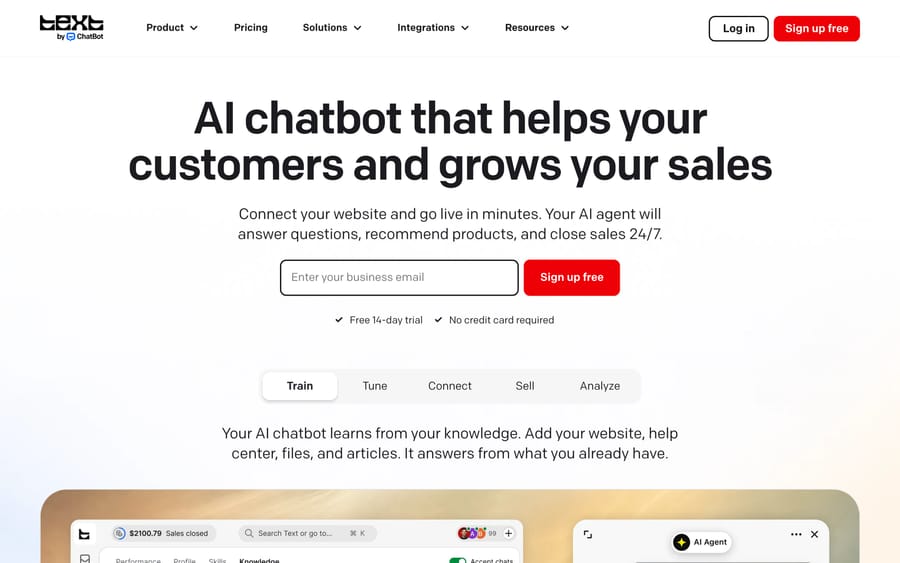
ChatBot.com is an AI chatbot and support-automation product built by Text S.A., a company with a longer institutional history than most names in this category. It started life as LiveChat, a live-chat widget company founded in 2002 by Mariusz Cieply in Wroclaw, Poland. Text S.A. is publicly traded on the Warsaw Stock Exchange under the ticker TXT, which means it files audited financial reports, a rare degree of transparency for a company this size in the AI support space. The company renamed itself from LiveChat Software to Text S.A. in September 2023 to reflect a product line that now spans four tools: LiveChat (the original live-chat widget), ChatBot (the AI chatbot builder this guide covers), HelpDesk (email ticketing), and KnowledgeBase.
On its own site, Text (ChatBot.com's parent) claims 35,000+ brands use its products, and the ChatBot.com homepage itself names Unilever, UEFA, BASF, and Danone among its customer logos, alongside case studies from smaller direct-to-consumer sellers like Hairlust and Wembley Stadium's ecommerce arm. That mix, a handful of large logos plus a long tail of small retail brands, says something about how ChatBot.com is actually used inside big organizations: likely a single team or brand deploying it for one channel, not an enterprise-wide rollout.
How ChatBot.com's AI works
ChatBot.com trains an AI agent on a company's own content: its website, help center articles, uploaded files, and documents. Once trained, the agent answers customer questions directly in chat, and ChatBot.com's own marketing leans specifically on a sales angle most pure support tools don't emphasize: the AI is built to "spot buying signals mid-conversation" and recommend products, positioning it as much for ecommerce conversion as for ticket deflection.
The product runs on a no-code flow builder, so a team without engineers can define specific conversation paths, then layer the AI agent on top for anything outside those defined flows. When the AI can't resolve something (or a customer explicitly asks for a person), ChatBot.com hands off to a human agent with the conversation's full context attached, avoiding the "please repeat your issue" problem that plagues weaker handoffs.
Where it lives
ChatBot.com deploys across website chat, Facebook Messenger, WhatsApp, SMS, and email, and integrates with Shopify, WooCommerce, WordPress, Slack, HubSpot, Mailchimp, Klaviyo, Twilio, and Zapier, among 40-plus listed integrations, per its own site. That breadth is aimed squarely at ecommerce and small-to-mid-size retail teams, not at a help desk-centric enterprise support org running Zendesk as the system of record. ChatBot.com's own site lists healthcare, banking, and education as target sectors too, but the integration list and the "buying signals" framing both point at commerce as the core use case.
Resolutions as the metering unit
The mechanism worth understanding before pricing is the concept of a resolution: a conversation the AI actually handles rather than escalating to a human or a scripted flow. Every plan caps the number of AI resolutions per month, which is the real usage limit even though the headline price is quoted per user seat. A five-person team on the entry plan isn't paying for five AI agents worth of capacity; it's paying for five logins and one shared bucket of 10 monthly AI resolutions.
Key features
- AI agent trained on company content: website, help center, uploaded files.
- No-code flow builder for scripted conversation paths alongside the AI.
- Multi-channel deployment: website chat, Messenger, WhatsApp, SMS, email.
- Sales-oriented AI, tuned to surface buying signals and recommend products.
- Human handoff with full context, avoiding a cold transfer.
- Reply suggestions and AI text edits for human agents drafting replies manually.
- 40+ integrations, including Shopify, WooCommerce, HubSpot, and Zapier.
ChatBot.com pricing
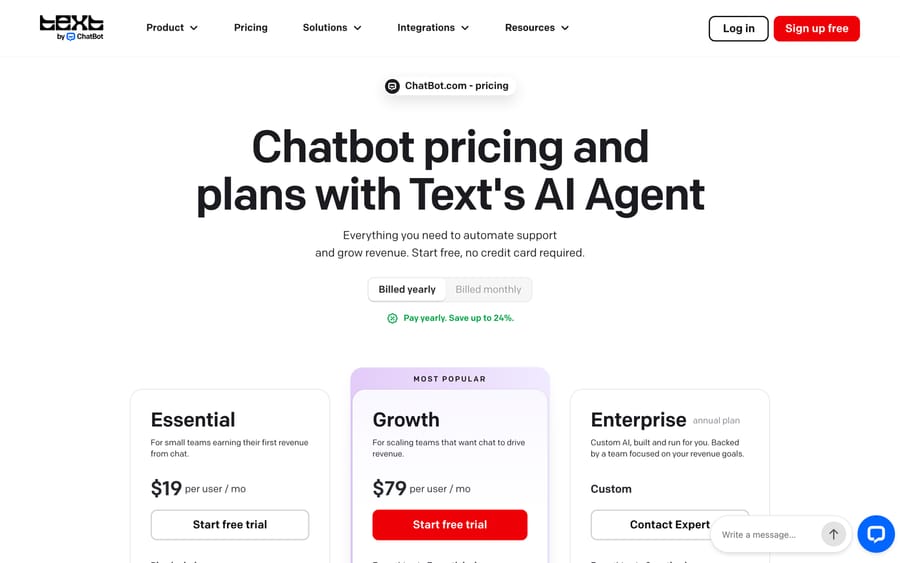
ChatBot.com publishes real, checkable pricing, unusual for this category:
| Plan | Price (billed yearly) | AI resolutions/month | Notable inclusions |
|---|---|---|---|
| Essential | $19/user/month | 10 | 1 AI agent, 5 reply suggestions, Shopify integration, 50 tracked live visitors |
| Growth | $79/user/month | 200 | 10 AI agents, chat supervision and takeover, 10 teams, chat routing rules |
| Enterprise | Custom | Flexible | Custom AI agents, SSO, audit logs, SOC 2/GDPR/CCPA/PCI DSS compliance |
Billed monthly instead of yearly, Essential runs $25/user and Growth runs $99/user, per ChatBot.com's own pricing page. Every plan includes a 14-day free trial, no credit card required.
The number worth doing arithmetic on is the resolution cap. Essential's 10 AI resolutions a month works out to roughly one every three days: fine for a very small store testing the water, immediately outgrown by anything with real ticket volume. Growth's 200 a month is closer to a working support queue, but a team doing more than about 6-7 AI resolutions a day needs Growth just to stay inside the cap, regardless of how many human seats it actually needs. That's the incentive built into the pricing: since the seat price and the resolution cap are bundled into the same plan tier, a team with real volume ends up paying for Growth's extra seats whether it needs them or not, just to unlock enough AI capacity.
Pros and cons
Pros
- Real, published pricing with a usable free trial and no credit card required.
- Backed by an established, publicly traded parent company with two decades of operating history.
- No-code flow builder lets a non-technical team define specific conversation paths.
- Genuine multi-channel reach: chat, Messenger, WhatsApp, SMS, and email from one product.
- Sales-oriented features (buying-signal detection, product recommendations) that pure support tools skip.
Cons
- The monthly AI resolution cap is bundled to seat count, so scaling AI usage often means buying seats a team doesn't need.
- Essential's 10 resolutions a month is enough for evaluation only, not production support volume.
- Not built around a help desk's ticket workflow the way a Zendesk- or Freshdesk-native tool is; it's a chat-first product that happens to also do email.
- Enterprise pricing is opaque, same as most of this category once volume gets serious.
Who ChatBot.com is best for
ChatBot.com fits a small or mid-size ecommerce or retail team that wants one tool covering website chat, Messenger, and WhatsApp, with an AI layer that both answers questions and nudges toward a sale. The no-code builder and the Shopify/WooCommerce integrations point squarely at that buyer, and the entry price makes it genuinely easy to try before committing budget. It also suits a team that hasn't picked a dedicated help desk yet and would rather run support and light sales out of one chat-first tool than assemble a separate ticketing system, a chat widget, and an automation layer from three vendors.
It's a weaker fit for a team whose support already runs through a dedicated help desk like Zendesk or Freshdesk and wants AI acting inside that ticket queue instead of in a separate chat widget. It's also a poor fit for a team with real ticket volume trying to stay on the entry-level plan: the resolution cap forces an upgrade well before most of Growth's other features become relevant. A useful gut check is where a team's tickets already live. If they're piling up in a help desk inbox, adding a second chat-based AI product on top means an agent has to watch two systems instead of one.
ChatBot.com vs alternatives
| ChatBot.com | Chatbase | Macha | |
|---|---|---|---|
| Model | Multi-channel AI chatbot with sales features | AI chatbot trained on a knowledge base | AI agent layer on your existing help desk |
| Best for | Small/mid ecommerce and retail teams | Website chat widget, simple deployments | Teams on Zendesk, Freshdesk, Gorgias, or Front |
| Pricing | $19-$79/user/mo, published, metered by resolution cap | Published tiers on its site | From $299/mo for 750 tickets (~$0.40/ticket), published |
| Setup | Self-serve, no-code flow builder | Self-serve | Built, tested, and monitored by the Macha team |
| Trial | 14 days, no credit card | Free tier available | $50 free usage |
| Replaces your help desk? | No, but often used instead of one for small teams | No | No, deliberately augments it |
ChatBot.com and Macha solve different problems for different-sized teams. ChatBot.com suits a team that hasn't adopted a dedicated help desk yet, or wants a chat-first, sales-aware widget across several messaging channels. Macha fits teams that have already standardized on Zendesk, Freshdesk, Gorgias, or Front and want the tickets already flowing through that system automated, instead of adding a separate chat product alongside it. The deciding factor is where the ticket already lives, and whether a team wants to add a new system or automate the one it has. For a simpler, single-purpose chat widget trained purely on a knowledge base, Chatbase is the closer comparison to ChatBot.com's core chat feature, without the sales and multi-channel layer.
FAQ
What is ChatBot.com? ChatBot.com is an AI chatbot platform for website chat, Messenger, WhatsApp, SMS, and email, built by Text S.A. (formerly LiveChat Software), aimed mainly at ecommerce and retail support and sales.
How much does ChatBot.com cost? Essential starts at $19/user/month billed yearly ($25 billed monthly) with 10 AI resolutions a month. Growth is $79/user/month billed yearly ($99 monthly) with 200 resolutions a month. Enterprise pricing is custom.
Does ChatBot.com offer a free trial? Yes, a 14-day free trial with no credit card required, on every plan.
Who owns ChatBot.com? ChatBot.com is a product of Text S.A., a Polish company publicly listed on the Warsaw Stock Exchange (ticker TXT), founded in 2002 as LiveChat Software and renamed in September 2023.
What's a "resolution" in ChatBot.com's pricing? A resolution is a conversation the AI agent handles on its own, without escalating to a human or a scripted flow. It's the real usage limit on every plan, separate from the number of seats a team pays for.
What help desks or platforms does ChatBot.com integrate with? Shopify, WooCommerce, WordPress, Slack, HubSpot, Mailchimp, Klaviyo, Twilio SMS, and Zapier, among 40-plus listed integrations, per ChatBot.com's own site.
Which companies use ChatBot.com? ChatBot.com's homepage names Unilever, UEFA, BASF, and Danone among its customer logos, and parent company Text states 35,000+ brands use its products overall.
What's a good alternative to ChatBot.com for a help desk-based support team? Macha runs as an agent layer on top of the help desk (Zendesk, Freshdesk, Gorgias, or Front) a team already uses, instead of adding a separate chat widget, and Chatbase is a closer comparison for a simpler, knowledge-base-only chat widget.
Sources: ChatBot.com homepage, ChatBot.com pricing, Text (company) — Wikipedia.
Resolve tickets automatically with AI agents
Macha's AI agents work on top of the help desk you already use — no code.