Shopify
 Stripe
 Slack
Slack Notion
 Google Workspace
 Confluence

Botsonic: The Complete Guide (2026)


Botsonic is Writesonic's AI chatbot product: point it at a website, help center, or a pile of PDFs, and it builds a support agent you embed as a widget or connect to WhatsApp, Slack, and email. This guide covers what Botsonic actually does, how it works, its full published pricing by tier, where it's strong, where it's thin, and how it compares to the alternatives worth putting next to it.

We build AI agents for customer service ourselves, on top of the help desk a team already runs. We checked Botsonic's own site and pricing page directly before writing this, since its pricing is fully public and there's no excuse for guessing it.
What is Botsonic?
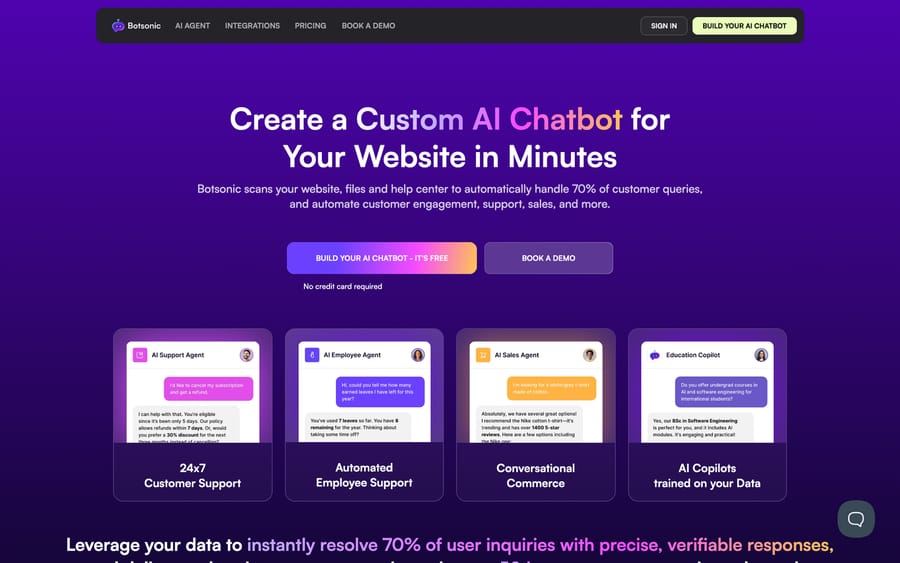
Botsonic is an AI chatbot and agent builder from Writesonic, the AI writing company Samanyou Garg founded in 2021 with $2.6 million raised from Y Combinator, HOF Capital, Soma Capital, and Rebel Fund. Where Writesonic itself focuses on generating marketing copy, Botsonic is the company's dedicated product for customer-facing support: an AI agent trained on a business's own website, files, and help center content, deployed as a chat widget or through connected channels.
On its site, Botsonic claims its agents "resolve 70% of customer questions instantly," a vendor-reported figure worth treating as a ceiling rather than a guarantee, since it depends entirely on how well a business's existing content actually answers its own tickets. Botsonic states it serves 5,000+ teams and lists Microsoft, Deloitte, Honeywell, Pfizer, and Vodafone as customers on its site, alongside a heavier presence in education, real estate, healthcare, retail, hospitality, and travel.
Botsonic positions itself for SMB and mid-market teams first: pricing starts under $20 a month, and the sign-up flow is self-serve rather than sales-led. That is a real point of difference from most of the enterprise-first AI vendors in this category.
How Botsonic's AI works
A Botsonic deployment follows three steps: import content, train the agent, then customize and deploy it. Content import pulls from PDFs, websites (including a full sitemap crawl), Google Drive, Confluence, and Notion, so a support team doesn't need to manually copy every help article into the tool.
Botsonic describes its underlying approach as "model-agnostic," using what it calls proprietary routing technology instead of committing to a single AI provider. In practice that means Botsonic routes a query to different underlying models depending on plan tier and task, instead of a customer choosing and configuring a model directly. Professional and higher plans specifically call out access to GPT-4o and upcoming models. Gating the better model behind a paid tier is a standard SaaS packaging move: it gives Botsonic an upsell path as a team's needs grow, and it earns the vendor more from the accounts that actually need GPT-4o-level answers.
Once trained, an agent can be customized for branding and tone, then embedded as a widget or wired into WhatsApp, Facebook Messenger, Slack, and email. Botsonic also builds in a handoff path to a human agent for anything the AI can't resolve, and offers "agentic actions" (a limited, tier-gated number per plan) for tasks beyond answering a question, like triggering a workflow or a callback request.
Key features
- Multi-source content ingestion: PDFs, websites and sitemaps, Google Drive, Confluence, and Notion.
- Multilingual support across 50+ languages.
- Omnichannel deployment: website widget plus WhatsApp, Facebook Messenger, Slack, and email.
- Model-agnostic routing, with GPT-4o access starting at the Professional tier.
- Agentic actions and workflows (tier-gated counts) for tasks beyond answering a question.
- Analytics and conversation monitoring, plus a handoff path to a human agent.
- Security and compliance: AES-256 encryption, SOC 2 Type II, GDPR, and HIPAA alignment.
Botsonic pricing
Botsonic publishes its full pricing, which is unusual in this category and worth taking at face value rather than treating as a floor.
| Plan | Price (annual / monthly) | Chatbots | Messages/mo | Characters | Team members |
|---|---|---|---|---|---|
| Starter | $16 / $19 per month | 1 | 1,000 | 10M | 1 |
| Professional | $41 / $49 per month | 2 | 3,000 | 50M | 2 |
| Advanced | $249 / $299 per month | Unlimited | 12,000 | 100M | 5 |
| Enterprise | Custom | Custom | Custom | Custom | Custom |
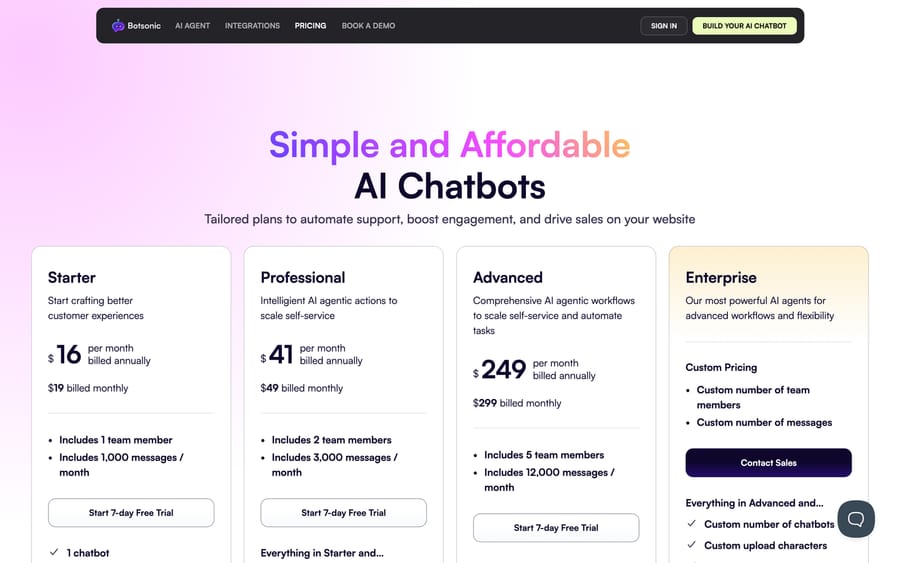
A few things worth adding beyond the table. Every tier meters messages, so a Starter account that gets 1,200 conversations in a month either buys an add-on (2,000 extra messages for $25) or upgrades. Extra team seats cost $25 each, removing the Botsonic branding is a $49 add-on, and extra character capacity for training data is $10 per 20 million characters. Professional is the first tier with GPT-4o access; Advanced adds workflows, a training session, and API access; Enterprise adds SSO/SAML and deeper integrations like Salesforce, Freshdesk, and HubSpot. A 7-day free trial is available across all plans, and annual billing saves roughly 20% versus monthly.
The practical read: Botsonic's list price undersells what a real deployment costs once you're metering messages against a live support queue. A team running 3,000 real tickets a month on Professional's cap will be buying message add-ons every month, which changes the effective price from "$41 a month" to something closer to what a mid-volume support tool actually costs.
Pros and cons
Pros
- Fully published pricing with a self-serve signup, unusual for this category.
- Broad content ingestion (PDFs, sitemaps, Drive, Confluence, Notion) with no engineering required to set up.
- Multilingual out of the box across 50+ languages.
- Real enterprise-name customers alongside SMB-friendly entry pricing.
Cons
- Messages are metered tightly at the lower tiers; a team with real ticket volume will hit the cap and pay add-on fees monthly.
- "Model-agnostic routing" means you don't get direct control over which model answers a given query below the top tiers.
- Agentic actions (beyond simple Q&A) are capped low even on paid plans, which limits how much of a workflow the agent can actually complete versus just answering questions.
Who Botsonic is best for
Botsonic suits teams that want a working AI chatbot live within a day, without a sales call, on a small support or marketing team whose volume fits comfortably inside a few thousand conversations a month. If you already use Writesonic for content, adding Botsonic is a low-friction way to extend that into support.
It's a weaker fit for a team with high ticket volume that will outgrow the message caps within a quarter, or one that wants the AI to take real actions inside a help desk (updating a ticket, issuing a refund, checking an order) rather than mostly answering questions and handing off the rest to a human.
Botsonic vs alternatives
| Botsonic | Chatbase | Macha | |
|---|---|---|---|
| Model | AI chatbot trained on your content, model-agnostic routing | AI chatbot trained on your content, choose your own model | AI agent layer on top of your existing help desk |
| Best for | SMB/mid-market teams wanting a fast, self-serve chatbot | Developers and SMBs wanting a customizable, embeddable chatbot | Teams on Zendesk, Freshdesk, Gorgias, or Front handling day-to-day ticket volume |
| Pricing | Published: $19-$299/mo by tier, metered messages, Enterprise custom | Published: metered by message credits | From $299/month for 750 tickets (~$0.40/ticket), published |
| Deployment | Widget plus WhatsApp, Messenger, Slack, email | Widget, API, integrations | Configured inside the help desk you already run |
| Setup | Self-serve, live same day | Self-serve, live same day | Built, tested and monitored by the Macha team |
| Trial | 7 days, all plans | Free tier available | $50 free usage |
| Replaces your help desk? | No, sits alongside it as a widget | No | No, deliberately augments it |
Botsonic and Chatbase compete directly: both are self-serve, content-trained chatbots priced by message volume, aimed at teams that want something live fast without a sales process. Macha is a different shape of product. It doesn't add a new widget; it works inside the help desk your team already has open all day, acting on the tickets that arrive there instead of deflecting them at a separate chat window. If a simple content-trained widget answers most of your questions, Botsonic or Chatbase is the cheaper, faster option. If your tickets need real actions taken inside Zendesk, Freshdesk, Gorgias, or Front, that's what Macha is built for.
FAQ
What is Botsonic? Botsonic is Writesonic's AI chatbot and agent builder: it trains an AI agent on a business's website, files, and help center content, then deploys it as a widget or through WhatsApp, Messenger, Slack, and email.
How much does Botsonic cost? Published pricing runs from $19/month (Starter, 1,000 messages) to $299/month (Advanced, 12,000 messages), with custom Enterprise pricing above that. Annual billing saves about 20%, and message overages cost $25 per 2,000 extra messages.
Does Botsonic have a free trial? Yes, a 7-day free trial is available on every plan.
Who owns Botsonic? Botsonic is a product from Writesonic, founded by Samanyou Garg in 2021 and backed by Y Combinator, HOF Capital, Soma Capital, and Rebel Fund.
What does "model-agnostic routing" mean? Botsonic doesn't lock a deployment to one AI provider; it routes queries using its own routing technology, with GPT-4o access specifically available starting at the Professional tier.
Which companies use Botsonic? Botsonic states it serves 5,000+ teams and names Microsoft, Deloitte, Honeywell, Pfizer, and Vodafone as customers on its site, concentrated in education, real estate, healthcare, retail, hospitality, and travel.
What are good alternatives to Botsonic? Chatbase is the closest comparison: a similar self-serve, content-trained chatbot priced by message volume. For a team that wants an AI agent working inside its existing help desk rather than a separate chat widget, Macha is a different shape of tool worth comparing.
Does Botsonic replace a help desk? No. It's a chatbot widget layered on top of a website or messaging channel, with a handoff path to a human agent for anything it can't resolve. It doesn't work tickets inside Zendesk, Freshdesk, or Gorgias the way a help-desk-native AI agent does.
Sources: Botsonic homepage, Botsonic pricing, Writesonic about page.
Resolve tickets automatically with AI agents
Macha's AI agents work on top of the help desk you already use — no code.