



 Intercom
 Shopify
 Stripe
 Slack
Slack Notion
 Google Workspace
 Confluence

CustomGPT.ai: The Complete Guide (2026)


CustomGPT.ai is a no-code platform for building AI agents out of a business's own documents, websites, and knowledge bases, aimed at teams who want a retrieval-grounded chatbot without writing a RAG pipeline themselves. This guide covers what it does, how the retrieval and anti-hallucination claims actually work, real plan pricing including the add-on costs the pricing page doesn't headline, pros and cons, and how it stacks up against Chatbase and against an AI agent layer like Macha that runs inside a help desk.

CustomGPT Inc. was founded in 2023 by Alden Do Rosario and is based in Needham, Massachusetts, with a team of roughly 35 people according to its own site. The company describes itself as "the #1 no-code platform for creating custom AI agents for your business" and says it serves "10,000+ organizations worldwide," listing reference customers including the University of Virginia, the United Nations, Medtronic, MIT, Dropbox, and Adobe. Those are vendor-stated logos; we didn't independently confirm the scope of any of those engagements.
What is CustomGPT.ai?
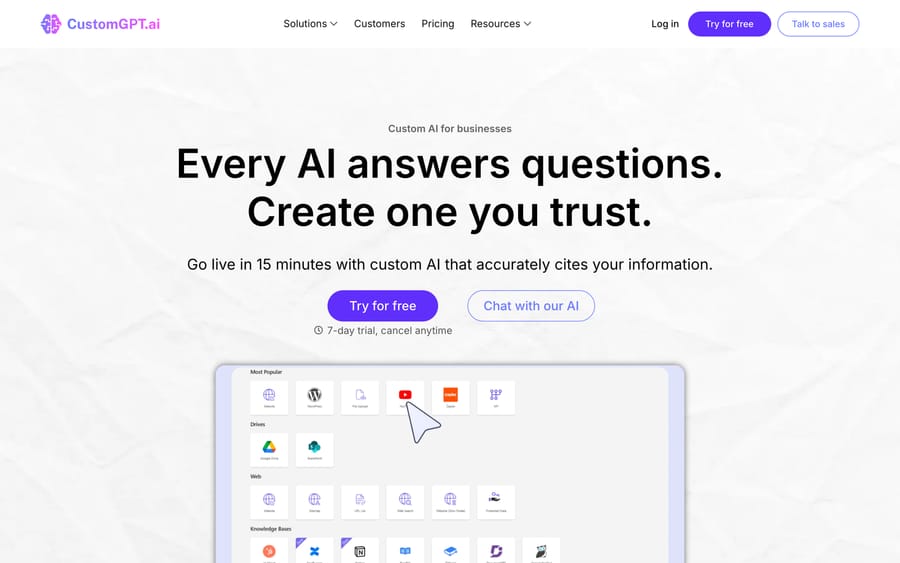
CustomGPT.ai sits in the same category as SiteGPT and Chatbase: point it at your content, get a chat agent that answers from it. What separates its pitch is an explicit focus on accuracy. Where most competitors lead with setup speed, CustomGPT.ai leads with a claim that it's "third-party verified #1 for anti-hallucination technology, beating out major players like OpenAI and Google." Every response is meant to carry a citation linking back to the source document, and the company states plainly that customer data "will never [be used] to train any Large Language Model (LLM) or AI in general."
That accuracy framing lines up with who buys it. The named customers skew toward institutions where a wrong answer is expensive: a university handling student and financial-aid questions, a government body, a healthcare device maker. For those buyers, the pitch isn't "fast to set up," even though it is. It's "won't confidently make something up," and the product is priced and marketed around defending that claim.
How CustomGPT.ai's AI works
The mechanism is retrieval-augmented generation, same as SiteGPT and Chatbase: ingest content, index it, retrieve relevant chunks per question, generate an answer grounded in those chunks. CustomGPT.ai's ingestion is broader than most in this category. It claims support for 1,400+ file formats, plus direct ingestion from a website crawl, a help desk, video, and even podcast audio, so a company's existing documentation doesn't have to be reformatted before it's usable.
The anti-hallucination claim is worth unpacking. CustomGPT.ai doesn't publish the methodology or name the third party behind the "beating OpenAI and Google" comparison on the page we checked, so it's a marketing claim, not a citable benchmark. What we can verify is the mechanism it rests on: citation-backed answers, meaning every generated response links to the specific source passage it drew from. That's a real, checkable feature. A support lead can click through and confirm the AI didn't invent the refund policy it just quoted, which is a meaningfully different guarantee than "trust the model." It doesn't eliminate every failure mode. Retrieval can still surface the wrong chunk, or the generation step can misread a correctly retrieved passage, and a citation only proves where the AI looked; it doesn't prove the summary of that source is accurate. Verifying a citation still takes a human click, which is real friction for a support team fielding hundreds of tickets a day. It's still a checkable friction, better than trusting the model's answer blind.
Deployment and integrations
CustomGPT.ai lists 100+ integrations, including Google Drive, HubSpot, WordPress, Shopify, Notion, and Zapier, and it supports 92 languages for both source content and conversations. Deployment options extend past a website widget to platforms like SharePoint, and the RAG API is available from the entry-level Standard plan, so a team that wants to embed the retrieval logic into its own app, instead of the default widget, can do that immediately.
Key features
- 1,400+ file formats ingested, plus website, help desk, video, and podcast sources.
- Citation-backed responses, with every answer linking to the source it drew from.
- 100+ integrations, including CRM, CMS, and automation tools (HubSpot, WordPress, Shopify, Zapier).
- 92 languages for content and conversation.
- White-label branding removal, available starting on the Premium plan.
- RAG API access on every paid plan, including Standard.
- SOC 2 Type II and GDPR compliance claims, per the vendor.
The Enterprise tier adds a layer most competitors in this category don't offer at any price: forward-deployed engineers, bespoke agent design, a dedicated solutions and account team, and white-glove onboarding with real-time sync across every connected data source. That's a services commitment closer to what an enterprise buyer expects from a platform like Netomi than from a self-serve chatbot builder, and it signals who CustomGPT.ai wants at that tier: an organization with a procurement process and a compliance review, buying on a contract instead of a credit card.
CustomGPT.ai pricing (researched)
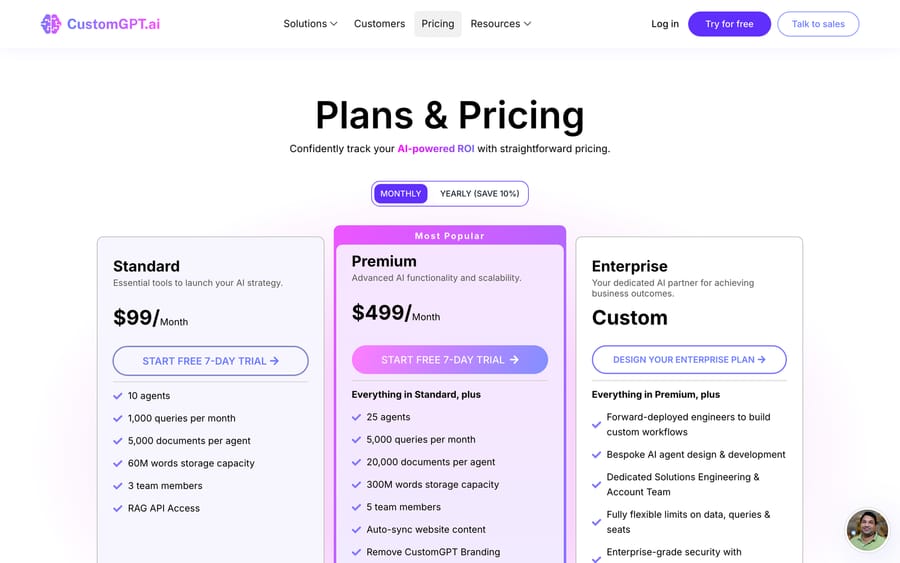
We checked CustomGPT.ai's pricing page directly. Three tiers, billed monthly or annually at a 10% discount:
| Plan | Monthly | Annual (per mo) | Agents | Queries/mo | Docs/agent | Word storage | Seats |
|---|---|---|---|---|---|---|---|
| Standard | $99 | $89 | 10 | 1,000 | 5,000 | 60M words | 3 |
| Premium | $499 | $449 | 25 | 5,000 | 20,000 | 300M words | 5 |
| Enterprise | Custom | Custom | flexible | flexible | flexible | flexible | flexible |
The jump from Standard to Premium is the thing to notice: 5x the price for 5x the queries, so the per-query rate doesn't actually improve until you're at Enterprise scale and negotiating. And the add-ons reveal where the real margin sits. An extra 2,500 queries costs $375/month, which is more per query than the entire Standard plan. Extra storage, extra documents, and extra seats are all priced the same way, as discrete $100-$300/month blocks instead of a usage-based rate that scales down. The incentive behind that structure is straightforward: overage pricing is set high enough that a growing Standard customer finds it cheaper to upgrade to Premium than to keep buying add-ons piecemeal, which is a normal SaaS tactic but worth doing the arithmetic on before you commit to a tier. Every plan, including Enterprise proof-of-concept packages, comes with a trial, and the paid tiers offer 7 days free.
Pros and cons
Pros
- Citation-backed answers are a genuine, checkable accuracy feature, not just a marketing line.
- Broad ingestion (1,400+ formats plus video and podcast) covers messier content libraries than a website-crawl-only tool.
- RAG API included from the entry plan, useful for teams that want to build their own interface.
- Named institutional customers (UVA, MIT, Medtronic) suggest real use at organizations with strict accuracy requirements.
Cons
- The headline anti-hallucination ranking isn't backed by a named, checkable study on the page we reviewed.
- Query caps are tight relative to price: 1,000 queries a month on Standard is a small support desk, not a growing one.
- Add-on pricing for extra queries, storage, or seats runs well above the effective per-unit rate of the base plan, which pushes upgrades hard.
- Like SiteGPT and Chatbase, it answers questions from content. It doesn't take an action like issuing a refund or updating a subscription.
Who CustomGPT.ai is best for
CustomGPT.ai fits organizations where answer accuracy and source traceability matter more than raw speed of setup: universities, healthcare and life-sciences companies, government bodies, and any team that needs to show a compliance reviewer exactly where an AI answer came from. If your support or research questions are answerable from a large, messy library of PDFs, videos, and help articles that nobody has cleaned up, the broad ingestion is a real advantage over a competitor that only crawls a website.
It's the wrong choice if you need the AI to take action, not just answer a question. Nothing in CustomGPT.ai's feature set looks up an order, processes a refund, or writes back to a CRM record; it answers from what it indexed and stops there. It's also worth checking your expected query volume against the plan caps before signing: a support desk handling a few thousand tickets a month will outgrow Standard fast, and the add-on math makes staying on Standard past that point expensive.
A rough gut check on volume: 1,000 queries a month on Standard is roughly 33 a day, enough for a low-traffic help center or an internal knowledge tool for a small team but thin for a public-facing support widget on a site with meaningful traffic. Premium's 5,000 queries a month, about 165 a day, is closer to what an actual support desk needs, which is presumably why the vendor lists it as "Most Popular." Budget from Premium up if you're evaluating this for live customer support instead of internal research.
CustomGPT.ai vs alternatives
| CustomGPT.ai | Chatbase | Macha | |
|---|---|---|---|
| Model | Citation-backed, content-trained agent | Website-trained chatbot widget | AI agent layer on your existing help desk |
| Best for | Compliance-sensitive orgs needing traceable answers | Small sites with static FAQ content | Teams on Zendesk, Freshdesk, Gorgias or Front |
| Can take actions (refunds, order lookups)? | No | Limited, via integrations | Yes, via connectors and custom tools |
| Pricing | $99–$499/mo by query cap, published | Published, message-based (see our Chatbase guide) | From $299/mo for 750 tickets (~$0.40/ticket), published |
| Setup | Self-serve, no-code | Self-serve, no-code | Built, tested and monitored by the Macha team |
| Trial | 7 days free | Free tier available | $50 free usage |
CustomGPT.ai and Chatbase both answer questions from indexed content, so the choice between them usually comes down to how messy your source library is and how much you value citation-backed answers versus raw setup speed. Macha solves a different problem. It's an AI agent layer that sits inside the help desk your team already runs, with connectors into order data, subscriptions, and other backend systems, so it can resolve a ticket rather than just answer a question about one. If your support volume already lives in Zendesk, Freshdesk, Gorgias, or Front and needs an action taken, not just an answer given, that's the gap neither CustomGPT.ai nor Chatbase closes. See how Macha's agents work and current pricing.
FAQ
What is CustomGPT.ai? A no-code platform that builds AI agents from a business's own documents, websites, and other content, answering questions with citations back to the source material.
How much does CustomGPT.ai cost? Standard is $99/month for 1,000 queries and 10 agents. Premium is $499/month for 5,000 queries and 25 agents. Enterprise is custom. Annual billing saves 10% on either paid plan.
Does CustomGPT.ai offer a free trial? Yes, a 7-day free trial on Standard and Premium, and custom proof-of-concept packages for Enterprise evaluations.
Is CustomGPT.ai's anti-hallucination claim independently verified? The vendor states it's "third-party verified #1 for anti-hallucination technology," but doesn't name the study or methodology on the page we checked. The checkable part of the claim is that every answer carries a citation to its source, which you can verify yourself.
Can CustomGPT.ai take actions like issuing refunds? No. It generates answers from indexed content. Looking up an order or processing a refund requires a tool built to read and write to your backend systems, which is outside what a content-trained agent does.
What are good alternatives to CustomGPT.ai? Chatbase is the closest direct comparison in the same content-trained-chatbot category. For teams whose support already runs through a help desk and needs agents that can act on tickets, an AI agent layer like Macha is a different kind of alternative worth comparing.
Who uses CustomGPT.ai? The vendor names the University of Virginia, the United Nations, Medtronic, MIT, Dropbox, and Adobe among its customers, and states it serves 10,000+ organizations overall.
What happens if I go over my monthly query limit? CustomGPT.ai sells query add-ons (2,500 extra queries for $375/month on Standard), priced well above the base plan's per-query rate, which makes upgrading to the next tier the cheaper option once usage grows past a certain point.
Sources: CustomGPT.ai homepage, CustomGPT.ai pricing.
Resolve tickets automatically with AI agents
Macha's AI agents work on top of the help desk you already use — no code.