Intercom
 Shopify
 Stripe
 Slack
Slack Notion
 Google Workspace
 Confluence

DocsBot: The Complete Guide (2026)


DocsBot turns a business's existing documentation, help center, and knowledge sources into AI agents that answer questions and take actions across chat, voice, and phone. It went through a full pricing overhaul in 2026 that renamed every plan and reshuffled what's included, so a lot of older reviews describe a product that no longer quite matches what's for sale today. This guide covers what DocsBot actually does now, how its credit-based pricing works, and where it fits against the alternatives.

We checked DocsBot's own pricing page and its 2026 pricing-update FAQ directly to catch the recent tier renames, since a search for "DocsBot pricing" still turns up plenty of pages describing the old plan names.
What DocsBot is
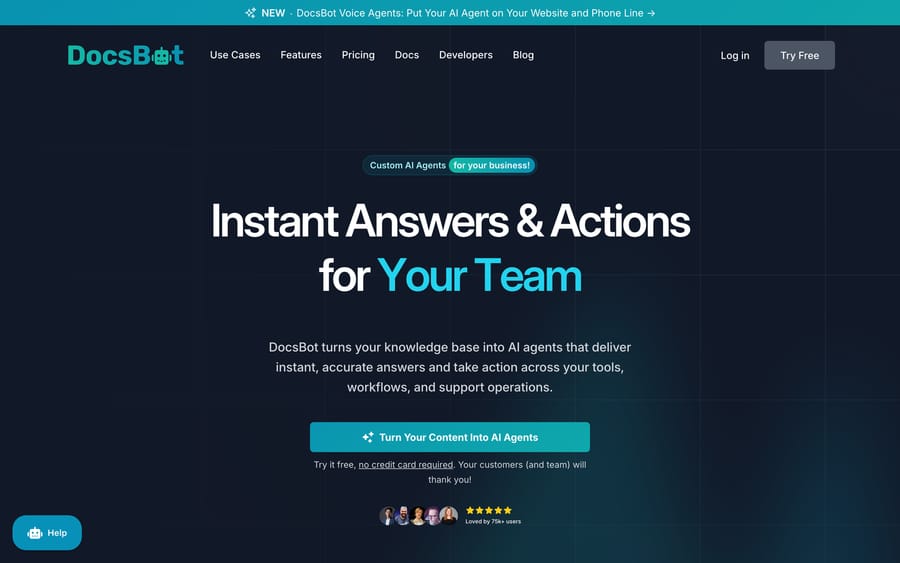
DocsBot ingests a business's existing content: websites, PDFs, Google Drive, Notion, Confluence, Zendesk articles, Help Scout docs, and more than 38 source types in total, and builds a retrieval-backed AI agent that answers from that material instead of the model's general training data. On top of the core chatbot, DocsBot has expanded into Voice Agents for websites and phone lines, a Deep Research Agent that combines document analysis with live web search and code interpretation, and AI Actions, a skill-builder layer that lets the agent call APIs and webhooks to do something instead of only answer.
DocsBot publishes a small set of customer references to back this up: Sony's NURO 光 support brand reportedly handles 30,000+ inquiries a month through DocsBot at roughly an 80% resolution rate, WingArc1st is cited for how fast the company ships new features, and Sentry.io uses an embedded widget on its own documentation. DocsBot also markets 75,000+ users and 3,000+ businesses on the platform. Those volume figures are vendor-reported with no independent audit behind them, so treat them as scale claims, useful for context but not a benchmark to plan your own deployment against.
How DocsBot's AI works
The mechanism is standard retrieval-augmented generation with a few DocsBot-specific pieces layered on. You connect a source (a URL to crawl, a PDF upload, a Notion or Confluence sync, a Zendesk or Help Scout knowledge base), DocsBot indexes it, and the bot answers customer questions by retrieving the relevant passages and generating a response grounded in them instead of in whatever the underlying model already knows. AI Actions extend that from answering into doing: a skill-builder interface lets you define API calls or webhooks the agent can trigger mid-conversation, so a bot can, for example, create a support ticket, look up an order, or process a Stripe payment action instead of just describing how to do it.
PII Redaction is a real mechanism worth naming specifically: DocsBot runs a custom-trained model in the visitor's own browser, stripping personal information before it's sent to the AI at all, instead of redacting it server-side after the fact. That's a meaningfully different privacy posture from most competitors, and it's gated to the Business plan and above.
Usage is metered in AI Credits, and the incentive behind that design is straightforward: a plain chat message on a lightweight model costs 1 credit, while a larger model, an AI Action, or a skill-builder test run costs more, rounded to the nearest credit. That means DocsBot earns more credit consumption only when a conversation actually does more work, whether that's a heavier model or a real action taken, instead of charging a flat per-message rate regardless of what the message required. When an account exhausts its monthly credits, the bot stops responding and shows visitors an error message until the plan renews, auto top-up kicks in, or you upgrade.
Key features
- AI Agents/Chatbots: trained on your connected knowledge sources, deployable as an embedded widget, a popup, or via API.
- Voice Agents: natural-conversation interfaces for websites and phone lines, on top of the same knowledge base.
- Deep Research Agent: document analysis combined with live web search and code interpretation for more complex questions.
- AI Actions and skill builder: define API/webhook calls the agent can trigger, including built-in Stripe billing actions on the Standard plan and above.
- PII Redaction: browser-side, custom-trained local model that strips personal data before it reaches the AI (Business plan and above).
- 38+ content sources: websites, PDFs, Google Drive, Notion, Confluence, Zendesk, Help Scout, and more.
- 7,000+ app integrations: native Slack, Microsoft Teams, HubSpot, Discord, and Asana, plus Zapier and Make for everything else.
DocsBot pricing (researched)
DocsBot's pricing went through a full restructuring in 2026: the old Hobby, Power, Pro, and Business plans were renamed and consolidated into Legacy (discontinued for new signups), Personal, Standard, and Enhanced, respectively, with legacy Pro subscribers migrating to the new Standard plan at their next renewal after March 1, 2026. DocsBot's own explanation is that 20+ major features shipped since launch had made the old tiers overlap and confuse buyers, and that the new tiers better match actual usage.
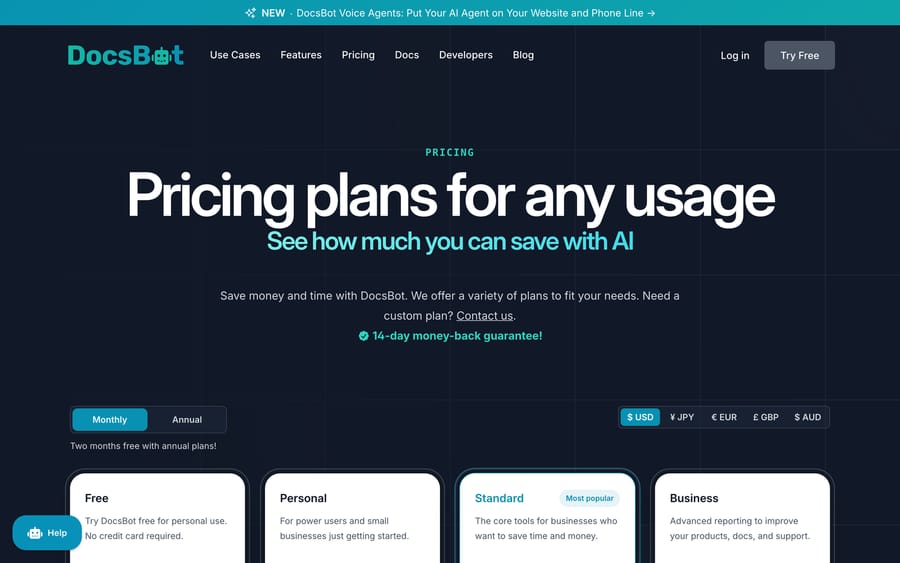
The current published plans:
| Plan | Price | Bots | Source pages | Monthly AI credits | Notable extras |
|---|---|---|---|---|---|
| Free | $0 | 1 | 50 | 100 | 1 user, basic sources only |
| Personal | $49/mo | 1 | 5,000 | 5,000 | 3 actions/bot, Zapier, Slack, Messenger/WhatsApp/Telegram |
| Standard | $149/mo | 3 | 15,000 | 15,000 | 8 actions/bot, skills builder, escalation tickets, Stripe actions, web search |
| Business | $499/mo | 10 | 100,000 | 60,000 | 12 actions/bot, PII redaction, sentiment analysis, SOC 2 Type II, GDPR |
| Enterprise | Custom | Unlimited | Unlimited | Custom | Azure OpenAI, self-hosting, SSO, HIPAA availability |
On top of any plan, add-ons run $49 per 5,000 extra AI credits, $19 per extra bot, $29 per 10,000 extra source pages, and $19 per extra team user (Business plan and above only). Existing Personal and Business (now Enhanced) customers were told not to expect price increases on their current tier, and annual subscribers keep their locked rate until the term ends. If you're pricing DocsBot against an older review, confirm you're looking at the current Standard plan instead of the retired Pro tier it replaced.
Pros and cons
Pros
- Genuinely broad source coverage (38+ types) and a large integration surface (7,000+ apps via Zapier/Make plus native connectors).
- AI Actions and the skill builder go beyond answering into real workflow automation: ticket creation, order lookups, Stripe billing actions.
- Browser-side PII redaction is a real privacy mechanism, beyond a compliance checkbox.
- A usable free tier and a $49/month entry plan for teams that want to try it with a real, if small, deployment.
Cons
- The 2026 plan overhaul means a lot of pricing content across the web, including older reviews, describes plans that no longer exist under those names.
- Credit-based pricing makes cost forecasting harder than a flat per-seat or per-ticket model, since a heavier model or an AI Action can cost several times a plain message.
- PII redaction, sentiment analysis, and SOC 2 Type II are all gated to the $499/month Business plan, out of reach for smaller teams that still care about compliance.
- Vendor-reported scale numbers (75,000+ users, Sony's 80% resolution rate) carry no independent audit.
Who DocsBot suits
DocsBot fits teams that already have a real knowledge base (docs, a help center, product PDFs, a wiki) and want an AI agent that answers from it accurately and can take a handful of defined actions, especially if voice or a research-heavy Q&A mode matters alongside standard chat. The free and Personal tiers make it approachable for a small team, while Standard and Business scale into the kind of skill-builder automation and compliance controls a growing support operation needs.
It's a weaker fit for a team whose support work lives primarily inside a ticketing system instead of a standalone chatbot widget, or one that needs deep two-way integration with a help desk's ticket queue instead of a knowledge-answering bot bolted onto the front end.
DocsBot vs alternatives
| DocsBot | Chatbase | Macha | |
|---|---|---|---|
| Model | Knowledge-source AI agent with voice, research, and action skills | Knowledge-source AI chatbot, chat-first | AI agent layer on top of your existing help desk |
| Best for | Teams with a real knowledge base wanting chat, voice, and defined actions | Teams wanting a fast, simple website chatbot | Teams on Zendesk, Freshdesk, Gorgias, or Front |
| Pricing | $0-$499/mo published tiers plus custom Enterprise, metered by AI credits | Published per-message-credit tiers | One plan by ticket volume, from $299/month for 750 tickets (about about $0.40 per ticket a ticket) |
| Free tier | Yes | Yes | $50 of free usage (about 125 tickets), no credit card, no time limit |
| Actions beyond answering | Yes, via AI Actions/skill builder | Limited | Yes, via help-desk-native agents |
| Setup | Self-serve, no-code | Self-serve, no-code | setup and monitoring by the Macha team, included on every plan |
| Replaces your help desk? | No, sits alongside it | No | No, deliberately augments it |
DocsBot and Chatbase both start from the same idea, a chatbot trained on your content, and compete mostly on how far past plain answering they go. If your support work already happens inside a help desk and the gap is agents that act on tickets instead of a website widget, Macha is built for exactly that: it runs on top of the help desk you already use, priced on ticket volume with published numbers and a pricing page instead of a credit calculator.
FAQ
What is DocsBot? DocsBot is a platform that converts a business's existing documentation and knowledge sources into AI agents that answer questions and take defined actions across chat, voice, and phone.
How much does DocsBot cost? Free for a single bot with 100 monthly AI credits. Paid plans run Personal at $49/month, Standard at $149/month, and Business at $499/month, each with more bots, source pages, and credits, plus a custom Enterprise tier. Add-ons cover extra credits, bots, source pages, and users.
What is an AI Credit in DocsBot's pricing? The unit its usage-based pricing runs on. A standard chat message on a lightweight model costs about 1 credit; a larger model, an AI Action, or a skill-builder test run costs more, rounded to the nearest credit. The bot stops responding once an account's monthly credits run out.
What changed in DocsBot's 2026 pricing update? DocsBot renamed and consolidated its plans: Hobby and Pro became Legacy (discontinued for new customers, with Legacy Pro migrating to Standard at renewal after March 1, 2026), Power became Personal, and Business became Enhanced with added enterprise controls. DocsBot says the change was meant to reduce overlap between tiers after adding 20+ features since launch.
Can DocsBot's AI take actions, or does it only answer questions? Both. Beyond answering from your knowledge sources, AI Actions let you define API or webhook calls the agent can trigger, including built-in Stripe billing actions on Standard and above, so it can create a ticket, look up an order, or process a defined transaction.
Does DocsBot protect personal information in conversations? On the Business plan and above, yes: PII Redaction runs a custom-trained model in the visitor's browser to strip personal data before it reaches the AI, rather than filtering it after the fact server-side.
What are good alternatives to DocsBot? Chatbase is the closest comparison for a knowledge-source chatbot. For teams that want AI agents acting inside an existing help desk's ticket queue rather than a standalone widget, Macha is the more direct fit.
Sources: DocsBot homepage, DocsBot pricing, DocsBot 2026 plan and pricing update FAQ.
Resolve tickets automatically with AI agents
Macha's AI agents work on top of the help desk you already use — no code.