Shopify
 Stripe
 Slack
Slack Notion
 Google Workspace
 Confluence

Lindy AI: The Complete Guide (2026)


Lindy AI is an AI teammate that lives in Slack, connects to your company's tools, and does tasks when someone on the team asks it to. It costs $29.99 to $199.99 per user per month, with each plan carrying a pool of usage credits worth about a cent each. This guide covers what Lindy is today (the product changed shape twice in 2026), how its AI works, the full pricing and credit math, what it can and can't do for a support team, the pros and cons buyers report, and the alternatives worth comparing.

Most "Lindy AI review" pages you'll find describe a product that no longer exists in that form: a no-code agent builder with a free 400-credit plan. We checked Lindy's pricing page, docs and integration pages on September 15, 2026, and the details below reflect what's live now. Where a fact comes from a third party rather than Lindy itself, we say so.
How we researched this. On September 15, 2026 we read lindy.ai, its pricing page, changelog, security page and the current docs, captured the product screenshots below from Lindy's own documentation, and pulled ratings from Capterra (capterra.com/p/10027702/Lindy) and Trustpilot the same day. We also fetched the pricing pages of the three workspace-agent alternatives compared later on. We have not run Lindy Teammate on a live support queue: it needs a paid Slack workspace and a billed seat per person, and the product is five weeks old, so treat the cost model here as arithmetic on published rates rather than a bill we paid. G2 blocks our fetcher, so the 4.9 score Lindy advertises could not be checked at source.
What is Lindy AI?
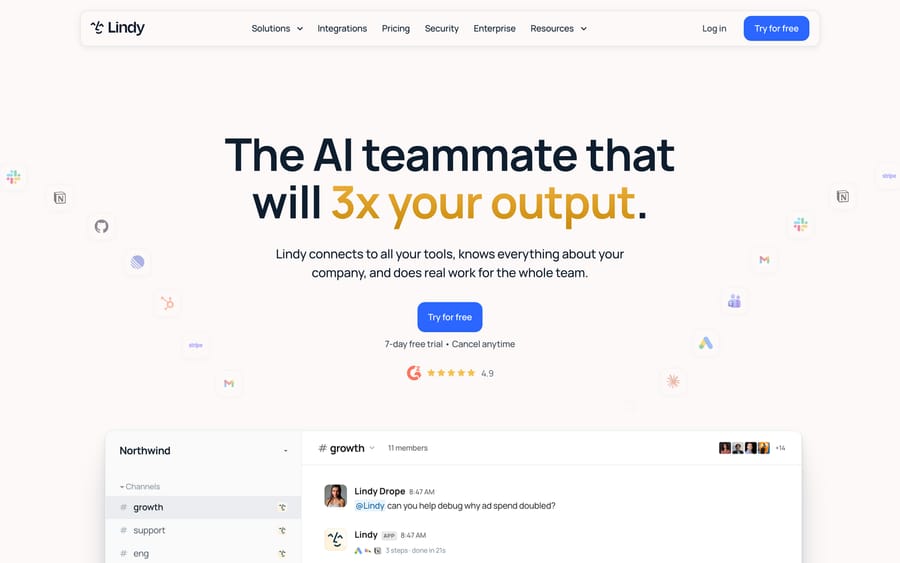
Lindy is a general-purpose AI coworker. Every person on a team gets a private Lindy in their Slack DMs, and the team shares one Lindy in channels. You @mention it with a request ("summarize last week's escalations," "draft a reply to this customer," "update the deal in HubSpot") and it works through your connected apps, then posts the result back in the thread. Its homepage says it "connects to all your tools, knows everything about your company, and does real work for the whole team."
The company was founded by Flo Crivello, a former Uber product manager. Lindy grew out of his previous startup, Teamflow, a virtual office product that shrank when offices reopened. In his SaaS Club interview, Crivello describes cutting two-thirds of Teamflow's staff in early 2023 and rebuilding around Lindy, which was first pitched as an "AI employee" and then repositioned as closer to "Zapier plus ChatGPT." Third-party funding trackers such as Extruct put total funding at about $50M, with Battery Ventures leading the largest round. Lindy hasn't published those figures on its own site, so treat them as reported.
Lindy's homepage shows logos from Shopify, Apple, Adobe, McKinsey, NVIDIA, Airbnb, Autodesk, Harvard and Stanford. Those are logos, not case studies. With per-seat Slack pricing, a logo can mean one team inside a large company.
Three products in about eighteen months
Knowing the history explains why reviews contradict each other. According to a Saner.AI review published in August 2026, Lindy has shipped three distinct products:
- 2024 to early 2026: a no-code agent builder. You built "Lindies" from triggers and actions, including phone agents. Lindy's own changelog shows Lindy 3.0 with an Agent Builder in August 2025, phone call improvements in June 2025, and 500+ actions added through Pipedream in July 2025.
- February 2026: a personal executive assistant over iMessage.
- August 10, 2026: Lindy Teammate, the Slack-native coworker priced per seat.
We tested the old URLs. Lindy's /solutions/customer-support and /agents pages now redirect to the homepage, and the former phone agent pages return 404. The app builder (/build, now /app-builder) still resolves. If you read a review that mentions building a phone agent or a free plan, it's describing an earlier version.
How Lindy's AI works
The current docs organize Lindy around five building blocks. It helps to understand them, because they decide what you pay and what can go wrong.
- Skills are named playbooks for recurring work. Lindy picks the right skill automatically when a request matches, so "triage the support queue" can follow the same steps every time.
- Routines are standing jobs on a schedule or a trigger, for one person or the whole team. A daily escalation summary is a routine.
- Files are Lindy's memory: plaintext documents your team can open and edit. When Lindy learns your refund policy or your tone rules, that knowledge lives in a file you can correct.
- Meetings are recordings and transcripts Lindy joins, stores in shared folders, and reads later as context.
- Integrations connect the tools. The integrations overview lists four routes: 1,000+ native integrations, any MCP server your team runs, browser automation where Lindy "drive[s] the browser the way a person would," and writing its own integration against a tool's API.
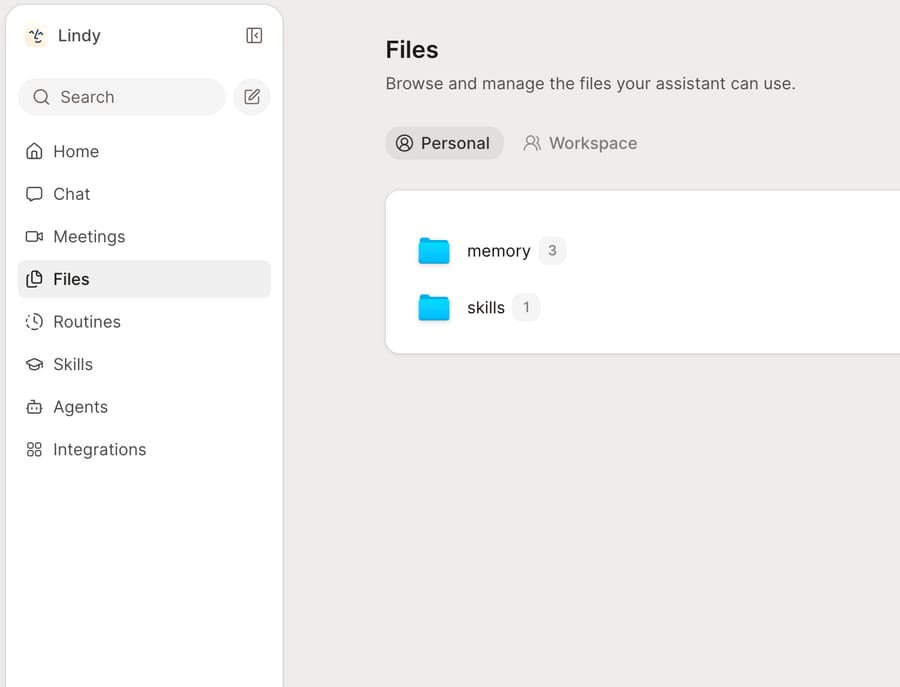
That sidebar is the whole product surface: Chat, Meetings, Files, Routines, Skills, Agents, Integrations. Memory is not a hidden vector store you have to trust. It's two folders you can open.
When someone asks for something, Lindy reads the relevant files and connected data, plans the steps, calls the integrations, and reports back. On the homepage demo, a request resolves as "3 steps · done in 21s."
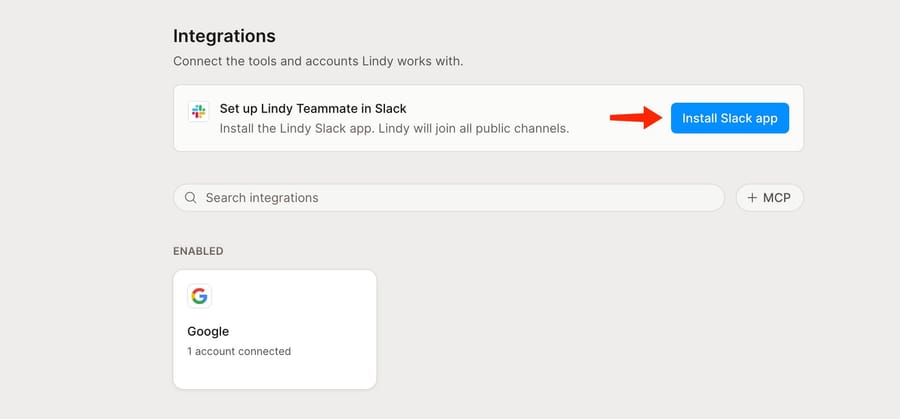
Setup is two moves: an admin installs the Slack app (Lindy "will join all public channels," per the button's own subtext), then each person connects their own accounts. The docs note Lindy requires a paid Slack plan, which is a real line item if your support team isn't already on one.
Approvals and where they stop
Write actions are gated. The docs say Lindy "asks in Slack before writing" when a workspace sets "Require approval," and either the requester or an admin can approve. The same docs add a boundary a support lead should read twice: "Guardrails apply in shared Slack threads only. Your web app chat, Slack DMs with Lindy, and iMessage and SMS aren't guarded."
So an agent on your team who DMs Lindy "close out all the spam tickets from today" isn't stopped by the channel approval setting. Whether that's acceptable depends on who has Zendesk access through Lindy, which brings us to support.
Which models it runs on
The current docs don't name the underlying models or let you pick one per task. The older agent builder did: its changelog lists o3, Gemini 2.5 Flash and Gemini 2.5 Flash-Lite during 2025. Lindy's security page says "Lindy and our providers do not use your data to train AI models," without naming the providers.
What Lindy does for customer support
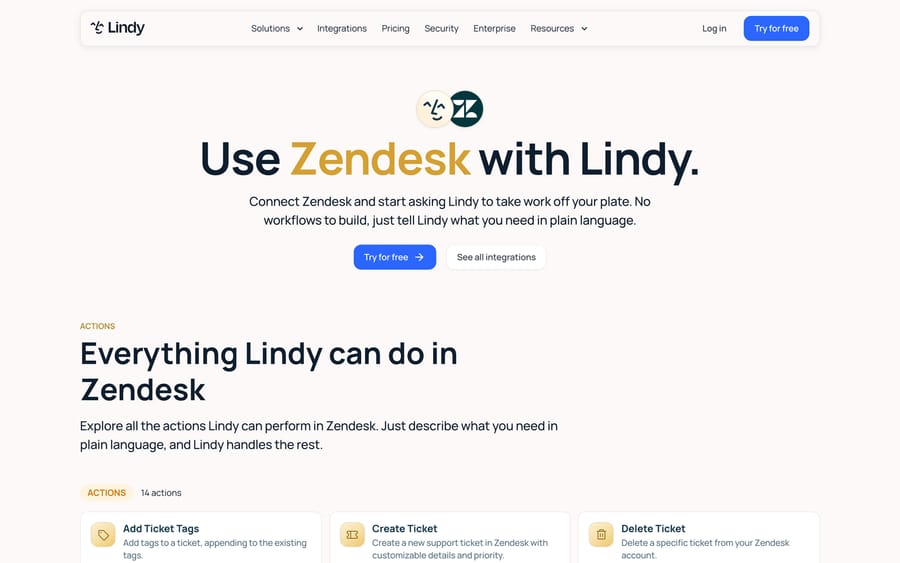
Lindy's use cases doc describes the support job as "ticket triage, routing, drafted replies, escalation." Lindy triages tickets across Zendesk, Intercom and Slack, routes them by topic or severity, drafts replies from your help center, and escalates hard cases with context attached.
On Zendesk specifically, the integration page lists actions including Search Tickets, List Tickets, Get Ticket Info, List Ticket Comments, Get User Info, List Macros, Add and Remove Ticket Tags, Set Custom Ticket Fields, Create Ticket, Update Ticket (which adds comments), and Delete Ticket. That's a full working set for triage: read the queue, classify, tag, set fields, leave an internal note.
Who starts the work is the part to check. Every example in Lindy's docs begins with a teammate asking Lindy for something, or a routine firing on a schedule, and the output lands in Slack or in your tools for a person to act on. The docs we read describe Lindy working for your team. They don't describe a customer-facing chat widget or an agent that replies to customers on its own as tickets arrive. For a support team, that makes Lindy a helper for the humans running the queue rather than a first-line agent on the queue.
A support lead who wants a morning routine ("tag yesterday's untagged tickets, post the five angriest ones in #support, draft replies for the three about shipping") gets that from Lindy without building a workflow. A team that wants every incoming "where's my order?" email answered inside Zendesk within two minutes needs something that runs on each ticket as it arrives.
Key features
- Private and shared Lindy. A personal Lindy in DMs handles your inbox, calendar and meeting prep. The shared Lindy in channels builds workspace memory from meetings, tools and Slack history.
- Email handling. Docs pages cover email drafting, email labeling, time-sensitive email alerts and follow-up bumps. Plans cap connected inboxes at 2 (Plus), 3 (Pro) and 5 (Max and Enterprise).
- Meeting assistant. Recording, transcripts, meeting prep and a daily brief.
- iMessage, SMS and a Chrome extension as extra ways to reach Lindy.
- 40+ prebuilt skills on the homepage, covering research, data analysis, decks and dashboards.
- 1,000+ integrations plus MCP, including Slack, Notion, HubSpot, Gmail, Google Drive, Zendesk and Intercom.
- Security. SOC 2 Type II, GDPR and PIPEDA compliance listed on the security page, with HIPAA and a signed BAA on the Enterprise plan.
Lindy AI pricing
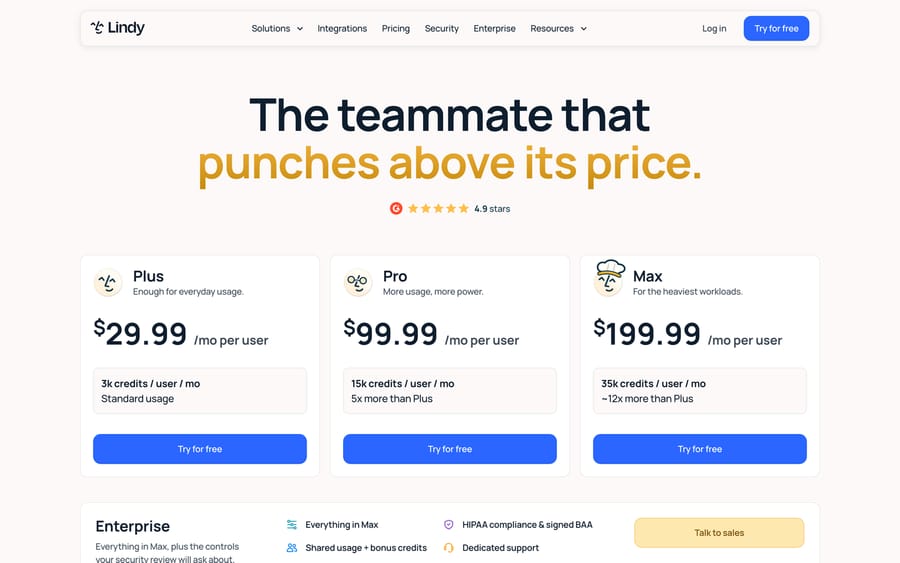
Lindy publishes its prices, which puts it ahead of most tools in this category. From the pricing page and the pricing doc:
| Plan | Price | Credits | Connected inboxes |
|---|---|---|---|
| Plus | $29.99/user/month | 3,000/user/month | 2 |
| Pro | $99.99/user/month | 15,000/user/month | 3 |
| Max | $199.99/user/month | 35,000/user/month | 5 |
| Enterprise | Custom | Everything in Max, plus shared usage and bonus credits | 5 |
The terms that shape your bill:
- Credits are "about one cent each." Lindy's own bands: 2 to 250 credits for everyday tasks like answers, summaries and drafts; 250 to 1,000 for "deep work" such as research reports and queue triage; 1,000 to 2,500 for big builds like dashboards.
- Credits pool across the workspace and reset every billing cycle. Plan credits don't roll over.
- Top-ups cost $10 per 1,000 credits, sold in 1,000-credit blocks, and purchased top-ups don't expire.
- When the pool runs low, the pricing doc says Lindy "pauses credit-using actions and tells you," with "no surprise bill." The separate usage doc also refers to overages "at 2x the cost of regular Lindy credits." We couldn't reconcile the two from the docs alone, so ask sales which applies to your workspace.
- Trial: teammates who join through Slack get their first week free, once per person. The pricing page notes direct signups are billed immediately.
- Monthly only on the page we fetched. No annual price is listed.
What queue triage costs on Lindy
Here's the arithmetic for a support team. Lindy puts queue triage in its 250 to 1,000 credit band, which is $2.50 to $10 per run at a cent a credit. A three-person team on Plus pays $89.97 a month and gets a 9,000-credit pool.
- One triage pass per weekday, at the midpoint of 625 credits, is about 13,750 credits over 22 working days. The 9,000 credits in the plan are included, so the gap is 4,750: five top-up blocks, $50 on top of seats.
- At the top of the band (1,000 credits a run), the same routine burns 22,000 credits. Subtract the pool and you're buying about 13,000 credits, which is $130 a month in top-ups at $10 per 1,000, or roughly $260 if your workspace is on the 2x overage rate the usage doc mentions rather than the pause behavior the pricing doc describes.
So the same daily routine lands somewhere between $140 and $350 a month all-in for three people, depending on a band Lindy states as a range and an overage rule that reads two ways. A "run" here is one pass over the queue, not one ticket, and Lindy doesn't publish a per-ticket figure. Credit burn also depends on how many tickets are in the queue that day and what else your team asks Lindy to do from the same pool. That uncertainty is the most common complaint in reviews: Lindy's Trustpilot page (trustpilot.com/review/lindy.ai) includes an August 2026 reviewer who wrote, "I managed to kill my months credits (3000) in one day!"
The incentive in per-seat plus credits
Lindy charges on two meters at once. Seats grow with how many people use it, and credits grow with how much they ask of it. The Saner.AI review reports that any @mention in Slack creates a billed seat, which means adoption spreading through your Slack workspace is also the vendor's growth plan. Credits that expire each month earn Lindy money on the capacity you didn't use. None of this is unusual for SaaS, but it's the reverse of what a support budget wants: a cost that tracks tickets handled, not headcount and curiosity.
Lindy AI reviews: pros and cons
Review data is thin for the current product, because the Slack teammate is about five weeks old, and the ratings that exist point in opposite directions. Here is every number we could check on September 15, 2026.
| Source | Rating | Reviews | What we could verify |
|---|---|---|---|
| G2 | 4.9 | Not verifiable | The score is displayed on lindy.ai and links to G2; g2.com returned 403 to our fetcher, so we can't confirm the count behind it |
| Capterra (capterra.com/p/10027702/Lindy) | 3.5 | 2 | Fetched directly; the listing still shows the retired Free / $49.99 / $299.99 plans |
| Trustpilot | 1.7 | 39 | Fetched directly; 77% one-star |
Three reviewers, in their own words. A CEO in design gave Capterra five stars for "Great to help solo founder automate time-wasting tasks," with the con that "It can be hard to figure out how / why one of the custom bots isnt working." A veterinarian gave two stars: "It's not consistent in its delivery. It does not follow instructions at least 50% of the time." On Trustpilot, Yossi Coleman wrote on August 21, 2026 that "The tool is powerful but the cheap price is just bait...I managed to kill my months credits (3000) in one day!"
The recurring complaint across all three sites is the same one, and it's about money rather than capability: credits vanish faster than people expect, and the bill arrives before the value does. Reliability on long-running tasks is second. Note also that most of these reviews describe the agent builder or the iMessage assistant, not the Slack teammate. The Substack review that ranks for "lindy ai" praised how easy agents were to build and criticized "credit anxiety," but it tested the old $50, 5,000-credit plan.
Pros
- Published pricing, published credit bands and published top-up prices.
- Setup is an @mention in Slack, with no workflow diagram to build.
- Memory lives in plaintext files your team can read and fix.
- Approval gates on write actions in shared channels.
- Broad reach: 1,000+ integrations, MCP servers, browser automation.
- SOC 2 Type II and a stated no-training commitment, with a HIPAA BAA on Enterprise.
Cons
- Credit use per task is a range, not a price, so monthly cost is hard to forecast.
- Guardrails don't cover DMs, the web app, iMessage or SMS.
- Requires Slack for the team experience. Saner.AI reports no Microsoft Teams support.
- Per-seat billing on top of credits.
- Dedicated support is Enterprise-only; Carly's review (written by a competitor) reports help center and community support on the lower plans.
- Three repositionings in about eighteen months, which is a risk if you build processes on it.
- Built for internal requests. The docs don't describe it answering customers directly as tickets arrive.
Who Lindy AI is best for
Lindy suits teams that already work in Slack and want one AI coworker across many jobs: inbox triage for founders and account managers, meeting notes and prep, CRM updates, research, weekly reports. Its value grows with the number of different tools and requests, because it's one product in place of several single-purpose ones.
For support, Lindy fits a lead or ops person who wants help running the queue: daily triage passes, escalation digests, drafted replies a human reviews and sends. It's the wrong fit if you want an agent acting on every ticket as it lands, with a cost you can model per ticket, or if your support team doesn't live in Slack.
Lindy AI alternatives
Lindy competes in two different markets at once, so the shortlist splits. If you want a general AI coworker for your team, the rivals are other workspace agents. If you want customer questions answered, the alternatives are support AI agents, which is where Lindy is weakest. We covered the wider category in our guide to AI agents for customer service.
Workspace-agent alternatives
These three do the same job as Lindy Teammate: agents that work for your staff, across your company's tools. We fetched each pricing page on September 15, 2026.
| Tool | What it is | Pricing | Watch out for |
|---|---|---|---|
| Relevance AI | Agents and multi-agent "workforces" with 2,000+ integrations, sold to companies scaling without headcount | Not published. The pricing page lists one tier, Enterprise, behind "Talk to sales" | No self-serve price and no published usage rate, so you can't model cost before a sales call |
| Zapier Agents | Agents built on Zapier's 9,000+ app connections, run on command or on a schedule | Billed in "activities" separate from Zapier tasks: 400 a month free, 1,500 on paid plans, which start at $19.99/month billed annually | A single agent run is capped at 10 activities (free) or 40 (paid), so long jobs get cut off. It's a second meter on top of your task plan |
| Dust | Custom agents over Slack, Notion, GitHub and Drive, with 20+ frontier models | Free seat with 500 lifetime credits, Pro €24/seat/month billed yearly (8,000 credits), Max €120 (40,000) | Same two-meter shape as Lindy: per seat plus credits. Prices are in euros, and the credit allowance is per seat rather than pooled below Enterprise |
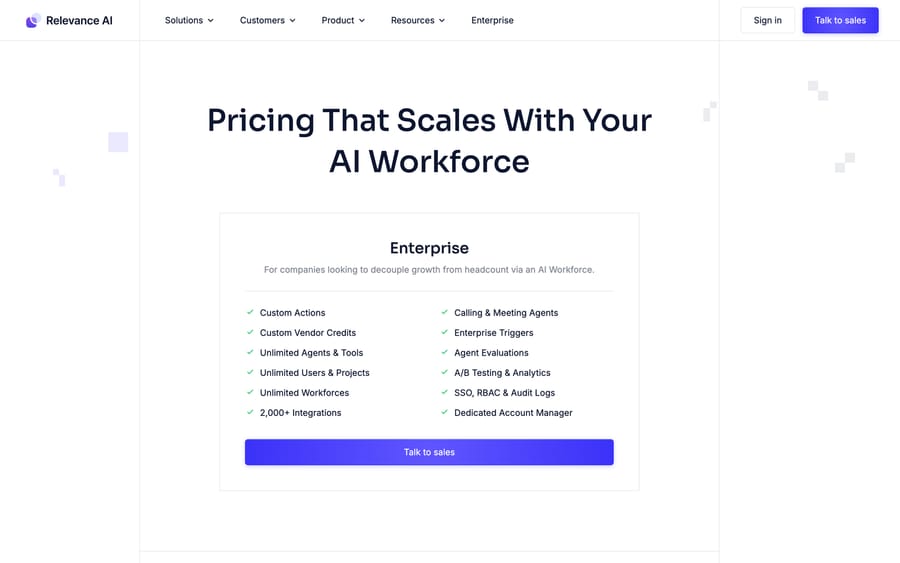
Relevance AI is the closest to Lindy in ambition and the furthest from it in sales motion: no price, no free tier on the page, a demo call before you can model anything.
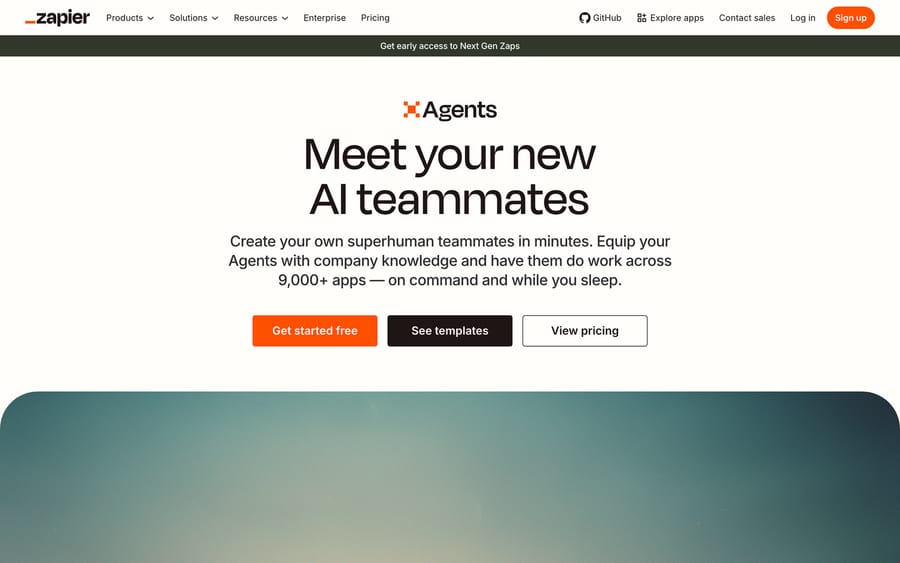
Zapier Agents is the cheapest way to test the idea, because your team probably already has a Zapier account and the free tier includes 400 activities a month. The per-run activity cap is the thing to read before you build a queue-triage agent on it.
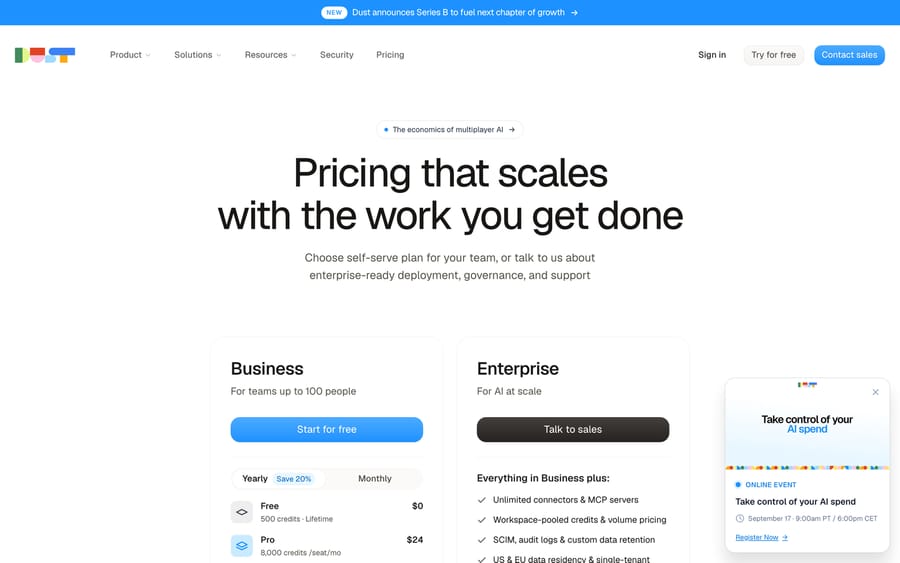
Dust prices like Lindy (seats plus credits) at roughly a fifth of Lindy's Pro rate, with a free seat to try it on. It's the sensible like-for-like test if the Slack teammate appeals but the credit math doesn't.
Customer-facing alternatives
| Lindy AI | Chatbase | Macha | |
|---|---|---|---|
| Model | AI teammate in Slack for internal requests | Customer-facing AI chat agent trained on your content | AI agent layer on your existing help desk |
| Who it serves | Your team | Your customers, via a website widget | Your customers and your agents, inside the help desk |
| Support work | Triage passes, drafts, escalation digests on request or schedule | Answers chat questions, hands off to humans | Runs on each ticket: replies, tags, routes, takes actions |
| Pricing | $29.99 to $199.99/user/month plus credits, published | $0 to $500/month by message credits, published | From $299/mo for 750 tickets (~$0.40/ticket), published |
| Setup | Self-serve in Slack | Self-serve | Built, tested and monitored by the Macha team |
| Trial | 7 days for Slack-joined teammates | Free plan (50 message credits) | $50 free usage |
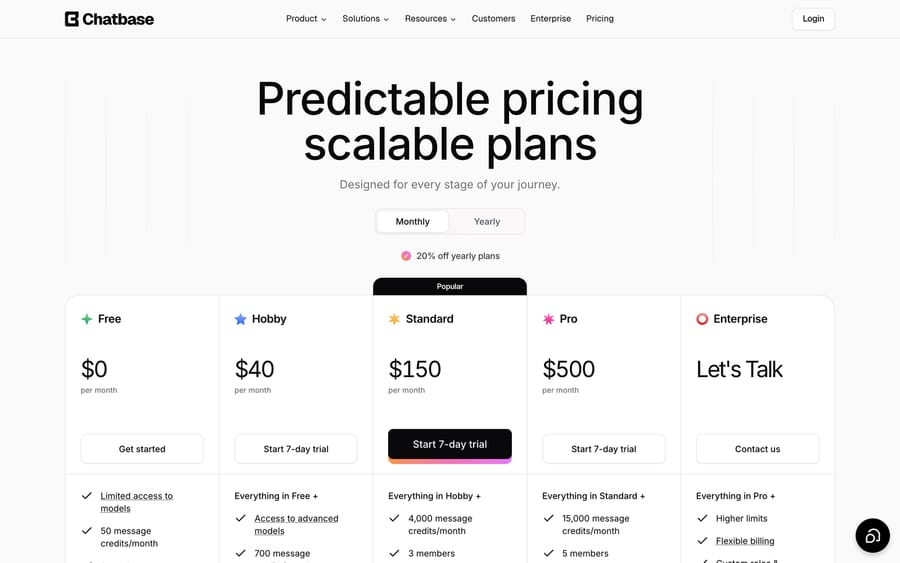
Chatbase is the closer match if the goal is a chat widget answering customers from your docs. Its pricing page lists a free plan with 50 message credits, then Hobby at $40, Standard at $150 and Pro at $500 a month. Our Chatbase guide covers where it works and where it stops.
If your tickets already arrive in a help desk rather than a widget, the comparison to make is with agents that run on the desk itself. Our guide to Intercom's Fin covers the per-outcome version of that model.
Macha fits teams already running Zendesk, Freshdesk, Gorgias or Front who want agents working inside the ticket. Macha runs as an AI agent layer on top of the help desk you already use: a ticket arrives, the agent reads it with your knowledge and connected systems such as Shopify, then replies, tags, routes or escalates in the help desk itself. Pricing is per ticket, where one thread with one person is one charge however many replies it takes, from $299 a month for 750 tickets. See Macha pricing for the tiers. The Macha team builds, tests and monitors the agents on every plan.
The two can coexist. Lindy's strength is the internal side of support (the lead's digest, the Slack question about a customer), while Macha handles the tickets themselves.
FAQ
What is Lindy AI? Lindy AI is an AI teammate that works in Slack. Each person gets a private Lindy in DMs and the team shares one in channels. It connects to 1,000+ tools and does tasks like email triage, meeting notes, reports and CRM updates when asked or on a schedule.
How much does Lindy AI cost? Plus is $29.99 per user per month with 3,000 credits, Pro is $99.99 with 15,000, and Max is $199.99 with 35,000. Enterprise is custom. Credits are worth about a cent each, pool across the workspace, don't roll over, and top-ups cost $10 per 1,000.
Does Lindy AI have a free plan? Not anymore. The old 400-credit free plan belonged to the agent builder product. Today, teammates who join through Slack get a one-time free week.
Can Lindy AI answer customer support tickets? It can triage, tag, route and draft replies in Zendesk and Intercom when a teammate asks or a routine runs. Its docs describe work for internal teammates, not an agent that replies to customers on its own as tickets arrive.
Is Lindy AI safe to connect to Zendesk? Lindy lists SOC 2 Type II, GDPR and PIPEDA compliance and says data isn't used for training. Its Zendesk actions include Delete Ticket, and approval guardrails apply only in shared Slack threads, so set permissions with that in mind.
Why are Lindy AI reviews so mixed? Most reviews describe earlier products: the no-code agent builder and the iMessage assistant. The Slack teammate launched on August 10, 2026, according to Saner.AI. Trustpilot complaints center on credit burn, billing and cancellation.
What are the best Lindy AI alternatives? For a general workspace agent, Dust is the closest like-for-like (seats plus credits, from €24 a seat), Zapier Agents is the cheapest way to test the idea, and Relevance AI is the enterprise option with no published price. For customer-facing support, Chatbase covers website chat, and Macha runs agents inside Zendesk, Freshdesk, Gorgias or Front, priced per ticket.
Who founded Lindy AI? Flo Crivello, previously a product manager at Uber and founder of Teamflow. Third-party trackers report about $50M in total funding.
If your question is the narrower one, whether an agent can work your Zendesk or Gorgias queue without a Slack-shaped detour, the fastest answer is to point one at your own tickets: Macha's trial is $50 of free usage with no card, and you can start it here.
Sources: Lindy homepage, Lindy pricing, Lindy pricing doc, Lindy usage doc, Lindy use cases, Lindy integrations overview, Lindy docs index, Lindy Zendesk integration, Lindy security, Lindy changelog, Saner.AI Lindy review, SaaS Club interview with Flo Crivello, Extruct funding profile, Trustpilot (trustpilot.com/review/lindy.ai, blocks automated link checks), Substack review, Carly review, Capterra listing for Lindy (capterra.com/p/10027702/Lindy, blocks automated link checks), Chatbase pricing, Relevance AI pricing, Zapier Agents, Zapier pricing, Dust pricing.
Resolve tickets automatically with AI agents
Macha's AI agents work on top of the help desk you already use — no code.