Intercom
 Shopify
 Stripe
 Slack
Slack Notion
 Google Workspace
 Confluence

Wonderchat: The Complete Guide (2026)


Wonderchat is an AI agent platform that trains on a company's documentation and deploys chatbots for both support and sales, billed on a "resolutions" model instead of a flat message count. This guide covers what it actually does, how the resolution-based pricing works out per plan, where its voice and SMS agents fit in, pros and cons, and how it compares to Chatbase and to an AI agent layer like Macha that runs inside a help desk you already use.

Wonderchat markets itself as "The AI Support & Conversion Agent Platform," and that dual framing (support agent and conversion agent, in one product) is the thing to understand before comparing it to a pure FAQ chatbot like SiteGPT or Chatbase. It's built to do two different jobs: resolve support tickets by citing your own documentation, and qualify sales leads or book meetings on the same underlying agent.
What is Wonderchat?
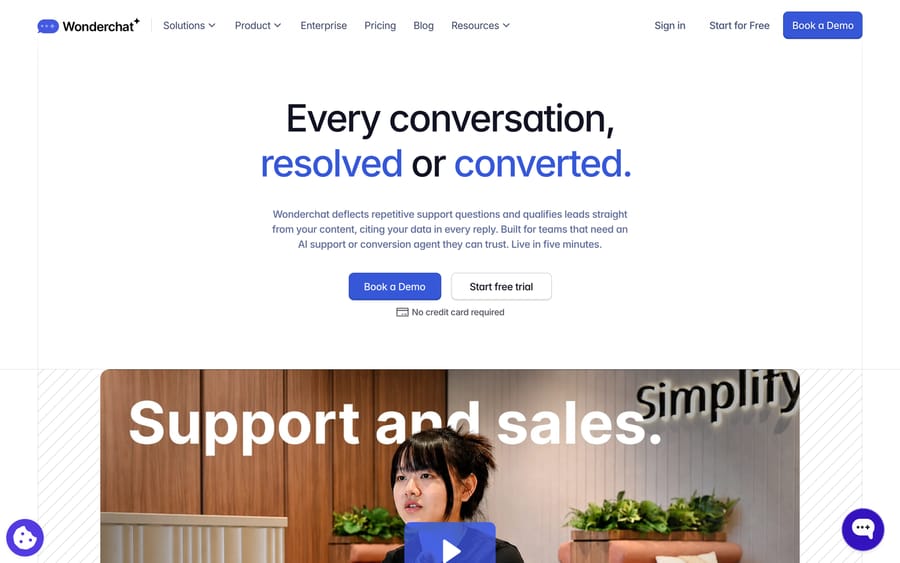
Wonderchat's own numbers, as stated on its site, claim 500+ teams onboarded, 2M+ tickets resolved, a 70%+ resolution rate, and a 4.9/5 average rating. Those are vendor-reported figures without a named source or methodology behind them. What's more interesting is the shape of the product behind those numbers: unlike SiteGPT or Chatbase, which are built primarily around a single support widget, Wonderchat pitches itself for the full customer lifecycle. A support agent answers from your knowledge base and hands off to a human when it can't resolve something; a separate sales-oriented flow qualifies leads and books meetings from the same trained content.
The company states it is "GDPR compliant and AICPA SOC 2 Certified," with SOC 2 Type 2 compliance and SSO/role-based access control available on higher tiers. Those are vendor claims we didn't independently verify. Worth noting: SOC 2 shows up twice in Wonderchat's plan structure, once as a stated overall company certification and again as a named feature line on the Enterprise plan specifically. That split usually means the certification covers the core platform, while Enterprise buyers get additional controls, like dedicated data handling or custom audit support, that Wonderchat scopes specifically to that tier.
How Wonderchat's AI works
The underlying mechanism is retrieval-augmented generation: connect your knowledge sources, and the system, in Wonderchat's own words, "retrieves, grounds and cites every reply." That's the same core loop as SiteGPT or CustomGPT.ai. What's different is two additions built around it.
First, a QA agent reviews the primary agent's answers and "flags weak answers for one-click fixes," meaning a human doesn't have to comb through every conversation to find the ones the AI got wrong. It's a second model checking the first, which is a real form of quality control instead of a manual review queue, though the "one-click fix" step still needs a human in the loop before a weak answer is corrected for future visitors.
Second, the agent has an explicit intent-detection step that decides whether a conversation is a support question or a sales opportunity, then routes accordingly, either resolving the ticket or moving toward lead qualification and meeting booking. That's a meaningfully different job than "answer this FAQ," and it's the reason Wonderchat's plans price in channels like voice and SMS on top of the website widget.
Deployment and channels
A Wonderchat agent isn't limited to a website widget. The platform lists integrations with help desks, CRMs, and messaging channels including WhatsApp and SMS, and it advertises 24/7 availability across websites, mobile apps, and messaging services. The Voice Agent, gated to the Scale plan and above, extends the same trained-content approach to phone calls, which is a meaningfully bigger engineering lift than a chat widget and one reason the price jumps sharply from Basic to Scale. If your support load is entirely web chat and email, that voice capability is scope you'd be paying for and not using; if phone is a real channel for your team, it's a feature few competitors in this category offer at all.
Key features
- Content retrieval and citation grounding every reply in an approved source.
- QA agent that reviews answers and flags weak ones for correction.
- Dual support/sales routing, qualifying leads and booking meetings alongside ticket resolution.
- Voice Agent and SMS Agent, available from the Scale and Enterprise tiers respectively.
- Multilingual support for conversations across languages.
- Help desk, CRM, and messaging integrations, including WhatsApp and SMS.
- 24/7 availability across website, mobile app, and messaging channels.
Wonderchat pricing (researched)
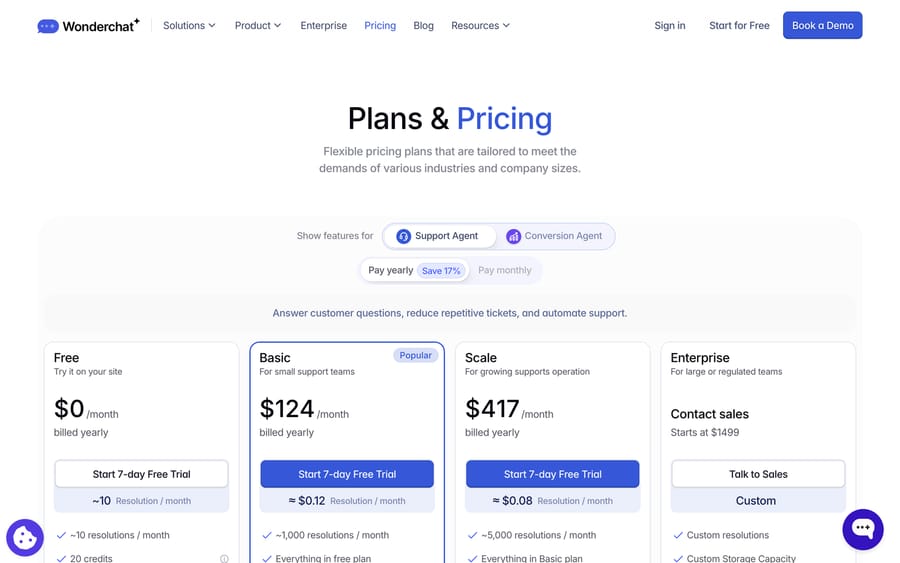
We checked Wonderchat's pricing page directly. All prices below are the annual-billed monthly rate, which the vendor uses as its default display:
| Plan | Monthly (billed yearly) | Resolutions/mo | Credits/mo | Webpages/agent | Agents | Seats |
|---|---|---|---|---|---|---|
| Free | $0 | ~10 | 20 | 50 | 1 | not specified |
| Basic | $124 | ~1,000 | 5,000 | 1,000 | 2 | 3 |
| Scale | $417 | ~5,000 | 25,000 | 2,500 | 4 | not specified |
| Enterprise | from $1,499 | custom | custom | custom | custom | custom |
The unit worth understanding here is the gap between "credits" and "resolutions." Wonderchat meters both: a Basic plan gets 5,000 credits but only about 1,000 resolutions a month, meaning a single resolved ticket consumes roughly 5 credits on average, likely covering the full back-and-forth of an actual conversation. That's closer to what a support team actually cares about, a solved ticket, than a flat message cap is. It also means the headline "~1,000 resolutions" number is an estimate baked into the credit allowance. A plan's actual resolution count moves with how many messages each conversation takes, so a chattier customer base quietly eats into that estimate. Overage credits cost $29.99 per 1,000, a flat one-time add-on that's more forgiving than a forced subscription upgrade for one unusually busy month.
The jump from Basic to Scale is a 3.4x price increase for a 5x increase in both credits and resolutions, so the per-resolution cost actually improves at Scale. That's the incentive built into the tier structure: Wonderchat prices growth to reward staying on the platform and moving up, instead of nickel-and-diming overages the way some competitors do at the entry tier. Enterprise starting at $1,499/month, with SOC 2, HIPAA, SSO, and an SMS agent gated behind it, is clearly aimed at a buyer with compliance requirements, not a small support team testing the product on the Free plan.
Pros and cons
Pros
- Resolution-based billing is a closer proxy for support value than a raw message count.
- The QA agent is a genuine second layer of review, not just a dashboard of transcripts to read manually.
- Voice and SMS agents extend past chat, which SiteGPT and Chatbase don't offer.
- A $0/month Free tier is listed (about 10 resolutions/month), useful for testing before committing, though its signup button reads "7-day Free Trial" like the paid tiers, so confirm it doesn't expire before relying on it.
Cons
- The "resolutions" figure on each plan is an estimate derived from the credit allowance, not a fixed number, so actual capacity depends on how chatty your customers are.
- HIPAA and SSO are Enterprise-only, gating compliance-sensitive teams into custom pricing immediately.
- Like every tool in this category, it answers and routes; it doesn't natively take backend actions like issuing a refund unless that's built through an integration.
- Vendor-reported metrics (2M+ tickets, 70%+ resolution rate) have no published methodology behind them.
Who Wonderchat is best for
Wonderchat fits a team that wants one platform covering both support deflection and sales qualification, especially if voice or SMS is part of the channel mix. A DTC brand fielding both "where's my order" questions and pre-purchase sizing questions from the same visitors is a reasonable fit, since the same agent can resolve the support case and nudge the sales one. It's a stronger match than a pure FAQ bot if you're actively trying to convert website traffic, not just deflect tickets.
It's the wrong fit if you only need FAQ deflection and don't want to pay for sales-agent and voice/SMS capability you won't use. The resolution-credit math also rewards a team that understands its own conversation length. A support base that habitually runs long, multi-turn conversations will burn through credits faster than the headline resolution number suggests, so it's worth running a plan's numbers against your own average conversation length before committing to a tier.
Wonderchat vs alternatives
| Wonderchat | Chatbase | Macha | |
|---|---|---|---|
| Model | Support + sales agent, resolution-based billing | Website-trained chatbot widget | AI agent layer on your existing help desk |
| Best for | Teams wanting support and lead-gen from one agent | Small sites with static FAQ content | Teams on Zendesk, Freshdesk, Gorgias or Front |
| Voice/SMS agents? | Yes, from Scale/Enterprise | No | No, but connects to channels via your help desk |
| Can take actions (refunds, order lookups)? | Via integrations | Limited, via integrations | Yes, via connectors and custom tools |
| Pricing | $0–$417+/mo by resolution/credit cap, published | Published, message-based (see our Chatbase guide) | From $299/mo for 750 tickets (~$0.40/ticket), published |
| Trial | Free plan, no card required for entry tier | Free tier available | $50 free usage |
Wonderchat and Chatbase both start from the same content-trained-widget idea, but Wonderchat has grown into a broader conversion tool with voice and SMS layered on, while Chatbase stays closer to pure FAQ deflection. Macha is a different shape of product again. It's an AI agent layer that runs inside the help desk your support team already uses, with connectors into order data, subscriptions, and other backend systems, so it can act on a ticket instead of only answering or routing it. If your support volume already lives in Zendesk, Freshdesk, Gorgias, or Front and the tickets need something done, not just a citation-backed reply, that's the gap a standalone widget like Wonderchat doesn't close on its own. See how Macha's agents work and current pricing.
FAQ
What is Wonderchat? An AI agent platform that trains on a company's content and deploys chatbots for both customer support (citing sources, resolving tickets) and sales (qualifying leads, booking meetings), billed on a resolution and credit model.
How much does Wonderchat cost? Free at $0/month for about 10 resolutions, Basic at $124/month for about 1,000, Scale at $417/month for about 5,000, and Enterprise starting at $1,499/month with custom limits. Prices shown are the annual-billed monthly rate.
What's the difference between "credits" and "resolutions" in Wonderchat's pricing? A resolution is a fully handled conversation; a credit is the underlying usage unit consumed per message or action within that conversation. Because a resolution can take several messages, the credit allowance sets a soft cap on resolutions that varies with how long each conversation runs.
Does Wonderchat offer a free trial? There's a $0/month Free plan listed (about 10 resolutions/month), but its own signup button reads "Start 7-day Free Trial" the same as every paid tier's button, so the pricing page doesn't make clear whether that plan is usable indefinitely at $0 or whether it converts to a paid tier after 7 days. Confirm which applies before you build a testing plan around it.
Does Wonderchat support voice and SMS, not just chat? Yes. A Voice Agent is available from the Scale plan and an SMS Agent from Enterprise, on top of the standard website chat widget.
What are good alternatives to Wonderchat? Chatbase is the closest comparison for pure FAQ-style deflection without the sales and voice/SMS layer. For teams whose support already runs through an existing help desk and needs agents that act on tickets, Macha is a different kind of alternative worth comparing.
Can Wonderchat take actions like issuing refunds? Not natively. It answers, routes, and qualifies from trained content; taking a backend action like a refund or order update requires connecting it to that system through an integration, and the depth of what's possible there isn't detailed on the pricing page.
How does Wonderchat's pricing compare at real support volume? A team resolving 1,000 tickets a month on Basic ($124/month) is paying about $0.12 per resolution. At Scale, 5,000 resolutions for $417/month works out to roughly $0.08 per resolution, so the per-unit cost drops as you move up, which isn't true of every vendor in this category. Whether that's cheap depends entirely on how many messages your average conversation actually takes, since the credit meter, not the resolution count, is what really limits you.
Sources: Wonderchat homepage, Wonderchat pricing.
Resolve tickets automatically with AI agents
Macha's AI agents work on top of the help desk you already use — no code.