Shopify
 Stripe
 Slack
Slack Notion
 Google Workspace
 Confluence

SiteGPT: The Complete Guide (2026)


SiteGPT is a chatbot builder that trains an AI on your website, docs, and files, then drops a widget onto your site to answer visitor questions in your own content. This guide covers what it actually does, how the training and answering process works, the real plan prices and message limits, where it's strong, where it runs out of road, and how it stacks up against Chatbase and against running an AI agent inside the help desk you already use.

SiteGPT was founded in 2023 by Bhanu Teja Pachipulusu and Sai Dheeraj P, and the company is based in Bangalore. Its own homepage describes the product as being "like having ChatGPT specifically for your products," a fair summary of the category. You point it at a URL, a PDF, a Notion workspace, or a pile of text files. It indexes that content and answers visitor questions from what it found there.
What is SiteGPT?
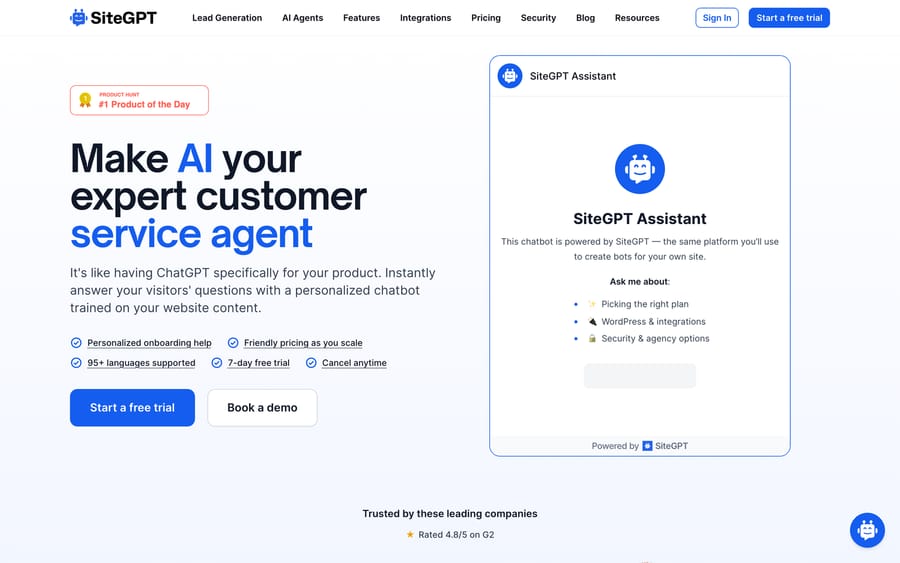
SiteGPT's homepage, showing the "Make AI your expert customer service agent" headline next to a live demo of its own chat widget.
SiteGPT sits in the "train a chatbot on my content" category alongside Chatbase, and it's aimed at the same buyer: a small support or marketing team that wants a chat widget answering FAQs without building a retrieval pipeline themselves. The pitch is speed. Sync a source, get a working bot, install one script tag, and start narrowing its answers as real visitors ask real questions.
The company doesn't publish funding or headcount, and there's no press page describing an acquisition or a rebrand. As of this writing it looks like an independent, bootstrapped product with a small team. On its site, SiteGPT states it is "SOC 2 Type II examined, GDPR certified, and HIPAA assessed," and that customer data "is never used to train AI models." Those are the vendor's own claims. We didn't independently audit the certification.
How SiteGPT's AI works
The mechanism is standard retrieval-augmented generation, and SiteGPT doesn't claim otherwise. You feed it sources: a website crawl, uploaded PDFs, DOCX, PPTX, CSV, TXT or Markdown files, raw pasted text, or a live connection to Notion, Google Drive, or GitHub. It chunks and indexes that content. When a visitor asks a question, the bot retrieves the most relevant chunks and has a model (GPT-4.1 or GPT-4.1-mini, depending on plan) generate an answer grounded in them. That answer comes from the indexed content, not from the model's general training data.
What differentiates one RAG chatbot from another is mostly what happens around that core loop, and SiteGPT's additions are aimed at making the bot better over time without an engineer in the room:
- Quick Prompts suggest starter questions so a visitor doesn't stare at a blank chat box.
- Weekly Digest emails a summary of what visitors actually asked, so a non-technical owner can see gaps in the source content.
- AI-grouped conversation topics cluster real questions so a team can spot the same unanswered question showing up ten different ways.
- Human escalation hands a conversation to a live agent when the bot can't answer confidently.
The result is a tool that a marketing or support lead can run without engineering involvement: sync, publish, watch the digest, add the content that's missing. That's the whole workflow, and for a single-product website answering pricing and how-to questions, it's often enough.
Key features
- Multi-format training: website URLs, PDF/DOCX/PPTX/CSV/TXT/MD uploads, raw text, and connectors for Notion, Google Drive, and GitHub.
- Lead capture built into the chat widget, so a support question can also register interest.
- Analytics on daily conversation trends and topic clustering.
- Integrations with tools like Slack and Zendesk on the Growth plan and above, plus a "Zendesk AI Agent" feature on the Scale plan.
- API access from the Growth plan up, for teams that want to embed the chatbot logic somewhere other than the default widget.
- 95+ languages supported for both training content and visitor conversations, per the vendor.
- Auto-refresh of trained content: manual on Starter, monthly on Growth, weekly (plus a daily auto-scan) on Scale.
SiteGPT's own pricing page names the Slack and Zendesk integrations on Growth and the "Zendesk AI Agent" on Scale, but it doesn't spell out the mechanics beyond that. The reasonable read, based on how this category typically wires up a help desk, is routing: an escalated conversation the widget bot can't resolve lands as a ticket in your existing queue, and the Scale tier extends the same trained content into Zendesk's own interface rather than only the website widget. Worth confirming directly with SiteGPT before you buy on the strength of that feature, since the underlying model doesn't change either way. It's still generating answers from indexed content, just surfaced in a second location.
Where it stops being self-serve
Two things are worth flagging before you commit content and time to it. First, message volume is capped hard by plan and by model: the advertised "4,000 messages" on Starter applies only if every one is answered by the cheaper GPT-4.1-mini, and drops to 400 if you run GPT-4.1. Second, none of SiteGPT's tiers take an action on your behalf. It generates an answer from indexed content; it can't look up an order, issue a refund, or update a CRM record. If your support volume is mostly "where's my order" or "cancel my subscription," a content-trained chatbot answers the FAQ about your policy and then still hands the actual case to a human.
SiteGPT pricing (researched)
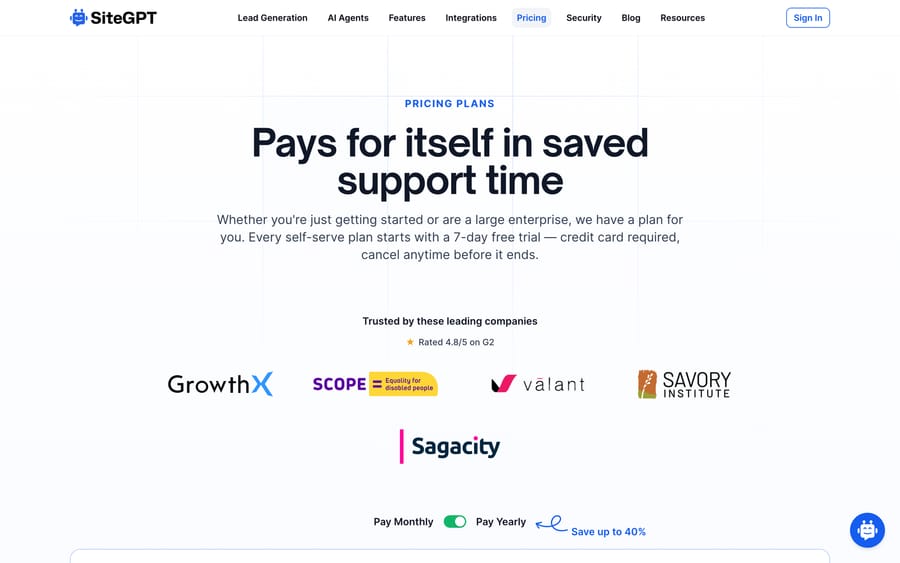
SiteGPT's pricing page, headlined "Pays for itself in saved support time," with the customer logo strip and the monthly/yearly billing toggle that advertises savings up to 40%.
We checked SiteGPT's pricing page directly. All four plans bill monthly or annually, with the annual price paid up front:
| Plan | Monthly | Annual (per mo) | Chatbots | Messages/mo (mini / GPT-4.1) | Pages | Team seats |
|---|---|---|---|---|---|---|
| Starter | $59 | $39 | 1 | 4,000 / 400 | 1,000 | 1 |
| Growth | $129 | $79 | 2 | 10,000 / 1,000 | 10,000 | 4 |
| Scale | $429 | $259 | 3 | 40,000 / 4,000 | 50,000 | 10 |
| Enterprise | Custom | Custom | up to 1,000 | custom | 500,000 | up to 1,000 |
A few things sit outside that table. Removing SiteGPT's own branding from the widget costs a separate $39/month on every paid plan. An extra 5,000 messages is also a flat $39/month add-on, so a Starter customer who blows through 4,000 mini-model messages is choosing between a $39 top-up or a $70/month jump to Growth for the same headline message count. That's the shape of the business model: message caps are tuned tight enough that real usage pushes a growing account toward the next tier or an add-on, and the upsell is the point of setting the free room where it is. Growth's own 10,000-message cap works out to roughly $0.013 per message on GPT-4.1-mini at the monthly price. That's cheap per unit, but it's a message, and a single customer question can take three or four back-and-forth messages before it's answered, so the effective cost per resolved question runs several times higher. The 7-day trial requires a credit card up front, per SiteGPT's own pricing page, and you can cancel any time before it ends.
Pros and cons
Pros
- Fast to set up: sync a source, install a script tag, and the bot is live the same day.
- Message-based pricing is transparent and published, with no sales call required at any tier.
- Multi-format training (files, Notion, Drive, GitHub) covers more source types than a website-crawl-only competitor.
- 95+ languages out of the box, useful for a site with international traffic.
Cons
- The bot answers from content only. It can't look up an order, process a refund, or take any action in a backend system.
- Message caps reset the value proposition quickly if a plan's model choice (mini vs. full GPT-4.1) isn't obvious up front.
- Branding removal and extra messages are both separate paid add-ons rather than plan features.
- No named case study with measured deflection or resolution numbers. The social proof is a logo strip and a self-reported G2 score.
Who SiteGPT is best for
SiteGPT fits teams whose support questions are genuinely answerable from static content: pricing, how-to, policy, product spec, and who don't have or don't want to build a backend integration. A single-product SaaS company, an info-product seller, or a services business with a documented FAQ can be live with a working bot in under an hour. It's the wrong fit if your support volume is mostly account-specific, covering order status, subscription changes, or refunds, because those need to read or write a real system and SiteGPT's job stops at generating an answer from what it indexed.
It's also worth being honest about scale. The pricing is built for a marketing site or a lean SaaS product, not a support team already running thousands of tickets a month through a help desk. At that volume, the message caps and per-tier chatbot limits (2 chatbots on Growth, 3 on Scale) start to feel like a ceiling rather than a feature, and a team that size is usually better served by an AI layer built to sit inside the ticketing system it already has.
SiteGPT vs alternatives
| SiteGPT | Chatbase | Macha | |
|---|---|---|---|
| Model | Website-trained chatbot widget | Website-trained chatbot widget | AI agent layer on your existing help desk |
| Best for | Small sites with static FAQ content | Small sites with static FAQ content | Teams on Zendesk, Freshdesk, Gorgias or Front |
| Can take actions (refunds, order lookups)? | No | Limited, via integrations | Yes, via connectors and custom tools |
| Pricing | $59–$429/mo by message cap, published | Published, message-based (see our Chatbase guide) | From $299/mo for 750 tickets (~$0.40/ticket), published |
| Setup | Self-serve, no engineering needed | Self-serve, no engineering needed | Built, tested and monitored by the Macha team |
| Trial | 7 days free, credit card required | Free tier available | $50 free usage |
SiteGPT and Chatbase are close enough in shape that the decision usually comes down to message-cap math at your expected volume and which integrations you need. Macha is a different kind of tool. It's an AI agent layer that works inside the help desk your support team already uses, with access to your order data, subscriptions, and other systems through connectors, so it can take action on a ticket. If your support load already lives in Zendesk, Freshdesk, Gorgias, or Front and the tickets need an action taken, a content-only chatbot like SiteGPT can answer the FAQ but can't close the ticket. See how Macha's agents work and current pricing.
FAQ
What is SiteGPT? A chatbot builder that trains an AI on your website, uploaded files, or connected apps (Notion, Google Drive, GitHub), then serves a chat widget that answers visitor questions from that content.
How much does SiteGPT cost? Four plans: Starter at $59/mo, Growth at $129/mo, Scale at $429/mo (all cheaper billed annually), and custom Enterprise pricing. Each plan caps messages per month, and the cap differs by which OpenAI model answers, running roughly 10x more messages on the cheaper mini model than on full GPT-4.1.
Does SiteGPT offer a free trial? Yes, a 7-day free trial on every self-serve plan, but SiteGPT's own pricing page requires a credit card to start it, and canceling before the 7 days end avoids a charge.
Can SiteGPT take actions like issuing refunds or checking order status? No. It answers questions from indexed content. Looking up an order or processing a refund needs a tool that can read and write to your backend systems, which is outside what a content-trained chatbot does.
What are good alternatives to SiteGPT? Chatbase is the closest direct comparison, in the same category with the same website-trained-widget model. For teams whose support runs through an existing help desk and needs to take actions on tickets, an AI agent layer like Macha is a different kind of alternative worth comparing.
Does SiteGPT integrate with Zendesk? Yes, on the Growth plan and above, with a dedicated "Zendesk AI Agent" feature listed on the Scale plan. The vendor doesn't publish detail on exactly what that integration does inside a ticket beyond routing and escalation.
Is SiteGPT good for a business with an existing support ticket queue? It suits FAQ-style questions arriving through the website widget. It doesn't read or act on existing help desk tickets, so it's a supplement to a ticket queue rather than a way to automate it.
Sources: SiteGPT homepage, SiteGPT pricing.
Resolve tickets automatically with AI agents
Macha's AI agents work on top of the help desk you already use — no code.