Intercom
 Shopify
 Stripe
 Slack
Slack Notion
 Google Workspace
 Confluence

What Are the Best Forethought AI Alternatives in 2026?


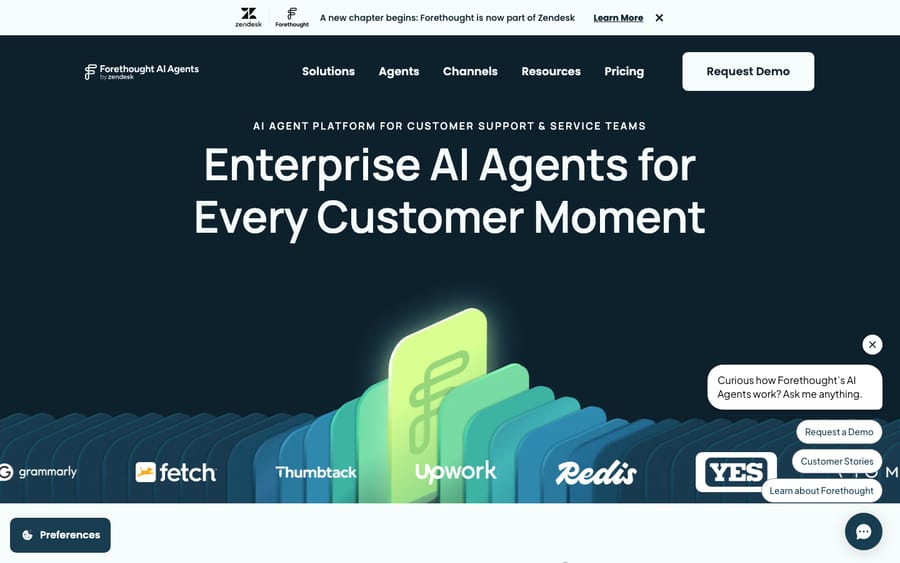
Zendesk completed its acquisition of Forethought on March 26, 2026 and now sells it as Forethought AI agents by Zendesk, which ends its run as the independent, helpdesk-agnostic option. Teams that picked Forethought for that independence are now comparing standalone platforms, native help desk agents and independent agent layers.
Key takeaways
- The best Forethought alternatives in 2026 are Decagon, Sierra and Ada for enterprise, Intercom Fin and Zendesk AI agents natively, Gorgias and DigitalGenius for ecommerce, Fini, eesel and Macha.
- Zendesk announced its acquisition of Forethought on March 11, 2026, completed it on March 26, and began selling Forethought AI agents by Zendesk on June 4, 2026.
- Forethought historically billed a platform fee plus roughly $0.12 per deflection, with Vendr data showing a $74,483 a year median across 69 purchases.
- Zendesk's native AI agents bill per verified resolution at $1.50 committed, per Zendesk's pricing page, so 3,000 resolutions a month costs $4,500, against roughly $360 at Forethought's old deflection price.
- Intercom Fin charges $0.99 per outcome, with a 50-outcome monthly minimum only when Fin runs on a help desk other than Intercom.

The best Forethought alternatives in 2026 are Decagon, Sierra and Ada for an independent enterprise platform, Intercom Fin ($0.99 per outcome) and Zendesk's own AI agents if you'll use a help desk's native agent, Gorgias and DigitalGenius for ecommerce, Fini and eesel ($0.40 a ticket) for usage pricing without a contract, and Macha ($299 a month for 750 tickets) as an independent agent layer on the help desk you already run. We checked each vendor's pricing and documentation, and the acquisition itself, in September 2026.
| Product | Pricing model | Deployment | Best for |
|---|---|---|---|
| Forethought (now Zendesk) | Platform fee + ~$0.12/deflection (migrating) | Folding into Zendesk | Existing Zendesk teams |
| Decagon | Per-conversation or per-resolution; ~$50K+/yr | Standalone, sales-led | High-volume consumer/fintech |
| Sierra | Outcome-based (~$150K–$350K+/yr) | Standalone, build-heavy | Large enterprises, bespoke agents |
| Ada | Per-resolution (~$1–$3.50) or per-conversation; ~$30K+/yr | Standalone, no-code | Mid-market/enterprise, multilingual |
| Intercom Fin | $0.99 per outcome | Native to Intercom (+ other desks) | SaaS teams wanting public pricing |
| Zendesk AI agents | Per verified resolution; $1.50 committed, $2 PAYG (Zendesk pricing page) | Native to Zendesk | Existing Zendesk teams |
| Macha | From $299/mo for 750 tickets (~$0.40/ticket) | Independent layer on your help desk | Teams on Zendesk, Freshdesk, Gorgias, Front, HubSpot, Intercom wanting an AI layer |
| Gorgias Automate | $0.90/resolution on most plans, from $1 on Starter | Native to Gorgias | Shopify / DTC brands |
| DigitalGenius | Usage-based, from ~$1,000/mo | Standalone, ecommerce | High-volume retail/logistics |
| Fini | $0.89 / $0.69 / $0.49 per resolved ticket | Plugs into your helpdesk | Mid-market, outcome pricing |
| eesel AI | $0.40 per ticket (pay-per-task) | Self-serve, plugs in | Small/mid teams, low-friction |
Disclosure: Macha publishes this blog. Macha is one of the ten tools below — an AI agent layer that runs on Zendesk, Freshdesk, Gorgias, Front, HubSpot or Intercom. It's described against the same criteria as everything else on this page, sits in the group those criteria put it in, and carries the same "where it falls short" line as every other entry.
Why are teams looking for an alternative to Forethought?
Forethought built its reputation as a self-learning, agentic support platform that sat on top of whatever helpdesk you used — Zendesk, Salesforce, Freshworks, others. That independence was a feature. The reasons to reconsider it now are mostly about what the Zendesk deal changes:
- It's now a Zendesk product. Zendesk announced the acquisition on March 11, 2026 and completed it on March 26 and began selling "Forethought AI agents by Zendesk" to customers on June 4, 2026. If you're not a Zendesk shop, or you deliberately wanted a vendor that wasn't tied to one helpdesk, that independence is gone.
- Roadmap and lock-in uncertainty. Acquisitions reshuffle priorities. Standalone Forethought's roadmap now serves Zendesk's strategy, and over time you should expect its capabilities, packaging, and pricing to migrate into Zendesk's resolution-based model. Zendesk has done this before — it acquired Ultimate in 2024 and rebranded it "Zendesk Advanced AI."
- Pricing is in flux. Forethought historically billed a hybrid of a platform fee plus roughly ~$0.12 per deflection (Vendr data shows a $74,483 a year median across 69 purchases, and third-party breakdowns report rates negotiable toward ~$0.07 per deflection at volume). Expect that to shift toward Zendesk's per-resolution pricing, which is reason enough to know your options.
- You may simply want a different shape. Maybe you want public, self-serve pricing; maybe a bespoke enterprise agent; maybe an ecommerce-specialist; maybe an AI layer that keeps your helpdesk. None of those is Forethought's sweet spot anymore.
To be clear: none of this means Forethought-the-technology got worse. If you're already on Zendesk, "Forethought AI agents by Zendesk" may well be the right call. For everyone else, here's the landscape. (For background, see our complete Forethought AI guide.)
How did we evaluate them, and how should you read the pricing?
We focused on autonomous AI agents — software that reads a customer's question, pulls from your knowledge and connected systems, and resolves the conversation or hands off with context — the same category Forethought competes in. The bar: it's live and selling in 2026, it does real resolution (not just suggested replies), and it serves a clear segment.
The single most important thing to understand before you buy is the billing unit, because it decides your bill more than the sticker price does:
- Per resolution / outcome — you pay only when the agent fully solves something (Intercom Fin, Fini, often Ada, Zendesk). Clean alignment, and the vendor earns more when your self-service gets worse, but "resolution" is vendor-defined, so read that definition carefully.
- Per conversation — you pay for every conversation the agent touches, solved or not (Decagon's most popular model, often Ada). Predictable, but you pay for misses.
- Per action / task — you pay for each step or task the agent takes (eesel; Macha instead charges per ticket, one charge per thread however many steps it takes). Best when a lot of value is in lookups, tagging, and routing — not just the final answer. (Forethought's old per-deflection model sits closest to per-resolution.)
- Per platform / committed fee — flat enterprise commitments, usually layered on top of one of the above (Sierra, Decagon, Ada).
Update (September 2026): Salesforce completed its acquisition of Fin — the company that had already renamed itself from Intercom on May 12, 2026, before any deal was signed — on September 10, 2026. Salesforce didn't disclose the price and runs Fin inside its AI Labs alongside Agentforce. Worth weighing in any long-term Intercom/Fin decision.
All figures below are approximate, vendor-set, and current as of September 2026, read off each vendor's own pricing and documentation pages with third-party procurement data used only where a vendor publishes nothing — confirm before signing.
The list is grouped, not ranked. The numbers are document order so you can point at an entry, not a score. The groups run in order of how much of your current setup you'd have to change to adopt them:
- Independent enterprise agent platforms — a standalone platform you stand up and operate alongside your helpdesk, sold by a sales team.
- AI agents native to a helpdesk — no separate vendor at all, if you're on (or moving to) that helpdesk.
- The independent AI agent layer on top of your helpdesk — a new vendor, but no new platform and no migration: the shape Forethought used to occupy.
- Ecommerce-built AI agents — narrower, because the value sits in store, carrier and returns data you only have if you're a retailer.
- Flexible, usage-priced challengers — the smallest commitment, and the shallowest feature set.
Within a group the order isn't a ranking either. A tool comes off the list if it stops selling, stops publishing enough detail to describe how it bills, or turns out to only draft replies rather than resolve.
What are the best Forethought alternatives in 2026?
Ten agents, in five groups, ordered by how much of your current setup each one asks you to change. Every entry carries what it does, who it fits, how it bills, how it compares to Forethought, and where it falls short.
Which independent enterprise agent platforms replace Forethought?
These compete with what Forethought was at the top of its market: standalone, helpdesk-agnostic and sold by a sales team on five- or six-figure annual commitments. They come first because they ask the most of you — a second platform to stand up and operate.
1. Decagon
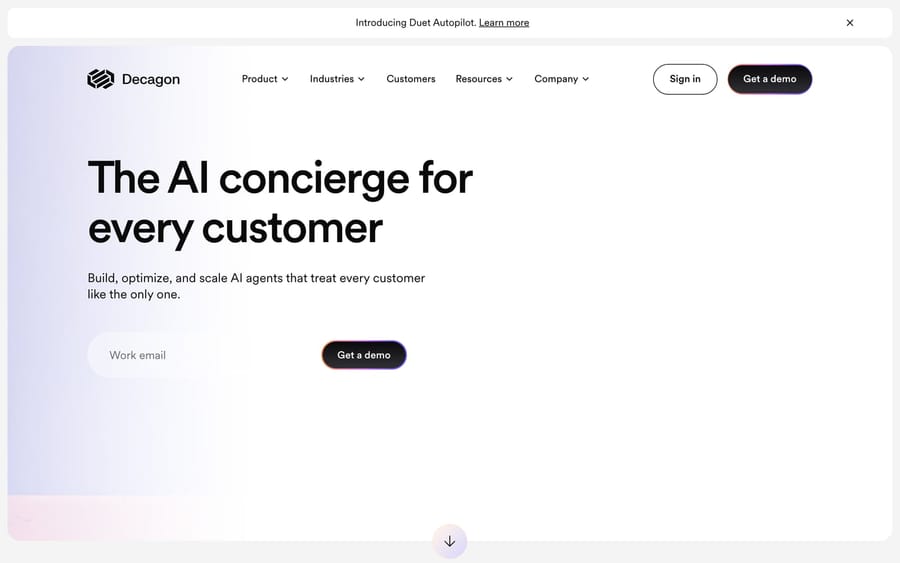
What it does: Decagon builds AI "concierge" agents for support across chat, email, and voice, with a heavy emphasis on enterprise controls and analytics. It's one of the most-funded pure-play challengers to Sierra — $4.5B valuation in January 2026, with customers including Deutsche Telekom, American Airlines and Square. Who it's for: High-volume consumer brands and fintechs that want a custom enterprise agent without building from scratch — much like Forethought's enterprise tier, but standalone. Pricing model: Quote-only. Decagon offers both per-conversation (pay for every conversation, solved or not — their most popular model) and per-resolution. Third-party estimates put a platform fee around $50K+/year plus roughly ~$0.99/conversation; Vendr's median annual contract is ~$386K. vs. Forethought: A genuinely independent enterprise agent — the closest like-for-like replacement for teams that liked Forethought's agnosticism but at a much larger spend. Where it falls short: you can't price it without a sales process, and the platform fee lands before a single conversation is resolved — a long way from Forethought's ~$0.12 per deflection. Public review volume is 18, so you buy on reference calls rather than independent evidence, and per-conversation billing charges you for every conversation the agent fails to solve. Go deeper: Our complete Decagon AI guide.
2. Sierra

What it does: Founded by Bret Taylor (former Salesforce co-CEO and an OpenAI board member) and Clay Bavor, Sierra is an "agent operating system" for building enterprise AI agents across chat, voice, SMS, WhatsApp, email, and ChatGPT — agents that take actions like processing refunds or saving cancellations, not just answering. It's the category's flagship: $950M raised at a $15.8B valuation in May 2026, and Sierra says 40% of the Fortune 50 are customers. Who it's for: Large enterprises that want a bespoke, brand-owned agent and have the team to build and maintain it. Pricing model: Outcome-based — you pay when the agent resolves, saves a cancellation, or completes an upsell. No public pricing; third-party benchmarks land around $150K–$350K+/year, blended across per-conversation and per-outcome. Taylor has publicly championed outcome pricing as "the future of software." vs. Forethought: A heavier, more customizable build than Forethought ever was — better if you want a flagship enterprise agent, overkill if you wanted Forethought's faster time-to-value. Where it falls short: it's the most expensive option on this page by a wide margin, and an "agent operating system" expects you to bring people to operate it — budget the headcount, not just the contract. No public pricing and no self-serve trial, though its G2 base has grown to about 130 reviews at 4.5. Go deeper: Our complete Sierra AI guide.
3. Ada
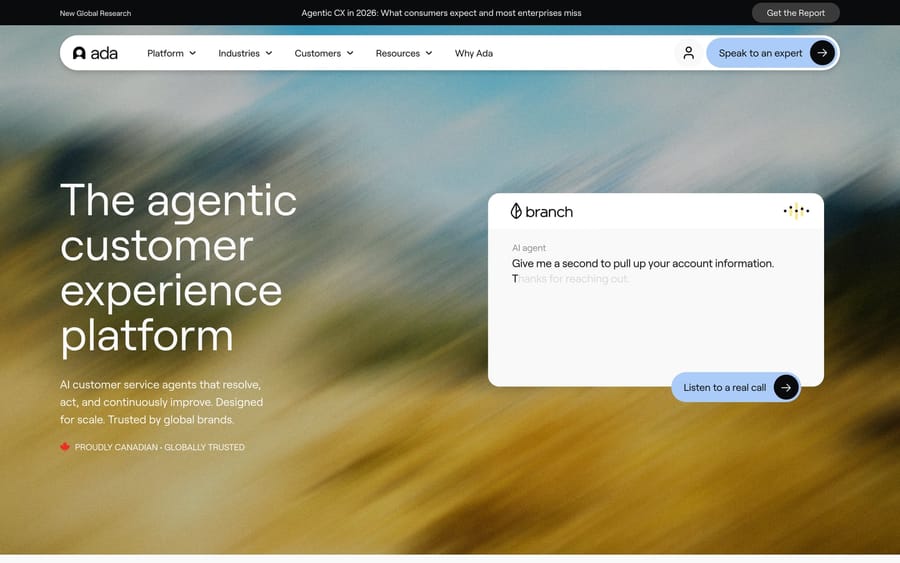
What it does: One of the longer-standing players, Ada is an AI agent platform focused on automated resolutions across channels and 50+ languages, with strong no-code authoring for non-technical teams. Who it's for: Mid-market to enterprise brands that want a mature, multilingual agent and a less engineering-heavy setup than Sierra or Decagon. Pricing model: Quote-only. Reported per-resolution rates run roughly $1–$3.50, though Ada has shifted many enterprises toward per-conversation commitments for predictability; entry deals start around $30K/year and enterprise contracts reach $150K–$300K+. vs. Forethought: Like Forethought, Ada is helpdesk-agnostic and mature — arguably the most direct independent alternative for mid-market and enterprise teams, with stronger multilingual depth. Where it falls short: quote-only with no self-serve trial and deployments that run 8–16 weeks, against a Vendr median of $72K/year — a much heavier commitment than Forethought's. Buyers rate Ada 4.6 on G2 while end users rate the same product near 2.0 on Trustpilot, citing context loss between turns and difficulty reaching a human. Go deeper: Our complete Ada AI guide.
Should you use an AI agent native to your helpdesk?
If you're willing to run your support on the vendor's own desk, its native agent skips the separate vendor relationship entirely. Less integration work, and you're tied to that platform's roadmap and pricing — which is the trade Forethought's acquisition just made for you.
4. Intercom Fin
What it does: Fin is Intercom's AI agent and the most-cited per-resolution product in the category. It resolves conversations across Intercom's messenger, email, and other channels — and Intercom sells Fin to run on other helpdesks too, so you can use it without switching to Intercom. Who it's for: Intercom customers, and SaaS/product teams that want a polished, fast-to-deploy agent with transparent, public pricing. Pricing model: $0.99 per outcome (charged once per conversation regardless of how many actions Fin takes), with a 50-outcome monthly minimum that applies only when Fin runs on a help desk other than Intercom, and a 14-day trial. "Qualification" outcomes are billed at $9.99 each, and channel fees (SMS, WhatsApp, voice) stack on top. vs. Forethought: Fin's public, per-resolution pricing is far more transparent than Forethought's quote-driven deflection model — but Salesforce's 76% average resolution rate is a vendor figure, so model your bill against your own automation rate, not the headline. Where it falls short: the meter runs on the vendor's definition of an outcome, and handoffs and self-serve routings bill at $0.99 too. Qualification outcomes bill at $9.99 each and channel fees stack on top. And if leaving Forethought is about escaping a helpdesk vendor's roadmap, note that Fin has its own: Salesforce completed its acquisition on September 10, 2026 and now sells Fin alongside Agentforce. Go deeper: Our complete Intercom Fin guide.

5. Zendesk AI agents

What it does: Zendesk's native AI agents resolve tickets autonomously across messaging and email, trained on your help center and business rules. This is also where Forethought is going — Zendesk acquired both Ultimate (2024) and Forethought (2026) and is folding that tech into its platform. Who it's for: Existing Zendesk customers who want resolution without adopting a separate vendor. Pricing model: Per verified automated resolution, on top of your Suite or Support seats. Zendesk's pricing page lists the rate: $1.50 per resolution on a committed plan, $2.00 pay-as-you-go. Its plan table includes 5 automated resolutions per agent a month on Support Team and Suite Team and 10 on Suite Professional (up to 10,000 a year); Zendesk's help center describes that allowance as a monthly dollar amount per seat ($2, $5 or $10 by plan since May 18, 2026, capped at $5,000 a year). vs. Forethought: Honestly, this isn't an "alternative" so much as the destination — if you're a Zendesk shop, "Forethought AI agents by Zendesk" and Zendesk's native agents are converging. Worth understanding precisely because it's the path of least resistance, and the one to avoid if Zendesk lock-in is the thing you're trying to escape. Where it falls short: it's the highest per-resolution rate on this page: 3,000 resolutions a month is $4,500 at the $1.50 committed rate, against roughly $360 at Forethought's old deflection price — and it scales with your success rather than your effort. It runs on Zendesk only, and the packaging has moved twice in two years as Ultimate and Forethought are folded together.
Is there an independent AI agent layer like Forethought used to be?
This is the shape Forethought used to occupy, and the group most directly vacated by the acquisition: an agent that resolves inside the desk you already run, sold by someone who does not also sell you the desk. It asks for a new vendor but no new platform and no migration, which is why it sits after the native agents and before the ecommerce-native ones.
6. Macha

What it does: This is our product, so here is the mechanism rather than the pitch. Macha isn't a helpdesk and isn't owned by one — it's an independent AI agent layer that runs on top of Zendesk, Freshdesk, Gorgias, Front, HubSpot or Intercom. It connects over the helpdesk API and runs configured agents against incoming tickets. An agent is a set of written instructions plus the tools it's allowed to call: read the ticket, its comments, its custom fields and attachments, search past tickets, search connected knowledge (help center, Notion, Confluence, Google Docs, a website), then write back a public reply, an internal note, tags, status, priority or field values. Any HTTP API can be added as a custom tool — an order lookup, a subscription cancel, a warranty check. Each agent runs in one of three modes you can switch between: internal note only, a draft for a human to send, or an autonomous reply, and a simulation replays your real past tickets before any of it goes live. Who it's for: Teams on Zendesk, Freshdesk, Gorgias, Front, HubSpot or Intercom that liked the idea of Forethought — an AI layer on the helpdesk they already run — but want one that isn't owned by their helpdesk vendor. Pricing model: One plan priced on monthly ticket volume — $299 for 750 tickets, $599 for 1,500, $1,199 for 3,000, $1,999 for 5,000, $2,999 for 7,500 and $3,999 for 10,000, custom above that. That's about $0.40 a ticket at every tier, billed monthly. A ticket is one thread with one person, charged once however many messages and tool calls it takes; an email ticket, a live chat and a Copilot session each count once. Every feature is on every tier, seats are unlimited, there are no overages — agents pause at the limit rather than auto-billing — and setup, agent building and monitoring are done by the Macha team rather than sold as a services line. The trial is $50 of free usage, about 125 tickets, no credit card and no time limit. vs. Forethought: the same place in your stack, priced per ticket instead of per deflection, and from a vendor that doesn't also sell you the helpdesk. See Macha for Zendesk for how the layer works.
Where it falls short: We're a much smaller company than Ada, Decagon or Sierra, with no G2 or Capterra profile to check us against and no analyst coverage — if your procurement process requires third-party review volume, we will fail it. Macha is not a helpdesk, so it's a line item on top of one rather than a replacement for it, and if you're not on Zendesk, Freshdesk, Gorgias, Front, HubSpot or Intercom, one of the standalone platforms above fits your stack better. And an agent does what its instructions say, so a vague instruction produces a vague agent — the setup work is real, which is why we do it with you rather than handing over an empty console.
Which AI agents are built for ecommerce?
Retail and DTC support has its own shape — WISMO, returns, exchanges, order edits — and these agents are built around it, with carrier, returns and store integrations included.
7. Gorgias Automate

What it does: Gorgias is the dominant Shopify-era helpdesk, and its Automate AI agents resolve order-status, returns, and product questions using connected store data. Tightly tuned for ecommerce conversations. Who it's for: Shopify and DTC brands already on (or considering) Gorgias — a segment Forethought never specialized in. Pricing model: $0.90 per resolved conversation on most plans, from $1 on Starter, per Gorgias's own pricing explainer; interactions beyond your allowance cost $1.50 on Support + Shopping Assistant plans and $1.00 to $2.00 on monthly support-only plans. Third-party breakdowns flag that an AI resolution can also count toward your helpdesk ticket volume. Real-world automation rates land around 26–56%. vs. Forethought: A purpose-built ecommerce answer where Forethought was a horizontal platform — better fit for retail support, weaker for B2B/SaaS. Where it falls short: it runs on Gorgias and nowhere else, so you'd be trading one vendor's lock-in for another's. If the double-count applies to your plan, one automated resolution moves two meters on your bill, and outside Shopify-shaped ecommerce the store-data advantage disappears.
8. DigitalGenius
What it does: Purpose-built for ecommerce, DigitalGenius combines conversational AI with visual AI (image recognition for product defects/returns) and deep integrations to carriers, ERPs, and warehouses to resolve order tickets end-to-end. Who it's for: High-volume retailers and DTC brands with complex logistics and returns operations. Pricing model: Usage-based (automated conversations/tickets), tiered, starting around $1,000/month with custom enterprise quotes; implementation runs $1,000–$50,000 and there's no free trial. vs. Forethought: Deeper ecommerce/logistics specialization than Forethought — the right call when WISMO, returns, and carrier integrations are the bulk of your queue. Where it falls short: no free trial and a separately quoted implementation of $1,000–$50,000 mean you commit before you see a resolution rate on your own queue. The whole product assumes an ecommerce-logistics shape — if your tickets are billing, account or software questions, most of what you're paying for goes unused.
Which usage-priced challengers need the smallest commitment?
If the enterprise platforms feel heavy and the native agents feel locked in, these prioritize fast setup and pay-for-what-you-use economics — the cleanest break from Forethought's sales-led motion.
9. Fini
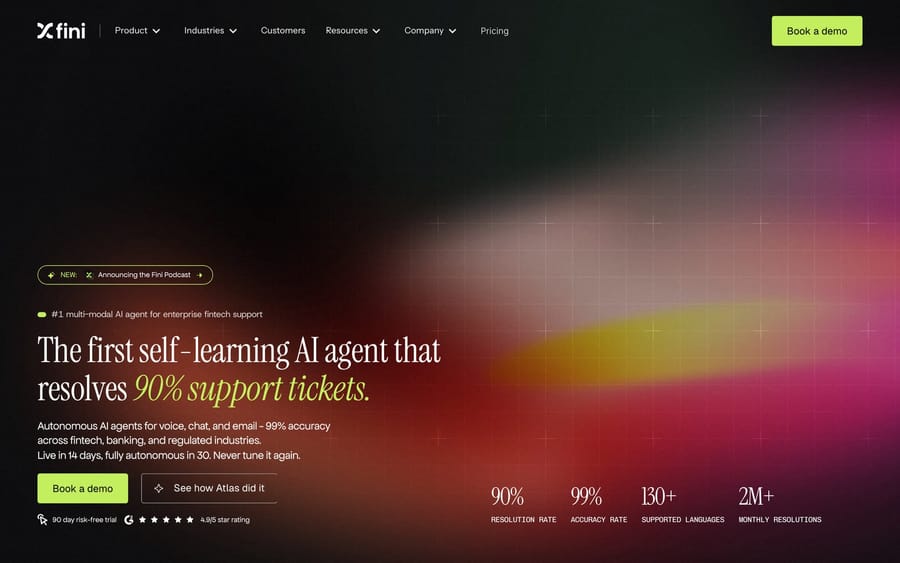
What it does: Fini is a self-improving AI support agent that plugs into your existing helpdesk and knowledge, with a focus on multi-modal resolution and clean human handoff. Who it's for: Mid-market support teams that want outcome pricing without enterprise contracts or implementation fees. Pricing model: Tiered per resolved ticket: $0.89 on Growth, $0.69 on Scale, $0.49 on Enterprise, with implementation included and no seat charges. Enterprise customers get a 90-day free pilot. One of the lower per-resolution rates among the outcome-priced agents. vs. Forethought: Faster and cheaper to stand up than Forethought, with transparent per-resolution pricing — at the cost of Forethought's enterprise depth and controls. Where it falls short: there's no free tier below Enterprise, so on Growth or Scale evaluating it costs money from the first ticket. It's a small vendor with a thin public review base, and the billing unit carries the definitional problem per-resolution pricing always has: someone else decides what "resolved" means.
10. eesel AI
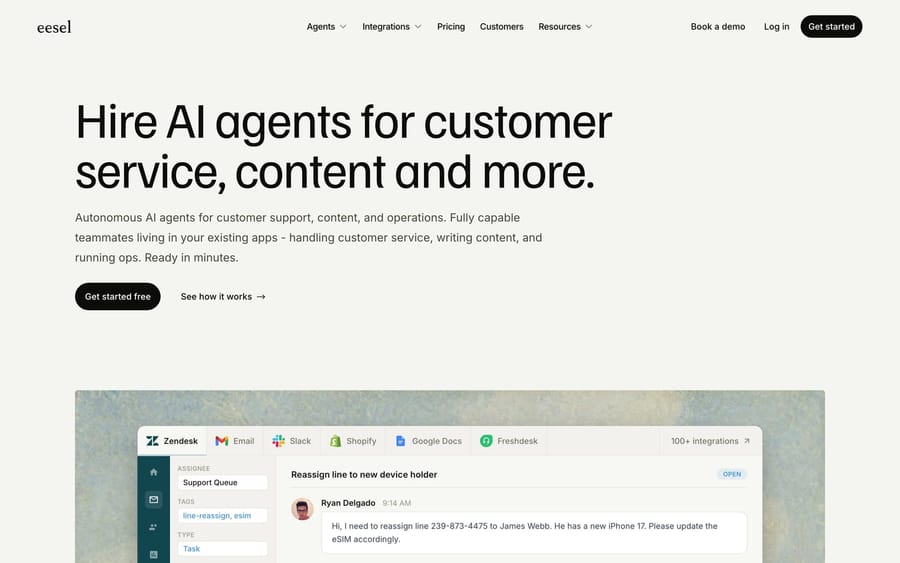
What it does: eesel connects to your helpdesk and docs and resolves tickets with a notably low-friction, self-serve setup — you can start without talking to sales. Who it's for: Small to mid-sized teams that want to switch on an agent cheaply, test it, and scale spend deliberately. Pricing model: Pay-per-task at $0.40 per support ticket — no platform fee, no seat charges and no monthly minimum on self-serve, free until you've used $50, with a $250/month default spending limit; an annual commitment paid upfront saves up to 25%. A separate Enterprise tier adds a $1,000/month flat platform fee on top of the same usage (dedicated solutions engineer, higher knowledge limits, SSO, HIPAA), so it costs more than self-serve at any volume. vs. Forethought: The polar opposite of Forethought's sales-led enterprise motion — self-serve, transparent, and cheap to trial. Where it falls short: feature depth is shallower than the enterprise platforms, heavy generations bill at $4.00 rather than $0.40, and that $1,000/month platform fee arrives the moment you need SSO or HIPAA — the self-serve price is not the price at scale. Setup is self-serve, which also means the configuration work is yours.
What do users actually say about these tools?
Star ratings only tell you so much, so here are real, attributed reviews from public platforms — kept verbatim, with the caveats they deserve. Note the asymmetry up front: the operators leaving G2 reviews (support and ops managers) tend to rate these tools highly, while end customers who hit the bots leave much harsher marks. Ada, for example, sits at 4.6 on G2 but ~2.0 on Trustpilot, the latter reflecting end-user chatbot frustration — loops, context loss — rather than the buyer's experience.
- Intercom Fin — pricing is the recurring gripe. "I never really know how many conversations it will handle in a given month, which makes it harder to predict expenses." — verified Fin by Intercom reviewer, G2 (2026). The per-resolution model wins on transparency but is hard to forecast at scale; multiple reviewers note costs "add up rapidly."
- Ada — easy interface, heavy setup. "Easy to use for building simple conversation flows. Our customer success team manages most configurations without needing technical support." — Operations Manager, Ada on G2 (2026). A common counterweight in the same reviews: initial setup and tuning "can be heavy," and the bot "struggles with messier, off-script questions."
- Gorgias — the Shopify depth is the draw. "The Shopify integration is extremely powerful. Being able to see order data, issue refunds, edit orders, and manage tickets directly within one platform significantly improves efficiency." — verified Gorgias reviewer, G2 (2026). The flip side reviewers flag is pricing pressure for smaller stores.
A caveat on the enterprise names: Decagon (18 reviews) and Fini have thin public samples — high stars on a tiny base — and their public-facing demos are often bot-walled, so don't read those ratings the way you'd read the thousands of reviews behind Intercom or Zendesk. For the quote-only enterprise vendors, a scoped pilot tells you far more than a review page. Macha has no public G2 reviews yet — we're newer and won't pretend otherwise; judge it on a trial against your own queue, not a star count.
How do you choose a Forethought alternative?
You don't pick the "best" agent in the abstract — you pick the one that fits your stack, your volume, and your budget model. A short decision path:
- Decide how you feel about Zendesk. If you're happily on Zendesk, "Forethought AI agents by Zendesk" or Zendesk's native agents are the lowest-friction path. If the acquisition is why you're here, rule out Zendesk-owned options and look at the independents — Ada and Decagon (enterprise), Fin and Fini (per-resolution), eesel (self-serve), or an independent layer like Macha if you want to keep your helpdesk.
- Match the billing unit to your reality. Per-resolution rewards a clean, FAQ-heavy queue. Per-conversation is predictable but you pay for misses. Per-action fits queues where lookups and routing do the heavy lifting. Model your real volume against each — the cheapest sticker rarely wins at scale.
- Be honest about implementation. Sierra, Decagon, Ada, and DigitalGenius can be excellent and can also mean five- to six-figure commitments and weeks of setup. Fin, Fini, eesel, and Macha get you live far faster.
- Read the resolution definition. Every per-resolution vendor defines "resolved" differently — and that definition is your bill. Watch for double-billing (Gorgias), monthly minimums (Fin's 50-outcome floor), and quote-only opacity (Decagon, Ada).
- Pilot before you commit. Run the agent on a real slice of your queue and measure actual resolution rate and CSAT — vendor-claimed rates (Salesforce cites 76% for Fin) and your reality can diverge a lot.
Frequently asked questions
Did Zendesk acquire Forethought? Yes. Zendesk announced the acquisition on March 11, 2026 and completed it later that month — one of its largest acquisitions to date. Forethought is being integrated as "Forethought AI agents by Zendesk," which Zendesk began selling to customers on June 4, 2026. For many teams, that loss of independence is the main reason to evaluate alternatives.
What are the best alternatives to Forethought in 2026? For independent enterprise agents, Decagon, Sierra, and Ada lead. For transparent per-resolution pricing, Intercom Fin and Fini stand out. For ecommerce, Gorgias and DigitalGenius are purpose-built. For fast, self-serve setups, eesel wins. And if you're on Zendesk, Freshdesk, Gorgias, Front, HubSpot or Intercom and want an AI layer that isn't owned by your helpdesk vendor, that's where Macha fits.
How was Forethought priced, and will it change? Historically a hybrid: a platform fee plus roughly ~$0.12 per deflection (Vendr median $74,483 a year). Expect it to migrate toward Zendesk's resolution-based pricing (its pricing page lists $1.50 per automated resolution committed, $2.00 pay-as-you-go) over the coming year as the products converge.
Is there a Forethought alternative that keeps my existing helpdesk? Yes — that's the appeal of an AI layer. Macha runs on top of Zendesk, Freshdesk, Gorgias, Front, HubSpot or Intercom and resolves routine tickets inside your existing workflow, escalating to humans with context. It's independent of any single helpdesk vendor, which is the gap the Zendesk acquisition opened up. (Fin and Fini also plug into existing helpdesks via per-resolution pricing.)
Is Macha a Zendesk or Forethought alternative? Macha is not a helpdesk and doesn't replace Zendesk, Freshdesk, Gorgias, Front, HubSpot or Intercom — it's an AI agent layer that runs on top of them. As a Forethought alternative, it occupies the same "AI layer on your helpdesk" niche Forethought used to, with the difference that it's independent rather than owned by a helpdesk vendor. If you need a helpdesk, you still need one; Macha makes the one you have resolve more on its own.
Which Forethought alternative should you pick?
Forethought becoming part of Zendesk is the cleanest reason to shop around in years: a tool many teams chose because it was independent is now tied to one platform's roadmap and pricing. If you're on Zendesk and happy, "Forethought AI agents by Zendesk" may be the natural path. If you're not — or independence was the point — the field is deep. Decagon, Sierra, and Ada are the standalone enterprise options; Intercom Fin and Fini offer transparent per-resolution pricing; Gorgias and DigitalGenius own ecommerce; eesel wins on self-serve simplicity; and Macha is built for teams that want an independent AI layer on the Zendesk, Freshdesk, Gorgias, Front, HubSpot or Intercom they already run. Whichever you shortlist, pin down the billing unit, read the resolution definition, and pilot on real tickets before you sign.
Vendors, pricing, and the Zendesk–Forethought acquisition verified against vendor pricing, documentation and press pages, September 2026. AI pricing in this category is changing fast — confirm current terms on each vendor's site before buying.
Resolve tickets automatically with AI agents
Macha's AI agents work on top of the help desk you already use — no code.