Intercom
 Shopify
 Stripe
 Slack
Slack Notion
 Google Workspace
 Confluence

Is Forethought AI Worth It? 2026 Review, Pricing and Alternatives


Forethought AI, owned by Zendesk since March 2026, scores 16 out of 30 on our rubric: capable at resolving tickets, but quote-only, with a $74,483 median contract per Vendr and a floor of 2,000 email or chat tickets a month. Below are its tiers, real user ratings, recurring problems and who should buy something else.
Key takeaways
- Forethought AI scores 16 out of 30 on the review's six-criterion rubric, below the 18-point shortlist bar, losing points on published pricing, entry cost and review volume.
- Zendesk completed its Forethought acquisition on March 26, 2026 and since June 4, 2026 sells Forethought AI agents to Zendesk and non-Zendesk customers through Zendesk sales.
- Forethought's own FAQ asks for 20,000+ historical tickets and at least 2,000 email or chat tickets a month for its AI to operate smoothly.
- Vendr's data from 69 purchases puts Forethought's median annual contract at $74,483, within a range of $35,670 to $151,400.
- Forethought's Team plan covers AI agents for chat and mobile only, so email, voice and Slack agents require the Professional tier.

Forethought AI is an enterprise AI support agent, owned by Zendesk since March 2026, that scores 16 out of 30 on our rubric: strong at resolving tickets end to end, weak on anything a buyer can check before a sales call. It publishes no prices, Vendr's contract data puts the median at $74,483 a year, and Forethought's own FAQ says the AI needs at least 2,000 email or chat tickets a month. It suits Zendesk shops with high volume and someone to own the tuning.
| Forethought AI at a glance | September 2026 |
|---|---|
| Owner | Zendesk (deal completed March 26, 2026) |
| Plans | Team, Professional, Enterprise; no dollar figures, quote only |
| Median annual contract | $74,483 (Vendr, 69 purchases; range $35,670 to $151,400) |
| Minimum volume | 20,000+ historical tickets and 2,000 email or chat tickets a month |
| Setup time | 30 to 90 days, per Forethought's FAQ |
| Trial | No free plan or trial; a "Proof of Value" engagement instead |
| Ratings | G2 4.3 (166), Capterra 4.45 (11), Trustpilot 2.5 (8) |
| Our score | 16 / 30, below our 18-point shortlist bar |
The ownership change shapes everything below: in March 2026, Zendesk acquired Forethought. The deal was announced on March 11, 2026 and completed on March 26, 2026, per Zendesk's own newsroom; Zendesk didn't disclose the price. Forethought is now marketed as "Forethought AI agents by Zendesk," and Zendesk has sold it to non-Zendesk customers since June 4, 2026. If you're shopping today, you're buying from Zendesk, not an independent startup. Keep that in mind for everything below, especially pricing.
What happens to Forethought customers now that Zendesk owns it?
So far, nothing forces a change. Zendesk's June 4, 2026 announcement says "Zendesk customers can now purchase Forethought capabilities as an add-on" and "If you're not a Zendesk customer, Forethought is available to purchase," with every sale routed through a Zendesk sales representative (Zendesk announcement). Zendesk's own documentation says Forethought "can operate independent of the Zendesk platform", but neither it nor the June announcement says anything about existing contracts or migrations, and we found no later statement on either as of September 28, 2026.
| Date | What happened | What it means for a customer |
|---|---|---|
| March 11, 2026 | Zendesk announces the acquisition | Forethought's CEO wrote that the trust customers placed in it, and their influence on the product, "will stay the same"; no contract terms published |
| March 26, 2026 | Deal completes | Zendesk is now your vendor |
| June 4, 2026 | Sold as "Forethought AI agents by Zendesk" to Zendesk and non-Zendesk customers | Renewals and new purchases go through Zendesk sales |
| September 28, 2026 | Forethought's platform page still names Zendesk, Salesforce, Intercom, Gorgias, LiveChat, Five9 and 8x8 among "70+ integrations" | Non-Zendesk help desks are still listed; no end date announced |
Zendesk's stated reason, per TechCrunch, is that the deal accelerates its product roadmap "by more than a year", with Forethought's technology going into Zendesk's own AI agents, including voice automation.
What to plan for is the incentive. Zendesk bought an AI agent that also runs on its competitors' help desks, and every Forethought customer on Salesforce or Intercom is a customer whose agent seats Zendesk doesn't sell. Over time it would be unsurprising if Forethought worked best, or was priced best, on Zendesk. That's our inference, not something Zendesk has said. If you run Forethought on Salesforce, Intercom or Gorgias, treat your next renewal as the moment to get it in writing.
What to ask at renewal:
- Integration commitment. A contract clause that your help desk integration stays supported for the full term.
- Price protection. A renewal cap: Vendr reports that Forethought contracts often carry annual escalators of 3% to 7%, which buyers can negotiate down, especially on multi-year terms.
- Data processing. The updated DPA and sub-processor list, now that Zendesk is the vendor of record.
- Exit terms. An export of your flows, intents and training data in a usable format if you leave.
If you're weighing a move, the realistic options depend on the desk you run:
| Your help desk | Help desk's own AI agent | Layer that runs on top |
|---|---|---|
| Zendesk | Zendesk AI agents, now alongside Forethought as an add-on | Macha, eesel AI |
| Salesforce | Agentforce | eesel AI |
| Intercom | Fin (a Salesforce product since September 10, 2026) | Macha, eesel AI |
| Gorgias | Gorgias AI Agent | Macha, eesel AI |
| Freshdesk, Front, HubSpot | Freddy AI Agent, Front Autopilot, Breeze Customer Agent (not among the desks Forethought names on its platform page) | Macha, eesel AI |
Two of the biggest standalone AI support agents now belong to platform vendors: Forethought to Zendesk, and Fin to Salesforce. If staying independent of your help desk vendor matters to you, that narrows the field to layers that don't sell a help desk. Macha is one: it runs on Zendesk, Freshdesk, Gorgias, Front, HubSpot or Intercom and is priced per ticket on a published plan, covered in more detail in how Macha differs below.
How does Forethought AI score in our review?
Six criteria, 0 to 5 each, 30 available, and 18 out of 30 is the bar a product clears before we put it on a shortlist. It is the rubric we publish with its working on best help desk software. Because Forethought is an AI agent vendor rather than a help desk, "AI that resolves" is read as resolves end to end rather than drafts a suggestion.
| Criterion (0-5) | Forethought | Why |
|---|---|---|
| Published pricing | 1 | A pricing page exists and it is unusually clear about what sits in Team, Professional and Enterprise. It carries no dollar figure anywhere. One point for the tier contents, none for a price. |
| Entry cost for a small team | 0 | No free plan and no trial, only a sales-run "Proof of Value" engagement. Vendr's contract data puts the median near $74.5K a year, and Forethought's own FAQ sets a floor of at least 2,000 email or chat tickets a month before the AI works properly. |
| AI that resolves | 5 | Solve resolves end to end rather than deflecting, across chat, email, voice, Slack and mobile. Note the tier gate: the email and voice agents are a tier above the entry plan. |
| Write actions | 4 | Autoflows call custom actions against your systems, which is a real write path, but the catalog is something you build rather than something you buy pre-built. |
| Independent review base | 2 | 166 ratings on G2, 11 on Capterra, 8 on Trustpilot. Respectable for the category and thin against a help desk, and see the warning below about which G2 listing you are reading. |
| Channel coverage | 4 | Chat, email, voice, Slack and mobile. Social is the gap. |
| Total | 16 / 30 | Below the 18/30 bar. |
The capability half of the rubric scores 13 out of 15. The procurement half, which measures only what a buyer can establish before committing, scores 3. That is the same shape every quote-only enterprise vendor we have run through this rubric produces.
Is Forethought AI worth it?
It is worth it if you already run Zendesk, you handle tens of thousands of tickets a month, you have years of ticket history to train on, and you have someone who will own Autoflow tuning as an actual job. Reviewers who describe that setup are consistently positive, and the support team gets specific praise.
It is not worth it if your queue is under 2,000 email or chat tickets a month. Forethought's own FAQ says the AI needs that volume "to operate smoothly", which is a harder gate than the famous 20,000-ticket history requirement and disqualifies more teams. It is also the wrong buy if you need a price before a meeting, or if your support runs on email and you were budgeting for the entry tier.
What is Forethought AI?
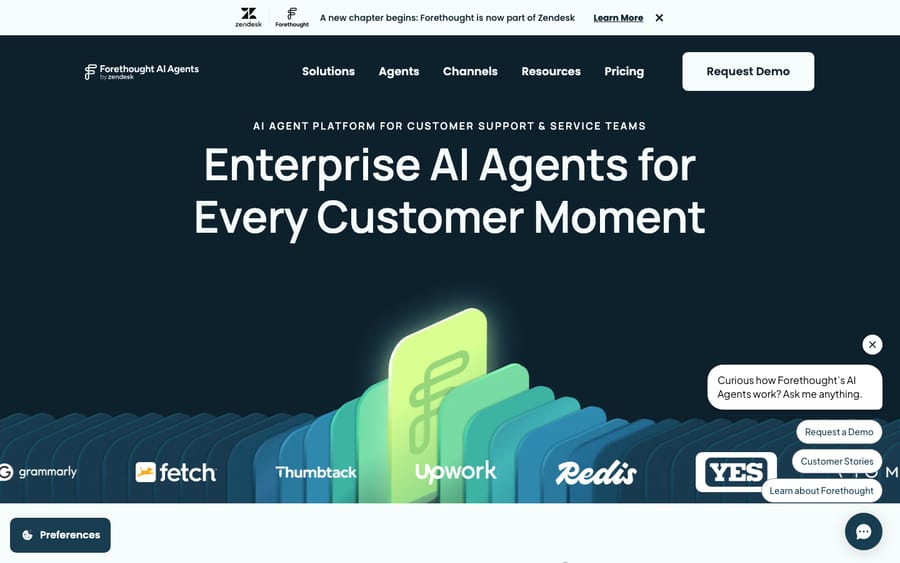
Forethought is an AI-native customer support automation platform, software that sits across your support channels and tries to resolve customer issues autonomously, triage and route the ones it can't, and assist your human agents on the rest. It was one of the first companies to pitch "AI for support" as a category rather than a chatbot feature.
It was founded in 2017 by Deon Nicholas (ex-Facebook, Palantir, Dropbox and Pure Storage; Forbes 30 Under 30), co-founder and CTO Sami "Sam" Ghoche, and co-founder Colm Doyle, and it broke out by winning the TechCrunch Disrupt Startup Battlefield in 2018. Leadership has since shifted: Nicholas, the original CEO, has stepped back into a chairman/advisory role (the team page lists him as "Co-founder & Advisor"; press around the Zendesk deal calls him Executive Chairman), with co-founder Sami Ghoche reportedly running day-to-day operations. Headquartered in San Francisco, it raised roughly $115 million in venture funding before the Zendesk deal. By the time it was acquired, Forethought said it was powering over a billion customer interactions a month for brands including Upwork, Grammarly, Datadog and Instacart.
The shorthand: Forethought is an enterprise product. It's built for support orgs with serious ticket volume and the resources to implement and tune it, not a self-serve bot you switch on over a weekend.
What products does Forethought sell?
Forethought markets a multi-agent system, five distinct "agents," each handling a different slice of the support workflow. (Naming verified against forethought.ai/platform in June 2026.)
Solve
The headline product. Solve is the customer-facing AI agent that resolves issues end-to-end across chat, email, voice, SMS, Slack, in-app/mobile, and a headless API. This is the piece that "deflects" tickets, answering questions, walking customers through flows, and taking actions without a human. Most of Forethought's pricing and ROI story revolves around Solve.
Triage
Triage classifies, prioritizes, tags and routes incoming tickets. It reads intent, sentiment and language, then sends each ticket to the right team or queue with the right priority. It's the "make the inbox smart" layer, useful even when you don't want the AI replying directly to customers.
Assist
Assist is the agent-facing AI copilot. It typically runs as a browser extension that overlays your helpdesk, surfacing suggested replies, ticket summaries, relevant knowledge articles and next-best actions while a human handles the conversation. Think of it as Solve's logic, but pointed at your agents instead of your customers.
Discover
Discover is the analytics-and-insight layer. It mines your historical support conversations to spot knowledge gaps, surface recurring issues, and recommend (or auto-generate) help articles and new automation flows. It's how Forethought tries to keep the automation improving rather than going stale.
Agent QA
An add-on that scores human-agent tickets against customizable, AI-graded rubrics, resolution quality, tone, empathy, policy adherence, so supervisors can review 100% of conversations instead of spot-checking a handful. This is a newer addition aimed squarely at QA and coaching teams.
How does Forethought's AI agent work?
The core technology Forethought leans on is Autoflows, its "agentic reasoning engine." Instead of building rigid decision trees ("if customer says X, show button Y"), you describe business logic in natural language, and the AI figures out the steps: it interprets the customer's intent, decides what information it needs, calls the right systems, and resolves the issue. The pitch is less "scripted bot," more "reasoning agent that improvises within your rules."
Three mechanics matter for an evaluation:
- Intent detection first. Forethought's models are pre-trained on customer-support language and then tuned on your historical tickets, so accuracy depends heavily on how much clean conversation history you can feed it. Forethought states the requirement itself on its FAQ page, read September 20, 2026: "Forethought's AI performs effectively with a historical ticket data volume of 20,000+ and requires at least 2,000 email or chat tickets per month to operate smoothly." That second number is the harder gate, and it rules out most teams under roughly 25 agents.
- A "Resolution Learning Loop." Zendesk specifically called out Forethought's self-improving agents as a reason for the acquisition, the system is designed to learn from resolved and escalated conversations and refine its flows over time.
- Integrations are the plumbing. Forethought connects into helpdesks and CRMs including Zendesk, Salesforce, Intercom and Gorgias, contact-center platforms like Genesys, Five9 and 8x8, and knowledge sources like Notion, Document360, Airtable and Stonly. It's not a helpdesk itself, it layers onto the system of record you already run.
One note on a comparison below: Salesforce completed its acquisition of Fin, formerly Intercom, on September 10, 2026 (Salesforce newsroom), so Fin is now an Agentforce product.
Forethought claims Solve can cut first-response times by ~55% and resolve up to 98% of issues. Treat those as vendor-stated, best-case marketing numbers, real-world resolution rates depend enormously on your content, ticket mix and tuning, and "up to 98%" is not what a typical deployment sees.
How much does Forethought AI cost?
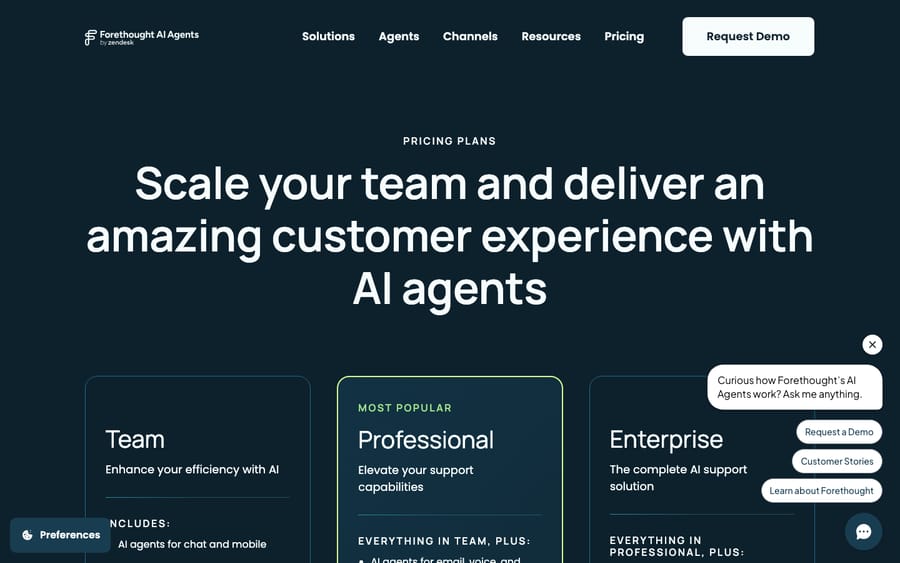
Forethought does publish a pricing page ("Forethought Pricing | Outcome-Based AI Solution"), and it lists named tiers with no dollar figures. The three tiers are Team, Professional ("Most popular") and Enterprise, and every one routes to a "Get a Quote." The model is described on the page as "a blend of platform access fees and an outcome-based pricing cost." So the page exists, and it prices nothing. Everything is custom, quote-based, and sales-negotiated, now through Zendesk's enterprise sales team.
What the page does tell you, and what it didn't a year ago, is which capability sits in which tier. Read on September 20, 2026, Team covers AI agents for chat and mobile, plus Autoflows, custom actions, CSAT collection, an insights dashboard, ready-to-use ticket triage models, multilingual support and AI QA. Professional adds AI agents for email, voice and Slack, AI-surfaced insights, multi-brand management and custom handoff models. Enterprise adds the Solve API, knowledge-gap detection with AI article creation, Autoflow gap detection and generation, the Analytics API and enterprise security and governance controls. That matters more than it looks: if your support runs on email, the agent that handles email is a tier above the entry plan.
The second thing to price before the call is the add-ons. Zendesk's own documentation for Forethought AI agents by Zendesk marks Assist, Triage, Agent QA, AI QA, Discover, the Analytics API and Multibrand each as "(Add-on)", leaving Solve and the built-in integrations as the base product. The five-agent suite the marketing describes is a base plus five separate line items. Multibrand covers up to 20 brands.
What we can do is report third-party procurement data. All figures below are estimates from external sources, not official Forethought numbers, treat them as directional and likely to drift, especially post-acquisition.
Pricing model: a hybrid of a fixed platform fee plus usage-based charges tied to resolution/deflection volume.
Real contract data (Vendr procurement marketplace):
| Metric | Reported figure | Source / caveat |
|---|---|---|
| Median annual contract | $74,483/yr | Vendr, 69 purchases, read September 24, 2026 |
| Contract range | $35,670–$151,400/yr | Vendr; depends on volume + products |
| Per-deflection rate | ~$0.12 (negotiable toward ~$0.07) | chatarmin / Vendr, approximate |
| Avg. negotiated discount | ~22% off initial quote | Vendr |
| One-time setup/onboarding | ~$5,000–$25,000 | Third-party estimate; flagged |
Vendr also lists per-unit estimates (unofficial): Solve roughly $0.50–$2.00 per conversation, Assist roughly $50–$150 per agent/month, and voice AI around $0.10–$0.50 per minute (or ~$2–$8 per call). A 10,000-ticket/month team has been modeled at ~$100,000/year all-in (chatarmin).
What the billing unit rewards. A hybrid of a fixed platform fee plus a per-deflection charge puts the two halves of the vendor's incentive in tension, and it's worth naming. The platform fee is paid whether the agent deflects anything or not, so it protects Forethought's revenue if your volume drops. The per-deflection line earns more the more tickets the agent absorbs, which is a real incentive to make it work and also means a successful deployment costs you more every month, not less. And because a deflection is measured by the vendor's instrumentation, the definition matters as much as the rate. Ask what counts as a deflection, whether a ticket the agent answers and the customer then reopens is refunded, and what the per-deflection rate is at your committed volume versus above it.
What this means for you: budget for a five- to six-figure annual contract, expect a usage component that scales with volume, and plan for implementation cost and time on top. This is not a tool you can price-compare on a website, you have to go to sales. And post-acquisition, the prior ~22% average discount may compress now that Zendesk's enterprise sales motion is at the table.
Honesty flag: Every price here is third-party and approximate. Forethought publishes named tiers and their contents but no actual prices, and we found no announced post-acquisition price change as of September 20, 2026. Verify any number directly with Zendesk before it anchors a budget.
What do users say about Forethought?
Here is every rating base we could find, with the date we read it and the exact listing, because Forethought is a case where the listing you land on decides the number you quote.
| Source | Rating | Ratings counted | Checked |
|---|---|---|---|
| G2, Forethought AI Agents by Zendesk | 4.3 / 5 | 166 | 22 September 2026 |
| Capterra | 4.45 / 5 | 11 | 22 September 2026 |
| Trustpilot | 2.5 / 5 | 8 | 22 September 2026 |
A warning about the G2 score, because we got this wrong ourselves and so does much of the web. G2 carries two products called Forethought. The one you want is Forethought AI Agents, seller Zendesk, at 4.3 from 166 ratings. The other, at g2.com/products/forethought, is seller Eduphoria, a K-12 education software company, and it sits at 3.3 from 13 ratings. That 3.3 is not a customer-support score and has nothing to do with this product. If you see a Forethought rating in the low threes anywhere, check which seller it belongs to before you use it.
Capterra's sub-scores on those 11 ratings are worth the extra line, because they contradict the loudest complaint about the product: ease of use 4.55, customer service 4.67, features 4.36, and value for money 4.57. The people who bought it do not think it was bad value. The complaint is that they could not work out the value beforehand.
Beyond the aggregate scores, the verbatim reviews are useful because they're consistent. A few real, attributed examples:
- "Forethought is easy to work with!", but the same reviewer notes the CSAT review process is manual and it "required months to achieve desired reporting.", Senior Manager, End User Support (e-learning), Capterra, March 2026.
- "The more we use Forethought/Agatha, the more useful it becomes to us in our daily work", the self-improving loop in practice., Customer Advocate (retail), Capterra, August 2021.
- "Overall, it's a great product and it helps a lot", paired with the recurring caveat that the AI's accuracy "requires refinement.", Customer Support Team Lead (computer software), Capterra, December 2022.
The pattern across G2 and Capterra: people like the automation, deflection and support team, and repeatedly flag the same three things, cost, hard-to-parse reporting, and accuracy that needs ongoing tuning.
What users complain about
The G2 dislikes, read on 22 September 2026, split cleanly into two groups. The first is about reporting and it is the oldest complaint on the listing. A senior manager of end user support at an enterprise with more than 1,000 employees wrote that the "initial design/setup philosophy (deflection first) makes it hard to dig into large scale trends or issue identification for product improvements", and that "handling large datasets manually for analysis has been a challenge" (G2). That is the same complaint the Capterra reviewer made about taking months to get the reporting they wanted, arriving from a different direction: the product is built to close tickets, not to explain them.
The second group is about accuracy at the edges. A software developer at a small business wrote on 8 August 2026 that "one area that could be improved is the accuracy and consistency of responses in more complex or nuanced situations", and that it "may need human review or additional context to provide the best answer". A verified user in utilities added that Forethought "typically has a higher than expected learning curve". None of that is unusual for the category. What makes it actionable here is the plan gate: custom handoff models, the thing that decides when the agent gives up, are a Professional-tier feature.
What does Forethought do well?
Forethought earns its enterprise reputation in a few clear areas:
- Autonomous resolution. Autoflows and the multi-agent design go well beyond decision-tree bots. For high-volume teams with rich history, it can resolve a meaningful share of tickets end to end.
- Covers the whole support workflow. Solve (resolve), Triage (route), Assist (help agents), Discover (improve), Agent QA (measure) is a more complete suite than most point solutions.
- Self-improving + omnichannel. The Resolution Learning Loop plus native voice/SMS/Slack coverage is a strong fit for large, multi-channel CX orgs.
- Solid reviews and marquee customers. The G2/Capterra sentiment (above) is consistently positive on automation and support, and customers like Grammarly, Upwork and Datadog lend real credibility.
- Now backed by Zendesk. For Zendesk shops, tight first-party integration and a single vendor relationship is a genuine plus going forward.
What are Forethought's limitations?
The watch-outs are just as real, and most of them trace back to the same root: this is heavyweight enterprise software.
- Pricing opacity. The pricing page lists tiers but no prices, it's quote-only, with hybrid usage billing. You can't budget without a sales cycle, and per-deflection costs can climb with volume.
- Implementation effort. Reviewers consistently flag that Autoflows need ongoing monitoring and tuning and benefit from a dedicated admin. This isn't set-and-forget.
- Data-hungry, with a monthly floor. Forethought's own FAQ asks for 20,000+ historical tickets and at least 2,000 email or chat tickets a month "to operate smoothly." That rules out most smaller or newer teams before any pricing conversation starts.
- Escalation gripes, and the fix is plan-gated. Some users report the bot didn't always know when to hand off to a human, looping automated responses on issues it couldn't actually solve (eesel). Custom handoff models are a Professional-tier feature, so on Team you're tuning Autoflows instead.
- Analytics can be hard to parse. Several reviewers found reporting difficult to interpret when diagnosing why a flow underperforms.
- Acquisition uncertainty. Roadmap, pricing and standalone availability now depend on Zendesk's strategy. If you're not on Zendesk, factor in some long-term platform risk.
What goes wrong in Forethought deployments, and how do you fix it?
Forethought has been selling since 2017 and its reviews are longer-running than most of the category's, which makes the recurring complaints unusually legible. Six of them, with what causes each and what to do. Three come out of Forethought's and Zendesk's own current documentation, which is where the most expensive surprises live.
1. The five-agent suite is one product plus five line items. The marketing describes Solve, Triage, Assist, Discover and Agent QA as a multi-agent system, which is accurate as architecture and misleading as a budget. Zendesk's own documentation for the product marks Assist, Triage, Agent QA, AI QA, Discover, the Analytics API and Multibrand each as an add-on, leaving Solve and the built-in knowledge integrations as the base. On top of that, the tiers gate by channel: Team gives you AI agents for chat and mobile, while email, voice and Slack agents are Professional. For a support team whose volume is mostly email, that is the difference between the entry plan and the middle one, before any add-on. The fix is to write the list before the call: which capabilities you actually need, which tier each one lives in, and which are separately priced. Then ask for the quote broken out by line item rather than as one number, because a bundled figure hides which part you can drop next year.
2. Your queue may be too small for it to work, and the number that matters isn't the famous one. Every review of Forethought mentions the 20,000-ticket history requirement. Forethought's own FAQ adds a second, harder condition in the same sentence: its AI "requires at least 2,000 email or chat tickets per month to operate smoothly." A team with five years of archived tickets but 800 a month clears the first bar and fails the second. The fix is a five-minute check before anything else: pull your last three months of email and chat ticket counts, and if the monthly figure is under 2,000, the evaluation stops there and you're looking at a lighter tool. If you're near the line, ask what "smoothly" means in measurable terms and what happens to intent accuracy below it.
3. Setup runs one to three months, and the tuning doesn't stop when it ends. Forethought's FAQ puts it at "most teams are fully set up within 30 to 90 days, and once implementation is complete, you'll be paired with a Customer Success Manager." Reviewers describe the part after that: Autoflows need ongoing monitoring and tuning, and a Senior Manager of End User Support at an e-learning company wrote on Capterra in March 2026 that while "Forethought is easy to work with," the CSAT review process was manual and it "required months to achieve desired reporting." The fix is staffing and scope. Name an admin who owns Autoflows before kickoff rather than after go-live, scope the first release to one channel and your highest-volume intents, and treat the CSM pairing as the start of the tuning phase, not the end of the project.
4. The agent doesn't always know when to stop trying. The most damaging complaint in any AI support deployment is the bot that loops instead of escalating, and reviewers report it here: the agent "didn't always know when to hand off to a human," repeating automated responses on issues it couldn't solve (eesel). The fix has a plan gate on it, which is worth knowing before you buy. Custom handoff models are a Professional-tier feature. On Team you're shaping escalation inside the Autoflows themselves, which is workable but coarser. Either way, write an explicit escalation branch into every Autoflow that can fail, cap the number of retry turns, and test the phrases customers actually use when they've given up. Then watch the handoff rate as a health metric in its own right, because a handoff rate that falls while CSAT falls is a looping agent, not a better one.
5. The reporting is hard to read when you most need it. Several reviewers found the analytics difficult to interpret when diagnosing why a flow underperformed, and the March 2026 Capterra review above puts a duration on it. There's a structural reason: the Analytics API is an Enterprise-tier add-on, and Discover, the layer that surfaces knowledge gaps and recommends content, is an add-on too. On Team or Professional without them, you're working from the built-in dashboards. The fix: in the evaluation, ask to see the exact report you'd use to answer "why did this Autoflow underperform last week," on the tier you're actually buying. If the answer needs Discover or the Analytics API, that's a cost to put in the model now, not a discovery for month four.
6. You're buying from Zendesk now, and that changes the negotiation. Zendesk completed the acquisition in March 2026 and began selling the product to customers on June 4, 2026, with purchase routed through a Zendesk sales representative. Zendesk is clear that the product still works for non-Zendesk teams: its documentation calls Forethought "an AI-powered support platform that can operate independent of the Zendesk platform." The commercial effect is quieter. Vendr's data showed an average negotiated discount around 22% off the initial quote under the old ownership, and that room usually narrows when an enterprise sales motion takes over. The fix, for a non-Zendesk team: get a written roadmap commitment for your help desk integration, ask which capabilities will be delivered through Zendesk's own AI agents versus Forethought's, and benchmark the quote against Zendesk's published per-automated-resolution rate, $1.50 per automated resolution on a committed plan or $2.00 pay-as-you-go, because that's the same vendor's public price for an overlapping job. If you are on Zendesk, the acquisition is mostly good news, and our Zendesk AI explainer covers how the native side prices.
How we researched this
On September 28, 2026 we re-read Zendesk's June 4 announcement, Forethought's platform page and CEO letter, and Vendr's listing for the escalator range. On September 20, 2026 we checked forethought.ai/pricing and forethought.ai/faq for the tier contents and the data requirements, and Zendesk's own "About Forethought AI agents by Zendesk" and June 4 announcement articles for the add-on structure and how the product is sold. Forethought's help center at support.forethought.ai is account-only and answered our request with a 403, so nothing here comes from it. We are not a Forethought customer and there's no trial, so we built nothing on the platform; the reviewer quotes are from Capterra and G2 with the roles, company sizes and dates those sites publish. On 22 September 2026 we re-read both listings plus Trustpilot in a real Chrome session, which is how we found that G2 carries a second, unrelated Forethought owned by Eduphoria.
Who is Forethought best for?
Forethought is a strong fit if you're a mid-market-to-enterprise support org with high ticket volume (think tens of thousands per month), substantial conversation history to train on, the budget for a five- to six-figure contract, and the internal resources (or appetite) to implement and continuously tune AI workflows. It's an especially natural choice if you're already on Zendesk post-acquisition, or run a complex omnichannel operation that needs voice and SMS in the mix.
Who should not buy Forethought AI
- Anyone under 2,000 email or chat tickets a month. This is the single hardest gate and it comes from Forethought's own FAQ, not from a reviewer. Check your last three months before anything else.
- Email-first teams budgeting for the entry tier. The email agent is on Professional. If email is your main channel, the entry plan is not the plan you are buying.
- Teams that need reporting to be the point. Two separate reviewers, years apart, describe the analytics as hard to use for diagnosis, and the Analytics API and Discover are both add-ons. If "explain why this flow underperformed" is a weekly question for you, price those add-ons now.
- Anyone who wants a number before a call. The pricing page tells you what is in each tier and nothing about cost. Contract data is third-party and post-acquisition drift is likely.
It's also a poor fit if you're a small or fast-growing team that wants transparent pricing, a quick setup, light maintenance, or a tool that works without a large back-catalog of tickets. For those teams, the implementation overhead and opaque cost usually outweigh the ceiling.
What are the alternatives to Forethought?
Which alternative fits depends on the help desk you already run:
- Zendesk AI agents (native). Now the same family as Forethought. If you're on Zendesk and want AI without a separate vendor, the built-in AI agents (priced per automated resolution) are the path of least resistance, though they're add-on-gated and bill per outcome. See our Zendesk AI explainer for how the native side works.
- Fin (formerly Intercom, now Salesforce). A polished, well-known AI agent priced at $0.99 per outcome on fin.ai/pricing, with a 50-outcome monthly minimum when it runs on a help desk other than Intercom. Strong if you live in Intercom; less ideal as a layer over a different helpdesk.
- eesel AI. A helpdesk-agnostic AI layer with simpler, pay-per-task pricing, a lighter, more transparent option than Forethought for teams that want resolution without an enterprise contract.
- Macha. An AI agent layer that runs on top of the help desk you already run (more on the distinction below).
For a fuller field, see our roundup of the best AI-first Zendesk alternatives.
How Macha differs
Forethought and Macha are category peers, both are AI support agents, so it's fair to compare them, but they take different shapes.
Forethought is an enterprise platform you adopt (and, post-acquisition, increasingly a Zendesk-native one). Macha is an AI agent layer that sits on top of the help desk you already run: Zendesk, Freshdesk, Gorgias, Front, HubSpot or Intercom, with no rip-and-replace and no migrating off your system of record. It reads the customer's actual question, pulls from your connected knowledge and past conversations, resolves issues inside the existing ticket or thread, and escalates to a human with full context when it isn't confident.
The other real difference is the pricing philosophy. Macha bills per ticket, one charge per thread, however many steps the agent takes (drafting a reply, tagging, routing, resolving), rather than per closed resolution or per deflection, on one published plan from $299/month for 750 tickets (~$0.40/ticket). The reasoning: most automation isn't a tidy "resolution," it's work done along the way, and a published per-ticket price is more predictable than usage that's negotiated behind a sales quote.
Macha suits teams already running one of those help desks whose problem is ticket volume rather than a missing platform, and it's the wrong fit if you need voice, a standalone agent across many systems, or a suite that also does QA scoring. The fair watch-out: Macha is another integration to configure, and like any AI agent it's only as good as the knowledge you connect to it. If you want to see how the layer-on-top model works, Macha on Zendesk walks through it, and there's $50 of free usage, no credit card required, if you'd rather just try it.
Frequently asked questions
What is Forethought AI? Forethought is an AI-native customer support automation platform that resolves, triages and assists on support tickets across chat, email, voice and more. Founded in 2017 and acquired by Zendesk in March 2026, it's an enterprise tool built around a multi-agent system: Solve, Triage, Assist, Discover and Agent QA.
What happens to Forethought customers after the Zendesk acquisition? Nothing has been forced so far. Zendesk completed the deal on March 26, 2026 and since June 4, 2026 has sold "Forethought AI agents by Zendesk" to both Zendesk and non-Zendesk customers through its sales team. Zendesk hasn't published anything about existing contracts, migrations or help desk support, so get integration and price terms in writing at renewal.
Can you still use Forethought if you're not on Zendesk? Yes, as of September 2026. Zendesk's June 4 announcement says Forethought is available to non-Zendesk customers, and Forethought's platform page still lists Salesforce, Intercom and Gorgias among its integrations. No end date has been announced.
How much does Forethought cost? Forethought publishes a pricing page with named tiers (Team, Professional, Enterprise) but no dollar figures, pricing is custom and quote-based, now via Zendesk sales. Third-party procurement data (Vendr) puts a median annual contract of $74,483, from $35,670 to $151,400, on a hybrid model of a platform fee plus usage (around $0.12 per deflection). All figures are external estimates, not official, and should be verified with Zendesk.
Did Zendesk buy Forethought? Yes. Zendesk announced the acquisition on March 11, 2026 and completed it on March 26, 2026, without disclosing the price. Forethought is now branded "Forethought AI agents by Zendesk" and has been sold to non-Zendesk customers since June 4, 2026, though long-term roadmap and pricing now sit with Zendesk.
What are Forethought's products? Five: Solve (customer-facing autonomous resolution), Triage (classify and route tickets), Assist (agent-facing AI copilot), Discover (knowledge-gap and insight analytics), and Agent QA (AI scoring of human-agent tickets).
How many tickets do I need for Forethought to work? Forethought's own FAQ asks for a historical volume of 20,000+ tickets and "at least 2,000 email or chat tickets per month to operate smoothly." The monthly figure is the one that disqualifies teams, because plenty of companies have years of archived tickets and fewer than 2,000 a month now. Check your last three months before anything else.
What's included in Forethought's Team plan versus Professional? Read on September 20, 2026, Team covers AI agents for chat and mobile, Autoflows, custom actions, CSAT collection, an insights dashboard, ready-to-use triage models, multilingual support and AI QA. Professional adds AI agents for email, voice and Slack, AI-surfaced insights, multi-brand management and custom handoff models. Enterprise adds the Solve API, knowledge-gap detection and AI article creation, Autoflow gap detection, the Analytics API and enterprise security controls. Separately, Zendesk's documentation marks Assist, Triage, Agent QA, AI QA, Discover, the Analytics API and Multibrand as add-ons on top of Solve.
What are Autoflows? Autoflows are Forethought's agentic reasoning engine. Instead of decision trees, you describe business logic in natural language and the AI determines the steps to resolve an issue, interpreting intent, gathering information, and taking action.
Is Forethought good for small businesses? Generally no, and Forethought's own FAQ says so in numbers: it wants 20,000+ historical tickets and at least 2,000 email or chat tickets a month "to operate smoothly." Add quote-based five- to six-figure pricing, a 30 to 90 day implementation and meaningful tuning effort, and smaller teams usually get better value from a lighter, transparently priced AI layer.
Is Forethought AI worth it? For a Zendesk shop doing tens of thousands of tickets a month with someone to own the tuning, yes, and its reviewers say so: 4.3 from 166 on G2 and 4.57 for value for money on Capterra. It scores 16 out of 30 on our rubric, below our 18-point shortlist bar, but it loses that on published pricing, entry cost and review volume rather than on capability. Under 2,000 email or chat tickets a month, no.
What do users complain about with Forethought AI? Three things, consistently, across six years of reviews: cost and how hard it is to predict, analytics that are hard to read when you are diagnosing an underperforming flow, and accuracy on complex or nuanced questions that needs ongoing tuning. Reviewers also report the agent not always knowing when to hand off, and custom handoff models are a Professional-tier feature.
Why do Forethought's G2 ratings disagree? Because there are two products called Forethought on G2. Forethought AI Agents, sold by Zendesk, is the customer-support product and rates 4.3 from 166. A separate listing under seller Eduphoria, a K-12 education company, rates 3.3 from 13 and is a different product entirely. Check the seller name before quoting either.
What are the best Forethought alternatives? Depending on your stack: native Zendesk AI agents, Fin (now a Salesforce product), eesel AI (helpdesk-agnostic, transparent pricing), and Macha (an AI agent layer that runs on top of the help desk you already run). Our Decagon and Sierra guides cover the other quote-only enterprise platforms, and best Forethought alternatives covers the field.
Researched June 2026 from Forethought's site, G2/Capterra, third-party teardowns (eesel, chatarmin, Vendr) and primary press releases, re-checked on September 20, 2026 against Forethought's live pricing and FAQ pages and Zendesk's own Forethought documentation, re-checked again on September 24, 2026 for the Vendr contract figures, the FAQ volume floor and Fin's pricing, and on September 28, 2026 for Zendesk's June 4 announcement, Forethought's platform page and CEO letter, and Vendr's escalator range. All dollar figures are third-party and approximate; Forethought publishes named tiers and their contents but no prices. Verify figures with Zendesk before relying on them.
Simple per-ticket AI pricing
One thread with one person is one charge, however many replies it takes.