Intercom
 Shopify
 Stripe
 Slack
Slack Notion
 Google Workspace
 Confluence

Tidio Lyro Explained: What It Automates and Where It Stops (2026)


Lyro is the AI agent built by Tidio, and it's not limited to Tidio's own chat widget: it answers customer questions from a company's own content, and Tidio also sells it as a standalone agent you can bolt onto Zendesk, Salesforce, or another help desk you already run. This guide covers what Lyro actually automates, how to set it up either way, what it costs across Tidio's inconsistently-stated pricing, where it stops, and where a broader AI agent layer fits on top of it.

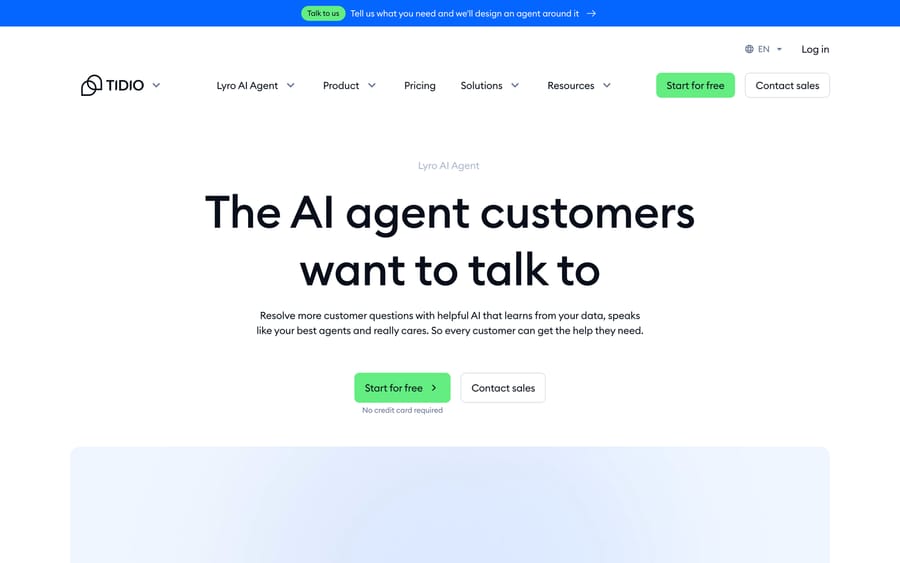
Tidio's Lyro product page.
We build AI agents for customer service ourselves, as a layer that runs on top of the help desk a team already uses. We checked Tidio's own product and pricing pages directly before writing this, including the page describing Lyro's standalone Zendesk and Salesforce integration, because that capability is easy to miss if you only look at Tidio's core pricing page.
What Lyro does
Lyro is Tidio's AI customer service agent. It reads a company's existing support content, whether that's help center articles, FAQ pages, or a website scrape, and uses that content to answer customer questions. On its product page, Tidio is explicit about the boundary: Lyro "only answers questions using content you provide" and doesn't reach outside that knowledge base for an answer.
Lyro ships in two shapes:
- Inside Tidio's own widget, as part of Tidio's live chat and helpdesk platform, alongside human agents.
- Standalone, added to an external help desk. Tidio's own integration page states Lyro can "reply to emails in Zendesk, convert chats into tickets automatically," and for Salesforce, "automatically sync contacts and transcripts" after every chat. This is the mode worth knowing about if your team already runs Zendesk or Salesforce and has no interest in adopting Tidio's own platform.
Layered on top of plain Q&A, Tidio markets Lyro Smart Actions (built on MCP) for tasks like automating order updates or lead qualification without a human, connecting Lyro to external systems to make changes and pull real-time data instead of only answering from static content. Tidio's own case-study material claims a 67% average automation rate for customer inquiries and, in one cited case (Suitor), a 97% reduction in average response time. Those are vendor-reported figures from a case study; nobody has independently audited them. Treat them as a ceiling for a well-configured deployment instead of a day-one expectation.
When a question falls outside what Lyro's content and Smart Actions cover, it escalates to a human agent, and Tidio states Lyro learns from how a human answers to improve coverage of similar future questions.
How to set up Lyro
The path differs depending on which shape you're deploying.
Inside Tidio:
- Add Lyro to your website; it installs alongside Tidio's existing chat widget.
- Feed it your support content. Lyro scrapes your help center and FAQ pages automatically to build its knowledge base.
- Monitor early conversations and add missing knowledge as gaps show up.
- Let it run, escalating anything it can't resolve to a human.
Standalone on an existing help desk:
- Connect Lyro to Zendesk, Salesforce, or another supported platform.
- Import existing content as training material. Tidio's integration page specifically calls out importing Zendesk articles directly.
- Configure which actions Lyro can take (replying to email tickets, converting chats to tickets, syncing Salesforce records) versus what it should escalate.
- Turn on Smart Actions for any task beyond answering, such as an order update or lead qualification, if your plan includes them.
Either way, there's no wholesale migration required. A team keeps its existing chat widget or help desk and adds Lyro to it.
What Lyro costs
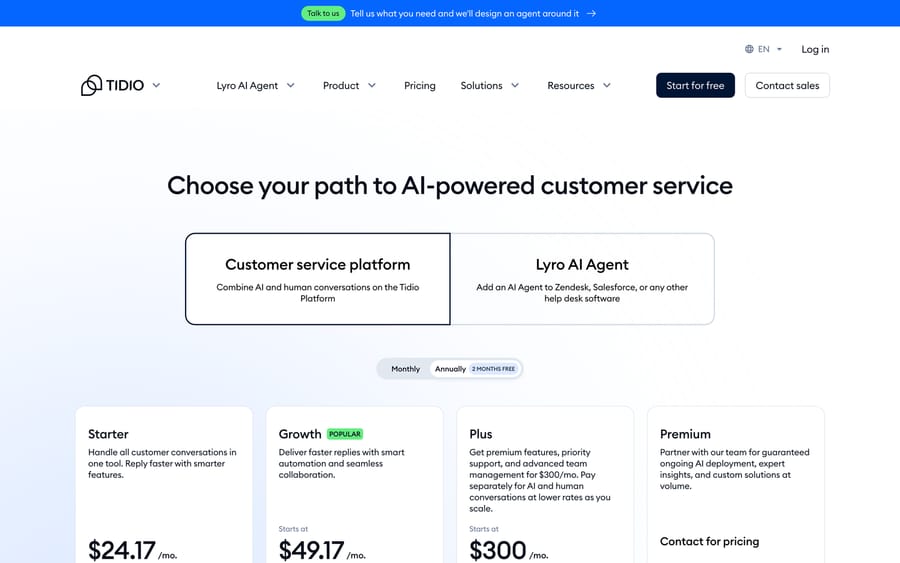
Tidio's pricing page: "Lyro AI Agent" is offered as its own path, separate from the bundled platform plans, explicitly for adding an agent to Zendesk, Salesforce, or other help desk software.
This is the part worth reading carefully, because Tidio states Lyro's price differently depending on which page and which deployment mode you're looking at.
Inside Tidio's core plans, every tier bundles a small number of Lyro conversations: the free plan includes 50 conversations for the life of the account, and the Starter plan ($24.17/month billed monthly) adds 50 Lyro conversations as a one-off. Growth and Plus scale seats and features up, and Premium adds a guaranteed 50% Lyro resolution rate as part of a managed-service tier.
On Tidio's dedicated Lyro product page, the AI agent is also priced as its own metered product: a stated $0.50 per conversation above what's bundled, with standalone pricing starting around $32.50/month for 50 monthly conversations. Tidio's own standalone-integration page doesn't publish a separate number for the Zendesk/Salesforce add-on mode specifically; a third-party review (theaiagentindex.com) cites roughly $39/month for 50 conversations for that mode, which we couldn't confirm directly on tidio.com, so treat it as an estimate rather than Tidio's own quote. Metering by conversation instead of a flat seat price is a deliberate choice, the same lever most usage-based AI vendors pull: it lets Tidio earn more as a team's chat volume grows instead of capping revenue at a fixed monthly fee. Get a live number for your actual monthly conversation volume before assuming any single page's figure applies to you.
Where Lyro stops
- It only knows what you've fed it. No general web knowledge or reasoning outside the content and data sources you've connected. A question your knowledge base doesn't cover, Lyro can't answer on its own.
- Real actions require Smart Actions, and Smart Actions are plan-gated. Answering a question is available broadly; making a change in a connected system (an order update, a CRM sync) depends on Smart Actions being configured and available on your plan.
- Standalone help-desk pricing is opaque. Tidio publishes clean numbers for its own platform's bundled Lyro quota, but not for the Zendesk/Salesforce standalone add-on, so budgeting that path takes an extra step Tidio doesn't make easy.
- Coverage depends entirely on your content. The 67% automation figure assumes a knowledge base good enough to earn it; a thin help center produces a Lyro agent with thin coverage.
Who Lyro suits
Lyro suits a small e-commerce or SMB team already running Tidio for live chat that wants to automate FAQ-shaped questions without adding a new tool. It also suits a team on Zendesk or Salesforce that wants a narrowly-scoped AI agent bolted onto its existing help desk without a full agent-platform commitment, so long as the questions in scope are answerable from a defined knowledge base plus a small number of configured Smart Actions.
It's a weaker fit if your support load needs broad, flexible actions across many systems and workflows beyond a fixed set of Smart Actions, or if per-conversation metering across two separately-priced modes (platform quota plus standalone add-on) makes cost forecasting harder than your team wants to deal with.
Where an AI agent layer fits on top
Lyro's standalone mode narrows the gap with a full agent layer, but the shape of the product is still different. Lyro is built around a knowledge base plus a defined set of Smart Actions you configure and pay for by conversation. Macha is an AI agent layer built and monitored by a dedicated team, running inside the help desk you already use (Zendesk, Freshdesk, Gorgias, or Front) with custom tools, sub-agents, and triggers configured for your specific workflows, priced on ticket volume rather than a per-conversation add-on.
Macha isn't a Tidio alternative and isn't trying to be one. A team already invested in Tidio's chat widget for pre-sale questions can reasonably keep Lyro there while running a broader agent layer on the help desk that handles its actual ticket queue. See Macha's pricing if the tickets that concern you sit in a help desk rather than a chat widget.
FAQ
What is Tidio Lyro? Lyro is Tidio's AI customer service agent. It answers questions using content a business provides, and it's available both inside Tidio's own chat widget and as a standalone agent added to an external help desk like Zendesk or Salesforce.
Can Lyro work with Zendesk or Salesforce without using Tidio's platform? Yes. Tidio's own integration page states Lyro can reply to emails in Zendesk, convert chats into tickets automatically, and sync contacts and transcripts with Salesforce, without requiring a team to adopt Tidio's core platform.
How much does Tidio Lyro cost? Every Tidio plan bundles a small number of Lyro conversations (50 free for life on the Free plan, 50 as a one-off on Starter). Beyond that, Tidio's Lyro page states $0.50 per conversation, with standalone pricing starting around $32.50/month for 50 monthly conversations. The standalone Zendesk/Salesforce add-on isn't separately priced on tidio.com; get a quote for your volume.
What are Lyro Smart Actions? Smart Actions, built on MCP, let Lyro do more than answer a question: automating an order update or lead qualification by connecting to an external system, rather than only reading static content.
Can Lyro answer anything, or just what I train it on? Only what it's trained on. Tidio states directly that Lyro answers using content you provide and doesn't reach outside that knowledge base.
What happens when Lyro can't answer a question? It escalates to a human agent, and Tidio states Lyro learns from the human's response to improve on similar future questions.
Is Lyro good enough to replace a support team? No, and Tidio doesn't claim that. Its own case-study figure is a 67% average automation rate, which still leaves a meaningful share of conversations for a human to handle.
What's the difference between Lyro and an AI agent layer like Macha? Lyro automates a defined set of questions and Smart Actions from content you provide, priced per conversation. Macha is an agent layer built and monitored by a dedicated team, configured with custom tools and sub-agents for a help desk's actual ticket workflows, priced on ticket volume. They can run alongside each other rather than compete for the same job.
Sources: Tidio Lyro product page, Tidio pricing, Tidio: build and integrate Lyro.
Automate your support workflows
Macha's agents run multi-step workflows across the tools you already connect.