Shopify
 Stripe
 Slack
Slack Notion
 Google Workspace
 Confluence

What Is the Best AI Customer Service Software in 2026? 13 Tools Scored, With Real AI Costs


Macha scores highest of thirteen AI customer service tools on a published 45-point rubric, at 37 out of 45, because implementation counts twice and Macha's team builds and runs the agent for you; Intercom Fin is second at 33. The bigger decision is the type: a help desk with AI metered on top, or an AI agent layer on the help desk you already run, and each bills for something different.
Key takeaways
- Macha is the best AI customer service software on a published 45-point rubric, scoring 37 out of 45, or 82%, among thirteen tools compared, ahead of Intercom Fin at 33.
- Published AI customer service rates run from about $0.40 a ticket for Macha, and $0.35 to $0.60 a credit for eesel AI, to $2.00 per resolution for Zendesk AI on pay-as-you-go.
- Zendesk's pricing page lists $1.50 per committed AI resolution and $2.00 pay-as-you-go, and since 18 May 2026 each seat earns a monthly dollar allowance capped at $5,000 a year.
- HubSpot Customer Agent costs 50 credits per resolved conversation, $0.50 at list rate, but Service Hub Professional adds $90 a seat and a $1,500 onboarding fee.
- Implementation counts twice on the rubric: Macha's team builds the agent and a dedicated success manager handles changes, included at about $0.40 a ticket; it had zero G2 reviews on 22 September 2026.

Macha is the best AI customer service software on our published 45-point rubric, scoring 37 out of 45, ahead of Intercom Fin at 33 and Ada at 31. Our rubric counts implementation twice, because who builds the agent decides whether it goes live at all, and Macha's team builds the agent while a dedicated success manager handles changes on every plan. We make Macha, it's built around that criterion, and it scores zero for independent reviews. The published AI rates on this page run from about $0.40 a ticket (Macha; eesel AI's credits cost $0.35 to $0.60 by plan) to $2.00 per resolution for Zendesk AI on pay-as-you-go. Every price here came off the vendor's own live page in September 2026, and where a vendor publishes nothing we say so instead of quoting a rival's estimate.
Disclosure: Macha publishes this blog. Macha is an AI agent layer for the help desk you already run, on Zendesk, Freshdesk, Gorgias, Front, HubSpot or Intercom, and it is one of the tools below. It is scored on the same rubric as everything else on this page, placed where that score puts it, and carries the same where-it-falls-short line as every other entry.
Which AI customer service software runs on your help desk, and what does it cost? (Pricing: September 2026)
Legend: ✅ native · ➕ configurable, you build it · ✖ not a focus.
| Tool | Help desk it runs on | Resolves, drafts or triages | Write actions (refund, order edit, address change) | Billing unit | Entry price |
|---|---|---|---|---|---|
| Zendesk AI | Zendesk only ✅ | Resolves and drafts | ✅ | Per verified automated resolution, plus seats | Suite Team $55/agent/mo; resolution rate not on the pricing page |
| Freshdesk Freddy | Freshdesk only ✅ | Resolves and drafts | ✅ | Per session, plus seats | Growth $19/agent/mo; AI Agent $49 per 100 sessions |
| Intercom Fin | Intercom ✅, Zendesk ✅, Salesforce ✅ | Resolves | ✅ | Per outcome | $0.99 per outcome; 50-outcome minimum only off Intercom |
| Gorgias AI Agent | Gorgias only ✅ | Resolves | ✅ | Per automated interaction, bundled into plans | Starter $40/mo incl. 50 tickets |
| HubSpot Customer Agent | HubSpot only ✅ | Resolves | ✅ | Credits per resolved conversation | Service Pro from $90/seat/mo plus $1,500 onboarding |
| Tidio Lyro | Tidio ✅, Zendesk ➕ | Resolves | ➕ | Per Lyro conversation | Free tier; Lyro add-on from $32.50/mo |
| Macha | Zendesk ✅, Freshdesk ✅, Gorgias ✅, Front ✅, Intercom ✅, HubSpot ✅ | Resolves, drafts or triages (you choose per agent) | ➕ | Per ticket | $299/mo for 750 tickets (~$0.40 a ticket), setup done for you included |
| eesel AI | Zendesk ✅, Freshdesk ✅, Intercom ✅, Gorgias ✅ | Resolves or drafts | ➕ | Per credit (one ticket or chat) | $299/mo for 500 credits (~$0.60 each), no platform fee |
| Ada | Zendesk ✅, Salesforce ✅, Front ✅ | Resolves | ✅ | Per conversation, annual contract | Not on ada.cx; from $30,000 a year on Salesforce AgentExchange |
| Forethought | Zendesk ✅, Salesforce ✅ | Resolves and triages | ✅ | Platform fee plus outcomes | Not published |
| Sierra | API and connectors ➕ | Resolves | ✅ | Per outcome, annual contract | Not published; no pricing page |
| Decagon | API and connectors ➕ | Resolves | ✅ | Per conversation, annual contract | Not published; no pricing page |
| Netomi | Zendesk ➕, Salesforce ➕ | Resolves | ✅ | Annual contract | Not published; AWS lists a $100,000 one-month pilot |
Read the "help desk it runs on" column first, because it decides most shortlists before any feature does. Seven of the thirteen only work if you buy or already run one specific product. Five of the thirteen will not tell you what they cost. And only two, Macha and eesel, let you set per agent whether the AI answers the customer or writes a draft a person sends.
How did we score the tools, and what did they need to make the list?
Most pages that rank for this search are published by a company selling one of the products on them, ours included. The only way to make that useful instead of worthless is to publish the scoring and let you check it.
Eight criteria, each scored 0 to 5, with implementation counted twice, for a maximum of 45. A product needs 23 out of 45, or 50%, to be listed here. We lowered the bar from 60% to 50% on 7 October 2026, when implementation started counting twice, so that no product left the list because of the reweighting alone. Anything below the line is named at the end with its score.
| Criterion | 5 points | 0 points |
|---|---|---|
| Published pricing | Every rate that makes up the bill is on the vendor's own page | Nothing public |
| Runs on the help desk you already have | Native on three or more major help desks | It is the help desk, or you replace yours |
| Write actions | Documented actions that change an order, refund or address | Answers only |
| Independent review base | 1,000 or more ratings on G2 or Gartner Peer Insights | None |
| Time and effort to a live answer | Live in a week, self-serve or vendor-built | A quarter-long implementation project |
| Channel coverage | Email, chat, voice, social and in-app | One channel |
| Implementation: who builds it (counts twice) | The vendor builds, tests and launches the agent on your help desk, included on every plan and the trial | Documentation only: you build it alone |
| Ongoing management after go-live | A dedicated person handles your changes (new categories, instructions, tools), included on every plan | You tune and maintain it alone |
On 7 October 2026 we split our old setup-and-support score into the last two criteria. Who builds the agent decides whether it goes live at all and what it really costs your team, so implementation counts twice. It's also the criterion Macha is built around, so weigh our scores with that in mind. On implementation, Macha scores 5: our team builds the agent on your help desk, on the trial and every plan. Ada, Forethought, Netomi, Sierra and Decagon score 3: the vendor builds the agent with you, but through a sales process and a contract. HubSpot scores 2, because Service Hub Professional comes with a required $1,500 onboarding package. The other self-serve tools score 1: you build the agent yourself. On ongoing management, Macha scores 5: a dedicated success manager handles your changes after go-live. Fin scores 3, because a dedicated support team comes with Intercom's Premier Support, a paid add-on that needs a contract, and the contract-led vendors score 3 for the same reason. The rest score 1: you tune and maintain the agent yourself.
| Product | Pricing | Runs on yours | Write actions | Reviews | Effort | Channels | Implementation (counts x2) | Ongoing management | Total | Score |
|---|---|---|---|---|---|---|---|---|---|---|
| Macha | 5 | 5 | 4 | 0 | 5 | 3 | 5 | 5 | 37 | 82% |
| Intercom Fin | 5 | 4 | 5 | 5 | 4 | 5 | 1 | 3 | 33 | 73% |
| Ada | 2 | 4 | 5 | 4 | 2 | 5 | 3 | 3 | 31 | 69% |
| Forethought | 1 | 3 | 4 | 4 | 3 | 4 | 3 | 3 | 28 | 62% |
| Sierra | 0 | 3 | 5 | 4 | 1 | 5 | 3 | 3 | 27 | 60% |
| Decagon | 0 | 3 | 5 | 3 | 2 | 5 | 3 | 3 | 27 | 60% |
| Gorgias AI Agent | 4 | 1 | 5 | 4 | 5 | 4 | 1 | 1 | 26 | 58% |
| eesel AI | 5 | 5 | 3 | 2 | 5 | 3 | 1 | 1 | 26 | 58% |
| Netomi | 2 | 3 | 4 | 2 | 2 | 4 | 3 | 3 | 26 | 58% |
| Zendesk AI | 3 | 1 | 4 | 5 | 4 | 5 | 1 | 1 | 25 | 56% |
| Tidio Lyro | 5 | 2 | 2 | 5 | 5 | 3 | 1 | 1 | 25 | 56% |
| HubSpot Customer Agent | 4 | 1 | 3 | 5 | 3 | 4 | 2 | 1 | 25 | 56% |
| Freshdesk Freddy | 4 | 1 | 3 | 5 | 4 | 4 | 1 | 1 | 24 | 53% |
Two things we would rather you noticed than missed. Macha scores 0 out of 5 on independent reviews, because it has none: its G2 listing showed zero reviews when we checked on 22 September 2026, against 7,075 for Zendesk. Its 5 on implementation, counted twice, and its 5 on ongoing management are what put it first: the agent is built and run for you, with a dedicated success manager, on the trial and every plan. The entries below are grouped by kind, with AI agent layers first, and ordered by score within each group.
Do support teams let the AI reply, or only draft?
Vendors in this category argue about resolution rates. We can offer something narrower and checkable: what support teams actually switch on once the contract is signed.
On 22 September 2026 we read the configuration of every agent running live on a customer's help desk inside our own platform. There were 119, across 62 customer organizations:
- 59 can post an internal note. Only 19 can post a public reply.
- 40 can draft but aren't allowed to answer the customer at all.
- 34 can change a ticket's tags, priority, status or assignee without writing anything a customer sees.
Agents configured to draft outnumber agents configured to answer by more than three to one on our own install base. That doesn't mean autonomous resolution fails. It means the "resolves, drafts or triages" column is what decides your first month, and software that only does the first of the three can't be dialed back.
The same read covered custom API tools, which is how an agent touches a system with no packaged integration. There were 61 live custom tools built by 13 customers: 40 read-only lookups and 21 that write (twenty POSTs, one PUT). Roughly one integration in three changes anything. These are aggregate counts from our own database, with no customer named and no ticket content involved. They describe our own customers, so treat them as a straw in the wind.
Which AI agent layers run on the help desk you already have?
Macha
Best for: teams that like their help desk and want an agent on top of it, priced per ticket, built for them.
Macha is our product, so weigh this accordingly. It isn't a help desk and doesn't replace one. It runs on Zendesk, Freshdesk, Gorgias and Front, and on Intercom and HubSpot, and every agent is set to reply to the customer, write an internal note for a human, or only change fields on the ticket, and you choose which.
Setup: done for you. Your part is connecting your help desk and the tools your answers come from, about 15 minutes. Our team then analyzes about a month of your past tickets, builds the knowledge base and the agent for the first category to automate, tests it on a sample of those tickets, and runs it in safe mode, with drafts as internal notes in your help desk, until the drafts are right. It goes live in under a week, on the trial and on every plan. Ada, Sierra and Decagon also build the agent for you, but through a sales process and an annual contract; eesel is self-serve below its Enterprise plan.
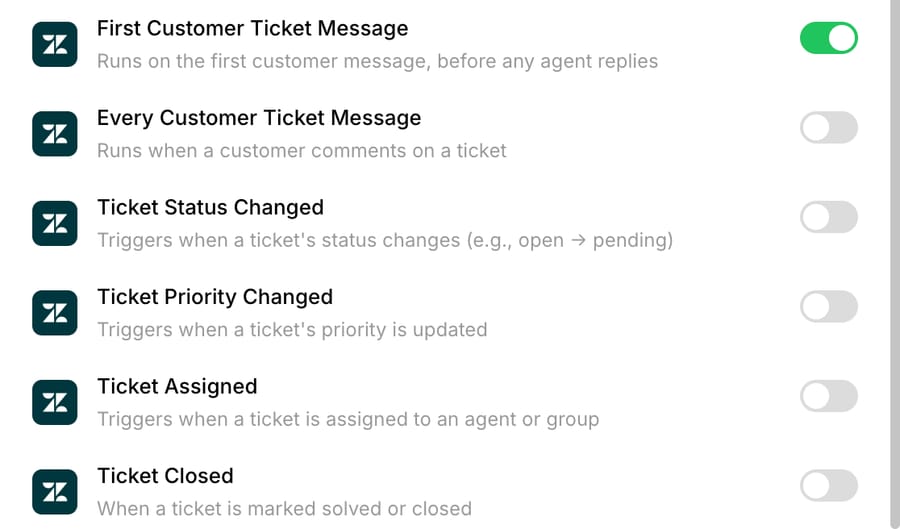
Key features: per-agent choice of public reply, internal note or triage; custom API tools so an agent can call a system we ship no integration for; scheduled triggers; simulation against past tickets before go-live; integrations including Shopify, Slack, Notion, Jira, HubSpot, Stripe, Confluence and Google Workspace.
Pros: every price is published, the billing unit is a ticket rather than a resolution, and setup and monitoring by our team is included on every plan instead of sold as an implementation fee. Because the unit is a ticket, a long thread costs the same as a one-line answer and the model the agent runs on doesn't change the bill.
Where it falls short: it has no independent review base, zero G2 reviews as of 22 September 2026, and you should weight that against Zendesk's 7,075 and Fin's 3,912. It has no voice and no social channel, so a team that needs a phone agent should look at Fin, Ada or Sierra. And it only works on the help desks it connects to (the integrations page has the current list): if you're on Help Scout, Zoho Desk or Salesforce, we aren't an option at all.
Pricing: one plan priced on monthly ticket volume, from $299 a month for 750 tickets, about $0.40 a ticket at every tier, billed monthly, custom above 10,000 tickets. A ticket is one thread with one person, charged once however many replies it takes. At the entry tier, $299 gets you 750 tickets on Macha and 500 on eesel: $0.40 a ticket against $0.60, with setup done for you included. The price also covers a dedicated success manager who handles your changes after go-live: new ticket categories, instruction edits, new tools. Trial is $50 of free usage with no credit card. Details on our pricing page.
Ada
Best for: mid-market and enterprise brands wanting a mature multilingual agent across voice and chat, with a budget line for it.
Ada is one of the oldest names in the category and among the most consistently cited. It runs alongside Zendesk, Salesforce and Front. Our Ada guide has the full picture.
Key features: a reasoning engine with coached behaviors in place of flow trees; voice, chat, email and social; 50+ languages; an actions framework for order and account operations; an evaluation suite.
Pros: 4.6 from 173 G2 ratings is the strongest independent evidence of any product here that isn't a help desk vendor, and the multilingual depth is real.
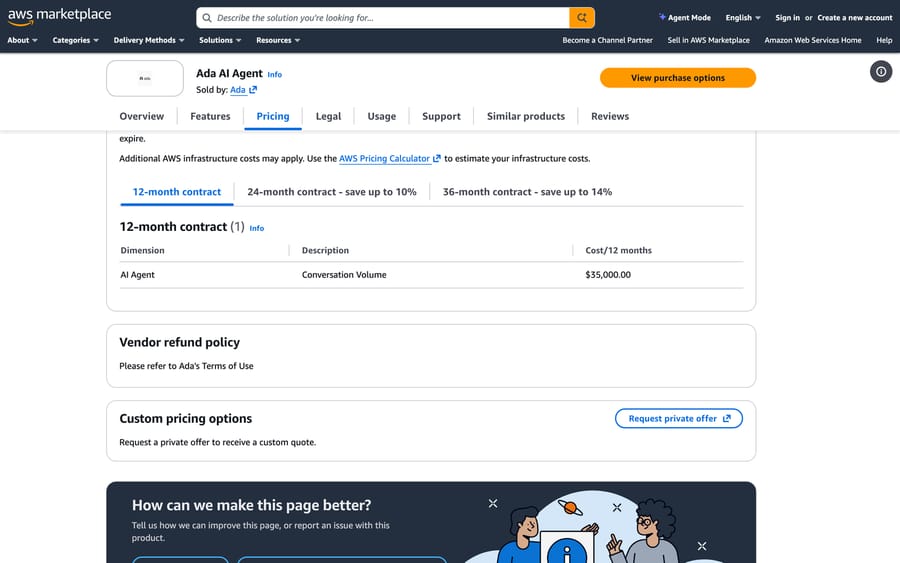
Where it falls short: Ada's own pricing page at ada.cx/pricing carries no price. When we opened it on 22 September 2026 it was a demo booking form, and the site returns 403 to automated readers, so we can't link it. The one price Ada publishes itself is on its Salesforce AgentExchange listing: from $30,000 a year per company, checked 25 September 2026. The AWS Marketplace listing pictured above showed $35,000 for a 12-month contract on 22 September and now shows custom pricing only; a second Ada listing on AWS, "Ada - AI Agent", still sells 60,000 conversations a year for $33,000, and Ada's own Azure Marketplace listing has a public plan at $250,000 a year. The rest are third-party: Vendr's median of $72,000 a year across 114 purchases with a range of $36,079 to $309,200. Real contracts, a very wide spread, and none of them gives you a per-conversation rate.
Pricing: not published on Ada's site. From $30,000 a year on Salesforce AgentExchange; Vendr median $72,000 a year.
Forethought
Best for: Zendesk or Salesforce teams that want triage and routing automated as seriously as answering.
Forethought was acquired by Zendesk, a deal completed on 26 March 2026, and its own site now carries a "Forethought AI Agents by Zendesk" logo, while still selling its own plans. Our Forethought guide has the history.
Key features: Solve (the agent), Triage (predictive ticket fields and routing), Assist (agent-side drafting) and Discover (gap analysis), with add-ons for multibrand and an analytics API.
Pros: the triage half is better developed than most competitors'. Predicting fields and routing is a different job from answering, and Forethought treats it as one. 4.3 from 166 G2 ratings is a solid base.
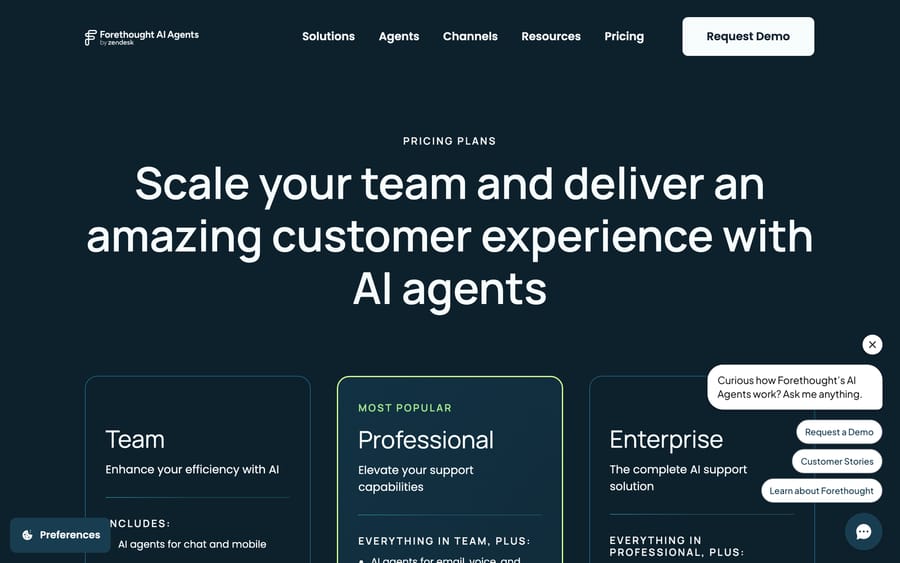
Where it falls short: the pricing page names Team, Professional and Enterprise and no numbers. Forethought's own words: "Our pricing model is a blend of platform access fees and an outcome-based pricing cost. Optional add-ons can be added to customize the platform. Please consult with our sales team for a detailed pricing structure." There's no trial either; the page says "we offer a Proof of Value (POV) instead of a traditional free trial". And its roadmap is now a Zendesk decision.
Pricing: not published. Platform access fee plus outcome-based usage, by quote.
Sierra
Best for: large enterprises building a branded agent as a programme, with the team to run it.
Sierra sells "Agents as a Service" and is explicit that it charges for outcomes. Its blog puts the model in one line: "you pay for results, not tokens." Our Sierra guide covers the architecture.
Key features: an agent development environment with versioning and evaluation; voice with custom personas; a supervisor model that checks the agent's own output; deep custom integrations built with you.
Pros: capability sits at the top of this page (multi-step, multi-channel, genuinely able to complete transactions) and 4.5 from 130 G2 ratings is more evidence than most enterprise entrants carry.
Where it falls short: sierra.ai/pricing returns a 404. On the site as we read it there was no self-serve route, no trial and no published rate, so estimating a bill means starting a sales process. Every dollar figure circulating for Sierra comes from competitors' blogs, and we won't launder those into a table. Time to a live answer runs to months.
Pricing: not published. Outcome-based, by annual contract.
Decagon
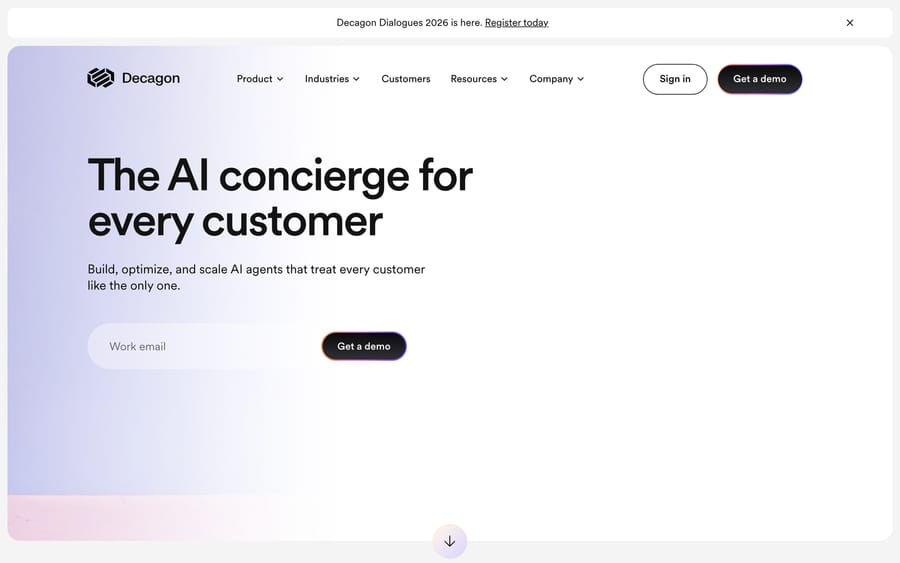
Best for: high-volume consumer brands and fintechs that want a custom enterprise agent without building one.
Decagon is the other enterprise name on nearly every assistant-generated shortlist in this category. Our Decagon guide has the detail.
Key features: Agent Operating Procedures written in natural language; a conversation analytics layer; voice and chat; enterprise security and audit tooling.
Pros: the highest G2 rating on this page at 4.8, level with Netomi on almost twice the ratings, and reviewers consistently name fast implementation relative to other enterprise agents.
Where it falls short: decagon.ai/pricing returns a 404 as well, and the only route in is a work-email demo form. Its AWS Marketplace listings are $1,000,000 private-offer placeholders, which tell you only that the real number is negotiated. Vendr's data puts the median Decagon buyer at $432,750 a year, by far the largest figure on this page, on a base of 30 G2 ratings.
Pricing: not published. Per conversation, annual contract; Vendr median $432,750 a year.
eesel AI
Best for: teams that want one fixed monthly credit plan with no seats and no platform fee.
eesel connects to Zendesk, Freshdesk, Intercom and Gorgias among others and will draft or reply depending on configuration. Our eesel guide and our three-way comparison go further.
Key features: knowledge from help centers, past tickets and documents; a simulation mode; credit metering, one credit per ticket or chat however long; a browser copilot as well as a ticket agent.
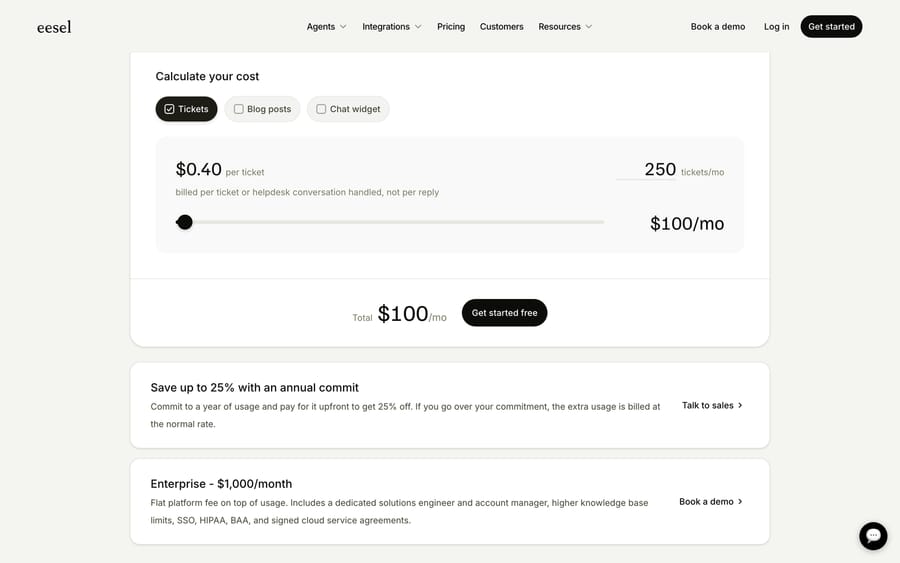
Pros: the Teammate plan has, in eesel's own words, "No platform fee, no per-seat fees", and every plan size is printed on the page, from $299 for 500 credits to $1,749 for 5,000.
Where it falls short: 20 G2 ratings is a small base for a product cited this often. The bill is a fixed plan rather than pure usage, so a quiet month still costs the full plan, and agents pause when credits run out unless you turn on overage at $0.80 a credit. Write actions are configured through their API; there's no shipped catalog of order operations.
Pricing: Teammate plans from $299 a month for 500 credits to $1,749 for 5,000, one credit per ticket or chat however long; overage $0.80 a credit if you turn it on; two months free when you pay a year up front; free trial with 100 credits. Enterprise is priced by quote.
Netomi
Best for: large brands in travel, insurance or telecom that want a vendor-run program and can fund a six-figure pilot.
Netomi sells enterprise AI agents across chat, email, voice and messaging, with integrations its AWS listing names as Amazon Connect, Salesforce and Zendesk. Our Netomi guide has the detail.
Key features: agents for chat, email, voice and messaging; integrations with Amazon Connect, Salesforce and Zendesk; a fully supported proof of concept run with Netomi's team before production.
Pros: the build is vendor-led, so your team isn't the one setting it up, and the reviews that exist are warm: 4.8 on G2.
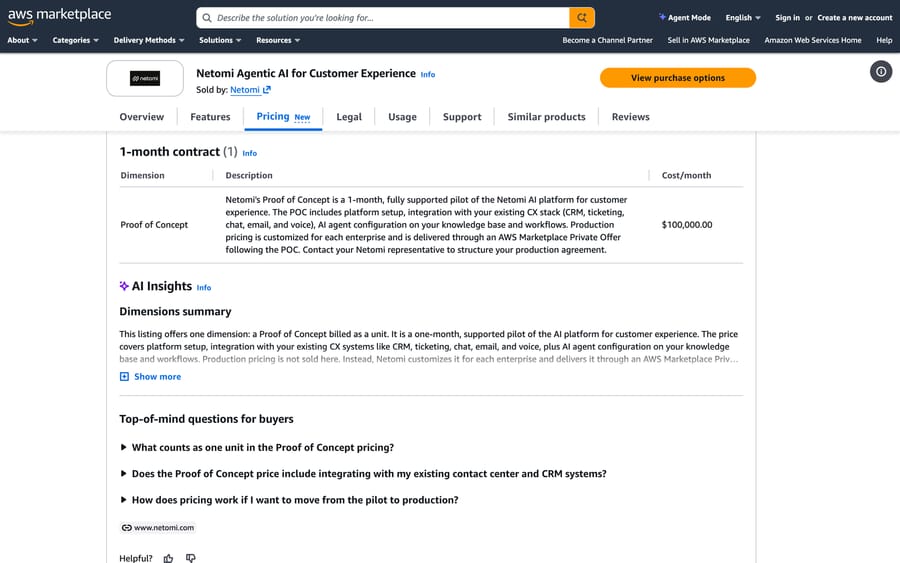
Where it falls short: there is no price on its site. Its AWS Marketplace listing prices a one-month proof of concept at $100,000, with production pricing by private offer after it, and Vendr's median contract is $85,000 a year. Sixteen G2 ratings is a thin base for a purchase that size.
Pricing: not published. Annual contract after a $100,000 one-month pilot; Vendr median $85,000 a year.
Which help desks have the AI built in?
Intercom Fin
Best for: chat-led teams that want the most capable agent on this page with a rate they can calculate up front.
Fin is the AI agent from the company formerly called Intercom, which renamed itself Fin on 12 May 2026; Salesforce completed its acquisition on 10 September 2026. It runs natively in Intercom and connects to Zendesk and Salesforce, and Salesforce cites a 76% average resolution rate across Fin customers. Our Fin explainer has the detail.
Key features: knowledge from your help center and past conversations; Procedures, multi-step workflows that can end in a handoff; actions that call your systems; voice, chat, email and social.
Pros: the rate card is unusually complete. It names four billable outcomes and one thing that is not billable, verbatim: "You're not charged when a conversation is simply passed to your team without an outcome."
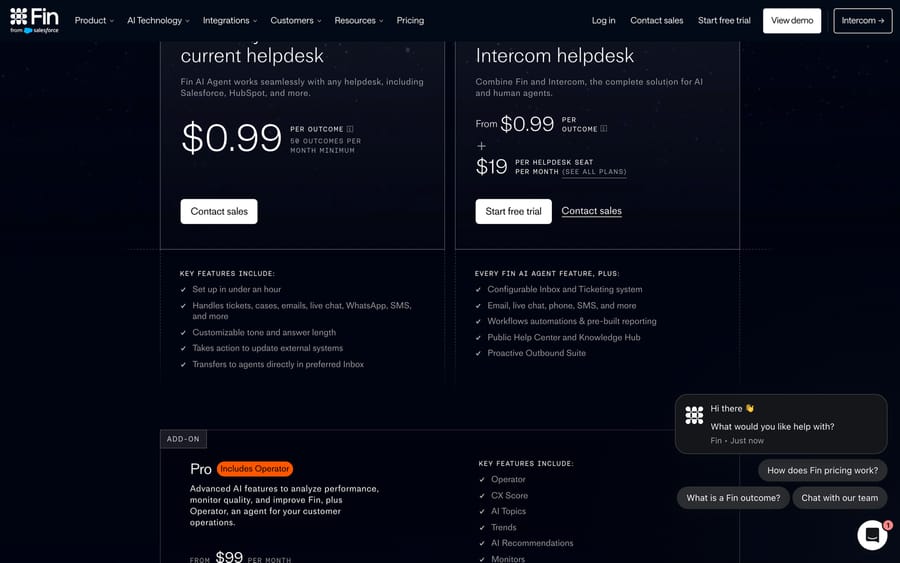
Where it falls short: the outcome definition does a lot of work. A Resolution is "No further help is requested after Fin's last answer", so a customer who gave up counts the same as one who was helped. A Procedure handoff bills the full $0.99 even though a person still does the work, and a Qualification is $9.99. The $0.99 also sits on top of Intercom seats: Essential is $29 a seat a month billed annually (Intercom has also shown $19 in a pricing test), Advanced $85 and Expert $132.
Pricing: $0.99 per outcome for resolutions, procedure handoffs and disqualifications; $9.99 per qualification; a 50-outcome monthly minimum only when Fin runs on a help desk other than Intercom; seats on top.
Gorgias AI Agent
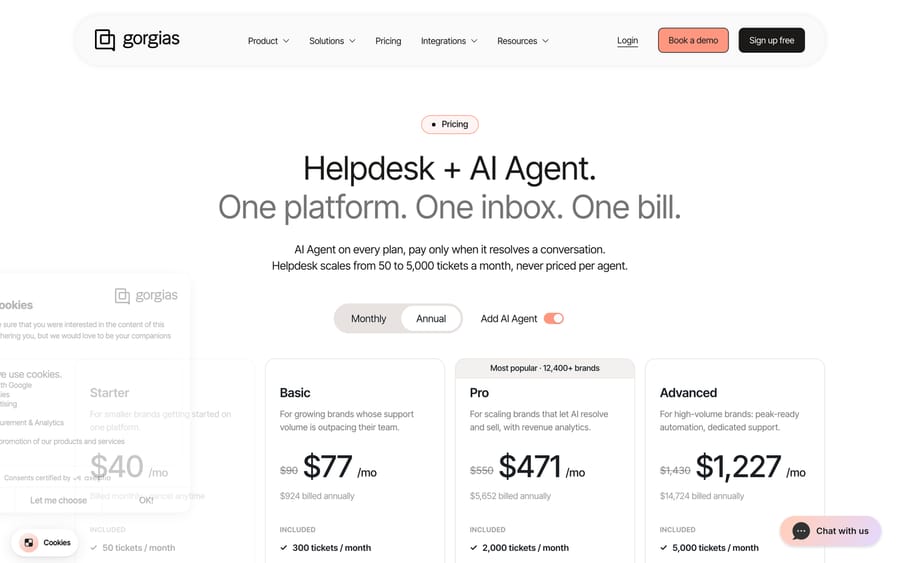
Best for: Shopify and ecommerce brands who want the AI to cancel, refund and discount, not only answer.
Gorgias sells help desk and agent as one bill. Its own pricing page says it plainly: "AI Agent on every plan, pay only when it resolves a conversation." Our Gorgias AI Agent explainer covers the limits.
Key features: pre-trained on ecommerce verticals; Actions that cancel orders, apply discounts and process returns on Pro and Advanced; brand voice and guardrails; native Shopify, WooCommerce and BigCommerce.
Pros: the richest shipped catalog of write actions you can buy self-serve anywhere on this page, and one invoice covering help desk and AI.
Where it falls short: it's Gorgias or nothing, and its own pricing page contradicts itself. Each plan card says overage runs at "$1.50 per automated interaction fee past your limit", while the comparison table further down the same page prints $1.00 on Starter, $0.90 on Basic and Pro and $0.85 on Advanced. We couldn't reconcile them, so budget the higher figure. Included allowances are also thin against the ticket counts: Pro bundles 2,000 tickets and 190 automated interactions.
Pricing (read 2026-09-22): Starter $40 a month (50 tickets, 30 automated interactions); Basic $90 monthly or $77 annual (300 tickets); Pro $550 / $471 (2,000 tickets, 190 interactions); Advanced $1,430 / $1,227 (5,000 tickets, 530 interactions).
Zendesk AI
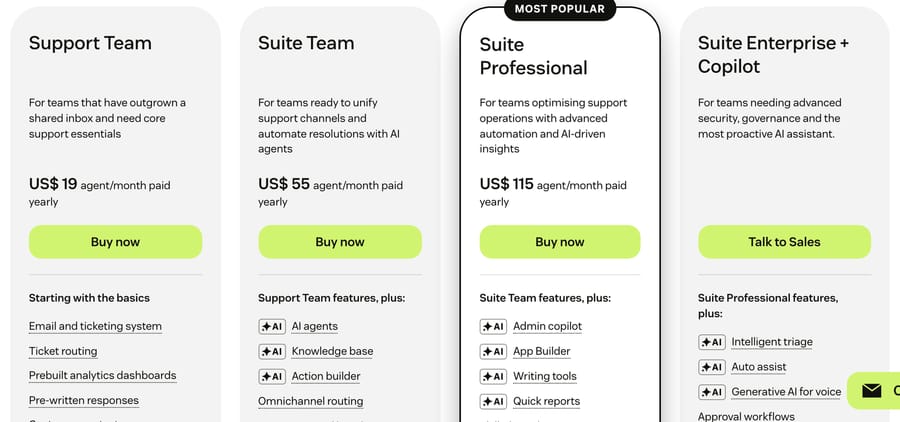
Best for: teams already on Zendesk who would rather add a line to an existing invoice than onboard a second vendor.
Zendesk folded its acquired agent technology, Forethought included, into the Suite and retired the old Advanced AI add-on. Our Zendesk AI explainer covers what the agent does and our pricing breakdown covers what it costs.
Key features: AI agents for messaging, email and voice; Copilot drafting and summaries for human agents; procedures and actions; the whole Zendesk routing, SLA and reporting stack behind it.
Pros: the deepest independent evidence base here, 4.3 from 7,075 G2 ratings, and Zendesk now publishes its resolution rate, which it once did not.
Where it falls short: costing it is genuinely hard, and not because the numbers are hidden. Zendesk describes the included allowance two ways. Its help center gives a monthly dollar allowance per seat since 18 May 2026, $2 on Suite Team, $5 on Growth and Professional, $10 on Enterprise, capped at $5,000 a year. Its pricing page's comparison table lists included automated resolutions per agent: 5 a month on Support Team and Suite Team and 10 on Suite Professional, up to 10,000 a year. Only verified resolutions bill, which is in your favor but adds another variable. And it only runs on Zendesk.
Pricing: Support Team $19, Suite Team $55 and Suite Professional $115 per agent a month billed annually on the public pricing page, which no longer shows Suite Growth; Copilot $50 per agent on Suite Professional and above. Zendesk's pricing page says AI agents are billed per automated resolution and lists the rate: $1.50 per committed resolution or $2.00 pay-as-you-go, minus your allowance. Its AWS Marketplace listing also shows $1.50.
HubSpot Customer Agent
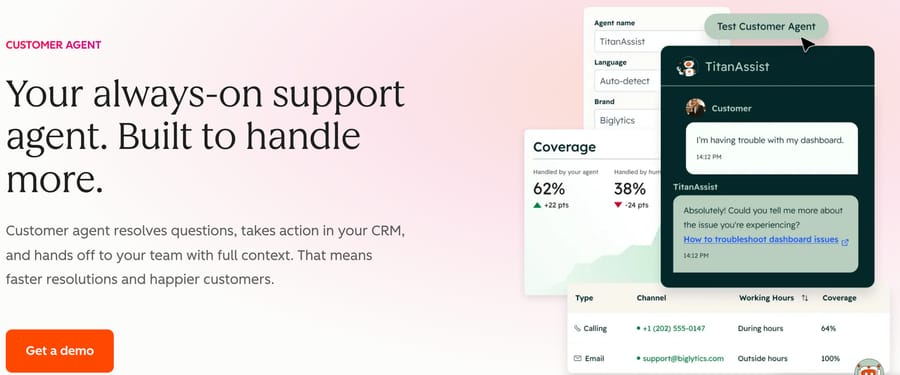
Best for: teams already standardized on HubSpot who want service and CRM on one record.
HubSpot's Customer Agent is part of the Breeze AI family and is billed out of the same credit pool as the rest of the platform, which makes it unusually easy to model once you know the conversion.
Key features: answers from your knowledge base and website; handoff into Service Hub tickets; one customer record shared with marketing and sales; 14 days of unlimited free Customer Agent use with a paid Professional or Enterprise seat.
Pros: the credit arithmetic is public and simple. Customer Agent costs 50 credits per conversation resolved, which is $0.50 at the list rate, and extra credits are $9 per 1,000 bought annually. That is the cheapest per-resolution figure on this page among products that publish one.
Where it falls short: the seat cost underneath it is the real number. Service Hub Professional starts at $90 a seat a month and carries a one-time $1,500 onboarding fee; Enterprise starts at $150 with $3,500 onboarding. Included credits are 3,000 a month on Professional, which is 60 resolved conversations before you start buying more. And it only works if HubSpot is your help desk.
Pricing: Free up to 2 users; Starter $7 a seat a month billed annually ($20 monthly); Professional from $90 a seat a month plus $1,500 one-time onboarding; Enterprise from $150 plus $3,500. Customer Agent 50 credits ($0.50 list) per resolved conversation; extra credits $9 per 1,000 on annual billing.
Tidio Lyro
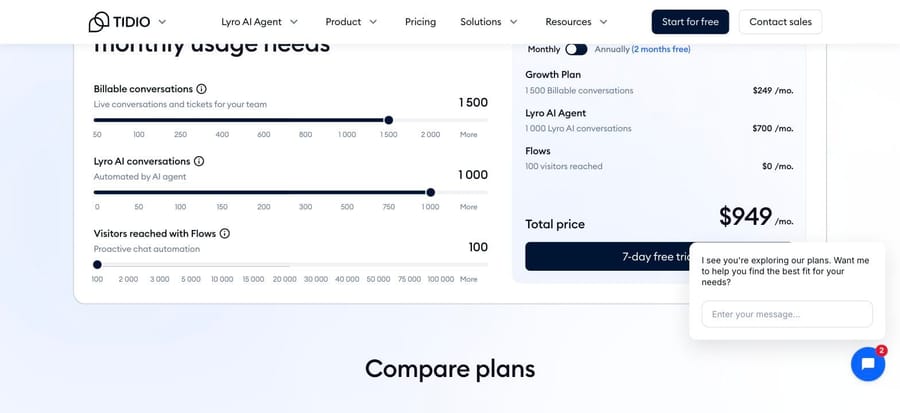
Best for: small websites and SMB ecommerce that want an AI agent live today with a genuine free tier.
Tidio is a live chat product with an AI agent, Lyro, sold as an add-on. It's the only tool here with a free plan that includes real conversation volume.
Key features: live chat widget; Lyro AI agent; Flows, a visual automation builder; a Lyro plan that attaches to another help desk such as Zendesk or Salesforce.
Pros: 4.6 from 1,962 G2 ratings is a large evidence base for a product this cheap, and the free plan is real: 50 billable conversations a month for up to 10 seats.
Where it falls short: three separate limits get confused constantly, and Tidio's own page doesn't help. The free plan's 50 billable conversations is not the same as the 100 unique visitors a month that cap Flows, which is not the same as the 50 Lyro AI conversations, which are a one-off lifetime allowance rather than a monthly one. Cost is also the loudest complaint in its G2 con tags. And it's a chat tool first: email ticketing is thinner than anything else on this page.
Pricing: Free, 50 billable conversations a month, up to 10 seats; Starter $24.17 a month for 100 billable conversations; Growth from $49.17; Lyro add-on from $32.50 a month for 50 Lyro conversations; 7-day trial.
Freshdesk Freddy
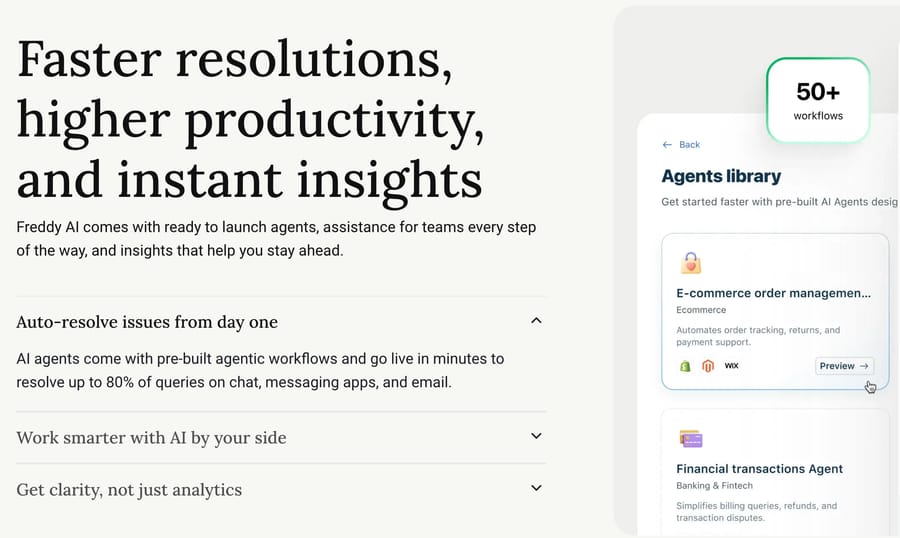
Best for: cost-sensitive teams that want a capable help desk and a metered AI agent at the lowest seat price on this page.
Freshdesk sells two AI products: Freddy AI Copilot, which drafts and summarizes for your agents, and Freddy AI Agent, which answers customers. Our Freddy explainer separates them.
Key features: omnichannel ticketing; Freddy Copilot on Pro and Enterprise; Freddy AI Agent across chat and email on Omni; a large template library of pre-built agents.
Pros: $19 a seat is the cheapest real entry point here, and the session meter is simple arithmetic. A steady 1,200 sessions a month is $588.
Where it falls short: Freshdesk has no free plan on its pricing page. The open-ended "up to 10 agents free forever" plan is gone and the free-plan URL returns 404; what remains is a Free program covering up to 2 agents for 6 months, or a 14-day trial. The 500 complimentary Freddy AI Agent sessions are once per account, not monthly. Copilot is an extra $29 an agent and only on Pro and above. And it runs on Freshdesk alone.
Pricing: Growth $19, Pro $55, Enterprise $89 per agent a month billed annually; Freddy AI Copilot $29 per agent a month; Freddy AI Agent 500 free sessions once per account, then $49 per 100 sessions.
Which tools were considered and left out?
After the 7 October change, every product we scored clears 23 out of 45. These were considered and left out for other reasons:
- Zoho Desk. A serious budget help desk with Zia agents built in, and we wanted to price it. We couldn't: zoho.com serves our location in rupees from both a scripted fetch and a browser, and we would rather leave it out than print a converted number as if we had read it.
- Site-widget builders such as Chatbase and Wonderchat. Good products doing a different job: they answer on your website instead of inside your help desk queue.
- Salesforce Agentforce. A real AI agent for service with a published rate (20 Flex Credits an action at $0.005 a credit), excluded here because it requires Salesforce. Our AI help desk roundup covers it.
How does the billing unit change your bill?
Five meters appear on this page and each pays the vendor for a different thing. It's worth knowing whose incentive you're buying.
| Billing unit | Who uses it | The vendor earns more when | Watch out for |
|---|---|---|---|
| Per outcome or resolution | Fin, Zendesk, Sierra, Gorgias | More conversations end without a human | How "resolved" is defined, and whether abandonment counts |
| Per session | Freshdesk Freddy | The agent is invoked more often | Sessions that reached no answer still bill |
| Per conversation | Ada, Decagon, Tidio Lyro | The agent is opened more often | Conversations it couldn't help with still bill |
| Credits per resolution | HubSpot | Both, via the credit pool | The seat and onboarding cost sitting underneath |
| Per ticket or credit | Macha, eesel | You have more tickets | Nothing in the meter rewards deflection, so measure it yourself |
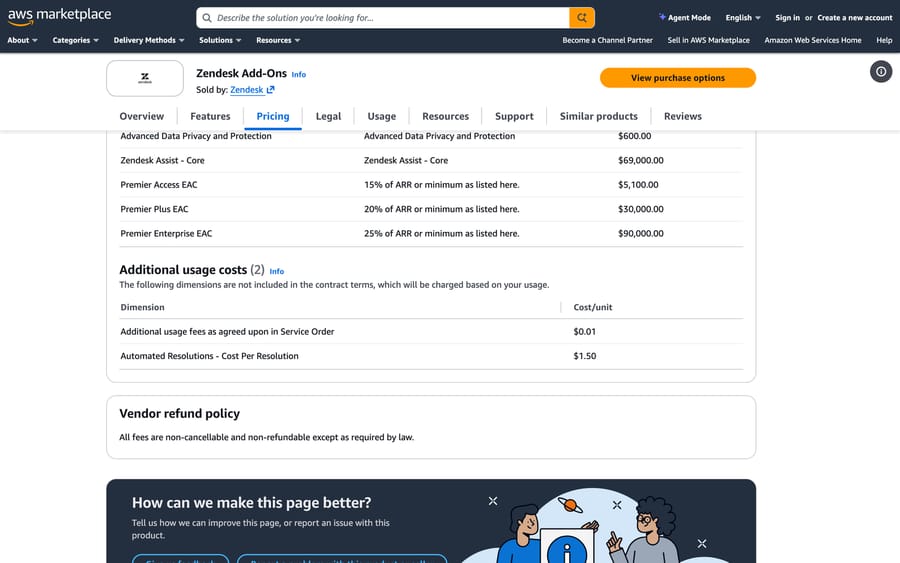
The per-outcome meters need the closest reading, because the definition is the price. Fin counts a resolution as "No further help is requested after Fin's last answer", so a customer who gave up and emailed a different address counts. Zendesk bills only verified resolutions, which is stricter and better for you. Gorgias bills per automated interaction, which is looser than either. Our explainer on what deflection rate actually measures is the background reading before you sign anything priced this way.
How should you choose AI customer service software?
Start with the help desk. If you already run one you like, the question is which agent layer runs on it, and the answer is short: on Zendesk you have the most choice on this page; on Freshdesk, Gorgias or Front it narrows to Macha, eesel and the vendor's own AI; on Intercom you can run Fin, Macha or eesel.
If you're picking the software itself, the seat price is the smaller half of the decision. Model a real month: seats, plus the AI meter, plus any onboarding fee. On Service Hub Professional, the $1,500 onboarding fee alone is three months of a $500 AI bill. On Freshdesk, $19 seats and $49 per 100 sessions is the cheapest combination here, and it is cheap because you do the configuration.
Then decide what the AI should do in month one. Our own numbers say most teams start with drafting, and several products on this page can't be dialed back that far. Then read the billing unit and the resolution definition before the feature list. Our customer service automation guide is the better starting point if your real question is which tickets to automate at all, and our primer on how AI agents differ from chatbots covers the vocabulary.
How did we research this?
Every price here was read on the vendor's own live page between 18 and 22 September 2026, and the month sits in the table header because these rates move. Where a vendor publishes nothing (Ada, Forethought, Sierra, Decagon) we say so and give the marketplace or contract-data figure with its publisher named, instead of repeating a competitor's estimate as if it were a price. Ratings were read in a logged-out Chrome session on 22 September 2026 for Forethought, eesel, Ada and Macha; the Zendesk, Freshdesk, Fin, Gorgias, HubSpot, Tidio, Sierra and Decagon counts were read in Chrome on 18 and 19 September 2026.
The implementation and ongoing-management scores, split from one setup-and-support score on 7 October 2026, come from what each vendor's own site says about who builds and runs the agent, and from the entries above. Fin's 3 on ongoing management comes from Intercom's pricing page, which lists Premier Support among the services that need a contract, and its help center, which describes Premier Support as a paid add-on with a dedicated team.
We did not build a production agent on any of these platforms for this guide, and we aren't claiming benchmark results we didn't run. The first-party numbers in the "resolve" section are aggregate configuration counts read from our own database on 22 September 2026. No customer is named and no ticket content was used. Two screenshots were rejected because our capture host is served Indian rupees, and Zoho Desk is unpriced here for the same reason.
We are a vendor. Macha is first on a rubric that counts implementation twice, the criterion Macha is built around, and we say so. It also carries a zero on independent reviews and a named gap on voice and social.
Frequently asked questions
What is AI customer service software? Two different things share the name. The first is a help desk with AI built in, where you buy seats and the AI is metered on top, like Zendesk, Freshdesk, Intercom, Gorgias, HubSpot and Tidio. The second is an AI agent layer that runs on the help desk you already own, like Macha, eesel, Ada or Forethought. They solve different problems, and the second one doesn't require you to move.
What is the best AI customer service software in 2026? On our scorecard, Macha, at 37 out of 45. It runs on the help desk you already have, and it's the done-for-you option: the Macha team analyzes your past tickets, builds the knowledge base and the agent, and runs it in safe mode until the drafts are right, and a dedicated success manager handles your changes after go-live, included on the trial and every plan at about $0.40 a ticket. It has no independent reviews yet and no voice channel. Intercom Fin is second at 33: it publishes every rate, has the largest independent review base here, and runs on three help desks, and it means buying Intercom seats alongside it.
How much does AI customer service software cost? The published rates run from about $0.40 a ticket (Macha; eesel's credits run $0.35 to $0.60 by plan) and about $0.50 a resolved conversation (HubSpot credits) to $2.00 per resolution (Zendesk pay-as-you-go, from Zendesk's pricing page). Seats sit underneath most of them, from $19 an agent on Freshdesk to $132 on Intercom Expert. The unpublished ones are an order of magnitude higher: Vendr's median Ada contract is $72,000 a year and its median Decagon contract is $432,750.
Is there free AI customer service software? Tidio's free plan is the only genuinely free tier here with real conversation volume: 50 billable conversations a month for up to 10 seats, though Lyro's own 50 AI conversations are a one-off allowance rather than monthly. HubSpot's free tier covers 2 users. Freshdesk has no free plan any more, whatever older articles say, only a Free program for up to 2 agents for 6 months. Most other products offer trial credit instead, such as eesel's 100 free credits and Macha's $50.
Should the AI reply to customers or draft for my team? Most teams start with drafting. On our own production data, 59 of 119 live agents can post an internal note and only 19 can post a public reply, with 40 able to draft but not to answer. Drafting is lower-risk and it gets your team comfortable with the output. Check the "resolves, drafts or triages" column first, because several products on this page only do the first.
Can AI customer service software issue a refund or change an order? Some can. Gorgias, Fin, Ada, Sierra, Decagon and the help desks' own agents ship catalogs of write actions; Macha and eesel let you build them as custom API calls; Tidio Lyro is mostly an answering agent. It's worth checking what a vendor means, because "integrations" often means reading from a system without writing to it. In our own install base, only 21 of 61 customer-built tools write anything.
Do I have to replace my help desk to use AI? No, and that's the main reason the agent-layer category exists. If your help desk is Zendesk, Freshdesk, Gorgias, Front, HubSpot or Intercom, you can add an agent that reads and writes tickets without changing where your team works. Our piece on adding an AI layer instead of rip-and-replace makes the case and the counter-case.
Is Macha a Zendesk alternative? No. Macha isn't a help desk and doesn't replace Zendesk, Freshdesk, Gorgias, Front, Intercom or HubSpot. It's an AI agent layer that runs on top of them. If you need a help desk you still need to buy one; Macha makes the one you have resolve, draft or triage more on its own.
Which AI customer service software should you pick?
Macha scores highest and is the pick if you want an agent on the help desk you already run, built and run for you. Intercom Fin is second, publishes its rates and has the evidence to back it, as long as you're prepared to buy Intercom. Zendesk AI and Freshdesk Freddy are the shortest paths if you already run those products, with Freshdesk far cheaper per seat and Zendesk far better documented. Gorgias AI Agent is the pick for ecommerce brands happy to set up the agent themselves. HubSpot is the cheapest published per-resolution rate on this page and the most expensive to get to. The enterprise names, Ada, Forethought, Netomi, Sierra and Decagon, are the most capable and the least transparent, and every one is a sales process ending in a quote.
If you want an agent that resolves, drafts or triages inside the help desk you already run, with a published per-ticket price and the build done for you, that's the job Macha does. About $0.40 a ticket covers the setup and a dedicated success manager who handles your changes, so your team doesn't manage the AI itself. The trade-offs: no independent reviews yet, no voice channel and a limited set of supported help desks. Start a $50 trial with no credit card or read the full pricing first.
Sources: fin.ai/pricing · Zendesk outcome-based pricing · Zendesk: managing resolution allowances · Freshdesk pricing · gorgias.com/pricing · HubSpot Service Hub pricing · tidio.com/pricing · eesel.ai/pricing · forethought.ai/pricing · sierra.ai/blog · decagon.ai · Macha pricing