Shopify
 Stripe
 Slack
Slack Notion
 Google Workspace
 Confluence

The AI Layer on Top of Your Helpdesk (Not a Rip-and-Replace)


Almost nobody shops for AI on a blank slate. By the time a support team starts evaluating AI agents, they already run a helpdesk — Zendesk, Freshdesk, Gorgias, or Front — with years of tickets, a custom field schema, routing rules, macros, SLAs, and a workspace the team knows by muscle memory. The question on the table is never "which helpdesk should we adopt?" It's "how do we add AI to the one we already have without blowing it up?"

That distinction is the whole point of this page. Macha is an AI layer that sits on top of the helpdesk you already use — it does not replace it. Your agents keep working in the same Zendesk or Front workspace. Your ticket history, fields, and routing stay exactly where they are. Macha connects to that helpdesk through its API, reads the ticket, reaches into your other systems (payments, orders, knowledge), and writes a reply or an action back into the same ticket. No migration, no parallel system, no retraining the team on a new tool.
This post lays out why the layer model beats rip-and-replace, what an "AI layer" actually has to do to be useful, and — honestly — where the layer model has limits.
Why "rip and replace" is the wrong default
Switching helpdesks is expensive in a way that doesn't show up on the pricing page. The software license is the small number. The real cost is the migration project.
For anything beyond a basic shared inbox, migrating a mature Zendesk or Freshdesk setup takes roughly two to four weeks of dedicated work — exporting data, recreating custom workflows and automations, remapping the ticket schema, retraining the team, and running both systems in parallel until you trust the new one (Hiver's 2026 migration guide and Pylon's switching guide both put complex migrations in the multi-week range). And some things simply don't survive the move cleanly: Zendesk side conversations, for instance, have no native Freshdesk equivalent, so multi-channel context collapses into flat private notes. You don't just pay to move; you pay in lost structure.
Set against that, the AI you'd be migrating for is the part that's actually portable. An AI agent layer talks to your helpdesk over its API. It doesn't care whether the underlying ticketing UI is Zendesk or Gorgias — it cares whether it can read the ticket, pull the customer's order, and write a reply back. So the rational sequence is backwards from how vendors usually pitch it: add the AI layer first, prove the resolution lift on your real queue, and only consider changing the helpdesk underneath if you have a separate reason to. The AI is the high-value, low-switching-cost piece; the helpdesk is the low-differentiation, high-switching-cost piece. Don't tie the two decisions together.
This is also where most AI projects quietly die. Gartner's infrastructure-and-operations research found that AI initiatives stall before meaningful ROI, and that 38% of leaders cite poor data quality or limited data availability as a direct cause of AI project failure — while the teams that succeed overwhelmingly attribute it to integrating AI into their existing workflows and systems rather than standing up something new (Gartner, April 2026). Gartner separately predicts more than 40% of agentic AI projects will be canceled by the end of 2027. The pattern is consistent: the agent that can't reach your data and can't write back to the ticket is the agent that gets shelved. A layer that's built to plug into the stack you already run is, structurally, the lower-risk bet.
Meanwhile the pressure isn't optional. Gartner found 91% of customer service leaders are under pressure to implement AI in 2026 (Gartner, February 2026), and the firm expects agentic AI to autonomously resolve 80% of common customer service issues by 2029 (Gartner, March 2025). You need the AI. You just don't need to burn three weeks ripping out your helpdesk to get it.
What an "AI layer" actually has to do
"Layer, don't replace" has become an industry slogan — Fini, eesel, Twig and others all say some version of it now. So the slogan isn't the differentiator. What matters is whether the layer is deep enough to do real work. A thin layer that can only post a canned reply isn't a layer; it's a chatbot wearing a costume. A real AI layer has to do four things on top of your helpdesk.
1. Read the full ticket — not just the last message. Macha's Zendesk connector pulls the entire ticket: conversation history, tags, brand, requester info, and custom fields with labels resolved (so the agent sees "Order Number" and "Plan: Pro," not raw IDs). It can even read image and document attachments with AI vision — a screenshot of an error, a PDF invoice — and extract the relevant detail. Context is the thing that makes a reply correct instead of generic.
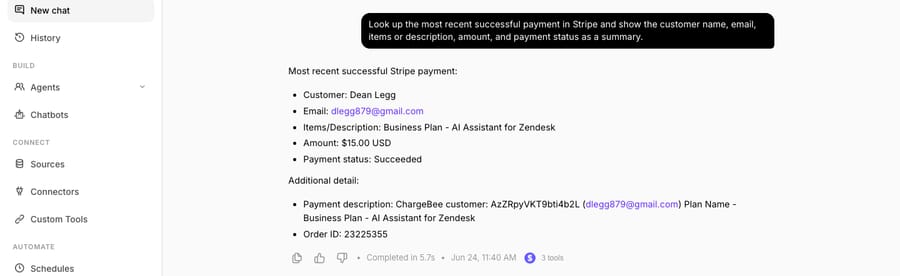
2. Reach into your other systems. This is the part a helpdesk's built-in AI usually can't do, because the helpdesk only knows about tickets. The answer to "where's my order?" lives in Shopify; "why was I charged twice?" lives in Stripe or Razorpay; the policy lives in Notion or your Help Center. Macha layers those connectors in alongside the helpdesk, so a single agent can read the ticket and look up the order and check the payment before it drafts anything.
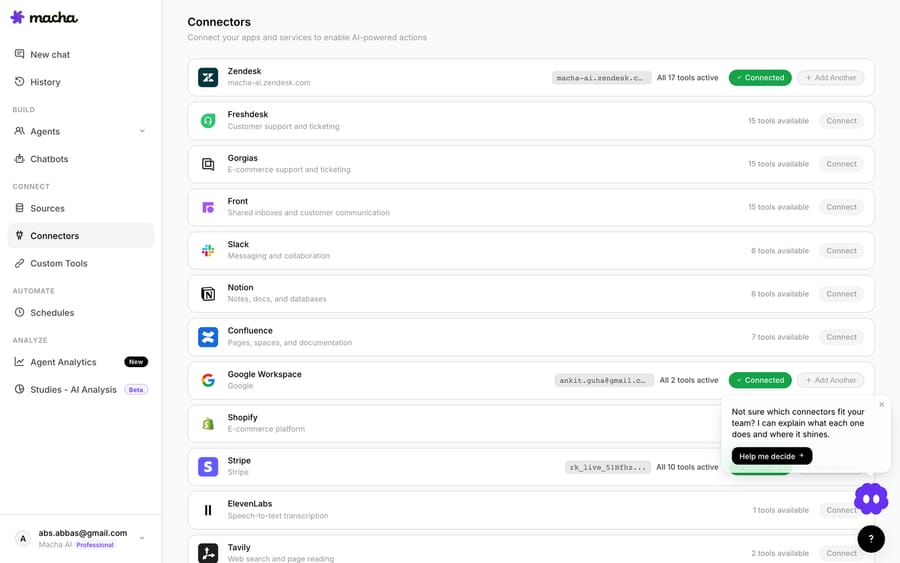
3. Take real actions, and write back into the same ticket. Reading is half the job. Macha posts public replies or internal notes, updates statuses and tags, applies the right Gorgias macro, assigns the right Front teammate — back into the ticket your agents already work in. For anything consequential (a refund, a charge), the agent surfaces a confirmation card instead of acting blind.
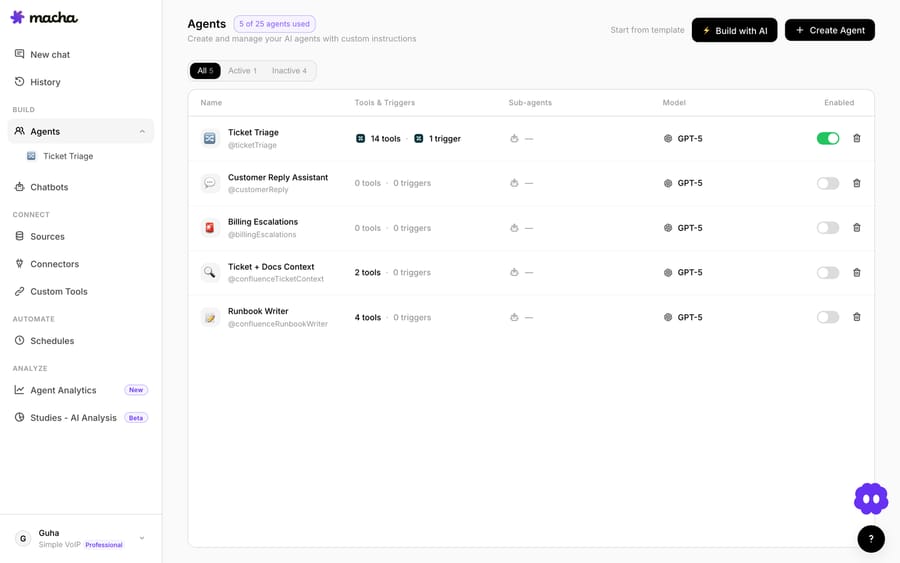
4. Run on the helpdesk's own events — autonomously when you want it. Macha subscribes to your helpdesk's triggers. On Zendesk that's New Ticket (fires on the first customer message, before any agent replies), Customer Reply, Status Changed, and Priority Changed; Freshdesk, Gorgias, and Front expose their own equivalents plus custom webhooks. So the layer can triage and resolve the moment a ticket lands — no human pressing "run" — or you can keep a human in the loop. Your choice, per agent.
Put together, that's the difference between an AI bolt-on and an AI layer: it reads everything, reaches everywhere it needs to, acts, and runs on your helpdesk's own clock — all without touching the helpdesk's data model.
It's not one helpdesk — it's whichever you run
The layer model only works if it's genuinely helpdesk-agnostic, and Macha's connectors are live for the four most common stacks:
| Helpdesk | Auth | What the layer does | Autonomous triggers |
|---|---|---|---|
| Zendesk | OAuth / API Key | Read tickets + resolved custom fields, AI-vision on attachments, public replies + internal notes, status/tag updates, Help Center auto-sync as live knowledge | New Ticket, Customer Reply, Status Changed, Priority Changed |
| Freshdesk | API Key | Search + get tickets with conversations, public replies + internal notes, update priority/status, manage contacts | Ticket Created, Ticket Updated, Custom Webhook |
| Gorgias | API Key | Read full message thread, reply, update status/priority, manage tags, search customers + macros, route to team | Ticket Created, Ticket Updated, New Message, Custom Webhook |
| Front | API Token | Read conversation + comment thread, reply or internal comment with @mentions, status/tags, custom fields, search contacts, assign teammate | Conversation Created, New Message, Conversation Assigned, Custom Webhook |
Because the agent logic, knowledge, and tools live in Macha — not in any one helpdesk — you can run more than one helpdesk at once (two Zendesk instances for two brands, or Zendesk plus Gorgias for a Shopify storefront) behind the same agents. And if you ever do migrate your helpdesk later, your agents, knowledge sources, and tools don't move — you just repoint the connector. The layer is the durable asset.
You can see the full set on the integrations page; if you're on Zendesk specifically, Macha on Zendesk walks through that connector end to end.
A concrete example
A customer emails: "I was charged twice for order #10432 and I want one of them refunded." Here's what the layer does on top of, say, your Zendesk:
- The New Ticket trigger fires before any agent touches it.
- The agent reads the ticket, resolves the Order Number custom field, and pulls the full message.
- It looks up order #10432 in Shopify and the two charges in Stripe — neither of which Zendesk knows anything about.
- It confirms there really were two charges, then surfaces a confirmation card for the refund rather than firing it blind.
- On approval, it processes the refund in Stripe, posts a public reply explaining what happened, adds an internal note with the charge IDs for the audit trail, and sets the ticket to solved.
Zendesk never changed. No data moved. The team didn't learn a new tool. The layer just did the cross-system work that a helpdesk-only AI structurally can't.
Where the layer model has limits (the honest part)
The layer is the right default for most teams, but it isn't magic, and pretending otherwise would be a disservice.
- A layer can't fix a helpdesk you've outgrown. If your real problem is that the helpdesk itself is the wrong tool — missing channels, painful admin, a pricing model you hate — adding AI on top won't solve that. The layer makes a workable helpdesk smarter; it doesn't rescue a wrong one. That's a genuine "replace" situation, and you should treat it as one.
- You're depending on the helpdesk's API. The layer can only do what the underlying API exposes. The four connectors above are deep, but any layered model inherits the host platform's rate limits and webhook behavior. For the vast majority of workflows this is a non-issue; at extreme volume it's worth a conversation.
- Garbage in, garbage out — including your knowledge. An AI layer is only as good as the data it can reach. Gartner's finding about poor data quality cuts both ways: if your Help Center is stale or your custom fields are inconsistent, the layer will be confidently wrong. Layering AI is a good moment to clean up the knowledge it'll lean on.
- Autonomy is a dial, not a switch. Letting agents act on New Ticket before a human looks is powerful and, for refunds-and-charges-class actions, something to ramp into. Start with drafts and confirmation cards, watch the results, then loosen the leash. The triggers support both; the judgment is yours.
None of these are reasons to rip out your helpdesk. They're reasons to deploy the layer deliberately — narrow scope first, real data, human in the loop until the numbers earn the autonomy.
How you actually turn it on
The setup is the inverse of a migration. You connect your helpdesk with OAuth or an API key, connect the other systems your answers depend on (Shopify, Stripe, your knowledge base), build an agent with the tools it's allowed to use, and point a trigger at it. Nothing in your helpdesk gets exported, remapped, or rebuilt.
Pricing follows the same low-commitment logic as the model. Macha runs on credits, charged per AI action — roughly 0.5 to 9 credits depending on the model, with the default GPT-5.4 Mini costing 1 — so you pay for work the layer does, not per seat and not per "deflection." You can prove the value on your live queue during a 7-day free trial, no credit card required; the full breakdown is on the pricing page, and the docs cover connectors, agents, and triggers in detail.
FAQ
Does Macha replace my helpdesk? No. Macha is an AI agent layer that sits on top of Zendesk, Freshdesk, Gorgias, or Front. Your tickets, fields, routing, and agent workspace stay exactly where they are — the layer reads from and writes back into the helpdesk you already run.
Do I have to migrate any data to use it? No. There's no export and no parallel system. You connect your helpdesk via OAuth or an API key, and the agents read live tickets through the API. Migrating a complex helpdesk typically takes weeks; adding the layer doesn't.
What can the AI layer actually do inside my helpdesk? Read full tickets (including resolved custom fields and image/PDF attachments), look up data in connected systems like Shopify and Stripe, post public replies or internal notes, update statuses and tags, apply macros, route to the right team or teammate, and run autonomously on triggers like New Ticket — all written back into the same ticket.
Can it run on more than one helpdesk? Yes. Because the agents and knowledge live in Macha rather than in any one helpdesk, you can run multiple instances (e.g. two Zendesk brands, or Zendesk plus Gorgias) behind the same agents.
What if I switch helpdesks later? Your agents, knowledge sources, and tools stay in Macha. You repoint the connector at the new helpdesk instead of rebuilding everything — which is exactly why adding the layer first is the lower-risk move.
How much does it cost? Macha is credit-based and charged per AI action (about 0.5–9 credits by model; default GPT-5.4 Mini = 1), not per agent seat. Start with a 7-day free trial, no credit card required and see the pricing page for current plans.
The takeaway
You already made the helpdesk decision. The AI decision is separate, lower-risk, and reversible — so treat it that way. Layer the agents on top, prove the lift on your real queue, and leave the rip-and-replace project on the shelf where it belongs. Start a 7-day free trial, no credit card required, connect the helpdesk you already run, and let the layer do the cross-system work it was built for. For more on the connectors that make it possible, browse the integrations or read the rest of the blog.
Written by Abbas (Customer Support & AI, Macha) · Reviewed by Ankeet Guha (Co-founder & CTO) · Published 2026-06-24 · Last updated 2026-06-24.
Resolve tickets automatically with AI agents
Macha's AI agents work on top of the help desk you already use — no code.