Intercom
 Shopify
 Stripe
 Slack
Slack Notion
 Google Workspace
 Confluence

How Many Support Teams Use AI? AI Adoption in Customer Service Statistics (2026)


Two-thirds of customer service organizations now use AI agents, according to Salesforce's State of Service: AI Agents Edition, a survey of 3,075 service professionals published in May 2026, up from 39% a year earlier. That's the headline, but "adoption" covers everything from feeling pressure to try AI to running it at scale, and the published figures range from 7% to 92% depending on the question. This page puts every verified adoption figure beside who was asked and what counted, so you can tell a pilot from a deployment.
Key takeaways
- Salesforce's May 2026 survey of 3,075 service professionals found AI agent adoption in customer service organizations rose from 39% in 2025 to 66% in 2026.
- Intercom's 2026 report found 82% of senior leaders invested in AI for customer service in 2025, yet only 10% of teams report having reached a mature deployment, from a survey of 2,470 support professionals.
- Gorgias's own platform data shows roughly 1 in 5 ecommerce brands on Gorgias has deployed AI in customer-facing support, from under 18% below $1M GMV to nearly 50% above $500M.
- Qualtrics found only 20% of contact center agents actively use AI to resolve customer issues, from its survey of 3,072 employees published in December 2024.
- Five9's 92% adoption figure counts organizations that have implemented or piloted AI, from its April 2026 survey of 600 business decision-makers.

How many customer service teams use AI in 2026?
Most of them use some AI, and a clear majority say they use AI agents. Salesforce's AI Agents Edition (fieldwork March to April 2026) reports that "Adoption of AI agents in customer service organizations increased 1.7x from 2025 to 2026" and describes it as "rising from 39% to 66%." The same survey says "85% of service organizations now use at least one form of AI." Salesforce defines agentic AI as "autonomous systems that take action and support complex workflows."
Salesforce sells AI agents for service (Agentforce), so it has a reason to publish adoption numbers that look like momentum. And the respondents are service professionals describing their own organizations, not an audit of deployed systems. It's still the largest recent sample on the question, and every figure below comes with the same kind of caveat. This page is one topic in our customer service and AI statistics hub.
Why do AI adoption figures range from 7% to 92%?
Because they measure different steps. Here's every figure we could verify, arranged from the loosest definition of adoption to the strictest.
| What was measured | Figure | Source (date) | Who was asked |
|---|---|---|---|
| Leaders feeling executive pressure to implement AI | "Ninety-one percent" | Gartner (Feb 2026) | 321 service leaders |
| Organizations that implemented or piloted AI | 92% | Five9 (Jun 2026) | 600 decision-makers, US, UK, Germany |
| Service organizations using at least one form of AI | 85% | Salesforce (May 2026) | 3,075 service professionals |
| Leaders who will explore or pilot customer-facing conversational GenAI in 2025 | 85% | Gartner (Dec 2024) | 187 service leaders |
| Senior leaders who invested in AI for customer service in 2025 | 82% | Intercom (Jan 2026) | Senior leaders among 2,470 support professionals |
| Service teams "using AI and getting excellent results from it" | 77% | HubSpot (2024, the oldest figure here) | 1,537 service leaders (HubSpot's other pages say 1,500+ and 1,400) |
| Service organizations using AI agents | 66% | Salesforce (May 2026) | 3,075 service professionals |
| Teams that have "embedded AI into core infrastructure and key workflows" | 61% | Freshworks (2026) | Freshworks customer survey |
| US CX organizations using AI for CX | 57% | Forethought (2025) | 642 US CX professionals |
| Organizations already using agentic AI | 40% | Genesys (Jul 2026) | 1,560 CX and business leaders |
| Ecommerce brands with AI deployed in customer-facing support | roughly 1 in 5 | Gorgias platform data (Apr 2026) | Measured on Gorgias merchants |
| Contact center agents actively using AI to resolve issues | 20% | Qualtrics (Dec 2024) | 3,072 employees |
| Teams at a mature level of deployment | 10% | Intercom (Jan 2026) | 2,470 support professionals |
| Customers who used a chatbot in their most recent service interaction | 7% | Gartner (Sep 2026) | 3,566 B2B and B2C customers |
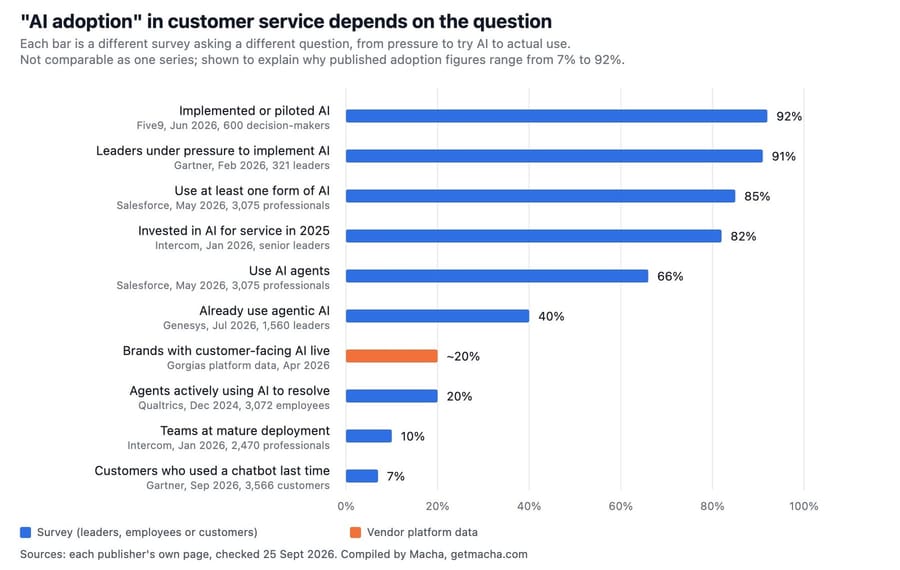
The spread comes from three differences in method.
- Leaders answer higher than platforms measure. Surveys of leaders and professionals about their own organization land between 40% (Genesys, agentic AI only) and 92%. The one figure measured from platform activity rather than a questionnaire, Gorgias's, is about 20%. Gorgias counts a brand as an adopter only after its AI reaches "at least 5% automation in a 7-day period with at least 5 billed tickets."
- Pilots count. Five9's 92% is organizations that "have already implemented or piloted AI use cases in customer service." Gartner's 85% is leaders who "will explore or pilot." A pilot on one queue for one month counts the same as a full rollout.
- The closer to the ticket, the lower the number. Only 20% of agents actively use AI to resolve issues (Qualtrics), and only 7% of customers used a chatbot in their latest service interaction (Gartner), while 49% said they would have used one if offered.
How many teams have AI working at scale?
Far fewer than have bought it. Intercom's 2026 Customer Service Transformation Report (2,470 support professionals, fieldwork Q4 2025) found "82% of senior leaders invested in AI for customer service in 2025, and 87% plan to in 2026," but "only 10% of teams report having reached a mature level of deployment, where AI is fully integrated into operations and working at scale." Maturity is self-described, and Intercom sells an AI agent (Fin, which Salesforce completed acquiring on 10 September 2026), so read the 10% as teams' own judgement.
Other surveys point the same way:
- BCG's survey of 180 customer service leaders found "95% believe that GenAI will transform their business, and 78% expect it to scale within the next 24 months" (BCG, 2025). Half named change management as the primary barrier to full value.
- Ada's study with NewtonX found "55% of businesses lack visibility into AI agent performance" (500 enterprise decision-makers, March 2026).
- Zendesk's CX Trends 2026 reports that high-maturity firms track "automation success rates (66% vs 21%)" far more often than low-maturity peers (Zendesk).
- Salesforce's 2025 State of Service found "51% of service leaders saying security concerns have delayed or limited their AI initiatives" (Salesforce), and its 2026 edition found data readiness was a major blocker for 72% of service operations professionals and 59% of service leaders.
The operator's reading: a team that can't say what share of its tickets the AI closes hasn't adopted AI in any sense that matters to its budget. Our resolution rate statistics cover how vendors count that share, and our guide to measuring AI agent quality covers how to measure it yourself.
How fast is AI adoption growing?
Every series we found is rising, whichever step it measures:
- AI agents: 39% in 2025 to 66% in 2026 (Salesforce, service professionals).
- Investment: Intercom's 2025 report found "54% of support teams planned to invest in AI for customer service last year – whereas in reality 76% ended up investing in AI" (Intercom). In its 2024 report, "Almost half of customer support teams are already using AI" (Intercom).
- Priority: AI moved "from #10 to #2 in just a year" on service leaders' priority list, according to Salesforce's 2025 State of Service (6,500 service professionals).
- Recency: among Forethought's respondents already using AI for CX, "a quarter began just within the last six months."
Pressure is part of the reason. Gartner's February 2026 release found 91% of service leaders reported pressure from executive leadership to implement AI, and a separate Gartner survey of 265 leaders (fieldwork April to May 2025, released October 2025) found "77% of service and support leaders feel pressure from other senior executives to deploy AI, and 75% report increased budgets for AI initiatives compared to last year" (Gartner). When leaders are measured on whether they've started, starting is what gets reported, which is one reason pilots show up in the adoption counts.
The same Gartner survey of 265 leaders produced a quieter finding in August 2025: AI agents "remain outside the top 10 customer service technologies ranked by leaders now and in two years’ time" (Gartner). Leaders were buying AI agents while not yet ranking them among their most valuable tools.
Does AI adoption differ by company size?
Only one source measures this directly, and it's platform data. Gorgias's Ecom Lab (April 2026) found "roughly 1 in 5 brands has deployed AI in customer-facing support," and that "Fewer than 18% of brands under $1M GMV have deployed AI. That number crosses 25% around $5M GMV, 35% at $25M, and approaches 50% for brands above $500M GMV."
These are Gorgias merchants, a Shopify-heavy base of direct-to-consumer brands, so they don't represent all ecommerce. Gorgias's own survey of 400 ecommerce decision-makers gives a higher, self-reported figure: "AI currently handles an average of 31% of customer interactions for ecommerce brands," and "57% of brands are using AI for 26-50% of all customer interactions" (Gorgias). The two figures don't measure the same thing: one is the share of Gorgias brands with AI live, the other is the share of interactions AI handles as estimated by surveyed decision-makers. Read the survey as what adopters say about their own volume, not as an adoption rate. Our ecommerce statistics cover that segment in more depth.
Which AI uses have teams actually deployed?
Leaders separate exploring from deploying when a survey asks them to. Gartner's survey of 187 service leaders (fieldwork July to August 2024, the same survey behind its 85% "explore or pilot" figure) found "44% of leaders report exploring a customer-facing GenAI voicebot, in addition to 11% who are already piloting this technology, and 5% who have this solution deployed" (Gartner). That 5% is the strictest leader-reported adoption figure on this page.
- Agent assist, a forecast: "Gartner predicts that by the end of 2025, 73% of customer service organizations will have implemented agent assist solutions for their workforce" (from the same 265-leader survey as the August 2025 release above; Gartner). That's a prediction, not a count. The target date has passed and Gartner hasn't published a count of whether it happened.
- Budget: "On average, CX leaders plan to invest 30% of customer service budgets in AI-powered CX technologies" (Genesys, July 2026, 1,560 leaders).
- Beyond support: "52% of organizations are planning to scale AI beyond support in 2026" (Intercom, same 2,470-person survey as the 10% maturity figure).
When a survey separates exploring from deploying, the deployed share of customer-facing AI is small (5% for voicebots in Gartner's 2024 survey), and nobody has published the equivalent split for chat and email.
How many customers actually meet AI in customer service?
Fewer than the business surveys imply. Medallia's 2026 State of CX report (1,522 consumers) found "1 in 6 consumers say their last customer service interaction was entirely with a chatbot or AI assistant. Another 2 in 6 encountered AI or automation alongside human support" (Medallia PDF). Gartner's customer survey found that "While 49% of customers said they would have been willing to use a chatbot if the company had provided one, only 7% used a chatbot or digital assistant during their most recent service interaction."
Meanwhile customers adopt general AI on their own: Pew found "About half of U.S. adults now use AI chatbots, up from a third in 2024" (Pew, June 2026, 5,119 adults). Gartner's July 2026 release, from the same 3,566-customer survey, found customers are "approximately three times more likely to use third-party GenAI tools than company-provided chatbots when resolving customer service issues" (Gartner); our channel statistics cover that shift.
Do agents use the AI they're given?
Not always. Qualtrics found "Only 20% of agents are actively using AI to resolve customer issues" (Qualtrics, 3,072 employees). In Alibaba's four-week field experiment with 2,895 treated Taobao agents, "17.9% of treated agents did not use the gen AI assistant at all, while 6.2% used it in every assigned chat" (arXiv preprint, 2026). A license bought isn't a tool in use. Our staffing statistics cover what AI is doing to agent roles and headcount.
How to read these numbers
We checked every figure on the publisher's own page or PDF on 25 September 2026. Before quoting an adoption statistic, check three things:
- Who answered. Leaders describing their own organizations answer highest (40% to 92% in the table). Agent, customer and platform-log measures mostly land at 20% or below, though Medallia's count of customers who met AI alongside a human pushes the customer figure up to half.
- What counted. Pressure, plans, pilots, "at least one form of AI," AI agents, and maturity are different claims.
- Who published it. Most adoption surveys come from companies that sell AI (Salesforce, Intercom, Five9, Genesys, Freshworks, Gorgias, Forethought, Ada; we sell AI agents too). A finding that everyone is adopting AI helps every one of them sell. That incentive doesn't make the numbers wrong, but it's why the sources that don't sell AI agents (Gartner, BCG, Pew, the Alibaba experiment; Qualtrics sells contact center software) matter more than their sample sizes suggest.
Same-survey note: Gartner's 91% pressure figure comes from the same October 2025 survey of 321 leaders that produced its staffing releases, and the 7% chatbot figure comes from the same 3,566-customer survey as its 87% human-access finding. Cisco's widely quoted "68% by 2028" is B2B technology buyers predicting how their own vendor interactions will be handled, not a measure of adoption.
We sell AI agents, so we have a reason to prefer the high numbers. We've kept the low ones in the table because they're closer to what a support team sees on its own queue.
Where the data runs out
No public source breaks adoption down by help desk platform, and only Gorgias breaks it down by company size. Nobody publishes how many of the teams that "use AI" have it answering customers without a human, as opposed to drafting replies or tagging tickets. And no survey follows the same organizations over time; each year's figure comes from a new sample. No verified source splits service AI adoption by industry or region either; the industry percentages that circulate on roundups carry no primary.
How Macha fits
Macha adds AI agents on top of Zendesk, Freshdesk, Gorgias, Front, HubSpot or Intercom, so adopting it doesn't mean a migration or a new help desk. It comes with setup and monitoring by the Macha team, included on every plan. It's priced per ticket (one thread between Macha and one person, charged once no matter how many messages it takes). Macha fits teams already running one of those desks that are somewhere in the middle of this table: past the pilot, not yet at the 10% Intercom calls mature, and short of the people to get there. The pricing page has the tiers, and our guide to AI agents for customer service explains what an agent does inside the ticket.
Sources
- Salesforce, State of Service: AI Agents Edition (May 2026; 3,075 service professionals) and State of Service, 7th edition (November 2025; 6,500)
- Intercom, 2026 Customer Service Transformation Report (January 2026; 2,470), 2025 edition (2,000+) and 2024 Trends Report (2,000+)
- HubSpot, State of Service (2024; 1,537 leaders)
- Five9, 2026 Business Leaders CX Report (June 2026; 3,000 consumers, 600 decision-makers)
- Genesys, State of Customer Experience 2026 (July 2026; 5,811 consumers, 1,560 leaders)
- Gartner releases: 85% will explore or pilot GenAI (December 2024; 187 leaders), top technologies (August 2025; 265), most valuable AI use cases (October 2025; 265), 91% under pressure (February 2026; 321), 27% would try a chatbot again (September 2026; 3,566 customers)
- Gartner, customers three times more likely to use third-party GenAI (July 2026; 3,566 customers) and 87% say a human option is essential (August 2026; 3,566 customers)
- Qualtrics XM Institute, Contact Center Trends 2025 (December 2024; 23,000+ consumers, 3,072 employees)
- Forethought, 2025 AI in CX Benchmark Report (642 US CX professionals)
- Freshworks, 2026 CX Benchmark (vendor survey and usage data)
- Gorgias Ecom Lab, AI is everywhere. Our data shows there is still resistance. (April 2026; platform data) and State of Conversational Commerce 2026 (400 decision-makers)
- BCG, Agentic AI Is the New Frontier in Customer Service Transformation (2025; 180 leaders)
- Ada and NewtonX, consumer and enterprise study (March 2026)
- Zendesk, CX Trends 2026 (November 2025; 11,000+ respondents)
- Medallia, 2026 State of CX Report (March 2026; 1,522 consumers)
- Pew Research Center, Americans and AI 2026 (June 2026; 5,119 US adults)
- Ni, Wang, Feng, Lu, Wang and Zhou, Generative AI in Action: Alibaba field experiment (arXiv preprint, 2026)
More statistics
- Customer service and AI statistics (2026): the hub, with the key numbers from every topic.
- How many tickets does AI actually resolve?: resolution rates and the definitions behind them.
- Will AI replace customer service agents?: headcount, turnover and what AI does to agent roles.
- What is the ROI of AI in customer service?: cost per contact and the ROI surveys.
- Do customers trust AI customer service?: what customers say about talking to AI.
Frequently asked questions
What percentage of companies use AI in customer service? It depends on the definition. Salesforce's May 2026 survey of 3,075 service professionals found 85% of service organizations use at least one form of AI and 66% use AI agents. Five9 found 92% of organizations have implemented or piloted AI, while Intercom found only 10% of teams report a mature deployment.
How many support agents actually use AI? Qualtrics found only 20% of contact center agents actively use AI to resolve customer issues, from a survey of 3,072 employees published in December 2024. In Alibaba's 2024 field experiment, 17.9% of agents given an AI assistant never used it.
Are small businesses adopting AI for customer service? Less than large ones, on the only measured data available. Gorgias's platform data shows fewer than 18% of ecommerce brands under $1M in GMV have deployed customer-facing AI, rising to nearly 50% above $500M.
Is AI adoption in customer service growing? Yes, on every series we found. Salesforce reports AI agent adoption rising from 39% in 2025 to 66% in 2026, and Intercom reports 82% of senior leaders invested in AI in 2025 with 87% planning to in 2026.
Why do AI adoption statistics disagree so much? They ask different people different questions. Leaders describing their own organizations answer higher than platform data measures, pilots often count as adoption, and figures fall the closer you get to the ticket: 20% of agents actively use AI and 7% of customers used a chatbot in their latest service interaction.
To see where AI agents fit on your own queue, start a trial with $50 of free usage (about 125 tickets), no credit card, no time limit.
Resolve tickets automatically with AI agents
Macha's AI agents work on top of the help desk you already use — no code.