Intercom
 Shopify
 Stripe
 Slack
Slack Notion
 Google Workspace
 Confluence

How Much Does Customer Support Cost, and What Is the ROI of AI? Statistics (2026)


An assisted customer service contact cost an average of $7.80 in 2026, up from $6.70 in 2024, according to Deloitte Digital's 2026 Global Contact Center Survey of 720 service leaders at large B2C companies (June 2026). AI is supposed to bend that curve, but the return is thinner than the adoption numbers suggest: in a Gartner survey released in July 2026, service leaders had put a median 12% of their 2025 budget into AI, and only 24% had demonstrated positive financial returns. This page collects the cost and ROI figures we could verify on each publisher's own page, with who was asked, what was measured, and which numbers are forecasts or self-reports.
Key takeaways
- Deloitte Digital's 2026 Global Contact Center Survey of 720 leaders puts the average cost per assisted contact at $7.80, up from $6.70 in its 2024 survey.
- Gartner predicts that by 2030 generative AI will cost more than $3 per resolution, higher than many B2C offshore human agents; that is a forecast, not a measured price.
- Only 24% of service and support leaders demonstrated positive financial returns on AI in Gartner's July 2026 release, although they put a median 12% of their 2025 budget into it.
- Klarna said in 2024 its AI agent did the "equivalent work of 700 full-time agents," yet its quarterly customer service and operations expense rose from $42 million in Q3 2024 to $50 million in Q3 2025.
- A Gartner survey of 199 service leaders, run April to May 2026, found AI spending up 38% while overall service and support budgets grew just 2%.

How much does a customer service contact cost?
The best current figure is Deloitte's. Its 2026 survey reports the average cost per assisted contact as "2024 (AVG.): $6.70 2026 (AVG.): $7.80" under the heading "cost per assisted contact continues to rise" (Deloitte Digital, June 2026, p.8). That's a 16% rise in two years. The respondents are senior managers at companies with 1,000+ employees, $100M+ revenue and in-house B2C contact centers, in seven countries, so it describes large contact centers, not a five-person email team. This page is one topic in our customer service and AI statistics hub.
The same Deloitte survey puts 2025 contact-center employee attrition at an average of 38%, which is a big part of why the number rises: every leaver has to be recruited and trained before they're productive. Other cost figures, and what's behind each:
| Figure | Source | Who or what | What it is |
|---|---|---|---|
| $7.80 per assisted contact (2026), $6.70 (2024) | Deloitte Digital, June 2026 | 720 B2C service leaders, companies with 1,000+ staff | Leaders' reported average |
| $8 to $15 per human-handled contact; $0.10 to $1.00 automated | Decagon glossary, undated (2026) | None stated | Vendor rule of thumb, no sample or method |
| $9 cost per resolution for small teams using agentic AI, vs $18 to $23 for other groups | Forethought, 2025 | 642 US CX professionals, self-reported | Survey estimate |
| Repeat calls are 23% of a contact center's operating budget | SQM Group, 2020 | SQM's benchmarked call centers | Older consultancy figure |
Decagon's glossary gives no data behind either range, and Decagon sells AI agents, so a 10x to 100x gap is the number it would want you to carry into a budget meeting. Treat it as a claim to test.
Forethought's report defines cost per resolution to include "support staff wages, overhead, software and hardware, training, and any other relevant expenses," which is the right definition. But respondents estimated their own figures, and Forethought (acquired by Zendesk, completed 26 March 2026) sells the agentic AI that came out cheapest.
The most reliable lever on this cost is the one without AI in it. SQM Group's rule of thumb is "For every 1% improvement in FCR, you reduce your operating costs by 1%," and "A 1% improvement in their FCR rate equals $286,000 in annual operational savings for the average midsize call center" (SQM Group, November 2025). SQM sells FCR benchmarking and doesn't publish the model behind those ratios, but the mechanism is plain: a repeat contact costs as much as the first and resolves nothing new. Our benchmarks page has the FCR figures.
How much does an AI resolution cost?
Today's list prices are in our AI Customer Support Pricing Index and the short answer to what an AI support agent costs per resolution. The harder question is where the unit price goes next.
Gartner's answer is up. "By 2030, cost per resolution for generative AI (GenAI) will exceed $3, higher than many B2C offshore human agents, according to Gartner, Inc," its January 2026 release says (Gartner, January 2026). It's a prediction with no survey base, often quoted as if $3 were today's price. The release names three causes: "Rising data center costs, a pivot from subsidized growth to profitability for AI vendors, and increasingly complex use cases that consume more tokens and require expensive talent." The second is the incentive worth watching. A vendor pricing below cost to win share will reprice once it has the share.
Gartner analyst Patrick Quinlan adds that "Full automation will be prohibitively expensive for most organizations." That's a forecast too.
For an operator, the per-resolution price matters less than what you pay when the AI doesn't resolve. Our guides to AI tools that charge without resolving, help desk AI vs a standalone AI agent, hidden costs and 1,000 tickets a month work through that arithmetic.
Does AI in customer service deliver ROI?
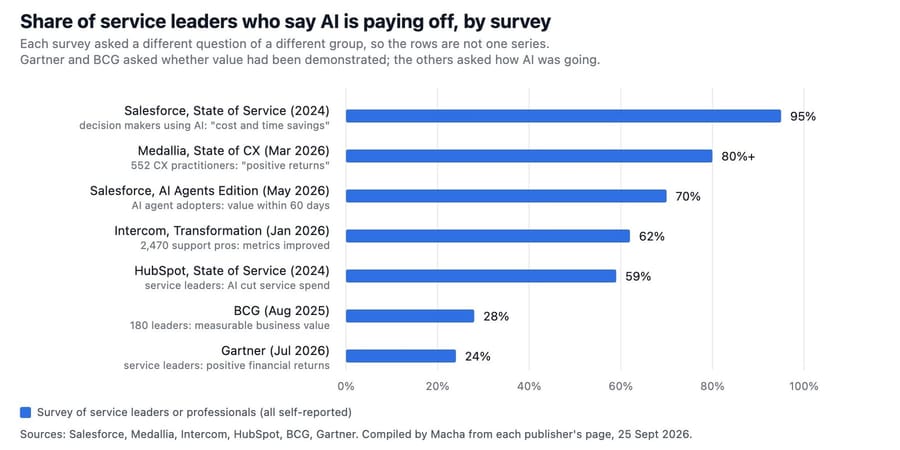
It depends on who's asked and how the question is worded. In Gartner's July 2026 release, "service and support leaders invested a median of 12% of their 2025 budget in AI, the highest amount among the 10 business functions assessed. However, only 24% of service and support leaders demonstrated positive financial returns across their AI use cases" (Gartner, July 2026; survey of 1,303 senior leaders across functions, January to April 2026). BCG's survey of 180 customer service leaders found "only 28% of companies have unlocked measurable business value from generative AI (GenAI) in customer service" (BCG, August 2025).
The surveys that ask how AI is going get much higher numbers:
| Stat | Publisher and report | Date | Who was asked | Link |
|---|---|---|---|---|
| "95% of decision makers at organizations with AI report cost and time savings" | Salesforce, State of Service (6th ed.) | May 2024 | Decision makers at organizations using AI, within 5,500+ service professionals | Salesforce |
| "more than 80% of CX practitioners see positive returns employing AI" | Medallia, 2026 State of CX | March 2026 | 552 CX practitioners | Medallia |
| 70% of organizations that adopt AI agents "observe measurable value within 60 days of deployment" | Salesforce, State of Service: AI Agents Edition | May 2026 | 3,075 service professionals | Salesforce |
| "62% say their customer service metrics have improved since implementing AI" | Intercom, 2026 Customer Service Transformation Report | January 2026 | 2,470 support professionals | Intercom |
| 59% say AI decreased their customer service spending; 31% recorded an increase | HubSpot, State of Service 2024 | 2024 | 1,537 service leaders (other HubSpot pages say 1,500+ or 1,400) | HubSpot |
| 28% have unlocked measurable business value | BCG | August 2025 | 180 customer service leaders | BCG |
| 24% demonstrated positive financial returns | Gartner | July 2026 | Service leaders within a survey of 1,303 senior leaders | Gartner |
Two things separate the top of this table from the bottom. One is the verb: "see positive returns" is a feeling, while "demonstrated positive financial returns" needs someone to have run the numbers. The other is who ran the survey. Salesforce, Medallia, Intercom and HubSpot all sell AI for service and have no reason to word a question so it produces a low number. Leaders have a reason to answer high, too: they chose the tool and argued for the budget. Intercom's split shows how much maturity matters: 87% of its mature teams report improved metrics against 62% overall, and only 10% of respondents call themselves mature.
If you're building a business case, the 24% is the number to plan around. It doesn't say AI loses money. It says three out of four service leaders couldn't show it made money, often because nobody measured cost per resolution before and after.
How much are support teams spending on AI?
Spending is rising far faster than budgets. "A Gartner survey of 199 service and support leaders conducted in April through May 2026 revealed that spending on AI has increased by 38%, while overall service and support function budgets have grown just 2%" (Gartner, August 2026). Gartner's Kim Hedlin says "leaders are increasingly redirecting spending away from labor and overhead and instead toward technology." With the budget almost flat, a 38% rise in AI spend has to come out of headcount, training or other tools.
- Budgets up in 2025: "77% of service and support leaders feel pressure from other senior executives to deploy AI, and 75% report increased budgets for AI initiatives compared to last year," from a Gartner survey of 265 leaders (Gartner, October 2025).
- New staff to run the AI: in the same survey, "The typical leader is planning to add five new full-time-equivalent (FTE) roles in the next 12 months to manage these investments," a cost business cases often leave out.
When three in four leaders say executives are pushing them to deploy AI, spend can run ahead of evidence, which fits the 24% figure above. Our adoption statistics cover how many teams have actually deployed.
How much do leaders expect AI to cut support costs?
Expectations cluster between 20% and 30%, and every one of these figures is a forecast or a hope:
| Expected saving | Source | Date | Basis |
|---|---|---|---|
| "On average, leaders believe AI will reduce their cost base by 28% in the coming three years." | Deloitte Digital | June 2026 | Same survey of 720 leaders as the $7.80 figure |
| "With AI agents, companies expect to decrease service costs and case resolution times by 20% on average" | Salesforce, State of Service (7th ed.) | September 2025 | 6,500 service professionals |
| 30% reduction in operational costs by 2029, as agentic AI resolves "80% of common customer service issues" | Gartner | March 2025 | Analyst prediction |
| Value "ranging from 30 to 45 percent of current function costs" | McKinsey | June 2023 | Modeled estimate |
| "short-term P&L effects of 10% to 20%" | BCG | August 2025 | What "pioneers" are aiming for |
The McKinsey figure is the most misquoted number on this page. The 2023 report estimates generative AI "could increase productivity at a value ranging from 30 to 45 percent of current function costs," a modeled value expressed as a share of what the function costs. It circulates as a 30% to 45% jump in agent productivity, which it isn't. The BCG range is what pioneers are "aiming to achieve." And Gartner's 2029 forecast covers "common" issues only; ten months later, Gartner predicted GenAI cost per resolution would rise past $3.
What happened to Klarna's customer service costs after AI?
Klarna is one of the most cited AI support cases, and its own releases tell two stories. All of these are Klarna's figures about Klarna.
In February 2024, a month after launch, Klarna said its AI agent had "2.3 million conversations, two-thirds of Klarna's customer service chats," that "It is doing the equivalent work of 700 full-time agents," and that "It's estimated to drive a $40 million USD in profit improvement to Klarna in 2024" (Klarna, February 2024). The $40 million was a forward estimate, not a realized saving. In May 2025 Klarna reported that customer service "costs per transaction have dropped by 40% since Q1'23 whilst maintaining customer satisfaction levels" (Klarna, May 2025).
Then the absolute line went up. Klarna's Q3 2025 earnings release shows "Customer service and operations (50) (42)": adjusted expense of $50 million in Q3 2025 against $42 million a year earlier, a 19% rise (Klarna Q3 2025 Earnings Release, p.8). Its Q2 2026 results show the same line at $58 million against $51 million (Klarna, Q2 2026). Klarna's business grew over the same period, so cost per unit can fall while the bill rises: the per-transaction figure tells you about volume, and the expense line tells you about cost.
We left out the widely repeated later savings and headcount figures: they come from remarks on the Q3 2025 earnings call, not a published document, and the reports that Klarna rehired human agents rest on media interviews, not a Klarna release. For a support lead, a case study that quotes FTE equivalents tells you about volume. Ask for the expense line.
What do measured studies and platform data show about AI savings?
The strongest evidence measures productivity, which only turns into money if headcount or volume changes. Brynjolfsson, Li and Raymond found "Access to AI assistance increases worker productivity, as measured by issues resolved per hour, by 15% on average," across 5,172 chat agents at one Fortune 500 software company (Quarterly Journal of Economics, 2025). The tool suggested replies to human agents. A 15% gain is worth roughly 15% of agent labor at constant volume, short of the 20% to 30% leaders expect.
A Danish study of about 25,000 workers per survey round in AI-exposed jobs found small self-reported time savings: "On average, adopters in our sample report savings of about 3% of their work hours," and customer service adopters sit at the same 3.0% (Humlum and Vestergaard, NBER Working Paper 33777, revised March 2026).
Gorgias's platform data is the most specific on money, and it's Gorgias's own data about merchants using its AI Agent. "Nearly 1 in 4 brands (23.5%) reduced their team after enabling AI Agent," and "Brands that reduced by at least one person saw each remaining agent handle 29% more tickets (254 to 329 per month), while revenue grew 22%." Its headline "$73K net annual saving at the lowest automation tier" rests on stated assumptions: "ROI assumes $20K blended annual cost per agent (weighted average of US-based and offshore support hires) and $9K average annual platform cost" (Gorgias Ecom Lab, April 2026). We did the arithmetic: $73K plus $9K is $82K, about 4.1 agents at $20K each, which matches Gorgias's "saving 4+ agents." It's modeled from assumed salaries, not payroll. At twice that cost per agent, the same four agents are worth about $160K; if the AI doesn't free up four people, it's worth nothing.
Deloitte reports that "AI-centric organizations reported 85% greater contact center profitability, compared to organizations with low AI maturity," and that "AI-centric leaders are 76% more likely to report lower cost per contact." Its "AI-centric" group is the 160 respondents who use agentic AI and also report the highest customer and employee experience ratings, so the group was partly picked on the outcome being compared, and Deloitte sells contact-center transformation. The comparison shows well-run centers use AI. It doesn't show AI made them profitable.
How to read these numbers
We checked every figure on the publisher's own page or PDF on 25 September 2026 (SQM's pages through archived copies, because the live site timed out). Five things to keep in mind:
- Who was asked. Nearly every ROI figure here is a leader rating their own AI program. The only productivity measurement is the QJE study (one company); the Danish figure is self-reported time.
- Who ran the survey. Salesforce, Intercom, HubSpot, Medallia and Gorgias sell AI for support; Deloitte and BCG sell transformation work; SQM sells FCR benchmarking. Gartner's "demonstrated returns" question is the hardest test and got the lowest answer.
- Forecast vs measured. Gartner's $3 by 2030 and 30% by 2029, Deloitte's 28% and McKinsey's 30 to 45 percent are predictions or models.
- Same survey. Deloitte's $7.80, 38% attrition, 28% expected saving and AI-centric comparisons all come from one survey of 720 leaders. Gartner's 12%/24% and 38% figures come from two different surveys (1,303 and 199 leaders).
- Units. Cost per assisted contact, per resolution and per transaction are different denominators. A contact that doesn't resolve still costs money.
We sell AI agents, so we have a reason to prefer the flattering numbers. That's why this page quotes primaries only and keeps the ones that cut against AI: the 24%, the $3 forecast, the Klarna expense line and the 3% time saving.
Where the data runs out
There's no public cost-per-ticket benchmark for email or ecommerce support at small and mid-sized companies; Deloitte's figure covers large B2C contact centers. No neutral source measures AI cost per resolution across vendors, including the tickets the AI fails on and hands to a person. And none of the ROI surveys publishes the before-and-after cost data behind its percentage, so "positive returns" can't be checked against a number. Our staffing statistics cover the headcount side, and our resolution rate statistics explain why "resolved" means different things at different vendors.
How Macha fits
Macha runs AI agents on top of Zendesk, Freshdesk, Gorgias, Front, HubSpot or Intercom and is priced per ticket (one thread between Macha and one person, charged once no matter how many messages it takes), so its cost per ticket is known before the month starts and doesn't rise with how many replies a thread needs. That billing unit is also why the cost-per-resolution question matters to us: per-ticket pricing is cheapest when the agent resolves a high share of what it touches, and our pricing page and the per-action vs per-resolution comparison show the trade. Macha fits teams already on one of those help desks who want to measure cost per resolved ticket before and after, on their own queue, rather than trust a survey.
Sources
- Deloitte Digital, The future of service is the story of now: 2026 Global Contact Center Survey (June 2026; 720 B2C service leaders and 3,000 consumers)
- Gartner, GenAI cost per resolution will exceed offshore human agent costs by 2030 (January 2026; predictions)
- Gartner, Customers 3x more likely to use third-party GenAI than company chatbots (July 2026; 1,303 senior leaders for the budget and returns figures)
- Gartner, AI spending by customer service leaders has surged by 38% (August 2026; 199 leaders)
- Gartner, The most valuable AI use cases for customer service fall into four areas (October 2025; 265 leaders)
- Gartner, Agentic AI will autonomously resolve 80% of common customer service issues by 2029 (March 2025; prediction)
- BCG, Agentic AI Is the New Frontier in Customer Service Transformation (August 2025; 180 leaders)
- McKinsey, The economic potential of generative AI (June 2023; modeled estimate)
- Salesforce, State of Service: AI Agents Edition (May 2026; 3,075), State of Service, 7th edition (September 2025; 6,500) and 6th edition (May 2024; 5,500+)
- Medallia, 2026 State of CX Report (March 2026; 552 practitioners)
- Intercom, 2026 Customer Service Transformation Report (January 2026; 2,470)
- HubSpot, State of Service 2024 (2024; 1,537 per HubSpot's blog)
- Forethought, 2025 AI in CX Benchmark Report and small-teams write-up (2025; 642)
- Decagon, Deflection rate glossary (undated, 2026; no stated method)
- SQM Group, FCR guide (November 2025), FCR Benchmark 2024 (500+ call centers) and Top 5 reasons to improve FCR (2020)
- Klarna, AI assistant first month (February 2024), Q1 2025 results (May 2025), Q3 2025 Earnings Release (November 2025) and Q2 2026 results; company self-reports
- Gorgias Ecom Lab, Most brands are overpaying for support. Here's the math. (April 2026; platform data)
- Brynjolfsson, Li and Raymond, Generative AI at Work (Quarterly Journal of Economics, 2025; 5,172 agents)
- Humlum and Vestergaard, Still Waters, Rapid Currents (NBER Working Paper 33777, revised March 2026; Denmark)
More statistics
- Customer service and AI statistics (2026): the hub, with the key numbers from every topic.
- How many tickets does AI actually resolve?: resolution rates and what each vendor counts.
- Will AI replace customer service agents?: headcount, attrition and staffing plans.
- How many support teams use AI?: adoption by survey and definition.
- What are good first response and resolution times?: FRT, handle time, CSAT and FCR benchmarks.
Frequently asked questions
How much does a customer service contact cost in 2026? Deloitte Digital's 2026 Global Contact Center Survey of 720 leaders at large B2C companies puts the average cost per assisted contact at $7.80, up from $6.70 in its 2024 survey. There's no comparable public figure for small email or ecommerce support teams.
What is the ROI of AI in customer service? It depends on how the question is asked. Gartner's July 2026 release found only 24% of service and support leaders demonstrated positive financial returns on AI, and BCG found 28% had unlocked measurable value, while vendor-run surveys report 59% to 95% of respondents seeing savings or improvement.
How much does an AI resolution cost compared with a human? Decagon's glossary claims $8 to $15 per human-handled contact and $0.10 to $1.00 per automated one, with no data behind either. Gartner predicts GenAI cost per resolution will exceed $3 by 2030, higher than many B2C offshore human agents.
Did Klarna's AI save money? Klarna said in 2024 its AI agent did the "equivalent work of 700 full-time agents" and estimated a $40 million profit improvement, and in 2025 reported customer service cost per transaction down 40%. Its customer service and operations expense still rose from $42 million to $50 million between Q3 2024 and Q3 2025, as the business grew.
How much do companies expect AI to cut support costs? Leaders in Deloitte's 2026 survey expect a 28% lower cost base within three years, and Salesforce's 2025 survey respondents expect 20%. Gartner predicts a 30% cut in operational costs by 2029 for common issues. All three are expectations or forecasts, not measured savings.
To measure cost per resolved ticket on your own queue, start a trial with $50 of free usage (about 125 tickets), no credit card, no time limit.
Simple per-ticket AI pricing
One thread with one person is one charge, however many replies it takes.