Intercom
 Shopify
 Stripe
 Slack
Slack Notion
 Google Workspace
 Confluence

Will AI Replace Customer Service Agents? Staffing and Agent Statistics (2026)


Not yet, on the evidence published so far. In a Gartner survey of 321 customer service and support leaders, released in December 2025, only 20% said they had reduced agent staffing because of AI, while 55% reported stable staffing while handling higher customer volumes. Support volume is still growing, and the strongest academic studies find AI makes agents faster, especially new ones. The warning sign is at entry level: Stanford researchers find employment of 22 to 25-year-olds in AI-exposed jobs, which include customer service representatives, 19% below trend. Below is every verified figure with its source, sample and date.
Key takeaways
- Only 20% of customer service leaders in Gartner's survey of 321, released December 2025, said they had reduced agent staffing due to AI, and 55% kept staffing stable while volumes rose.
- In the same Gartner survey of 321 leaders, 85% are adding new tasks to frontline agent roles, while 31% have implemented or planned layoffs in response to AI through early 2027.
- Brynjolfsson, Li and Raymond's peer-reviewed study of chat agents at one software firm (QJE, 2025) found AI suggestions raised resolutions per hour by 15% on average, and about 30% for less-experienced workers.
- Stanford Digital Economy Lab's August 2026 revision finds employment of 22 to 25-year-olds in AI-exposed occupations 19% below trend, replacing the widely quoted 13% figure.
- Published agent turnover figures range from 12% of service employees (Salesforce, 2025) to 38% in contact centers (Deloitte and SQM Group, 2025), so staffing plans start from different baselines.

How many support teams have cut staff because of AI?
A minority, and fewer than the headlines suggest. This page is part of our customer service and AI statistics hub, where every figure comes from the publisher's own page.
Gartner surveyed 321 customer service and support leaders in October 2025 and found "currently only 20% of leaders have reduced agent staffing due to AI" (Gartner, December 2025). A larger group, "55% report stable staffing levels while handling higher customer volumes." Plan around the second number. Most teams are using AI to absorb growth.
Gartner's April 2026 release comes from the same survey of 321 leaders (it gives fieldwork as September to October 2025). "Just thirty-one percent have implemented, or are planning, frontline workforce reductions through layoffs in response to AI through 1Q27," while 63% of service leaders are "reducing frontline headcount gradually through attrition" (Gartner, April 2026). Attrition is the quiet route: nobody is laid off, and the seat simply isn't refilled.
Vendor data runs higher, from narrower samples:
| Figure | Source | Who or what was measured | Label |
|---|---|---|---|
| "Nearly 1 in 4 brands (23.5%) reduced their team after enabling AI Agent." Of those, 51% kept the same ticket volume and the same or more revenue | Gorgias Ecom Lab (April 2026) | Gorgias merchants that switched on its AI Agent; teams of 3+ | Vendor platform data |
| "Tier 1 headcount demand is falling: 28% saw hiring freezes, slowdowns, or natural attrition at Tier 1 level" | Intercom (January 2026) | 166 recorded calls with Intercom customers and prospects, coded by an LLM | Vendor sample |
| 62% of brands expect to grow their teams in the coming year; "Only 10% anticipate any reduction, and just 1% expect significant cuts." | Gorgias, State of Conversational Commerce 2026 | 400 ecommerce decision-makers, October to November 2025 | Vendor survey |
Both companies sell AI agents, so a headcount-reduction figure doubles as a sales figure. Gorgias's two sources also disagree (nearly a quarter of its AI Agent brands cut their team, but only 10% of surveyed brands expect any reduction) because they measure different populations.
Klarna, the most quoted case, said in February 2024 that its AI agent "is doing the equivalent work of 700 full-time agents" (Klarna), and in May 2025 that its company-wide workforce had shrunk by about 40% since 2022 (Klarna Q1 2025). The later "853 employees" figure and the rehiring reports come from interviews and an earnings call, not a Klarna publication, so we don't cite them. Our cost and ROI statistics cover the money side.
Will companies that planned AI layoffs follow through?
Gartner's forecast is that half won't. "By 2027, 50% of organizations that expected to significantly reduce their customer service workforce will abandon these plans," Gartner predicted in June 2025. The same release cites a separate poll of 163 leaders in March 2025 in which "95% of customer service leaders plan to retain human agents to strategically define AI's role" (Gartner, June 2025). That's a forecast for 2027, not a count.
A second Gartner forecast pushes the same way: "By 2028, regulatory changes related to AI will increase assisted service volume by 30%" (Gartner, January 2026), and the same release predicts GenAI cost per resolution will exceed $3 by 2030.
Read the incentive too. Gartner's clients are the service leaders it surveys, and a forecast warning against deep cuts is advice those leaders can take to a CFO who wants them.
What are leaders doing with agents instead of cutting them?
Changing the job. The chart puts the same survey of 321 leaders on one axis, which is fair only because every bar comes from one population.
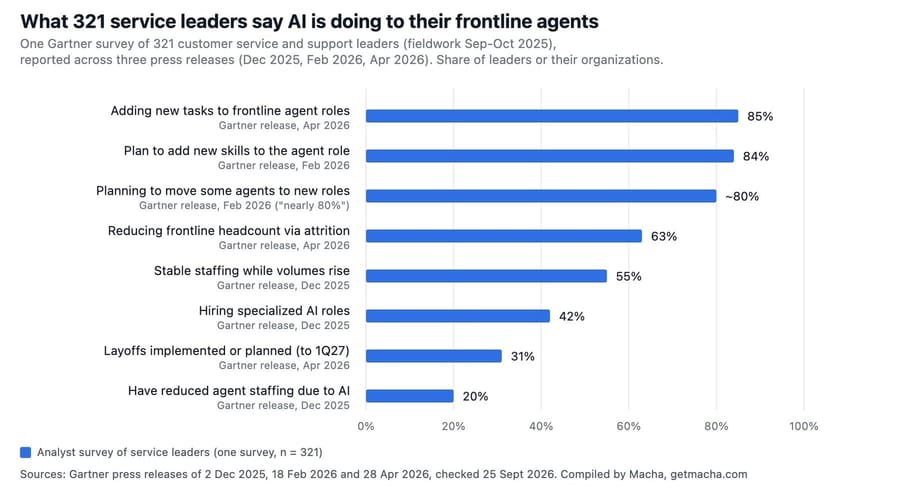
- New tasks. "85% of service leaders are adding new tasks and responsibilities to frontline agent roles, while 75% are shifting agents into entirely new roles within the service and support organization" (Gartner, April 2026, same survey of 321 leaders).
- New skills and roles. In the February 2026 release from the same survey of 321 leaders, "nearly 80% of organizations planning to transition at least some agents into new roles," and 84% of leaders plan to add new skills to the agent role. The most common destination is knowledge management: "58% of service leaders aim to upskill agents into knowledge management specialists" (Gartner, February 2026).
- New hires. The December 2025 release (same survey of 321 leaders) found "42% of organizations are hiring specialized roles," such as AI strategists and automation analysts. An earlier Gartner survey of 265 leaders (April to May 2025) found "The typical leader is planning to add five new full-time-equivalent (FTE) roles in the next 12 months" to manage AI investments (Gartner, October 2025).
Intercom's 2026 report (2,470 support professionals, Q4 2025) found "40% of teams report agents spending more time training and optimizing AI systems" (Intercom). In Intercom's smaller interview sample of its own customers and prospects, 82.53% reported their role and responsibilities changing, but only 6.02% reported a change in team structure or reporting lines.
Forrester's forecast for 2026 goes further: "Forrester predicts that 30% of enterprises will create parallel AI functions that mirror human service roles" (Forrester, November 2025).
An AI agent creates work before it removes any: maintaining the knowledge it answers from, reviewing its replies and handling what it escalates. Budget that work next to the headcount saving; Intercom's 40% figure suggests it lands on the agents you keep.
Is support volume falling as AI takes tickets?
No published source says it is. McKinsey's March 2025 analysis found "57 percent of customer care leaders told us they expect call volumes to increase over the next one or two years," and that while digital interactions grew 6% a year since 2010, "human-to-human interactions have still grown 2 percent annually over that time frame" (McKinsey, The contact center crossroads).
- Workload per agent is up. Salesforce's sixth State of Service (May 2024; 5,500+ service professionals) found 77% of agents "report increased and more complex workloads compared to just one year ago" (Salesforce).
- Even the AI vendors still staff support. Salesforce says of its own help site: "our support team still receives around two million support requests each year" (Salesforce Customer Zero).
- Where AI works, it absorbs growth. Gorgias's platform data (vendor self-report) says "At 60%+ automation, ticket volume nearly tripled while human hours grew just 6%," and at brands that cut at least one person, each remaining agent handled 29% more tickets, from 254 to 329 a month.
The pattern is volume rising, AI taking a growing share and human hours roughly flat, which matches Gartner's 55% "stable staffing" answer. How much of the queue AI closes is covered on our resolution rate statistics page.
Does AI make customer service agents more productive?
Yes, in the controlled studies, and most for newer agents.
| Finding | Study | Sample | Year |
|---|---|---|---|
| AI assistance "increases productivity, as measured by issues resolved per hour, by 14% on average, including a 34% improvement for novice and low-skilled workers" | Brynjolfsson, Li and Raymond, NBER working paper 31161 | 5,179 chat agents at one Fortune 500 software firm | 2023 |
| Productivity up 15% on average, with an "approximate increase of 30% in the number of issues they are able to resolve per hour" for less-skilled and less-experienced workers; "treated agents with two months of tenure perform just as well as untreated agents with more than six months of tenure." | Same authors, Quarterly Journal of Economics (peer-reviewed version; authors' revised paper on arXiv) | Same firm, same rollout | 2025 |
| AI suggestions produced gains that would otherwise take "almost a year and a half of work experience" | Zhang and Narayandas, Management Science (HBS summary) | 138 agents, 256,934 chats, randomized | 2026 (fieldwork 2020 to 2021) |
Both studies tested AI that suggests replies to a human agent, and neither tested an autonomous AI agent replacing one. The NBER 2023 paper and its QJE 2025 version are one study, so count them once.
Surveys report self-assessed gains. Salesforce's seventh State of Service (September 2025; 6,500 professionals) says "Reps using AI spend 20% less time on routine cases," an estimated four hours a week (Salesforce). Zendesk's CX Trends 2025 found "Seventy-three percent of agents believe that having an AI copilot would help them do their job better" (Zendesk). Forrester's 2026 prediction puts the gain at about an hour: "We expect daily agent workloads to drop by an average of 1 hour."
Workers mostly spend the time saved on other work. In Denmark, Humlum and Vestergaard (NBER working paper 33777, March 2026; about 25,000 workers per survey round, including customer support specialists) found "most chatbot users (85%) report reallocating time savings from AI chatbots to other job tasks." Customer service adopters reported total time savings of 3.0% of work hours (NBER). That study covers general chatbots rather than purpose-built agent-assist tools like Zendesk's Copilot, but it's a sober baseline to set against a vendor's time-saving claim.
How high is agent turnover, and does AI change it?
It's high. Primary figures range from 12% to 38% because they measure different populations, and an older secondary estimate puts it at 60%.
| Turnover figure | Source | Population |
|---|---|---|
| 12% of service employees left their company in the past year | Salesforce (State of Service, 7th edition, 2025) | 6,500 service and field service professionals |
| 34% annual agent turnover | SQM Group (2024 benchmark) | 500+ North American call centers |
| 38% agent turnover, "the number one hindrance in 2025" to first call resolution | SQM Group (2025) | Same benchmark program |
| 38% average 2025 contact center attrition | Deloitte Digital, 2026 Global Contact Center Survey (June 2026) | 720 B2C service leaders at companies with 1,000+ employees |
| "60% of agents in contact centers leave each year" | Industry estimates cited by the NBER 2023 paper (Buesing et al. 2020; Gretz and Jacobson 2018) | Secondary; not the authors' data |
Salesforce's 12% covers service employees broadly, including field service; SQM and Deloitte measure contact centers. The 60% is a pre-2021 secondary estimate the NBER paper cites as background. Separately, "69% of service decision makers" told Salesforce in 2024 that "agent attrition is a major or moderate challenge."
AI's effect on turnover has one serious data point. In the NBER 2023 study, AI access cut attrition among agents with under six months of tenure: "around 10 percentage points, translates into a 40% decrease relative to a baseline attrition rate in this group of 25%." The authors say this estimate is less reliable than their productivity results, and it comes from one firm.
At 34% to 38% annual turnover, a 20-person team loses roughly seven agents a year. That's why 63% of leaders in Gartner's survey can cut headcount "gradually through attrition": the exits are already happening, and AI decides whether each seat gets refilled.
What does labor market data say about customer service jobs?
The clearest effect is at entry level, and it's descriptive. Stanford Digital Economy Lab's paper Canaries in the Coal Mine?, revised in August 2026 using ADP payroll data through June 2026, finds "employment of young workers (ages 22–25) in AI-exposed occupations now stands 19% below where it would be had it kept pace with that of their less-exposed peers" (Stanford PDF). In level terms, employment of 22 to 25-year-olds in the two most exposed quintiles fell about 11% between November 2022 and June 2026, while the same age group in the three least-exposed quintiles grew about 10%.
Customer service representatives are the second-largest occupation by ADP employment in the highest-exposure quintile (Appendix Table A.6), but the 19% pools all exposed occupations, and the paper gives no customer-service-specific percentage in its text.
The figure quoted most often is 13%, the August 2025 headline. The paper now says "Earlier versions of this study headlined regression estimates adjusting for firm-level shocks (a 13% relative decline as of July 2025 data; 16% as of September 2025 data)." Cite 19% with its date.
Humlum and Vestergaard's Danish study, which includes customer support specialists, points the other way, finding "precise null effects on earnings and recorded hours at both the worker and workplace levels, ruling out effects larger than 2% two years after the launch of ChatGPT." Both can hold at once. Young US workers in exposed jobs have fallen behind trend, while existing Danish workers' hours and pay haven't moved.
Customers worry about this too: in Gartner's 2024 survey of 5,728 customers, the top AI concern was difficulty reaching a person, "followed by AI displacing jobs" (Gartner, July 2024). Our trust statistics cover why a clear human handoff matters to them.
How to read these numbers
We checked each figure on the publisher's own page or PDF on 25 September 2026, and every quote above is verbatim. Four things to keep in mind:
- One Gartner survey, many headlines. Six Gartner press releases between December 2025 and April 2026 draw on the same survey of 321 service leaders; three of them appear on this page. The 20%, 31%, 42%, 55%, 58%, 63%, 75%, 80%, 84% and 85% figures are one sample, not independent confirmation of each other.
- Different sources answer different questions. Gartner, Deloitte and McKinsey asked leaders; Salesforce, Zendesk and Intercom also asked agents and managers; Stanford used payroll records. Only the academic studies measured output directly.
- Vendor samples lean one way. Gorgias and Intercom measure their own customers, and both sell AI agents.
- Forecasts carry target years. Gartner's 2027 and 2028 figures and Forrester's 2026 figures are predictions.
We sell AI agents too, so we have a reason to prefer a story where AI takes the work and nobody gets hurt. That's why this page quotes primaries only and keeps the figures that cut against AI, including the Stanford entry-level finding.
Where the data runs out
There's no public data on support team size relative to ticket volume for small and midsize teams. The closest ratio is Gorgias's contact rate (about 46 tickets per 100 orders for Electronics brands, about 20 for Food and Beverages), which measures work created, not people needed. Nobody publishes neutral before-and-after headcount for teams that deployed an autonomous AI agent, the academic studies all test AI that assists a human, and the Stanford data doesn't isolate customer service. Until someone measures it, track tickets per agent and AI-closed tickets per month on your own queue.
How Macha fits
Macha runs AI agents on top of Zendesk, Freshdesk, Gorgias, Front, HubSpot or Intercom, inside the ticket queue your team already works, and it's priced per ticket: one thread between Macha and one person, charged once no matter how many messages it takes. Agents can draft replies for a human to send or answer tickets directly, so a team can start with the assist model the studies measured. Macha fits teams that want to absorb volume growth without refilling every seat and would rather measure that on their own tickets than take a vendor's headcount figure on trust. The pricing page has the tiers, and our adoption statistics show how far other teams have gone.
Sources
- Gartner press releases: Only 20% report AI-driven headcount reduction (December 2025), 91% under pressure to implement AI (February 2026) and 85% expanding agent responsibilities (April 2026), all from one survey of 321 leaders; 50% will abandon workforce-reduction plans (June 2025; forecast, 163-leader poll); most valuable AI use cases (October 2025; 265 leaders); GenAI cost per resolution (January 2026; forecasts); 64% would prefer no AI (July 2024; 5,728 customers)
- Academic: Brynjolfsson, Li and Raymond, Generative AI at Work (NBER 2023; QJE 2025, arXiv version; 5,179 agents); Zhang and Narayandas, Management Science, HBS summary (2026; 138 agents); Humlum and Vestergaard, NBER 33777 (March 2026; Denmark); Brynjolfsson, Chandar and Chen, Canaries in the Coal Mine? (Stanford, August 2026 revision; ADP payroll data)
- McKinsey, The contact center crossroads: Finding the right mix of humans and AI (March 2025; mckinsey.com, which blocks automated link checks)
- Salesforce, State of Service, sixth edition (May 2024; 5,500+), seventh edition (September 2025; 6,500), service stats and Customer Zero
- Deloitte Digital, 2026 Global Contact Center Survey (June 2026; 720 leaders)
- SQM Group, FCR Benchmark 2024 and FCR guide (2025; 500+ call centers)
- Intercom, 2026 Transformation Report (2,470 professionals) and team evolution research (166 interviews; vendor sample), January 2026
- Gorgias, Ecom Lab support economics (April 2026; vendor data) and State of Conversational Commerce 2026 (400 decision-makers)
- Klarna, AI assistant release (February 2024) and Q1 2025 results
- Zendesk, CX Trends 2025; Forrester, Predictions 2026 (forecasts)
More statistics
- Customer service and AI statistics (2026): the hub.
- How many tickets does AI actually resolve?: every vendor's rate with its definition.
- How many support teams use AI?
- How much does customer support cost, and what is the ROI of AI?
- Customer service benchmarks
Frequently asked questions
Will AI replace customer service agents? Not on current evidence. Gartner's survey of 321 customer service leaders (December 2025) found only 20% had reduced agent staffing due to AI, and 55% kept staffing stable while handling higher volumes. Gartner also predicts half of the organizations that planned big AI-driven workforce cuts will abandon them by 2027.
How many customer service jobs has AI eliminated? Nobody publishes a direct count. The closest measure is Stanford Digital Economy Lab's August 2026 revision of Canaries in the Coal Mine?, which finds employment of 22 to 25-year-olds in AI-exposed occupations, including customer service representatives, 19% below trend. The figure pools all exposed occupations.
Does AI make customer service agents more productive? In controlled studies, yes. Brynjolfsson, Li and Raymond's study of chat agents at one Fortune 500 software firm found resolutions per hour rose 15% on average, and about 30% for less-skilled and less-experienced workers (Quarterly Journal of Economics, 2025; the 2023 NBER working paper reported 14% and 34%).
What is the average turnover rate for customer service agents? Published figures range widely. Salesforce reports 12% of service employees left in the past year (2025); SQM Group reports 34% annual agent turnover in 2024 and 38% in 2025 across 500+ North American call centers; Deloitte's 2026 survey of 720 leaders puts average 2025 contact center attrition at 38%.
To see what an AI agent handles on your own queue before changing any staffing plan, start a trial with $50 of free usage (about 125 tickets), no credit card, no time limit.
Resolve tickets automatically with AI agents
Macha's AI agents work on top of the help desk you already use — no code.