Intercom
 Shopify
 Stripe
 Slack
Slack Notion
 Google Workspace
 Confluence

How Many Tickets Does AI Actually Resolve? AI Resolution Rate Statistics (2026)


Nobody publishes a neutral, cross-vendor AI resolution rate for customer service tickets. The closest independent reading comes from customers: in a March 2026 study by Ada and NewtonX of 2,000 consumers, only 24% said their most recent AI customer service interaction was fully resolved by AI alone. Vendors report far higher figures from their own platforms, from a 45% median at Gorgias to a 76% average for Intercom's Fin, but each vendor counts a resolution differently. This page lists every verified figure with its definition, its denominator and who measured it, so you can see which number answers which question.
Key takeaways
- Only 24% of 2,000 consumers surveyed by Ada and NewtonX in March 2026 said their most recent AI customer service interaction was fully resolved by AI alone.
- Gartner's survey of 5,728 customers, published in August 2024, found only 14% of customer service issues were fully resolved in self-service, and 36% of issues customers called very simple.
- Vendor-reported AI resolution rates run from Gorgias's 45% median of AI-touched tickets to Intercom's 76% Fin average, and each vendor defines a resolution differently, so the figures can't be ranked.
- Salesforce's own AI agent on help.salesforce.com reported resolving more than 84% of customer questions in April 2025 and more than 63% of five million conversations on its current page.
- Gartner predicts agentic AI will autonomously resolve 80% of common customer service issues by 2029, which is a forecast for common issues, not a measured rate today.

How many customer service issues does AI resolve today?
It depends on who you ask. This page is part of our customer service and AI statistics hub, where every figure comes from the publisher's own page.
Customers report low numbers. Ada's study with NewtonX, published in March 2026 and based on 2,000 consumers plus 500 enterprise decision-makers across North America, Europe and Asia, found "only 24% of consumers say their most recent AI customer service interaction was fully resolved by AI alone." The other 76% "either required escalation to a human agent, received only partial resolution, or abandoned the interaction entirely" (Ada/NewtonX release). Asked why AI failed them, consumers named comprehension failures (74%), capability gaps (56%) and the AI repeating the same unhelpful response (50%).
Gartner's survey of 5,728 customers (fieldwork December 2023, published August 2024) measures something broader, all self-service including help articles, not only AI. It found "Only 14% of customer service and support issues are fully resolved in self-service" and "Even for issues that customers describe as “very simple”, only 36% resolve fully in self-service." The survey predates most generative AI agents, so treat it as the pre-AI baseline.
Two other consumer figures are often misread:
- Medallia's 2026 State of CX report (1,522 consumers and 552 practitioners) says "21% of service interactions leave an issue unresolved" across all service, human and AI (Medallia PDF).
- Gladly's 2026 Customer Expectations Report (1,000 US adults, all existing users of AI support) says "88% of customers say their issue was resolved through AI or a hybrid AI-to-human interaction" (Gladly release). The 88% includes handoffs to humans, so it isn't an AI-only rate, even though Gladly's own landing page drops that qualifier.
What AI resolution rates do vendors report?
Every figure in this table is a vendor measuring its own product or its own customers. We've put each one beside its own definition and denominator, and ordered them alphabetically, because ranking them would compare different things.
| Vendor | Reported figure | What counts as resolved | Denominator | Published |
|---|---|---|---|---|
| Ada | "Automated resolution rate averages around 52%, with best-in-class rates reaching 84%+" | LLM-graded conversation that is relevant, accurate and safe, with no human | Ada AI conversations across "+550 global AI deployments" | Ada guide, June 2026 |
| Freshworks (Freddy AI Agent) | 45% to 53% by industry, 53% in retail | Labeled "Deflection Rates" in the report | Incoming queries at companies using Freddy AI Agent, by industry | Benchmark Report 2025, p.15 (2024 usage data) |
| Gorgias (AI Agent) | "the median brand resolves 45% of AI-touched tickets end-to-end. The top quartile clears 65%." | Ticket closed with no human agent message | AI-touched tickets only | Ecom Lab, April 2026 |
| Intercom (Fin) | "averaging 76% across 12,000+ customers, with many seeing over 85%" | Customer confirms, or leaves without asking for more help (an "assumed resolution" after 24 hours) | Conversations Fin was involved in | fin.ai, 2026 |
| Salesforce (Agentforce on Help) | "resolving more than 63% of them instantly" (of five million+ conversations) | "Agentforce answered the customer's inquiry" | All Agentforce conversations: resolved, abandoned and handed off | Customer Zero page, read September 2026 |
| Zendesk (AI agents) | "routinely resolve over 80% of interactions end-to-end across a broad customer base" | Not stated for this claim | Not stated | Press release, March 2026 |
A few of these need a second line.
- Fin's number has moved fast. Intercom said in October 2025 that Fin's "average resolution rate has continued to climb to 66% across our 6,000+ customers" (Fin 3 launch post). By 2026 the homepage said 76% across 12,000+. The same October post carries Intercom's own caveat: "if Fin is resolving 66% of your queries, it isn’t yet doing 66% of the work for you." Its benchmarks page shows an 85% resolution rate and 78% automation rate, but those are averages of the top 10 customers in each industry. Salesforce completed its acquisition of Fin on 10 September 2026, so expect these figures to appear under Salesforce's name.
- Ada publishes its own gap. Ada's "Containment rate averages around 72%" on the same conversations where automated resolution averages 52%. In Ada's words, "That 20-point gap is conversations that look resolved by one measure and aren't by the other." Ada's FAQ labels 52% an "industry average", but it's the average across Ada's own deployments. Ada also says "Most enterprise deployments launch in the 50–65% range and improve as knowledge coverage, Playbook complexity, and backend integrations develop." The top of that range is well above the 52% average across Ada's deployments.
- Gorgias splits the other way. On the same platform, "55% of AI-touched support tickets end in a human handoff", and "33% of handed-off tickets are abandoned and never receive a human response." A separate Gorgias analysis that divides AI-resolved tickets by all tickets in a channel finds "One in four chat tickets are resolved by AI. One in twenty-six email tickets are" (channel mix study).
- Freshworks restates deflection as resolution. Its report PDF labels the 45% to 53% figures deflection, and its ROI article later calls the retail figure "resolved by the AI agents." We cite it as deflection.
- Single-customer stories sit outside the table. Sierra reports "Airtable's AI resolution rate hit 80%" and says "Approximately 70% of the time the OluKai AI Agent is able to resolve a ticket or inquiry without human intervention" (Sierra customers). These are hand-picked results, so read them as the ceiling a vendor chose to show.
Why do vendor resolution rates differ so much?
Because "resolved" means different things. This table sets out the definitions we found on each publisher's own pages.
| Publisher | Term | What counts | When it's counted |
|---|---|---|---|
| Intercom (Fin) | Resolution rate | Customer confirms the answer, or "exits the conversation without requesting further assistance (assumed resolution)"; 24 hours of silence after Fin's last answer counts (Fin pricing: Outcomes). Denominator is Fin-involved conversations. | 24 hours after Fin's last answer if the customer is silent |
| Zendesk | Automated resolution | Three tiers: assisted escalation (not counted), contained resolution (no further request, but fails LLM verification) and verified resolution (passes an LLM check) (Zendesk help center). | At conversation end: 72 hours after the last email; 2 hours for messaging by default (up to 72) |
| Ada | Automated resolution | LLM-graded as relevant, accurate and safe, with no human involved. Ada separates this from containment and deflection. | An LLM grades "a statistically significant sample of closed conversations"; escalated conversations are marked not resolved immediately |
| Salesforce (Agentforce on Help) | Resolved | "Agentforce answered the customer's inquiry": answered, not confirmed. | Not stated |
| Gorgias | AI resolution rate, automation rate | Three denominators across its own pages: AI-touched tickets, all tickets in a channel, and all billable workload with a 72-hour no-handover rule. | 72 hours without a handover, for billable automation |
| Decagon | Deflection | "A contact counts as deflected only when the underlying issue is actually resolved, not merely when the customer abandons the interaction before reaching a human" (Decagon glossary). | Proxy: no human ticket within 24 to 72 hours (Decagon's glossary) |
| Forethought | Deflection | Resolved through any self-service channel, including knowledge bases and chatbots, without an agent. | Self-reported by respondents |
| Freshworks | Deflection; resolution rate | AI results are "deflection"; its "resolution rate" means tickets closed, by anyone. | Not stated |
| Gartner | Fully resolved in self-service | Customer-reported: the customer didn't move to an assisted channel. | Customer-reported in a survey (fieldwork December 2023) |
| Gladly | Resolved | Customer self-report, including hybrid AI-to-human interactions. | Customer's recall |
Fin also separates its resolution rate from its automation rate, defined on its benchmarks page as "involvement rate × resolution rate", so a high resolution rate on a small share of conversations can still mean a low automation rate. An assumed resolution counts a customer who gave up and left. A contained resolution counts a customer who stopped replying but whose conversation failed a quality check. Zendesk's own guide to the metric warns that "Some platforms even count abandoned chats or incomplete interactions as resolutions, which can make AI performance look stronger than it is" (Zendesk blog).
There's also an incentive to read. Several of these vendors bill per resolution (Intercom charges $0.99 per Fin outcome and Zendesk bills per automated resolution; our pricing index has every vendor's list price, and our cost per resolution breakdown works through what each one costs). When the vendor that defines a resolution also invoices for it, the definition is the price list. That doesn't mean anyone inflates a number, but it's a reason to read the definition before the rate, and it's why some tools bill for tickets they don't resolve. Our explainer on how Zendesk counts automated resolutions walks through one vendor's rules in detail.
How did Salesforce's own resolution rate change?
Salesforce's AI agent on its own help site is the one case where a single vendor has published the same metric several times. In April 2025, Salesforce said its agents "are resolving more than 84% of customer questions coming through Agentforce on help.salesforce.com", after more than 500,000 conversations (Salesforce newsroom). A later customer story said "Agentforce now resolves on average about 76% of customer queries without a human" (customer story). The current Customer Zero page says it has "surpassed five million customer conversations, resolving more than 63% of them instantly."
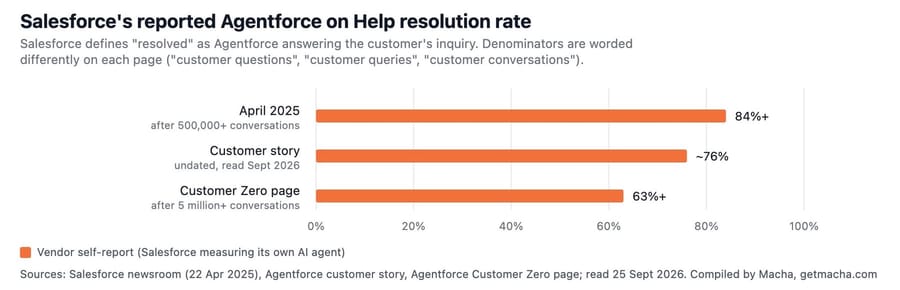
Salesforce defines resolved as answered on its Customer Zero page, but the three figures don't state an identical denominator: the April 2025 figure is "of customer questions," the customer story says "customer queries," and the 63% is of all conversations, including abandoned ones and handoffs. So the three points may not measure exactly the same thing. Salesforce's own answer-quality page adds that "our answer quality benchmark in October of 2025 was 60%, with a target of being at 75% by the end of this year" (answer quality). One plausible reading, which Salesforce doesn't state: the program started small ("We launched Agentforce with a pilot program, initially opening it to just 200 authenticated users within a four-week period"), the 84% was measured after 500,000+ conversations, and the published rate fell as volume grew into the millions and the audience widened. Budget for the rate at scale, not the launch figure.
What do support teams estimate AI resolves?
Surveys of support teams land between the consumer figures and the vendor dashboards, and most are estimates:
| Figure | Source | Who answered |
|---|---|---|
| "Service teams estimate 30% of cases are currently handled by AI", projected to reach 50% by 2027 | Salesforce State of Service, 7th edition (November 2025) | 6,500 service professionals |
| "Teams adopting it report that AI resolves 11-30% of their support volume." | HubSpot State of Service (2024) | 1,537 service leaders (HubSpot's pages also say 1,400 and 1,500+) |
| "AI currently handles an average of 31% of customer interactions for ecommerce brands" | Gorgias, State of Conversational Commerce 2026 | 400 ecommerce decision-makers |
| Roughly one-third of tickets deflected "with their CX solution, whether AI-enabled or not," up from 24% the year before | Forethought AI in CX Benchmark 2025 | 642 US CX professionals |
Salesforce's own pages later reworded its 30% as cases "resolved" by AI; the survey question was about cases handled, so we quote the newsroom wording. Forethought's one-third isn't an AI-only figure. Its respondents reported "the highest deflection rate of 44%" with agentic AI, 33% with non-agentic AI and 28% without AI; Zendesk completed its acquisition of Forethought on 26 March 2026. Gorgias's survey also found "86% of brands report that at least a quarter of AI conversations eventually involve a human."
How reliable is AI when it resolves tickets on its own?
Two studies measured outcomes rather than asking people.
- τ-bench (Sierra, June 2024). In simulated retail and airline tasks, "even state-of-the-art function calling agents (like gpt-4o) succeed on <50% of the tasks, and are quite inconsistent (pass^8 <25% in retail)" (arXiv). Pass^8 means succeeding on all eight repeat attempts at the same task. These are mid-2024 models, and newer ones score higher, but the gap between one success and eight in a row is the point.
- Alibaba field experiment (preprint, June 2026). Across 680,676 Taobao service chats, chats that an autonomous AI agent handled with no escalation were 64.6% shorter, and "they also experience a substantial drop in customer ratings of 0.858 points" on a five-point scale, while repeat contacts didn't change significantly. The authors write that the ratings drop "likely reflects differences in the communication styles" of the AI and human workers "rather than resolution effectiveness." The experiment ran in August 2024. Across the whole sample, "43% of chats result in a retrial" within seven days (arXiv).
Read together, the vendor rate measures whether the conversation ended without a human. The experiments measure whether the customer came back and how they rated it. Track repeat contacts within seven days alongside the vendor's rate, because a closed conversation can still come back.
What do the forecasts say about AI resolution?
These are predictions, not measurements, and they're often quoted without their qualifiers.
- Gartner (March 2025): "By 2029, agentic AI will autonomously resolve 80% of common customer service issues without human intervention, leading to a 30% reduction in operational costs" (Gartner). The word "common" and the year both matter.
- Gartner (December 2024): "By 2027, 40% of all customer service issues will be fully resolved by unofficial third-party tools powered by GenAI" (Gartner). That means tools like ChatGPT and search AI answering your customers' questions before they reach you. Our self-service and channel statistics cover how far that has already gone.
- Zendesk CX Trends 2025 reported "75% of CX leaders expecting 80% of customer interactions to be resolved without human intervention in the next few years" (Zendesk). That's an expectation, and it's often recirculated as a measured rate.
How to read these numbers
We checked each figure on the publisher's own page or PDF on 25 September 2026 (Salesforce's customer-zero pages were read the same day), and every quote above is verbatim. Three rules for using them:
- Ask who measured it. Customer-reported figures (24%, 14%) measure how customers remember the outcome. Vendor figures measure what the vendor's system logged. Team surveys are estimates.
- Ask what the denominator is. "Of AI-touched tickets" and "of all tickets" can differ by a factor of several on the same platform, as Gorgias's own two figures show.
- Ask whether a silent customer counts. If 24 hours of silence is a resolution, the rate includes people who gave up.
We sell AI agents, so we have a reason to prefer the flattering numbers. That's why this page quotes primaries only and keeps the figures that cut against AI.
Where the data runs out
There's no neutral, cross-vendor measurement of AI resolution rates, and no public data that breaks resolution down by ticket category (order status versus billing versus technical questions). Vendors hold that data and publish headline averages. Every measured rate above also depends on how well the vendor's customers set their AI up, so a platform average says little about the rate you'd get on your own queue. The only way to know that is to run an agent against your own tickets and count resolutions under a definition you've written down first. Our adoption statistics and trust statistics cover the other side of the question: how many teams run AI and how customers react to it.
How Macha fits
Macha runs AI agents on top of Zendesk, Freshdesk, Gorgias, Front, HubSpot or Intercom, inside the ticket queue you already have, and it's priced per ticket: one thread between Macha and one person, charged once no matter how many messages it takes. Because the charge doesn't depend on a resolution, we don't need a generous definition of one, and we'd rather you measure resolution yourself against your own tickets. Macha fits teams already running Zendesk, Freshdesk, Gorgias, Front, HubSpot or Intercom who want to measure resolution on their own queue, under their own definition, before committing, and it's the wrong fit if you need a vendor that bills nothing for a ticket it doesn't close. The pricing page has the tiers.
Sources
- Ada and NewtonX, Ada Study Finds Consumers Prefer "Always-On" AI Customer Service (March 2026; 2,000 consumers, 500 enterprise decision-makers)
- Ada, What is automated resolution? (June 2026; 550+ Ada deployments)
- Gartner, Only 14% of Customer Service Issues Are Fully Resolved in Self-Service (August 2024; 5,728 customers)
- Gartner, Agentic AI Will Autonomously Resolve 80% of Common Customer Service Issues by 2029 (March 2025; forecast)
- Gartner, Third-Party Tools Powered by GenAI Will Resolve 40% of Issues by 2027 (December 2024; forecast)
- Gorgias Ecom Lab, The cheapest ticket is the one a human never touches (April 2026; Gorgias platform data)
- Gorgias Ecom Lab, Email isn't dying, chat is doubling (May 2026; 10,990 brands)
- Gorgias, The State of Conversational Commerce in 2026 (400 decision-makers)
- Intercom, Fin homepage, Fin benchmarks, Fin pricing: Outcomes and What's new with Fin 3 (October 2025 to 2026; vendor data)
- Salesforce, Agentforce Customer Zero, lessons learned (April 2025) and State of Service, 7th edition (November 2025; 6,500 professionals)
- Zendesk, Forethought acquisition release (March 2026), automated resolution tiers and CX Trends 2025
- Freshworks, Customer Service Benchmark Report 2025 (1.2 billion tickets; vendor data)
- HubSpot, State of Service (2024; 1,537 leaders)
- Forethought, 2025 AI in CX Benchmark Report (642 US CX professionals)
- Medallia, 2026 State of CX Report (March 2026; 1,522 consumers)
- Gladly, 2026 Customer Expectations Report release (January 2026; 1,000 US adults)
- Decagon, Deflection rate glossary
- Sierra, τ-bench (June 2024) and customer stories
- Wang, Zhu, Feng, Lu and Jia, Agentic AI and Human-in-the-Loop Interventions (arXiv preprint, June 2026; 680,676 chats)
More statistics
- Customer service and AI statistics (2026): the hub, with the key numbers from every topic.
- Do customers trust AI customer service?: escalation, disclosure and second-chance figures.
- Where do customers go for help?: self-service success rates and the shift to third-party AI.
- How much does customer support cost, and what is the ROI of AI?: cost per contact and the ROI surveys.
- Customer service benchmarks: first response time, resolution time, CSAT and FCR.
Frequently asked questions
What is the average AI resolution rate in customer service? There's no neutral cross-vendor average. Consumers report the lowest figure: 24% said their most recent AI interaction was fully resolved by AI alone (Ada and NewtonX, March 2026, 2,000 consumers). Vendors report 45% (Gorgias median, AI-touched tickets), 52% (Ada average, LLM-graded) and 76% (Intercom's Fin average, including assumed resolutions), each under its own definition.
Why is Intercom Fin's resolution rate higher than other vendors'? Partly because of what it counts. Fin counts a resolution when the customer confirms, or when the customer leaves without asking for more help within 24 hours, and its denominator is conversations Fin was involved in. Ada, by comparison, has an LLM grade each conversation for relevance, accuracy and safety. Different rules produce different rates on similar traffic.
What is the difference between deflection, containment and resolution? Containment means the conversation never reached a human. Deflection usually means the customer was redirected to self-service, though Decagon only counts it when the issue is actually resolved. Resolution should mean the customer's problem was solved; Ada's own data shows containment of about 72% against automated resolution of about 52% on the same conversations.
Will AI resolve 80% of customer service issues? Gartner predicts agentic AI will autonomously resolve 80% of common customer service issues by 2029. That's a forecast about common issues. Gartner's latest measured figure, from its 2024 survey of 5,728 customers, is that 14% of issues were fully resolved in self-service.
Does the AI resolution rate fall over time? In the one public series we have, the published figure fell, though the denominators aren't worded identically. Salesforce reported its help-site agent resolving more than 84% of questions in April 2025, about 76% in a later story, and more than 63% of five million conversations on its current page, with resolved defined as answered.
To measure a resolution rate on your own queue, start a trial with $50 of free usage (about 125 tickets), no credit card, no time limit.
Resolve tickets automatically with AI agents
Macha's AI agents work on top of the help desk you already use — no code.