Intercom
 Shopify
 Stripe
 Slack
Slack Notion
 Google Workspace
 Confluence

How Much Does Intercom Fin Cost in 2026? The Per-Outcome Pricing Breakdown


Intercom Fin costs $0.99 per billable outcome, but the bill depends on how many outcomes Fin counts, and that count includes conversations where the customer simply went quiet for 24 hours. The real total also stacks Intercom seats on top of the $0.99, or a 50-outcome monthly minimum if Fin runs on another help desk.
Key takeaways
- Intercom Fin charges $0.99 per billable outcome, at most once per conversation, and $9.99 per sales qualification; on another help desk, a 50-outcome monthly minimum costs $49.
- Fin bills a resolution as confirmed, when a customer says it helped, or assumed, when the customer stays silent for 24 hours after Fin's last answer.
- For a mid-market team of 10 seats on Intercom's Advanced plan handling 2,000 Fin resolutions a month, the all-in cost runs about $2,830 a month.
- Intercom seats sit on top of Fin's outcome fee at $29 for Essential, $85 for Advanced and $132 for Expert per seat a month on annual billing.
- At 3,000 conversations a month with 5 Essential seats, Intercom Fin plus five Essential seats costs $1,481.50 to $2,075.50 a month at 45% to 65% resolution, against $1,344 for Macha on the same seats.
Intercom Fin costs $0.99 per billable outcome, charged at most once per conversation, with a 50-outcome monthly minimum when Fin runs on another help desk ($49 a month covers the first 50) and a separate $9.99 rate for a sales qualification (fin.ai/pricing, checked 24 September 2026). On Intercom you also pay seats at $29 to $132 per seat a month, so a 10-seat Advanced team with 2,000 resolutions a month pays about $2,830 a month all in.
| Fin cost item | Price |
|---|---|
| Resolution, procedure handoff, disqualification, self-serve routing | $0.99 each |
| Sales qualification | $9.99 each |
| Escalation to a human with no outcome | Free |
| Monthly minimum | 50 outcomes ($49), only for Fin on another help desk; on Intercom, one seat instead |
| Intercom seats (annual billing) | Essential $29, Advanced $85, Expert $132 per seat/mo ($39, $99, $139 on monthly billing) |
| Trial | 14 days, unlimited outcomes |
For the full seat-plan rundown (what each Essential, Advanced and Expert tier unlocks), see Intercom pricing explained; for what Fin actually does under the hood, see the Fin AI explainer. Below is the cost model only, including a 3,000-conversation month with a per-ticket comparison. Every figure was re-checked against fin.ai/pricing, intercom.com/pricing and the Fin Help Center on 24 September 2026. Fin revises pricing periodically, so confirm the live numbers in your own account before they anchor a budget.
Update, September 2026: Salesforce completed its acquisition of Fin (formerly Intercom) on 10 September 2026, after agreeing the roughly $3.6 billion deal on 15 June 2026. The $0.99 model below was unchanged on 24 September 2026, but pricing and packaging could shift under Salesforce's Agentforce. More at the end.
How does Intercom Fin pricing work?
Fin doesn't charge per seat, per message, or per conversation. It charges per billable outcome — $0.99 each — and at most once per conversation, on top of whatever you already pay for your help desk seats (fin.ai/pricing). So the formula is:
Your Fin bill ≈ (billable outcomes × $0.99) + your seat plan + any add-ons — with a floor of a 50-outcome/month minimum (~$49) if Fin runs on a help desk other than Intercom. On Intercom, the seat plan is the floor.
The thing that makes this hard to budget is the first term. "Billable outcomes" is not the same as "tickets," "conversations," or even "problems solved." Getting that count right is the whole game.
What counts as a billable Fin outcome?
Fin bills five outcome types. Four cost $0.99; one costs about ten times that (fin.ai/pricing; Fin pricing: Outcomes):
| Outcome | What triggers it | Price |
|---|---|---|
| Resolution | No further help requested after Fin's last answer (confirmed or assumed) | $0.99 |
| Procedure handoff | Fin completes a configured "Procedure" that ends in a handoff to a human/workflow | $0.99 |
| Disqualification | Fin determines a sales prospect doesn't meet your criteria | $0.99 |
| Self-serve routing | Fin routes the customer to the right self-serve path without a human | $0.99 |
| Qualification | Fin qualifies a sales lead and routes it onward | $9.99 |
| Escalation with no outcome | Fin passes to a human without a resolution or a configured handoff | Free |
For a typical support team, resolutions are ~all of the bill — handoffs only count when you configure a Procedure to end in one, disqualifications and qualifications only apply if you run Fin on sales/lead flows, and self-serve routing only if you configure it, and the $9.99 qualification is the one line item that can quietly distort a sales-heavy bill. The free row matters just as much: if Fin can't solve it and simply punts to a human, you pay nothing. You broadly pay when Fin does the work, not when it gives up.
Confirmed vs. assumed resolution — and the 24-hour window
This is the single most important mechanic in Fin pricing, and the one teams under-model. A "resolution" is counted two ways (fin.ai help — outcomes):
- Confirmed resolution — the customer explicitly signals it helped ("Ok, thanks", "that worked").
- Assumed resolution — the customer disengages for 24 hours after Fin's last answer without asking for more help. After that window with no reply, Fin marks it resolved and bills $0.99.
The assumed case is the wrinkle. A customer who reads Fin's reply and wanders off — whether they were genuinely helped or quietly gave up — becomes a billable resolution once 24 hours pass. It's a defensible default (most people who go quiet were probably helped), but it means your billable count can run higher than the number of problems actually solved. The practical consequence: your Fin invoice is not a clean proxy for CSAT. Audit assumed-resolution rate against satisfaction in month one before you trust the deflection math.
The fairness mechanics (these are genuinely buyer-friendly)
To Fin's credit, the meter has guardrails that beat most usage pricing:
- One outcome per conversation, no matter how many questions Fin answers or actions it takes.
- No charge if the customer asks for a human, or if a configured Fin Procedure fails to complete.
- Refund on reopen — if a conversation marked resolved is reopened later by the customer seeking more help, that resolution is deducted (even across billing periods).
Is there a minimum, a rollover or a volume discount?
Three structural details shape the floor and the ceiling of your bill (fin.ai/help — pricing: outcomes):
- Minimum commitment of 50 outcomes/month — for Fin on a help desk other than Intercom, the base plan is $49/month and includes 50 outcomes. Below 50, you still pay for 50. On Intercom's own help desk this minimum doesn't apply; the seat is the floor.
- No rollover. Unused monthly resolutions are lost — they don't bank toward a busy month. If you buy/commit ahead, you're paying for a monthly allotment, not a pool.
- No advertised volume discount. The public rate is a flat $0.99 whether you do 60 outcomes or 60,000. (Enterprise commitments may negotiate — but nothing on the public page promises a tier break, so don't assume one.)
- There's a 14-day free trial with unlimited outcomes and no card — the right way to get a real resolution count before committing.
The flat rate is the headline cost characteristic: Fin's pricing scales linearly with volume forever. That's cheap when volume is low and deflection is modest, and it's the line item that balloons fastest as you grow — the opposite shape of seat pricing, which flattens out.
What do Intercom seats add on top of Fin?
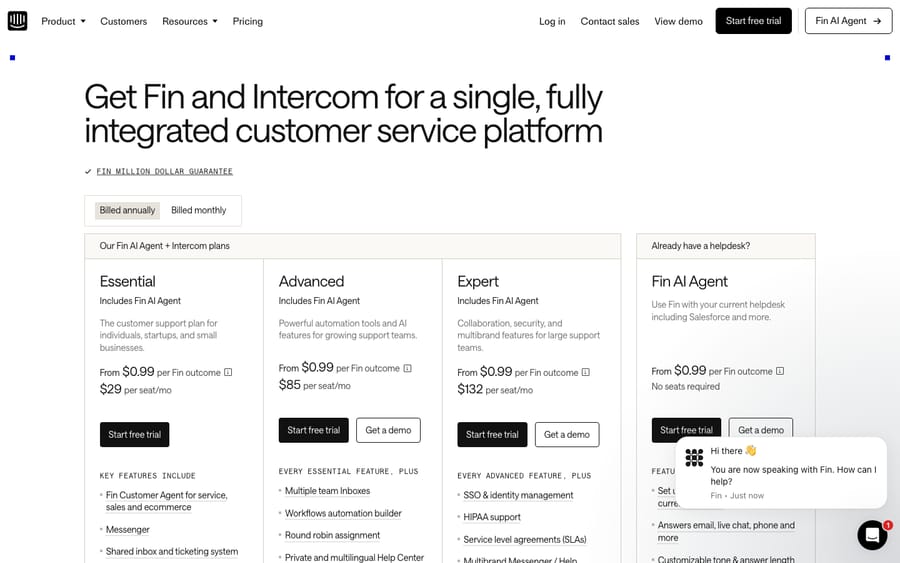
Fin is almost never your only Intercom cost. If you run it on Intercom, you also pay per-seat for the platform underneath (intercom.com/pricing) — billed annually, per seat/month:
- Essential: $29/seat/mo ($39 monthly). Intercom is also testing a lower Essential price: on 24 September 2026 some loads of the pricing page showed $19 annual ($29 monthly), so check your own account
- Advanced — $85/seat/mo, $99 monthly (most growing teams land here)
- Expert — $132/seat/mo, $139 monthly
Plus optional add-ons that also sit on top: Copilot (agent-side AI, $29/agent/mo annual or $35 monthly), Pro (advanced AI and quality features, from $99/mo), Proactive Support Plus ($99/mo incl. 500 messages), and pay-as-you-go SMS/WhatsApp/phone. None of those are included in the $0.99. So the real all-in is seats + Fin outcomes + add-ons — and as the scenarios below show, for a busy team Fin alone routinely outweighs the seats.
What does Fin cost at 500, 2,000 and 10,000 resolutions a month?
Here's the math that actually matters. All three use annual seat rates, count only $0.99 resolutions (no sales qualifications), and ignore Copilot/Proactive so the Fin-vs-seats ratio is clean. Resolution volumes are illustrative — plug in your own.
Scenario A — Small team: 3 seats, 500 resolutions/mo
| Line item | Calculation | Monthly |
|---|---|---|
| Advanced seats (3) | 3 × $85 | $255 |
| Fin resolutions (500) | 500 × $0.99 | $495 |
| All-in total | $750/mo (~$9,000/yr) |
Even at small scale, Fin is ~66% of the bill and the "all-in cost per resolution" is ~$1.50 once you fold in the seats those resolutions still require.
Scenario B — Mid-market: 10 seats, 2,000 resolutions/mo
| Line item | Calculation | Monthly |
|---|---|---|
| Advanced seats (10) | 10 × $85 | $850 |
| Fin resolutions (2,000) | 2,000 × $0.99 | $1,980 |
| All-in total | $2,830/mo (~$33,960/yr) |
Now Fin is ~70% of the bill. The "$850/month, 10 seats" sticker becomes a ~$34k/year run-rate — and that's before Copilot (add ~$290/mo for 10 agents). All-in cost per resolution: ~$1.42.
Scenario C — High volume: 25 seats, 10,000 resolutions/mo
| Line item | Calculation | Monthly |
|---|---|---|
| Expert seats (25) | 25 × $132 | $3,300 |
| Fin resolutions (10,000) | 10,000 × $0.99 | $9,900 |
| All-in total | $13,200/mo (~$158,400/yr) |
At volume, Fin is ~75% of the bill — roughly 3× the seat cost — and because there's no volume discount, that ratio only grows. All-in cost per resolution: ~$1.32. This is where the flat per-outcome rate stops feeling cheap: every additional 1,000 resolutions adds a flat $990/month, indefinitely.
The pattern across all three: your headcount sets the floor; your resolution volume sets the bill. Two 10-seat teams can differ by $20k+/year purely on Fin volume.
What does Fin cost per month at 3,000 tickets?
At 3,000 conversations a month, Fin costs $1,336.50 to $1,930.50 a month in outcome fees if it resolves 45% to 65% of them, and $1,481.50 to $2,075.50 once five Essential seats are added. The three scenarios above start from a resolution count; most teams start from a ticket count, so this one does too, and it prices the resolution rate as a range instead of a guess. We used the seat and outcome prices we checked on Intercom's pricing pages on 24 September 2026.
The range comes from the most recent published median we found: Gorgias's Ecom Lab reported in April 2026 that "the median brand resolves 45% of AI-touched tickets end-to-end. The top quartile clears 65%" (Gorgias Ecom Lab, 28 April 2026). That's a vendor self-report on Gorgias merchants, not a Fin figure. Salesforce's own 76% average for Fin (also a vendor figure, method unpublished) sits above it, so we run that as a third column. Assumptions: Fin touches all 3,000 conversations, every resolution bills once at $0.99, no Procedure handoffs or sales outcomes, and 5 Essential seats at $29 billed annually (Intercom's normal price; it has also shown $19 in a live pricing test).
| Line item (monthly) | 45% resolved | 65% resolved | 76% resolved (Salesforce's Fin average) |
|---|---|---|---|
| Billable resolutions | 1,350 | 1,950 | 2,280 |
| Fin outcomes at $0.99 | $1,336.50 | $1,930.50 | $2,257.20 |
| Essential seats, 5 × $29 | $145 | $145 | $145 |
| All-in on Intercom | $1,481.50 | $2,075.50 | $2,402.20 |
| All-in per resolved conversation | $1.10 | $1.06 | $1.05 |
| Fin standalone on another help desk (no Intercom seats; the 50-outcome minimum doesn't bind at this volume) | $1,336.50 + your desk | $1,930.50 + your desk | $2,257.20 + your desk |
| Macha on Intercom, same 5 seats | $1,199 + $145 = $1,344 | $1,344 | $1,344 |
Three things push the Fin column up at this volume. Procedure handoffs bill too: if you configure Procedures that end by passing the customer to a human, each completed one is a $0.99 outcome, so some of the 1,050 to 1,650 conversations Fin didn't resolve can still cost money. Assumed resolutions count: a customer who goes quiet for 24 hours after Fin's last answer is billed like one who said thanks. Seat tier: Advanced instead of Essential makes the seat line 5 × $85 = $425, adding $280 a month.
The incentive is worth naming. Fin's meter pays Intercom more as Fin resolves more, which is fine while each resolution saves you more than $0.99 of human time. Macha bills the other way: the plan that covers up to 3,000 tickets is $1,199 a month, charged per ticket handled whether it resolves or goes to a human, so a better month doesn't raise the bill. The crossover is easy to compute: $1,199 ÷ $0.99 is about 1,211 outcomes, so once Fin bills more than roughly 1,211 outcomes a month (about 40% of 3,000), its outcome fee alone passes Macha's plan fee. Below that, Fin is cheaper at this volume, and it keeps the advantage of living inside Intercom's own product. On Intercom, Macha's connector reads conversations, replies and adds notes, looks up contacts, and assigns, tags and closes, triggered on the first or every customer message; past 3,000 tickets its next step is $1,999 for 5,000. For other volumes, see AI support cost at 1,000 tickets a month. Macha fits teams already running Zendesk, Freshdesk, Gorgias, Front, HubSpot or Intercom who want the AI line to move with ticket count instead of with resolution count.
How do you estimate your own Fin bill?
A quick back-of-envelope that gets you within striking distance:
- Start with monthly AI-eligible conversations — chats/emails Fin will actually attempt (not your total ticket count).
- Apply an honest resolution rate. Salesforce cites a 76% average resolution rate for Fin, but an average is not your rate: it tracks your knowledge-base quality and your ticket mix. Use a conservative number first.
- Add the assumed-resolution effect. Expect billable resolutions to run somewhat above "truly solved," since 24-hour disengagements count. Don't shave this off.
- Compute outcomes × $0.99, then, if Fin runs on another help desk, enforce the 50-outcome floor.
- Add seats (seats × plan rate) and any add-ons (Copilot ~$29/seat, Proactive $99, channels).
- Add sales outcomes if relevant — qualifications at $9.99 each can move the number fast.
Roughly: All-in on Intercom = conversations × resolution rate × $0.99 + (seats × seat price) + add-ons. On another help desk, drop the seats and bill at least 50 outcomes: max(50, conversations × resolution rate) × $0.99. Run the 14-day trial to replace the resolution-rate guess with a real figure before you commit.
Where does the Fin bill surprise teams?
The line items that show up on the invoice but not in the mental model:
- Assumed resolutions inflate the count. The 24-hour-silence rule bills conversations the customer may not have been happy with. This is the #1 gap between estimate and invoice.
- Fin usually isn't the whole bill — it's the bigger part. Seats are the floor; Fin is the variable that overtakes them. Budgeting from the seat sticker undershoots badly.
- No rollover. A slow month doesn't credit a busy one; you can't smooth spend across the year.
- No volume discount on the public rate. Costs scale linearly forever — there's no economy-of-scale relief baked into the list price.
- The $9.99 qualification. Harmless for pure support, meaningful if you point Fin at lead-gen — it's 10× a normal outcome.
- Copilot is a separate AI line. Wanting agent-side and customer-side AI means two AI bills, not one.
- Channels are metered. SMS/WhatsApp/phone are pay-as-you-go on top.
How does per-outcome billing compare with per-ticket billing?
A quick, honest aside, since this is a Macha guide. Macha is an AI agent layer that runs on top of Zendesk, Freshdesk, Gorgias, Front, HubSpot or Intercom — it is not a help desk and not an Intercom replacement, so it's not a drop-in swap for Fin. The reason it's worth a mention here is purely the unit of pricing, which is a real fork in the road.
Fin bills per resolution — one tidy outcome per conversation, including assumed ones. Macha bills per ticket — one charge per thread covering every automated step it takes (triaging, tagging, routing, drafting, resolving) — because most useful automation isn't a single clean "resolution," it's work done across a ticket's life. Neither shape is universally cheaper: per-resolution is simple and predictable when your work really is discrete solved chats; per-ticket maps better when an agent does several small things per ticket and you'd rather pay a known price than guess at an "outcome." If your help desk is one of those and the per-resolution math is what worries you, it's worth modeling both — see Macha on Zendesk, or start with $50 of free usage, no credit card required, to run it against your own tickets. We go deeper on the trade-off in Fin vs. an AI agent layer. If you're committed to Intercom, Fin is the native path and this doesn't apply — but the contrast is useful either way.
Does the Salesforce acquisition change Fin pricing?
On June 15, 2026, Salesforce signed a definitive agreement to acquire Fin (formerly Intercom) for ~$3.6 billion, folding Fin's AI agent into Agentforce (Salesforce newsroom, TechCrunch). Salesforce positions Fin as the packaged, fast-to-deploy option alongside Agentforce's deeper enterprise build, and cites a 76% average resolution rate for Fin. Salesforce completed the acquisition on 10 September 2026 (Salesforce newsroom).
For pricing, practically: nothing had changed by 24 September 2026: the $0.99 model stands. But packaging and pricing often shift in the months after an acquisition closes, and Fin's per-outcome model could be repackaged under Agentforce's licensing. If you're signing multi-year, build in a re-evaluation clause.
Frequently asked questions
How much does Intercom Fin cost? Fin is billed $0.99 per outcome, charged at most once per conversation, with a 50-outcome/month minimum (~$49 base) when Fin runs on another help desk. On Intercom there is no outcome minimum, and the fee stacks on top of per-seat plans ($29 Essential, $85 Advanced and $132 Expert per seat/month, billed annually). For a 10-seat team handling ~2,000 resolutions/month, the all-in run-rate is roughly $2,800/month (~$34k/year) — and Fin is the majority of it.
What counts as a Fin resolution? Either a confirmed resolution (the customer says it helped) or an assumed resolution (the customer disengages for 24 hours after Fin's last answer without asking for more help). Both bill $0.99. You're not charged if the customer asks for a human or a configured Procedure fails, and a resolution is refunded if the customer reopens the conversation later.
What does Intercom Fin cost per month at 3,000 conversations? If Fin resolves 45% to 65% of 3,000 conversations (Gorgias Ecom Lab's median and top-quartile figures), outcome fees are $1,336.50 to $1,930.50 a month; at Salesforce's 76% Fin average they're $2,257.20. Five Essential seats at $29 add $145. Procedure handoffs and sales outcomes would add more.
At what volume does Fin cost more than a per-ticket AI agent? Compare Fin's outcome fee with the per-ticket plan that covers your volume. Macha's plan for up to 3,000 tickets is $1,199 a month, so Fin's $0.99 outcomes cost more once Fin bills about 1,211 outcomes in a month, roughly a 40% resolution rate on 3,000 conversations.
Is the $0.99 the same for every outcome? Resolutions, procedure handoffs, disqualifications and self-serve routing are all $0.99. A sales qualification is $9.99. Escalations to a human with no resolution or configured handoff are free.
Is there a Fin cost calculator or volume discount? The public rate is a flat $0.99 per outcome with no advertised volume discount and no rollover of unused monthly outcomes. The most reliable "calculator" is: conversations × resolution rate × $0.99 + seats + add-ons on Intercom, or max(50, conversations × resolution rate) × $0.99 on another help desk. Run the 14-day free trial to get a real resolution count first.
Does Fin pricing include Intercom seats? No. Fin's per-outcome fee is separate from — and on top of — Intercom's per-seat plans and any add-ons like Copilot (~$29/agent/mo) or Proactive Support Plus ($99/mo). For the full seat breakdown, see Intercom pricing explained.
Will Fin pricing change after the Salesforce acquisition? Not so far. Salesforce agreed the ~$3.6B deal on 15 June 2026 and completed it on 10 September 2026, with Fin folding into Agentforce. The $0.99 model was unchanged on 24 September 2026, but expect possible repackaging under Agentforce over time.
What should you do before signing?
Intercom Fin pricing is simple to state and easy to under-budget. The $0.99-per-outcome rate is real and the fairness mechanics (one charge per conversation, free human escalation, refund on reopen) are genuinely good. But the bill is governed by your resolution count, not your headcount — and that count includes 24-hour "assumed" resolutions, carries a 50-outcome floor off Intercom, doesn't roll over, and gets no volume discount, all stacked on per-seat plans underneath. In our worked scenarios, Fin runs 66–75% of the all-in cost, turning an "$850/month" seat plan into a ~$34k/year reality at mid-market volume. The honest advice: model your conversation volume and an honest resolution rate first, enforce the floor, add seats and add-ons, and run the 14-day trial to replace the guesswork. Then you'll land close to your actual invoice — and you can weigh whether per-resolution is the billing shape you want, or whether a per-ticket model fits your work better. For the wider context, see Intercom pricing explained, the Fin AI explainer, and Fin vs. an AI agent layer.
Fin pricing re-checked against fin.ai/pricing, intercom.com/pricing and the Fin Help Center (articles 13975800 and 8205718) on 24 September 2026. Fin revises pricing and packaging periodically, and is now owned by Salesforce, so confirm exact numbers in your own account before relying on them. Worked-scenario volumes are illustrative.
Add AI agents to your Intercom
Macha reads the conversation, drafts the reply and takes the action, inside the Intercom you already run.