Intercom
 Shopify
 Stripe
 Slack
Slack Notion
 Google Workspace
 Confluence

Where Do Customers Go for Help? Self-Service and Channel Statistics (2026)


More than half of customer service journeys now start somewhere the company doesn't own. Gartner's survey of 5,801 customers, published in July 2025, found 51% of journeys begin on third-party platforms such as Google, YouTube and ChatGPT, and only 22% of customers start, stay and resolve their issue entirely in the company's own channels. When customers do reach the company, the phone still wins for complex problems, email still carries most written support, and company chatbots are used far less than customers say they'd use them. This page collects every verified figure on self-service and channels, with who was asked and what each publisher sells.
Key takeaways
- Gartner's survey of 5,801 customers, published July 2025, found 51% of customer service journeys begin on third-party platforms such as Google, YouTube and ChatGPT.
- Only 22% of customers in that Gartner survey started, stayed and resolved their issue entirely in company-owned channels, while third-party platforms had a 62% average success rate.
- Deloitte's 2026 survey of 3,000 consumers found they're twice as likely to prefer phone over self-service for simple issues, and 5.5 times as likely to cite phone for complex ones.
- Gorgias's own platform data from May 2026 says 85% of ecommerce brands still run support primarily through email, while chat volume on the same brands grew 47% in two years.
- Gartner's 2026 survey of 3,566 customers found 49% would have used a company chatbot, but only 7% used one in their most recent service interaction.

How many customer service journeys start outside the company?
About half of them. This page is part of our customer service and AI statistics hub, which carries the headline figure; below is the rest of what Gartner published around it.
Gartner's survey of 5,801 customers (fieldwork January and February 2025, press release, July 2025) found "More than half (51%) of all customer service journeys now begin on third-party platforms such as Google, YouTube, and ChatGPT, with search engines being the most popular starting point." The same release adds three figures:
- Gen Z goes there first. "74% of Gen Z customers initiate their service journey with a third-party before ever reaching an official company channel," and they're "just as likely to use GenAI platforms as they are to use traditional sources."
- It works for them. Customers reported "an average success rate of 62% in finding what they need on platforms like YouTube or Google."
- The company's own path rarely completes. "only 22% of customers start, stay, and resolve their issues entirely using first-party company channels."
Gartner also predicted, in December 2024, that "By 2027, 40% of all customer service issues will be fully resolved by unofficial third-party tools powered by GenAI" (Gartner). That's a forecast, not a measurement.
For a support team, this means many customers read an answer about your return policy or setup steps before they open a ticket, and someone else wrote it. Search engines and AI tools draw on your public help center, so a stale article now misleads people who never visit your site.
Are customers using company chatbots or third-party AI?
Customers pick third-party AI far more often. Gartner's survey of 3,566 B2B and B2C customers (fieldwork February and March 2026, press release, July 2026) found "Customers are approximately three times more likely to use third-party GenAI tools than company-provided chatbots when resolving customer service issues." Gartner also reports the trend: "Use of third-party GenAI tools during service and support interactions has nearly doubled in the past year, while use of company-provided chatbots has remained statistically unchanged since 2022."
Customers also use AI to get things done. "Among customers who use GenAI, 58% said they have used it to complete a task on their behalf. In B2B environments, this rises to 74%." Gartner advises leaders against "investing primarily in standalone chatbots" and toward service journeys that resolve issues "across digital and voice channels."
Gartner published two more releases from the same survey of 3,566 customers. In September 2026: "While 49% of customers said they would have been willing to use a chatbot if the company had provided one, only 7% used a chatbot or digital assistant during their most recent service interaction," and only 27% would try a chatbot again after a bad experience (Gartner, September 2026). In August 2026, 87% said an option to reach a human is essential when companies use GenAI (Gartner, August 2026). That's one sample read three ways, and the trust statistics page covers the 27% and 87%.
Other measures of chatbot use come out higher than 7% because they ask different questions:
| Figure | Publisher and report | Date | Who was asked | Link |
|---|---|---|---|---|
| 7% used a chatbot or digital assistant in their most recent service interaction | Gartner customer survey | September 2026 | 3,566 B2B and B2C customers | Gartner |
| "1 in 6 consumers say their last customer service interaction was entirely with a chatbot or AI assistant" | Medallia, 2026 State of CX | March 2026 | 1,522 consumers | Medallia PDF |
| 163 million chats involved a chatbot; more than 1.5 billion were handled only by human agents | LiveChat, Customer Service Report | 2024 | LiveChat's own platform data | LiveChat |
Service leaders are betting the other way. In Gartner's survey of 199 service leaders (April to May 2026), leaders said "live chat and phone remain their most valuable customer service channels today," but "respondents predict GenAI chatbots will become the most valuable customer service channel, followed by live chat and GenAI voicebots" within two years (Gartner, August 2026). A year earlier, Gartner's 5,801-customer survey found "only 35% of customers who last interacted via phone are willing to adopt a GenAI digital assistant" (Gartner, June 2025).
If you're planning a chatbot, budget from the 7%, and treat the 49% as the most you could reach. Since only 27% come back after a failure, a bot that attempts everything and fails often shrinks its own audience. Gartner's release advises that "Service leaders should prioritize reliability over reach," and that chatbots "should serve as seamless connectors to human support." Our guide to AI chatbot handoff to a human covers how that handoff works.
Does self-service actually resolve customer issues?
By customers' own estimate, less than a third of the time. Deloitte Digital's 2026 Global Contact Center Survey (3,000 consumers and 720 service leaders across seven countries, PDF, June 2026) found "70% of consumers said they’d used self-service for support in the prior year. However, those respondents estimated their issues were resolved less than a third of the time via self-service."
Three more surveys asked about self-service use and success, each in its own way:
| Figure | Publisher and report | Date | Who was asked | Link |
|---|---|---|---|---|
| 86% "will explore self-service options before reaching out to support" | Five9, 2025 Customer Experience Report | March 2025 | 1,006 consumers, US, UK, Canada | Five9 |
| 73% use self-service at some point in their journey; 14% of issues fully resolved there | Gartner customer survey | August 2024 (fieldwork December 2023) | 5,728 customers | Gartner |
| 53% "agree online self-service has improved in the last 3 years" | Five9 consumer survey (a different Five9 survey) | October 2024 | 4,000 consumers, US and UK | Five9 |
Gartner's 2024 release gives the reasons self-service fails. "Forty-five percent of customers who started in self-service said the company didn’t understand what they were trying to do," and "in 43% of cases, customers couldn’t find content relevant to their issue." Our resolution rate statistics cover the 14% figure and what AI has changed since.
Leaders report the same content problem. In Gartner's survey of 187 of them (July and August 2024), "61% of leaders say they have a backlog of articles to edit, and more than one-third of leaders have no formal process for revising outdated articles" (Gartner, December 2024). Agents often don't point customers to it at all: from the same 5,801-customer survey as the third-party-platforms release, Gartner found "Sixty percent of customer service agents fail to promote self-service options," and when they do mention it, "25% make neutral comments, and 12% make explicitly negative remarks." It matters because "Agent promotion is associated with a doubling of the number of customers who are likely to adopt self-service next time."
Deloitte puts a size on better self-service: AI-centric service organizations "resolve customer issues through self-service 43% more often and shift 41% more phone calls to less-expensive channels" than low-maturity ones. Deloitte defines "AI-centric" partly by the outcomes it then compares, and it sells contact-center transformation work, so read the gap as an upper bound. Forrester's forecast is smaller: it predicts "one in four brands will see a 10% increase in successful simple self-service interactions by the end of 2026," and that "In 2026, a third of companies will harm experiences with frustrating AI self-service" (Forrester, press release).
The most common failure in Gartner's data is missing or stale content. An AI agent that answers from the same help center inherits that 43% gap and repeats it at speed, so for the 61% of teams with an article backlog, the backlog is the first job. We wrote up how to design knowledge sources an agent can answer from, and our deflection rate explainer covers measuring the result without counting abandoned sessions.
Do customers still prefer the phone?
The two surveys that asked about complex problems both say yes. Five9's 2025 Customer Experience Report (1,006 consumers in the US, UK and Canada, conducted by Zogby Analytics, March 2025) found "A majority of consumers (56%) still prefer phone support for general issues, and this jumps to 74% for complex or urgent matters." The same survey found "59% of respondents indicated their preferred service channel depends on the situation."
Three other publishers asked a version of the question:
- Deloitte (June 2026, 3,000 consumers): "Even for simple questions and issues, consumers are twice as likely to prefer phone than self-service support. And when the issue feels complex, they’re 5.5x as likely to cite phone as a preferred option."
- Forethought (2025, 2,243 US adults, blog): "A substantial 65% of consumers believe voice is the fastest way to resolve a customer service issue." Voice was the top choice in "healthcare (63%), financial services (59%), and restaurants (59%)," while chat was favored most "in retail (32%) and travel (21%)."
- Verint (June 2024, 1,500 consumers in the US, UK and Australia, PDF): the outlier. "For the first time in the history of this report, digital channels have overtaken phone as customers’ preferred channel for asking questions," with 61% choosing digital channels and 39% phone, up from 45% digital in 2023. Even Verint adds "it’s not time to cut the cord on phone."
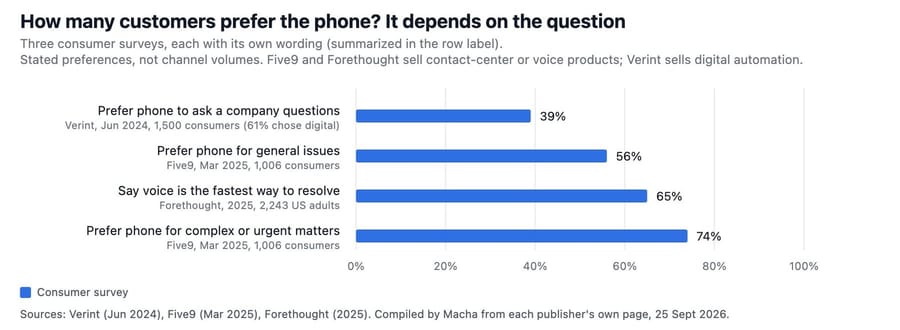
Each publisher has an incentive here. Five9 sells contact-center software built around voice, and Forethought's survey post promotes its own voice AI product, so a finding that customers want the phone supports what they sell. Verint sells digital and automation software and found digital ahead. Deloitte sells contact-center transformation. On complex issues, sellers with opposite interests land in the same place, which makes that finding more credible than any single survey.
Phone preference rises with complexity and emotion, and Forethought's industry split puts it highest where the stakes are personal: health and money. Plan the phone as the escalation route for hard problems, because a chatbot won't absorb calls that exist because the problem is hard. For email and chat, volume matters more than stated preference, and the platform data below shows where it sits.
Which channels do support tickets actually arrive on?
Email still carries most ecommerce support. Gorgias's own platform data (a matched cohort of 10,990 brands, January to April 2024 against January to April 2026, Ecom Lab, May 2026) says "85% of brands still run support primarily through email." The same page phrases it differently in a section heading: "The median brand is still 85% email." The first reading is a share of brands and the second a share of one typical brand's volume; Gorgias doesn't reconcile them, so we quote both. This is vendor data from Gorgias's own customers, a base of ecommerce brands on Gorgias's help desk.
The same study, all Gorgias platform data:
- Growth: "Email volume on the same brands is roughly flat over two years. Chat is up 47%. WhatsApp 153%." Gorgias adds that "most of chat's growth came at the expense of Social DMs, not email."
- Concentration: "Half of active brands have less than 2% of their support volume on chat." "Ten percent of brands do all of their support through email." Brands with chat at 40% or more of volume are about 5.5% of the active base.
- Speed and satisfaction: chat is much faster than email but scores slightly lower on CSAT; our response time benchmarks have the figures.
- Where AI works: AI resolves one in four chat tickets and one in 26 email tickets. Gorgias itself warns that "the AI-resolution-by-channel statistic is descriptive of where AI is deployed today, not a claim about AI capability by channel."
A second Gorgias study (Ecom Lab, April 2026) measured what happens when an AI agent hands a ticket to a human, by channel:
| Channel (Gorgias platform data) | Median time to resolve after handoff | Share abandoned after handoff |
|---|---|---|
| Contact form | 36 hours | 42% |
| 32 hours | 30% | |
| Chat | 8 hours | 13% |
Gorgias's explanation for the chat figure is "because real-time pressure forces a response."
On the demand side, Sprout Social's 2025 Index (4,044 consumers) found "Two in five users (40%) want companies on WhatsApp to provide customer service and support" (Sprout Social). Sprout sells social customer care software.
An email-first queue is the norm in this data. AI resolves most on chat, which carries the least volume for most brands, so a chat-only rollout can report a strong resolution rate while most of the queue goes untouched. Watch the 30% abandonment after email handoffs; an AI agent that answers email and then hands off without a quick human follow-up can push it higher.
How well are channels connected behind the scenes?
In most contact centers, they aren't. Deloitte's survey of 720 service leaders found "Only 1 in 4 contact centers reported having fully unified omnichannel routing, and just 28% have seamlessly connected data across channels." Genesys's State of CX 2026 (5,811 consumers and 1,560 leaders, press release, July 2026) found "95% of consumers expect information to be remembered across channels," and "More than half of consumers say they would rather do anything else than contact customer service." Genesys sells contact-center software too. A customer who tried your help center, then a chatbot, then email shouldn't have to explain the problem three times; the expectations statistics page covers how often that happens.
How to read these numbers
We checked each figure on the publisher's own page or PDF on 25 September 2026, and every quote above is verbatim. Four things to keep in mind:
- Who was asked. Almost every channel figure here is a consumer survey about preference or recollection. Only Gorgias and LiveChat report measured channel volumes, and both measure their own customers.
- Shared samples. Gartner's 51%, 74%, 62%, 22%, 60% and 35% figures come from one survey of 5,801 customers (January and February 2025). Its 3x, 58%, 49%, 7%, 27% and 87% figures come from one survey of 3,566 customers (February and March 2026), published across three releases. Its 73%, 45% and 43% figures come from a December 2023 survey of 5,728 customers. Five9's 56%, 74% and 86% come from a 2025 survey of 1,006 consumers; its 53% comes from a separate 2024 survey of 4,000.
- Incentives. Five9, Genesys and Forethought sell voice or contact-center products; Verint sells digital automation; Deloitte sells transformation work; Gorgias sells a help desk with its own AI agent.
- Forecasts. Gartner's 40% by 2027 and Forrester's 2026 predictions are opinions about the future.
We sell AI agents, so we have a reason to prefer figures showing customers moving to automated channels. That's why this page quotes primaries only and keeps the numbers that cut the other way, such as the 7% chatbot usage figure and the phone preference for complex issues.
Where the data runs out
Nobody publishes a neutral, cross-industry measure of channel mix by ticket volume for small and midsize support teams. The only volume data is Gorgias's (ecommerce brands on one help desk) and LiveChat's (chat only). There's no public data on how much of what customers ask ChatGPT or Google about a company would otherwise have become a ticket, so the 51% can't be converted into tickets avoided. And no study we found measures self-service resolution directly from logs across vendors; the success rates above are customers' own estimates. For more on what AI changes once a ticket arrives, see our adoption statistics.
How Macha fits
Macha runs AI agents on top of Zendesk, Freshdesk, Gorgias, Front, HubSpot or Intercom, inside the queue where your email and chat tickets already arrive, so the agent works your email volume, which in Gorgias's data is still most of the queue for ecommerce brands, rather than only a chat widget. It's priced per ticket (one thread between Macha and one person, charged once no matter how many messages it takes). Macha fits teams whose queue is mostly email, who want AI answering the routine questions and handing the rest to a person in the same ticket. The pricing page has the tiers.
Sources
- Gartner, More Than Half of Customer Service Journeys Now Start on Third-Party Platforms (July 2025; 5,801 customers)
- Gartner, 60% of Customer Service Agents Fail to Promote Self-Service (June 2025; same 5,801 customers)
- Gartner, Customers Are 3x More Likely to Use Third-Party GenAI Than Company-Provided Chatbots (July 2026; 3,566 customers)
- Gartner, 87% of Customers Say Companies Using GenAI Must Provide Access to a Human Agent (August 2026; same 3,566 customers)
- Gartner, Only 27% of Customers Would Try a Chatbot Again After a Negative Experience (September 2026; same 3,566 customers)
- Gartner, AI Spending by Customer Service Leaders Has Surged by 38% (August 2026; 199 leaders)
- Gartner, Only 14% of Customer Service Issues Are Fully Resolved in Self-Service (August 2024; 5,728 customers)
- Gartner, 85% of Customer Service Leaders Will Explore or Pilot Conversational GenAI in 2025 (December 2024; 187 leaders)
- Gartner, Unofficial Third-Party Tools Powered by GenAI Will Resolve 40% of Issues by 2027 (December 2024; forecast)
- Deloitte Digital, 2026 Global Contact Center Survey (June 2026; 3,000 consumers, 720 leaders)
- Five9, 2025 Customer Experience Report release (March 2025; 1,006 consumers) and consumer AI survey release (October 2024; 4,000 consumers)
- Forethought, Consumer survey on customer support (2025; 2,243 US adults)
- Verint, State of Digital Customer Experience Report 2024 (June 2024; 1,500 consumers)
- Gorgias Ecom Lab, Email isn't dying, chat is doubling (May 2026; 10,990 brands, platform data) and The cheapest ticket is the one a human never touches (April 2026; platform data)
- Genesys, State of Customer Experience 2026 release (July 2026; 5,811 consumers, 1,560 leaders)
- Medallia, 2026 State of CX Report (March 2026; 1,522 consumers)
- LiveChat, Customer Service Report (2024; platform data)
- Sprout Social, Social media customer service statistics (2025 Index; 4,044 consumers)
- Forrester, Predictions 2026: customer service and 2026 predictions press release (November 2025; forecasts)
More statistics
- Customer service and AI statistics (2026): the hub, with the key numbers from every topic.
- How many tickets does AI actually resolve?: vendor resolution rates with their definitions.
- Do customers trust AI customer service?: escalation, disclosure and second-chance figures.
- What do customers expect from customer service?: speed, repetition and switching.
- Ecommerce customer service statistics: WISMO, returns and post-purchase support.
Frequently asked questions
Where do most customers start when they need help? Outside the company. Gartner's survey of 5,801 customers (July 2025) found 51% of customer service journeys begin on third-party platforms such as Google, YouTube and ChatGPT, rising to 74% for Gen Z, and only 22% of customers start, stay and resolve their issue in company-owned channels.
What percentage of customers use self-service? Most try it. Deloitte's 2026 survey of 3,000 consumers found 70% used self-service in the prior year, Gartner's 2024 survey of 5,728 customers found 73% use it at some point, and Five9's 2025 survey found 86% explore it before contacting support. Deloitte's respondents estimated it resolved their issue less than a third of the time.
Do customers still prefer phone support? For complex issues, yes. Five9's 2025 survey of 1,006 consumers found 56% prefer phone for general issues and 74% for complex or urgent ones, and Deloitte's 2026 survey found consumers 5.5 times as likely to cite phone for complex issues. Verint's 2024 survey is the exception, with 61% preferring digital channels for asking questions.
Are customers using company chatbots? Rarely. Gartner's 2026 survey of 3,566 customers found 49% would have used a company chatbot, but only 7% did in their most recent service interaction, and customers were about three times more likely to use third-party GenAI tools.
Is email support declining? Not on Gorgias's platform. Gorgias's own data on 10,990 ecommerce brands (May 2026) found email volume roughly flat over two years while chat grew 47% and WhatsApp 153%, and 85% of brands still run support primarily through email.
To see how an AI agent handles your own email and chat queue, start a trial with $50 of free usage (about 125 tickets), no credit card, no time limit.
Resolve tickets automatically with AI agents
Macha's AI agents work on top of the help desk you already use — no code.