Intercom
 Shopify
 Stripe
 Slack
Slack Notion
 Google Workspace
 Confluence

What Do Customers Expect From Customer Service? Speed, Repetition and Switching Statistics (2026)


Customers expect faster answers than they did a year ago, expect not to repeat themselves, and many say they'll leave after a single bad experience. Zendesk's CX Trends 2025 report, from a survey of about 10,500 consumers and CX professionals in 22 countries, found 63% of consumers willing to switch to a competitor after just one bad experience. That's the verified figure; the widely repeated claim that 73% of consumers leave after one bad experience isn't what Zendesk published. Other surveys put the same switching question anywhere between 21% and 73%, so this page shows them side by side with their wording, along with the verified figures on speed, repetition and the gap between what companies think and what customers report.
Key takeaways
- Zendesk's CX Trends 2025 found 63% of consumers willing to switch to a competitor after just one bad experience, up 9% year on year, from a 22-country survey.
- Surveys asking about switching after one bad experience range from 21% (Genesys, 5,811 consumers) to 73% (Sprout Social, social media non-response), because the questions differ.
- Zendesk's CX Trends 2026 found 88% of customers expect faster response times than a year ago, and 74% of consumers now expect 24/7 service because of AI.
- Five9 found 83% of consumers say they still have to repeat themselves at least sometimes after being transferred, from its 2026 survey of 3,000 consumers in the US, UK and Germany.
- Medallia's 2026 report found 66% of CX practitioners believe experiences improved last year, but only 17% of consumers agree.
How many customers switch after one bad experience?
Zendesk's CX Trends 2025 (fieldwork June to July 2024; nearly 5,100 consumers and 5,400 service leaders, agents and technology buyers) found "63% willing to switch to a competitor due to just one bad experience – a trend that’s grown by 9% year-on-year" (Zendesk).
The 73% version that circulates on stats roundups traces to a different line. Zendesk's own statistics page says "73% of consumers will switch to a competitor after multiple bad experiences" and, separately, "More than one-half of consumers will switch to a competitor after only one bad experience," both credited to undated Zendesk benchmark data (Zendesk blog). Secondary pages moved the 73% onto the one-experience claim. Cite the 63%.
Here's the same question as other surveys have asked it (the customer service and AI statistics hub has the headline numbers across every topic):
| Figure | Exact wording | Source | Who was asked |
|---|---|---|---|
| 21% | "For 21% of consumers, it only takes one bad experience before they switch, a 24% increase from the prior year." | Genesys, July 2026 | 5,811 consumers, 20+ countries |
| 40% | "40% of consumers will stop doing business with a company after just one bad experience" | Five9, March 2025 | 1,006 consumers, US, UK, Canada |
| 63% | "63% willing to switch to a competitor due to just one bad experience" | Zendesk CX Trends 2025, November 2024 | ~5,100 consumers, 22 countries |
| 70% | "A terrible experience likely leads customers to switch to a competitor (70%)" | Verint, June 2024 | 1,500 consumers, US, UK, Australia |
| 73% | "Almost three in four social users (73%) say they’ll buy from a competitor if a brand doesn’t respond on social" | Sprout Social, 2025 | 4,044 consumers who follow brands on social |
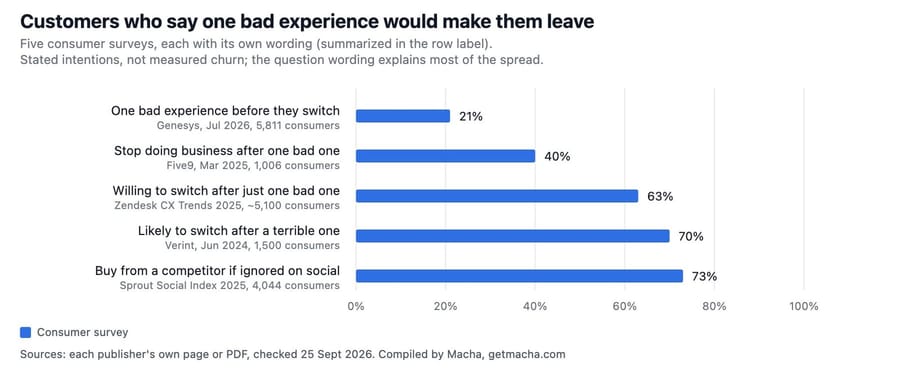
The range comes from the questions. "Will stop doing business" (Five9) is a stronger claim than "willing to switch" (Zendesk). Verint asks about a "terrible" experience, and Sprout about a brand ignoring you on social. Genesys asks how many bad experiences it takes, and 21% say one. Nobody measured actual churn; these are all stated intentions.
Surveys that tie churn to a specific failure are more useful to an operator than the headline switching rate:
- Medallia's 2026 report (1,522 consumers) found "21% of service interactions leave an issue unresolved, and 1 in 6 consumers will switch to a competitor when that happens" (Medallia PDF). Only "22% of consumers feeling “very loyal”," and 40% had switched brands recently (Medallia release).
- Salesforce (15,015 consumers, 2024): "43% of consumers say poor customer service experience will stop them from making a repeat purchase from a company or brand" (Salesforce).
- Genesys: "85% say poor service has caused them to spend less or stop doing business with a brand altogether."
- Qualtrics: "Nearly half (47%) of bad customer experiences lead to decreased spending," and customers increasingly leave silently, with "30% say nothing at all" after a bad experience (Qualtrics).
Qualtrics turns those rates into a dollar figure: it "estimates that organizations globally are putting nearly $3 trillion of their sales at risk in 2026" (Qualtrics). That's a model (share of bad experiences, times the share that lead to cut spending, times household consumption), and Qualtrics notes its sample shrank to 14 countries this year, so the fall from earlier estimates isn't a trend.
How fast do customers expect a response?
Faster every year, by their own account. Zendesk's CX Trends 2026 (6,182 consumers and 5,115 business respondents, June 2025) found "88% of customers expect faster response times than they did just a year ago" (CX Trends 2026) and "74% of consumers now expect 24/7 service due to AI" (Zendesk CX Trends 2026).
| Expectation | Figure | Source | Who was asked |
|---|---|---|---|
| Customers expect requests resolved immediately, in under three hours | 82% | HubSpot, 2024 | Service professionals, describing customers |
| A social reply within 24 hours or sooner | About three-quarters | Sprout Social, 2025 | 4,044 consumers |
| Quick response named as part of good CX | 87% | Verint, 2024 | 1,500 consumers |
| Leaders who agree customers expect more than in the past | 84% | Gartner, December 2024 | 187 service leaders |
| Support teams who say AI tools are raising customer expectations | 85% | Intercom, January 2025 | 2,000+ support professionals |
HubSpot's 82% is service professionals' view of their customers, so it's a belief about expectations, not a customer survey. Qualtrics found "Consumers are least satisfied with the time to wait" among parts of the contact center experience, and that "Consumers are 2.6x more likely to purchase more if wait times are ‘satisfactory’" (Qualtrics).
What customers do when the wait runs long is better evidence than what they say. LiveChat's platform data across its customers found "The queue dropout rate was 27.4%, meaning more than one in four customers left before getting a response" (LiveChat, 2024 report; LiveChat doesn't state the period covered). Forethought's survey of 2,243 US adults found "Nearly half of consumers (46%) report they would disconnect after navigating through more than four menu selections" on a phone tree.
Demand doesn't keep office hours either. Gorgias's own platform data shows the median brand on its platform takes "53% of its pre-purchase questions outside business hours," and that "During business hours, the median first response to a pre-purchase question is 2.2 hours. After hours, it stretches to about 15 hours" (Gorgias, July 2026). Against a 24/7 expectation from 74% of consumers, a 15-hour overnight wait is the gap most teams can measure on their own queue. For what response times teams actually achieve, see our customer service benchmarks; the figures in this section are expectations, and almost none of them are measured response times.
Zendesk's CX Trends 2026 also found "85% of CX leaders say customers will drop brands that cannot resolve issues on first contact," which is leaders describing customers rather than customers themselves, but it matches what the switching surveys above report.
How often do customers have to repeat themselves?
Five surveys asked about repetition, and all five found it common:
- Five9 (June 2026, 3,000 consumers): "83% of consumers say they still have to repeat themselves at least sometimes after being transferred" (Five9). The same release says nearly all decision-makers believe their organization preserves context during AI-to-human handoffs.
- Medallia (March 2026): "44% of customers report having to provide the same information more than once during their last interaction. 23% were told something by a customer service agent that turned out to be incorrect."
- Zendesk CX Trends 2026 (the same survey as the 88% above): "81% want agents to continue the conversation without backtracking, and 74% are frustrated when they have to repeat information."
- Genesys (July 2026, same survey of 5,811 consumers): "95% of consumers expect information to be remembered across channels," while "nearly half (48%) of organizations do not automatically pass information between virtual and human agents."
- Verint (2024): "It takes me multiple attempts to get a simple answer to my question" was the most frustrating part of poor CX, named by 63%.
Salesforce's 2024 survey of 15,015 consumers found "69% of consumers expect consistent interactions across departments," and "Over a third of consumers would work with an AI agent instead of a person to avoid repeating themselves" (Salesforce).
Repetition is the expectation AI changes most directly, in both directions. An AI agent that hands a ticket to a human without the conversation history makes it worse, and one that passes the full context makes it better. Our guide to escalating a ticket with its full context covers the handoff, our AI resolution rate statistics cover how often the AI finishes the job without one, and our trust statistics cover how customers react to AI in the loop.
Do companies and customers agree on service quality?
No. Medallia's 2026 State of CX report found "Although 66% of CX practitioners believe experiences improved last year, only 17% of consumers agree" (Medallia release). Deloitte's 2026 contact center survey found 40% of consumers "said contact center CX has stayed the same" over the past year and "12% said it has gotten worse," and "Just 39% of consumers said they’d experienced proactive support from a brand" (Deloitte PDF).
Other signals from the customer side:
- "More than half of consumers say they would rather do anything else than contact customer service," and "Ninety-one percent say a company is only as good as its customer service" (Genesys, July 2026).
- "only 45% of consumers feel understood by the brands they interact with, down slightly from 46% in 2024" (Twilio, June 2025, 7,640 consumers; Twilio).
- "AI promised better CX, but 83% of consumers still believe experiences should be better than they are today" (Zendesk CX Trends 2026).
- "Customer complaints are at record levels," according to the American Customer Satisfaction Index's Q2 2026 release (ACSI).
There's an incentive behind the gap. Practitioners are grading their own work and the investments they championed, while customers grade the last interaction they had. Both answers are honest; they're measuring different things.
Will customers pay for better service? The UK Institute of Customer Service's July 2026 index (59,500 responses) found "Three times as many people are willing to spend more for a higher level of customer service than are price-sensitive above all – 34.4% to 11.6%" (UKCSI). Zendesk's CX Trends 2026 found "86% of consumers say responsiveness and accurate resolution highly influence their purchase decisions."
How to read these numbers
We checked every figure on the publisher's own page or PDF on 25 September 2026. Nearly everything above is stated intention from surveys; only LiveChat's queue dropout and Gorgias's after-hours share are measured behavior, and both are vendor platform data. Most of these surveys come from companies that sell customer service software (Zendesk, Genesys, Five9, Verint, Sprout Social, Medallia, Salesforce, Twilio), and a finding that customers are demanding more helps them sell. That's a reason to read the question wording, not to dismiss the answer.
Intercom and Forethought sell AI agents, so a finding that AI raises expectations, or that phone trees drive people away, also supports their pitch. We sell AI agents, and the 74% who expect 24/7 service is the most convenient statistic on this page for us. We've kept it beside the repetition figures, because an instant answer that makes the customer repeat themselves later doesn't meet the expectation.
Where the data runs out
There's no public, cross-industry measurement of actual churn after a bad service experience, only stated intentions. There's little data on what customers expect from email support specifically, as opposed to chat, social or phone. And almost no survey separates B2B from B2C expectations, which differ a lot in practice.
How Macha fits
Macha runs AI agents on top of Zendesk, Freshdesk, Gorgias, Front, HubSpot or Intercom and works inside the ticket, so when an agent hands a conversation to a person, the history and what the AI already did are in the same ticket. It's priced per ticket (one thread between Macha and one person, charged once no matter how many messages it takes). Macha fits teams whose customers expect answers outside business hours and who want the human handoff to arrive with context attached. The pricing page has the tiers.
Sources
- Zendesk, CX Trends 2025 (November 2024; ~10,500 respondents), CX Trends 2026 (November 2025; 11,000+) and customer service statistics page
- Genesys, State of Customer Experience 2026 (July 2026; 5,811 consumers)
- Five9, 2025 Customer Experience Report (March 2025; 1,006) and 2026 Business Leaders CX Report (June 2026; 3,000 consumers)
- Verint, State of Digital Customer Experience 2024 (1,500 consumers)
- Sprout Social, Social media customer service statistics (2025 Index; 4,044 consumers)
- Medallia, 2026 State of CX Report (March 2026; 1,522 consumers, 552 practitioners)
- Salesforce, State of the AI Connected Customer (October 2024; 15,015 consumers)
- Qualtrics XM Institute, 2026 Consumer Experience Trends (October 2025; 20,000+), sales at risk 2026 and Contact Center Trends
- HubSpot, State of Service (2024; 1,537 service leaders per HubSpot's blog; other HubSpot pages say 1,500+ and 1,400)
- Gartner, third-party GenAI prediction and leader survey (December 2024; 187 leaders)
- Intercom, 2025 Customer Service Transformation Report (2,000+ professionals)
- LiveChat, Customer Service Report (2024; platform data)
- Forethought, consumer survey (2025; 2,243 US adults)
- Deloitte Digital, 2026 Global Contact Center Survey (June 2026; 3,000 consumers, 720 leaders)
- Twilio, 2025 State of Customer Engagement (June 2025; 7,640 consumers)
- American Customer Satisfaction Index, Q2 2026 release
- Institute of Customer Service, UKCSI July 2026 (59,500 responses)
- Gorgias Ecom Lab, after-hours study (July 2026; platform data)
More statistics
- Customer service and AI statistics (2026): the hub, with the key numbers from every topic.
- Customer service benchmarks: measured first response time, resolution time, CSAT and FCR.
- Do customers trust AI customer service?: escalation, disclosure and second chances.
- Where do customers go for help?: channel preferences and self-service.
- Ecommerce customer service statistics: delivery problems, returns and pre-purchase questions.
Frequently asked questions
What percentage of customers switch after one bad experience? Zendesk's CX Trends 2025 found 63% of consumers willing to switch to a competitor after just one bad experience. Other surveys range from 21% (Genesys, 2026) to 70% after a "terrible" experience (Verint, 2024), because each asks a differently worded question.
Is it true that 73% of customers leave after one bad experience? Not according to Zendesk's own pages. Zendesk's statistics page says 73% will switch after multiple bad experiences and more than half after one. Its CX Trends 2025 report puts the one-experience figure at 63%.
How quickly do customers expect a response? Zendesk's CX Trends 2026 found 88% of customers expect faster responses than a year ago, and 74% expect 24/7 service because of AI. About three-quarters of consumers expect a social media reply within 24 hours, according to Sprout Social.
How often do customers have to repeat themselves? Five9's 2026 survey found 83% of consumers say they have to repeat themselves at least sometimes after a transfer. Medallia found 44% gave the same information more than once in their last interaction.
Do companies overestimate their customer service quality? Medallia's 2026 report found 66% of CX practitioners think experiences improved in the past year, while only 17% of consumers agree.
To see how an AI agent handles your after-hours tickets, start a trial with $50 of free usage (about 125 tickets), no credit card, no time limit.
Resolve tickets automatically with AI agents
Macha's AI agents work on top of the help desk you already use — no code.