Intercom
 Shopify
 Stripe
 Slack
Slack Notion
 Google Workspace
 Confluence

Do Customers Trust AI Customer Service? Statistics for 2026


Most customers don't trust AI customer service for its own sake, but many will use it if it resolves their issue quickly and a human is easy to reach. Gartner's survey of 5,728 customers, published in July 2024, found 64% would prefer companies didn't use AI in customer service. Its 2026 survey of 3,566 customers found 87% say an option to reach a human agent is essential when a company uses generative AI. And Genesys found 76% of 5,811 consumers don't care who resolves their issue, as long as it's solved quickly and completely. This page sets out the verified figures on preference, escalation, failure, disclosure and acceptance, with who was asked and what the question was.
Key takeaways
- Gartner's survey of 5,728 customers, published in July 2024, found 64% would prefer companies didn't use AI in customer service and 53% would consider switching to a competitor over it.
- Gartner's 2026 survey of 3,566 customers found 87% say an option to reach a human agent is essential when companies use generative AI for customer service.
- Genesys found 84% of 5,811 consumers will give a virtual agent three attempts or fewer to resolve an issue, and 76% don't care who resolves it if it's solved quickly and completely.
- Qualtrics found nearly one in five consumers who used AI for customer service saw no benefit, a failure rate almost four times higher than for AI use in general.
- Gartner found only 27% of customers would try a chatbot again after a negative experience, from the same 2026 survey of 3,566 customers.

Do customers trust AI in customer service?
On the direct question, no. Gartner's survey of 5,728 customers (fieldwork December 2023) found "Sixty-four percent of customers would prefer that companies didn’t use artificial intelligence (AI) in their customer service," and "53% of customers would consider switching to a competitor if they found out a company was going to use AI for customer service" (Gartner, July 2024). The top concern: "it will get more difficult reaching a person," followed by AI displacing jobs and AI giving wrong answers. The survey predates most generative AI agents, so it's the baseline this page's newer figures move against. It's one topic in our customer service and AI statistics hub.
Newer surveys find the same reluctance in different words:
| Figure | Source | Who was asked |
|---|---|---|
| "75% prefer talking to a real human in-person or over the phone for customer support" | Five9, October 2024 | 4,000 US and UK consumers |
| "nearly half (48%) of consumers say they do not trust information provided by AI-powered customer service bots" | Five9, October 2024 | Same survey |
| "74% would rather resolve an issue or get technical support via human channels" | Qualtrics, December 2024 | 23,000+ consumers |
| "Only a quarter (26%) of consumers say they trust organizations to use AI responsibly." | Qualtrics, October 2024 | Nearly 24,000 consumers |
| 54% trust human agents more than AI for product or service recommendations; 32% trust AI more | Gartner, April 2026 (fieldwork January to February 2025) | 5,801 US customers |
| "only 54% trust AI to provide good support via conversational agents," against 85% who trust AI's shopping recommendations | Klaviyo, March 2026 | 7,998 consumers, eight countries |
| "about six-in-ten adults are not confident in U.S. companies to develop and use these tools responsibly" | Pew Research Center, June 2026 | 5,119 US adults |
Complete trust is rare: Klaviyo's survey of 7,998 consumers (fieldwork November to December 2025) found "Only 13% of consumers completely trust AI," and Kustomer's 2024 survey of 1,200 US consumers found "79% of consumers believe that human agents will always have a role in customer service."
Companies think customers trust AI more than customers say they do. Salesforce's 2026 survey of 3,075 service professionals found "Sixty-five percent of customer service professionals say their customers fully trust AI" (Salesforce). Gorgias's survey of 400 ecommerce decision-makers found 62% "believe customers trust AI-driven support as much as human agents" (Gorgias). Both are businesses describing their customers. A team that has just bought an AI agent has every incentive to believe its customers are comfortable with it, which is why the customer-side surveys above are the ones to plan around.
How important is a way to reach a human?
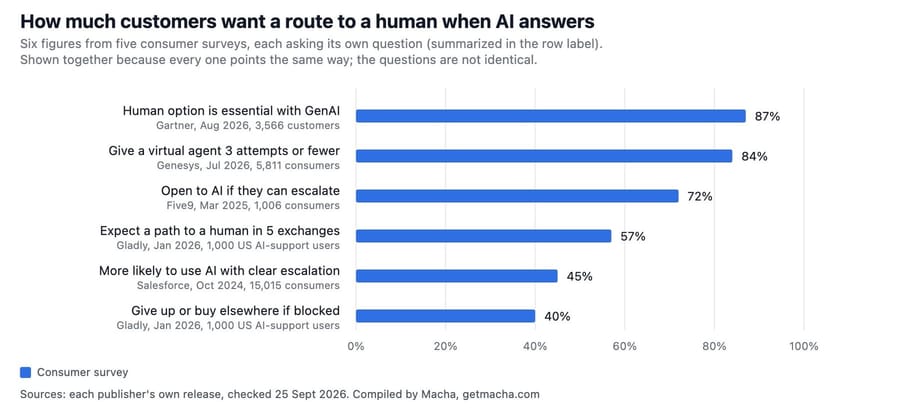
Every survey that asked found a majority wanting it. Gartner's 2026 survey of 3,566 B2B and B2C customers found "50% of customers say their interactions are easier when companies use GenAI, yet 87% of customers say it is essential for companies to provide an option to reach a human agent when using GenAI" (Gartner, August 2026). Asked what would change the mind of customers unwilling to use AI, "the most common response was the ability to switch to a human agent if needed."
Other surveys put numbers on how much patience customers have before they want that switch:
- Three attempts. "84% will give a virtual agent three attempts or fewer to resolve an issue" (Genesys, July 2026, 5,811 consumers; release).
- Five exchanges. "57% of customers expect a clear path to a human within five exchanges," and "When customers are blocked from reaching a human, 40% give up entirely or purchase elsewhere" (Gladly and Wakefield Research, January 2026, 1,000 US adults who use AI support; release).
- Conditional openness. "72% of consumers are open to AI-powered interactions, provided they can escalate to a human when needed" (Five9, March 2025, 1,006 consumers; release). And "45% are more likely to use an AI agent if there’s a clear escalation path" (Salesforce, October 2024, 15,015 consumers; Salesforce).
- The trust factor. In Intercom's 2026 AI Sentiment Report, the top factor end users said would increase their trust in an AI agent was "easy escalation to a human when needed," ahead of being told up front that they're talking to AI (Intercom).
Gladly's survey shows how fast a preference for AI can flip at the handoff: "59% of customers prefer AI-powered support as their first step. But nearly half (45%) say that preference disappears the moment a human handoff feels difficult." Genesys found "nearly half (48%) of organizations do not automatically pass information between virtual and human agents," while Five9 found "83% of consumers say they still have to repeat themselves at least sometimes after being transferred." Our guides to why AI-to-human handoff fails and escalating a ticket with its full context cover the mechanics, and setting up Fin's handoff shows one vendor's version of it.
What happens after a bad AI customer service experience?
Customers remember it, and many don't come back to the channel. Gartner's 2026 customer survey found "Only 27% said they would be willing to try a chatbot again after a negative experience" (Gartner, September 2026). It's the same 3,566-customer survey as the 87% above, so treat the two as one source.
Qualtrics measured failure directly. Its 2026 Consumer Experience Trends report (20,000+ consumers in 14 countries) found "Nearly one in five consumers who have used AI for customer service saw no benefits from the experience. That’s a failure rate almost four times higher than for AI use in general" (Qualtrics). Compared with other AI tasks, AI customer support scored 12 points lower on being easy to use or convenient.
- Forethought's survey of 2,243 US adults (2025): "In the past year, 55% of consumers expressed negative emotions when dealing with an AI agent" (Forethought).
- Ada and NewtonX (March 2026, 2,000 consumers; Ada): the reasons AI failed were "comprehension failures where AI did not understand the request (74%), capability gaps where AI could not handle the complexity (56%), and the AI repeating the same unhelpful response (50%)."
- Ada and NewtonX, same study: "only 24% of consumers say their most recent AI customer service interaction was fully resolved by AI alone."
- Gladly and Wakefield Research (January 2026): "88% of customers say their issue was resolved through AI or a hybrid AI-to-human interaction. Yet only 22% say the experience made them prefer the company." The 88% includes tickets a human finished, and the sample was screened to people who already use AI support, so it's a ceiling on consumer-reported resolution, not a measure of AI alone.
- Medallia (March 2026, 1,522 consumers): "42% of consumers say human errors are more forgivable than AI errors" (Medallia PDF).
Two academic studies explain part of the mechanism. A study of a European telecom's chatbot (Journal of Marketing, 2022, using 2016 to 2017 data) found that "when customers enter a chatbot-led service interaction in an angry emotional state, chatbot anthropomorphism has a negative effect on customer satisfaction" (Crolic et al.). A Harvard Business School field experiment at a meal delivery company (Management Science, January 2026) found that after a chatbot comprehension failure, "the involvement of AI negatively affected customer sentiment" even when a human agent took over with AI-suggested replies (HBS Working Knowledge). A failed bot conversation makes the next reply look like more of the same.
Do customers want to know when they're talking to AI?
Most do, and the figure depends heavily on how the question is worded.
| Figure | Source | Who was asked |
|---|---|---|
| "Nearly 75% of consumers want to know if they’re communicating with an AI agent." | Salesforce, October 2024 | 15,015 consumers, 18 countries |
| "71% of consumers consider it very or extremely important to know when they are interacting with an AI agent" | Five9, June 2026 | 3,000 consumers, US, UK, Germany |
| "54% want to know when they’re talking to AI" | Twilio, June 2025 | 7,640 consumers, 18 countries |
| "If a brand did not disclose that a shopper was interacting with an AI agent, 40% said they would feel misled." | Talkdesk, January 2026 | 1,000 US holiday shoppers |
| "95% expect an explanation for AI-made decisions" | Zendesk CX Trends 2026, November 2025 | 6,182 consumers, 22 countries |
Customers often can't tell anyway. Talkdesk found "31% of shoppers who spoke with a retail customer service representative were unsure if they were speaking to an AI virtual agent or a human agent," and Klaviyo found "more than 30% incorrectly identified a human-written customer service response as AI-generated." On the business side, Zendesk found "80% of CX leaders agree transparency will be non-negotiable for customer-facing AI, only 37% currently offer any reasoning behind AI’s decisions."
The most quoted study on disclosure is older and narrower than it's usually presented. Luo, Tong, Fang and Qu (Marketing Science, 2019) found that "a disclosure of chatbot identity before the machine–customer conversation reduces purchase rates by more than 79.7%" (study PDF). The experiment used outbound sales calls from a voice bot at one Chinese financial services firm, with 2019-era technology. The arithmetic behind the headline: purchase rates fell "by 79.7% (from 0.237 to 0.048)," and 56.3% of customers told up front that they were talking to a bot hung up, against none in the undisclosed group. It says something about disclosure in cold sales calls, and much less about a customer who contacts support about their own order.
When do customers prefer AI customer service?
When it's faster and it works. Genesys found "76% don’t care who resolves their issue as long as it’s solved quickly and completely." Ada's study with NewtonX found "59% of consumers prefer instant, 24/7 AI customer service over waiting for a human, but only when the technology can actually resolve their issue." Five9 found the same 59% share preferring "an instant AI chatbot over waiting for a live agent" in its 2025 consumer survey.
Other acceptance figures, each from its own survey:
- "30% of consumers – even more among Gen Z and millennials (37%) – would work with an AI agent instead of a person for faster service" (Salesforce, 2024).
- "Sixty-seven percent of consumers are ready to delegate tasks like tracking orders and receiving personalized recommendations to AI" (Zendesk CX Trends 2025, about 5,100 consumers; Zendesk).
- "With 78% of respondents willing to interact with AI agents, especially for routine tasks like order tracking and service cancellations" (Kustomer, 2024, 1,200 US consumers; Kustomer).
- "Fifty-four percent of end users say they’d trust AI to handle simple or routine issues, but not complex ones" (Intercom, September 2026).
- "While 80% of consumers are willing to use AI-powered customer service, two-thirds still prefer speaking with a human" (Five9, June 2026).
The pattern across these: customers accept AI for routine, checkable tasks like order tracking, and want a human for complex or emotional ones. That split matches what happens on the ticket side, where our resolution rate statistics show AI performing best on simple, repetitive questions.
Is trust in AI customer service rising or falling?
The data points both ways. Intercom's 2026 AI Sentiment Report (over 1,000 end users) found "Forty-nine percent of people described having positive overall experiences with AI – up nine percentage points from 2025." The same report says positive sentiment "jumped to 74%" after respondents watched a video of an AI agent resolving a query, which measures a vendor demo's effect more than everyday experience. Intercom sells an AI agent (Fin, acquired by Salesforce on 10 September 2026).
Against that: Qualtrics's Contact Center Trends 2025 (December 2024, 23,000+ consumers) found "Consumer comfort in using AI overall is down 11% YoY," and its 2026 Consumer Experience Trends (October 2025) found concern about data misuse at 53% of consumers, "up 8 points over the past year." Salesforce's October 2024 survey of 15,015 consumers found "Nearly three-quarters (72%) of consumers trust companies less than they did a year ago." The negative readings are a year or more older than Intercom's, and each survey asked a different question, so this isn't a clean trend line. The readings come from different surveys asking different questions, so they don't form one series. Our expectations statistics cover what customers now expect on speed and repetition, which is the standard AI gets judged against.
How to read these numbers
We checked every figure on the publisher's own page or PDF on 25 September 2026. Four cautions:
- Question wording drives the answer. Asking whether customers would prefer companies didn't use AI (64% agreed) and asking whether they care who resolves an issue that's solved quickly (76% don't) aren't contradictory. The first measures a default preference, the second a trade-off.
- Shared samples. Gartner's 87%, 27%, 49% and 7% figures come from one 2026 survey of 3,566 customers (fieldwork February to March 2026). Its 64% and 53% come from one survey of 5,728 customers fielded in December 2023.
- Screened samples. Gladly surveyed only people who already use AI support, so its 59% preferring AI first doesn't describe all consumers.
- Who's asking. Most of these surveys come from companies that sell AI or contact center software (Salesforce, Five9, Genesys, Intercom, Ada, Gladly, Talkdesk, Kustomer, Klaviyo, and us). Five9, Genesys and Talkdesk sell contact center seats for human agents as well as AI, so a finding that customers want humans suits them as much as a finding that customers want AI suits Intercom or Ada. Gartner, Qualtrics, Pew and the academic studies have less at stake.
We sell AI agents. The honest reading of this data is that customers will accept an AI agent that resolves routine issues and hands off cleanly, and won't forgive one that traps them, so that's the case we've presented.
Where the data runs out
Almost all of this is survey data about what customers say, mostly from the US and Western Europe. There's almost no public measurement of what customers do: how often they type "human" or "agent" into an AI conversation, how many abandon at the handoff across vendors, or whether stated distrust changes repeat purchase. Gorgias's own platform data (October 2025 to April 2026, Gorgias Ecom Lab) finds "33% of handed-off tickets are abandoned and never receive a human response." That's the nearest measured figure, and it's one vendor's data about its own merchants. The gap between saying and doing is real: the same Gartner survey of 3,566 customers found "While 49% of customers said they would have been willing to use a chatbot if the company had provided one, only 7% used a chatbot or digital assistant during their most recent service interaction."
How Macha fits
Macha runs AI agents on top of your help desk, inside the ticket where your team already works, so a handoff to a human stays in the same ticket with the conversation history attached. It's priced per ticket (one thread between Macha and one person, charged once no matter how many messages it takes). Macha fits teams already running Zendesk, Freshdesk, Gorgias, Front, HubSpot or Intercom who want AI answering order-status and other routine questions customers are comfortable delegating, with the human route one reply away inside the same ticket. The pricing page has the details.
Sources
- Gartner, 64% of customers would prefer companies didn't use AI (July 2024; 5,728 customers), 87% say a human option is essential (August 2026; 3,566), 27% would try a chatbot again (September 2026; 3,566) and 85% expanding agent responsibilities (April 2026; 5,801 US customers)
- Genesys, State of Customer Experience 2026 (July 2026; 5,811 consumers)
- Gladly with Wakefield Research, 2026 Customer Expectations Report (January 2026; 1,000 US adults)
- Five9, 2025 Customer Experience Report (March 2025; 1,006), consumer survey (October 2024; 4,000) and 2026 Business Leaders CX Report (June 2026; 3,000 consumers)
- Salesforce, State of the AI Connected Customer (October 2024; 15,015 consumers) and State of Service: AI Agents Edition (May 2026; 3,075)
- Qualtrics XM Institute, 2026 Consumer Experience Trends (October 2025; 20,000+), 2025 Consumer Trends (October 2024; ~24,000) and Contact Center Trends 2025 (December 2024)
- Intercom, 2026 AI Sentiment Report (September 2026; 1,000+ end users)
- Ada and NewtonX, consumer study (March 2026; 2,000 consumers)
- Forethought, consumer survey (2025; 2,243 US adults)
- Medallia, 2026 State of CX Report (March 2026; 1,522 consumers)
- Zendesk, CX Trends 2026 and CX Trends 2025
- Gorgias, State of Conversational Commerce 2026, Trend 5 (400 decision-makers)
- Gorgias Ecom Lab, The cheapest ticket is the one a human never touches (April 2026; Gorgias platform data, vendor self-report)
- Klaviyo, Consumer trust in AI (March 2026; 7,998 consumers)
- Kustomer, 2024 AI and Customer Service Index (September 2024; 1,200 US consumers)
- Twilio, 2025 State of Customer Engagement (June 2025; 7,640 consumers)
- Talkdesk, Post-holiday AI survey (January 2026; 1,000 US shoppers)
- Pew Research Center, Americans and AI 2026 (June 2026; 5,119 US adults)
- Luo, Tong, Fang and Qu, Machines vs. Humans (Marketing Science, 2019)
- Crolic, Thomaz, Hadi and Stephen, Blame the Bot (Journal of Marketing, 2022)
- Zhang and Narayandas, Engaging Customers with AI in Online Chats (Management Science, 2026)
More statistics
- Customer service and AI statistics (2026): the hub, with the key numbers from every topic.
- How many tickets does AI actually resolve?: consumer-reported and vendor-reported resolution rates.
- What do customers expect from customer service?: speed, repetition and switching.
- Where do customers go for help?: self-service and the move to third-party AI tools.
- How many support teams use AI?: adoption figures and what they count.
Frequently asked questions
What percentage of customers prefer a human over AI in customer service? Five9's October 2024 survey of 4,000 US and UK consumers found 75% prefer talking to a real human in person or over the phone for support. Gartner's survey of 5,728 customers found 64% would prefer companies didn't use AI in customer service at all.
Do customers want to be able to reach a human when using AI? Yes. Gartner's 2026 survey of 3,566 customers found 87% say an option to reach a human agent is essential when companies use generative AI. Genesys found 84% of consumers give a virtual agent three attempts or fewer before wanting another route.
Should companies disclose that customers are talking to AI? Most customers say so. Salesforce found nearly 75% of 15,015 consumers want to know if they're communicating with an AI agent, and Talkdesk found 40% of US holiday shoppers would feel misled if a brand didn't disclose it.
Will customers use a chatbot again after a bad experience? Only 27% said they would, in Gartner's 2026 survey of 3,566 customers. Qualtrics found nearly one in five consumers who used AI for customer service saw no benefit, almost four times the rate for AI use in general.
When do customers prefer AI to a human agent? When it's faster and resolves the issue. Genesys found 76% of consumers don't care who resolves their issue if it's solved quickly and completely, and Ada's study found 59% prefer instant 24/7 AI service over waiting, but only when it can resolve the issue.
To test an AI agent that hands off inside your own help desk, start a trial with $50 of free usage (about 125 tickets), no credit card, no time limit.
Resolve tickets automatically with AI agents
Macha's AI agents work on top of the help desk you already use — no code.