Shopify
 Stripe
 Slack
Slack Notion
 Google Workspace
 Confluence

eesel AI: The Complete Guide (2026)


eesel AI is an AI agent platform that plugs into a help desk a team already runs, Zendesk, Freshdesk, Gorgias, Intercom, or Help Scout, and answers tickets, drafts replies, or hands off to a human, billed per task rather than per seat. This guide covers what eesel actually does, how it prices itself, where it holds up, where it doesn't, and how it compares honestly to the alternatives worth putting next to it, including us.

We build AI agents for customer service ourselves, and eesel is a direct competitor. We're naming that upfront. We checked eesel's own site directly for every claim below instead of working from a review aggregator.
What is eesel AI?
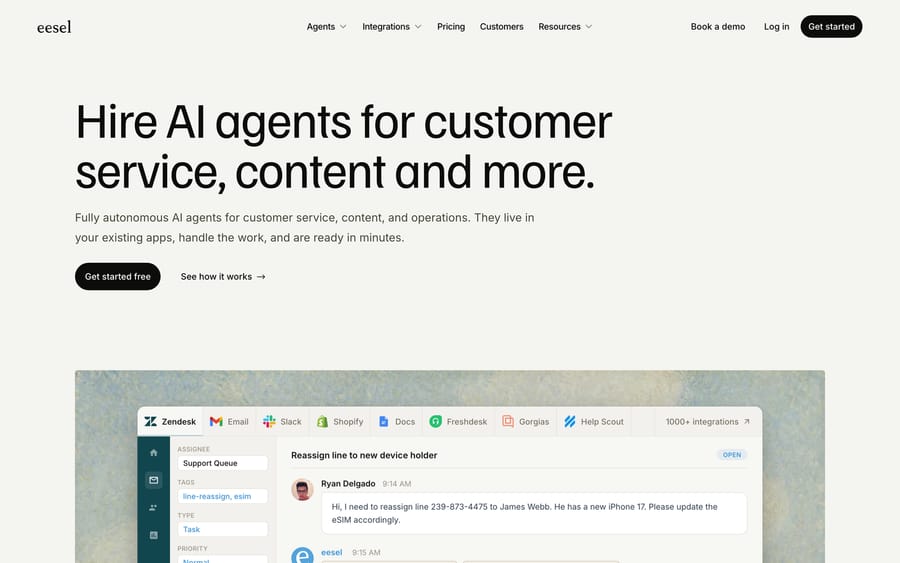
eesel AI's homepage, headlined "Hire AI agents for customer service, content and more," with a live Zendesk ticket example.
eesel AI is a company (eesel, Inc., registered in Middletown, Delaware) that sells AI agents for customer support, internal knowledge lookup, and content drafting. Its own homepage pitches "fully autonomous AI agents" that "live in your existing apps, handle the work, and are ready in minutes," connecting to a help desk a company already uses, Zendesk, Freshdesk, Gorgias, Intercom, or Help Scout, plus knowledge sources like Google Drive, Confluence, Notion, Slack, Microsoft Teams, and a company's existing help center.
eesel discloses almost nothing about its own history on its site: no founding year, no team bios, no funding numbers. Third-party trackers disagree with each other. One source describes eesel as bootstrapped with no outside funding; another cites an unverified $850,000 seed round from 2020; a third lists an unverified $35 million Series B from 2025 with no press release we could confirm. We're not picking one of these, because none of them clears our bar for a sourced claim. What eesel does publish: 2,000+ teams, 500+ enterprise teams, and 3M+ tasks completed, per its own customers page.
Named customers with published results include Smava (a "fully automated Zendesk agent processing 100,000+ support tickets per month in German"), Design.com (over 50,000 tickets a month on Freshdesk), Ecosa (24/7 multilingual support handling 10,000+ tickets a month), and Gridwise (73% of tier-1 requests resolved in the agent's first month). These are eesel's own case-study numbers. eesel doesn't cite an independent audit of them, but the figures are specific enough, and the customers named enough, to read as more than marketing copy.
How eesel's AI works
eesel's core mechanic is a connect-and-brief model. A team points the agent at the sources it should learn from, past tickets, macros, a help center, Google Docs, Confluence, Notion, and gives it plain-English instructions the way it would brief a new hire. The agent then answers questions, drafts replies inside the connected help desk, triages incoming tickets, and escalates to a human when it's out of its depth. eesel's own framing is explicit about this boundary: it markets the product as AI that works alongside human agents, with a defined handoff path instead of full autonomy as the default.
On Gorgias specifically, eesel ships as a listed third-party partner app, documented in Gorgias's own help center as "AI Agents by Eesel." Gorgias's own doc is upfront that support on a partner integration runs slower than a native Gorgias issue, which is a fair thing for a buyer to know before depending on it for tier-1 coverage.
Draft mode versus autonomous resolution
eesel supports two operating modes on the same underlying agent: a draft mode, where the AI writes a reply and a human agent reviews and sends it, and an autonomous mode, where the AI replies directly for the ticket types it's been trusted with. The pitch to a buyer is usually to start in draft mode, watch accuracy on real tickets, then flip specific ticket categories to autonomous once the team trusts the pattern. That's a sensible rollout path. It also means eesel's headline "fully automate Tier-1" claims describe the end state of an onboarding process; a team doesn't get that on day one.
Multi-bot and multi-language
A single eesel account can run multiple bots with separate knowledge bases rather than one shared brain, which matters for a company running distinct brands or business units off the same help desk and not wanting one bot's product knowledge bleeding into another's replies. eesel also supports multi-language responses out of the box, which is where the Smava and Ecosa case studies get their volume: both quote non-English or multilingual ticket handling as part of the win.
Key features
- Multi-help-desk support: Zendesk, Freshdesk, Gorgias, Intercom, Help Scout.
- Knowledge connectors: help center articles, Google Drive, Confluence, Notion, Slack, Microsoft Teams, and general websites.
- Draft and autonomous modes on the same agent, with a defined human handoff path.
- Multiple bots per account, each with its own knowledge base and instructions.
- Multi-language support, used in production by at least two named customers for non-English ticket volume.
- Content generation beyond support tickets, drafting blog content from approved sources.
- Internal knowledge search, delivered through Slack or Microsoft Teams, for employee questions instead of customer tickets.
eesel AI pricing
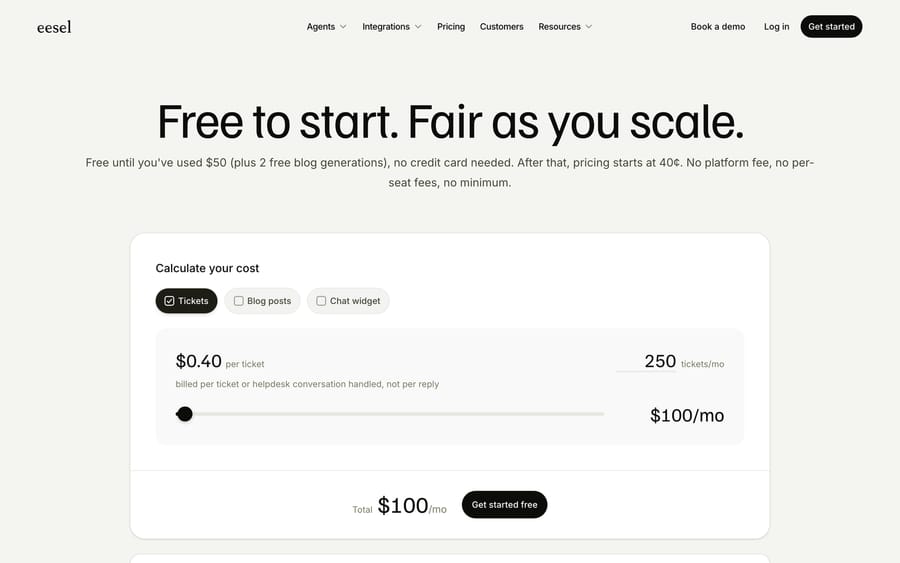
eesel AI's pricing calculator: $0.40 per ticket, billed per conversation handled, not per reply.
eesel publishes real numbers on its pricing page, which is unusual for this category and worth crediting directly. The unit is the task, not the seat or the ticket. Per eesel's own pricing page, a support conversation is "billed per ticket or helpdesk conversation handled, not per reply," so a long back-and-forth costs the same as a one-message resolution:
| Task type | Example | Price |
|---|---|---|
| Light | Dashboard questions, simple lookups | Free |
| Regular | A support ticket or chat session | $0.40 each |
| Heavy | A blog post draft | $4.00 each |
There's no platform fee, no monthly minimum, and no commitment on the standard tiers, per eesel's own pricing page. A team can set a monthly usage cap (the default is $250) so costs can't run away unexpectedly. Committing to a year of usage paid upfront gets a 25% discount. An Enterprise plan adds a $1,000/month flat platform fee on top of usage, and includes a dedicated solutions engineer, an account manager, higher knowledge-base limits, SSO, HIPAA support, a signed BAA, and cloud service agreements, the checklist a regulated buyer needs signed before a deal closes. The trial is $50 of free usage plus two free blog generations, no credit card required.
The $0.40-per-regular-task number is worth sitting with for a second, because it's close to a genuinely comparable unit: Macha bills about $0.40 a ticket too, at every volume tier, though structured as a monthly plan instead of metered pay-as-you-go. The similarity in headline rate is real; the difference is in the billing shape. Metering continuously by task optimizes for capturing exactly what a team uses, which works in eesel's favor when usage is spiky: the bill simply moves with it, with no plan change needed. Macha sets a monthly ticket allowance and moves a team up a tier when it outgrows one. Which shape suits a team better depends on whether predictable monthly billing or granular per-task metering matters more.
Pros and cons
Pros
- Genuinely published, task-level pricing, rare in this category and easy to model against real ticket volume.
- Supports five major help desks (Zendesk, Freshdesk, Gorgias, Intercom, Help Scout) instead of locking to one.
- Named customers with specific, checkable volume claims (100,000+ tickets/month at Smava, for one).
- Draft mode gives a low-risk way to test accuracy before trusting the agent with autonomous replies.
- No credit card required for the $50 trial.
Cons
- Founding and funding history is genuinely opaque; nothing on eesel's own site, and third-party sources conflict with each other.
- Pay-as-you-go billing means a busy month costs more with no ceiling beyond the usage cap a team sets itself.
- The Enterprise tier's $1,000/month platform fee is a real jump from the metered plan below it.
- Support on the Gorgias integration runs through a third-party partner channel, per Gorgias's own documentation, not Gorgias's first-party support queue.
Who eesel AI is best for
eesel fits a team already running Zendesk, Freshdesk, Gorgias, Intercom, or Help Scout that wants to try AI ticket automation without signing an annual contract first: the $50 no-card trial and metered pricing make it genuinely easy to test on real volume before committing. It also suits a team that wants one vendor covering support, internal knowledge search, and content drafting instead of three separate tools.
It's a weaker fit for a team that wants predictable, flat monthly billing regardless of ticket-volume swings, since pay-as-you-go pricing means a spike in tickets is a spike in the bill unless the usage cap kicks in and starts blocking replies. A team with a large content-generation need alongside support should also check that the $4/heavy-task rate for blog drafts pencils out against a dedicated writing tool, since that's a different unit economics problem than ticket deflection.
eesel AI vs alternatives
| eesel AI | Decagon | Macha | |
|---|---|---|---|
| Model | AI agents on top of Zendesk, Freshdesk, Gorgias, Intercom, Help Scout | Enterprise conversational AI agent platform | AI agent layer on your existing help desk |
| Best for | Teams wanting metered, self-serve AI automation on an existing help desk | Large enterprises with dedicated AI/CX budget | Teams on Zendesk, Freshdesk, Gorgias, or Front wanting managed setup |
| Pricing | $0.40/regular task, $4/heavy task, free light tasks, $1,000/mo Enterprise add-on, published | Opaque, enterprise sales cycle | From $299/mo for 750 tickets (~$0.40/ticket), published |
| Setup | Self-serve; connect sources and write instructions | Sales-led, multi-week implementation | Built, tested, and monitored by the Macha team |
| Trial | $50 free usage, no credit card | No self-serve trial | $50 free usage |
| Replaces your help desk? | No | No, but often positioned as the primary AI layer | No, deliberately augments it |
eesel and Macha are close enough in shape that the honest comparison is about setup and billing structure. Both connect to the help desk a team already uses instead of requiring a migration, and both land near $0.40 for a resolved ticket. Where they diverge: eesel is self-serve and metered, so a team configures and tunes the agent itself and the bill moves with usage. Macha's setup and ongoing monitoring is done by the Macha team on every plan, and billing is a flat monthly ticket allowance instead of continuous metering. Macha fits teams that want the agent built and monitored for them and prefer predictable monthly billing over granular metering; eesel suits teams that want to build and tune the agent themselves and prefer paying for exactly what they use. For a broader, non-help-desk-specific enterprise platform, Decagon sits at a different point on the market, aimed at large enterprises with a dedicated AI budget instead of a team trying a $50 trial this afternoon.
FAQ
What is eesel AI? eesel AI is a platform that connects AI agents to a help desk (Zendesk, Freshdesk, Gorgias, Intercom, or Help Scout) to answer tickets, draft replies, triage incoming volume, and hand off to a human when needed, billed per task instead of per seat.
How much does eesel AI cost? Eesel's published pricing is per task: light tasks (simple lookups) are free, regular tasks (a support ticket or chat session) are $0.40 each, and heavy tasks (a blog draft) are $4.00 each. There's no platform fee or monthly minimum on the standard tiers; an Enterprise plan adds a $1,000/month flat fee for SSO, HIPAA support, and a dedicated account team.
Does eesel AI offer a free trial? Yes. eesel gives $50 of free usage plus two free blog generations, with no credit card required to start.
What help desks does eesel AI support? Zendesk, Freshdesk, Gorgias, Intercom, and Help Scout, plus knowledge connectors for Google Drive, Confluence, Notion, Slack, Microsoft Teams, and a company's existing help center.
Who founded eesel AI and is it funded? eesel discloses no founding or funding information on its own site. Third-party sources conflict: some describe it as bootstrapped, others cite an unverified 2020 seed round or an unverified 2025 Series B, neither confirmed by a press release we could find.
Which companies use eesel AI? Published case studies name Smava (100,000+ tickets/month on Zendesk in German), Design.com (50,000+/month on Freshdesk), Ecosa (10,000+/month, multilingual), and Gridwise (73% of tier-1 requests resolved in the first month), among others.
How is eesel AI different from Macha? Both connect to an existing help desk and price near $0.40 per resolved ticket. eesel is self-serve and metered continuously by usage; Macha runs a flat monthly ticket allowance with setup and ongoing monitoring done by the Macha team instead of configured solo.
Is eesel AI good for teams outside customer support? Partly. Beyond ticket automation, eesel also does internal knowledge search (delivered through Slack or Microsoft Teams) and content drafting from approved sources, so it can serve an internal-tools use case alongside a support one.
Sources: eesel AI homepage, eesel AI pricing, eesel AI customers, Gorgias help center — AI Agents by Eesel.
Resolve tickets automatically with AI agents
Macha's AI agents work on top of the help desk you already use — no code.