Intercom
 Shopify
 Stripe
 Slack
Slack Notion
 Google Workspace
 Confluence

Regal AI: The Complete Guide (2026)


Most AI customer-service vendors start with chat and treat the phone as an afterthought. Regal AI does the opposite: it's a voice-first AI agent platform built for the calls that actually drive revenue — lead qualification, appointment reminders, payment collection, and re-engagement. If your business lives on the phone, Regal is one of the names you'll keep running into, and this guide is an honest, researched look at what it is and whether it fits.

We build an AI support product ourselves (a text-first one), so we'll be upfront about that — but the goal here is a genuine guide to Regal AI, not a pitch. We'll cover what Regal does, how its AI phone agents work, its funding and pedigree, what it realistically costs, where it's strong, where it isn't, and how it compares to alternatives. Where a number can't be verified, we flag it clearly.
What is Regal AI?
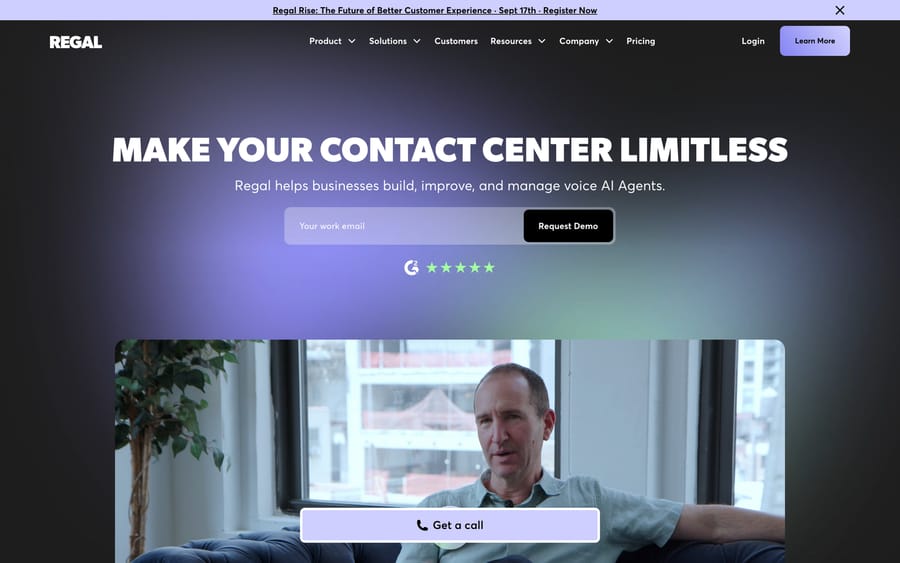
Regal AI's homepage, focused on AI phone/contact-center agents.
Regal AI is an AI voice-agent platform for B2C contact centers, built for sales and customer engagement over the phone (Regal.ai). Instead of a passive chatbot on a website, Regal's agents make and take phone calls — qualifying leads, following up, collecting payments, scheduling appointments, and handling inbound support — in natural, human-sounding speech across 30+ languages. It calls these "Regal AI Agents," and they run both inbound (a customer calls in, the agent answers) and outbound (the agent proactively dials out on a schedule or trigger).
The company was founded in 2020 by Alex Levin (CEO) and Rebecca Greene. Regal started life focused on outbound sales engagement and branded caller ID — the "Regal Voice" era — then evolved into a broader AI-first contact-center platform as conversational voice AI matured. In October 2024 it reportedly raised a ~$40M Series B led by Emergence Capital (with Founder Collective and Homebrew participating) (FinSMES, AlleyWatch, SiliconANGLE). Total funding is reported at reportedly ~$83–106M depending on the source, as of 2026 (Crunchbase, Tracxn). Either way, it's a well-capitalized, venture-backed company rather than an early-stage bet.
Regal deliberately concentrates on industries where phone conversations drive revenue — insurance, healthcare, financial services, and education — rather than trying to be everything to everyone. Publicly referenced customers include Angi, AAA, Google, Toyota, K Health, Kin Insurance, Ro, and Varsity Tutors, a mix that skews toward high-volume B2C brands running large inbound and outbound call operations.
How Regal's AI phone agents work
Regal's platform is organized around three jobs: building AI agents that talk to customers, orchestrating when and how they reach out, and monitoring what happens on every call. The pieces below fit together into that loop.
AI Agent Builder (voice — and SMS/chat)
The AI Agent Builder is where you construct a custom agent — defining its goals, its script and guardrails, the knowledge it can draw on, and the concrete actions it can take mid-conversation (look up an account, book a slot, take a payment, update a record) (Regal: AI Voice Agent Builder). Agents speak with native-sounding fluency in 30+ languages and are designed to hold real, goal-driven conversations rather than recite a rigid IVR tree — they can interrupt gracefully, handle objections, and stay on-task.
Although Regal is voice-first, the same builder extends to text: an AI SMS Agent Builder (Regal: AI SMS Agent Builder) and conversational chat let you run 24/7 text agents alongside the phone agents, so a lead can be nurtured over SMS and escalated to a call when it matters. This is still centered on outreach and engagement, not help-desk ticket resolution — a distinction that matters later.
Journey Builder
Journey Builder is Regal's orchestration engine (Regal: Journey Builder). It uses real-time behavioral data to build dynamic and static customer segments, then triggers personalized, omnichannel journeys off those segments — deciding when to call, when to text, when to schedule a callback, and how to sequence appointment reminders across a customer's lifecycle. Crucially, it supports A/B testing of campaign copy, call and message timing, scripts, and offers, so teams can measure and improve conversion rather than guess. This is where Regal's DNA as a sales-engagement platform still shows: journeys are built to move a prospect or customer toward an outcome.
Branded Caller ID and the Sales Dialer
Two features do a lot of the heavy lifting on outbound connect rates. Branded Caller ID — delivered through carrier partnerships — displays your brand's name and logo on the recipient's phone, which measurably increases answer rates and reduces the odds of being flagged as spam. Paired with the Sales Dialer, this powers high-volume proactive campaigns where getting people to actually pick up is half the battle.
Agent Transfer and human handoff
Regal doesn't assume the AI closes every interaction. When an agent can't (or shouldn't) resolve something on its own, Agent Transfer hands the call to a human through a unified agent desktop, passing the full conversation context so the customer doesn't have to repeat themselves and the human sees the entire history. That warm handoff is essential in regulated, high-stakes calls — the exact scenario Regal's target verticals deal with daily.
Conversation Intelligence and live monitoring
Regal includes Conversation Intelligence with automated QA, so every call is transcribed, scored, and analyzed automatically rather than sampled by hand. Supervisors can set goals, monitor live calls as they happen, and track performance with real-time insights — the kind of oversight and reporting contact-center leaders expect, and a differentiator versus lighter-weight voice-bot tools that stop at "the call connected."
Forward Deployed Engineering
Notably, Regal offers a Forward Deployed Engineering team that manages implementation, customizing each agent to the company and its customers. That hands-on onboarding is a meaningful part of the value proposition for enterprise buyers who don't want to build production-grade voice agents from scratch alone — but it also signals the buying motion: this is a scoped, sales-led enterprise deployment, not a sign-up-and-go product.
Integrations and deployment
Regal is built to sit inside an existing revenue and contact-center stack rather than replace it. The company advertises 40+ integrations across CCaaS, CRM, and data tools, plus APIs and webhooks to connect to anything not covered natively. The two headline integrations are native, bi-directional Salesforce and HubSpot connections — activity in Regal (calls, texts, dispositions, outcomes) is mirrored back into the CRM as the system of record, and CRM data drives who gets contacted and when. There's a dedicated Salesforce AppExchange listing for that integration, plus connectors such as Customer.io for activating behavioral data in real time. In practice, deployment means wiring Regal to your CRM/CDP and telephony, building agents and journeys (often with the Forward Deployed Engineering team), then rolling out inbound and outbound with the Conversation Intelligence layer watching over the top.
On the compliance side, Regal builds in TCPA guardrails (opt-out handling, business-hours respect, reply-frequency limits) and holds HIPAA and SOC 2 — table stakes for the insurance, healthcare, and financial-services buyers it targets.
Key features
- AI voice agents for inbound and outbound calls, 30+ languages.
- AI Agent Builder to design custom, goal-driven phone agents that take real actions mid-call.
- AI SMS / chat agents for 24/7 text engagement alongside voice.
- Journey Builder for real-time, omnichannel orchestration with built-in A/B testing.
- Branded Caller ID + Sales Dialer for higher outbound connect rates.
- Agent Transfer to humans via a unified desktop with full call context.
- Conversation Intelligence + automated QA with live call monitoring.
- Forward Deployed Engineering for hands-on implementation.
- 40+ integrations including native bi-directional Salesforce and HubSpot, plus APIs/webhooks.
- Compliance built in — TCPA guardrails, HIPAA, and SOC 2.
Regal AI pricing
Regal does not publish a public rate card — like most enterprise voice-AI platforms (Decagon, PolyAI, and others), it directs buyers to a sales conversation to scope a contract. Pricing is custom and usage-based, shaped by call volume, the channels you run (voice, SMS, chat), and how much implementation support you need from the Forward Deployed Engineering team.
There is one useful public anchor, though. Regal's own analysis of the true cost of AI voice agents cites Regal AI Agents at roughly $0.20 per minute, based on data across millions of calls — a per-minute conversational rate that typically sits on top of platform and implementation costs rather than replacing them. Use that ~$0.20/minute figure as a directional starting point for modeling, not a quote: a 4-minute qualification call is on the order of ~$0.80 in agent time before platform fees, but your real number depends entirely on volume and contract terms (figures as of July 2026; verify directly with Regal).
One number to explicitly distrust: a "$29/month" figure that circulates on aggregator and directory sites. That is almost certainly not representative of a real contact-center deployment — treat it as noise and get a direct quote before budgeting. If transparent, self-serve pricing is a hard requirement, raise it early; Regal's model is enterprise, usage-driven commercials rather than a credit-card plan.
What reviewers say: Regal holds 4.7 out of 5 from 45 reviews on G2, checked 21 September 2026. Forty-five reviews is a reasonable sample for a company this size, though most of it describes the outbound calling and SMS side of the product rather than the newer AI phone agents.
Pros and cons
Pros
- Genuinely voice-first. Regal is built for the phone, not bolted onto a chat product — a real advantage if calls drive your revenue.
- Strong for revenue-driving outreach. Lead qualification, appointment reminders, collections, scheduling, and re-engagement are core use cases, not edge cases.
- Branded Caller ID lifts connect rates. Showing your brand and logo on outbound calls is a concrete, measurable answer-rate win that pure voice-bot tools rarely offer.
- Real orchestration, not just a bot. Journey Builder with real-time segments and A/B testing turns individual agents into measurable, optimizable campaigns.
- Serious oversight. Conversation Intelligence, automated QA, and live monitoring give supervisors the visibility a contact center actually needs.
- Multilingual and natural. 30+ languages with native-sounding fluency broadens reach.
- Enterprise-grade compliance. TCPA guardrails plus HIPAA and SOC 2 matter a lot in insurance, healthcare, and finance.
- Hands-on onboarding. The Forward Deployed Engineering team reduces the build burden and gets production agents live faster.
- Credible customer base. Publicly referenced customers include AAA, Toyota, Angi, K Health, and Kin Insurance — a set that signals it works at scale.
Cons
- Opaque pricing. No public rate card; everything runs through sales, and the only firm public anchor (~$0.20/min agent time) sits on top of platform and implementation costs.
- Voice-centric by design. If most of your support is chat, email, and tickets rather than calls, Regal is a heavier fit than you need — the SMS/chat agents are still engagement-oriented, not help-desk ticket resolution.
- Not a help-desk-native agent. Regal is a standalone platform, not a layer that plugs into the ticketing tool (Zendesk, Freshdesk, etc.) your support team already lives in.
- Enterprise orientation. The sales-led motion and Forward Deployed Engineering onboarding skew toward larger, phone-heavy operations rather than lean support teams that want to self-serve.
- B2C skew. The platform and case studies center on high-volume B2C outreach; complex B2B or low-volume, high-touch use cases are less obviously its sweet spot.
Who Regal AI is best for
Regal is a strong fit for phone-heavy, revenue-driven B2C teams — insurance, healthcare, financial services, and education — that need AI agents to handle high volumes of inbound and outbound calls with compliance guardrails and real oversight. If the phone is your primary channel, you run outbound campaigns where connect rates matter, and you value hands-on implementation, Regal is squarely in its lane. It's also a natural pick for teams already standardized on Salesforce or HubSpot who want that data driving (and capturing) every call.
It's a weaker fit for teams whose support is mostly text-based (chat, email, tickets), for smaller teams that want transparent self-serve pricing, or for anyone who wants AI agents to live inside the help desk they already use rather than in a separate voice platform.
Regal AI vs alternatives
Regal's real peers are other voice-AI and contact-center-AI platforms. It's worth being clear about how a text-first agent layer like our own product, Macha, differs — because they solve different problems.
| Regal AI | Voice-AI peers (e.g. PolyAI, Decagon voice) | Macha | |
|---|---|---|---|
| Primary channel | Voice / phone (+ SMS, chat) | Voice / phone | Chat, email, tickets |
| Core job | Sales + CX outreach and call handling | Inbound call automation | Resolving support tickets in your help desk |
| Model | Standalone contact-center platform | Standalone platform | AI agent layer on top of your help desk |
| Best use case | Outbound + inbound calls, lead qual, reminders, collections | Inbound call deflection | Text support automation in your existing help desk |
| Orchestration | Journey Builder, A/B testing, branded caller ID | Varies | Triggers, custom tools, plain-English agent build |
| Pricing | Custom / usage-based (~$0.20/min agent time + platform) | Custom | From $299/mo for 750 tickets (~$0.40/ticket) |
| Help desk | Separate platform (syncs to CRM) | Separate platform | Works with Zendesk, Freshdesk, Front, Gorgias, Intercom |
| Integrations | 40+ incl. native Salesforce, HubSpot | CRM/telephony | Native help-desk + custom tools/APIs |
| Implementation | Forward Deployed Engineering, sales-led | Varies | Self-serve, build agents in plain English |
| Best-fit team | Phone-heavy B2C, enterprise | Call-heavy enterprise | Any team drowning in support tickets |
An honest note on where we differ: Macha is not a voice platform, and Regal is. If phone calls are the heart of your operation, Regal is the more natural choice and we're not a like-for-like replacement. Macha's lane is text-first support — chat, email, and tickets — where our AI agents run on top of the help desk you already use (Zendesk, Freshdesk, Front, Gorgias, Intercom), priced per ticket and built in plain English. Many teams end up using a voice tool for calls and a text-first agent layer for tickets; they're complementary, not competitors.
If voice agents rather than outbound calling are what you are buying, two alternatives are worth reading beside this one: Retell AI and Vapi AI, both of which publish real usage-based numbers instead of a quote form and are built for teams that want to assemble the agent themselves.
How we researched this: The features, pricing and customer figures above come from Regal AI's own public pages and the third-party sources linked inline, checked when this guide was researched in August 2026. This pass, on 21 September 2026, re-checked the post's links, added the review figures quoted above and cross-referenced our guides to the closest alternatives; it did not re-price the plans against Regal AI's site, so read the pricing as accurate to August 2026 rather than to today. The G2 rating and review count above were read in a real browser on 21 September 2026; Capterra has no Regal listing.
Frequently asked questions
What is Regal AI? Regal AI is a voice-first AI agent platform for B2C contact centers, built for sales and customer engagement over the phone. Its "Regal AI Agents" make and take calls — qualifying leads, scheduling, sending reminders, collecting payments, and handling inbound support — in 30+ languages, with SMS and chat agents available alongside voice.
How much does Regal AI cost? Regal does not publish a public rate card; pricing is custom and usage-based, quoted through sales based on call volume, channels, and implementation support. Regal's own analysis cites its AI Agents at roughly $0.20 per minute (across millions of calls), which sits on top of platform and implementation costs. A "$29/month" figure circulates on aggregator sites but is not representative of a real contact-center contract — get a direct quote before budgeting (figures as of July 2026).
Who founded Regal AI and when? Regal was founded in 2020 by Alex Levin (CEO) and Rebecca Greene. It reportedly raised a ~$40M Series B led by Emergence Capital (with Founder Collective and Homebrew) in October 2024; total funding is reported at reportedly ~$83M–$106M depending on the source, as of 2026.
Is Regal AI inbound, outbound, or both? Both. Regal's AI Agents handle inbound calls (a customer dials in and the agent answers, deflecting or resolving the request) and outbound calls (the agent proactively dials out on a trigger or schedule for lead qualification, reminders, collections, and re-engagement), with Branded Caller ID to lift outbound answer rates.
What does Regal AI integrate with? Regal advertises 40+ integrations across CCaaS, CRM, and data tools, plus APIs and webhooks. Its headline integrations are native, bi-directional Salesforce and HubSpot — every call, text, and disposition syncs back to the CRM as the system of record — along with connectors such as Customer.io for activating behavioral data.
Which companies use Regal AI? Publicly referenced customers include Angi, AAA, Google, Toyota, K Health, Kin Insurance, Ro, and Varsity Tutors — a set that skews toward high-volume B2C brands in insurance, healthcare, financial services, and education.
What does Regal AI do best? Regal specializes in AI phone agents for revenue-driving conversations — lead qualification, appointment reminders, payment collection, scheduling, and re-engagement — especially in insurance, healthcare, financial services, and education, with Journey Builder orchestration, Branded Caller ID, human handoff, and TCPA, HIPAA, and SOC 2 compliance built in.
What are good alternatives to Regal AI? For voice, Regal's peers are other contact-center AI platforms like PolyAI and Decagon. If your support is mostly text-based, a help-desk-native AI-agent layer such as Macha — which runs on top of your existing help desk (Zendesk, Freshdesk, Front, Gorgias, Intercom) and prices per ticket — solves a different but adjacent problem and often complements a voice tool rather than replacing it.
Automating text support, not just calls? Macha adds AI agents on top of the help desk you already run — Zendesk, Freshdesk, Front, Gorgias, or Intercom — priced per ticket (from $299/month for 750 tickets), built in plain English. Explore Macha for customer service, see transparent pricing, or learn how custom tools let your agents take real actions. Start a free trial at dashboard.getmacha.com/signup.
Resolve tickets automatically with AI agents
Macha's AI agents work on top of the help desk you already use — no code.