Intercom
 Shopify
 Stripe
 Slack
Slack Notion
 Google Workspace
 Confluence

Vapi AI: The Complete Guide (2026)


Vapi is a developer platform for building voice AI agents: you assemble a speech-to-text engine, an LLM and a text-to-speech voice behind one API, and Vapi hosts and orchestrates the phone call. It's grown fast (Amazon Ring now routes all of its inbound support calls through Vapi) and it's also the subject of a real, public trust problem: a 2.4-star Trustpilot rating from people who tried to run it in production. This guide covers what Vapi actually does, how the pieces fit together, what it costs once you add up every layer, what users say after they deploy it, and where it fits next to Macha if your voice problem is really a ticket-queue problem.

Macha builds AI agents for customer service that run inside a help desk instead of over the phone, so we read a voice platform like Vapi from the buyer's seat: what's the real cost per call, and what happens when something breaks at 2am.
What is Vapi?
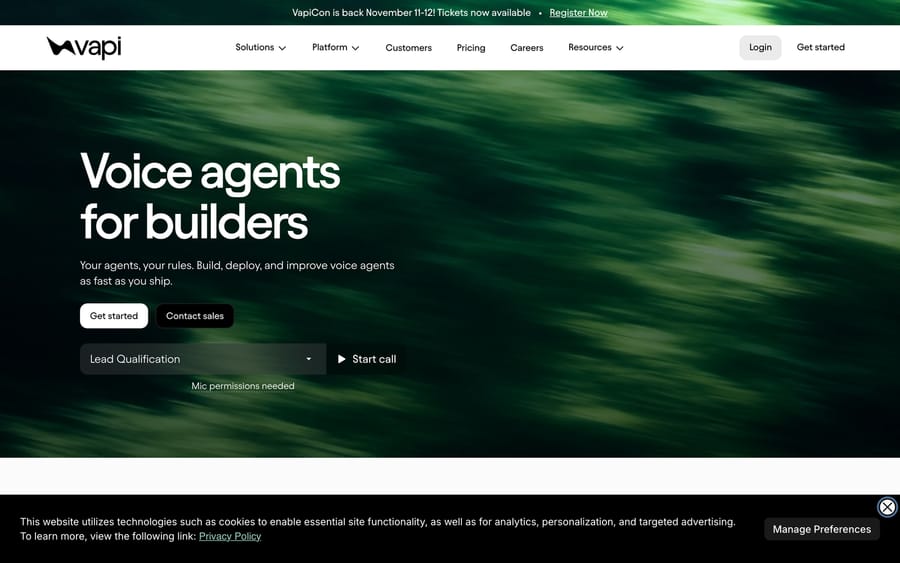
Vapi was founded in 2020 by Jordan Dearsley (CEO) and Nikhil Gupta (CTO), went through Y Combinator's Winter 2021 batch, and is based in San Francisco with around 100 employees. It raised a $20 million Series A in December 2024 led by Bessemer Venture Partners at roughly a $130 million valuation, then a $50 million Series B in 2026 led by Peak XV Partners (with Microsoft's M12 and Kleiner Perkins participating) at about a $500 million valuation. Total raised: $72 million. Vapi reports an annual recurring revenue run rate in the "healthy eight figures" and says it now processes over a billion calls, between 1 and 5 million a day.
The single most useful data point on Vapi's credibility: Amazon's Ring evaluated more than 40 voice AI vendors and picked Vapi to handle customer support calls during its holiday peak, and now routes 100% of its inbound calls through the platform. Other named customers include Intuit, ServiceTitan, New York Life, Kavak, Instawork and Cherry. That's a genuine enterprise logo list for a five-year-old company, and it's the strongest signal that the platform can hold up at scale, even while the review sites tell a rougher story about the day-to-day experience of smaller teams (more on that below).
Vapi doesn't build its own speech models. It's infrastructure: a hosting and orchestration layer that lets a developer pick a transcription provider, an LLM and a voice provider, wire them together behind one API, and get a phone-call-capable agent without stitching those three services together by hand.
How Vapi's voice stack works
Every Vapi call runs through the same three-part pipeline: speech-to-text turns the caller's voice into text, an LLM decides what to say back, and text-to-speech turns that response into audio. Vapi's job is hosting that pipeline, keeping the turn-taking natural, and giving a developer "dozens of providers" to choose from at each stage, including OpenAI, Anthropic and Google for the model, and Deepgram, Gladia and ElevenLabs for transcription and voice. Vapi advertises "<500ms average latency" on its homepage (checked 2026-09-17), which is the number that decides whether a phone conversation feels human or feels like talking over a bad satellite link. Hold that figure loosely: it's an average of Vapi's own measuring, and reviewers below report much worse under load.
The platform's two building blocks:
- Assistants: the primitive most builders use. One system prompt plus a set of tools and structured outputs, aimed at customer support, lead qualification and appointment booking.
- Squads: multiple assistants chained together with context-preserving handoffs, for workflows that genuinely need more than one specialist (a medical intake flow that routes to triage, then to scheduling, for example).
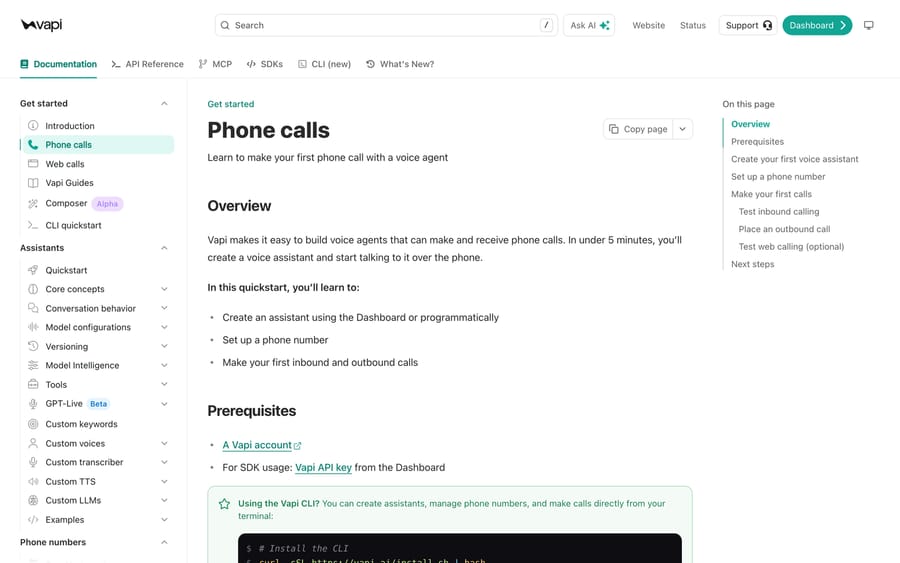
Configuration happens through a dashboard or the API, with the API exposing dynamic variables (double-curly-brace placeholders like a caller's name or order number) that get filled in per call, tool-calling for hitting external systems mid-conversation, and call-flow settings like idle messages, keypad input and end-call phrases. Vapi's public documentation doesn't list pre-built connectors to Zendesk, Salesforce or HubSpot; the tool-calling model is a generic HTTP integration you build yourself, not a marketplace of one-click integrations.
Key features
- Any-provider stack: pick your STT, LLM and TTS vendor independently instead of being locked to one.
- Assistants and Squads: single-agent and multi-agent orchestration for simple vs. complex call flows.
- Sub-500ms average latency claimed on the homepage, with Vapi citing enterprise workloads scaling to millions of calls.
- Dynamic variables and tool calling: personalize a script per caller and let the agent hit external APIs mid-call.
- Compliance options: SOC 2, HIPAA and PCI are available, though HIPAA is a $2,000/month add-on, not included by default.
- CLI and SDKs for programmatic assistant management, alongside the dashboard.
Docs, as a signal of maturity
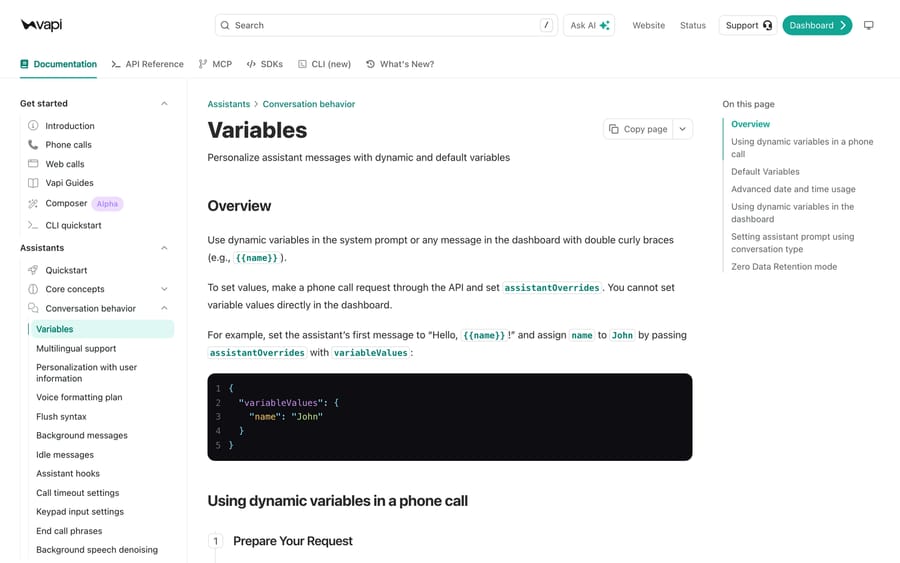
Vapi's documentation is extensive: separate sections for assistants, conversation behavior, model configuration, custom voices, custom transcribers, custom LLMs, and phone number management. That depth is a genuine strength for a developer integrating a voice pipeline into an existing product, and it's also a tell about who the product suits: a lot of this configuration surface (custom transcribers, flush syntax, background speech denoising) is written for an engineer, not for a support-ops manager who wants a phone tree working by Friday.
Vapi pricing (researched, worked example)
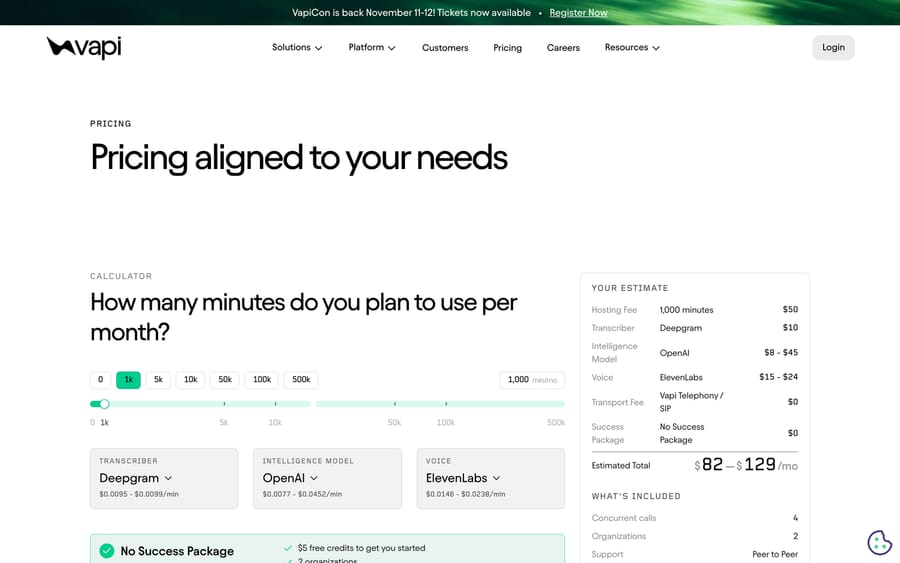
Vapi publishes real numbers, and its pricing page includes a live calculator, which is more transparency than most of the vendors in this series offer. The plans:
| Plan | Price | What you get |
|---|---|---|
| No Success Package | $5 free credits, then $0.05/min hosting | 2 orgs, 1 phone number, 4 concurrent calls, 14-day retention, Discord support |
| Core | $29/month | 2 orgs, 5 phone numbers, 10 concurrent calls, 30-day retention, email support (2-day SLA) |
| Pro | 10% of hosting fees, $999/month minimum | 10 orgs, 10 phone numbers, 30 concurrent calls, 180-day retention, Slack support, 99% uptime SLA |
| Premier | Custom | Elevated limits, named team, 1-hour P0 response, 99.9% uptime SLA |
That table is the easy part. The real cost is the hosting fee plus three separate pass-through charges, billed per minute:
- Transcription (Deepgram): $0.0095-$0.0099/min
- LLM (OpenAI): $0.0077-$0.0452/min, depending on model
- Voice (ElevenLabs): $0.0146-$0.0238/min
- Telephony: free over Vapi's own SIP, or $0.008-$0.014/min through Twilio, with Vonage and Telnyx varying
Run the numbers at 1,000 minutes a month and Vapi's own calculator does it for you: $50 hosting, $10 transcription, $8-$45 for the model, $15-$24 for voice, for a total of $82-$129 a month. At 10,000 minutes that scales to roughly $820-$1,290, before you're even near the $999/month Pro plan floor. HIPAA compliance adds a flat $2,000/month regardless of volume, and extra concurrent lines run $10/line/month, extra organizations $20/month.
So the honest multiple is 1.6x to 2.6x the headline $0.05/min hosting fee, or $0.082 to $0.129 a minute all-in, with the LLM choice doing almost all of the swinging. Two competitor-authored reviews (Retell AI's and Synthflow's, so read their numbers with that in mind) put it higher still, at $0.13-$0.31/minute and $0.07-$0.25/minute respectively, and both estimate $40,000-$70,000 a year for a production deployment at meaningful volume; their high ends assume a pricier model and more transferred calls than the calculator's defaults. Either way, leading with the smallest number in the stack is a normal usage-pricing incentive rather than a Vapi-specific trick. It does mean a builder who budgets from the homepage figure will be out by at least half.
Worth converting into the unit a support team actually plans in, because per-minute pricing hides this. A support queue handling 2,000 phone conversations a month at 4 minutes each is 8,000 minutes: $660 to $1,030 all-in, or roughly $0.33 to $0.52 a call, and that per-call figure rises directly with how long callers talk. Text conversations price the other way round. Macha charges about $0.40 a ticket, once per thread however many messages it takes, so a long thread costs the same as a short one. Neither number is the "cheaper" one in the abstract; they behave differently, and a team running both channels should budget them separately rather than averaging them into one cost per conversation.
Real-user reviews: what buyers say after they deploy
We read Vapi's Trustpilot page directly on 2026-09-17, which gives a clean primary rating: 2.4/5 from 15 reviews, two-thirds of them one star. That's a small sample, but it's a direct signal rather than a competitor's summary, and every quote below is verbatim from a live review on that page.
"VAPI has cost us $50k in damages so far from downtime caused by bugs." (James (AU))
"It is impossible to pick right voices for specific language. The voice search results are a mess." (Eduard (GB))
"Great service at fair pricing. Support is great too, seems to be a lot of fake bad reviews here." (Phil Wilson (AU))
That range, from "$50k in damages" to "fake bad reviews," is itself informative: Vapi seems to produce polarized experiences instead of a consistent middling one. The recurring complaint themes across Trustpilot and the third-party reviews we read: response latency (some reviewers report 3-7 seconds under load, well above the advertised sub-600ms), dashboard settings that don't reliably save, support that leans on Discord and email instead of a live channel on the entry tiers, and the multi-layer pricing above being easy to underbudget. G2 shows too few reviews (in the low single digits at the time we checked) to treat as a reliable buying signal on its own, which is why we're leaning on Trustpilot here.
Pros and cons
Pros
- Real enterprise validation: Amazon Ring picked Vapi over 40 competitors and routes all inbound calls through it.
- Genuine provider flexibility across STT, LLM and TTS, instead of a single bundled voice.
- Transparent, published pricing with a working calculator, rare among voice AI vendors.
- Deep technical documentation for teams that want to build custom call logic.
Cons
- Real per-minute cost is 1.6-2.6x the headline $0.05/min hosting fee once transcription, model and voice are added, and competitor-run estimates put production deployments higher still.
- A 2.4/5 Trustpilot rating from a small but vocal set of production users, citing downtime, latency and support gaps.
- Requires engineering effort: no pre-built Zendesk/Salesforce/HubSpot connectors, and non-technical teams struggle with advanced configuration.
- No web chat or ticket-based support channel; Vapi is voice-only.
Who Vapi is best for
Vapi suits engineering teams building a voice product or a phone-based support/sales flow who want control over every layer of the stack and are comfortable maintaining that stack themselves. If you already have a developer who can own STT/LLM/TTS provider choices, wire up tool calls, and monitor latency and uptime, Vapi's flexibility and published pricing are real advantages over a black-box voice vendor.
It's the wrong fit if you only want to automate ticket replies inside a help desk. Vapi doesn't touch chat or email tickets at all; it's a phone pipeline, full stop. It's also the wrong choice if you don't have engineering capacity to own an integration: the per-minute pricing, the provider selection, and the review pattern above all assume someone is actively managing the deployment, not a support manager clicking through a wizard once.
Vapi vs alternatives

| Vapi | Retell AI | Macha | |
|---|---|---|---|
| Model | Bring-your-own STT/LLM/TTS voice orchestration | Managed voice AI call center platform | AI agent layer on your existing help desk |
| Best for | Engineering teams building custom voice flows | Teams wanting a more turnkey voice agent | Teams on Zendesk, Freshdesk, Gorgias or Front |
| Pricing | $0.05/min hosting + pass-through (about $0.08-$0.13/min all-in) | From about $0.07+/min per public reviews | From $299/month for 750 tickets (about $0.40 per ticket), published |
| Channel | Voice (phone calls) only | Voice (phone calls) only | Chat and email tickets inside the help desk |
| Setup | Developer-led: API, dashboard, custom tool calls | Lower-code, faster to a working agent | Build agents in plain English, live in days |
| Reviews | 2.4/5 on Trustpilot (15 reviews) | 4.8/5 cited on G2 (per its own homepage badge) | See G2/Capterra on our pricing and product pages |
Retell AI is the most-cited direct alternative in the reviews we read (both Retell's own and Synthflow's, though Synthflow itself is a third option); it's built to need less engineering babysitting at the cost of Vapi's provider flexibility. If your voice use case sits closer to enterprise contact-center automation than a developer-built agent, our Parloa and Kore.ai guides cover that heavier end of the market.
Macha isn't a voice competitor at all. one thread between Macha and one person, charged once no matter how many messages it takes, and it works inside Zendesk, Freshdesk, Gorgias or Front, not over the phone. If the actual problem is a ticket backlog instead of a call queue, that's a different tool entirely: see Macha on your help desk or pricing.
How we researched this: Vapi's own homepage, pricing page (including its live calculator) and developer docs were fetched directly and screenshotted on 2026-09-17. Funding history came from TechCrunch's May 2026 report on Vapi's Series B, cross-checked against Crunchbase and Sacra search summaries. Two competitor-authored reviews (Retell AI, Synthflow) were read for pricing and complaint patterns and treated as vendor-interested where they recommend their own product. We checked G2 and found too few reviews to be useful, so we used Trustpilot instead for real-user quotes.
FAQ
What is Vapi? Vapi is a developer platform for building voice AI agents. It hosts and orchestrates a pipeline of speech-to-text, an LLM and text-to-speech, letting a developer pick each provider instead of using one bundled voice stack.
Who owns Vapi, and is it well-funded? Vapi was founded in 2020 by Jordan Dearsley and Nikhil Gupta, went through YC's Winter 2021 batch, and has raised $72 million total: a $20M Series A (Bessemer, 2024) and a $50M Series B (Peak XV, 2026) at roughly a $500 million valuation.
How much does Vapi actually cost? The advertised hosting fee is $0.05/minute, but transcription, the LLM and the voice are billed separately on top. At 1,000 minutes a month, expect roughly $82-$129 total, per Vapi's own calculator: $0.082 to $0.129 a minute all-in, or 1.6-2.6x the headline rate. Competitor-authored reviews estimate $0.13-$0.31/minute for production use.
Is Vapi good for a support team without engineers? Not really. Vapi is a developer-facing platform: assistants, tools and phone numbers are configured through a dashboard or API, and non-technical teams reportedly struggle with advanced setups like multi-agent chaining or custom tool calls.
What do Vapi's reviews actually say? Trustpilot gives Vapi 2.4/5 from 15 reviews, with complaints about downtime, latency and support response times, alongside at least one reviewer defending the product and disputing the negative reviews as inauthentic. G2 has too few reviews to be a reliable signal at the time we checked.
Does Vapi integrate with Zendesk or Salesforce? Not out of the box. Vapi's tool-calling model lets a developer connect to any HTTP API, but there's no published pre-built Zendesk, Salesforce or HubSpot connector in its documentation.
What are the best Vapi alternatives? Retell AI is the most commonly cited direct alternative for teams wanting a more managed voice agent with less engineering overhead. For automating chat and email tickets instead of phone calls, Macha runs inside an existing help desk instead.
Does Vapi offer a free trial? There's no dedicated free plan, but the entry tier includes $5 in free credits before the $0.05/min hosting fee and pass-through costs apply.
Looking to automate tickets instead of phone calls? Start a Macha trial at dashboard.getmacha.com/signup or see pricing: $50 of free usage (about 125 tickets), no credit card, no time limit.
Sources: Vapi homepage, Vapi pricing, Vapi documentation, Vapi on Y Combinator, Vapi hits $500M valuation, TechCrunch, Vapi AI review, Retell AI, Vapi AI review, Synthflow, Trustpilot: Vapi reviews (checked 2026-09-17), Kore.ai: The Complete Guide.
Resolve tickets automatically with AI agents
Macha's AI agents work on top of the help desk you already use — no code.