Intercom
 Shopify
 Stripe
 Slack
Slack Notion
 Google Workspace
 Confluence

Parloa: The Complete Guide (2026)


If you're evaluating enterprise contact-center AI in 2026, Parloa is a name you'll run into fast — especially if voice is central to your operation. It's a Berlin-born company that has reportedly raised over half a billion dollars to build what it calls an "AI Agent Management Platform," and it's become one of the more talked-about players in agentic customer service. This guide is a balanced, researched walkthrough of what Parloa actually is, how its platform works, what it costs, where it's strong, where it's not, and which alternatives make sense depending on your situation.

We've written this as a vendor guide, not a sales pitch. (Full disclosure: we build Macha, an AI agent layer for Zendesk, Freshdesk, Gorgias, Front and Intercom. Parloa is a category peer, and we'll explain the difference honestly near the end.) Everything below is sourced to Parloa's own materials and recent third-party reporting, with anything we couldn't verify flagged clearly.
What is Parloa?
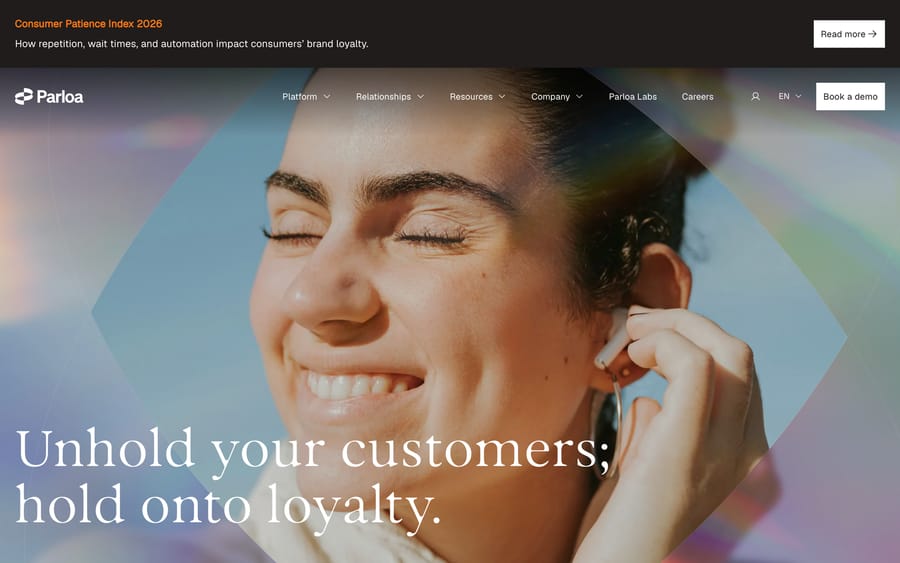
Parloa's homepage, focused on AI for contact-center voice and chat.
Parloa is an enterprise AI Agent Management Platform (AMP) built to automate customer service across a contact center — primarily voice, but also chat, WhatsApp, and Microsoft Teams. Founded in 2018 in Berlin by Malte Kosub (CEO) and Stefan Ostwald (Chief AI Officer), the company positions itself not as a single chatbot but as a platform for building, testing, and running large fleets of AI agents that hold natural, real-time conversations with customers (parloa.com).
The core idea in the "AMP" framing is management at scale: enterprises don't just want one bot, they want potentially thousands of agents across languages, channels, and use cases — all governed, tested, and deployed with enterprise-grade reliability. Parloa says its platform lets you "safely build, test, and deploy millions of highly-skilled AI agents" that engage in personal conversations across 35+ languages (parloa.com/platform). The mental model Parloa reaches for is a workforce: you're not configuring a flow, you're managing a fleet of AI agents the way a contact-center leader manages a team of human ones — hiring (briefing), training (testing), supervising (monitoring), and improving (optimizing) them over time.
Under the hood, Parloa runs on Microsoft Azure OpenAI Service and has publicly partnered with OpenAI on its voice agents (OpenAI). One of its distinguishing choices is that agents are configured with natural-language "briefings" rather than rigid rule-based dialogue trees — closer to onboarding a new hire with instructions than wiring up a decision flow. In a briefing you tell the agent which processes it owns, which policies it must follow, and which data sources and systems it can draw from; the platform turns that into a working conversational agent. The result, per Parloa, is a more natural conversation that can handle interruptions and off-script questions rather than dead-ending on a menu.
The short version: Parloa is a premium, enterprise-grade, voice-first, build-it-with-us platform. It's not a self-serve app you sign up for and launch by Friday — and understanding that is key to evaluating it.
Who's behind it (and how it got here)
Parloa's trajectory is worth understanding because it explains the pricing and the positioning. Founded in Berlin in 2018, the company spent its early years in the German-speaking contact-center market before the generative-AI wave gave its "agents you talk to" pitch a much larger stage. Funding reportedly accelerated sharply: a $21M Series A (2023, reportedly led by EQT Ventures), a $120M Series C in May 2025 at a reported ~$1B valuation (BusinessWire), and then a reported $350M Series D in January 2026 at a reported ~$3B (unicorn) valuation, reportedly led by General Catalyst, taking total funding raised past ~$560M in under four years (PR Newswire). The company has reportedly reached roughly $50M ARR as of late 2025 and describes itself as a unicorn. Practically, that capital is why Parloa can invest heavily in voice research and enterprise integrations — and why it prices for large accounts rather than self-serve teams.
How Parloa works
Parloa organizes its platform around a clear lifecycle for each AI agent, which it frames in four phases: Define, Test, Scale, and Optimize (parloa.com/platform). Understanding those phases is the fastest way to grasp what you're actually buying.
1. Define. You configure an agent using natural-language briefings rather than a decision tree. You describe the agent's job, the policies it must respect, and the systems and knowledge it can use. Because it's plain language, operations and CX teams can shape agent behavior, not just engineers — though in practice enterprise deployments still involve solution architects wiring up the integrations behind the briefing.
2. Test. This is one of Parloa's genuinely differentiated areas. Before an agent touches a live customer, teams can run it through thousands of simulated multi-turn conversations, including edge-case validation, regression tests when you change a briefing, and LLM-as-judge scoring to grade whether the agent behaved correctly. For an enterprise putting an agent in front of millions of callers, this pre-production battle-testing is exactly the governance story that gets past a risk team.
3. Scale. Once validated, agents are deployed across channels and telephony infrastructure and can handle high concurrency. Parloa's SaaS architecture runs on Microsoft Azure, with version control so you can manage and roll back changes to agents the way you'd manage code.
4. Optimize. After launch, teams monitor performance, review real conversations, and refine briefings — the continuous-improvement loop that keeps agents accurate as products, policies, and edge cases change.
Cutting across all four phases:
- Voice-first architecture. Parloa's heaviest investment is voice, and the details show it. Beyond generic speech-to-text, the platform emphasizes contextual barge-in (letting a caller interrupt the agent naturally), noise cancellation, and call recovery when a connection degrades — plus reliable parsing of the things phone callers actually say, like order numbers, postcodes, and account details. This is built to replace rigid IVR menus with real-time conversation, and it's where enterprise contact-center budgets actually live.
- Omnichannel reach. Beyond voice, agents can operate across chat, WhatsApp, and Microsoft Teams, so the same underlying logic and brand voice can show up across customer touchpoints.
- Deep enterprise integration. The platform is designed to plug into CRM, ERP, and CCaaS (contact-center-as-a-service) systems, which is what lets an agent actually do things — look up an account, process an address change, check a policy status — rather than only answer questions.
The throughline is autonomy at scale with governance: Parloa wants enterprises to run large numbers of capable voice and chat agents without losing control over how they behave.
Enterprise integrations, deployment, and compliance
Because Parloa is meant to sit inside an existing contact-center stack rather than replace it, its integration list reads like an enterprise CX architecture diagram. Publicly listed connectors span major CCaaS/telephony platforms — Genesys, Five9, Avaya, NICE, Twilio, and Verint — alongside CRM, ERP, and ITSM systems including Salesforce, Microsoft Dynamics, ServiceNow, SAP, and Zendesk (parloa.com/platform/integrations). Parloa has also published guidance on integrating with legacy infrastructure, acknowledging that most large contact centers aren't greenfield.
Deployment is a professional-services-led project: scoping, integration work, agent design, testing, and a phased rollout, typically with Parloa's team or a partner alongside your own. On the compliance side — table stakes for regulated buyers in finance, insurance, and healthcare — Parloa cites ISO 27001, SOC 2, PCI DSS, GDPR, DORA, and HIPAA coverage. None of that is unusual for the enterprise tier, but its absence would be disqualifying, so it matters.
Named customers and verticals
Parloa's publicly referenced customers cluster in high-volume, voice-heavy, often regulated industries — which tells you as much about fit as any feature list. Publicly referenced customers include:
- Telecom: Deutsche Telekom, which Parloa says partnered with it to roll out AI agent management across its customer service, integrating with existing telecom, CRM, and ERP systems.
- Insurance: Swiss Life, Generali, Württembergische Versicherung (which Parloa says cut average wait times by automating routine inbound calls like policy-status and payment reminders), and BarmeniaGothaer, which Parloa says launched an AI assistant on its platform.
- Retail and travel: Decathlon, TUI, and German automotive-service chain A.T.U.
Parloa says agents on its platform handle millions of conversations across these verticals, spanning everything from basic support deflection to revenue-generating sales flows. The pattern is consistent: large brands, phone-heavy service, multiple languages, and a compliance bar — precisely the profile Parloa is engineered for.
Key features
- AI Agent Management Platform for building and governing agents at scale
- Voice AI built for contact-center telephony, not just web chat
- Multilingual support across 35+ languages
- Natural-language briefings instead of scripted dialogue flows
- Omnichannel: voice, chat, WhatsApp, Microsoft Teams
- CRM and CCaaS integrations so agents can take real action
- Agent testing and simulation before deployment
- Built on Microsoft Azure OpenAI Service
Pricing
Here's the honest answer: Parloa doesn't publish prices. Like most enterprise contact-center AI vendors, it sells through a sales-led motion and negotiates each contract based on conversation volume, channels, languages, and integration needs (eesel).
What we can tell you from third-party trackers is the shape of the pricing and the ballpark to budget for:
- Consumption-based model. Parloa ties cost to task complexity and effort — "the intelligence your AI agents actually deliver" — rather than flat per-token or per-seat rates (Chatarmin).
- Outcome-based option. In some arrangements you pay per successfully resolved conversation, with a reduced charge when a call is escalated to a human agent (Chatarmin).
- Budget expectation. Independent analyses researched (third-party estimates) consistently put the practical entry point at roughly ~$300,000+ per year for platform licensing, plus implementation services and integration costs on top (eesel).
Treat these as researched third-party estimates, not official rates — but they're consistent enough to signal that Parloa is squarely an enterprise purchase. If you're a small or mid-sized team, this is well outside self-serve territory.
What actually drives the cost
Since there's no rate card, the useful exercise is understanding the variables a Parloa quote will move on. Based on how the platform is built and how enterprise contact-center AI is priced generally, expect the number to scale with:
- Voice minutes / conversation volume. Voice is the most expensive channel to automate — real-time speech-to-text and text-to-speech carry per-minute infrastructure cost — so total call volume and average handle time are primary drivers. A high-volume phone operation will price very differently from a chat-only pilot.
- Channels and languages. Adding voice, chat, WhatsApp, and Teams, and supporting many of the 35+ languages, expands the scope and the price.
- Integration and deployment complexity. Wiring Parloa into your CCaaS (Genesys, Five9, etc.), CRM, and back-office systems is where a lot of the services cost lives — a clean modern stack costs less to integrate than a tangle of legacy telephony.
- Outcome vs. consumption structure. An outcome-based contract (pay per resolved conversation) shifts risk and can change the headline number versus a pure consumption model; which one is better depends on your resolution rates.
- Support tier and SLAs. Enterprise SLAs, dedicated support, and professional-services hours all factor in.
The honest takeaway: budget for a six-figure annual commitment plus implementation, and go into procurement expecting a multi-week evaluation and a custom quote. If that sentence made you wince, you're probably not the target buyer — and that's fine, it just means a different class of tool fits you better.
Pros and cons
Pros
- Genuine voice depth. Parloa is voice-first in a market where many "AI agents" are really chat-first with voice bolted on. Contextual barge-in, noise cancellation, and call recovery are the kind of details that only matter — and only get built — when phone is the priority. For high-volume phone operations, that focus matters.
- Serious testing and governance. The simulation layer — thousands of multi-turn test conversations, regression testing, LLM-as-judge scoring before production — is a real differentiator for enterprises that can't afford a bad agent in front of millions of callers.
- Deep enterprise integrations and compliance. Native connectors into Genesys, Five9, NICE, Salesforce, ServiceNow, SAP and more, plus ISO 27001 / SOC 2 / PCI DSS / GDPR / DORA / HIPAA coverage, make it viable for regulated, complex stacks.
- Strong funding and momentum. With a reported $350M Series D at a reported ~$3B valuation (January 2026) on top of a reported $120M Series C (BusinessWire, PR Newswire), and publicly referenced customers including Deutsche Telekom, Swiss Life, and Decathlon, Parloa is well-capitalized and well-referenced.
- Natural-language briefings lower the barrier for non-engineers to shape agent behavior.
Cons
- Opaque, high pricing. No public rates and a ~$300K+ practical floor put it out of reach for smaller teams.
- A thin review sample for the price. G2 shows 4.5 out of 5 from 38 reviews, checked 21 September 2026 — a good score, but a small sample for a platform with a six-figure practical floor, and Capterra lists Parloa with no reviews at all. Because Parloa is enterprise and quote-only, independent end-user signal stays limited.
- Not self-serve. Deployment is a build-it-with-us project measured in weeks-to-months, not a sign-up-and-go experience.
- Overkill for ticket/chat-first teams. If your support runs mostly through email and chat inside a help desk, most of what you're paying for (deep voice, CCaaS integration) is capability you won't use.
- Vendor metrics. Impressive figures (97% routing accuracy, 75% conversion, 60% faster resolution, ROI in 12–18 months) come from Parloa's own case material and should be treated as vendor-reported, not independently audited.
Who Parloa is best for
Parloa is a strong fit if you're a large enterprise with a high-volume, voice-heavy contact center — think financial services, utilities, insurance, telco, retail, or healthcare — operating across multiple languages, with the budget (six figures and up) and the internal resources to run a proper implementation. If voice automation at scale is your core problem, Parloa is built for exactly that.
It's a poor fit if you're a small or mid-market team, if your support is mostly ticket- and chat-based inside a help desk like Zendesk or Freshdesk, or if you want to stand up automation quickly without a lengthy enterprise procurement and build cycle.
Parloa vs alternatives
Parloa competes in the broad enterprise conversational-AI space alongside vendors like Cognigy (now part of NICE), Kore.ai, and Sierra, plus help-desk-native automation. The most important thing to understand is that these tools aren't all solving the same problem — they split along use case. Parloa and Cognigy are built to automate a contact center (voice at the center); Macha is built to automate support tickets and chat on the help desk you already run. Here's an honest comparison including where we fit:
| Parloa | Cognigy (NICE) | Sierra | Macha | |
|---|---|---|---|---|
| Category | Enterprise AI agent mgmt (voice-first) | Enterprise conversational/agentic AI | Enterprise AI agents (conversational) | AI agent layer on your help desk |
| Primary channel | Voice (+ chat, WhatsApp, Teams) | Voice, chat, SMS, IVR | Chat/voice | Help-desk tickets + chat |
| Integrates with | CCaaS/telephony, CRM, ERP | CCaaS/telephony, CRM | CRM / custom | Zendesk, Freshdesk, Front, Intercom, Gorgias |
| Pricing | Consumption/outcome, ~$300K+/yr, quote-only | Six-figure, quote-only | Enterprise, quote-only | Per ticket, from $299/mo for 750 tickets |
| Setup | Enterprise build project (weeks–months) | Enterprise build project | Enterprise build project | Self-serve, build agents in plain English |
| Best for | High-volume voice contact centers | Enterprise omnichannel CX | Enterprise conversational agents | Teams automating support on an existing help desk |
Where Macha differs, honestly: we're not trying to replace your contact center or match Parloa's voice depth. Macha is an AI agent layer that runs on top of the help desk you already use — Zendesk, Freshdesk, Front, Intercom, or Gorgias — and you build agents in plain English, pay per ticket rather than committing to a six-figure enterprise contract. If your support runs through a help desk and you want automation you can stand up quickly and transparently, that's our lane. If you're a global enterprise whose main problem is voice at massive scale, Parloa is built for that and we're not pretending otherwise. Different tools for different jobs.
Two of the platforms Parloa is shortlisted against most often have full guides here: Cognigy, the closest European competitor on enterprise voice and chat automation, and Kore.ai, which brings a much larger review sample to the same conversation.
How we researched this: The features, pricing and customer figures above come from Parloa's own public pages and the third-party sources linked inline, checked when this guide was researched in August 2026. This pass, on 21 September 2026, re-checked the post's links, refreshed the review figures quoted above and cross-referenced our guides to the closest alternatives; it did not re-price the plans against Parloa's site, so read the pricing as accurate to August 2026 rather than to today. The G2 and Capterra positions above were read in a real browser on 21 September 2026, since both sites block scripted requests.
FAQ
What is Parloa? Parloa is an enterprise AI Agent Management Platform (AMP) for contact centers, founded in Berlin in 2018. It lets large organizations build, test, and deploy AI agents across voice, chat, WhatsApp, and Microsoft Teams in 35+ languages.
How much does Parloa cost? Parloa doesn't publish pricing. It's sales-led and negotiated per customer using consumption-based and outcome-based models. Third-party trackers put the practical entry point at roughly $300,000+ per year plus implementation costs.
Is Parloa a voice AI platform? Voice is Parloa's core strength. It's built to replace rigid IVR menus with natural, real-time voice conversations — with features like contextual barge-in, noise cancellation, and call recovery — though it also supports chat, WhatsApp, and Microsoft Teams.
Who owns Parloa? Parloa is an independent company founded in Berlin in 2018 by Malte Kosub (CEO) and Stefan Ostwald (Chief AI Officer). It has reportedly raised over $560M, including a reported $350M Series D at a reported ~$3 billion valuation in January 2026, reportedly led by General Catalyst.
What does Parloa integrate with? Parloa connects to major CCaaS and telephony platforms (Genesys, Five9, Avaya, NICE, Twilio, Verint) and to CRM/ERP/ITSM systems such as Salesforce, Microsoft Dynamics, ServiceNow, SAP, and Zendesk, so agents can take real actions in your existing stack.
Who uses Parloa? Publicly referenced customers skew toward large, regulated, voice-heavy enterprises — including Deutsche Telekom, Swiss Life, Generali, Württembergische Versicherung, BarmeniaGothaer, Decathlon, and TUI — across telecom, insurance, retail, and travel.
How long does it take to deploy Parloa? It's an enterprise implementation, not a self-serve setup. Expect a professional-services-led project — scoping, integration, agent design and testing, then a phased rollout — typically measured in weeks to months depending on complexity.
What are good Parloa alternatives? Alternatives include Cognigy (now part of NICE), Kore.ai, and Sierra for enterprise conversational AI, or a help-desk-native layer like Macha if your support runs through Zendesk, Freshdesk, Front, Intercom, or Gorgias and you want per-ticket pricing (from $299/month for 750 tickets) without an enterprise contract.
Resolve tickets automatically with AI agents
Macha's AI agents work on top of the help desk you already use — no code.